【混合條件句完整攻略】2 大類型公式、倒裝句型、注意事項與 30 題實戰練習
混合條件句是什麼?這是許多英文學習者在突破中階瓶頸時最常搜尋的問題之一。混合條件句(Mixed Conditionals)是英文假設語氣中層次最高的句型,它將第二條件句與第三條件句的結構混合組合,讓 if 子句與主要子句分屬不同的時間軸——條件發生在過去,結果卻體現在現在;或者現在的狀態決定了過去的走向。這種跨越時間維度的邏輯表達,正是混合條件句有別於其他條件句的核心所在。
許多學習者以為條件句只有三種類型,卻不知道混合條件句才是英文母語者日常表達「後悔」與「反事實推論」時最自然的選擇。一旦你掌握這個句型,你的英文書寫與口說將立刻呈現出截然不同的層次感——這也是 IELTS Writing Band 7 以上考生與一般學習者之間最關鍵的語法分水嶺。
本篇文章由 PREPEDU 為你完整拆解混合條件句的兩大核心類型、公式結構、正式書寫中的倒裝句型(Inversion),以及使用時最容易犯的文法錯誤。文章末尾附有選擇題、填空題與句子改寫三大類型的實戰練習題,幫助你在閱讀之後立即驗證學習成效,真正將這個句型內化為你的英文輸出能力。

I. 什麼是混合條件句?(Mixed Conditionals 定義、結構與核心邏輯)
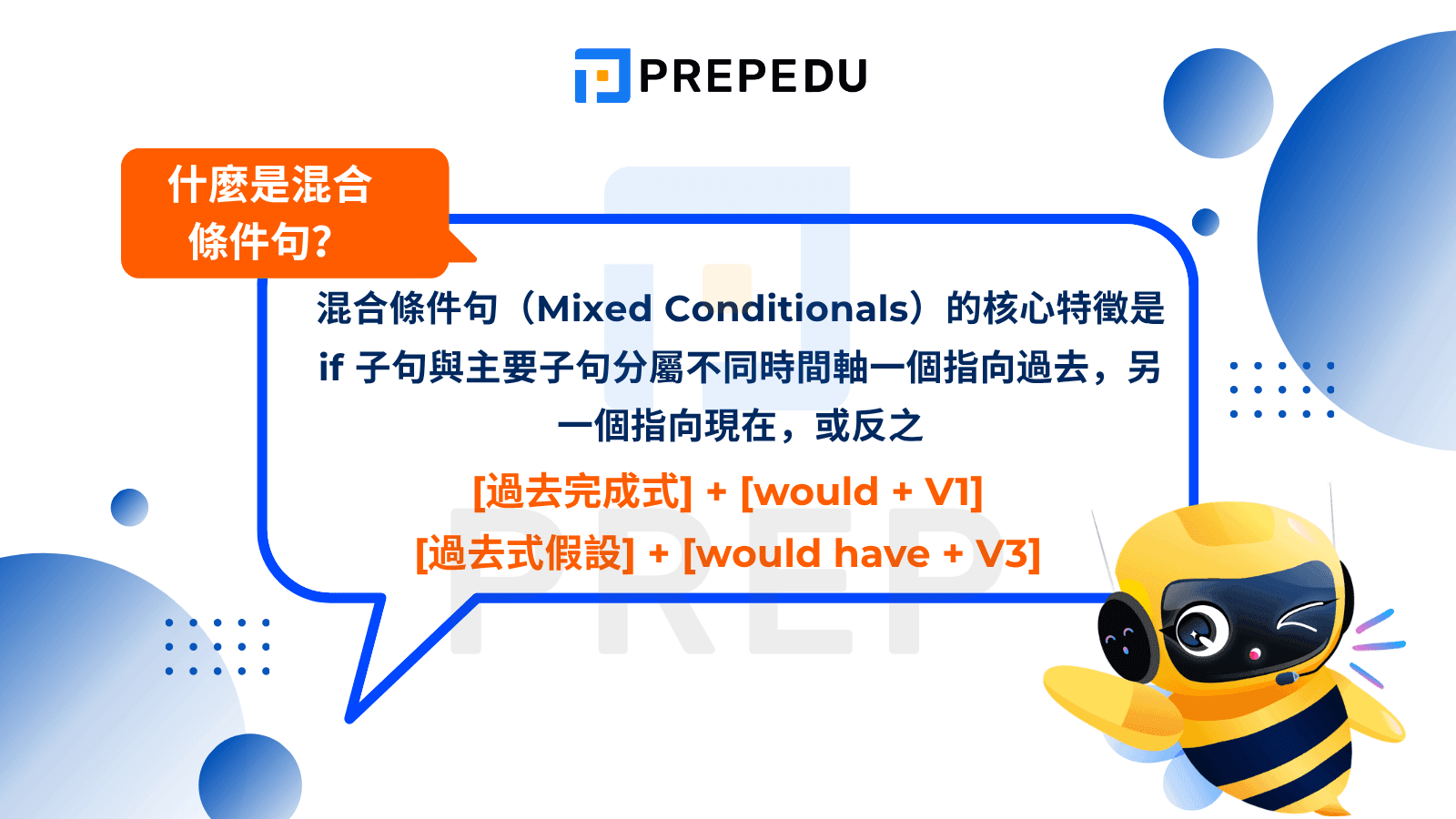
混合條件句(Mixed Conditionals)的核心特徵是 if 子句與主要子句分屬不同時間軸——一個指向過去,另一個指向現在,或反之。這種「時間軸交錯」,是它與傳統三種條件句最根本的差異。
混合條件句(Mixed Conditionals)是英文條件句與結果不在同一個時間點上發生的假設句。傳統 Type 1 至 Type 3 條件句要求前後子句的時態保持對稱,而混合條件句打破了這個限制。條件可能發生在過去,而結果卻體現在現在;或者條件是現在恆久的特質或狀態,而結果卻影響了過去某個具體事件。這種「時間軸交錯」的特性,使混合條件句成為表達後悔、反事實推論與跨時態邏輯分析的核心語法工具。
以下是四種條件句的時間軸對比,幫助你一次釐清混合條件句在整個體系中的位置:
|
條件句類型 |
If 子句時態 |
主要子句時態 |
時間方向 |
語意焦點 |
|
Type 1 |
現在式 |
will + V1 |
現在 → 未來 |
可能發生的未來條件 |
|
Type 2 |
過去式假設 |
would + V1 |
現在 → 現在 |
現在與現實相反的假設 |
|
Type 3 |
過去完成式 |
would have + V3 |
過去 → 過去 |
過去事件的反事實假設 |
|
混合類型一 |
過去完成式 |
would + V1 |
過去 → 現在 |
過去條件影響現在狀態 |
|
混合類型二 |
過去式假設 |
would have + V3 |
現在 → 過去 |
現在特質影響過去結果 |
混合條件句的基本結構由兩個子句組成:一個帶有 if 的條件子句,以及一個表達假設結果的主要子句。兩個子句的英文時態組合,決定了整個句子的時間方向與語意焦點。以下是兩個基本例句,讓你先建立直觀的語感:
-
If Xiaowang had studied engineering at university, he would be working at a tech firm in Taipei right now.(如果小王當年在大學讀工程系,他現在就在台北的科技公司上班了。)
-
If she were a more experienced negotiator, the deal would have closed successfully at last month's meeting in Hong Kong.(如果她是一位更有經驗的談判者,上個月在香港的會議上那筆交易就能順利完成了。)
掌握混合條件句,代表你的英文文法能力已超越基礎層次,能精準描述跨越時間維度的假設情境。對備考 IELTS Writing Band 7+ 或 TOEIC 高分的你而言,這是提升語法多樣性不可忽視的關鍵句型。
II. 混合條件句英文的兩大核心類型與公式
混合條件句英文的兩大類型,核心區別只有一個:誰在前,誰在後——是「過去的選擇決定現在的處境」,還是「現在的特質決定過去的走向」。判斷清楚這兩個時間方向,時態組合就會自然到位。在英文文法體系中,混合條件句英文主要分為兩種核心模式:「過去條件影響現在結果」,以及「現在狀態影響過去結果」。值得注意的是,除了 would 之外,主要子句也可使用 might 或 could 來表達不同程度的可能性與確定性。
1. 類型一:過去影響現在(Past Condition ➡ Present Result)
公式:
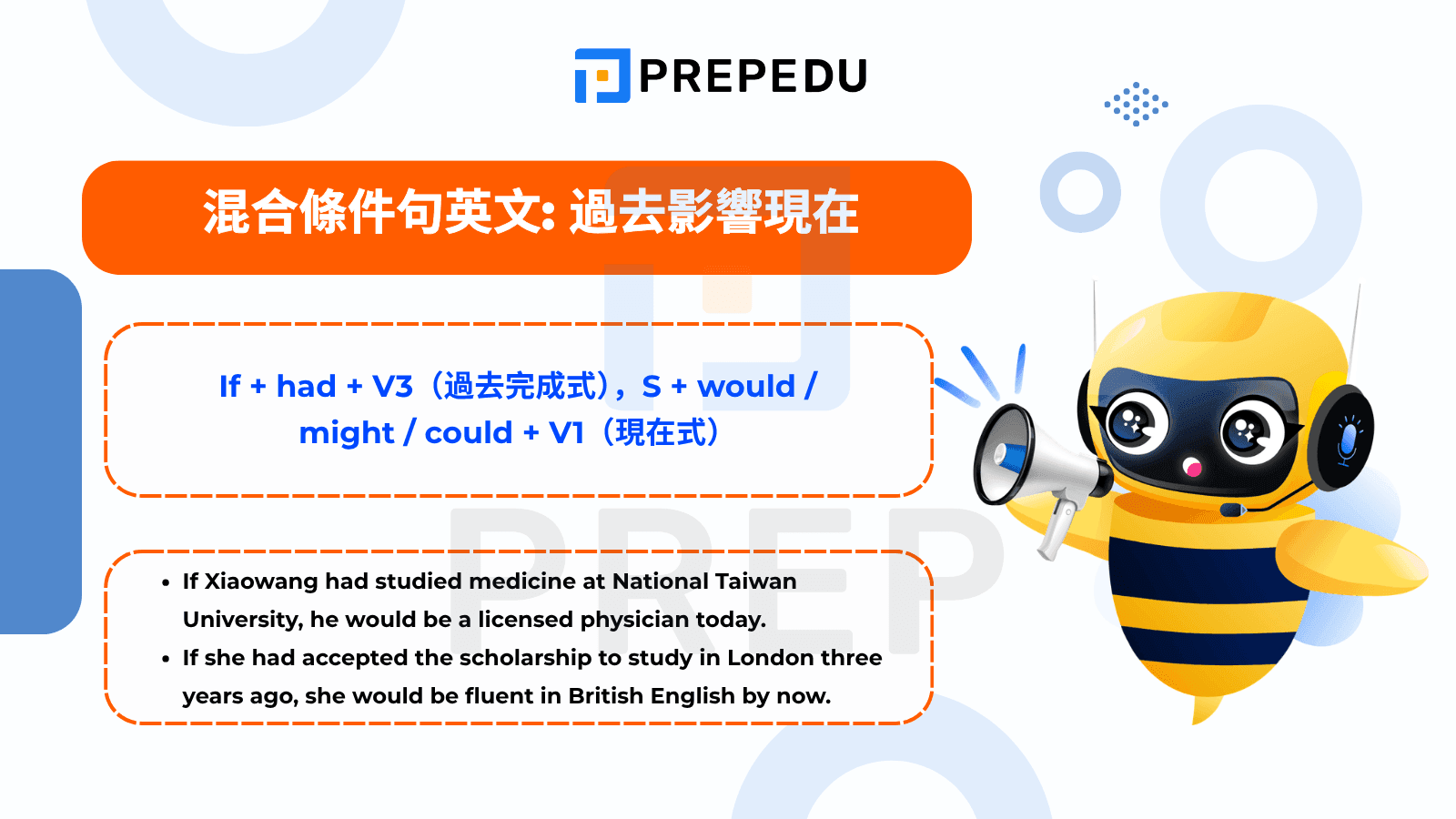
If + had + V3(過去完成式),S + would / might / could + V1(現在式)
這個混合條件句句型用於描述:過去某件事沒有發生(或發生了),導致現在的狀態與現實不同。If 子句採用第三條件句的結構(過去完成式),鎖定過去的反事實假設;主要子句則採用第二條件句的結構(現在條件式),呈現當下的假設結果。
判斷這個類型的關鍵訊號,是主要子句中常出現 now、today、still、at the moment、right now 等表示「現在」的時間副詞。這些詞語明確將結果定位在當下,而非過去。
語意重點在於:整個句子所描述的兩個事實,一個與過去相反,另一個與現在相反。句子傳達的是「過去若有不同選擇,現在的處境就會截然不同」這樣的邏輯。
例句:
-
If Xiaowang had studied medicine at National Taiwan University, he would be a licensed physician today.(如果小王當年在台灣大學讀醫學系,他今天就已經是一名執照醫師了。)
-
If she had accepted the scholarship to study in London three years ago, she would be fluent in British English by now.(如果她三年前接受了倫敦的獎學金,她現在英式英語早就說得流利了。)
-
If Xiaowang had not left his job in Kaohsiung so hastily, he might still be building his career there today.(如果小王當初沒有那麼倉促地離開高雄的工作,他今天也許還在那裡穩定發展。)
情態助動詞的選用說明:
在主要子句中,would、might 與 could 各有不同語意強度。
-
Would 表示說話者幾乎確定的假設結果
-
Might 表示結果存在可能性但非必然
-
Could 則強調能力或機會層面的假設
選用哪個助動詞,取決於你想表達的確信程度。
IELTS Writing 視角:許多 IELTS Band 6 學習者在混合條件句類型一中,會不自覺地在主要子句中加入 have,寫出「he would have been working at a tech firm now」——這實際上已經滑入 Type 3 的句型,語意從「現在的狀態假設」變成了「過去的結果假設」。兩個句子英文都合法,但語意截然不同。判斷公式只需看主要子句:有 have → Type 3(結果在過去);沒有 have 且有 now/today/still → 混合類型一(結果在現在)。這一個 have 的有無,就是 IELTS Band 6 與 IELTS Band 7 分水嶺。
2. 類型二:現在影響過去(Present Condition ➡ Past Result)
公式:
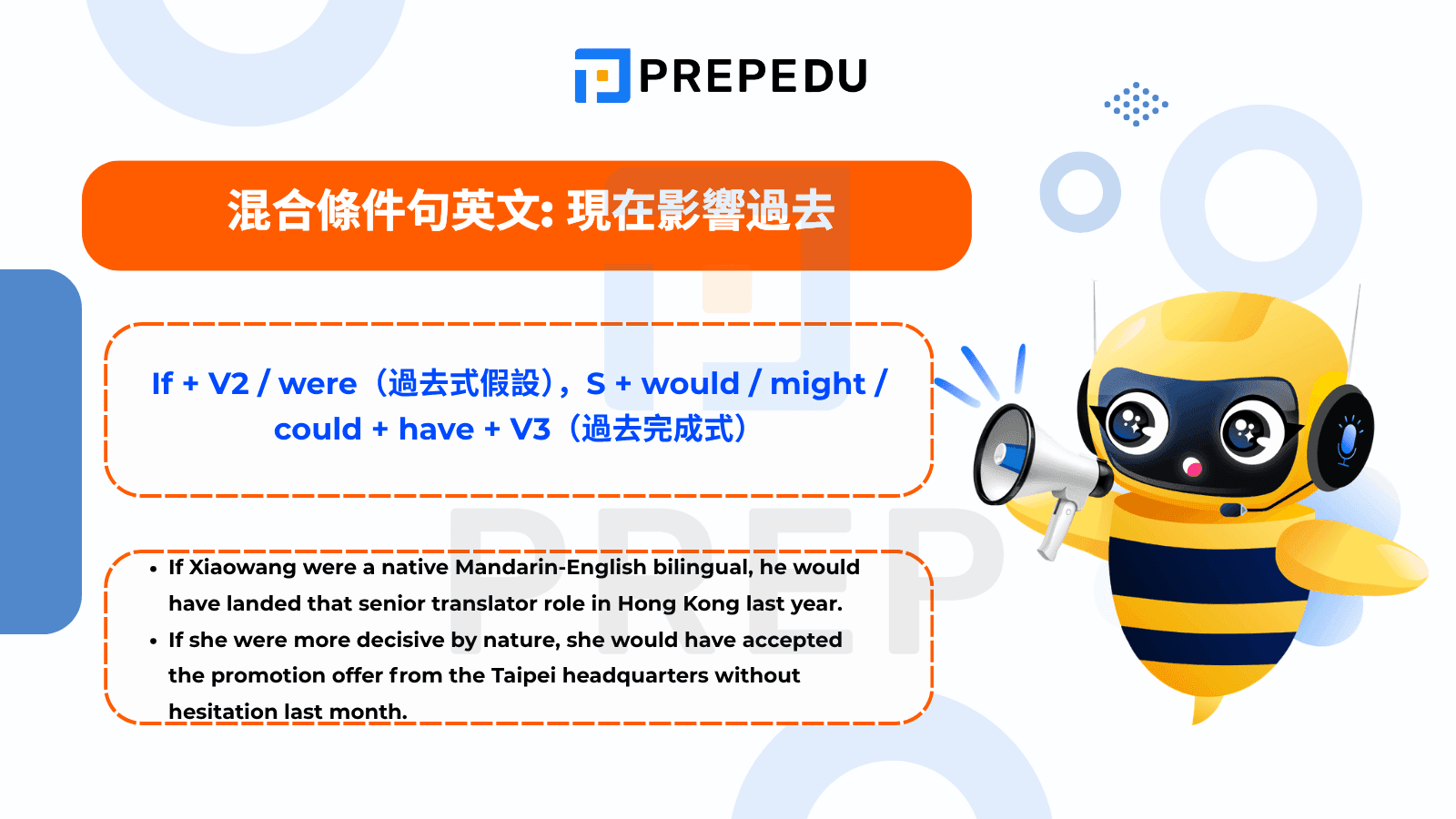
If + V2 / were(過去式假設),S + would / might / could + have + V3(過去完成式)
這個混合條件句句型用於描述:某人現在的特質、身份、性格或恆久狀態,若與現實不同,過去某個具體事件的結果也會截然不同。If 子句採用第二條件句的結構(過去式假設現在的反事實),主要子句則採用第三條件句的結構(過去完成式表達假設的過去結果)。
判斷這個類型的關鍵訊號,是主要子句中常出現 yesterday、last week、last year、at that time、in 2022 等明確指向過去的時間副詞。
語意重點在於:If 子句描述的是現在持續的狀態與現實相反,而主要子句的結果則回溯至過去某個時間點。這種句型常用於描述「因為我現在就是這樣的人,所以當時那件事才會那樣發生或沒有發生」。
以下是 5 個中英對照例句:
-
If Xiaowang were a native Mandarin-English bilingual, he would have landed that senior translator role in Hong Kong last year.(如果小王是中英雙語母語者,他去年就能在香港爭取到那個高級翻譯職缺了。)
-
If she were more decisive by nature, she would have accepted the promotion offer from the Taipei headquarters without hesitation last month.(如果她天生更果決,她上個月就會毫不猶豫地接受台北總部的升遷邀請了。)
-
If Xiaowang had a professional diving certification, he could have joined the marine research expedition off the coast of Keelung last summer.(如果小王有專業潛水執照,他去年夏天就能參加在基隆外海進行的海洋研究考察了。)
類型一 vs 類型二即時分辨法:
|
判斷步驟 |
操作方式 |
例子 |
|
步驟 1 |
看 if 子句的動詞形式 |
had + V3 → 指向過去; were/V2 → 指向現在狀態 |
|
步驟 2 |
看主要子句的時間副詞 |
now/today/still → 結果在現在; last week/year → 結果在過去 |
|
步驟 3 |
看主要子句有無 have |
would + V1(無 have)→ 類型一; would have + V3 → 類型二 |
三個步驟全部一致,才能確認句型類型。任何一步驟出現矛盾,代表句子本身有語法問題需要修正。
III. 混合條件句的倒裝句型(Inversion)
在正式書面英文或學術寫作中,混合條件句可以省略 if,將助動詞移至句首,形成倒裝句結構(Inversion)。這種句型在語意上與標準句型完全相同,差別只在語序調整,目的是強化語氣或符合正式文體的要求。
值得注意的是,混合條件句的倒裝規則延伸自單一條件句的倒裝邏輯:省略 if,助動詞前移,主詞緊隨其後,其餘子句結構不變。
|
類型 |
標準句型(with If) |
倒裝句型(without If) |
|
類型一 |
If + had + V3,S + would / might + V1 |
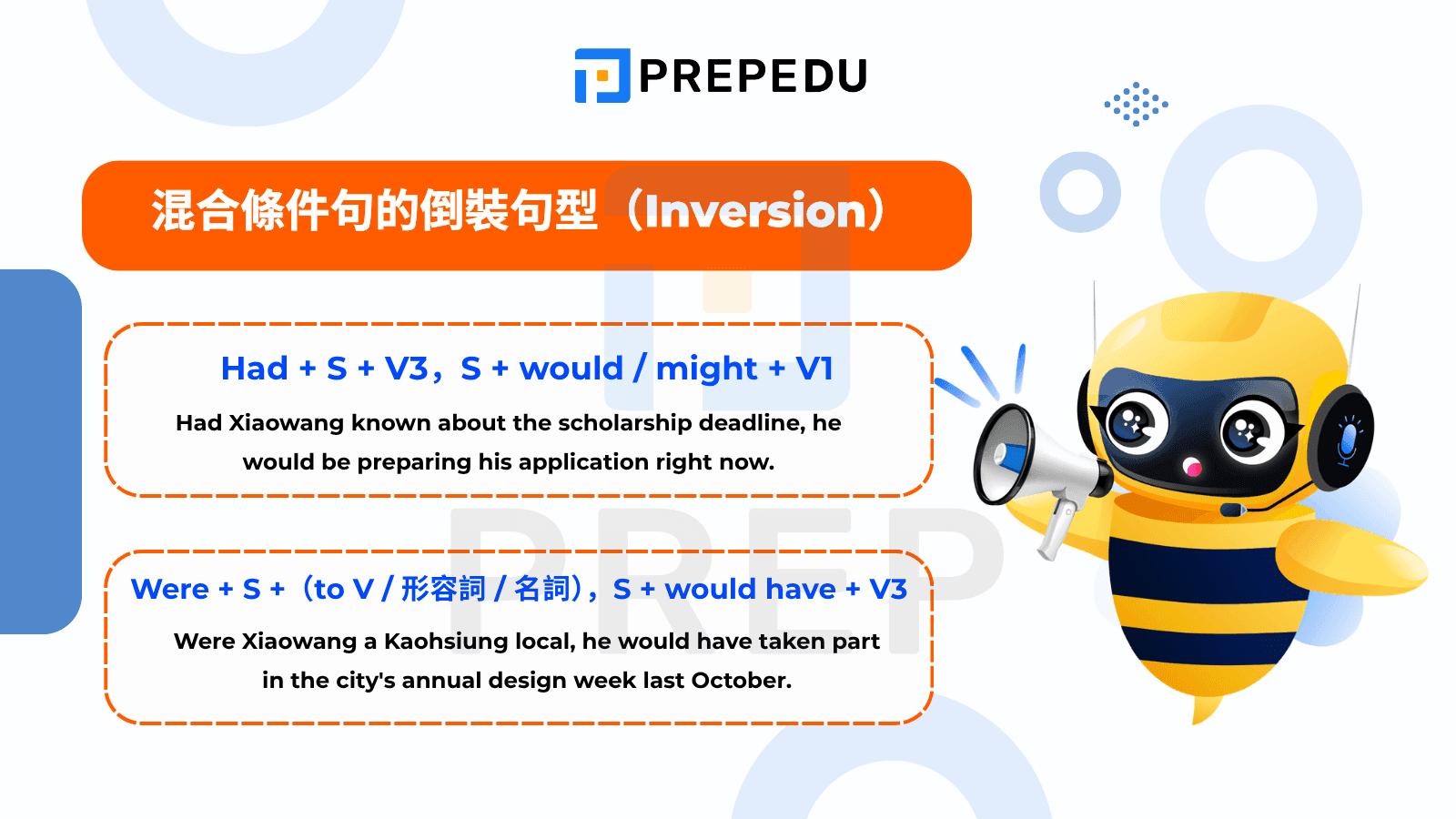
Had + S + V3,S + would / might + V1 |
|
類型二 |
If + were / V2,S + would have + V3 |
Were + S +(to V / 形容詞 / 名詞),S + would have + V3 |
1. 類型一的倒裝結構(Had + S + V3)
將 If 子句中的 had 移至句首,主詞緊跟其後,動詞維持過去分詞(V3)形式。主要子句的 would / might + V1 保持不變。否定形式則在 had 後加 not,寫為 Had + S + not + V3。
|
標準句型 |
倒裝句型 |
|
If Xiaowang had known about the scholarship deadline, he would be preparing his application right now. |
Had Xiaowang known about the scholarship deadline, he would be preparing his application right now.(如果小王當時知道獎學金的截止日期,他現在就會在準備申請文件了。) |
|
If she had taken the advanced IELTS writing course last year, she might be scoring Band 8 by now. |
Had she taken the advanced IELTS writing course last year, she might be scoring Band 8 by now.(如果她去年修了進階 IELTS 寫作課程,她現在或許已經可以拿到 Band 8 了。) |
2. 類型二的倒裝結構(Were + S + to V / 形容詞 / 名詞)
將 If 子句中的 were 移至句首,主詞緊跟其後。若 if 子句的謂語為「were + to + V」,倒裝後維持同樣結構。主要子句的 would / might + have + V3 保持不變。
|
標準句型 |
倒裝句型 |
|
If Xiaowang were a Kaohsiung local, he would have taken part in the city's annual design week last October. |
Were Xiaowang a Kaohsiung local, he would have taken part in the city's annual design week last October.(如果小王是高雄在地人,他去年十月就會參加該市的年度設計週了。) |
|
If she were to have more flexible working hours, she would have finished the Hong Kong project report ahead of schedule last quarter. |
Were she to have more flexible working hours, she would have finished the Hong Kong project report ahead of schedule last quarter.(如果她的工作時間更有彈性,她上季就能提前完成那份香港專案報告了。) |
理論部分到此完整。你已掌握混合條件句的兩大類型公式、倒裝句型,以及最容易失分的兩個文法陷阱。接下來的三大題型 30 題練習,以選擇題測辨認能力、以填空題測時態應用、以改寫題測整體輸出——建議從頭到尾不看解答作答,找出真正的知識盲點,再回頭對照對應的公式章節。
IV. 使用混合條件句的 2 大注意事項
掌握公式與倒裝句型之後,還需要留意兩個讓台港學生最容易失分的文法陷阱。這兩點是考試評分與學術寫作中最高頻的錯誤來源,在使用混合條件句時必須格外留意。
1. 注意事項一:If 子句中的 Be 動詞一律使用 Were
在假設語氣中(包含混合條件句的類型二),無論主詞是 I、he、she、it 還是單數名詞,be 動詞一律使用 were,而非 was。這是正式英文文法的硬性規範,在 IELTS Writing 與 TOEIC 的語法評分標準中明確要求。
在非正式口語中,部分母語者確實會說 If I was..., 但在學術寫作與考試作答中,were 是唯一正確且被認可的選項。
|
✅ 正確 |
❌ 錯誤 |
|
If she were a more empathetic team leader, she would have handled the conflict among colleagues in the Taipei office far more effectively last week.(如果她是一位更有同理心的團隊領導者,她上週就能更有效地處理台北辦公室同事之間的衝突。) |
If she was a more empathetic team leader, she would have handled the conflict among colleagues in the Taipei office far more effectively last week. |
|
If I were a permanent resident of Hong Kong, I would have been eligible for that government grant last year.(如果我是香港的永久居民,我去年就有資格申請那項政府補助。) |
If I was a permanent resident of Hong Kong, I would have been eligible for that government grant last year. |
2. 注意事項二:如何區分混合條件句與第三條件句(Type 3)
混合條件句與第三條件句(Type 3)在 if 子句的結構上完全相同(都使用過去完成式),初學者極易混淆。判斷兩者的最可靠方法,是觀察主要子句的時態與時間副詞。
第三條件句的 if 子句與主要子句均指向過去,表達「過去事件影響過去結果」;混合條件句類型一的 if 子句指向過去,但主要子句卻指向現在,表達「過去事件影響現在狀態」。
|
比較項目 |
第三條件句(Type 3) |
混合條件句類型一(Mixed) |
|
If 子句時態 |
If + had + V3 |
If + had + V3(相同) |
|
主要子句時態 |
Would have + V3 |
Would + V1(無 have) |
|
主要子句時間指向 |
過去(yesterday、last year) |
現在(now、today、still) |
|
語意焦點 |
過去事件影響過去結果 |
過去事件影響現在狀態 |
|
例句 |
If Xiaowang had prepared better, he would have passed the interview last Monday.(如果小王當時準備得更充分,他上週一就會通過那場面試了。) |
If Xiaowang had prepared better, he would be working at that company now.(如果小王當時準備得更充分,他現在就會在那家公司上班了。) |
一個實用的判斷口訣:
-
主要子句看到 now、today、still → 混合條件句類型一
-
看到 yesterday、last year、at that time → 第三條件句
V. 混合條件句綜合練習題(附詳細解答)
理論學完之後,真正的進步來自反覆的實戰練習。以下提供三種題型,分別測驗你對混合條件句的辨認、時態應用與句型改寫能力。建議先獨立作答,再核對解答,針對答錯的題目回頭複習對應的公式章節,找出自己的知識盲點。
1. 練習一:選擇題
請根據上下文與時間副詞,選出正確的動詞時態組合。
1. If Xiaowang ______ harder at university, he ______ a certified engineer today. (A)studied / would be (B)had studied / would be (C)had studied / would have been (D)studied / would have been
2. If she ______ more open-minded, she ______ more friends at the Hong Kong exchange programme last semester. (A)is / would make (B)were / would make (C)had been / would have made (D)were / would have made
3. If they ______ the Taipei property ten years ago, the family ______ financially secure right now. (A)bought / would be (B)had bought / would be (C)had bought / would have been (D)buy / would be
4. If Xiaowang ______ a native English speaker, he ______ the international seminar in Taipei much more confidently last Friday. (A)is / would handle (B)were / would have handled (C)had been / would have handled (D)were / would handle
5. If she ______ the early warning signs in her business plan, she ______ in such financial difficulty now. (A)noticed / would not be (B)had noticed / would not be (C)had noticed / would not have been (D)noticed / would not have been
6. If Xiaowang ______ more disciplined about studying, he ______ a higher IELTS band score on last month's test. (A)is / would achieve (B)were / would have achieved (C)had been / would have achieved (D)were / would achieve
7. If she ______ the project deadline last Tuesday, her manager ______ still disappointed in her now. (A)had not missed / would not be (B)did not miss / would not be (C)had not missed / would not have been (D)did not miss / would not have been
8. If he ______ a permanent resident of Hong Kong, he ______ eligible for the public housing scheme last year. (A)is / would be (B)were / would be (C)were / would have been (D)had been / would have been
9. If they ______ the partnership deal with the Taipei firm back in 2018, the startup ______ in a far stronger position today. (A)signed / would be (B)had signed / would have been (C)had signed / would be (D)signed / would have been
10. If Xiaowang ______ based in Kaohsiung at the moment, he ______ the annual Southern Taiwan Tech Expo in person last weekend. (A)is / would attend (B)were / would have attended (C)had been / would have attended (D)were / would attend
解答:
|
題號 |
答案 |
說明 |
|
1 |
(B) |
過去條件(had studied)影響現在結果(today → would be)。類型一混合條件句。 |
|
2 |
(D) |
現在特質(were more open-minded)影響過去結果(last semester → would have made)。類型二。 |
|
3 |
(B) |
過去條件(had bought)影響現在結果(right now → would be)。類型一。 |
|
4 |
(B) |
現在身份(were a native English speaker)影響過去結果(last Friday → would have handled)。類型二。 |
|
5 |
(B) |
過去條件(had noticed)影響現在結果(now → would not be)。類型一。 |
|
6 |
(B) |
現在特質(were more disciplined)影響過去結果(last month → would have achieved)。類型二。 |
|
7 |
(A) |
過去條件(had not missed)影響現在結果(still / now → would not be)。類型一。 |
|
8 |
(C) |
現在身份(were a permanent resident)影響過去結果(last year → would have been)。類型二。 |
|
9 |
(C) |
過去條件(had signed)影響現在結果(today → would be)。類型一。 |
|
10 |
(B) |
現在狀態(were based in Kaohsiung)影響過去結果(last weekend → would have attended)。類型二。 |
2. 練習二:填空題
請依據括號內的動詞原形,填入正確的混合條件句時態。標有「倒裝句型」的題目,請直接以倒裝形式作答。
1. If Xiaowang ______ (study)law at National Taiwan University, he ______ (be)a qualified barrister today.
2. If she ______ (be)more punctual by habit, she ______ (not / miss)the early morning flight from Taipei to Hong Kong last Tuesday.
3. ______ (have)I ______ (know)about the IELTS score requirement, I would be applying for that master's programme right now.(倒裝句型)
4. If Xiaowang ______ (not / spend)all his savings on unnecessary purchases years ago, he ______ (be)in a stable financial position at this moment.
5. If she ______ (be)a more experienced driver, she ______ (not / cause)that rear-end collision on the Zhongshan North Road last winter.
6. ______ (be)she more self-confident in public settings, she ______ (deliver)a far more convincing pitch at last week's startup competition in Taipei.(倒裝句型)
7. If they ______ (invest)in renewable energy infrastructure a decade ago, the company ______ (lead)the green energy market in Taiwan right now.
8. If Xiaowang ______ (be)a native Cantonese speaker, he ______ (negotiate)that Hong Kong contract without a translator last quarter.
9. ______ (have)she ______ (complete)the advanced training programme, she would not be struggling with this client brief now.(倒裝句型)
10. If he ______ (be)more detail-oriented by nature, he ______ (not / submit)the wrong version of the report to the board last Monday.
解答與解析:
|
題號 |
正確答案 |
解析 |
|
1 |
had studied / would be |
過去條件→現在結果(today)。類型一標準公式。 |
|
2 |
were / would not have missed |
現在習慣特質(were more punctual)→ 過去結果(last Tuesday)。類型二。 |
|
3 |
Had / known |
類型一倒裝:Had I known...,主要子句 would be 維持現在式結果(right now)。 |
|
4 |
had not spent / would be |
過去條件(had not spent)→ 現在結果(at this moment)。類型一。 |
|
5 |
were / would not have caused |
現在特質(were more experienced)→ 過去結果(last winter)。類型二。 |
|
6 |
Were / would have delivered |
類型二倒裝:Were she more self-confident,主要子句 would have delivered(過去結果:last week)。 |
|
7 |
had invested / would be leading |
過去條件(had invested)→ 現在結果(right now)。類型一。(would lead 亦正確) |
|
8 |
were / would have negotiated |
現在身份(were a native Cantonese speaker)→ 過去結果(last quarter)。類型二。 |
|
9 |
Had / completed |
類型一倒裝:Had she completed...,主要子句維持現在結果(now)。 |
|
10 |
were / would not have submitted |
現在特質(were more detail-oriented)→ 過去結果(last Monday)。類型二。 |
3. 練習三:句子改寫與翻譯
本練習分為三類:
-
A 將事實句改寫為混合條件句
-
B 將標準句改寫為倒裝句型
-
C 中文翻譯為完整混合條件句
A 事實句改寫為混合條件句(1–4)
1. 事實:Xiaowang did not practise English consistently when he was a student. He is not confident speaking English in meetings now. → 請改寫為類型一混合條件句。
2. 事實:She is not a creative problem-solver. She did not come up with an effective solution at last month's product launch meeting in Taipei. → 請改寫為類型二混合條件句。
3. 事實:He did not save any money during his twenties. He is facing serious financial pressure right now. → 請改寫為類型一混合條件句。
4. 事實:Xiaowang does not hold a Hong Kong permanent residency. He was not eligible to apply for the local business grant last year. → 請改寫為類型二混合條件句。
B 標準混合條件句改寫為倒裝句型(5–8)
5. If I had realised the extent of the grammar error sooner, I would be submitting a much cleaner draft right now.
6. If she were a more empathetic communicator, she would have resolved the misunderstanding with the Hong Kong client last week without any escalation.
7. If Xiaowang had built a broader professional network during his time at university in Taipei, he would have far more career options available to him today.
8. If they were a more adaptable and cohesive team, they would have secured the contract with the Kaohsiung firm at last month's final pitch.
C 中文翻譯為完整混合條件句(9–10)
9. 如果小王當年通過了 IELTS 考試,他現在就已經在英國攻讀碩士學位了。 → 請寫出標準句型與倒裝句型各一。
10. 如果她天生更有耐心,她上季就不會因為一個小誤解而放棄那個高雄的合作機會。 → 請寫出標準句型與倒裝句型各一。
解答:
|
題號 |
參考答案 |
|
1 |
If Xiaowang had practised English consistently when he was a student, he would be confident speaking in meetings now.(如果小王學生時代有持續練習英語,他現在開會發言就會很有自信了。) |
|
2 |
If she were a more creative problem-solver, she would have proposed a more effective solution at last month's product launch meeting in Taipei.(如果她天生更擅長創意解題,她上個月在台北的產品發表會上就能提出更有效的解決方案了。) |
|
3 |
If he had saved money consistently during his twenties, he would not be facing such serious financial pressure right now.(如果他在二十多歲時有持續存錢,他現在就不必承受這麼大的財務壓力了。) |
|
4 |
If Xiaowang were a Hong Kong permanent resident, he would have been eligible to apply for the local business grant last year.(如果小王是香港永久居民,他去年就有資格申請那項本地商業補助了。) |
|
5 |
Had I realised the extent of the grammar error sooner, I would be submitting a much cleaner draft right now.(如果我早一點發現那個文法錯誤的嚴重性,我現在就能提交一份更完善的草稿了。) |
|
6 |
Were she a more empathetic communicator, she would have resolved the misunderstanding with the Hong Kong client last week without any escalation.(如果她是一個更有同理心的溝通者,她上週就能在沒有任何升級衝突的情況下化解與香港客戶的誤解了。) |
|
7 |
Had Xiaowang built a broader professional network during his time at university in Taipei, he would have far more career options available to him today.(如果小王在台北讀大學期間建立了更廣泛的人脈,他今天就會有更多職涯選擇了。) |
|
8 |
Were they a more adaptable and cohesive team, they would have secured the contract with the Kaohsiung firm at last month's final pitch.(如果他們是一支更有適應力、更有凝聚力的團隊,他們上個月最終提案時就能拿下與高雄公司的合約了。) |
|
9 |
標準句型:If Xiaowang had passed the IELTS exam back then, he would be studying for his Master's degree in the UK now.(如果小王當年通過了 IELTS 考試,他現在就已經在英國攻讀碩士學位了。)倒裝句型:Had Xiaowang passed the IELTS exam back then, he would be studying for his Master's degree in the UK now. |
|
10 |
標準句型:If she were more patient by nature, she would not have abandoned that collaboration opportunity with the Kaohsiung partner over a minor misunderstanding last quarter.(如果她天生更有耐心,她上季就不會因為一個小誤解而放棄那個高雄的合作機會了。)倒裝句型:Were she more patient by nature, she would not have abandoned that collaboration opportunity with the Kaohsiung partner over a minor misunderstanding last quarter. |
VI. 混合條件句常見問題(FAQ)
1. 混合條件句類型一與類型二如何快速分辨?
最快的分辨方法只需要看一個地方:主要子句的時間副詞。出現 now、today、still、right now 等指向現在的詞 → 類型一(過去條件影響現在結果)。出現 yesterday、last week、last year、last month 等指向過去的詞 → 類型二(現在狀態影響過去結果)。不需要先分析 if 子句,主要子句的時間標記已經直接告訴你結果落在哪個時間點,時態組合就自然確定了。
2. 在混合條件句的倒裝結構中,否定句怎麼寫?
類型一否定倒裝:Had + S + not + V3, S + would/might + V1。例如:Had she not accepted the transfer to the Taipei branch, she might still be working in Hong Kong today.(如果她當初沒有接受調往台北分部,她今天也許還在香港工作。)類型二否定倒裝的情況較少見,因為 Were 子句通常描述現在的特質(如 Were he more patient...),否定在這裡語意上較為複雜,書面語中不常出現。
3. 混合條件句的主要子句可以用 could 嗎?
可以。Could 在主要子句中替換 would,表達「有能力的假設」或「有機會的假設」,而非確定的結果。
-
類型一:If she had taken that IELTS course, she could be scoring Band 8 by now.(如果她當時修了那門 IELTS 課程,她現在或許有機會達到 Band 8。)
-
類型二:If he had a Hong Kong ID, he could have applied for that scholarship last year.(如果他有香港身份證,他去年就有可能申請那個獎學金了。)
Could 與 would 的差別在於確定性:would 表示幾乎確定的假設結果,could 表示有可能性但不確定。在 IELTS Writing 中,靈活切換兩者能展示更高的語法多樣性。
結論
混合條件句的本質,是一種跨越時間維度的邏輯推演——它讓語言能夠同時站在兩個時間點上說話:「過去的選擇,決定了現在的樣貌;現在的特質,解釋了過去的走向。」掌握這個句型,你的英文不只是文法正確,而是具備了一種母語者才有的思維靈活度。
本文完整解析了混合條件句的兩大類型公式(含情態助動詞選用)、倒裝句型(含否定形式)、兩大注意事項(were 規範 / 與 Type 3 的辨別),以及三大題型共 30 道練習題與詳細解答。每一個環節,都圍繞同一個核心問題:結果在哪個時間點?
接下來的練習方向很具體:在本週的英文寫作或口說練習中,有意識地嘗試用一個混合條件句描述你生活中的真實後悔或反事實假設——「如果我當年選擇了不同的道路,我現在的處境就會不同。」把語法與真實情感連結,才是讓句型從「懂了」進入「會用」的最短路徑。PREPEDU 提供分主題、分難度的 IELTS 與 TOEIC 語法練習題,讓你在真實考題情境中持續鞏固混合條件句的應用能力。

你好!我叫黃秋賢,現在在 prepedu.com 擔任內容企劃。我有超過5年的英語與韓語自學經歷,親身備考 IELTS、TOEIC 與 TOPIK,累積了大量第一手的學習者視角——包括哪些語法規則最讓台灣與香港學習者混淆,以及如何在有限的備考時間內最有效地修正這些錯誤。目前已在 prepedu.com 撰寫超過 1000 篇英語學習文章,內容涵蓋語法、詞彙與考試策略,累積協助數千位學習者解決自學過程中的語法疑問。
評論












統一企業編號:202227322W
地址:114 LAVENDER STREET, #11-83 CT HUB 2, SINGAPORE (338729)