There is และ There are: ความหมาย กฎการใช้ ตัวอย่างประโยคครบ 3 รูปแบบ พร้อมแบบฝึกหัด
นักเรียนหลายคนเขียน "There is many students" หรือ "There are some water" โดยไม่รู้ว่าผิด เพราะไม่แน่ใจว่าควรดูอะไรก่อนเลือกระหว่าง There is กับ There are ความสับสนส่วนใหญ่เกิดจากคำนามนับไม่ได้อย่าง water, information หรือ furniture ที่ฟังดูเป็นเอกพจน์แต่มีกฎการใช้ที่แตกต่างออกไป รวมถึงกรณี list หลายอย่างในประโยคเดียวซึ่งนักเรียนมักเลือกผิดโดยดูแค่คำนามตัวแรก
บทความนี้รวบรวมกฎทุกกรณีพร้อมตัวอย่างเปรียบเทียบกับ Have/Has ตัวอย่างประโยคครบ 3 รูปแบบพร้อมคำแปล กรณีพิเศษที่มักออกสอบพร้อมวิธีตัดสินใจแบบ step-by-step และแบบฝึกหัด 15 ข้อพร้อมเฉลยคำอธิบายทุกข้อ เนื้อหาอ้างอิงจาก Cambridge Grammar in Use และ Oxford English Grammar ออกแบบมาสำหรับนักเรียน ป.4 ถึง ม.2 และผู้ที่ต้องการทบทวนพื้นฐานก่อนสอบ

I. There is / There are คืออะไร?
There is และ There are แปลว่า "มี" ในแบบที่บอกว่ามีสิ่งใดดำรงอยู่ในสถานที่หนึ่ง เช่น "There is a book on the table" (มีหนังสืออยู่บนโต๊ะ) แตกต่างจาก Have/Has ซึ่งแปลว่า "มี" ในแบบแสดงความเป็นเจ้าของ เช่น "I have a book" (ฉันมีหนังสือเล่มหนึ่ง) There is ใช้กับคำนามเอกพจน์และคำนามนับไม่ได้ ส่วน There are ใช้กับคำนามพหูพจน์
ตารางเปรียบเทียบ There is/are กับ Have/Has เพื่อให้เห็นความต่างอย่างชัดเจน:
|
โครงสร้าง |
ความหมาย |
ตัวอย่าง |
|
There is/are + noun |
มี (การมีอยู่ของสิ่ง) |
There is a cat in the room. |
|
Have/Has + noun |
มี (ความเป็นเจ้าของ) |
She has a cat. |
|
There is/are + noun |
แนะนำสิ่งที่ผู้ฟังยังไม่รู้ |
There are two dogs outside. |
หลักสังเกตง่ายๆ: ถ้าต้องการบอกว่า "มีสิ่งนั้นอยู่" โดยไม่ระบุเจ้าของ ให้ใช้ There is หรือ There are ตามชนิดของคำนามที่ตามหลัง
การเลือก There is หรือ There are ขึ้นอยู่กับชนิดของคำนามที่ตามหลัง ซึ่งมีกฎชัดเจนในส่วนถัดไป
II. กฎการใช้ There is และ There are อย่างถูกต้อง
กฎการเลือก There is หรือ There are ทำงานแบบนี้: ดูที่คำนามที่ตามหลัง ไม่ใช่ดูที่สถานการณ์หรือความรู้สึก คำนามประเภทต่างกัน บังคับให้ใช้รูปแบบต่างกัน
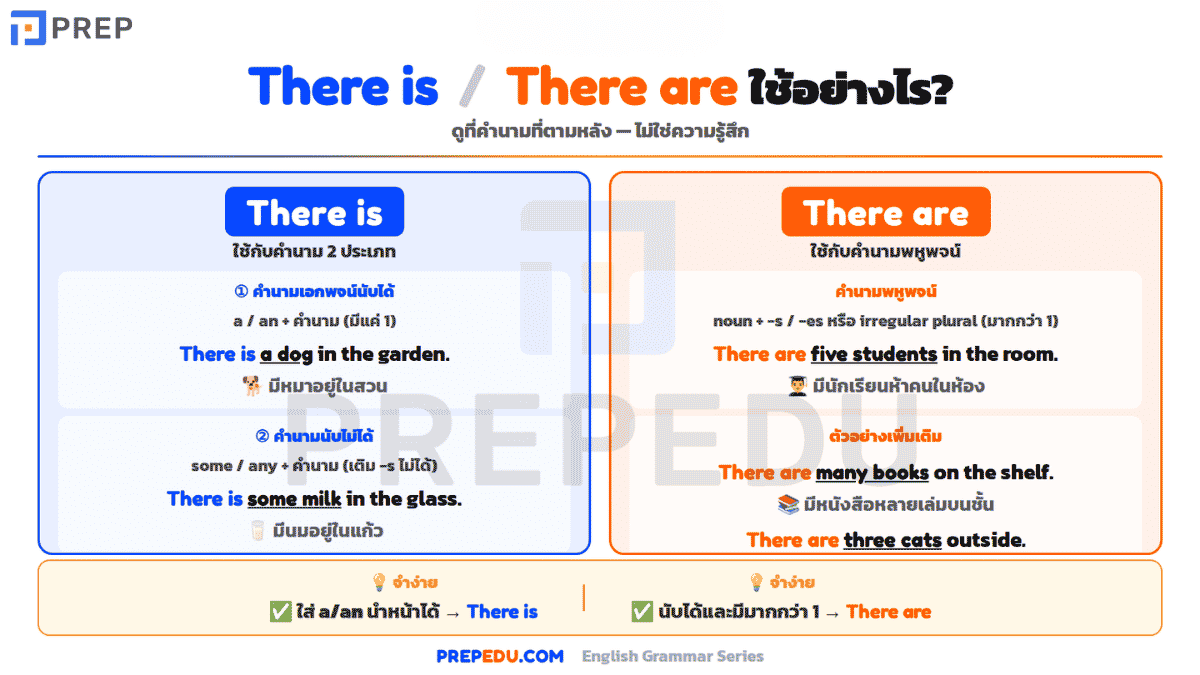
1. There is - ใช้กับอะไร
There is ใช้กับ 2 ประเภท:
ประเภทที่ 1 - คำนามเอกพจน์ที่นับได้ (Singular countable noun) คือคำนามที่มีแค่ 1 และใส่ a หรือ an นำหน้าได้
-
There is a dog in the garden. (มีหมาอยู่ในสวน)
-
There is an apple on the plate. (มีแอปเปิลอยู่บนจาน)
-
There is a student in the library. (มีนักเรียนอยู่ในห้องสมุด)
ประเภทที่ 2 - คำนามนับไม่ได้ (Uncountable noun) คือคำนามที่ไม่สามารถเติม -s หรือใส่ a/an ได้ มักนำหน้าด้วย some หรือ any
-
There is some milk in the glass. (มีนมอยู่ในแก้ว)
-
There is water on the floor. (มีน้ำอยู่บนพื้น)
-
There is some noise outside. (มีเสียงดังข้างนอก)
Tip จำง่าย: ถ้าใส่ a/an นำหน้าคำนามได้ = singular → ใช้ There is
2. There are - ใช้กับอะไร
There are ใช้กับคำนามพหูพจน์ (Plural noun) คือคำนามที่มีมากกว่า 1 มักเติม -s, -es หรือเป็น irregular plural
-
There are five students in the room. (มีนักเรียนห้าคนในห้อง)
-
There are many books on the shelf. (มีหนังสือหลายเล่มบนชั้น)
-
There are children playing outside. (มีเด็กๆ กำลังเล่นข้างนอก)
-
There are two cats on the sofa. (มีแมวสองตัวอยู่บนโซฟา)
Tip จำง่าย: ถ้านับได้และมีมากกว่า 1 = plural → ใช้ There are
III. ประโยค There is / There are ครบทุกรูปแบบ
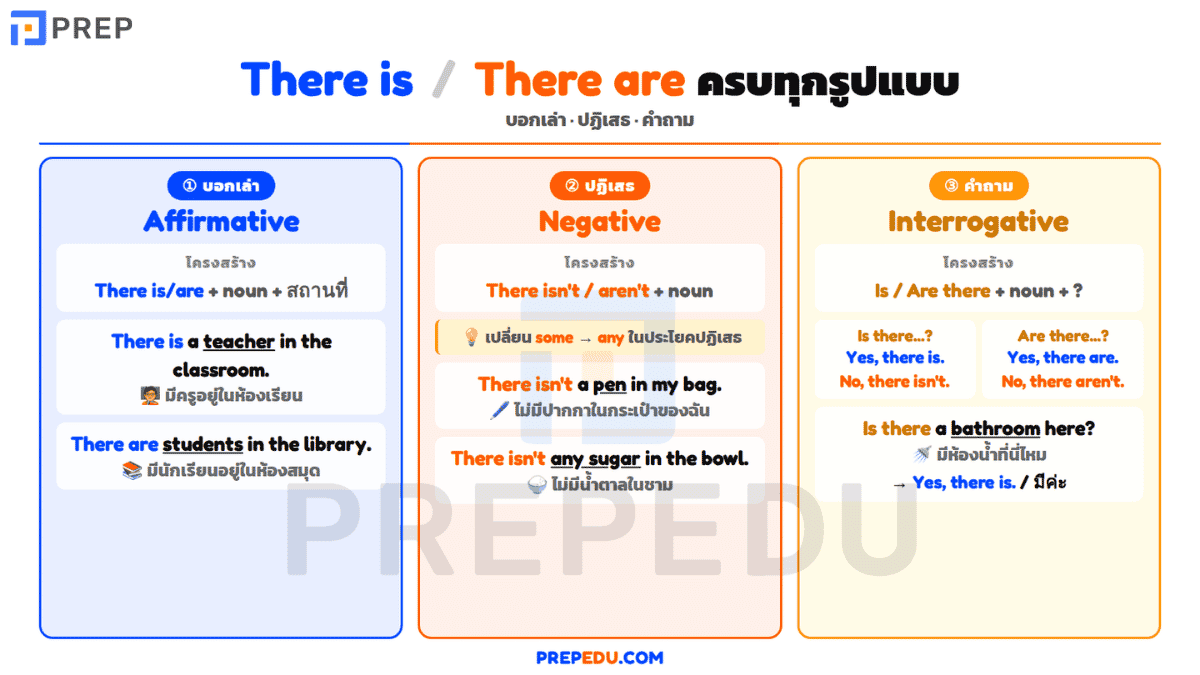
1. ประโยคบอกเล่า (Affirmative)
โครงสร้าง:
There is/are + noun phrase + (สถานที่/เวลา)
-
There is a teacher in the classroom. - มีครูอยู่ในห้องเรียน
-
There is a dog under the table. - มีหมาอยู่ใต้โต๊ะ
-
There is some juice in the glass. - มีน้ำผลไม้อยู่ในแก้ว
-
There are two cats on the sofa. - มีแมวสองตัวอยู่บนโซฟา
-
There are many flowers in the garden. - มีดอกไม้หลายดอกอยู่ในสวน
-
There are five books on the desk. - มีหนังสือห้าเล่มอยู่บนโต๊ะ
2. ประโยคปฏิเสธ (Negative)
โครงสร้าง:
There isn't/aren't + noun phrase
รูปแบบเต็มคือ There is not / There are not แต่ในภาษาพูดและการเขียนทั่วไปนิยมใช้รูปย่อ There isn't / There aren't
หมายเหตุ: ในประโยคปฏิเสธ ให้เปลี่ยน some เป็น any
-
There isn't a pen in my bag. - ไม่มีปากกาในกระเป๋าของฉัน
-
There isn't any sugar in the bowl. - ไม่มีน้ำตาลในชาม
-
There aren't any students in the library. - ไม่มีนักเรียนในห้องสมุด
-
There aren't many chairs in the room. - ไม่มีเก้าอี้มากในห้อง
3. ประโยคคำถาม (Interrogative)
โครงสร้าง:
Is there / Are there + noun phrase + ?
ตอบสั้น (Short answer):
-
Is there...? → Yes, there is. / No, there isn't.
-
Are there...? → Yes, there are. / No, there aren't.
ตัวอย่างถามตอบ:
-
Is there a bathroom here? - Yes, there is. / มีห้องน้ำที่นี่ไหม - มีค่ะ/ครับ
-
Is there any coffee? - No, there isn't. / มีกาแฟไหม - ไม่มีค่ะ/ครับ
-
Are there any students? - Yes, there are. / มีนักเรียนไหม - มีค่ะ/ครับ
-
Are there many people? - No, there aren't. / มีคนเยอะไหม - ไม่เยอะค่ะ/ครับ
โครงสร้าง existential there ใช้ verb agreement ตาม noun ที่ตามหลัง: singular → is, plural → are กฎนี้ใช้กับทั้งบอกเล่า ปฏิเสธ และคำถาม
กรณีที่นักเรียนมักสับสน เช่น คำนามนับไม่ได้และ list หลายอย่าง มีวิธีตัดสินใจที่ชัดเจน ดูในส่วนถัดไป
บทความแนะนำอ่านเพิ่มเติม:
IV. There is หรือ There are? วิธีเลือกในกรณีที่สับสน
เมื่อสับสนระหว่าง There is กับ There are ให้ดูที่คำนามที่ตามหลัง: ถ้าเป็นคำนามนับไม่ได้ (เช่น water, money, information) ให้ใช้ There is เสมอ ถ้ามีรายการหลายอย่าง เช่น "There is/are a cat and two dogs" ให้ดูที่ผลรวม เนื่องจากรวมแล้วมีมากกว่า 1 จึงใช้ There are ส่วน It is ต่างจาก There is ตรงที่ It is ใช้เมื่อ "it" อ้างถึงสิ่งที่รู้อยู่แล้ว
1. Uncountable Nouns - "There is some water" ถูกหรือผิด?
นักเรียนหลายคนสับสนเพราะคำอย่าง water, money, information ฟังดูเป็นเอกพจน์ แต่เป็นคำนามนับไม่ได้ (uncountable) ซึ่งใช้ There is เสมอ ไม่มีข้อยกเว้น
❌ ผิด: "There are some water in the glass."
✅ ถูก: "There is some water in the glass."
กฎ: คำนามนับไม่ได้ + There is เสมอ ไม่ว่าจะมีมากหรือน้อย
คำนามนับไม่ได้ที่ต้องจำ ได้แก่ water, milk, money, information, furniture, advice, music, homework, rice, bread ทั้งหมดนี้ใช้ There is เสมอ
2. List หลายอย่าง - ใช้ There is หรือ There are?
เมื่อมีรายการหลายอย่างในประโยคเดียว ให้ดูที่ "จำนวนรวมทั้งหมด" ไม่ใช่แค่ noun แรก
❌ ผิด: "There is a cat and two dogs in the yard."
✅ ถูก: "There are a cat and two dogs in the yard."
เหตุผล: มีทั้งแมว 1 ตัวและหมา 2 ตัว รวมกันเป็น 3 ตัว = plural → ใช้ There are
เปรียบเทียบให้ชัด:
-
"There is a book." - 1 อย่าง = singular → There is ✅
-
"There are a book and a pen." - 2 อย่าง รวมกัน = plural → There are ✅
3. There is vs It is - ต่างกันอย่างไร?
นี่คือจุดที่นักเรียนสับสนโดยไม่รู้ตัว ทั้งสองแปลว่า "มี" หรือ "เป็น" แต่ใช้ในบริบทต่างกันโดยสิ้นเชิง
There is = แนะนำสิ่งใหม่ที่ผู้ฟังยังไม่รู้ว่ามี It is = อ้างถึงสิ่งที่รู้อยู่แล้ว หรือพูดถึงสิ่งที่ระบุได้ชัดเจน
ตัวอย่างคู่เปรียบเทียบ:
-
"There is a bird on the branch." (แนะนำว่ามีนกตัวหนึ่ง - ผู้ฟังยังไม่รู้)
-
"It is a small bird." (อ้างถึงนกที่เพิ่งพูดถึงไป)
จำง่าย: There is = มีอะไรบางอย่าง | It is = สิ่งนั้นคืออะไร
โครงสร้าง existential there ทำหน้าที่แนะนำ entity (สิ่งใดสิ่งหนึ่ง) ใหม่เข้ามาใน discourse (การสนทนา/ข้อความ) ขณะที่ anaphoric it (การอ้างอิงย้อนกลับ) อ้างกลับไปยัง entity ที่ถูกกล่าวถึงก่อนหน้า
V. แบบฝึกหัด There is / There are พร้อมเฉลยทุกข้อ
ทำแบบฝึกหัดสองชุดนี้ก่อนดูเฉลย จะช่วยให้รู้ว่าจุดไหนยังต้องทบทวน
1. แบบฝึกหัดชุดที่ 1: เติม There is / There are (8 ข้อ)
เติม There is หรือ There are ลงในช่องว่าง
1. _______ a cat on the roof.
2. _______ three birds in the tree.
3. _______ some milk in the bottle.
4. _______ many cars on the road.
5. _______ a pencil in the box.
6. _______ some children playing outside.
7. _______ any water in the glass.
8. _______ two dogs and a cat in the yard.
เฉลยชุดที่ 1:
[prep_collapse_expand open_text="View more" close_text="Show less"]
1. There is - a cat = singular countable noun
2. There are - three birds = plural (มากกว่า 1)
3. There is - milk = uncountable noun
4. There are - many cars = plural
5. There is - a pencil = singular countable noun
6. There are - children = plural (irregular plural ของ child)
7. There is - water = uncountable noun
8. There are - two dogs + a cat รวมกัน = plural (มากกว่า 1)
[/prep_collapse_expand]
2. แบบฝึกหัดชุดที่ 2: เลือกคำตอบที่ถูก (7 ข้อ)
เลือก There is หรือ There are ที่ถูกต้อง
1. _______ some information on the board. (There is / There are)
2. _______ twelve months in a year. (There is / There are)
3. _______ a dog and two cats at home. (There is / There are)
4. _______ some furniture in the room. (There is / There are)
5. _______ a lot of noise outside. (There is / There are)
6. _______ five students absent today. (There is / There are)
7. _______ an interesting movie on TV. (There is / There are)
เฉลยชุดที่ 2:
[prep_collapse_expand open_text="View more" close_text="Show less"]
1. There is - information = uncountable noun ใช้ There is เสมอ
2. There are - twelve months = plural (12 อย่าง)
3. There are - dog + cats รวมกัน = มากกว่า 1 = plural
4. There is - furniture = uncountable noun แม้มีหลายชิ้น
5. There is - noise = uncountable noun
6. There are - five students = plural
7. There is - an interesting movie = singular (a/an นำหน้า = singular)
[/prep_collapse_expand]
VI. คำถามที่พบบ่อยเกี่ยวกับ There is / There are (FAQ)
There is และ There are แปลว่า "มี" ในแบบบอกการมีอยู่ของสิ่ง (existence) ต่างจาก Have/Has ที่แสดงความเป็นเจ้าของ Past tense ของ There is คือ There was และ Past tense ของ There are คือ There were สำหรับนักเรียนระดับประถม-มัธยมต้น กฎหลักที่ต้องจำมี 2 ข้อ: (1) singular/uncountable → There is และ (2) plural → There are
1. There is / There are แปลว่าอะไร?
There is และ There are แปลว่า "มี" ในแบบบอกว่ามีสิ่งใดดำรงอยู่ในสถานที่หรือสถานการณ์หนึ่ง ต่างจาก "มี" แบบความเป็นเจ้าของที่ใช้ Have/Has
ตัวอย่าง: "There is a park near my house." = มีสวนสาธารณะอยู่ใกล้บ้านฉัน (บอกว่ามีสวนอยู่ ไม่ได้บอกว่าใครเป็นเจ้าของ)
2. There is / There are ต่างจาก Have / Has อย่างไร?
There is/are ใช้บอกว่า "มีสิ่งนั้นอยู่" (existence) ส่วน Have/Has ใช้บอกว่า "ใครมีสิ่งนั้น" (possession) ความต่างนี้สำคัญมาก
-
"There is a book on the table." - มีหนังสืออยู่บนโต๊ะ (ไม่ระบุเจ้าของ)
-
"She has a book." - เธอมีหนังสือ (ระบุเจ้าของชัดเจน)
3. ใช้ There is หรือ There are กับ "some"?
ขึ้นอยู่กับคำนามที่ตามหลัง some ไม่ใช่ขึ้นอยู่กับ some เอง
-
some + uncountable → There is some (เช่น "There is some water." / "There is some rice.")
-
some + plural → There are some (เช่น "There are some books." / "There are some students.")
4. There is / There are ใช้ใน Past Tense ได้ไหม?
ได้ แค่เปลี่ยน is → was และ are → were กฎ singular/plural/uncountable ยังคงเดิมทุกอย่าง
-
"There was a dog here yesterday." - เมื่อวานมีหมาอยู่ที่นี่ (singular → was)
-
"There were many people at the party." - งานปาร์ตี้มีคนเยอะ (plural → were)
There is ใช้กับ singular nouns และ uncountable nouns - There are ใช้กับ plural nouns เท่านั้น กฎนี้ไม่มีข้อยกเว้นสำหรับระดับ ป.4-ม.2 จำ 2 ข้อนี้ได้ก็ทำข้อสอบได้ถูกต้องเกือบทุกข้อ
There is there are เป็นโครงสร้างไวยากรณ์พื้นฐานที่สำคัญ ใช้บอกว่า "มี" สิ่งใดสิ่งหนึ่งอยู่ การเลือกใช้ there is or there are ให้ถูกต้องขึ้นอยู่กับคำนามที่ตามหลัง โดย there is ใช้กับคำนามเอกพจน์และคำนามนับไม่ได้ ส่วน there are ใช้กับคำนามพหูพจน์เท่านั้น
หากคุณต้องการพัฒนาทักษะภาษาอังกฤษเพิ่มเติม คอร์สเรียน IELTS ออนไลน์ ของ PREP Education จะช่วยให้คุณเชี่ยวชาญไวยากรณ์ขั้นสูง รวมถึง there is there are และโครงสร้างสำคัญอื่นๆ ที่จำเป็นสำหรับการสอบ IELTS ด้วยระบบการเรียนการสอนที่ทันสมัยและครูผู้เชี่ยวชาญที่พร้อมให้คำแนะนำแบบเฉพาะบุคคล

สวัสดีค่ะ ฉันชื่อมุก ปัจจุบันดูแลด้านเนื้อหาผลิตภัณฑ์ของ Prep Education ค่ะ
ด้วยประสบการณ์มากกว่า 5 ปีในการเรียน IELTS ออนไลน์ด้วยตนเอง ฉันเข้าใจดีถึงความท้าทายที่ผู้เรียนต้องเผชิญ แล้วก็รู้ว่าอะไรที่มันเวิร์ก
มุกอยากเอาประสบการณ์ตรงนี้มาช่วยแชร์ แล้วก็ซัพพอร์ตเพื่อน ๆ ให้ได้คะแนนที่ดีที่สุดค่ะ
ความคิดเห็น
เนื้อหาแบบพรีเมียม
ดูทั้งหมด



แผนการเรียนรู้ส่วนบุคคล


อ่านมากที่สุด




ติดต่อ Prep ผ่านโซเชียล





Address: ตึก C.P. Tower 2 (ฟอร์จูนทาวน์) ชั้น 21 ถนนรัชดาภิเษก แขวงดินแดง เขตดินแดง กรุงเทพฯ 10400
Hotline: +66 25 44 0068
Email: sawatdee@prepedu.com