sion、tion 結尾單字整理:構詞規則、發音差異與常見用法解析
sion、tion 結尾單字有哪些?這兩種字尾該怎麼分辨與正確發音?其實,sion, tion 結尾單字多半為名詞,常由動詞轉變而來,用來表示「行為、過程或結果」,例如 decision、education、information。掌握這類字尾規則,你就能快速判斷詞性,並在閱讀與寫作中更準確地理解句意。
在英文構詞系統中,-tion 與 -sion 皆源自拉丁語,廣泛出現在學術與正式書面語中。許多學習者雖然認得單字,卻常在拼寫與發音上混淆,例如 confusion 與 conclusion、action 與 station。其實,只要理解字尾的構詞邏輯與常見變化規則,就能大幅降低拼錯與誤用的機率。
在本篇文章中,PREPEDU 將系統整理常見 sion、tion 結尾單字,解析構詞來源、發音規則與實際例句,並說明常見拼寫差異與記憶技巧,幫助你建立清晰的字尾辨識能力。當你掌握這類高頻名詞結構,英文閱讀與寫作表達都會更加流暢與專業。

sion, tion 結尾單字
I. 以 sion 結尾單字整理
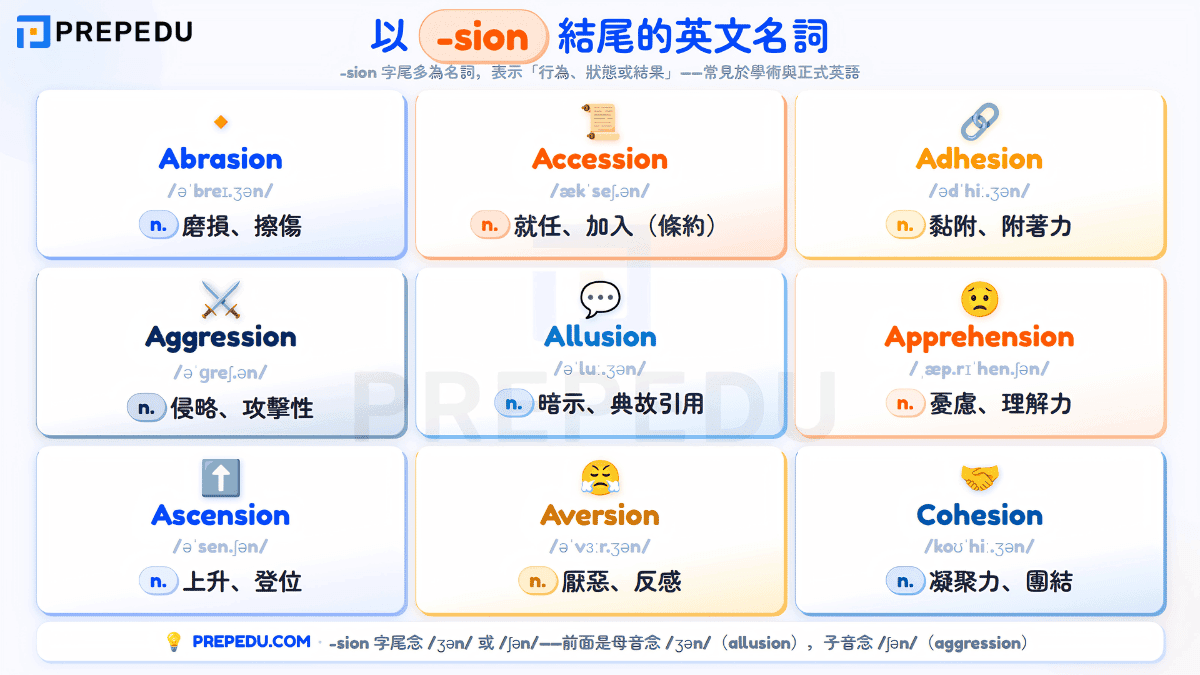
以 sion 結尾的英文單字大多是名詞,來自拉丁文字根,廣泛用於學術、商業及日常語境。這些 sion 結尾的單字通常由動詞演化而來,例如 discuss → discussion、decide → decision、express → expression。掌握這些轉化規律,能讓你快速推測陌生詞彙的意思,在 ion 結尾詞彙辨識上建立強大的直覺。
1. sion 結尾的英文名詞
英文名詞是 sion 結尾單字中最龐大的詞類。以下 20 個高頻詞彙涵蓋學術、職場及日常場合,是 IELTS、TOEIC 考試中反覆出現的核心字彙。每個詞彙均附 IPA 音標,方便你掌握 sion 結尾發音。
|
sion 結尾單字 |
中文翻譯 |
例句 |
|
abrasion (n.) /əˈbreɪ.ʒən/ |
磨損;擦傷 |
The hiker suffered a minor abrasion on her knee after falling on the rocky trail. (那位健行者在岩石小徑上跌倒後,膝蓋上有一處輕微的擦傷。) |
|
accession (n.) /ækˈseʃ.ən/ |
就任;加入;加入條約 |
The country's accession to the trade organization boosted its economy significantly. (該國加入貿易組織後,經濟顯著提升。) |
|
adhesion (n.) /ədˈhiː.ʒən/ |
黏附;附著力 |
The adhesion of the paint to the metal surface was tested under extreme conditions. (在極端條件下測試了油漆對金屬表面的附著力。) |
|
aggression (n.) /əˈɡreʃ.ən/ |
侵略;攻擊性 |
The government condemned the military aggression against the neighboring country. (政府譴責了對鄰國的軍事侵略行為。) |
|
allusion (n.) /əˈluː.ʒən/ |
暗示;典故;間接提及 |
The author's allusion to Greek mythology added depth to the novel. (作者對希臘神話的典故為這部小說增添了深度。) |
|
apprehension (n.) /ˌæp.rɪˈhen.ʃən/ |
憂慮;逮捕;領會 |
There was growing apprehension among investors about the economic downturn. (投資者對經濟衰退的憂慮日益加深。) |
|
ascension (n.) /əˈsen.ʃən/ |
上升;晉升;升天 |
Her rapid ascension to the position of CEO surprised many in the industry. (她迅速晉升為執行長一事讓業界許多人感到驚訝。) |
|
aversion (n.) /əˈvɜːr.ʒən/ |
厭惡;強烈反感 |
He has a strong aversion to public speaking and avoids it whenever possible. (他對公開演講有強烈的反感,盡可能地避免。) |
|
cohesion (n.) /koʊˈhiː.ʒən/ |
凝聚力;團結;黏合力 |
Team cohesion is essential for achieving project goals on time. (團隊凝聚力對於按時達成專案目標至關重要。) |
|
collision (n.) /kəˈlɪʒ.ən/ |
碰撞;衝突;撞擊 |
The collision between the two vehicles caused a major traffic jam on the highway. (兩輛車的碰撞在高速公路上造成了嚴重的交通堵塞。) |
|
collusion (n.) /kəˈluː.ʒən/ |
串通;勾結;共謀 |
The investigation revealed collusion between government officials and the corporation. (調查揭露了政府官員與企業之間的串通勾結。) |
|
compassion (n.) /kəmˈpæʃ.ən/ |
同情心;憐憫;惻隱之心 |
Nurses must show compassion toward patients during their recovery. (護理師在病患康復期間必須展現同情心。) |
|
complexion (n.) /kəmˈplek.ʃən/ |
膚色;面色;整體面貌 |
A healthy diet and regular exercise can improve your complexion. (健康的飲食和規律的運動可以改善你的膚色。) |
|
compression (n.) /kəmˈpreʃ.ən/ |
壓縮;壓迫;緊縮 |
Data compression allows large files to be stored and transmitted more efficiently. (資料壓縮使大型檔案能夠更有效地儲存和傳輸。) |
|
compulsion (n.) /kəmˈpʌl.ʃən/ |
強迫;衝動;強制行為 |
She felt a compulsion to check her phone every few minutes during the meeting. (她在會議中感到一種每隔幾分鐘就要查看手機的衝動。) |
|
concession (n.) /kənˈseʃ.ən/ |
讓步;特許權;承認 |
Both sides had to make significant concessions to reach a compromise. (雙方都必須做出重大讓步才能達成妥協。) |
|
concussion (n.) /kənˈkʌʃ.ən/ |
腦震盪;強烈震動 |
The athlete was diagnosed with a concussion after the collision on the field. (那位運動員在場上碰撞後被診斷出腦震盪。) |
|
condescension (n.) /ˌkɒn.dɪˈsen.ʃən/ |
居高臨下;傲慢態度 |
His tone of condescension made the junior staff feel undervalued. (他居高臨下的語氣讓資淺員工感到不受重視。) |
|
confession (n.) /kənˈfeʃ.ən/ |
告白;懺悔;供認 |
The suspect made a full confession to the police after hours of questioning. (嫌疑犯在數小時的訊問後向警方做了全部供認。) |
|
convulsion (n.) /kənˈvʌl.ʃən/ |
痙攣;抽搐;劇烈動盪 |
The patient experienced severe convulsions and was rushed to the emergency room. (病患經歷了嚴重的痙攣,被緊急送往急診室。) |
|
corrosion (n.) /kəˈroʊ.ʒən/ |
腐蝕;侵蝕;鏽蝕 |
Regular maintenance can prevent the corrosion of metal bridges and pipelines. (定期維護可以防止金屬橋樑和管線的腐蝕。) |
|
delusion (n.) /dɪˈluː.ʒən/ |
妄想;錯覺;幻覺 |
He was under the delusion that he could finish the project without any help. (他抱有妄想,以為自己可以不靠任何幫助就完成這個專案。) |
|
derision (n.) /dɪˈrɪʒ.ən/ |
嘲笑;嘲弄;輕蔑 |
His unconventional proposal was met with derision from senior colleagues. (他的非傳統提案遭到資深同事們的嘲笑。) |
|
diffusion (n.) /dɪˈfjuː.ʒən/ |
擴散;傳播;滲透 |
The diffusion of digital technology has transformed communication worldwide. (數位科技的傳播已經改變了全球的溝通方式。) |
|
digression (n.) /daɪˈɡreʃ.ən/ |
離題;偏離;題外話 |
The professor's frequent digressions made the lecture difficult to follow. (教授頻繁的離題使得講座難以跟上。) |
|
dispersion (n.) /dɪˈspɜːr.ʃən/ |
分散;散布;色散 |
The dispersion of light through a prism produces a rainbow of colors. (光線通過稜鏡的色散會產生彩虹般的色彩。) |
|
dissension (n.) /dɪˈsen.ʃən/ |
意見分歧;不和;爭論 |
Internal dissension weakened the political party before the general election. (內部的意見分歧在大選前削弱了該政黨。) |
|
diversion (n.) /daɪˈvɜːr.ʒən/ |
轉移;消遣;改道 |
The road closure required a traffic diversion through the side streets. (道路封閉需要車輛改道行經小巷。) |
|
emission (n.) /ɪˈmɪʃ.ən/ |
排放;散發;發出 |
Reducing carbon emissions is critical to combating global climate change. (減少碳排放對於應對全球氣候變遷至關重要。) |
|
emulsion (n.) /ɪˈmʌl.ʃən/ |
乳劑;乳狀液 |
Milk is a natural emulsion of fat droplets suspended in water. (牛奶是脂肪液滴懸浮在水中的天然乳狀液。) |
|
evasion (n.) /ɪˈveɪ.ʒən/ |
逃避;規避;迴避 |
Tax evasion is a serious criminal offense in most countries. (逃稅在大多數國家是嚴重的刑事犯罪。) |
|
excursion (n.) /ɪkˈskɜːr.ʒən/ |
遠足;短途旅行;郊遊 |
The school organized an excursion to the science museum for all students. (學校為所有學生安排了一次前往科學博物館的遠足。) |
|
expulsion (n.) /ɪkˈspʌl.ʃən/ |
驅逐;開除;排出 |
The student faced expulsion for repeatedly violating the school's code of conduct. (該學生因反覆違反學校行為守則而面臨開除。) |
|
fission (n.) /ˈfɪʃ.ən/ |
裂變;分裂;細胞分裂 |
Nuclear fission releases a tremendous amount of energy from splitting atoms. (核裂變透過分裂原子釋放出巨大的能量。) |
|
fusion (n.) /ˈfjuː.ʒən/ |
融合;聚變;合併 |
The restaurant is famous for its creative fusion of Asian and European cuisines. (這家餐廳以其創意的亞歐料理融合菜餚聞名。) |
|
hypertension (n.) /ˌhaɪ.pɚˈten.ʃən/ |
高血壓;過度緊張 |
Hypertension significantly increases the risk of heart disease and stroke. (高血壓會顯著增加心臟病和中風的風險。) |
|
immersion (n.) /ɪˈmɜːr.ʒən/ |
沉浸;浸入;沉浸式學習 |
Language immersion programs are highly effective for achieving fluency. (語言沉浸式課程對於達到流利程度非常有效。) |
|
implosion (n.) /ɪmˈploʊ.ʒən/ |
內爆;向內崩潰 |
The implosion of the old building was controlled by demolition experts. (舊建築的內爆拆除由爆破專家控制進行。) |
|
incision (n.) /ɪnˈsɪʒ.ən/ |
切口;切開;手術切口 |
The surgeon made a small incision to remove the tumor with minimal scarring. (外科醫生做了一個小切口,以最少的疤痕切除腫瘤。) |
|
incursion (n.) /ɪnˈkɜːr.ʒən/ |
入侵;突襲;侵犯 |
The military incursion into the border region quickly escalated the conflict. (對邊境地區的軍事入侵迅速使衝突升級。) |
|
indecision (n.) /ˌɪn.dɪˈsɪʒ.ən/ |
猶豫不決;優柔寡斷 |
Her indecision about which university to attend lasted for several months. (她對於要就讀哪所大學猶豫不決了好幾個月。) |
|
infusion (n.) /ɪnˈfjuː.ʒən/ |
注入;輸液;浸泡飲品 |
The startup needs a fresh infusion of capital to fund its rapid expansion. (這家新創公司需要注入新的資金來支持其快速擴張。) |
|
intermission (n.) /ˌɪn.tɚˈmɪʃ.ən/ |
中場休息;間歇;幕間 |
The audience bought refreshments during the fifteen-minute intermission. (觀眾在十五分鐘的中場休息時購買了點心。) |
|
introversion (n.) /ˌɪn.trəˈvɜːr.ʒən/ |
內向性格;性格內斂 |
Introversion is not a flaw; it is simply a different personality orientation. (內向不是缺陷;它只是一種不同的人格取向。) |
|
intrusion (n.) /ɪnˈtruː.ʒən/ |
侵入;干擾;不請自來 |
The company invested heavily in cybersecurity to prevent network intrusion. (公司大量投資網路安全以防止網路侵入。) |
|
inversion (n.) /ɪnˈvɜːr.ʒən/ |
倒置;反轉;逆溫層 |
Temperature inversion can trap air pollutants near the ground level. (逆溫現象會將空氣污染物困在接近地面的地方。) |
|
lesion (n.) /ˈliː.ʒən/ |
損傷;病變;病灶 |
The MRI scan revealed a small lesion on the patient's brain. (核磁共振掃描顯示病患腦部有一處小型病變。) |
|
mansion (n.) /ˈmæn.ʃən/ |
豪宅;大廈;莊園 |
The billionaire purchased a mansion with a stunning ocean view. (那位億萬富翁購買了一棟擁有絕美海景的豪宅。) |
|
obsession (n.) /əbˈseʃ.ən/ |
癡迷;執念;強迫思想 |
His obsession with perfection often delayed project completion. (他對完美的執念經常延誤專案的完成。) |
|
omission (n.) /oʊˈmɪʃ.ən/ |
遺漏;省略;疏忽 |
The omission of critical data from the report raised serious concerns. (報告中關鍵資料的遺漏引發了嚴重的擔憂。) |
|
oppression (n.) /əˈpreʃ.ən/ |
壓迫;壓制;壓抑 |
The people fought bravely against political oppression for decades. (人民數十年來勇敢地對抗政治壓迫。) |
|
pension (n.) /ˈpen.ʃən/ |
退休金;養老金;年金 |
She contributed to her pension fund consistently throughout her entire career. (她在整個職業生涯中持續向退休基金繳款。) |
|
percussion (n.) /pɚˈkʌʃ.ən/ |
打擊樂;敲擊;叩診 |
She has played percussion in the city orchestra since she was twelve. (她從十二歲起就在市立管弦樂團演奏打擊樂器。) |
|
persuasion (n.) /pɚˈsweɪ.ʒən/ |
說服;勸說;信念 |
It took a great deal of persuasion to convince him to accept the job offer. (花了很大的力氣說服他接受這份工作邀約。) |
|
possession (n.) /pəˈzeʃ.ən/ |
擁有;財產;持有 |
The possession of illegal substances can result in severe legal penalties. (持有非法物質可能導致嚴厲的法律處罰。) |
|
precision (n.) /prɪˈsɪʒ.ən/ |
精確;精密;準確度 |
Scientific experiments require a high degree of precision in measurement. (科學實驗在測量上需要高度的精確性。) |
|
procession (n.) /prəˈseʃ.ən/ |
遊行隊伍;行列;行進 |
A solemn procession of mourners walked slowly through the streets. (一列莊嚴的哀悼隊伍緩緩走過街道。) |
|
propulsion (n.) /prəˈpʌl.ʃən/ |
推進;驅動力;推力 |
The spacecraft relies on ion propulsion technology for deep-space travel. (該太空船依靠離子推進技術進行深太空旅行。) |
|
protrusion (n.) /proʊˈtruː.ʒən/ |
突出;凸出物;隆起 |
The rocky protrusion on the cliff made it a popular spot for climbers. (懸崖上的岩石凸出物使其成為攀岩者的熱門地點。) |
|
provision (n.) /prəˈvɪʒ.ən/ |
提供;條款;準備;糧食 |
The contract includes a provision allowing early termination by either party. (合約中包含一項允許任一方提前終止的條款。) |
|
regression (n.) /rɪˈɡreʃ.ən/ |
回歸;退化;退步 |
The therapist noticed a regression in the child's social behavior. (治療師注意到這個孩子的社交行為出現了退化。) |
|
remission (n.) /rɪˈmɪʃ.ən/ |
緩解;病情減輕;赦免 |
The patient's cancer went into complete remission after six months of chemotherapy. (病患的癌症在六個月的化療後完全緩解。) |
|
repercussion (n.) /ˌriː.pɚˈkʌʃ.ən/ |
反響;(負面)後果;影響 |
The sudden policy change had serious repercussions for the entire industry. (突如其來的政策變更對整個產業產生了嚴重的後果。) |
|
repression (n.) /rɪˈpreʃ.ən/ |
壓抑;鎮壓;強制壓制 |
Political repression silenced opposition voices and restricted press freedom. (政治鎮壓壓制了反對聲音並限制了新聞自由。) |
|
repulsion (n.) /rɪˈpʌl.ʃən/ |
排斥;斥力;強烈厭惡 |
Magnetic repulsion occurs when two like poles are placed close together. (當兩個相同磁極靠近時,就會產生磁斥力。) |
|
reversion (n.) /rɪˈvɜːr.ʒən/ |
恢復;回復原狀;逆轉 |
The reversion to old habits undermined his progress in therapy. (恢復舊習慣破壞了他在治療中的進展。) |
|
revulsion (n.) /rɪˈvʌl.ʃən/ |
強烈厭惡;憎惡;反感 |
She felt a deep sense of revulsion at the sight of the polluted river. (她看到被污染的河流時感到一陣深深的厭惡。) |
|
secession (n.) /sɪˈseʃ.ən/ |
脫離;分裂;退出 |
The secession of the southern states led to the American Civil War. (南方各州的脫離導致了美國南北戰爭。) |
|
seclusion (n.) /sɪˈkluː.ʒən/ |
隱居;幽靜;與世隔絕 |
The author retreated to the seclusion of a mountain cabin to finish her novel. (作者退隱到山間小屋的幽靜之中以完成她的小說。) |
|
session (n.) /ˈseʃ.ən/ |
會議;課程;時段 |
The afternoon training session will focus on presentation skills. (下午的培訓課程將著重於簡報技巧。) |
|
subdivision (n.) /ˌsʌb.dɪˈvɪʒ.ən/ |
細分;分區;住宅區 |
The new residential subdivision will include 200 homes and a community park. (新的住宅分區將包括兩百戶住宅和一座社區公園。) |
|
subversion (n.) /səbˈvɜːr.ʒən/ |
顛覆;破壞;推翻 |
The government accused the activist group of attempting political subversion. (政府指控該社運團體企圖進行政治顛覆。) |
|
succession (n.) /səkˈseʃ.ən/ |
繼承;連續;一系列 |
A rapid succession of events led to a major political crisis in the region. (一連串事件迅速導致了該地區的重大政治危機。) |
|
supervision (n.) /ˌsuː.pɚˈvɪʒ.ən/ |
監督;管理;指導 |
Young children should always use the internet under adult supervision. (幼兒應始終在成人監督下使用網路。) |
|
suppression (n.) /səˈpreʃ.ən/ |
壓制;抑制;鎮壓 |
The suppression of free speech is widely regarded as a violation of human rights. (壓制言論自由被普遍視為侵犯人權的行為。) |
|
television (n.) /ˈtel.ɪˌvɪʒ.ən/ |
電視;電視機;電視廣播 |
Television remains one of the most influential forms of mass media today. (電視至今仍是最具影響力的大眾媒體形式之一。) |
|
transfusion (n.) /trænsˈfjuː.ʒən/ |
輸血;注入;輸液 |
The critically injured patient required an emergency blood transfusion. (那位傷勢嚴重的病患需要緊急輸血。) |
|
transgression (n.) /trænzˈɡreʃ.ən/ |
違反;過失;罪過 |
The employee was dismissed for repeated transgressions of company policy. (該員工因反覆違反公司政策而被解僱。) |
2. sion 結尾的英文動詞
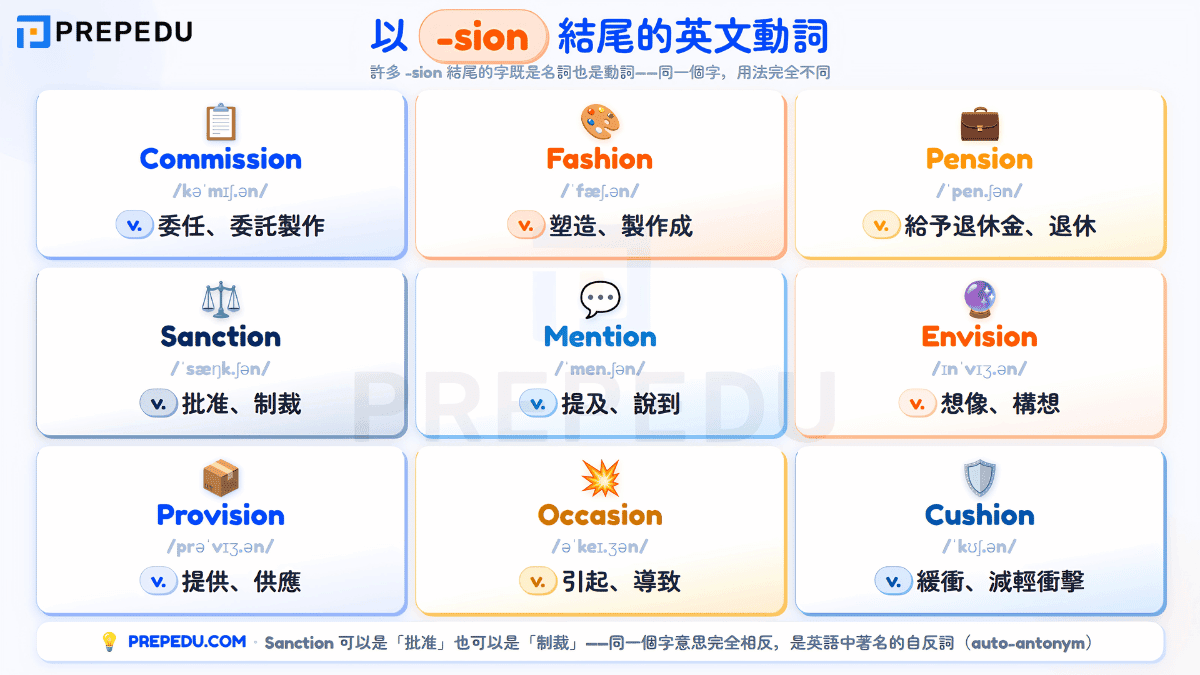
直接以 sion 結尾的英文動詞相對較少,但其中有幾個在正式書寫與職場溝通中相當實用。注意:commission、fashion、pension、tension 等字雖以 -sion 作結,但原始字根的分析有時不同於純粹的 -sion 後綴;而 position、sanction、mention 雖形似,實際字尾為 -tion,需特別區分。
|
sion 結尾單字 |
中文翻譯 |
例句 |
|
commission (v.) /kəˈmɪʃ.ən/ |
委託;授予;正式啟用 |
The publishing house commissioned three experienced writers to update the textbook.(出版社委託三位資深作者更新這本教科書。) |
|
fashion (v.) /ˈfæʃ.ən/ |
塑造;製作;設計 |
The teacher fashioned a creative lesson plan from everyday materials.(老師用日常材料設計了一個創意課程計劃。) |
|
pension (v.) /ˈpen.ʃən/ |
(以退休金)打發;使退休 |
The school pensioned off its oldest faculty members last year.(學校去年讓其最資深的教職員退休。) |
|
sanction (v.) /ˈsæŋk.ʃən/ |
批准;認可;制裁 |
The board officially sanctioned the revised bilingual curriculum framework. (董事會正式批准了修訂後的雙語課程框架。) |
|
mention (v.) /ˈmen.ʃən/ |
提及;提到;談及 |
The teacher mentioned several effective strategies for improving TOEIC listening scores. (老師提到了幾種提高TOEIC聽力分數的有效策略。) |
|
pension (v.) /ˈpen.ʃən/ |
(以退休金)使退休 |
The company pensioned off senior employees as part of its restructuring plan.(公司將資深員工納入退休計畫作為重組的一部分。) |
|
envision (v.) /ɪnˈvɪʒ.ən/ |
展望;想像(比 vision 更常用) |
The CEO envisions a dynamic workplace where innovation thrives through collaboration.(執行長展望了一個透過合作促進創新發展的活力職場。) |
|
provision (v.) /prəˈvɪʒ.ən/ |
為…提供物資/設備 |
The team was well provisioned with all the necessary software tools before the project started.(在專案開始前,團隊已配備了所有必需的軟體工具。) |
II. 以 tion 結尾單字整理
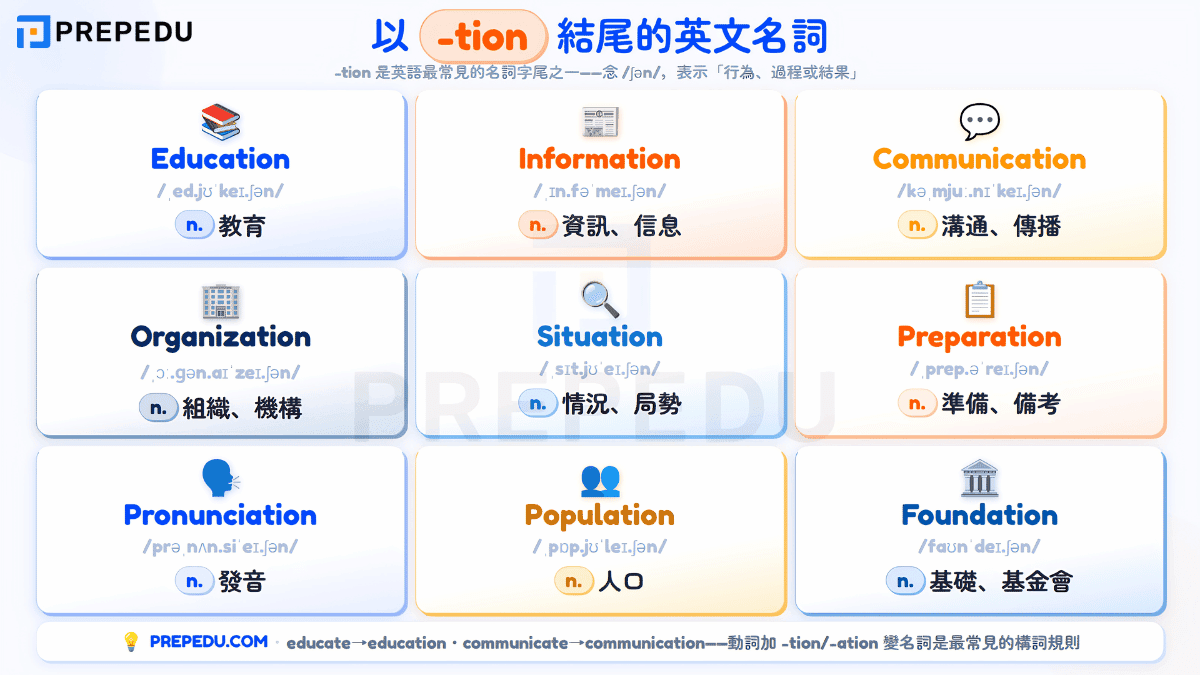
tion 結尾的單字是英語詞彙系統中數量最多、使用頻率最高的字尾之一。無論是 education、communication,還是 preparation,這些 tion 結尾的單字幾乎貫穿所有英語考試題目和真實語境。tion 結尾發音固定為 /ʃən/,比 sion 更容易掌握,是擴充英文單字 tion 結尾詞彙量的絕佳切入點。
1. tion 結尾的英文名詞
以下 20 個 tion 結尾的名詞是 IELTS 和 TOEIC 高頻詞彙的核心,涵蓋教育、職場、社會及語言學習等主題。這些詞彙不僅是考試必備,在日常英語溝通中也極為常用。請特別注意每個詞彙的 IPA 音標,確保你的 tion 結尾發音準確無誤。
|
tion 結尾單字 |
中文翻譯 |
例句 |
|
education (n.) /ˌed.jʊˈkeɪ.ʃən/ |
教育;學識 |
A quality education opens doors to meaningful career opportunities worldwide. (優質教育為世界各地有意義的職業機會打開大門。) |
|
information (n.) /ˌɪn.fəˈmeɪ.ʃən/ |
資訊;情報;消息 |
The website provides accurate information about IELTS and TOEIC exam formats. (該網站提供關於IELTS和TOEIC考試格式的準確資訊。) |
|
communication (n.) /kəˌmjuː.nɪˈkeɪ.ʃən/ |
溝通;通訊;交流 |
Effective communication in English is essential for global career advancement. (有效的英語溝通對全球職業發展至關重要。) |
|
organization (n.) /ˌɔː.ɡən.aɪˈzeɪ.ʃən/ |
組織;機構;安排 |
The international organization sponsors English proficiency training across Asia. (這個國際組織在亞洲各地贊助英語能力培訓。) |
|
situation (n.) /ˌsɪt.jʊˈeɪ.ʃən/ |
情況;狀況;處境 |
The team handled the critical situation with remarkable composure. (團隊以非凡的鎮定處理了這一嚴峻情況。) |
|
preparation (n.) /ˌprep.əˈreɪ.ʃən/ |
準備;備考;預備 |
Systematic preparation over three months is the surest path to a high IELTS band. (三個月的系統性備考是取得高雅思成績的最確定途徑。) |
|
pronunciation (n.) /prəˌnʌn.siˈeɪ.ʃən/ |
發音;讀音 |
Correct pronunciation boosts a speaker's confidence and credibility in any setting. (正確的發音能在任何場合提升說話者的自信和可信度。) |
|
population (n.) /ˌpɒp.jʊˈleɪ.ʃən/ |
人口;群體;種群 |
A growing population of learners in Taiwan is pursuing TOEIC certification for career advancement. (台灣越來越多的學習者為職業發展追求TOEIC認證。) |
|
foundation (n.) /faʊnˈdeɪ.ʃən/ |
基礎;基金會;根基 |
Grammar is the foundation on which all productive language skills are built. (語法是所有語言技能得以建立的基礎。) |
|
imagination (n.) /ɪˌmædʒ.ɪˈneɪ.ʃən/ |
想像力;創意 |
Creative writing demands both vocabulary depth and a vivid imagination. (創意寫作需要詞彙的深度和生動的想像力。) |
|
examination (n.) /ɪɡˌzæm.ɪˈneɪ.ʃən/ |
考試;檢查;審查 |
The examination consists of four distinct sections covering all core language skills. (考試由四個涵蓋所有核心語言技能的部分組成。) |
|
motivation (n.) /ˌməʊ.tɪˈveɪ.ʃən/ |
動力;激勵;目的 |
Intrinsic motivation sustains long-term language learning far more than external rewards. (內在動力比外在獎勵更能維持長期語言學習。) |
|
question (n.) /ˈkwes.tʃən/ |
問題;疑問;質疑 |
The examiner posed a complex question that required critical thinking. (考官提出了一個需要批判性思維的複雜問題。) |
|
solution (n.) /səˈluː.ʃən/ |
解決方案;答案 |
Finding an effective solution to vocabulary gaps requires consistent daily review. (找到解決詞彙缺口的有效方案需要持續的每日複習。) |
|
nation (n.) /ˈneɪ.ʃən/ |
國家;民族 |
Each nation develops distinct communication norms that shape language learning. (每個國家都發展出影響語言學習的獨特溝通規範。) |
|
attention (n.) /əˈten.ʃən/ |
注意力;關注;照顧 |
Pay close attention to the speaker's intonation patterns during the listening test. (在聽力測試期間,密切關注說話者的語調模式。) |
|
competition (n.) /ˌkɒm.pɪˈtɪʃ.ən/ |
競爭;比賽;競爭者 |
She secured first place in the national English competition with a near-perfect score. (她以近乎完美的成績在全國英語比賽中獲得第一名。) |
|
generation (n.) /ˌdʒen.əˈreɪ.ʃən/ |
世代;一代人;產生 |
Every generation of learners faces unique linguistic challenges in an evolving world. (每一代學習者在不斷演變的世界中面臨獨特的語言挑戰。) |
|
translation (n.) /trænsˈleɪ.ʃən/ |
翻譯;轉換;譯文 |
Precise translation preserves the original author's intent and cultural nuance. (精確的翻譯保留了原作者的意圖和文化細微差別。) |
|
qualification (n.) /ˌkwɒl.ɪ.fɪˈkeɪ.ʃən/ |
資格;學歷;條件 |
A TOEIC qualification significantly strengthens your professional profile in global companies. (TOEIC資格認證能顯著增強您在跨國企業中的專業形象。) |
|
recommendation (n.) /ˌrek.ə.menˈdeɪ.ʃən/ |
建議;推薦;推薦信 |
Her professor wrote a strong recommendation letter that secured her scholarship. (她的教授寫了一封有力的推薦信,使她獲得了獎學金。) |
|
presentation (n.) /ˌprez.ənˈteɪ.ʃən/ |
演講;呈現;簡報 |
His confident presentation skills impressed the entire board of directors. (他自信的演講技巧給整個董事會留下了深刻印象。) |
|
concentration (n.) /ˌkɒn.senˈtreɪ.ʃən/ |
專注;集中;濃度 |
Deep concentration is essential when tackling difficult listening comprehension passages. (深度專注對於處理困難的聽力理解篇章至關重要。) |
|
demonstration (n.) /ˌdem.ənˈstreɪ.ʃən/ |
示範;展示;示威 |
The teacher gave a clear demonstration of how to structure an IELTS Task 1 response. (老師清楚地示範了如何構建IELTS任務一的回答。) |
|
interpretation (n.) /ɪnˌtɜː.prɪˈteɪ.ʃən/ |
解釋;口譯;詮釋 |
Each reader brings a unique interpretation to the same literary text. (每位讀者對同一文學文本帶來獨特的詮釋。) |
|
implementation (n.) /ˌɪm.plɪ.menˈteɪ.ʃən/ |
執行;實施;落實 |
Successful implementation of a study plan requires discipline and consistency. (成功執行學習計劃需要紀律和一致性。) |
|
investigation (n.) /ɪnˌves.tɪˈɡeɪ.ʃən/ |
調查;研究;偵查 |
A thorough investigation into the root cause of errors improves writing accuracy. (對錯誤根本原因的深入調查能提升寫作準確度。) |
|
conversation (n.) /ˌkɒn.vəˈseɪ.ʃən/ |
對話;交談;會話 |
Engaging in daily conversation practice is the fastest way to develop spoken fluency. (每日參與對話練習是培養口語流利度最快的方法。) |
|
observation (n.) /ˌɒb.zəˈveɪ.ʃən/ |
觀察;評語;遵守 |
Careful observation of native speakers reveals natural rhythm and intonation patterns. (仔細觀察母語者揭示了自然的語言節奏和語調模式。) |
|
determination (n.) /dɪˌtɜː.mɪˈneɪ.ʃən/ |
決心;毅力;判定 |
Unwavering determination separates learners who achieve Band 7 from those who plateau. (堅定不移的決心區分了達到7分和停滯不前的學習者。) |
|
contribution (n.) /ˌkɒn.trɪˈbjuː.ʃən/ |
貢獻;捐款;投稿 |
Your active contribution to group discussions develops both fluency and confidence. (你積極參與小組討論能培養流利度和自信。) |
|
institution (n.) /ˌɪn.stɪˈtjuː.ʃən/ |
機構;制度;習俗 |
She enrolled in a reputable language institution to prepare for the IELTS exam. (她報名了一所聲譽卓著的語言機構為IELTS考試做準備。) |
|
distinction (n.) /dɪˈstɪŋk.ʃən/ |
區別;榮譽;特色 |
She graduated with distinction, earning the highest academic honour in her faculty. (她以優異成績畢業,獲得所在學院的最高學術榮譽。) |
|
satisfaction (n.) /ˌsæt.ɪsˈfæk.ʃən/ |
滿意;滿足感;償還 |
The deep satisfaction of passing IELTS motivates many learners to set higher goals. (通過IELTS的深度滿足感激勵許多學習者設定更高目標。) |
|
action (n.) /ˈæk.ʃən/ |
行動;動作;措施 |
Taking consistent action every day is the most reliable path to fluency. (每天採取持續的行動是通往流利度最可靠的路徑。) |
|
reaction (n.) /riˈæk.ʃən/ |
反應;回應;排斥反應 |
The learner's immediate reaction to error correction reveals their emotional resilience. (學習者對錯誤糾正的即時反應揭示了他們的情感韌性。) |
|
section (n.) /ˈsek.ʃən/ |
部分;章節;科別 |
The reading section of the IELTS exam contains three passages of increasing difficulty. (IELTS考試的閱讀部分包含三篇難度遞增的文章。) |
|
collection (n.) /kəˈlek.ʃən/ |
收藏;收集;集合 |
Build a personal collection of high-frequency words from authentic reading materials. (從真實閱讀材料中建立個人高頻詞彙收藏。) |
|
connection (n.) /kəˈnek.ʃən/ |
連結;聯繫;關係 |
Making a logical connection between ideas is the hallmark of coherent academic writing. (在想法之間建立邏輯連結是連貫學術寫作的標誌。) |
|
direction (n.) /daɪˈrek.ʃən/ |
方向;指導;指示 |
Without clear direction, study sessions become inefficient and unfocused. (沒有明確的方向,學習時段會變得低效且缺乏重點。) |
|
protection (n.) /prəˈtek.ʃən/ |
保護;防護;防禦 |
Copyright protection ensures that educational content creators receive proper recognition. (著作權保護確保教育內容創作者獲得適當的認可。) |
|
reflection (n.) /rɪˈflek.ʃən/ |
反思;反射;映像 |
After each mock test, spend ten minutes on reflection to identify recurring mistakes. (每次模擬測試後,花十分鐘進行反思以識別反覆出現的錯誤。) |
|
correction (n.) /kəˈrek.ʃən/ |
糾正;更正;修改 |
Timely correction of grammar errors reinforces accurate language usage. (及時糾正語法錯誤能鞏固準確的語言使用。) |
|
infection (n.) /ɪnˈfek.ʃən/ |
感染;傳染;影響 |
Enthusiasm is an infection — when teachers love language, students follow. (熱情是一種感染——當老師熱愛語言時,學生也會隨之而來。) |
|
suggestion (n.) /səˈdʒes.tʃən/ |
建議;暗示;提議 |
Every suggestion from your teacher is a stepping stone toward a higher score. (老師的每一個建議都是邁向更高分數的墊腳石。) |
|
function (n.) /ˈfʌŋk.ʃən/ |
功能;作用;職責 |
Understanding the function of each word class is fundamental to grammar mastery. (理解每個詞類的功能是掌握語法的根本。) |
|
fraction (n.) /ˈfræk.ʃən/ |
分數;一小部分;小數 |
Even a small fraction of your daily time devoted to vocabulary review yields measurable results. (即使是每天一小部分時間用於詞彙複習也能產生可衡量的成果。) |
|
interaction (n.) /ˌɪn.təˈræk.ʃən/ |
互動;交流;相互作用 |
Regular interaction with English native speakers accelerates spoken language development. (與英語母語者的定期互動能加速口語語言發展。) |
|
transaction (n.) /trænˈzæk.ʃən/ |
交易;辦理;事務 |
TOEIC business emails frequently involve professional transaction language and terminology. (TOEIC商業電子郵件經常涉及專業交易語言和術語。) |
|
introduction (n.) /ˌɪn.trəˈdʌk.ʃən/ |
介紹;引言;入門 |
A compelling essay introduction hooks the reader in the very first sentence. (引人注目的文章引言在第一句就能吸引讀者。) |
|
production (n.) /prəˈdʌk.ʃən/ |
生產;製作;產量 |
The production of high-quality written content demands both skill and discipline. (高品質書面內容的產出需要技能和紀律。) |
|
reduction (n.) /rɪˈdʌk.ʃən/ |
減少;降低;縮減 |
A reduction in grammatical errors directly improves TOEIC writing scores. (語法錯誤的減少直接提升TOEIC寫作分數。) |
|
instruction (n.) /ɪnˈstrʌk.ʃən/ |
指示;說明;教學 |
Follow every test instruction carefully to avoid unnecessary point deductions. (仔細遵循每條考試指示,以避免不必要的扣分。) |
|
construction (n.) /kənˈstrʌk.ʃən/ |
建設;構建;句子結構 |
Accurate sentence construction is assessed in both IELTS writing tasks. (準確的句子構建在兩項IELTS寫作任務中都受到評估。) |
|
destruction (n.) /dɪˈstrʌk.ʃən/ |
破壞;摧毀;消滅 |
The destruction of rainforests is a popular IELTS essay topic involving environmental arguments. (雨林的破壞是涉及環境論述的熱門IELTS作文主題。) |
|
location (n.) /ləʊˈkeɪ.ʃən/ |
位置;地點;場所 |
The exam centre's location in the city centre is easy to reach by public transport. (考試中心位於市中心,乘坐公共交通工具便於抵達。) |
|
indication (n.) /ˌɪn.dɪˈkeɪ.ʃən/ |
跡象;指示;暗示 |
A rising score trend is a clear indication that your study method is working. (不斷提升的成績趨勢是你學習方法有效的明確跡象。) |
|
allocation (n.) /ˌæl.əˈkeɪ.ʃən/ |
分配;配置;撥款 |
Smart time allocation across IELTS sections prevents the most common test-day pitfall. (在IELTS各部分之間合理的時間分配能防止最常見的考試日失誤。) |
|
confirmation (n.) /ˌkɒn.fəˈmeɪ.ʃən/ |
確認;確認書;證實 |
Send a confirmation email within 24 hours of registering for any standardized exam. (在報名任何標準化考試後24小時內發送確認電子郵件。) |
|
transformation (n.) /ˌtræns.fəˈmeɪ.ʃən/ |
轉變;轉型;改造 |
The transformation of a struggling learner into a confident speaker takes time and commitment. (將一個掙扎的學習者轉變為自信的說話者需要時間和投入。) |
|
pronunciation (n.) /prəˌnʌn.siˈeɪ.ʃən/ |
發音;讀音方式 |
Mastering English pronunciation requires targeted practice with IPA phonetic symbols. (掌握英語發音需要結合IPA音標進行有針對性的練習。) |
|
appreciation (n.) /əˌpriː.ʃiˈeɪ.ʃən/ |
欣賞;感激;增值 |
Deep appreciation for literary language enriches both reading and writing skills. (對文學語言的深度欣賞能豐富閱讀和寫作技能。) |
2. tion 結尾的英文動詞
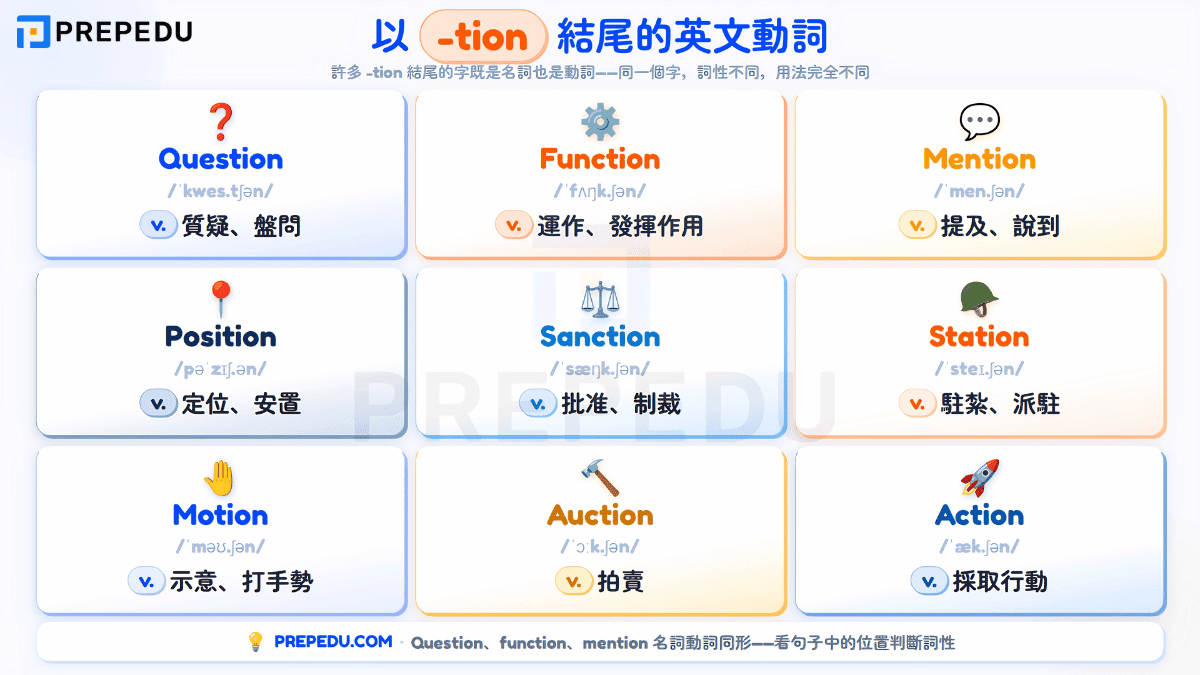
與 sion 相比,tion 結尾的動詞更為豐富。question、function、mention、position 等詞彙都是日常溝通中不可缺少的動詞。其中許多詞彙兼具名詞和動詞兩種詞性,理解這個特性能幫助你更準確判斷句子結構,在 TOEIC 文法題和 IELTS 閱讀理解中減少失誤。
|
tion 結尾單字 |
中文翻譯 |
例句 |
|
question (v.) /ˈkwes.tʃən/ |
質疑;詢問;審問 |
Critics questioned the accuracy of the published test preparation guide. (批評者質疑已出版的考試備考指南的準確性。) |
|
function (v.) /ˈfʌŋk.ʃən/ |
運作;發揮作用;起作用 |
The brain functions at peak efficiency after seven to eight hours of sleep. (大腦在七到八小時睡眠後以最佳效率運作。) |
|
mention (v.) /ˈmen.ʃən/ |
提及;提到;談及 |
The teacher mentioned several practical strategies for improving TOEIC scores. (老師提到了幾種提高TOEIC分數的實用策略。) |
|
position (v.) /pəˈzɪʃ.ən/ |
定位;安置;放置 |
She strategically positioned herself as an expert in business English communication. (她策略性地將自己定位為商務英語溝通的專家。) |
|
sanction (v.) /ˈsæŋk.ʃən/ |
批准;制裁;認可 |
The board officially sanctioned the new bilingual curriculum framework. (董事會正式批准了新的雙語課程框架。) |
|
station (v.) /ˈsteɪ.ʃən/ |
駐紮;安置;部署 |
Teaching assistants were stationed at different points of the exam hall to assist candidates. (助教被安置在考場不同位置以協助考生。) |
|
motion (v.) /ˈməʊ.ʃən/ |
示意;做手勢;提議 |
The moderator motioned for the speakers to begin the debate. (主持人示意演講者開始辯論。) |
|
auction (v.) /ˈɔːk.ʃən/ |
拍賣;競賣 |
The school auctioned donated books to raise funds for its language program. (學校拍賣了捐贈書籍以為語言課程籌集資金。) |
|
action (v.) /ˈæk.ʃən/ |
執行;採取行動 |
The committee agreed to action the proposed changes to the curriculum immediately. (委員會同意立即執行提議的課程變更。) |
|
caption (v.) /ˈkæp.ʃən/ |
為…加說明文字;配字幕 |
The media team captioned all instructional videos to make them accessible to hearing-impaired learners. (媒體團隊為所有教學影片配上字幕,使聽障學習者也能使用。) |
|
ration (v.) /ˈræʃ.ən/ |
定量分配;限量供應 |
Effective learners ration their study time to prevent burnout and maintain long-term consistency. (有效的學習者定量分配學習時間,以防止精力耗盡並保持長期一致性。) |
|
petition (v.) /pɪˈtɪʃ.ən/ |
請願;陳情;申請 |
Students petitioned the administration to introduce more flexible exam retake policies. (學生向校方請願,要求引入更靈活的考試重考政策。) |
III. sion 與 tion 結尾的核心差異:讓你一次看懂
在掌握了大量的英文基礎詞彙後,許多學習者常會在寫作或拼字時卡關:「這個字到底該寫成 -sion 還是 -tion?」要徹底解決這個痛點,最關鍵的一步就是理解這兩個字尾在拼寫選擇與發音上的底層邏輯。其實,這套變形規律並不混亂,核心邏輯只有一條:「動詞字根的最後一個字母(或音節),決定了名詞字尾的長相。」 以下我們將從「拼寫衍生規律」與「發音辨識」兩大維度,為您進行深度拆解。
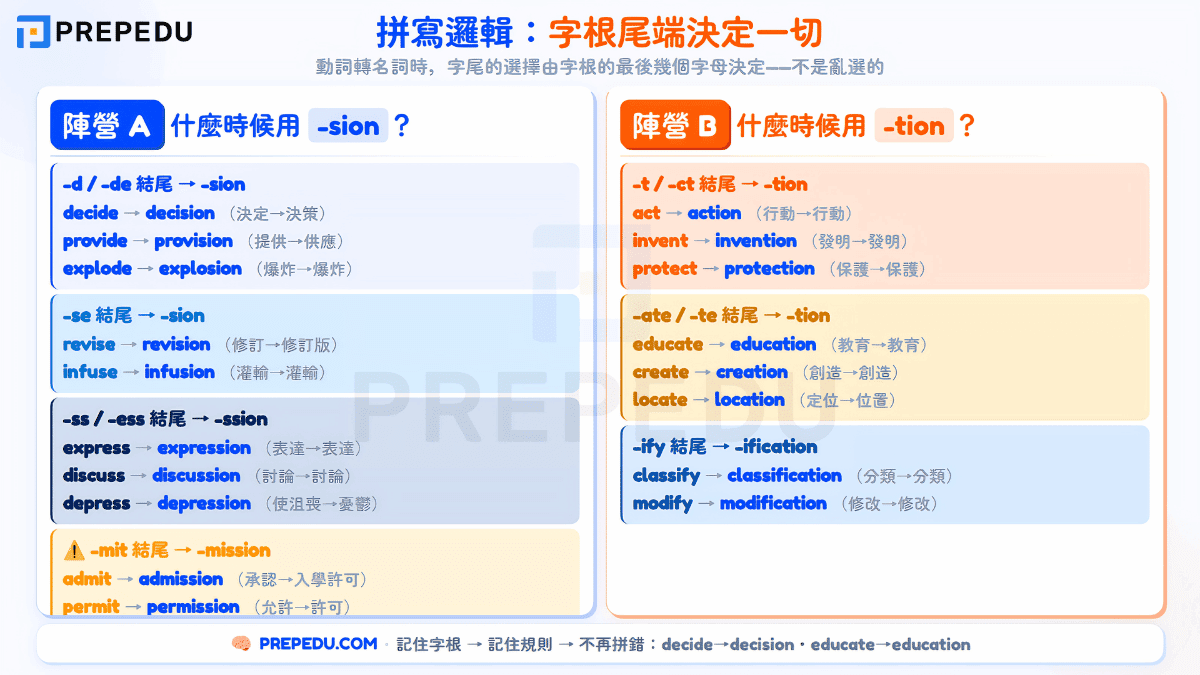
1. 拼寫邏輯:字根尾端決定一切
英文動詞在轉化為名詞時,字尾英文的變化主要是為了兼顧「發音的流暢度」與「字源的延續性」。我們可以將其歸納為兩大陣營:
|
陣營 A:什麼時候使用 -sion? |
陣營 B:什麼時候使用 -tion? |
|
當動詞字根英文的結尾字母為 -d、-de、-se、-ss、-mit 時,為了發音方便,名詞通常會轉化為 -sion。
|
這是英文中更為普遍的名詞字尾。當動詞字根以 -t、-te、-ate、-ct、-ify 等字母結尾時,幾乎毫無例外會選擇 -tion。
|
2. 發音規律:聽力與口說的混淆根源
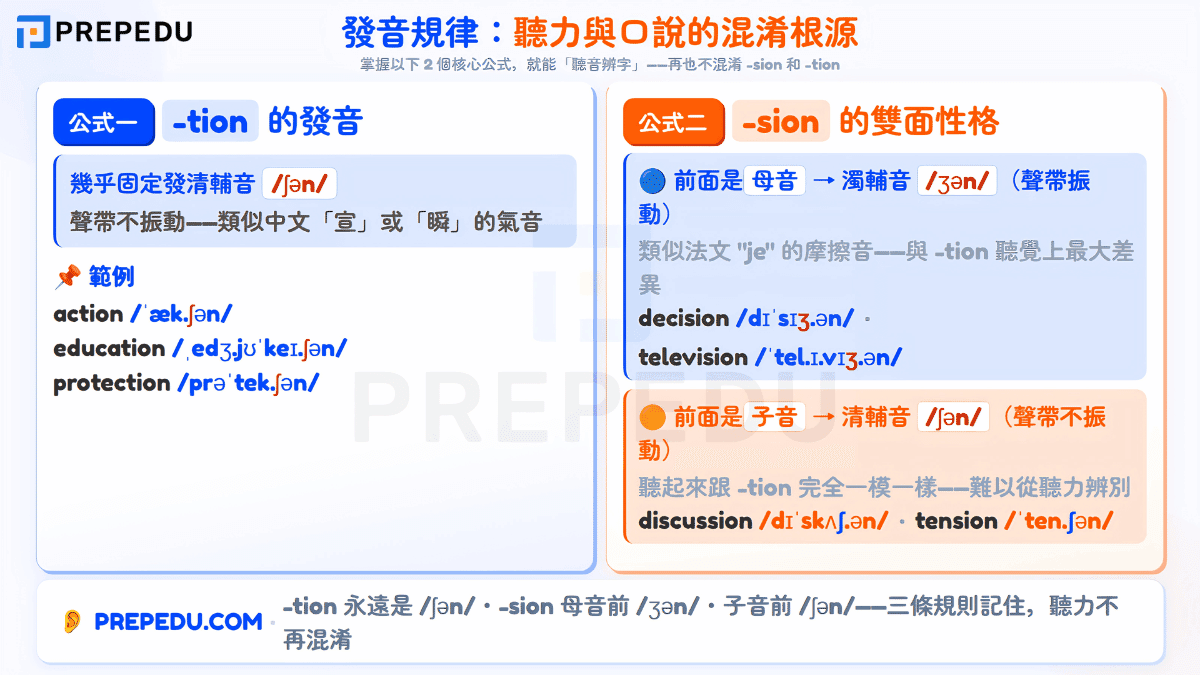
除了拼寫之外,英文發音規則更是許多學習者產生混淆的根本原因。只要掌握以下兩個核心公式,就能「聽音辨字」:
公式一:-tion 的發音極為專一 → 在絕大多數情況下,-tion 幾乎固定發清輔音 /ʃən/(類似中文的「宣」或「瞬」的氣音,聲帶不振動)。範例: action /ˈæk.ʃən/、education /ˌedʒ.jʊˈkeɪ.ʃən/。
公式二:-sion 具有「雙面性格」 → -sion 的發音取決於它「前面緊鄰的字母是英文母音還是英文子音」:
-
若 -sion 前面是「母音」(A, E, I, O, U):它會被同化為濁輔音 /ʒən/(發音時聲帶需要振動,類似法文 “je” 的摩擦音)。這也是它與 -tion 在聽覺上最大的不同。範例: decision /dɪˈsɪʒ.ən/、television /ˈtel.ɪ.vɪʒ.ən/。
-
若 -sion 前面是「子音」(如 L, N, R, S):此時它的發音會退回清輔音 /ʃən/,聽起來就跟 -tion 完全一模一樣。範例: discussion /dɪˈskʌʃ.ən/、tension /ˈten.ʃən/。
核心總結對照表 → 為了方便記憶,我們可以將上述複雜的規律濃縮成一張表格:
|
字尾 |
常見動詞字根結尾 |
標準發音 |
關鍵記憶點 |
|
-sion |
-d, -de, -se, -ss, -mit |
/ʃən/ 或 /ʒən/ |
前面是母音時發 /ʒən/(聲帶振動);前面是子音時發 /ʃən/。 |
|
-tion |
-t, -ate, -ct, -ify |
/ʃən/ |
發音雷打不動,永遠是清脆的 /ʃən/。 |
掌握了這個底層邏輯後,下次再遇到需要語尾變化的單字,只需往前看一眼動詞字根的結尾,或者靜下心來聆聽發音是否帶有鼻腔與聲帶的共鳴,就能準確無誤地寫出正確的單字了!
IV. 關於 sion, tion 結尾單字的練習題
詞彙知識只有透過主動練習才能真正內化。以下練習題涵蓋填空、選擇與句子改寫三種題型,幫助你鞏固本文所學的所有 sion, tion 結尾單字。請先獨立作答,再對照後面的答案解析,確認自己對每個詞彙的詞類與用法都有正確理解。
1. 題型一:填空題
請從括號中選擇正確的 sion 或 tion 結尾單字,填入空格中,使句子完整且語意正確。
-
The professor gave a detailed ______ of the ancient artifact.(discussion / description / decision)
-
She has a remarkable ______ for business and always makes profitable choices.(vision / version / revision)
-
Good ______ between team members prevents misunderstandings and delays.(communication / competition / commission)
-
The students showed great ______ when they practiced speaking every single day.(motivation / mention / motion)
-
Before entering the restricted area, you must have written ______.(permission / passion / profession)
-
The chemical factory accident caused a massive ______ that could be heard miles away.(explosion / extension / exclusion)
-
The sudden ______ of the schedule caused a lot of confusion among the passengers.(revision / revision / precision)
-
Technology has brought about a major ______ in the way we communicate with others.(revolution / reputation / regulation)
-
Regular exercise and a balanced diet are essential for the ______ of chronic diseases.(prevention / provision / profession)
-
After careful ______, the committee decided to approve the funding for the project.(consideration / conclusion / confusion
2. 題型二:選擇題
請選出最符合句子語意的詞彙。
-
The new app update offers ______ features that are not available in the free version. (A) optional (B) traditional (C) rational (D) functional
-
Teachers ______ a more interactive teaching approach at the annual conference. (A) commissioned (B) mentioned (C) auctioned (D) stationed
-
Her ______ performance in the IELTS exam earned her a scholarship at a top university. (A) divisional (B) occasional (C) exceptional (D) additional
-
The board finally ______ the revised curriculum after months of review. (A) sanctioned (B) motioned (C) fashioned (D) questioned
-
______, students in Taiwan focus more on reading and writing than on speaking. (A) Rationally (B) Functionally (C) Traditionally (D) Nationally
-
The software engineer asked for an ______ on the deadline because of unexpected bugs. (A) expansion (B) extension (C) expression (D) exclusion
-
The doctor suggested a second opinion to avoid any ______ regarding the diagnosis. (A) provision (B) confusion (C) persuasion (D) precision
-
Due to the economic downturn, the company had to make a difficult ______ to lay off staff. (A) direction (B) decision (C) description (D) destination
-
The government issued strict ______ to control environmental pollution in urban areas. (A) regulations (B) reputations (C) situations (D) generations
-
She gave a clear ______ on how to operate the new medical equipment safely. (A) impression (B) instruction (C) institution (D) intuition
3. 題型三:詞類改寫題
請將括號中的詞彙改為正確的詞類形式,填入空格中。
-
She greeted every visitor with a warm and ______ smile.(passion → 形容詞)
-
The company hired him because of his ______ background in finance.(profession → 形容詞)
-
The committee reviewed each proposal ______ before reaching a verdict.(rational → 副詞)
-
______, participants must register at least one week before the exam date.(addition → 副詞)
-
This grammar guide has significant ______ value for IELTS candidates.(educate → 形容詞)
-
The two companies signed a ______ agreement to develop the new technology together.(nation → 形容詞)
-
We need to approach this problem ______ and not let our emotions guide us.(emotion → 副詞)
-
The manager gave some ______ comments that helped improve my report.(construct → 形容詞)
-
______, the project was completed on time despite the budget cuts.(fortune → 副詞)
-
The newly designed workspace is highly ______ and improves employee productivity.(function → 形容詞)
4. 答案解析
|
題型一答案 |
題型二答案 |
題型三答案 |
|
|
|
V. sion、tion 結尾單字常見問題 FAQ
1. sion 和 tion 的發音有什麼不同?
-tion 的發音幾乎固定為 /ʃən/,例如 education /ˌed.jʊˈkeɪ.ʃən/、communication /kəˌmjuː.nɪˈkeɪ.ʃən/,規律清晰,幾乎不存在例外。-sion 的發音則分兩種:若前接母音或 r,通常唸 /ʒən/,例如 vision /ˈvɪʒ.ən/、division /dɪˈvɪʒ.ən/;若前接子音,通常唸 /ʃən/,例如 comprehension /ˌkɒm.prɪˈhen.ʃən/、mansion /ˈmæn.ʃən/。掌握這個規律,就能在 IELTS 口說中避免發音失分。
2. 怎麼判斷一個動詞該加 -tion 還是 -sion?
最可靠的判斷方法是看字根結尾。動詞以 -d 或 -de 結尾時,名詞化通常加 -sion(decide→decision、include→inclusion、divide→division)。動詞以 -t、-te 或 -fy 結尾時,名詞化通常加 -tion(educate→education、act→action、qualify→qualification)。動詞以 -ss 結尾時,加 -ion 後字尾為 -ssion(discuss→discussion、express→expression)。記住這三條規律,就能應對 TOEIC 文法題中80%以上的字尾選擇題。
3. sion、tion 結尾單字有哪些常見的拼寫錯誤?
最常見的三種錯誤:第一,將 -tion 誤拼為 -sion,例如 education 寫成 educasion;第二,混淆 -ssion 與 -tion,例如 discussion 寫成 disscution;第三,漏掉雙子音,例如 commission 寫成 comision。解決方法是在背單字時同步練習 IPA 音標,因為發音與拼寫高度關聯——一旦能正確發音,正確拼寫的機率也大幅提升。
4. 這類詞彙在 IELTS 和 TOEIC 中出現頻率如何?
極高。-tion 和 -sion 結尾的名詞是 IELTS 學術閱讀和 TOEIC 商業郵件中出現頻率最高的詞類之一。根據劍橋英語語料庫分析,高頻學術詞彙中有超過30%帶有 -tion 後綴,例如 information、communication、organization、examination。在 TOEIC 700分以上的考生中,能正確辨識這類名詞的詞性與用法是關鍵的區別能力之一。
結論
sion 和 tion 結尾的英文單字構成了英語詞彙系統的重要骨幹。這些字尾規律清晰:-tion 發音固定為 /ʃən/,-sion 依前接字母分為 /ʃən/ 或 /ʒən/;名詞數量最多,動詞和形容詞透過有規律的字尾變化衍生而來。理解這個規律,不僅能快速擴充詞彙量,更能提升在 IELTS 和 TOEIC 中辨識詞義、判斷句子結構的能力。
本文系統整理了 sion 結尾名詞、sion 結尾動詞、tion 結尾名詞、tion 結尾動詞),並附有 IPA 音標、情境例句與三種題型的練習題,讓你從理解到應用,一步到位。核心規律只有一條:字根結尾決定字尾選擇——掌握這個原則,面對任何陌生的 -ion 結尾單字,你都能準確判斷發音與拼寫。
PREPEDU 提供完整的英語詞彙學習資源,從 IELTS 學術詞彙到 TOEIC 商業用語,幫助你建立系統化的詞彙知識體系。下一步,可以進一步學習其他高頻英文字尾(如 -ment、-ness、-ity)的構詞規律,讓你的英文詞彙擴充更加有結構、有方向。

你好!我叫黃秋賢,現在在 prepedu.com 擔任內容企劃。我有超過5年的英語與韓語自學經歷,親身備考 IELTS、TOEIC 與 TOPIK,累積了大量第一手的學習者視角——包括哪些語法規則最讓台灣與香港學習者混淆,以及如何在有限的備考時間內最有效地修正這些錯誤。目前已在 prepedu.com 撰寫超過 1000 篇英語學習文章,內容涵蓋語法、詞彙與考試策略,累積協助數千位學習者解決自學過程中的語法疑問。
評論










統一企業編號:202227322W
地址:114 LAVENDER STREET, #11-83 CT HUB 2, SINGAPORE (338729)