「明天見」英文怎麼說?See you tomorrow 口語、正式、縮寫與情境對話全攻略
「明天見」最標準、最通用的英文就是 See you tomorrow,正式或非正式場合都能用,對同事、朋友、客戶幾乎都通。但只會這一句,往往會講到變成口頭禪,聽起來機械又單調。其實道地的「明天見」是一整個系統:輕鬆隨興時可以說 See ya tomorrow、Catch you tomorrow;要講明天的時段或時間就用 tomorrow morning、at 9、first thing tomorrow;對客戶或長官要正式一點,就改 Looking forward to seeing you tomorrow、I'll speak to you tomorrow;傳訊息給朋友還能縮寫成 cu tmr。記得一個觀念:See you tomorrow 是一句道別的社交用語,不是「一定會見面」的承諾,所以即使臨時沒見到也不算失約。
這篇會帶你從各種說法開始,接著比較 See you tomorrow 和 later/then/soon/around 差在哪,再診斷常見的中式英文錯誤,教你別人說 See you tomorrow 時要怎麼回,最後用三段情境對話和 FAQ,把這些說法真正用進日常對話裡。

- I. 「明天見」英文怎麼說?
- 1. See you tomorrow
- 2. See ya tomorrow
- 3. Catch you tomorrow
- 4. Talk to you tomorrow
- 5. See you bright and early tomorrow
- 6. See you tomorrow morning/afternoon
- 7. See you in the morning
- 8. See you tomorrow at +(時間)
- 9. See you first thing tomorrow
- 10. Looking forward to seeing you tomorrow
- 11. I'll speak to you tomorrow
- 12. See you at the meeting tomorrow
- 13. cu tmr/see u tmrw
- 14. ttyl tmr
- II. See you tomorrow 和 see you later/then/soon/around 差在哪?
- III. 「明天見」常見的中式英文錯誤
- IV. 別人說「See you tomorrow」英文要怎麼回?
- V. 情境對話示範:3 種場合的明天見英文
- VI. 明天見英文常見問題(FAQ)
- 結語
I. 「明天見」英文怎麼說?
很多人查「明天見英文」其實只背了 See you tomorrow 一句,然後從早到晚反覆使用——問題不在單字不夠,而在缺少一套「依對象與時間具體度」挑選說法的系統。最標準的答案是 See you tomorrow,而下面 14 種說法會由隨興、指定時間、正式,一路排到訊息縮寫,讓你依場合換句話說。
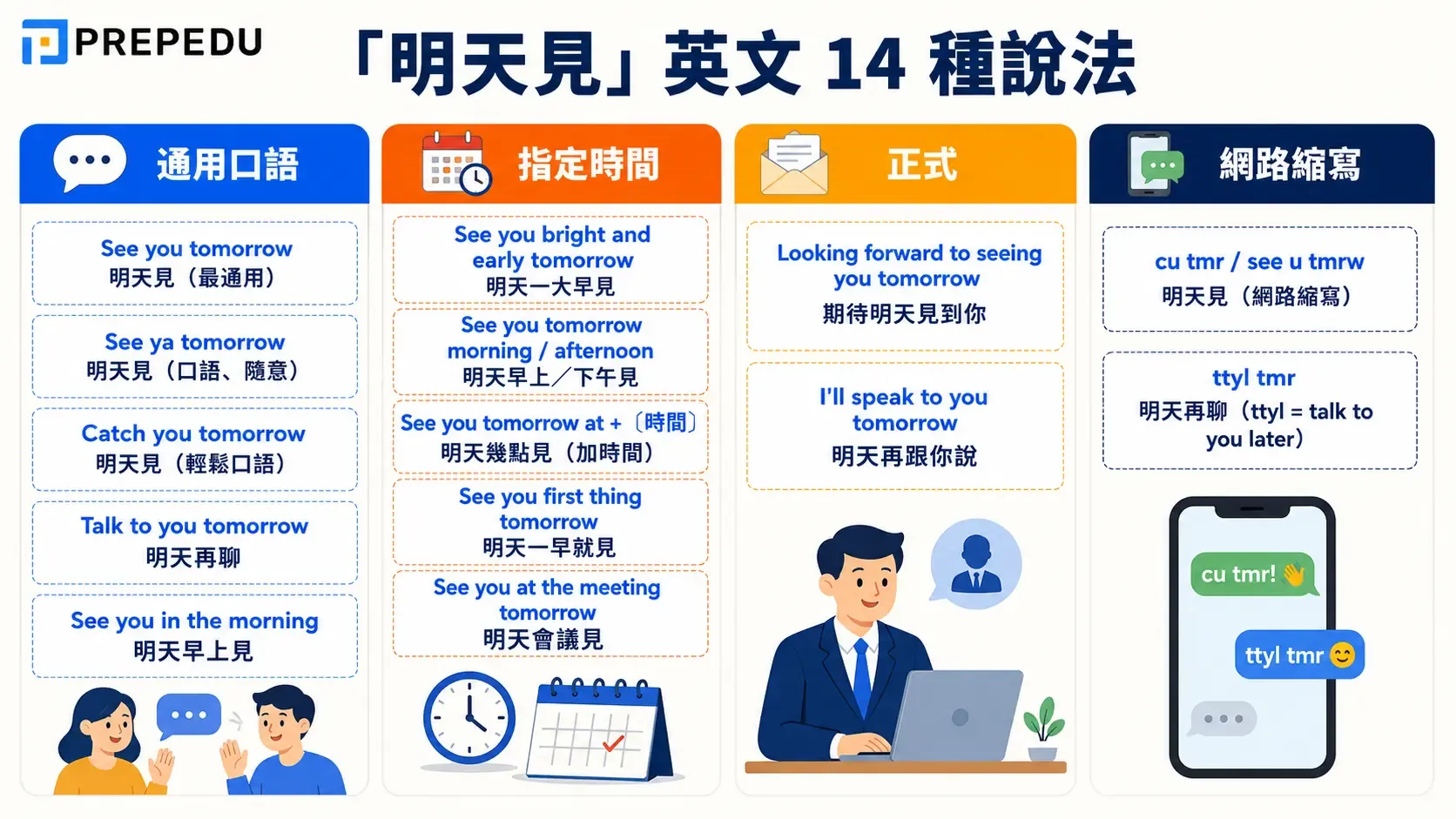
1. See you tomorrow
See you tomorrow 是最標準、最安全的「明天見」,正式與非正式場合都能用,對象幾乎不限。要特別記住的是,這是一句道別的社交用語,並不是「明天一定會見面」的承諾,所以就算明天臨時沒碰到面,也不算說謊或失約——它的功能等同中文的「明天見」這種客套收尾。語域中性,口說和書寫都合適。口語中 see you 常被連音唸成「see-ya」,這也帶出了下一個更口語的說法。更多例句:
-
See you tomorrow, Lisa.(明天見,Lisa。)
-
See you tomorrow, drive safely!(明天見,路上小心!)
-
Thanks for today — see you tomorrow.(今天謝謝你,明天見。)
2. See ya tomorrow
See ya tomorrow 是 See you tomorrow 的口語縮讀,ya 就是 you 在口語快速說話時被弱化的發音,聽起來更輕鬆隨興。它只用在說話或和熟人傳訊息(朋友、要好的同事),不要用在正式 email 或對客戶——那會顯得太隨便。美式英語裡尤其常見,發音接近 /siː jə/。提醒你:ya 是用拼字去反映口語的省音,並不是拼錯字,所以在訊息裡看到別人寫 see ya 不用糾正。更多例句:
-
See ya tomorrow, man!(明天見啦,老兄!)
-
Cool, see ya tomorrow at practice.(好,明天練習見。)
-
Gotta run — see ya tomorrow!(先閃了,明天見!)
3. Catch you tomorrow
Catch you tomorrow 意思是「明天再找你、明天再碰面」,語氣輕鬆,還帶一點期待感。這裡的 catch 有「主動去逮到、找到你」的味道,比單純的 See you 更主動一些。它屬於隨興語域,通常用在朋友或熟同事之間;它的近親是 Catch you later。和客戶或上司道別時請避免使用,會顯得太隨便。更多例句:
-
Catch you tomorrow, then!(那明天見囉!)
-
I'll catch you tomorrow after lunch.(我明天午餐後找你。)
-
Catch you tomorrow — have a good one!(明天見,今天愉快!)
4. Talk to you tomorrow
Talk to you tomorrow 用在「明天不一定見面、但會再聯絡」的情況,例如講電話、傳訊息或線上溝通。它和 See you 的差別在於 talk 強調「用講的、用聯絡的」,不一定要碰面。語域中性,熟一點或稍正式的場合都可以用;想更正式時,可以改成 Speak to you tomorrow。傳訊息時它也常被縮寫成 ttyl。更多例句:
-
Okay, talk to you tomorrow.(好,明天再聊。)
-
I'll email the file tonight and talk to you tomorrow.(我今晚寄檔案,明天再聊。)
-
Talk to you tomorrow about the plan.(計畫的事明天再談。)
5. See you bright and early tomorrow
See you bright and early tomorrow 強調「明天一大早、精神飽滿地見」,常用在工作或要趕早班的情境。bright and early 是固定搭配,順序不能顛倒(不說 early and bright),它帶有對早晨的正面、有精神的語感。語氣偏隨興到中性。常見的中式英文是把它直譯成 very early morning see,這在英文裡並不成立,自然的講法就是把 bright and early 整組放進句子裡。更多例句:
-
See you bright and early tomorrow!(明天一大早見!)
-
Big day ahead — see you bright and early tomorrow.(明天是大日子,一大早見。)
-
Rest up; see you bright and early tomorrow.(好好休息,明天一早見。)
6. See you tomorrow morning/afternoon
在 See you tomorrow 後面加上時段,就成了 See you tomorrow morning/afternoon/evening,這是把時間講清楚最直接的方式。語域中性,各種場合都適用。要小心一個介系詞英文陷阱:不要說 in tomorrow morning,tomorrow morning 前面不加 in,直接接在動詞後即可。另外 tomorrow night 指的是「明天晚上」。更多例句:
-
See you tomorrow morning at the office.(明天早上辦公室見。)
-
See you tomorrow afternoon for coffee.(明天下午見,一起喝咖啡。)
-
See you tomorrow evening at the party.(明天晚上派對見。)
7. See you in the morning
See you in the morning 指的是「(明天)早上見」;如果你說這句話的當下已經是傍晚或晚上,不用加 tomorrow,對方也聽得懂是指隔天早上。語氣中性又帶點溫暖,常在晚上道別時使用。in the morning 在這種情境下預設就是「明天早上」,美式、英式都這樣用。常見錯誤是把介系詞講成 see you at morning,正確要用 in the morning。更多例句:
-
Goodnight! See you in the morning.(晚安!明早見。)
-
Get some sleep — see you in the morning.(早點睡,明早見。)
-
See you in the morning, first one in makes coffee!(明早見,先到的人泡咖啡!)
8. See you tomorrow at +(時間)
要約明確時間,就用 See you tomorrow at + 時間,例如 See you tomorrow at 9、at 3 p.m.,最適合開會或正式約見。語域中性偏正式。時間前面的介系詞用 at;常見錯誤是說成 see you tomorrow on 9,on 用在日期而非鐘點,講幾點要用 at。也可以講得更完整,例如 at 9 in the morning、at 3 in the afternoon。更多例句:
-
See you tomorrow at 10 sharp.(明天十點整見。)
-
See you tomorrow at 2 in the meeting room.(明天兩點會議室見。)
-
Let's say see you tomorrow at noon?(那就明天中午見?)
9. See you first thing tomorrow
See you first thing tomorrow 意思是「明天一上班、一早第一件事就見」,職場上很常用。first thing(in the morning)是固定搭配,指一天開始的第一件事,帶有「優先處理、馬上就辦」的語感。語域中性偏正式。它和 bright and early 的差別在於:bright and early 強調「一大早」這個時間點,first thing 強調的是「這是最先要做的事」。更多例句:
-
I'll see you first thing tomorrow to go over it.(明天一早就跟你過一遍。)
-
Send it now; I'll review it first thing tomorrow.(現在寄來,我明天一早就看。)
-
See you first thing tomorrow, okay?(明天一早見,好嗎?)
10. Looking forward to seeing you tomorrow
Looking forward to seeing you tomorrow 是最正式、有禮的「期待明天見到您」,口說和 email 都適用,特別適合對客戶、長官或重要對象使用。這裡有一個非常常見的中式英文文法陷阱:looking forward to 後面要接動名詞 V-ing,不是原形動詞英文。❌ looking forward to see you 是錯的,✅ 正確要說 looking forward to seeing you,因為這裡的 to 是介系詞,後面必須接動名詞。更多例句:
-
Looking forward to seeing you tomorrow, Mr. Chen.(陳先生,期待明天見到您。)
-
We're looking forward to seeing you tomorrow at the launch.(期待明天發表會見到您。)
-
Looking forward to seeing you tomorrow and finalizing the deal.(期待明天見面敲定合作。)
11. I'll speak to you tomorrow
I'll speak to you tomorrow 是較正式的「明天再跟您談」,常用在商務電話或會議結束時。speak 在語域上比 talk 正式,所以 speak to you tomorrow 聽起來比 talk to you tomorrow 更得體、更專業。英式英語偏好 speak to,美式則 speak to 和 speak with 都會用。它含有「再聯絡、再談事情」的意思,不一定要見面。更多例句:
-
Thank you for your time. I'll speak to you tomorrow.(謝謝您撥冗,明天再跟您談。)
-
I'll speak to you tomorrow once I have the numbers.(等我有數據,明天再跟您談。)
-
Great call — I'll speak to you tomorrow.(這通電話很好,明天再聊。)
12. See you at the meeting tomorrow
See you at the meeting tomorrow 指定了場合「明天會議見」,在職場裡精準又好用。它的結構是 see you at + 場合/地點。提醒一個細節:see you in the meeting tomorrow 也說得通(in 強調「在會議當中」),但用在道別時,at the meeting 更自然。這個句型很好延伸,把 meeting 換成 class、party、gym 就能套用到別的場合。更多例句:
-
See you at the meeting tomorrow, 10 a.m. sharp.(明天會議見,早上十點整。)
-
See you at the meeting tomorrow — I'll bring the slides.(明天會議見,我帶簡報。)
-
See you at the standup tomorrow.(明天站立會議見。)
13. cu tmr/see u tmrw
cu tmr/see u tmrw 是傳訊息時的縮寫英文,cu 等於 see you,tmr 或 tmrw 等於 tomorrow。它只用在和朋友傳訊息的隨興場合。請特別注意:絕對不要用在職場、email 或正式溝通,那會顯得不夠禮貌、不夠專業。這類縮寫在美式、青少年的訊息文化裡很常見,常見變體還有 cya tmr、see ya tmrw。更多例句:
-
ok cu tmr!(好,明天見!)
-
see u tmrw at school(明天學校見)
-
cu tmr, gn!(明天見,晚安!)
14. ttyl tmr
ttyl tmr 由 ttyl(talk to you later)延伸而來,意思接近「明天再聊」,非常隨興,只用於傳訊息。ttyl 本身是 talk to you later 的縮寫,加上 tmr 就把重點放在「明天」。它和 cu tmr 的差別在於:cu tmr 偏「見面」,ttyl tmr 偏「再講話、再聊」。一樣只適合朋友間的訊息,不能用在職場。更多例句:
-
gtg, ttyl tmr!(要走了,明天再聊!)
-
busy now, ttyl tmr ok?(現在很忙,明天再聊好嗎?)
-
ttyl tmr, take care!(明天再聊,保重!)
II. See you tomorrow 和 see you later/then/soon/around 差在哪?
這四句都以 See you 開頭,所以很容易混用,但差別其實落在兩條軸線上:時間有多「具體」,以及到底有多「確定會見面」。tomorrow 是最具體、也最確定的——明天就見;later、soon 沒講清楚是哪一天;then 必須是先前已經約好的時間點;around 則是完全不約,有緣再碰。掌握這兩條軸線,下面四種說法就不會再用錯。
|
See you 說法 |
時間有多明確 |
會不會真的見面 |
語域 |
中文 |
|
See you tomorrow |
很明確(明天) |
高,通常會 |
中性 |
明天見 |
|
See you later |
不明確 |
中,未必今天 |
隨興 |
待會/改天見 |
|
See you then |
明確(已約定的時間) |
高,已約好 |
中性偏正式 |
到時候見 |
|
See you soon |
不明確(不久後) |
中,帶期待 |
中性 |
很快再見 |
|
See you around |
完全不約 |
低,隨緣 |
隨興 |
有緣再見 |
當你確定明天就會見面時,就用 tomorrow,這是最精準的選擇。而這幾句其實都只是英文道別的一小部分,想一次掌握更多場合的說法,可以參考再見英文怎麼說?最完整的英文道別方式總整理。
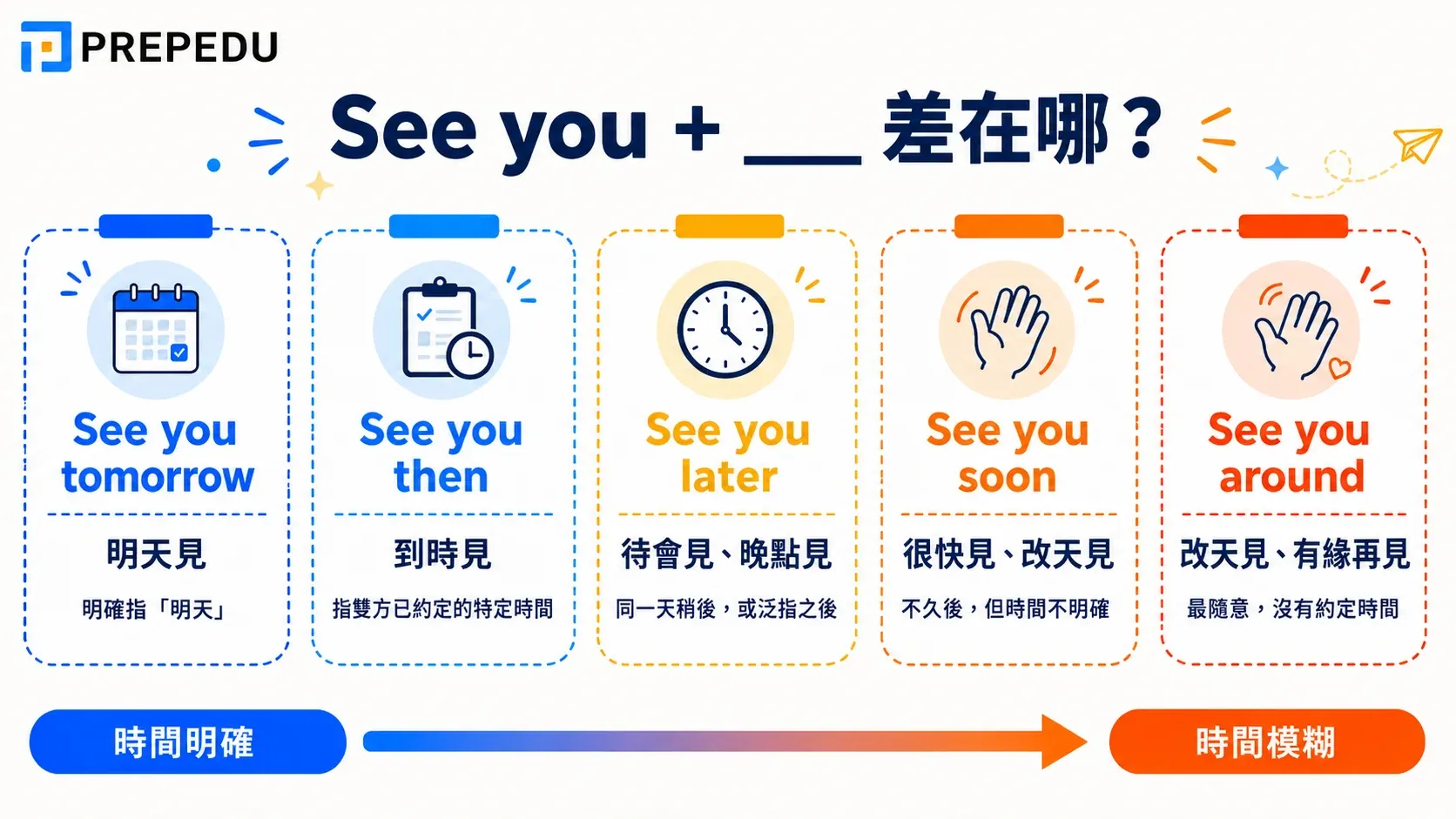
1. See you later
See you later 指「待會或改天再見」,沒有指定時間,而且不一定是今天。對照 tomorrow,later 是模糊的,tomorrow 則明確指「明天」。很多台灣學習者會以為 later 一定是「等一下、今天稍晚」,其實它也可以指未來某個沒講明的時間。在美式英語裡,See you later 幾乎像 bye 一樣,是非常日常的隨興道別。更多例句:
-
See you later!(待會見/回頭見!)
-
See you later, I've got class now.(待會見,我現在要上課。)
-
It was nice meeting you — see you later!(很高興認識你,改天見!)
2. See you then
See you then 用在「時間已經約好」的時候,then 指的就是那個約定好的時間點。語域中性偏正式。使用前提是雙方先前已經談定了時間(例如明天三點、週五)。對照 tomorrow,then 是用來代替重複講一次已經說過的時間,所以特別適合用在確認行程的場合。更多例句:
-
Tomorrow at 3? — Great, see you then!(明天三點?好,到時見!)
-
The meeting's set for Friday — see you then.(會議定在週五,到時見。)
-
Sure, 8 a.m. works. See you then.(好,早上八點可以,到時見。)
3. See you soon
See you soon 表示「很快會再見面」,帶有期待的語氣,但沒有明確說是哪一天。語感溫暖偏中性。soon 大約是接下來幾天到一兩週內,但並不固定。對照 tomorrow,當你還不確定是不是明天會見面時,用 soon 比較保險。它也很常用在 email 結尾,或和珍惜的人道別時。更多例句:
-
Take care, see you soon!(保重,很快再見!)
-
Thanks for visiting — see you soon!(謝謝你來,很快再見!)
-
I'll be in town next week, see you soon.(我下週會在城裡,很快見。)
4. See you around
See you around 是「有緣再見、到處都可能碰到」的超隨意說法,完全不約定任何時間。around 指的是在同一個範圍裡(同社區、同校、同公司)不約而遇。對照 tomorrow,around 剛好相反——它就是「不約」。語域很隨興,不適合用在正式場合或對客戶。美式英語裡很常見。更多例句:
-
Anyway, see you around!(總之,有緣再見!)
-
Nice chatting — see you around campus.(聊得很開心,校園見。)
-
See you around, take it easy!(再見啦,放輕鬆!)
III. 「明天見」常見的中式英文錯誤
「明天見」會講錯,多半不是因為單字量不夠,而是把中文的語序和邏輯整組搬進英文:中文「明天見」把時間放在前面,於是直譯成 Tomorrow see;或是選錯了動詞(用 meet 或 goodbye)。換句話說,錯誤的根源是語言干擾,而不是缺哪個字。下面四個典型錯誤,先看錯在哪、再看為什麼錯,最後給你正確說法。
-
❌ Tomorrow see 為什麼錯:這是照著中文「明天/見」的語序直譯。英文裡動詞 see 要放在前面,tomorrow 是英文時間副詞,習慣放在句尾。 ✅ 正確:See you tomorrow.
-
❌ Meet you tomorrow(當道別語用) 為什麼錯:meet 多指「初次認識」或「主動安排碰面」,不是日常道別用語;而且開頭少了主詞,聽起來很突兀。若真的是要約見面才用 I'll meet you tomorrow at…。 ✅ 正確:See you tomorrow.
-
❌ Goodbye tomorrow 為什麼錯:goodbye 後面接時間會變成「跟明天說再見」的怪邏輯,語意不對。goodbye 應該單獨使用。 ✅ 正確:Goodbye! See you tomorrow.
-
❌ See you tomorrow again 為什麼錯:again(再一次)是多餘的,因為 tomorrow 本身已經暗示「下一次見面」。除非真的要強調「明天又會再見一次」,否則不需要 again。 ✅ 正確:See you tomorrow.
IV. 別人說「See you tomorrow」英文要怎麼回?
很多人卡住,是因為以為「回話一定要講得不一樣」,但英文道別的原則其實是對等:對方說什麼,你回得幾乎一模一樣,反而最自然、最安全。想更有禮貌,就在對等回應前面加一句祝福。下面三種回法,從最簡單的對等回應,到加上祝福的禮貌版,依親疏與場合往上加。
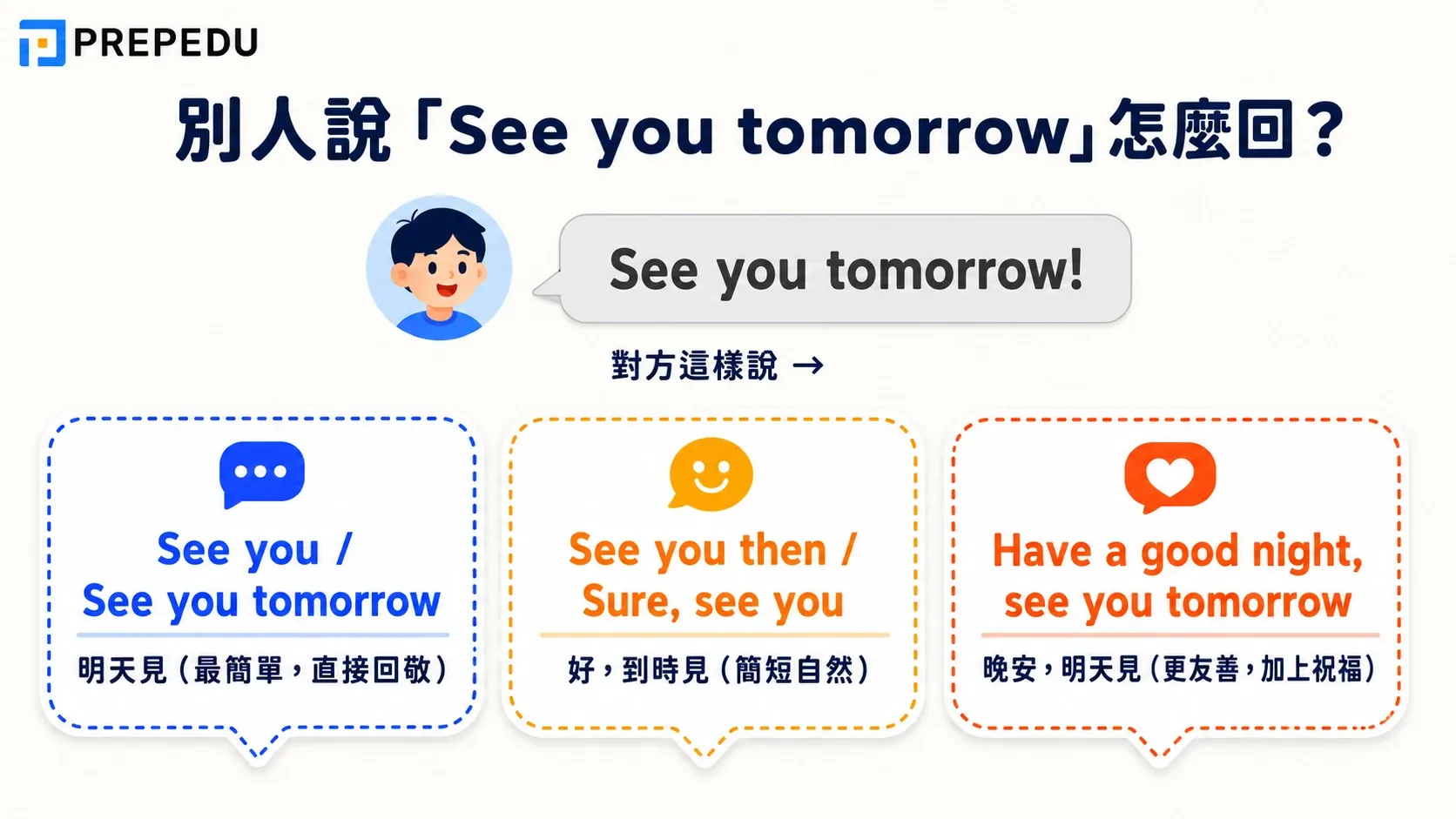
1. See you/See you tomorrow
最簡單安全的回法就是對等回應:See you 或 See you tomorrow。語域中性,對任何對象都適用。只回一句 See you 完全沒問題,並不會顯得失禮。想更親切一點,可以在後面加上對方的名字。更多例句:
-
See you tomorrow! — See you tomorrow!(明天見!明天見!)
-
See you tomorrow. — See you, Tom!(明天見。再見,Tom!)
-
See you tomorrow. — Yep, see you!(明天見。好,再見!)
2. See you then/Sure, see you
如果時間已經約好了,可以回 See you then 或 Sure, see you 來做確認。語域中性偏正式。then 指的就是先前談定的那個時間點(呼應前面 See you then 的用法);加上 Sure 則多了一層「沒問題、我同意」的確認語氣。更多例句:
-
See you tomorrow at 9. — Sure, see you then!(明天九點見。好,到時見!)
-
See you at the meeting tomorrow. — See you then.(明天會議見。到時見。)
-
See you tomorrow morning. — Sure, see you!(明早見。好,再見!)
3. Have a good night, see you tomorrow
想更有禮貌、更溫暖,可以在回應前加一句祝福:Have a good night, see you tomorrow。這是三種回法裡禮貌程度最高的,適合對同事、長輩或熟客使用。常見變體有 Have a good evening、Take care,都能放在 see you tomorrow 前面當作暖心的收尾。更多例句:
-
See you tomorrow. — Have a good night, see you tomorrow!(明天見。祝你有個美好的夜晚,明天見!)
-
See you tomorrow. — You too, take care — see you tomorrow!(明天見。你也是,保重,明天見!)
-
See you tomorrow. — Have a good evening, see you then!(明天見。祝你有個愉快的傍晚,到時見!)
V. 情境對話示範:3 種場合的明天見英文
單背句子還不夠,真正讓人卡住的,是在一整段道別裡「該對誰用哪一句」。其實同樣一句「明天見」,語域會隨對象改變:對同事偏正式中性,對鄰居中性,對好友就隨興。下面三段對話會照真實的收尾節奏(打招呼 → 詢問 → 回應 → 反應 → 鋪陳 → 結束)走一遍,讓你看到語域怎麼換。
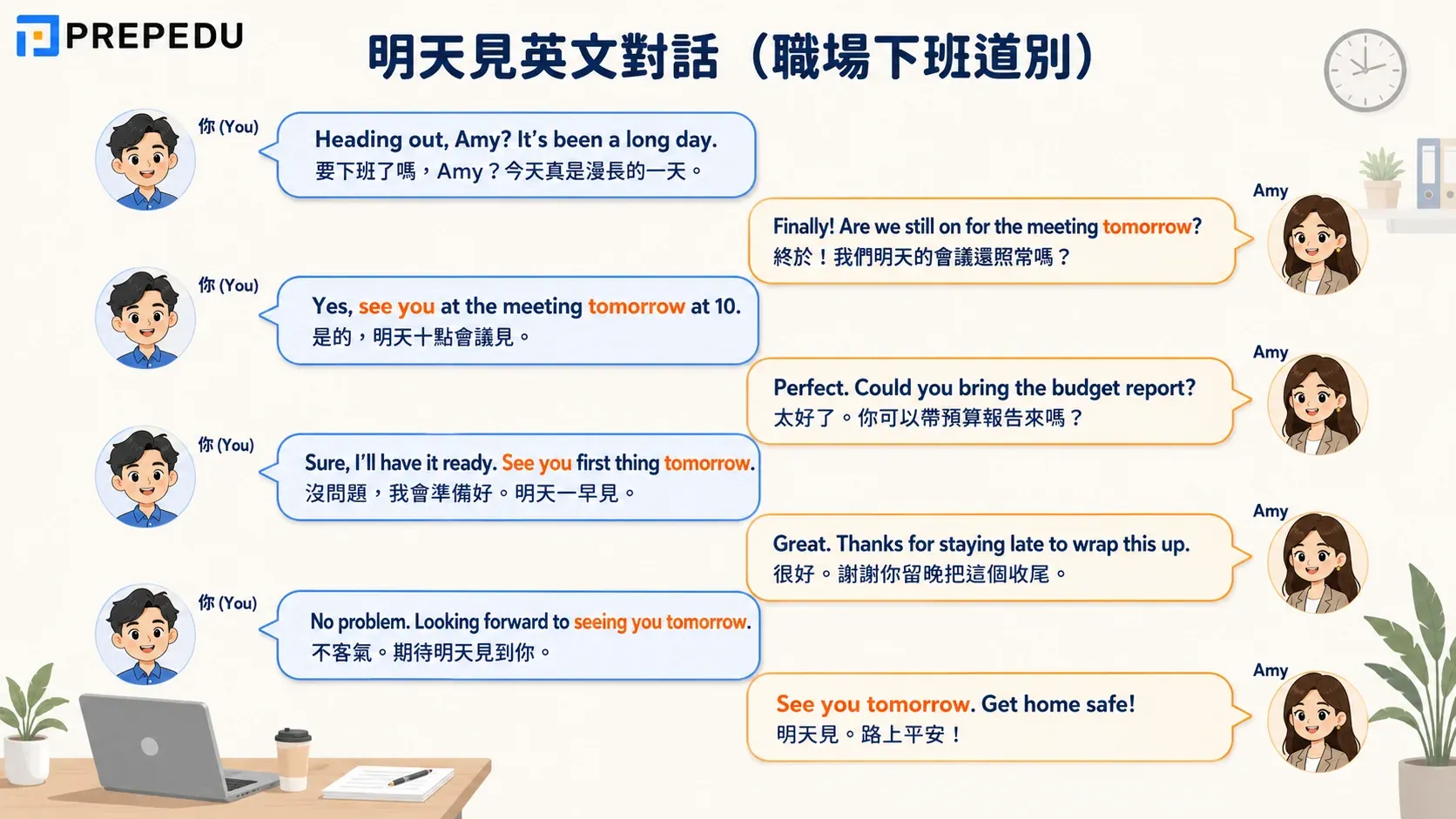
1. 職場場景:和同事下班道別(正式/中性)
|
角色 |
明天見英文對話 |
中文翻譯 |
|
你 (You) |
Heading out, Amy? It's been a long day. |
要下班了嗎,Amy?今天真是漫長的一天。 |
|
同事 Amy |
Finally! Are we still on for the meeting tomorrow? |
終於!我們明天的會議還照常嗎? |
|
你 (You) |
Yes, see you at the meeting tomorrow at 10. |
是的,明天十點會議見。 |
|
同事 Amy |
Perfect. Could you bring the budget report? |
太好了。你可以帶預算報告來嗎? |
|
你 (You) |
Sure, I'll have it ready. See you first thing tomorrow. |
沒問題,我會準備好。明天一早見。 |
|
同事 Amy |
Great. Thanks for staying late to wrap this up. |
很好。謝謝你留晚把這個收尾。 |
|
你 (You) |
No problem. Looking forward to seeing you tomorrow. |
不客氣。期待明天見到你。 |
|
同事 Amy |
See you tomorrow. Get home safe! |
明天見。路上平安! |
2. 鄰里場景:和鄰居/熟人道別(中性)
|
角色 |
明天見英文對話 |
中文翻譯 |
|
你 (You) |
Evening, Mr. Lin. Heading up? |
晚安,林先生。要上樓了嗎? |
|
鄰居 Mr. Lin |
Yes. Chilly tonight, isn't it? |
是啊。今晚有點冷,對吧? |
|
你 (You) |
It really is. They say it'll be clear tomorrow morning, though. |
真的。不過聽說明天早上會放晴。 |
|
鄰居 Mr. Lin |
Good. Are you putting the bins out early? |
那好。你明天會早點把垃圾拿出去嗎? |
|
你 (You) |
I will. See you in the morning then. |
會的。那明早見。 |
|
鄰居 Mr. Lin |
Sounds good. Have a restful night. |
好啊。祝你睡個好覺。 |
|
你 (You) |
You too, Mr. Lin. See you tomorrow! |
你也是,林先生。明天見! |
3. 朋友場景:和好友道別(隨興口語)
|
角色 |
明天見英文對話 |
中文翻譯 |
|
你 (You) |
That movie was awesome. I'm beat though, gotta head home. |
那部電影超讚。不過我累爆了,得回家了。 |
|
好友 Jay |
Same. Wanna grab brunch tomorrow before the game? |
我也是。明天比賽前要不要一起吃個早午餐? |
|
你 (You) |
For sure! Catch you tomorrow around eleven? |
當然!明天十一點左右見? |
|
好友 Jay |
Eleven works. I'll text you the spot. |
十一點可以。我再傳地點給你。 |
|
你 (You) |
Cool, talk to you tomorrow then. Don't oversleep, lazy! |
好,那明天再聊。別睡過頭啦,懶蟲! |
|
好友 Jay |
Ha, look who's talking. See ya tomorrow! |
哈,你還說我。明天見啦! |
|
你 (You) |
cu tmr! |
明天見! |
VI. 明天見英文常見問題(FAQ)
讀完前面,這裡把大家最後還會猶豫的幾個問題集中解答,每題都先給一句結論,方便快速查找。
1. See you tomorrow 可以用在正式場合嗎?
可以。See you tomorrow 屬於中性說法,正式場合也完全適用,不會顯得失禮。如果想再更正式、更有禮一點,可以改用 Looking forward to seeing you tomorrow,或在商務電話、會議後用 I'll speak to you tomorrow。換句話說,See you tomorrow 是安全底線,要往上加禮貌度只是換句話說而已。
2. 「明天早上見」英文怎麼說?
「明天早上見」可以說 See you tomorrow morning,或在傍晚、晚上道別時直接說 See you in the morning(這時不必加 tomorrow,對方就懂是指隔天早上)。要避免常見的介系詞錯誤:不要說 in tomorrow morning,tomorrow morning 前面不加 in。時間、地點的介系詞最容易混淆,想一次徹底搞懂,可以參考這篇 In On At 用法全解析,就不會再把 in/on/at 用錯。
3. Until tomorrow 跟 See you tomorrow 一樣嗎?
意思相近,但語氣不同。Until tomorrow(或 Till tomorrow)比較文言、帶點情感色彩,聽起來像「明天之前先這樣了」,常出現在書面或比較有戲劇感的語境。日常口語道別,還是以 See you tomorrow 最自然、最常用,不建議天天把 Until tomorrow 掛嘴邊。
4. 說 See you tomorrow 後面還要加 bye 嗎?
不一定。See you tomorrow 本身就已經是一句完整的道別,後面不必再加 bye。如果想顯得更親切、更口語,當然也可以說 Bye, see you tomorrow! 或 See you tomorrow, bye!,兩種都很自然,純粹看你想不想多加一層友善的收尾。想讓收尾更暖心,也可以在道別時順帶祝福對方,這篇祝平安健康英文怎麼說整理了不少自然又實用的祝福語。
結語
說穿了,把 See you tomorrow 當作核心,再依對象與情境換句話說,「明天見」就能講得自然又道地:和朋友隨興時用 See ya tomorrow、Catch you tomorrow,要講清楚時間用 tomorrow morning、at 9、first thing tomorrow,對客戶或長官正式一點用 Looking forward to seeing you tomorrow、I'll speak to you tomorrow,傳訊息給熟人則縮寫成 cu tmr。剩下的,就是在真實對話裡反覆開口,把這些說法練到脫口而出。
如果想把這些道別說法真正練成反射,最有效的方法是開口說、而且有人即時糾正你。PrepTalk English 線上英語會話 就是為日常溝通設計的課程,搭配 Teacher Bee AI 全天候陪練,你可以用 VSR 情境角色扮演自選場景——例如「下班和同事道別」或「和朋友約明天」——直接演練今天學到的每一句「明天見」,把它從看得懂變成講得出來。

你好!我叫黃秋賢,現在在 prepedu.com 擔任內容企劃。我有超過5年的英語與韓語自學經歷,親身備考 IELTS、TOEIC 與 TOPIK,累積了大量第一手的學習者視角——包括哪些語法規則最讓台灣與香港學習者混淆,以及如何在有限的備考時間內最有效地修正這些錯誤。目前已在 prepedu.com 撰寫超過 1000 篇英語學習文章,內容涵蓋語法、詞彙與考試策略,累積協助數千位學習者解決自學過程中的語法疑問。
評論












統一企業編號:202227322W
地址:114 LAVENDER STREET, #11-83 CT HUB 2, SINGAPORE (338729)