情人眼裡出西施英文怎麼說?8種最道地說法與例句整理
情人眼裡出西施英文怎麼說?這是許多學習者在翻譯中文諺語時最常遇到的難題之一。最道地的說法是 Beauty is in the eye of the beholder,意指美的標準完全取決於觀看者本身的感受,沒有客觀定論。這句話在英語世界流傳數百年,至今仍是表達「情人眼裡出西施」概念時最自然、最被廣泛認可的表達方式。
有個許多英文老師從未告訴你的事實:「Beauty is in the eye of the beholder」並非出自 Shakespeare,而是由愛爾蘭小說家 Margaret Wolfe Hungerford 於 1878 年小說《Molly Bawn》中定型,收錄於 Oxford Dictionary of Quotations。 然而,情人眼裡出西施英文的說法不只一種。根據語境的不同,英語使用者還會用 Love is blind、To each their own、One man's trash is another man's treasure 等表達,來傳遞相近卻又各有側重的含義。每一種說法背後,都隱含著英語文化對愛情、審美與個人偏好的獨特理解。掌握這些細微差異,才能在真實對話中開口就精準、自然。
PREPEDU 在這篇文章中,將依照以下三大核心脈絡幫你建立完整的使用地圖:八種最道地表達的語域與語感差異——從經典文學用語 Beauty is in the eye of the beholder 到口語 To each their own,一次看懂、四段真實對話示範——涵蓋朋友閒聊、同事話題、閨蜜深談與 IELTS 口說練習情境、常見問題解答——處理「Love is blind」與「Beauty is in the eye of the beholder」的差異、IELTS Speaking 實戰用法、以及這句諺語真正的歷史源頭。
讀完這篇文章後,你不只能在日常聊天中自然接話,更能在 IELTS Speaking Part 2「描述一個你欣賞的人」、TOEIC Speaking 跨文化情境題中,用地道諺語為答題增添文化深度與評分印象分。

I. 情人眼裡出西施英文怎麼說?最常見的基本說法
「情人眼裡出西施」是華語世界中最具詩意的愛情諺語之一,意指一個人在戀愛時,往往覺得對方無論如何都是最美麗、最完美的存在。這句話的核心概念是:美的標準因人而異,感情更能讓人用不同的眼光看待世界。英文裡有幾種自然道地的說法,可以精準傳遞這份含義,以下逐一說明。在逐一介紹前,先用一張比較表快速掌握八種說法的語域、語氣、核心意涵與 CEFR 等級差異:
|
情人眼裡出西施英文說法 |
語域 |
語氣 |
核心意涵 |
CEFR 建議 |
最佳使用時機 |
|
Beauty is in the eye of the beholder |
正式/半正式 |
文雅 |
美完全取決於觀者的主觀 |
B2 |
討論審美、回應外貌評論 |
|
Love is blind |
口語/文學 |
浪漫帶幽默 |
愛情讓人忽略缺點 |
B1 |
談論戀愛盲區、忽視缺點 |
|
One man's trash is another man's treasure |
口語 |
輕鬆玩笑 |
別人眼中平凡,你視如珍寶 |
B2 |
強調偏好落差 |
|
Beauty lies in the eyes of the beholder |
書面/正式 |
文學感 |
同 Beauty is in... 但更文雅 |
C1 |
寫作、演講、正式對話 |
|
Everyone has their own taste |
口語 |
隨和 |
每個人都有自己的品味 |
A2 |
日常聊天、為選擇辯護 |
|
To each their own |
口語 |
中立尊重 |
各有所好,尊重差異 |
B1 |
結束討論、表達包容 |
|
Different people have different preferences |
中性/教學 |
清晰直白 |
不同的人偏好不同 |
A2 |
跨文化溝通、解釋場景 |
|
He/She may not be your type, but... |
口語 |
委婉轉折 |
承認差異後強調個人特別 |
B1 |
為別人的選擇辯護 |
這張表可以當作隨時查閱的語感地圖。接著,PREPEDU 帶你逐項深入。
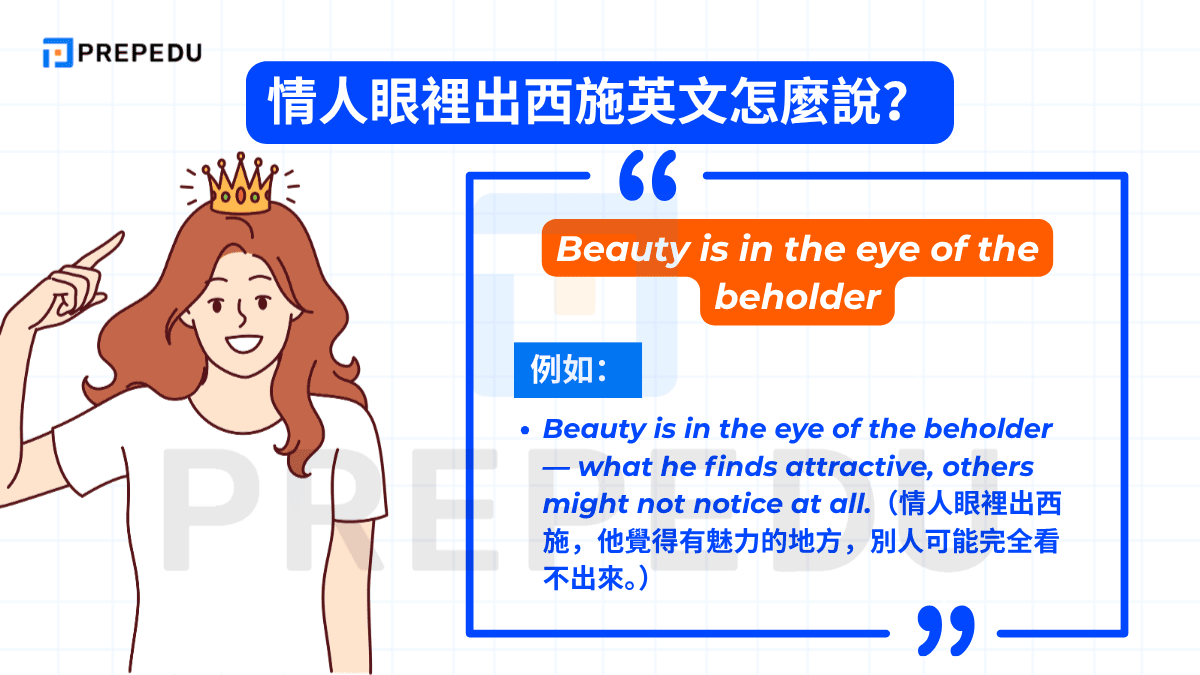
1. Beauty is in the eye of the beholder
Beauty is in the eye of the beholder 是「情人眼裡出西施英文」最經典、最廣為人知的對應說法。字面上的意思是「美存在於觀看者的眼中」,強調對美的感受完全取決於個人主觀判斷,沒有絕對的標準。這個表達方式適用於討論審美觀、品味差異,或在輕鬆對話中回應別人對外貌的看法。
根據 Oxford Dictionary of Quotations,這句諺語的現代定型出自愛爾蘭小說家 Margaret Wolfe Hungerford(筆名 The Duchess)於 1878 年出版的小說《Molly Bawn》,原文為 Beauty is in the eye of the beholder。更早之前,類似概念可追溯至古希臘詩人 Theocritus(約公元前 3 世紀)以及 Shakespeare 的劇作——但完整句型是 1878 年才定型的。許多英文老師誤認為出自 Shakespeare,這是常見的引用錯誤,PREPEDU 特別提醒你在學術寫作或 IELTS Writing 中要正確引用。例句:
-
Beauty is in the eye of the beholder — what he finds attractive, others might not notice at all.(情人眼裡出西施,他覺得有魅力的地方,別人可能完全看不出來。)
-
I know she's not everyone's type, but beauty is in the eye of the beholder.(我知道她不是每個人的菜,但情人眼裡出西施。)
-
Don't judge his taste. Beauty is in the eye of the beholder.(別評論他的品味。美是因人而異的。)
2. Love is blind
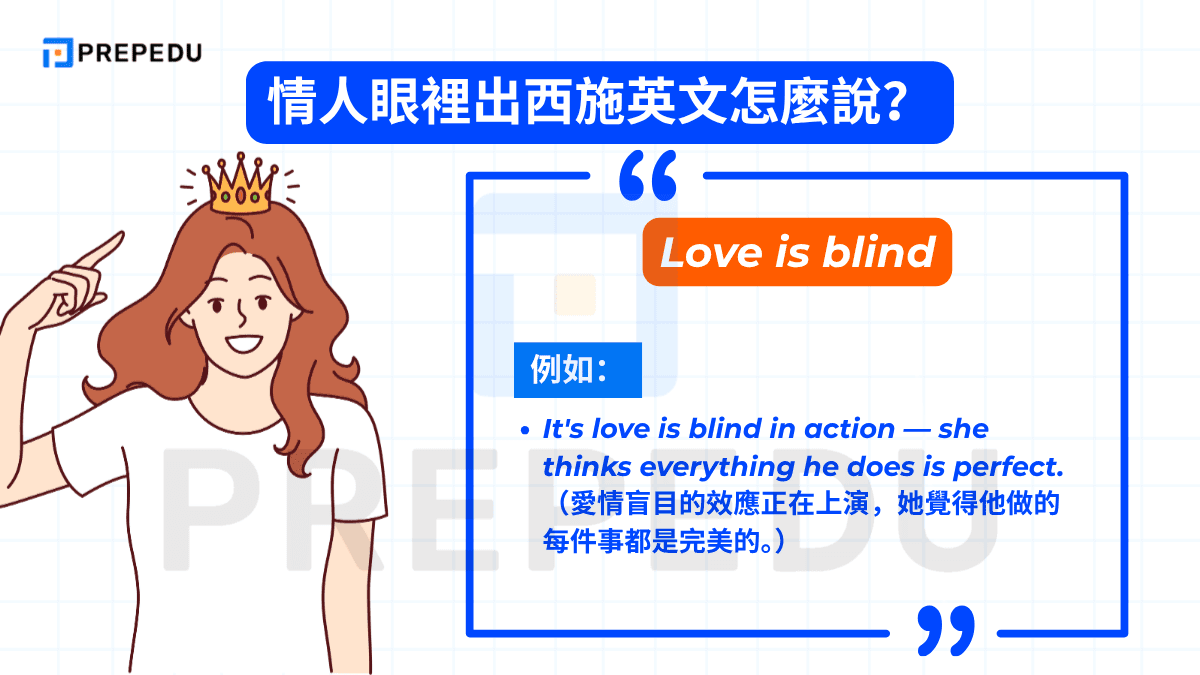
Love is blind 強調的是愛情讓人看不見對方的缺點,帶有輕微的浪漫色彩,甚至帶點幽默的語氣。它不只談審美,更著重於感情中人們對缺點的包容與忽視。日常對話、文學作品及電影中都常出現這個表達。
這句話真正的文學源頭,是 Shakespeare 1596 年劇作《威尼斯商人》(The Merchant of Venice)第二幕第六場——Jessica 說:But love is blind, and lovers cannot see the pretty follies that themselves commit.(但愛情是盲目的,戀人們看不見自己所做的那些可愛的愚行。)PREPEDU 提醒:當你需要在 IELTS Speaking Part 2 或 TOEIC Speaking 中加入文學引用時,Love is blind 是少數可直接引用 Shakespeare 的英文慣用語之一——這個語言深度能立即提升 Lexical Resource 評分。例句:
-
They say love is blind, and I believe it — she adores him no matter what.(都說愛情是盲目的,我相信這句話,她無論如何都崇拜著他。)
-
Love is blind. That's why he never notices her flaws.(愛情是盲目的,所以他從來不在乎她的缺點。)
-
It's love is blind in action — she thinks everything he does is perfect.(愛情盲目的效應正在上演,她覺得他做的每件事都是完美的。)
3. One man's trash is another man's treasure
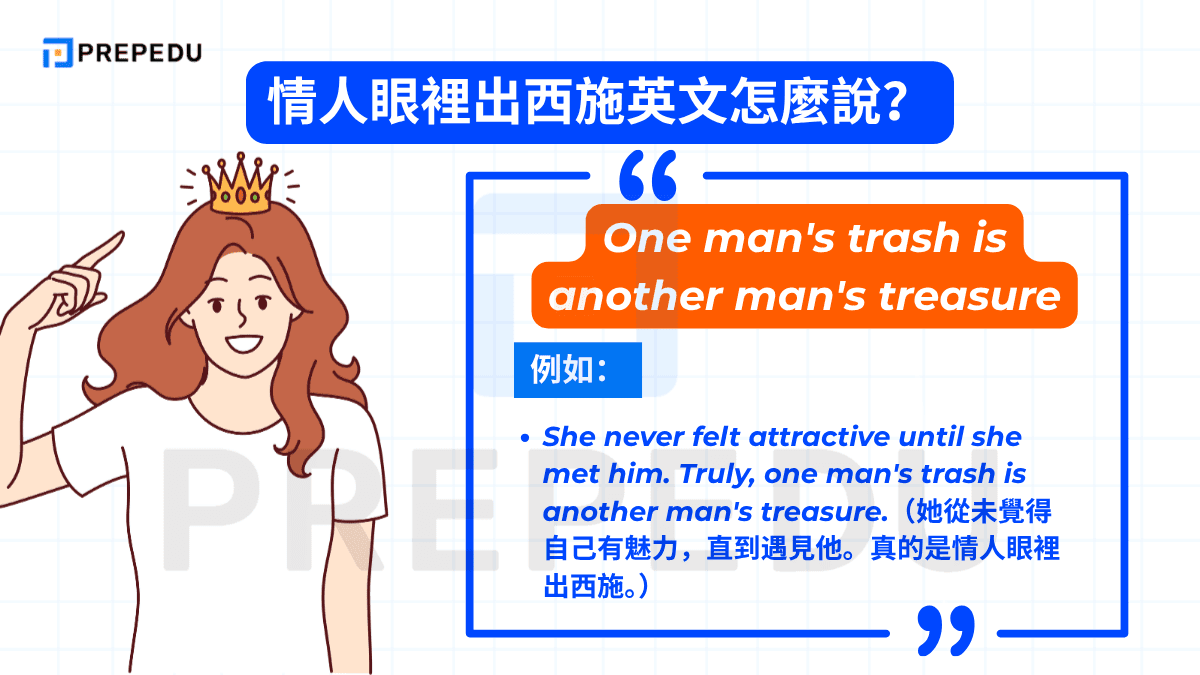
One man's trash is another man's treasure 的字面意思是「一個人的垃圾,是另一個人的寶藏」,延伸到感情與審美上,表達的是:別人不欣賞的,你可能視若珍寶。語氣偏口語,常用在輕鬆、甚至帶點玩笑的情境中,表達每個人的偏好截然不同。
這個諺語其實廣泛用於各種偏好差異,不限於感情——跳蚤市場、二手書店(例如台北誠品二手書店或香港中環舊書攤)都常聽到。在感情語境中使用時帶有一絲自嘲的幽默感,所以用在閨蜜之間沒問題,但不適合當面對當事人說——那會顯得不尊重。例句:
-
One man's trash is another man's treasure — he left her, but now someone else cherishes her deeply.(一個人的垃圾是另一個人的寶藏,他離開了她,但現在有人把她當寶貝。)
-
You might not like that style, but one man's trash is another man's treasure.(你可能不喜歡那種風格,但蘿蔔白菜各有所愛。)
-
She never felt attractive until she met him. Truly, one man's trash is another man's treasure.(她從未覺得自己有魅力,直到遇見他。真的是情人眼裡出西施。)
4. Beauty lies in the eyes of the beholder
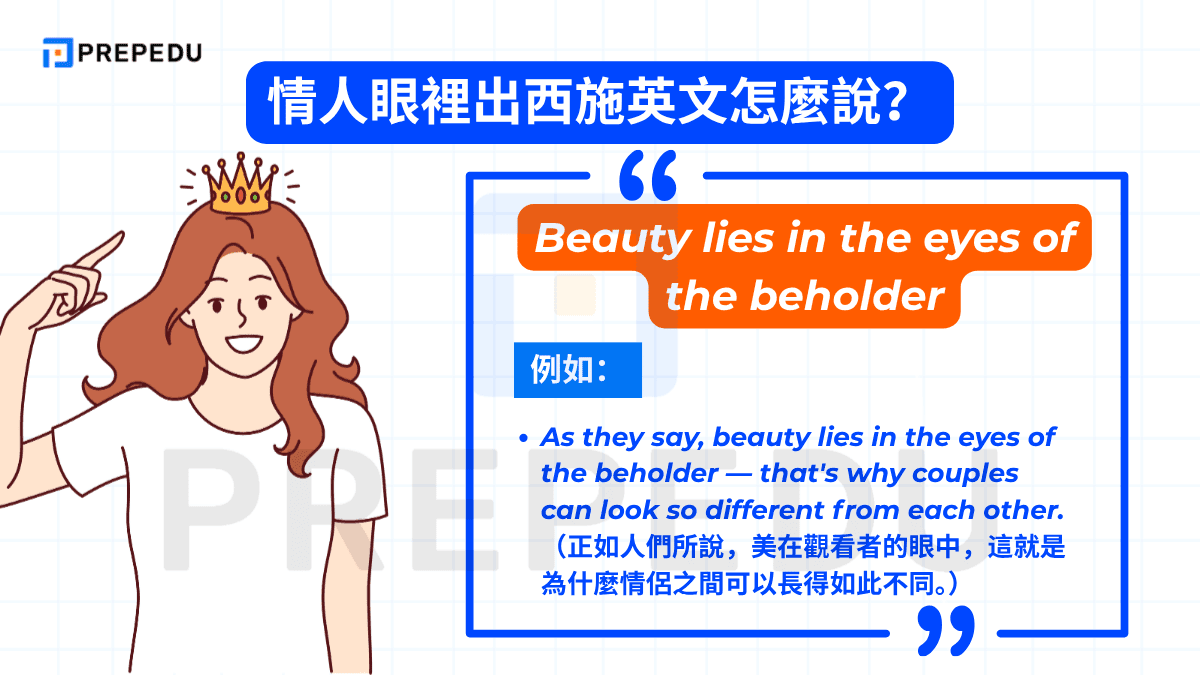
這是「Beauty is in the eye of the beholder」的另一種表達形式,語感更文雅,帶有書面語的氣質。兩者含義幾乎相同,但這個版本更常出現在寫作、演講或較正式的對話場合中。使用上可以視情境自由替換。
關鍵差異在英文動詞:is(原版)偏靜態陳述,lies(變體)偏動態隱喻——後者暗示「美就存放於」觀者眼中,帶有更深的文學意象。這個微妙差異在 IELTS Writing Task 2 或學術文章中特別有用:用 lies 版本能讓句子顯得更 sophisticated。例句:
-
Beauty lies in the eyes of the beholder, so never let others define your standard of attractiveness.(美在觀看者的眼中,所以永遠不要讓別人來定義你的審美標準。)
-
As they say, beauty lies in the eyes of the beholder — that's why couples can look so different from each other.(正如人們所說,美在觀看者的眼中,這就是為什麼情侶之間可以長得如此不同。)
-
Beauty lies in the eyes of the beholder, and she has always seen him as the most handsome man in the room.(美在觀看者的眼中,而她始終覺得他是房間裡最帥的男人。)
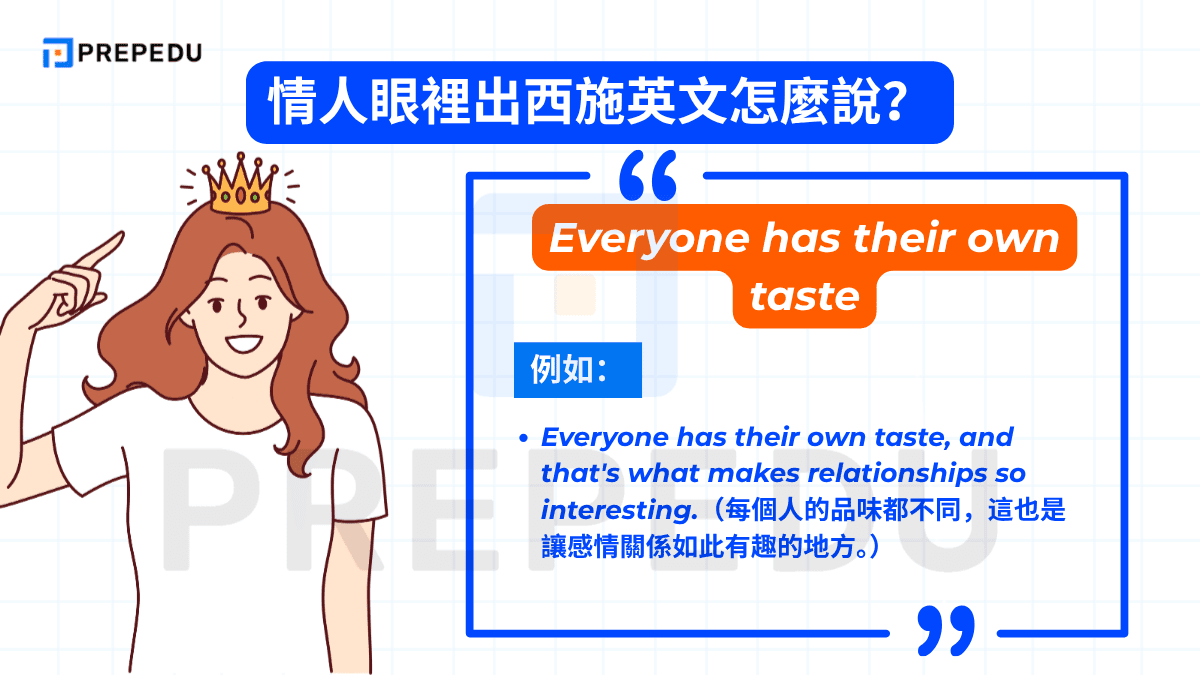
5. Everyone has their own taste
Everyone has their own taste 更加日常、口語,直接表達「每個人都有自己的品味」。相較於前面幾個表達,它的語氣更輕鬆自然,適合用在隨意聊天、討論偏好差異或為某人的選擇辯護時。例句:
-
Everyone has their own taste — she loves his quirky sense of humor, even if others don't get it.(每個人的品味不同,她喜歡他古怪的幽默感,即使別人不懂。)
-
Don't question her choice. Everyone has their own taste.(別質疑她的選擇,蘿蔔白菜各有所愛。)
-
Everyone has their own taste, and that's what makes relationships so interesting.(每個人的品味都不同,這也是讓感情關係如此有趣的地方。)
6. To each their own
To each their own 是英語中最簡練的表達之一,意思是「各有所好」或「術業有專攻,品味各不同」。它語氣中立,帶有尊重他人選擇的態度,常用於不想多加評論、表示理解和包容時。在對話中,這句話往往以一種點到為止的方式結束討論。
這個說法源自拉丁諺語 Suum cuique(各取所需),經歷千年演變進入英語。現代用法中,To each their own 其實是性別中立版本——傳統寫法是 To each his own,但近十年母語者普遍改用 their 以涵蓋所有性別。PREPEDU 建議你在口說與寫作中一律使用 To each their own——這既自然又符合當代英語使用習慣,是少數值得主動記憶的「進化型」表達。例句:
-
He's not my type, but to each their own.(他不是我的菜,但情人眼裡出西施,各有所好。)
-
To each their own — I don't understand the attraction, but I'm happy for them.(各有所好,我不懂那種吸引力,但我為他們感到高興。)
-
She asked why he likes her so much. He just smiled and said, "To each their own."(她問他為什麼那麼喜歡她,他只是微笑說:「蘿蔔白菜各有所好。」)

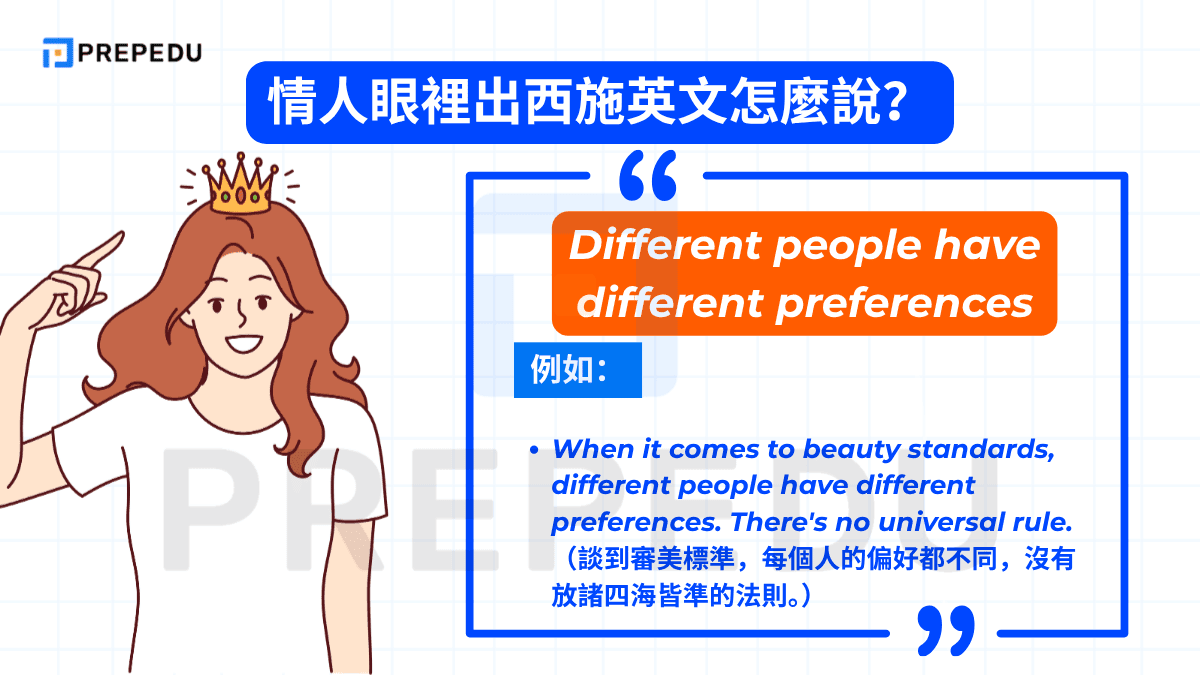
7. Different people have different preferences
這個說法是最直白、最易懂的表達方式,意思是「不同的人有不同的偏好」。雖然少了一些詩意,但清晰度極高,適合在解釋或說明時使用,尤其是在跨文化溝通或需要讓對方立即理解含義的場合。例句:
-
Different people have different preferences, and that's completely normal when it comes to attraction.(不同的人有不同的偏好,在吸引力這件事上,這是完全正常的。)
-
Don't be surprised that they make such a good couple — different people have different preferences.(不要對他們成為好情侶感到驚訝,情人眼裡出西施嘛。)
-
When it comes to beauty standards, different people have different preferences. There's no universal rule.(談到審美標準,每個人的偏好都不同,沒有放諸四海皆準的法則。)
8. He/ she may not be your type, but...
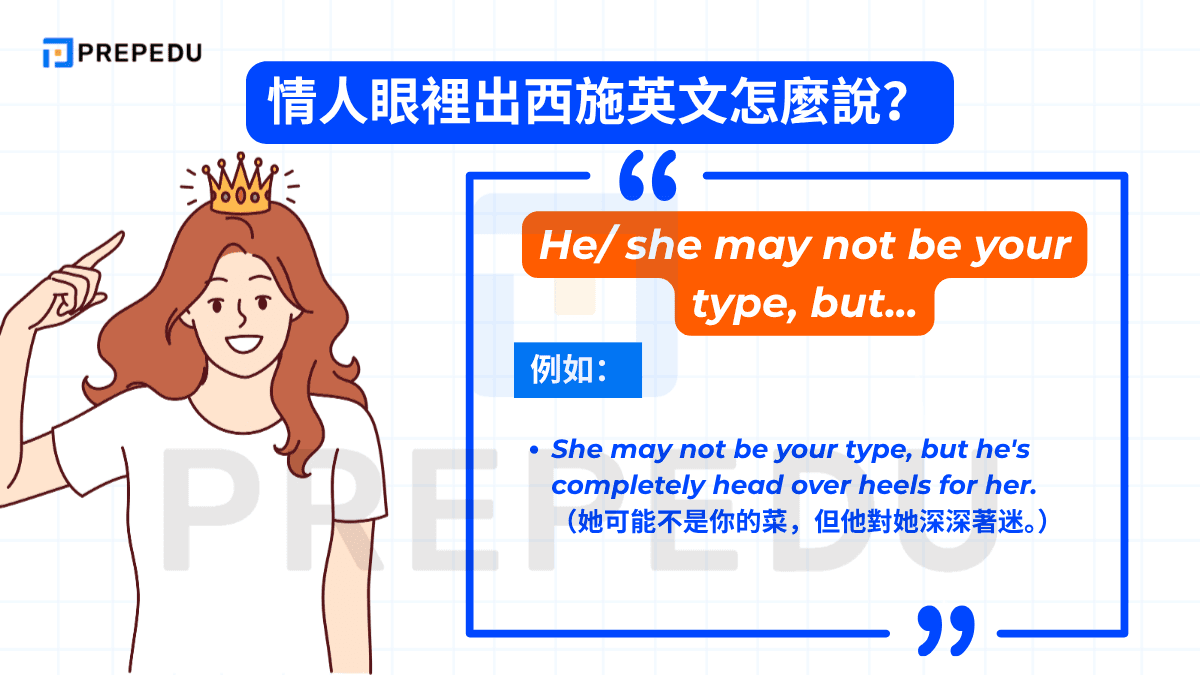
He/ she may not be your type, but… 是一個實用的「轉折句型」,前半部分承認某人可能不符合大眾或對方的審美偏好,後半部分則引出真正重要的觀點,通常是強調對方在某個人眼中的特別之處。這個句型語氣委婉,在日常對話中非常自然。例句:
-
She may not be your type, but he's completely head over heels for her.(她可能不是你的菜,但他對她深深著迷。)
-
He may not be your type, but she finds him absolutely wonderful.(他可能不符合你的審美,但她覺得他完全棒透了。)
-
They may not be your type, but beauty is in the eye of the beholder — and they're clearly perfect for each other.(他們可能不是你的理想型,但情人眼裡出西施,他們顯然非常適合彼此。)
II. 情人眼裡出西施英文對話
以下提供三段自然的英文對話,幫助你在實際情境中靈活運用這些表達方式,每段對話後附有完整中文翻譯。
1. 對話一:朋友之間討論約會對象
|
情人眼裡出西施英文對話 |
中文翻譯 |
|
|
2. 對話二:同事之間聊起明星的外貌話題
|
情人眼裡出西施英文對話 |
中文翻譯 |
|
|
3. 對話三:閨蜜之間討論感情選擇
|
情人眼裡出西施英文對話 |
中文翻譯 |
|
|
4. 對話四:IELTS Speaking Part 2 練習情境
|
情人眼裡出西施英文對話 |
中文翻譯 |
|
|
III. 情人眼裡出西施英文常見問題 FAQ
1. Beauty is in the eye of the beholder 和 Love is blind 有什麼差別?哪一個更貼近「情人眼裡出西施」?
這兩句諺語雖然都涉及「主觀感受」,但核心側重完全不同。Beauty is in the eye of the beholder 強調的是「審美的主觀性」——美的標準因人而異,不一定與愛情有關;它可以用於藝術、建築、設計等任何審美語境。而 Love is blind 則專指「愛情中的盲點」——愛情讓人看不見對方的缺點,帶有浪漫與幽默色彩。從語意貼近度來看,Beauty is in the eye of the beholder 更接近「情人眼裡出西施」的核心意涵,因為中文原典強調的是「戀愛中看到的美麗」,不一定涉及忽略缺點;而 Love is blind 則更貼近「愛情使人盲目」的延伸概念。
PREPEDU 建議:在正式討論審美主觀性時選前者,在談論戀愛中的包容心態時選後者——兩者搭配使用,能展現更細膩的語感層次。
2. 在 IELTS 或 TOEIC 口說中使用這些諺語,會加分還是扣分?要注意什麼?
使用諺語在 IELTS Speaking 與 TOEIC Speaking 中通常能加分,但有三個前提條件。
-
第一、使用必須自然——若是硬塞入話題不相關的諺語,考官會判定為「背誦痕跡」,反而扣 Lexical Resource 分數。
-
第二、發音與重音必須正確——例如 beholder 的重音落在第二音節 /bɪˈhəʊldə/,許多台灣與香港考生會誤念成第一音節。
-
第三、使用頻率要適度——整個 Speaking 測驗中用 1–2 個諺語為佳,不要在每題答案都塞入。
PREPEDU 實戰建議:Beauty is in the eye of the beholder 最適合 IELTS Speaking Part 2 描述人物題;To each their own 最適合 IELTS Speaking Part 3 討論偏好題;Love is blind 若要引用,請搭配 As Shakespeare said in The Merchant of Venice... 以展現文學知識深度。
3.「Beauty is in the eye of the beholder」真的是 Shakespeare 說的嗎?這句諺語的真正源頭是誰?
不是。這是一個流傳最廣的引用錯誤。根據 Oxford Dictionary of Quotations 與 Phrase Finder 資料庫考證,這句諺語的現代完整句型定型於 1878 年,出自愛爾蘭小說家 Margaret Wolfe Hungerford(筆名 The Duchess)的小說《Molly Bawn》。更早可追溯的類似概念來自古希臘詩人 Theocritus(約公元前 3 世紀),他在田園詩中表達過相近的美學相對主義觀點;18 世紀蘇格蘭小說家 David Hume 與 19 世紀初 Margaret Hungerford 的同時代作家都用過類似表述。Shakespeare 確實寫過 Love is blind(《威尼斯商人》1596)以及 "Beauty's a flower"(《第十二夜》),但並未寫過 "Beauty is in the eye of the beholder" 這句話的完整版本。這個區分在學術寫作與 IELTS Writing Task 2 引用時特別關鍵——寫錯來源會被判為「factual inaccuracy」。PREPEDU 建議你記住這個簡單版本:諺語本身出自 Hungerford (1878),概念可追溯至 Theocritus 公元前 3 世紀。
結論
「情人眼裡出西施英文」從來不是一道單選題,而是一組反映英語文化中愛情、審美與個人偏好觀點的表達集合。從最經典的 Beauty is in the eye of the beholder、最文學的 Love is blind(出自 Shakespeare 的《威尼斯商人》)、到最口語的 To each their own——每一句諺語都承載著不同的情感厚度與使用語境。英文表達的細膩度,正是從理解這些層次開始的。
這八種說法可以沿三條主軸分類:情感軸(強烈浪漫 → 中立尊重 → 輕鬆幽默)、語域軸(文學書面 → 半正式 → 日常口語)、以及情境軸(辯護選擇 → 討論審美 → 解釋偏好 → 結束話題)。透過四段對話情境——從台北信義區咖啡廳閒聊、捷運大安站辦公室話題、香港中環閨蜜聚會,到 IELTS Speaking Part 2 模擬——你看到這些諺語如何在不同文化場域中展現不同的語言質地。FAQ 進一步幫你釐清 Beauty is in the eye of the beholder 與 Love is blind 的核心差異、考試實戰策略,以及這句諺語真正的歷史源頭(Margaret Wolfe Hungerford, 1878,而非 Shakespeare)。
下一步,PREPEDU 邀請你從本週開始進行兩個具體練習:一、選擇三個最貼合你生活情境的表達(例如 Beauty is in the eye of the beholder、Love is blind、To each their own),在本週的英文對話、訊息或社群貼文中各使用兩次,建立語感反射;二、若你正在準備 IELTS 或 TOEIC 口說,把這三句納入你的「人物描述」與「偏好討論」答題素材庫,並練習自然融入而非背誦。當你能在咖啡廳、辦公室、甚至考場中脫口而出一句「Well, beauty is in the eye of the beholder」時——那句中文諺語的詩意,就真正成為你英文思維的一部分。搭配 PREPEDU 的系統化英文學習資源,你可以在更多文化情境中找到恰如其分的那一句話。

你好!我叫黃秋賢,現在在 prepedu.com 擔任內容企劃。我有超過5年的英語與韓語自學經歷,親身備考 IELTS、TOEIC 與 TOPIK,累積了大量第一手的學習者視角——包括哪些語法規則最讓台灣與香港學習者混淆,以及如何在有限的備考時間內最有效地修正這些錯誤。目前已在 prepedu.com 撰寫超過 1000 篇英語學習文章,內容涵蓋語法、詞彙與考試策略,累積協助數千位學習者解決自學過程中的語法疑問。
評論











統一企業編號:202227322W
地址:114 LAVENDER STREET, #11-83 CT HUB 2, SINGAPORE (338729)