To V และ V-ing ต่างกันอย่างไร? คู่มือเลือกใช้ให้ถูกในทุกประโยคสำหรับผู้เรียน IELTS
ในข้อสอบ IELTS Writing Task 2 หนึ่งในจุดที่ Preppies ไทยถูกตัดคะแนน Grammatical Range and Accuracy บ่อยที่สุดคือการเลือกใช้ระหว่าง "to do" กับ "doing" ผิดตัว เพราะภาษาไทยไม่มีโครงสร้างเทียบเท่าให้รู้สึกได้โดยอัตโนมัติ — เรียนรู้ tense รวมหลายเดือนแต่ใช้ "I enjoy to read" แทน "I enjoy reading" ก็ยังถูกตัดคะแนน
To V และ V-ing คือสองรูปแบบของกริยาที่ทำหน้าที่เป็นคำนามหรือขยายความในประโยค To V (To Infinitive) ประกอบด้วย to + verb รูปฐาน มักบอกถึงเป้าหมายหรืออนาคต ส่วน V-ing (Gerund) คือ verb + -ing ทำหน้าที่เป็นคำนาม มักบอกถึงประสบการณ์ที่เกิดขึ้นจริงหรือกิจกรรม การเลือกผิดเปลี่ยนความหมายของประโยคได้ทั้งหมด เช่น "stopped to smoke" (หยุดเพื่อสูบบุหรี่) ≠ "stopped smoking" (เลิกสูบบุหรี่)
ความสับสนระหว่างสองรูปนี้ไม่ได้เกิดจากความขี้เกียจ แต่เกิดจาก 3 สาเหตุ คือกริยาบางตัวรับเฉพาะ To V บางตัวรับเฉพาะ V-ing บางตัวรับได้ทั้งสองโดยความหมายไม่เปลี่ยน และบางตัวเปลี่ยนความหมายเมื่อเปลี่ยนรูป การจำเป็นกลุ่มจะเร็วกว่าการท่องทีละกริยาหลายเท่า
บทความนี้รวบรวม กริยา 33 ตัว แบ่ง 4 กลุ่มหลัก ตาม Cambridge English Grammar in Use พร้อมตัวอย่างขั้นต่ำ 2 ประโยคต่อกริยา ครอบคลุม 10 ส่วน: นิยาม, กฎการสะกด -ing, 4 กลุ่มกริยา, หลังบุพบท, โครงสร้างพิเศษ, ข้อผิดพลาดที่ Preppies ไทยมักทำ, แบบฝึกหัด 3 ชุดพร้อมเฉลย และ FAQ มาเริ่มถอดรหัส To V กับ V-ing กันเลย!
I. To V และ V-ing คืออะไร?
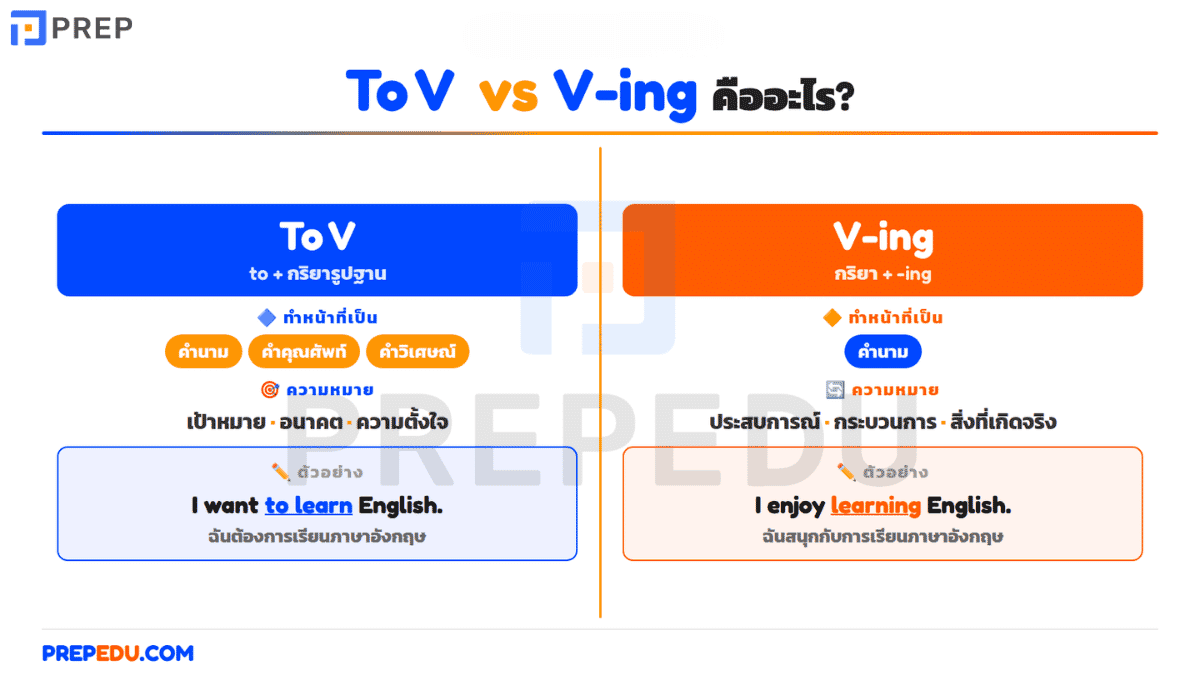
To V (To Infinitive) และ V-ing (Gerund) คือสองรูปแบบที่กริยาเปลี่ยนตัวเองให้ทำหน้าที่เป็นคำนามหรือส่วนขยายในประโยค To V ประกอบด้วย to + verb รูปฐาน มักบอกถึงเป้าหมายหรือเหตุการณ์ในอนาคต ส่วน V-ing คือ verb + -ing ทำหน้าที่เหมือนคำนาม มักบอกถึงกิจกรรมหรือประสบการณ์ ทั้งสองรูปไม่ใช่กาล (tense) แต่เป็น verb form (อ้างอิง: Cambridge English Grammar)
ความแตกต่างหลักอยู่ที่มุมมองเวลาและความหมายแฝง To V มอง verb เป็น "ความตั้งใจ" หรือ "เป้าหมาย" ที่ยังไม่ได้เกิด ส่วน V-ing มอง verb เป็น "กระบวนการ" หรือ "ประสบการณ์" ที่กำลังเกิดหรือเกิดขึ้นแล้ว
|
รูปแบบ |
โครงสร้าง |
หน้าที่ |
มุมมองเวลา |
ตัวอย่าง |
|
To V |
to + verb รูปฐาน |
คำนาม, คำคุณศัพท์, คำกริยาวิเศษณ์ |
เป้าหมาย, อนาคต, ความตั้งใจ |
I want to learn English. |
|
V-ing |
verb + -ing |
คำนาม |
ประสบการณ์, กระบวนการ, สิ่งที่เกิดจริง |
I enjoy learning English. |
-
ตัวอย่าง To V: to go (ไป), to eat (กิน), to study (เรียน), to work (ทำงาน)
- ตัวอย่าง V-ing: going (การไป), eating (การกิน), studying (การเรียน), working (การทำงาน)
II. กริยาที่ตามด้วย To V
กริยาที่ตามด้วย To V คือกริยาที่แสดงเจตนา ความต้องการ หรือเป้าหมายในอนาคต กริยากลุ่มนี้รับ to + verb รูปฐานโดยไม่มีตัวเลือกอื่น — ใช้ V-ing แทนผิดทันที
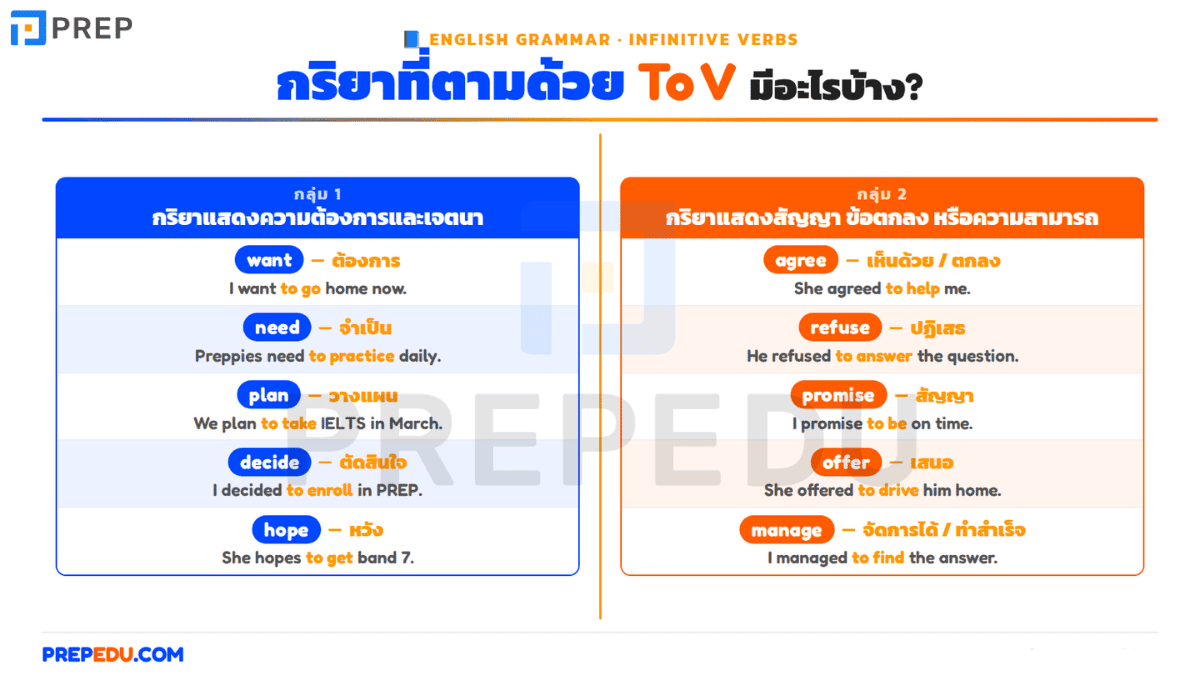
1. กลุ่ม 1: กริยาแสดงความต้องการและเจตนา
|
กริยา |
ความหมาย |
ตัวอย่าง (2 ประโยค) |
|
want |
ต้องการ |
I want to go home now. / She wants to learn Chinese. |
|
need |
จำเป็น |
She needs to study harder. / Preppies need to practice daily. |
|
plan |
วางแผน |
They plan to visit Bangkok. / We plan to take IELTS in March. |
|
decide |
ตัดสินใจ |
He decided to quit his job. / I decided to enroll in PREP. |
|
hope |
หวัง |
We hope to win the contest. / She hopes to get band 7. |
|
expect |
คาดหวัง |
I expect to pass the exam. / They expect to arrive at 8 PM. |
2. กลุ่ม 2: กริยาแสดงสัญญา ข้อตกลง หรือความสามารถ
|
กริยา |
ความหมาย |
ตัวอย่าง (2 ประโยค) |
|
agree |
เห็นด้วย |
She agreed to help me. / They agreed to meet at the cafe. |
|
refuse |
ปฏิเสธ |
He refused to answer the question. / The boy refused to eat vegetables. |
|
promise |
สัญญา |
I promise to be on time. / He promised to call her back. |
|
offer |
เสนอ |
She offered to drive him home. / The company offered to refund the money. |
|
manage |
จัดการได้, ทำสำเร็จ |
He managed to finish the report. / I managed to find the answer. |
|
afford |
มีกำลังจ่าย |
Can you afford to buy that car? / We can't afford to waste time. |
|
learn |
เรียนรู้ |
They learned to swim last summer. / She learned to drive at 25. |
|
prepare |
เตรียม |
We prepare to leave at dawn. / He prepares to give a speech. |
III. กริยาที่ตามด้วย V-ing
กริยาที่ตามด้วย V-ing คือกริยาที่บอกความรู้สึก ประสบการณ์ หรือกิจกรรมที่เกิดขึ้นจริง กริยากลุ่มนี้รับ verb + -ing เท่านั้น — ใช้ To V แทนถูกตัดคะแนนทันที
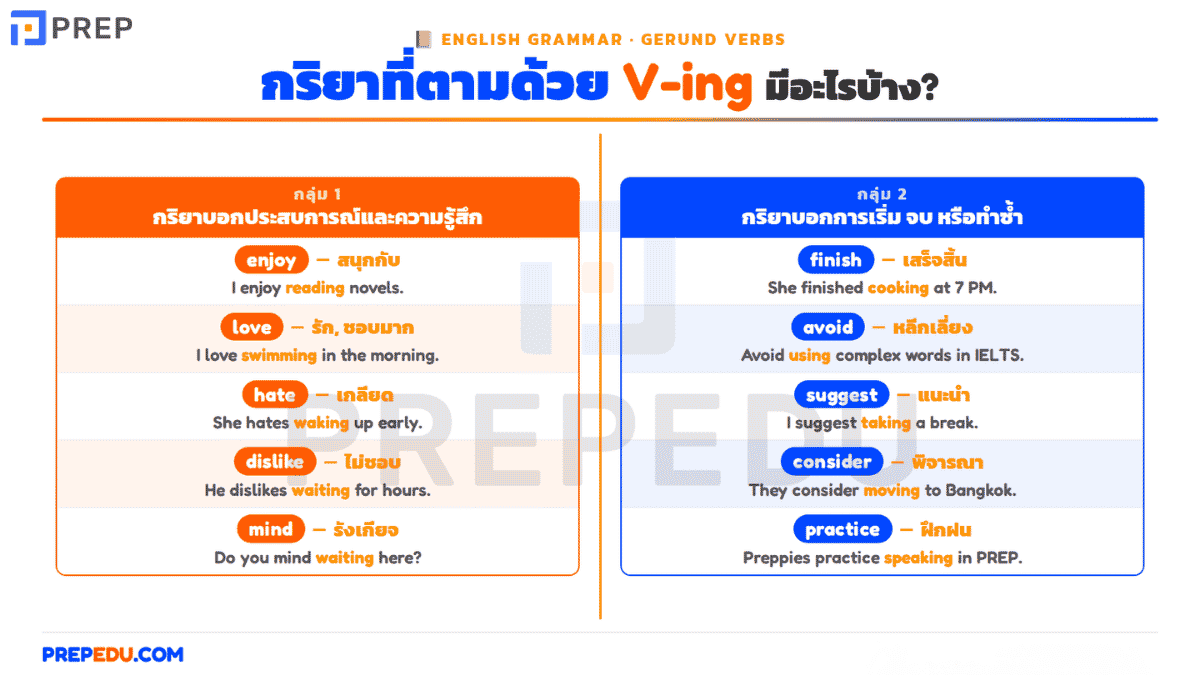
1. กลุ่ม 1: กริยาบอกประสบการณ์และความรู้สึก
|
กริยา |
ความหมาย |
ตัวอย่าง (2 ประโยค) |
|
enjoy |
สนุกกับ |
I enjoy reading novels. / She enjoys traveling in Thailand. |
|
love |
รัก, ชอบมาก |
I love swimming in the morning. / He loves playing football. |
|
hate |
เกลียด |
She hates waking up early. / I hate waiting in lines. |
|
dislike |
ไม่ชอบ |
He dislikes waiting for hours. / She dislikes eating alone. |
|
mind |
รังเกียจ |
Do you mind waiting here? / I don't mind helping you. |
|
miss |
คิดถึง |
I miss seeing my family. / She misses walking in Lumpini Park. |
2. กลุ่ม 2: กริยาบอกการเริ่ม จบ หรือทำซ้ำ
|
กริยา |
ความหมาย |
ตัวอย่าง (2 ประโยค) |
|
finish |
เสร็จสิ้น |
She finished cooking at 7 PM. / Have you finished writing the essay? |
|
avoid |
หลีกเลี่ยง |
He avoids eating junk food. / Avoid using complex words in IELTS. |
|
suggest |
แนะนำ |
I suggest taking a break. / She suggested going to the BTS Asoke. |
|
consider |
พิจารณา |
They consider moving to Bangkok. / I'm considering applying for the scholarship. |
|
practice |
ฝึกฝน |
She practices playing the piano daily. / Preppies practice speaking in PREP virtual room. |
|
deny |
ปฏิเสธ (ว่าไม่ได้ทำ) |
He denied stealing the money. / She denied knowing the truth. |
|
keep |
ทำต่อไป |
Keep trying until you succeed. / She keeps complaining about everything. |
|
quit |
เลิก |
She quit smoking last year. / He quit drinking for his health. |
IV. กฎการสะกดเมื่อเติม -ing
การเติม -ing มี 3 กฎสะกดที่ผู้เรียนพลาดบ่อยที่สุด: ตัด e ที่ท้าย, ซ้ำพยัญชนะตัวสุดท้าย และเปลี่ยน ie เป็น y การสะกดผิดในข้อสอบ IELTS Writing ถูกตัดคะแนน Lexical Resource ทันที แม้ความหมายจะถูกก็ตาม
1. กฎที่ 1: คำลงท้าย -e → ตัด e ทิ้งก่อนเติม -ing
เมื่อ verb ลงท้ายด้วย e ที่ไม่ออกเสียง ต้องตัด e ทิ้งก่อนเติม -ing
ถูก:
-
write → writing (ไม่ใช่ writeing)
-
make → making (ไม่ใช่ makeing)
-
come → coming (ไม่ใช่ comeing)
-
live → living (ไม่ใช่ liveing)
ข้อยกเว้น (คง e ไว้):
-
be → being (คง e ตัวที่หนึ่ง)
-
see → seeing (มี ee ไม่ใช่ e เดียว)
2. กฎที่ 2: คำพยางค์เดียวจบด้วย พยัญชนะ-สระ-พยัญชนะ → ซ้ำพยัญชนะตัวสุดท้าย
คำกริยาพยางค์เดียวที่จบด้วยลำดับ พยัญชนะ + สระ + พยัญชนะ ต้องซ้ำพยัญชนะตัวสุดท้ายก่อนเติม -ing กฎนี้เรียกว่า doubling rule
ถูก:
-
run → running (ซ้ำ n)
-
stop → stopping (ซ้ำ p)
-
sit → sitting (ซ้ำ t)
-
swim → swimming (ซ้ำ m)
ไม่ซ้ำเมื่อ:
-
มีสระสองตัวก่อนพยัญชนะ: rain → raining (ไม่ซ้ำ n)
-
ลงท้ายด้วยพยัญชนะสองตัว: jump → jumping (ไม่ซ้ำ p)
-
คำสองพยางค์ที่ stress ไม่ลงพยางค์สุดท้าย: open → opening (ไม่ซ้ำ n)
3. กฎที่ 3: คำลงท้าย -ie → เปลี่ยนเป็น y ก่อนเติม -ing
Verb ที่ลงท้ายด้วย ie ต้องเปลี่ยน ie เป็น y ก่อนเติม -ing กฎนี้มีกริยาน้อยตัวแต่สำคัญเพราะใช้บ่อย
ถูก:
-
lie → lying (โกหก/นอน)
-
die → dying (ตาย)
-
tie → tying (ผูก)
V. กริยาที่ใช้ได้ทั้ง To V และ V-ing
กริยาบางตัวรับได้ทั้ง To V และ V-ing แต่แบ่งเป็น 2 กลุ่ม: กลุ่มที่ความหมายไม่เปลี่ยน และกลุ่มที่ความหมายเปลี่ยนตามรูป กลุ่มที่สองคือกับดักใหญ่ที่สุดในข้อสอบ IELTS Reading
1. ใช้ได้ทั้งสองรูปโดยความหมายเดียวกัน
กริยา 7 ตัวต่อไปนี้ใช้ To V หรือ V-ing แทนกันได้โดยความหมายไม่เปลี่ยน ส่วนใหญ่เป็นกริยาบอกความชอบและการเริ่ม-จบ
|
กริยา |
To V |
V-ing |
ความหมาย |
|
like |
I like to read books. |
I like reading books. |
ชอบ |
|
love |
She loves to dance. |
She loves dancing. |
รัก |
|
hate |
He hates to wait. |
He hates waiting. |
เกลียด |
|
prefer |
I prefer to walk. |
I prefer walking. |
ชอบมากกว่า |
|
begin |
It began to rain at noon. |
It began raining at noon. |
เริ่ม |
|
start |
She started to cry. |
She started crying. |
เริ่ม |
|
continue |
They continued to work. |
They continued working. |
ทำต่อ |
2. ใช้ได้ทั้งสองรูปแต่ความหมายเปลี่ยน (กับดักหลักของ IELTS)
กริยา 5 ตัวนี้เปลี่ยนความหมายทั้งหมดเมื่อเปลี่ยนรูป — เลือกผิดประโยคแปลคนละเรื่อง กลุ่มนี้ปรากฏใน Cambridge IELTS Test ทุกเล่ม
|
กริยา |
+ To V |
+ V-ing |
ตัวอย่างเปรียบเทียบ |
|
remember |
จำได้ว่าต้องทำในอนาคต |
จำได้ว่าเคยทำแล้ว |
Remember to lock the door before leaving. (อย่าลืมล็อกประตู — สั่งให้ทำในอนาคต) I remember locking the door this morning. (จำได้ว่าล็อกแล้ว — เกิดขึ้นในอดีต) |
|
forget |
ลืมที่จะทำในอนาคต |
ลืมว่าเคยทำ |
Don't forget to call me tonight. (อย่าลืมโทรหา — ในอนาคต) I'll never forget meeting you in Bangkok. (จะไม่มีวันลืมการพบเจอ — ในอดีต) |
|
stop |
หยุดเพื่อทำสิ่งอื่น |
เลิกทำสิ่งนั้น |
She stopped to rest under the tree. (หยุดเพื่อพัก — มีจุดประสงค์) She stopped smoking last month. (เลิกสูบบุหรี่ — เลิกทำกิจกรรม) |
|
try |
พยายามทำ (ลองวิธี) |
ลองทำ (ทดลอง) |
Try to sleep before midnight. (พยายามนอนก่อนเที่ยงคืน — ตั้งใจทำ) Try drinking warm milk if you can't sleep. (ลองดื่มนมอุ่นดู — ทดลองวิธี) |
|
regret |
เสียใจที่ต้องทำในอนาคต |
เสียใจที่เคยทำแล้ว |
I regret to inform you that the meeting is cancelled. (เสียใจที่ต้องแจ้ง — ในอนาคต) I regret saying that to her yesterday. (เสียใจที่พูดไปแล้ว — ในอดีต) |
VI. หลังบุพบทใช้ V-ing เสมอ
หลังบุพบท (Preposition) ทุกตัว verb ที่ตามมาต้องอยู่ในรูป V-ing โดยไม่มีข้อยกเว้น กฎนี้ตรงไปตรงมาแต่ Preppies พลาดบ่อยเพราะคิดว่า to ทุกตัวคือ to-infinitive
1. บุพบทที่พบบ่อยและตัวอย่างการใช้
|
บุพบท |
ตัวอย่าง |
|
in |
I'm interested in learning Korean. |
|
at |
She's good at cooking Thai food. |
|
of |
I'm tired of waiting for the BTS. |
|
about |
Think about studying abroad next year. |
|
for |
Thank you for coming today. |
|
by |
You learn English by practicing daily. |
|
without |
He left without saying goodbye. |
|
before |
Wash hands before eating. |
|
after |
After finishing the test, call me. |
2. วลีที่จบด้วย to + V-ing (ไม่ใช่ to-infinitive!)
4 วลีต่อไปนี้มี "to" แต่ตามด้วย V-ing ไม่ใช่ verb รูปฐาน เพราะ to ในวลีเหล่านี้เป็น preposition ไม่ใช่ infinitive marker
|
วลี |
ตัวอย่าง |
|
look forward to |
I look forward to meeting you. (ตั้งตารอ) |
|
be used to |
I'm used to waking up at 5 AM. (เคยชินกับ) |
|
be accustomed to |
She's accustomed to working late. (คุ้นเคยกับ) |
|
object to |
They object to building the new road. (คัดค้าน) |
VII. โครงสร้างพิเศษและ Bare Infinitive
นอกจาก To V และ V-ing ปกติ ยังมีโครงสร้างพิเศษ 4 รูปแบบที่ต้องจำเพราะกฎเฉพาะ และ Bare Infinitive (V รูปฐานไม่มี to) กลุ่มนี้พบใน IELTS Speaking Part 2 และ TOEIC Part 5
1. โครงสร้างที่ใช้ To V
It's + adjective + to V (มันเป็น...ที่จะทำ):
-
It's easy to learn English with the right method.
-
It's important to study every day for IELTS.
Too + adjective + to V (...เกินไปที่จะทำ):
-
She's too tired to work tonight.
-
It's too hot to go out at noon.
Adjective + enough + to V (...พอที่จะทำ):
-
He's old enough to drive a car now.
-
She's smart enough to understand the question.
2. โครงสร้างที่ใช้ V-ing
V-ing เป็นประธานของประโยค:
-
Swimming is fun in summer.
-
Reading books before bed helps me sleep better.
Verb + object + from + V-ing (กันไม่ให้...):
-
This vitamin prevents you from getting sick.
-
The wall stops noise from entering the room.
Spend/waste time + V-ing:
-
I spend 2 hours daily reading English news.
-
Don't waste time worrying about things you can't control.
3. Bare Infinitive (V รูปฐานไม่มี to)
Bare Infinitive คือ verb รูปฐานที่ตามหลังกริยาบางตัวโดยไม่ต้องมี to ใช้หลัง 2 กลุ่มหลัก
กลุ่ม 1: Modal Verbs — ใช้ Bare Infinitive เสมอ:
-
can, could, will, would, shall, should, may, might, must
-
ตัวอย่าง: She can speak Thai fluently. / You must study for the exam.
กลุ่ม 2: กริยาบังคับ-อนุญาต-ช่วย — make, let, help:
-
The teacher made us redo the homework.
-
My parents let me stay out late on weekends.
-
She helped me finish the project. (help + V หรือ help + to V ก็ได้)
อ่านเพิ่มเติม:
VIII. แบบฝึกหัด To V vs V-ing พร้อมเฉลย
1. แบบฝึกหัดที่ 1: เลือกรูปที่ถูกต้อง (To V หรือ V-ing)
เลือกคำตอบที่ถูกต้องในวงเล็บ:
-
I want (to learn / learning) Spanish next year.
-
She enjoys (to read / reading) novels every weekend.
-
We're looking forward to (meet / meeting) you in Bangkok.
-
He stopped (to drink / drinking) coffee because of insomnia.
-
They decided (to move / moving) to Chiang Mai.
-
I'm interested in (to study / studying) abroad.
-
Don't forget (to call / calling) me tonight.
-
She's used to (work / working) late hours.
2. แบบฝึกหัดที่ 2: เติมกริยาในรูปที่ถูกต้อง
เติมกริยาในวงเล็บให้อยู่ในรูปที่ถูกต้อง (To V หรือ V-ing):
-
I avoid ____________ (eat) fast food.
-
She agreed ____________ (help) me with my homework.
-
The children kept ____________ (laugh) during the movie.
-
He's good at ____________ (play) chess.
-
We hope ____________ (visit) Japan next summer.
-
Do you mind ____________ (open) the window?
-
They prepared ____________ (leave) at 6 AM.
-
I regret ____________ (say) that to her yesterday.
3. แบบฝึกหัดที่ 3: แก้ประโยคที่ผิด
ระบุข้อผิดพลาดและแก้ให้ถูกต้อง:
-
My teacher made me to redo the assignment.
-
I look forward to hear from you soon.
-
She suggested to go to the Asoke night market.
-
He's used to drink Thai milk tea every morning.
-
Let me to explain the rule again.
-
I enjoy to swim in the morning.
เฉลย
[prep_collapse_expand open_text="View more" close_text="Show less"]
แบบฝึกหัดที่ 1:
-
to learn (want + To V)
-
reading (enjoy + V-ing)
-
meeting (look forward to + V-ing)
-
drinking (stop + V-ing = เลิก)
-
to move (decide + To V)
-
studying (preposition in + V-ing)
-
to call (forget + To V = ลืมที่จะทำในอนาคต)
-
working (be used to + V-ing)
แบบฝึกหัดที่ 2:
-
eating (avoid + V-ing)
-
to help (agree + To V)
-
laughing (keep + V-ing)
-
playing (preposition at + V-ing)
-
to visit (hope + To V)
-
opening (mind + V-ing)
-
to leave (prepare + To V)
-
saying (regret + V-ing = เสียใจที่เคยทำ)
แบบฝึกหัดที่ 3:
-
❌ "made me to redo" → ✅ "made me redo" (make + Bare Infinitive)
-
❌ "look forward to hear" → ✅ "look forward to hearing" (preposition to + V-ing)
-
❌ "suggested to go" → ✅ "suggested going" (suggest + V-ing)
-
❌ "used to drink" → ✅ "used to drinking" (be used to + V-ing)
-
❌ "Let me to explain" → ✅ "Let me explain" (let + Bare Infinitive)
-
❌ "enjoy to swim" → ✅ "enjoy swimming" (enjoy + V-ing)
[/prep_collapse_expand]
IX. คำถามที่พบบ่อย (FAQs)
1. Gerund กับ Present Participle ต่างกันยังไง?
Gerund และ Present Participle หน้าตาเหมือนกันที่ V-ing แต่ทำหน้าที่ต่างกันในประโยค
-
Gerund ทำหน้าที่เป็นคำนาม — เป็นประธาน, กรรม, หรือตามหลังบุพบท เช่น "Swimming is fun" (Swimming = ประธาน)
-
Present Participle ทำหน้าที่เป็นส่วนหนึ่งของกาล (continuous tense) หรือขยายคำนาม เช่น "She is swimming" (กาล), "the swimming pool" (ขยาย pool)
วิธีตรวจ: ถ้าแทน V-ing ด้วย "the act of..." แล้วประโยคยังเข้าใจได้ → Gerund. ถ้าแทนไม่ได้ → Present Participle
2. มีกฎความรู้สึกในการจำกริยาที่ใช้กับ To V หรือ V-ing ไหม?
มี — ใช้แนวคิด "อนาคต/เป้าหมาย" สำหรับ To V และ "ประสบการณ์/กระบวนการ" สำหรับ V-ing
-
To V กลุ่ม future-oriented: want, hope, plan, decide, expect, agree, refuse, promise — ทุกตัวมองไปข้างหน้า
-
V-ing กลุ่ม experience-oriented: enjoy, hate, dislike, finish, avoid, practice, miss — ทุกตัวเกี่ยวกับสิ่งที่เคยทำหรือกำลังทำ
ข้อยกเว้นมีบ้าง (เช่น suggest + V-ing แม้จะเสนอแนะอนาคต) แต่กฎทั่วไปครอบคลุมประมาณ 80% ของกรณี
3. ทำไมหลัง modal verb (can, must, will) ไม่ใส่ to?
Modal verb เป็นกริยาช่วยที่มีความหมายในตัวเอง (ความสามารถ ความจำเป็น ความเป็นไปได้) จึงเชื่อมกับ Bare Infinitive โดยตรงโดยไม่ต้องผ่าน to
-
ถูก: She can speak Thai. / You must study harder.
-
ผิด: She can to speak Thai. / You must to study harder.
ข้อยกเว้นเล็ก: "ought to" เป็น modal ที่ตามด้วย to เสมอ เช่น "You ought to apologize"
4. จำเป็นต้องท่องลิสต์กริยาทั้งหมดไหม?
ไม่จำเป็นต้องท่องทุกตัว — ท่องกริยาที่ใช้บ่อยที่สุดประมาณ 30 ตัว แล้วเรียนรู้ที่เหลือผ่านการอ่านและฟัง
จากข้อสอบ Cambridge IELTS Volume 14-18 พบว่ากริยา 30 ตัวแรกครอบคลุม 85% ของคำถามที่เกี่ยวกับ To V vs V-ing บทความนี้รวม 33 ตัวที่ปรากฏบ่อยที่สุด — จำกลุ่มนี้ให้แม่นจะตอบคำถาม Grammar IELTS ส่วนใหญ่ได้
To V (To Infinitive) ประกอบด้วย to + verb รูปฐาน บอกถึงเป้าหมายและอนาคต ส่วน V-ing (Gerund) คือ verb + -ing บอกถึงประสบการณ์และกระบวนการ บทความนี้ครอบคลุม 33 กริยาแบ่งเป็น 4 กลุ่มหลัก 3 กฎสะกด -ing ไทยมักทำ และแบบฝึกหัด 3 ชุด พร้อมเฉลย
เมื่อจำกริยาแต่ละกลุ่มและกฎพิเศษ (โดยเฉพาะ stop, remember, forget, look forward to) ได้แม่นแล้ว ความผิดพลาดในข้อสอบ IELTS Writing และ TOEIC Part 5 จะลดลงทันที — และนี่คือจุดต่างระหว่าง band 7 กับ band 6
การแยกแยะและใช้ To V กับ Ving อย่างถูกต้องเป็นหนึ่งในความท้าทายที่สำคัญสำหรับผู้เรียนภาษาอังกฤษ Prepedu จัดทำแผนตารางเรียน IELTS ออนไลน์ที่ออกแบบมาเพื่อสร้างความเข้าใจที่ลึกซึ้งและความชำนาญในการใช้โครงสร้างไวยากรณ์นี้ หลักสูตร Grammar Foundation อธิบายกฎการใช้ To V และ Ving ผ่านตัวอย่างจริงและบริบทที่เข้าใจง่าย พร้อมแบบฝึกหัดที่ช่วยฝึกการจำแนกและเลือกใช้อย่างถูกต้อง หลักสูตร Writing พัฒนาทักษะการใช้ทั้งสองโครงสร้างในบริบทที่เหมาะสม เช่น การแสดงความคิดเห็น การให้เหตุผล และการเสนอแนะ ขณะที่หลักสูตร Speaking ฝึกความคล่องแคล่วในการเลือกใช้ To V และ Ving อย่างถูกต้องและรวดเร็วในการสนทนา ระบบ Virtual Writing Room และ Virtual Speaking Room ตรวจจับข้อผิดพลาดในการใช้โครงสร้างนี้และให้คำอธิบายที่ชัดเจนพร้อมตัวอย่างที่ถูกต้อง ทีมอาจารย์มืออาชีพให้ความสำคัญกับการแก้ไขข้อผิดพลาดอย่างละเอียดเพื่อให้ผู้เรียนเข้าใจและไม่ทำผิดซ้ำ ส่งผลให้คะแนนไวยากรณ์พัฒนาอย่างมีนัยสำคัญ

สวัสดีค่ะ ฉันชื่อมุก ปัจจุบันดูแลด้านเนื้อหาผลิตภัณฑ์ของ Prep Education ค่ะ
ด้วยประสบการณ์มากกว่า 5 ปีในการเรียน IELTS ออนไลน์ด้วยตนเอง ฉันเข้าใจดีถึงความท้าทายที่ผู้เรียนต้องเผชิญ แล้วก็รู้ว่าอะไรที่มันเวิร์ก
มุกอยากเอาประสบการณ์ตรงนี้มาช่วยแชร์ แล้วก็ซัพพอร์ตเพื่อน ๆ ให้ได้คะแนนที่ดีที่สุดค่ะ
ความคิดเห็น
เนื้อหาแบบพรีเมียม
ดูทั้งหมด


แผนการเรียนรู้ส่วนบุคคล


อ่านมากที่สุด




ติดต่อ Prep ผ่านโซเชียล





Address: ตึก C.P. Tower 2 (ฟอร์จูนทาวน์) ชั้น 21 ถนนรัชดาภิเษก แขวงดินแดง เขตดินแดง กรุงเทพฯ 10400
Hotline: +66 25 44 0068
Email: sawatdee@prepedu.com