【化學英文單字全攻略】從基礎元素到專業命名邏輯,實驗室必備詞彙看這篇就夠!
化學英文單字怎麼說?這個問題困擾著無數科學學習者與研究工作者。從基本的元素名稱到複雜的有機化合物命名,從實驗室器材到化學反應描述,化學英文涵蓋超過1000個專業詞彙,每個都承載著精確的科學意義。無論是基礎的 hydrogen、oxygen,還是進階的 tetrachloride、hydroxyl,掌握正確的發音、拼寫與用法,是你在國際科學舞台上展現專業能力的關鍵。
學習化學英文單字不僅僅是記憶術語,更是建立科學思維與國際溝通能力的重要過程。當你需要閱讀 Nature Chemistry 期刊、撰寫研究報告、參與國際研討會,或是在跨國實驗室中與同事協作時,精確的化學英文運用直接影響你的專業表現。PREPEDU 團隊深耕語言教育多年,深知系統化學習的重要性,因此整理出這份涵蓋核心術語、元素週期表、命名規則、實驗操作與反應描述的完整攻略。
本文將帶你從最基礎的物質組成開始,循序漸進掌握元素符號、化合物命名、實驗器材、化學反應,甚至是專業文獻閱讀所需的進階詞彙,讓你在任何科學情境中都能自信地運用化學英文單字,展現紮實的專業素養。
I. 核心化學英文單字:物質組成的基礎詞彙
在建立扎實的化學英文基礎時,我們必須從最基本的物質組成概念開始學習。這些核心化學英文單字不僅是你理解後續所有化學概念的基石,更是在閱讀科學文獻、撰寫實驗報告時不可或缺的專業詞彙。以下分類整理將幫助你循序漸進地掌握從微觀原子到宏觀物質狀態的完整詞彙體系。
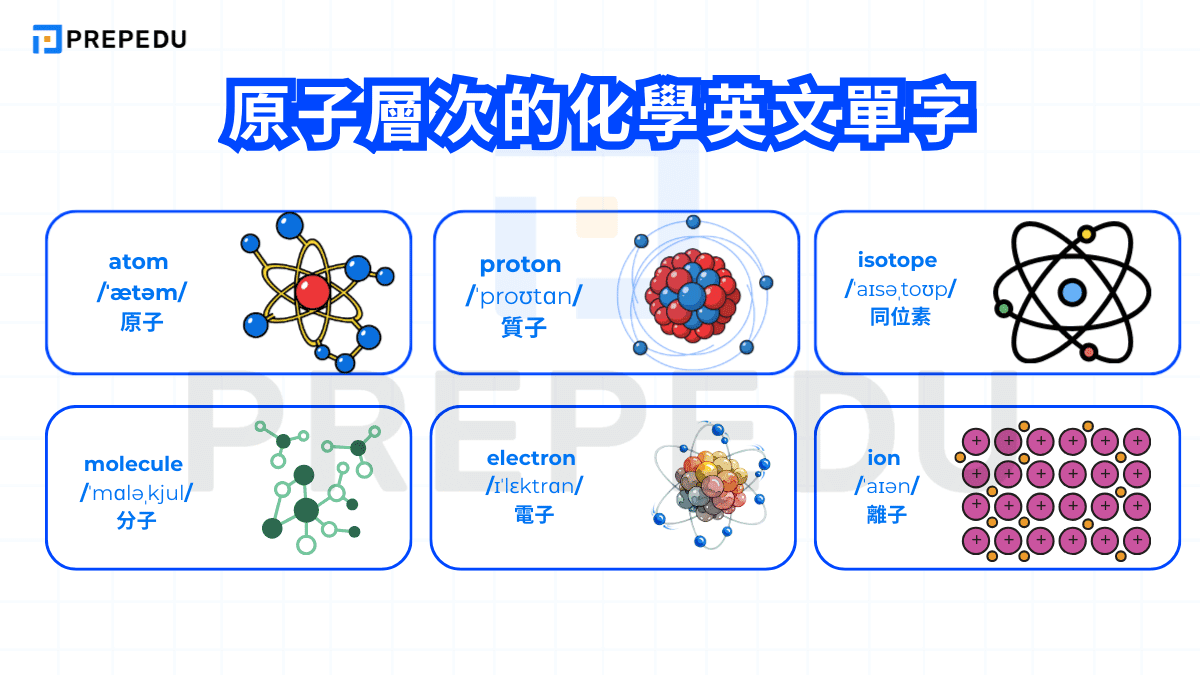
1. 原子層次的化學英文單字
原子與分子是化學世界的基本單位,理解這些化學英文單字的精確定義是你掌握化學語言的第一步。
|
化學英文單字 |
中文翻譯 |
例句 |
|
atom /ˈætəm/(n.) |
原子 |
Every chemical element consists of atoms with unique properties.(每種化學元素都由具有獨特性質的原子組成。) |
|
molecule /ˈmɑləˌkjul/(n.) |
分子 |
A water molecule contains two hydrogen atoms and one oxygen atom.(一個水分子包含兩個氫原子和一個氧原子。) |
|
element /ˈɛləmənt/(n.) |
元素 |
Oxygen is the most abundant element in the Earth's crust.(氧是地殼中含量最豐富的元素。) |
|
compound /ˈkɑmpaʊnd/(n.) |
化合物 |
Sodium chloride is a compound formed from sodium and chlorine.(氯化鈉是由鈉和氯形成的化合物。) |
|
nucleus /ˈnukliəs/(n.) |
原子核 |
The nucleus contains protons and neutrons at the atom's center.(原子核位於原子中心,包含質子和中子。) |
|
proton /ˈproʊtɑn/(n.) |
質子 |
The number of protons determines the atomic number of an element.(質子數量決定元素的原子序。) |
|
neutron /ˈnutrɑn/(n.) |
中子 |
Neutrons contribute to the mass of an atom without affecting its charge.(中子增加原子質量但不影響其電荷。) |
|
electron /ɪˈlɛktrɑn/(n.) |
電子 |
Electrons orbit the nucleus in specific energy levels.(電子在特定能階繞原子核運行。) |
|
isotope /ˈaɪsəˌtoʊp/(n.) |
同位素 |
Carbon-14 is an isotope used for radiocarbon dating.(碳-14是用於放射性碳定年的同位素。) |
|
ion /ˈaɪən/(n.) |
離子 |
Sodium forms a positive ion by losing one electron.(鈉失去一個電子形成正離子。) |
|
cation /ˈkætˌaɪən/(n.) |
陽離子 |
Metal atoms typically form cations in chemical reactions.(金屬原子在化學反應中通常形成陽離子。) |
|
anion /ˈænˌaɪən/(n.) |
陰離子 |
Chloride is an anion with a negative charge.(氯離子是帶負電荷的陰離子。) |
|
valence /ˈveɪləns/(n.) |
價數 |
The valence of hydrogen is one in most compounds.(氫在大多數化合物中的價數是一。) |
|
bond /bɑnd/(n.) |
鍵 |
Covalent bonds involve the sharing of electrons between atoms.(共價鍵涉及原子之間電子的共享。) |
2. 物質狀態與溶液化學
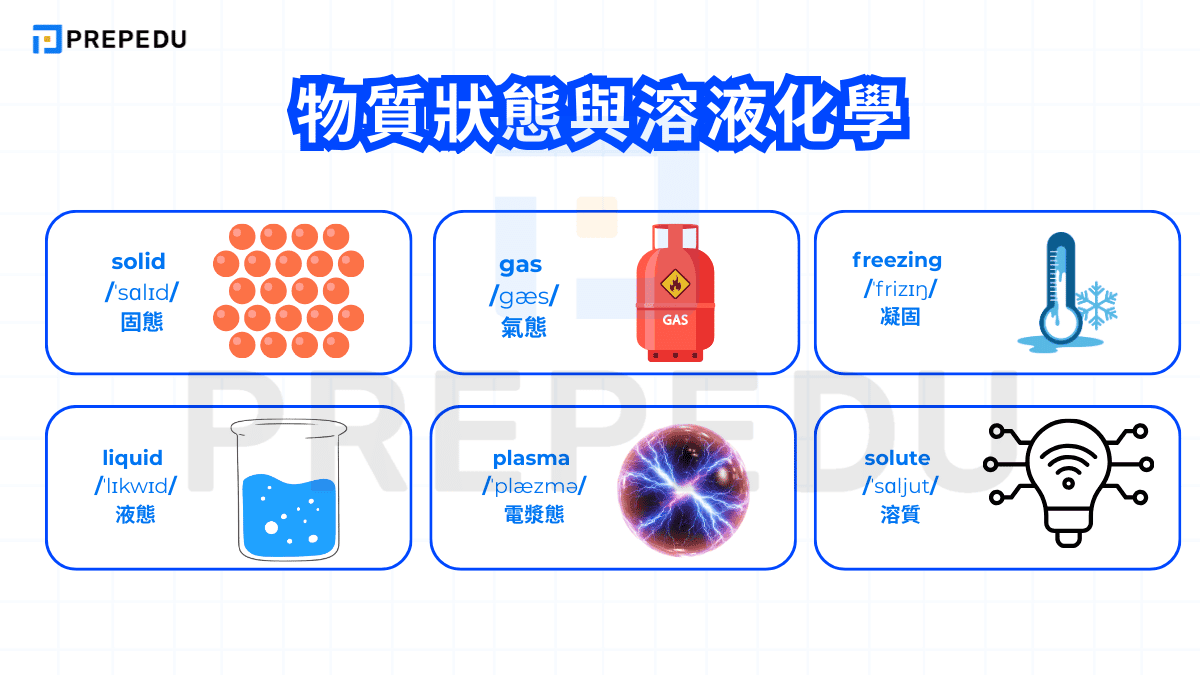
理解物質的不同狀態與溶液相關的化學英文單字,是進行實驗操作與理解化學反應的重要基礎。
|
化學英文單字 |
中文翻譯 |
例句 |
|
solid /ˈsɑlɪd/(n.) |
固態 |
Ice is the solid form of water at low temperatures.(冰是水在低溫下的固態形式。) |
|
liquid /ˈlɪkwɪd/(n.) |
液態 |
Mercury remains liquid at room temperature.(汞在室溫下保持液態。) |
|
gas /gæs/(n.) |
氣態 |
Oxygen exists as a colorless gas under normal conditions.(氧在正常條件下是無色氣體。) |
|
plasma /ˈplæzmə/(n.) |
電漿態 |
Stars consist mainly of plasma at extremely high temperatures.(恆星主要由極高溫的電漿組成。) |
|
phase /feɪz/(n.) |
相 |
Water can exist in three phases depending on temperature and pressure.(水可以根據溫度和壓力存在於三種相態。) |
|
melting /ˈmɛltɪŋ/(n.) |
熔化 |
The melting point of pure water is zero degrees Celsius.(純水的熔點是攝氏零度。) |
|
freezing /ˈfrizɪŋ/(n.) |
凝固 |
Freezing occurs when a liquid transforms into a solid.(凝固發生在液體轉變為固體時。) |
|
evaporation /ɪˌvæpəˈreɪʃən/(n.) |
蒸發 |
Evaporation increases with higher temperature and air movement.(蒸發隨著溫度升高和空氣流動而增加。) |
|
condensation /ˌkɑndɛnˈseɪʃən/(n.) |
凝結 |
Condensation forms water droplets on cold surfaces.(凝結在冷表面上形成水滴。) |
|
sublimation /ˌsʌbləˈmeɪʃən/(n.) |
昇華 |
Dry ice undergoes sublimation directly from solid to gas.(乾冰直接從固態昇華為氣態。) |
|
solute /ˈsɑljut/(n.) |
溶質 |
Sugar is the solute when dissolved in water.(糖溶於水時是溶質。) |
|
solvent /ˈsɑlvənt/(n.) |
溶劑 |
Water is often called the universal solvent.(水常被稱為萬能溶劑。) |
|
solution /səˈluʃən/(n.) |
溶液 |
A saline solution contains salt dissolved in water.(鹽水溶液含有溶解在水中的鹽。) |
|
concentration /ˌkɑnsənˈtreɪʃən/(n.) |
濃度 |
The concentration of acid affects the reaction rate.(酸的濃度影響反應速率。) |
|
molarity /moʊˈlærəti/(n.) |
莫耳濃度 |
Molarity measures the number of moles per liter of solution.(莫耳濃度測量每公升溶液中的莫耳數。) |
|
dilution /daɪˈluʃən/(n.) |
稀釋 |
Dilution reduces the concentration of a solution.(稀釋降低溶液的濃度。) |
|
saturation /ˌsætʃəˈreɪʃən/(n.) |
飽和 |
Saturation occurs when no more solute can dissolve.(當無法再溶解更多溶質時達到飽和。) |
|
precipitation /prɪˌsɪpəˈteɪʃən/(n.) |
沉澱 |
Precipitation forms when two solutions react to produce an insoluble solid.(當兩種溶液反應產生不溶固體時形成沉澱。) |
|
filtration /fɪlˈtreɪʃən/(n.) |
過濾 |
Filtration separates solid particles from liquids.(過濾將固體顆粒從液體中分離。) |
II. 元素週期表必背英文詞彙
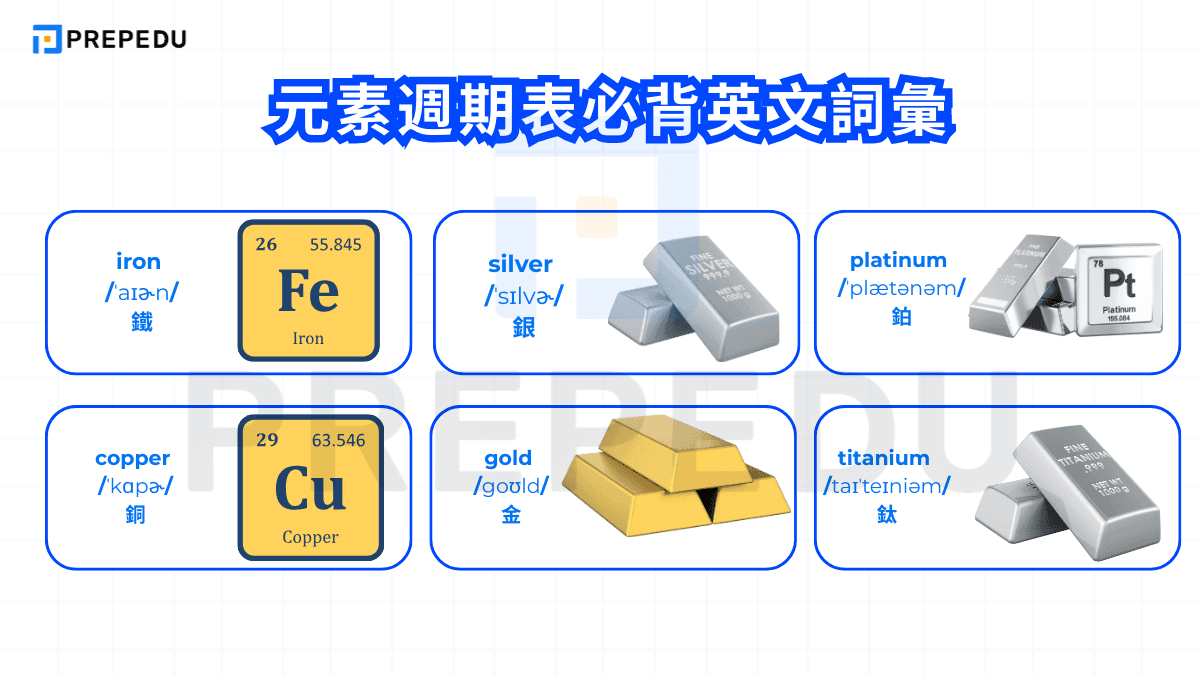
元素週期表英文是化學的基礎框架,掌握常見元素的化學英文單字能讓你在閱讀科學文獻時游刃有餘。許多元素名稱源自拉丁文或希臘文,理解這些語源不僅有助於記憶,更能展現你對化學語言的深入理解。
1. 前20號元素
前20號元素構成了大部分常見化合物,這些化學英文單字的精確掌握是化學學習的基本功。
|
化學英文單字 |
中文翻譯 |
例句 |
|
hydrogen /ˈhaɪdrədʒən/(n.) |
氫 |
Hydrogen is the lightest and most abundant element in the universe.(氫是宇宙中最輕且最豐富的元素。) |
|
helium /ˈhiliəm/(n.) |
氦 |
Helium is used in balloons because it is lighter than air.(氦用於氣球因為它比空氣輕。) |
|
lithium /ˈlɪθiəm/(n.) |
鋰 |
Lithium batteries power most modern electronic devices.(鋰電池為大多數現代電子設備供電。) |
|
beryllium /bəˈrɪliəm/(n.) |
鈹 |
Beryllium is used in aerospace applications due to its light weight.(鈹因其輕質量而用於航空航天應用。) |
|
boron /ˈbɔrɑn/(n.) |
硼 |
Boron is essential for plant growth and development.(硼對植物生長和發育至關重要。) |
|
carbon /ˈkɑrbən/(n.) |
碳 |
Carbon forms the basis of all organic compounds.(碳形成所有有機化合物的基礎。) |
|
nitrogen /ˈnaɪtrədʒən/(n.) |
氮 |
Nitrogen makes up about 78% of Earth's atmosphere.(氮約佔地球大氣的78%。) |
|
oxygen /ˈɑksɪdʒən/(n.) |
氧 |
Oxygen is essential for cellular respiration in living organisms.(氧對生物體的細胞呼吸至關重要。) |
|
fluorine /ˈflʊəˌrin/(n.) |
氟 |
Fluorine is the most reactive chemical element.(氟是最具反應性的化學元素。) |
|
neon /ˈniɑn/(n.) |
氖 |
Neon produces a bright red-orange glow when electrified.(氖通電時產生明亮的紅橙色光芒。) |
|
sodium /ˈsoʊdiəm/(n.) |
鈉 |
Sodium reacts violently with water to produce hydrogen gas.(鈉與水劇烈反應產生氫氣。) |
|
magnesium /mægˈniziəm/(n.) |
鎂 |
Magnesium burns with an intense white light.(鎂燃燒時發出強烈的白光。) |
|
aluminum /əˈlumənəm/(n.) |
鋁 |
Aluminum is widely used in packaging and construction.(鋁廣泛用於包裝和建築。) |
|
silicon /ˈsɪləˌkɑn/(n.) |
矽 |
Silicon is the primary material used in computer chips.(矽是製造電腦晶片的主要材料。) |
|
phosphorus /ˈfɑsfərəs/(n.) |
磷 |
Phosphorus is a key component of DNA and ATP.(磷是DNA和ATP的關鍵成分。) |
|
sulfur /ˈsʌlfɚ/(n.) |
硫 |
Sulfur gives rotten eggs their characteristic smell.(硫賦予臭雞蛋其特有氣味。) |
|
chlorine /ˈklɔrin/(n.) |
氯 |
Chlorine is commonly used to disinfect drinking water.(氯常用於消毒飲用水。) |
|
argon /ˈɑrgɑn/(n.) |
氬 |
Argon is used to create an inert atmosphere in welding.(氬用於在焊接中創造惰性氣氛。) |
|
potassium /pəˈtæsiəm/(n.) |
鉀 |
Potassium is vital for proper nerve and muscle function.(鉀對神經和肌肉的正常功能至關重要。) |
|
calcium /ˈkælsiəm/(n.) |
鈣 |
Calcium strengthens bones and teeth in the human body.(鈣強化人體的骨骼和牙齒。) |
2. 常見過渡金屬
過渡金屬在工業應用與生物化學中扮演關鍵角色,這些化學英文單字在材料科學與醫學領域中頻繁出現。
|
化學英文單字 |
中文翻譯 |
例句 |
|
iron /ˈaɪɚn/(n.) |
鐵 |
Iron is essential for hemoglobin production in blood cells.(鐵對血細胞中血紅素的產生至關重要。) |
|
copper /ˈkɑpɚ/(n.) |
銅 |
Copper is an excellent conductor of electricity and heat.(銅是電和熱的優良導體。) |
|
zinc /zɪŋk/(n.) |
鋅 |
Zinc is a cofactor for over 300 enzymes in the body.(鋅是體內超過300種酵素的輔因子。) |
|
silver /ˈsɪlvɚ/(n.) |
銀 |
Silver has natural antibacterial properties used in medicine.(銀具有天然抗菌特性,用於醫學。) |
|
gold /goʊld/(n.) |
金 |
Gold is highly resistant to corrosion and tarnishing.(金對腐蝕和失去光澤具有高度抗性。) |
|
mercury /ˈmɝkjəri/(n.) |
汞 |
Mercury is the only metal that is liquid at room temperature.(汞是唯一在室溫下呈液態的金屬。) |
|
platinum /ˈplætənəm/(n.) |
鉑 |
Platinum catalysts are used in automobile exhaust systems.(鉑催化劑用於汽車排氣系統。) |
|
titanium /taɪˈteɪniəm/(n.) |
鈦 |
Titanium combines high strength with low weight.(鈦結合了高強度與輕質量。) |
|
chromium /ˈkroʊmiəm/(n.) |
鉻 |
Chromium plating provides corrosion resistance to metal surfaces.(鍍鉻為金屬表面提供抗腐蝕性。) |
|
manganese /ˈmæŋgəˌniz/(n.) |
錳 |
Manganese is crucial for bone formation and metabolism.(錳對骨骼形成和代謝至關重要。) |
|
cobalt /ˈkoʊbɔlt/(n.) |
鈷 |
Cobalt is a key component of vitamin B12.(鈷是維生素B12的關鍵成分。) |
|
nickel /ˈnɪkəl/(n.) |
鎳 |
Nickel is widely used in stainless steel production.(鎳廣泛用於不鏽鋼生產。) |
|
tungsten /ˈtʌŋstən/(n.) |
鎢 |
Tungsten has the highest melting point of all metals.(鎢在所有金屬中具有最高熔點。) |
|
palladium /pəˈleɪdiəm/(n.) |
鈀 |
Palladium catalyzes numerous organic reactions.(鈀催化許多有機反應。) |
|
rhodium /ˈroʊdiəm/(n.) |
銠 |
Rhodium is one of the rarest precious metals.(銠是最稀有的貴金屬之一。) |
III. 英文化學命名邏輯解密
掌握化學英文單字的命名邏輯,是從單純記憶提升到真正理解的關鍵。國際純粹與應用化學聯合會(IUPAC)建立了系統化的命名規則,理解這套規則能讓你面對陌生化合物時也能推導出其結構與性質。
1. 數量詞首系統
化學命名中的數量詞首源自希臘文,這套系統貫穿整個化學英文單字體系。
|
化學英文詞首 |
中文翻譯 |
範例化合物 |
|
mono- |
一 |
Carbon monoxide CO(一氧化碳) |
|
di- |
二 |
Carbon dioxide CO₂(二氧化碳) |
|
tri- |
三 |
Sulfur trioxide SO₃(三氧化硫) |
|
tetra- |
四 |
Carbon tetrachloride CCl₄(四氯化碳) |
|
penta- |
五 |
Phosphorus pentachloride PCl₅(五氯化磷) |
|
hexa- |
六 |
Sulfur hexafluoride SF₆(六氟化硫) |
|
hepta- |
七 |
Iodine heptafluoride IF₇(七氟化碘) |
|
octa- |
八 |
Octane C₈H₁₈(辛烷) |
|
nona- |
九 |
Nonane C₉H₂₀(壬烷) |
|
deca- |
十 |
Decane C₁₀H₂₂(癸烷) |
這套化學英文單字的詞首邏輯延伸到有機化合物的碳鏈長度命名。甲烷(methane) 有一個碳、乙烷(ethane) 有兩個碳、丙烷(propane) 有三個碳、丁烷(butane) 有四個碳。從戊烷(pentane) 開始,英文名稱直接使用希臘數字詞首,形成系統化的命名模式。
2. 無機化合物命名規則
無機化合物的命名遵循嚴格規則,掌握這些化學英文單字的命名邏輯能讓你準確解讀化學式。
|
命名規則 |
化學英文單字 |
中文翻譯 |
例句 |
|
簡單離子 |
chloride /ˈklɔraɪd/(n.) |
氯離子/氯化物 |
Sodium chloride is common table salt.(氯化鈉是食鹽。) |
|
簡單離子 |
oxide /ˈɑksaɪd/(n.) |
氧離子/氧化物 |
Aluminum oxide forms a protective coating.(氧化鋁形成保護塗層。) |
|
簡單離子 |
sulfide /ˈsʌlfaɪd/(n.) |
硫離子/硫化物 |
Hydrogen sulfide has a rotten egg smell.(硫化氫有臭雞蛋的氣味。) |
|
含氧酸根(高氧化態) |
sulfate /ˈsʌlfeɪt/(n.) |
硫酸根 |
Copper sulfate is used in fungicides.(硫酸銅用於殺真菌劑。) |
|
含氧酸根(低氧化態) |
sulfite /ˈsʌlfaɪt/(n.) |
亞硫酸根 |
Sodium sulfite preserves food products.(亞硫酸鈉保存食品。) |
|
含氧酸根(高氧化態) |
nitrate /ˈnaɪtreɪt/(n.) |
硝酸根 |
Potassium nitrate is used in fertilizers.(硝酸鉀用於肥料。) |
|
含氧酸根(低氧化態) |
nitrite /ˈnaɪtraɪt/(n.) |
亞硝酸根 |
Sodium nitrite cures processed meats.(亞硝酸鈉醃製加工肉品。) |
|
含氧酸根(最高氧化態) |
perchlorate /pɚˈklɔreɪt/(n.) |
高氯酸根 |
Ammonium perchlorate is a rocket propellant.(高氯酸銨是火箭推進劑。) |
|
含氧酸根(最低氧化態) |
hypochlorite /ˌhaɪpəˈklɔraɪt/(n.) |
次氯酸根 |
Sodium hypochlorite is a bleaching agent.(次氯酸鈉是漂白劑。) |
這些化學英文單字的字尾變化(-ide, -ate, -ite) 不是隨意的,而是反映了離子中氧原子數量的系統性差異。理解這套邏輯後,你能從名稱直接推導出化學式。
3. 有機化學基礎命名
有機化學的命名系統更為複雜,但同樣遵循清晰的邏輯。官能基的化學英文單字命名直接指示了分子中的關鍵結構。
|
化學英文單字 |
中文翻譯 |
字尾/結構 |
範例 |
|
alkane /ˈælkeɪn/(n.) |
烷烴 |
-ane |
Methane CH₄, Ethane C₂H₆(甲烷、乙烷) |
|
alkene /ˈælkin/(n.) |
烯烴 |
-ene |
Ethene C₂H₄, Propene C₃H₆(乙烯、丙烯) |
|
alkyne /ˈælkaɪn/(n.) |
炔烴 |
-yne |
Ethyne C₂H₂, Propyne C₃H₄(乙炔、丙炔) |
|
alcohol /ˈælkəˌhɔl/(n.) |
醇 |
-ol |
Methanol CH₃OH, Ethanol C₂H₅OH(甲醇、乙醇) |
|
aldehyde /ˈældəˌhaɪd/(n.) |
醛 |
-al |
Methanal HCHO, Ethanal CH₃CHO(甲醛、乙醛) |
|
ketone /ˈkitoʊn/(n.) |
酮 |
-one |
Propanone CH₃COCH₃(丙酮) |
|
carboxylic acid /ˌkɑrbəkˈsɪlɪk ˈæsɪd/(n.) |
羧酸 |
-oic acid |
Ethanoic acid CH₃COOH(乙酸) |
|
ester /ˈɛstɚ/(n.) |
酯 |
-yl -oate |
Ethyl ethanoate CH₃COOC₂H₅(乙酸乙酯) |
|
ether /ˈiθɚ/(n.) |
醚 |
-yl -yl ether |
Diethyl ether C₂H₅OC₂H₅(乙醚) |
|
amine /əˈmin/(n.) |
胺 |
-amine |
Methylamine CH₃NH₂(甲胺) |
|
amide /ˈæmaɪd/(n.) |
醯胺 |
-amide |
Ethanamide CH₃CONH₂(乙醯胺) |
|
hydroxyl /haɪˈdrɑksəl/(n.) |
羥基 |
-OH |
Methanol contains a hydroxyl group.(甲醇含有羥基。) |
|
carbonyl /ˈkɑrbənɪl/(n.) |
羰基 |
C=O |
Aldehydes and ketones contain carbonyl groups.(醛和酮含有羰基。) |
|
carboxyl /kɑrˈbɑksəl/(n.) |
羧基 |
-COOH |
Acetic acid has a carboxyl functional group.(乙酸有羧基官能基。) |
IV. 實驗室實戰英文單字
理論知識必須與實踐結合才能真正內化。實驗室中的每個動作、每件器材都有其精確的化學英文單字,使用正確的術語不只是專業要求,更是確保實驗安全與結果準確性的基礎。
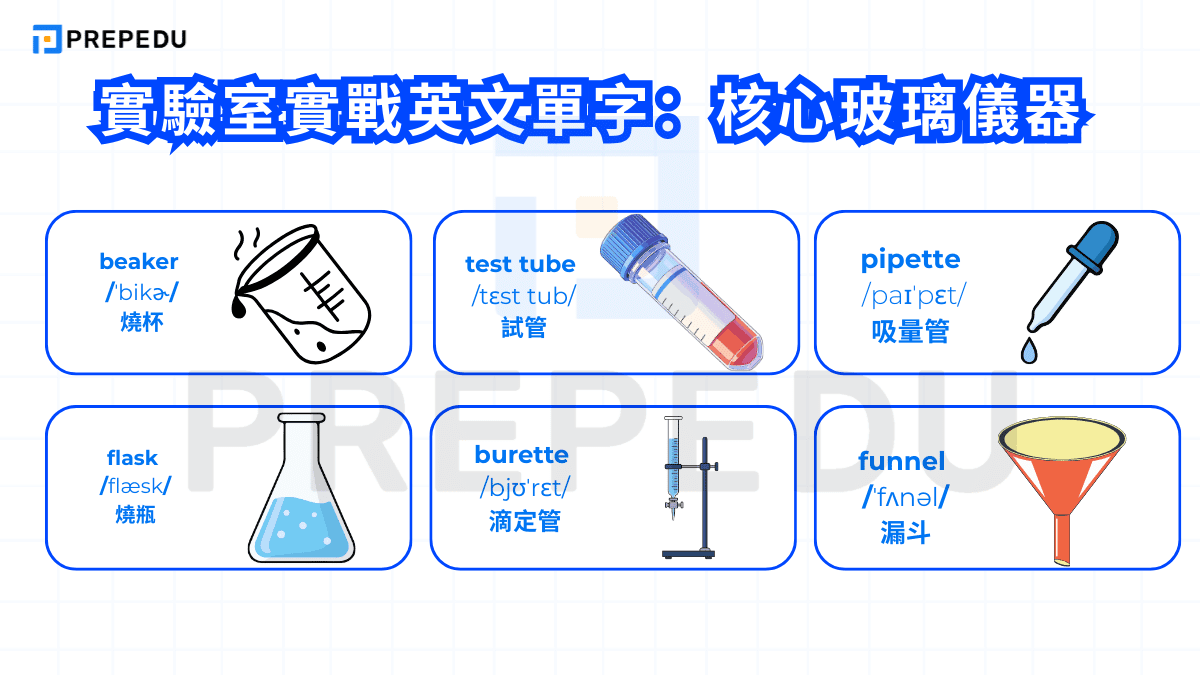
1. 核心玻璃儀器
精確掌握實驗器材的化學英文單字,能讓你在國際實驗室環境中順暢溝通。
|
化學英文單字 |
中文翻譯 |
例句 |
|
beaker /ˈbikɚ/(n.) |
燒杯 |
The beaker is used for mixing and heating liquids.(燒杯用於混合和加熱液體。) |
|
flask /flæsk/(n.) |
燒瓶 |
Round-bottom flasks are ideal for heating and reflux.(圓底燒瓶適合加熱和迴流。) |
|
Erlenmeyer flask /ˈɝlənˌmaɪɚ flæsk/(n.) |
錐形瓶 |
Erlenmeyer flasks are commonly used for titrations.(錐形瓶常用於滴定。) |
|
test tube /tɛst tub/(n.) |
試管 |
Test tubes hold small amounts of chemicals for reactions.(試管盛裝少量化學品進行反應。) |
|
burette /bjʊˈrɛt/(n.) |
滴定管 |
The burette delivers precise volumes of titrant.(滴定管精確輸送滴定劑體積。) |
|
pipette /paɪˈpɛt/(n.) |
吸量管 |
Volumetric pipettes transfer exact volumes of liquids.(容量吸管轉移準確體積的液體。) |
|
graduated cylinder /ˈgrædʒuˌeɪtəd ˈsɪləndɚ/(n.) |
量筒 |
Graduated cylinders measure approximate liquid volumes.(量筒測量大約的液體體積。) |
|
funnel /ˈfʌnəl/(n.) |
漏斗 |
The funnel guides liquids into narrow containers.(漏斗將液體導入狹窄容器。) |
|
separatory funnel /ˈsɛpərəˌtɔri ˈfʌnəl/(n.) |
分液漏斗 |
Separatory funnels separate immiscible liquids.(分液漏斗分離不互溶液體。) |
|
condenser /kənˈdɛnsɚ/(n.) |
冷凝管 |
The condenser cools vapor back to liquid form.(冷凝管將蒸氣冷卻回液態。) |
|
crucible /ˈkrusəbəl/(n.) |
坩堝 |
Crucibles withstand extremely high temperatures.(坩堝耐受極高溫度。) |
|
evaporating dish /ɪˈvæpəˌreɪtɪŋ dɪʃ/(n.) |
蒸發皿 |
Evaporating dishes concentrate solutions by evaporation.(蒸發皿通過蒸發濃縮溶液。) |
|
watch glass /wɑtʃ glæs/(n.) |
表玻璃 |
Watch glasses cover beakers to prevent contamination.(表玻璃覆蓋燒杯防止污染。) |
|
stirring rod /ˈstɝɪŋ rɑd/(n.) |
攪拌棒 |
The stirring rod mixes solutions thoroughly.(攪拌棒徹底混合溶液。) |
2. 測量與加熱設備
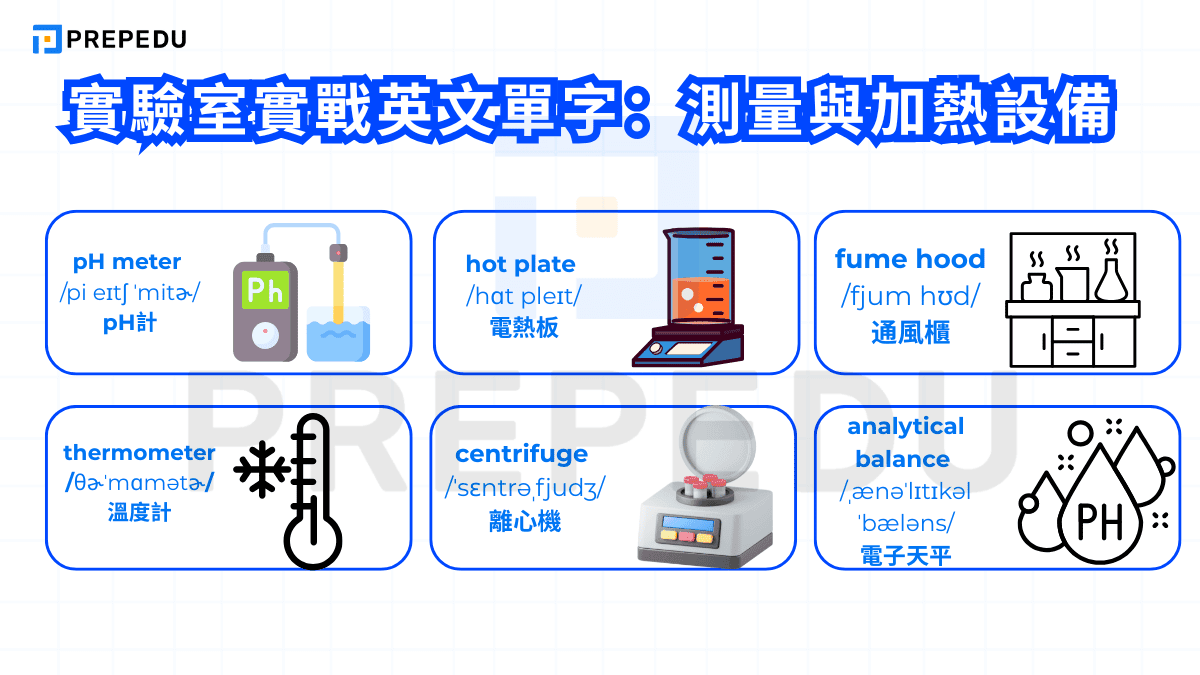
現代實驗室結合傳統與先進設備,這些化學英文單字在實驗報告中頻繁出現。
|
化學英文單字 |
中文翻譯 |
例句 |
|
analytical balance /ˌænəˈlɪtɪkəl ˈbæləns/(n.) |
電子天平 |
The analytical balance measures mass to milligram precision.(電子天平測量質量精確到毫克。) |
|
pH meter /pi eɪtʃ ˈmitɚ/(n.) |
pH計 |
The pH meter accurately determines solution acidity.(pH計準確測定溶液酸度。) |
|
thermometer /θɚˈmɑmətɚ/(n.) |
溫度計 |
The thermometer monitors temperature during reactions.(溫度計在反應過程中監測溫度。) |
|
Bunsen burner /ˈbʌnsən ˈbɝnɚ/(n.) |
本生燈 |
The Bunsen burner provides an open flame for heating.(本生燈提供明火加熱。) |
|
hot plate /hɑt pleɪt/(n.) |
電熱板 |
The hot plate offers controlled heating without flame.(電熱板提供無明火的受控加熱。) |
|
magnetic stirrer /mægˈnɛtɪk ˈstɝɚ/(n.) |
磁力攪拌器 |
The magnetic stirrer mixes solutions continuously.(磁力攪拌器持續攪拌溶液。) |
|
water bath /ˈwɔtɚ bæθ/(n.) |
水浴 |
The water bath provides gentle uniform heating.(水浴提供溫和均勻的加熱。) |
|
centrifuge /ˈsɛntrəˌfjudʒ/(n.) |
離心機 |
The centrifuge separates components by density.(離心機按密度分離成分。) |
|
fume hood /fjum hʊd/(n.) |
通風櫃 |
The fume hood removes toxic vapors from the lab.(通風櫃從實驗室移除有毒蒸氣。) |
|
desiccator /ˈdɛsɪˌkeɪtɚ/(n.) |
乾燥器 |
The desiccator stores moisture-sensitive chemicals.(乾燥器儲存對濕度敏感的化學品。) |
3. 實驗操作動詞
實驗操作需要精確的化學英文單字描述,這些動詞構成了實驗報告的動作骨架。
|
化學英文單字 |
中文翻譯 |
例句 |
|
weigh /weɪ/(v.) |
稱量 |
Weigh the sample accurately before beginning the reaction.(在開始反應前準確稱量樣品。) |
|
measure /ˈmɛʒɚ/(v.) |
測量 |
Measure exactly 50 mL of solution using a pipette.(使用吸量管準確測量50毫升溶液。) |
|
transfer /trænsˈfɝ/(v.) |
轉移 |
Transfer the liquid carefully to avoid spillage.(小心轉移液體以避免溢出。) |
|
add /æd/(v.) |
加入 |
Add the acid dropwise to the base solution.(逐滴將酸加入鹼溶液。) |
|
mix /mɪks/(v.) |
混合 |
Mix the reactants thoroughly before heating.(加熱前徹底混合反應物。) |
|
stir /stɝ/(v.) |
攪拌 |
Stir the solution continuously for ten minutes.(持續攪拌溶液十分鐘。) |
|
heat /hit/(v.) |
加熱 |
Heat the mixture gently to avoid decomposition.(溫和加熱混合物以避免分解。) |
|
cool /kul/(v.) |
冷卻 |
Cool the solution to room temperature before filtering.(過濾前將溶液冷卻至室溫。) |
|
filter /ˈfɪltɚ/(v.) |
過濾 |
Filter the precipitate using filter paper.(使用濾紙過濾沉澱物。) |
|
decant /dɪˈkænt/(v.) |
傾析 |
Decant the supernatant carefully without disturbing the sediment.(小心傾析上層清液而不攪動沉澱物。) |
|
titrate /ˈtaɪˌtreɪt/(v.) |
滴定 |
Titrate the solution until the endpoint is reached.(滴定溶液直到達到終點。) |
|
distill /dɪˈstɪl/(v.) |
蒸餾 |
Distill the mixture to separate components by boiling point.(蒸餾混合物以通過沸點分離成分。) |
|
evaporate /ɪˈvæpəˌreɪt/(v.) |
蒸發 |
Evaporate the solvent to concentrate the solution.(蒸發溶劑以濃縮溶液。) |
|
crystallize /ˈkrɪstəˌlaɪz/(v.) |
結晶 |
Crystallize the product by slow cooling.(通過緩慢冷卻使產物結晶。) |
V. 英文化學反應與性質描述
描述化學現象需要豐富的化學英文單字詞彙庫,這不只是為了撰寫論文,更是為了準確理解科學文獻中的實驗細節。
1. 常見反應類型
化學反應分為多種類型,每種都有其特定的化學英文單字,理解這些術語能幫助你預測反應產物。
|
化學英文單字 |
中文翻譯 |
例句 |
|
oxidation /ˌɑksɪˈdeɪʃən/(n.) |
氧化 |
Oxidation involves the loss of electrons from a substance.(氧化涉及物質失去電子。) |
|
reduction /rɪˈdʌkʃən/(n.) |
還原 |
Reduction is the gain of electrons by a chemical species.(還原是化學物質獲得電子。) |
|
redox reaction /ˈridɑks riˈækʃən/(n.) |
氧化還原反應 |
Redox reactions involve simultaneous oxidation and reduction.(氧化還原反應涉及同時氧化和還原。) |
|
neutralization /ˌnutrələˈzeɪʃən/(n.) |
中和 |
Neutralization occurs when acid and base react.(當酸和鹼反應時發生中和。) |
|
combustion /kəmˈbʌstʃən/(n.) |
燃燒 |
Combustion reactions release energy as heat and light.(燃燒反應以熱和光的形式釋放能量。) |
|
synthesis /ˈsɪnθəsɪs/(n.) |
合成 |
Synthesis reactions combine simple substances into complex ones.(合成反應將簡單物質組合成複雜物質。) |
|
decomposition /ˌdikɑmpəˈzɪʃən/(n.) |
分解 |
Decomposition breaks complex compounds into simpler ones.(分解將複雜化合物分解成較簡單的物質。) |
|
substitution /ˌsʌbstəˈtuʃən/(n.) |
取代 |
Substitution reactions replace one atom or group with another.(取代反應用另一個原子或基團替換一個。) |
|
addition /əˈdɪʃən/(n.) |
加成 |
Addition reactions join molecules together without losing atoms.(加成反應將分子連接在一起而不失去原子。) |
|
elimination /ɪˌlɪməˈneɪʃən/(n.) |
消去 |
Elimination reactions remove small molecules from larger ones.(消去反應從較大分子中移除小分子。) |
|
polymerization /pəˌlɪmərəˈzeɪʃən/(n.) |
聚合 |
Polymerization links small molecules into long chains.(聚合將小分子連接成長鏈。) |
|
hydrolysis /haɪˈdrɑləsɪs/(n.) |
水解 |
Hydrolysis uses water to break chemical bonds.(水解使用水來破壞化學鍵。) |
|
catalyst /ˈkætəlɪst/(n.) |
催化劑 |
The catalyst speeds up reactions without being consumed.(催化劑加速反應而不被消耗。) |
|
equilibrium /ˌikwəˈlɪbriəm/(n.) |
平衡 |
Chemical equilibrium occurs when forward and reverse rates equalize.(當正反應和逆反應速率相等時達到化學平衡。) |
2. 物質性質描述
描述物質性質的化學英文單字在安全資料表與實驗報告中大量出現。
|
化學英文單字 |
中文翻譯 |
例句 |
|
flammable /ˈflæməbəl/(adj.) |
易燃的 |
Flammable substances require careful storage away from heat.(易燃物質需要遠離熱源小心儲存。) |
|
corrosive /kəˈroʊsɪv/(adj.) |
腐蝕性的 |
Corrosive chemicals damage living tissue and materials.(腐蝕性化學品損害生物組織和材料。) |
|
toxic /ˈtɑksɪk/(adj.) |
有毒的 |
Toxic compounds pose serious health risks upon exposure.(有毒化合物暴露時構成嚴重健康風險。) |
|
reactive /riˈæktɪv/(adj.) |
反應性的 |
Reactive substances easily undergo chemical changes.(反應性物質容易發生化學變化。) |
|
stable /ˈsteɪbəl/(adj.) |
穩定的 |
Stable compounds resist decomposition under normal conditions.(穩定化合物在正常條件下抗分解。) |
|
volatile /ˈvɑlətəl/(adj.) |
揮發性的 |
Volatile liquids evaporate rapidly at room temperature.(揮發性液體在室溫下快速蒸發。) |
|
soluble /ˈsɑljəbəl/(adj.) |
可溶的 |
The compound is soluble in polar solvents.(該化合物可溶於極性溶劑。) |
|
insoluble /ɪnˈsɑljəbəl/(adj.) |
不溶的 |
Insoluble precipitates settle at the bottom of the container.(不溶沉澱物沉降到容器底部。) |
|
hygroscopic /ˌhaɪgrəˈskɑpɪk/(adj.) |
吸濕性的 |
Hygroscopic substances absorb moisture from the air.(吸濕性物質從空氣中吸收水分。) |
|
viscous /ˈvɪskəs/(adj.) |
黏稠的 |
Viscous liquids flow slowly due to high internal friction.(黏稠液體因高內摩擦力而流動緩慢。) |
|
concentrated /ˈkɑnsənˌtreɪtəd/(adj.) |
濃縮的 |
Concentrated acids must be diluted before use.(濃酸在使用前必須稀釋。) |
|
dilute /daɪˈlut/(adj.) |
稀釋的 |
Dilute solutions contain low concentrations of solute.(稀溶液含有低濃度的溶質。) |
|
pure /pjʊr/(adj.) |
純的 |
Pure substances have constant composition throughout.(純物質整體具有恆定組成。) |
|
impure /ɪmˈpjʊr/(adj.) |
不純的 |
Impure samples contain unwanted contaminants.(不純樣品含有不需要的污染物。) |
VI. 專家也可能好奇的化學英文問答
在掌握了大量化學英文單字後,許多學習者會對更深層次的語言現象產生好奇心。以下這些進階探索問題旨在解決學習過程中經常遇到的困惑,並提供獨特的跨文化語言見解。
1. IUPAC 命名規則是否適用於所有化學英文單字?
IUPAC 提供了系統化命名規則,但並非所有化合物都只使用 IUPAC 名稱。許多常用化合物保留了俗名(common name),例如水(water) 的 IUPAC 名稱是 dihydrogen monoxide,但實務上沒有人這樣稱呼。乙酸的俗名是 acetic acid,IUPAC 名稱是 ethanoic acid,兩者在文獻中都會出現。學習化學英文單字時,你需要同時掌握系統名稱與常用俗名,理解兩者的對應關係。藥物化學中更是如此,許多藥物有商品名、通用名與化學名三種稱呼,每種都是重要的專業詞彙。
2. Ether 與 Ester 如何區分?
這是非常典型的化學英文單字拼寫與概念混淆。Ether(醚) 的結構是 R-O-R',兩個烴基通過氧原子連接,最常見的例子是 diethyl ether(乙醚),化學式是 C₂H₅-O-C₂H₅。Ester(酯) 的結構是 R-COO-R',包含羰基與氧的組合,例如 ethyl acetate(乙酸乙酯),化學式是 CH₃-COO-C₂H₅。記憶技巧是:ether 的拼寫較短,結構也較簡單;ester 多了一個字母 s,結構中也多了一個羰基碳。在實驗室中誤用這兩個化學英文單字可能導致完全錯誤的實驗設計,影響安全與結果準確性。
3. 為何某些元素符號與英文名稱不相關?
這個問題的答案藏在化學史中。許多元素的化學符號源自拉丁文名稱,而非現代英文。鈉(Sodium) 的符號 Na 來自拉丁文 Natrium,意為「碳酸鈉」。鉀(Potassium) 的符號 K 來自拉丁文 Kalium,意為「鹼」。鐵(Iron) 的符號 Fe 來自拉丁文 Ferrum。金(Gold) 的符號 Au 來自拉丁文 Aurum,意為「發光之物」。銀(Silver) 的符號 Ag 來自拉丁文 Argentum。理解這些化學英文單字背後的語源不只有助於記憶,更能讓你欣賞化學語言的歷史深度,在國際學術交流中展現文化素養。
4. 科學論文中被動語態與主動語態的使用差異?
傳統上科學論文偏好被動語態以強調客觀性,例如 "The solution was heated" 而非 "We heated the solution"。但近年來許多期刊鼓勵使用主動語態以提高可讀性。關鍵在於一致性與清晰度。當描述標準程序時,被動語態如 "The mixture was stirred for 30 minutes" 是合適的化學英文表達。當強調研究者的選擇時,主動語態如 "We chose to use methanol as the solvent" 更為恰當。掌握這兩種語態的化學英文單字表達能讓你的寫作更靈活專業,適應不同期刊的風格要求。
結語
透過這份系統化的學習資源,你不僅掌握了超過1000個化學英文單字,還深入了解它們的命名邏輯、實驗應用與文化內涵。從最基本的原子分子到複雜的有機命名,從實驗室器材到化學反應描述,這已不再只是背單字,而是全面提升科學語言精準度與專業溝通能力的過程。
化學英文單字是科學語言學習中最具挑戰性但也最有價值的主題之一。只要持續累積、靈活運用,不僅能讓你的表達更貼近國際標準,也能讓你在學術研究、實驗操作與跨國合作中更具自信與深度。讓化學英文成為你專業能力的最佳證明,開啟你的國際科學之路。PREPEDU 相信,當你將語言視為掌握知識的工具而非學習的障礙時,你的科學之路將會走得更遠更穩。
對 IELTS 或 TOEIC 考試結構感到陌生?考試當天的不確定感會影響你的表現。PREPEDU 的 Test Practice 提供真實模擬環境,讓你在實戰前熟悉題型和時間限制。
系統收錄超過 1,000 道練習題,定期更新以反映最新考試趨勢。AI 引擎分析你的錯誤,針對弱點提供改進方案。進度追蹤系統將你的成長數據化,讓進步一目了然。
現在開始練習,在考試中展現實力。立即體驗 PREPEDU 的雅思真題和多益測驗試題。

你好!我叫黃秋賢,現在在 prepedu.com 擔任內容企劃。我有超過5年的英語與韓語自學經歷,親身備考 IELTS、TOEIC 與 TOPIK,累積了大量第一手的學習者視角——包括哪些語法規則最讓台灣與香港學習者混淆,以及如何在有限的備考時間內最有效地修正這些錯誤。目前已在 prepedu.com 撰寫超過 1000 篇英語學習文章,內容涵蓋語法、詞彙與考試策略,累積協助數千位學習者解決自學過程中的語法疑問。
評論









統一企業編號:202227322W
地址:114 LAVENDER STREET, #11-83 CT HUB 2, SINGAPORE (338729)