身體部位英文完整指南:從頭到腳 200+ 詞彙、發音、慣用語與醫療情境
如何正確用英文表達身體各個部位?身體部位英文是英語學習的基礎,從日常的 My head hurts(我頭痛)到看醫生時的精確描述,這些詞彙直接影響溝通效果。多數學習者都會 head、arm、leg,卻在 temple(太陽穴)、forearm(前臂)、shin(小腿前側)這類進階詞彙前卡住——而這些,正是看醫生、描述外貌、運動受傷時最需要用到的字。
身體部位英文有幾個最常見的混淆點:stomach 和 belly 都指「肚子」卻有正式與口語之分;「五官」不能直譯成 five senses(那是「五感」);小腿前側(shin)和小腿肚(calf)是兩個完全不同的字。搞清楚這些差異,才能在醫療諮詢或正式場合精準表達。
本文由 PREPEDU 教學團隊整理,完整涵蓋:從頭到腳的 200+ 身體部位英文詞彙(全身、頭臉、軀幹、四肢、內臟、骨骼、體液七大類,附 IPA 發音與例句)、十個道地身體慣用語,以及 stomach/belly、ache/pain/sore、torso 範圍等常見問題解答。無論你準備 IELTS、TOEIC,還是計畫海外求學、就醫,這份指南都能直接派上用場。
I. 身體部位英文詞彙系統
學習身體部位英文最有效的方法,是結合視覺化記憶與正確發音——看著圖、唸出音、配上例句,記憶會比單純背單字深得多。本節從全身概覽開始,再依「頭臉 → 軀幹 → 四肢」三大區域細分,逐步建立完整詞彙網。
1. 全身外部部位速覽
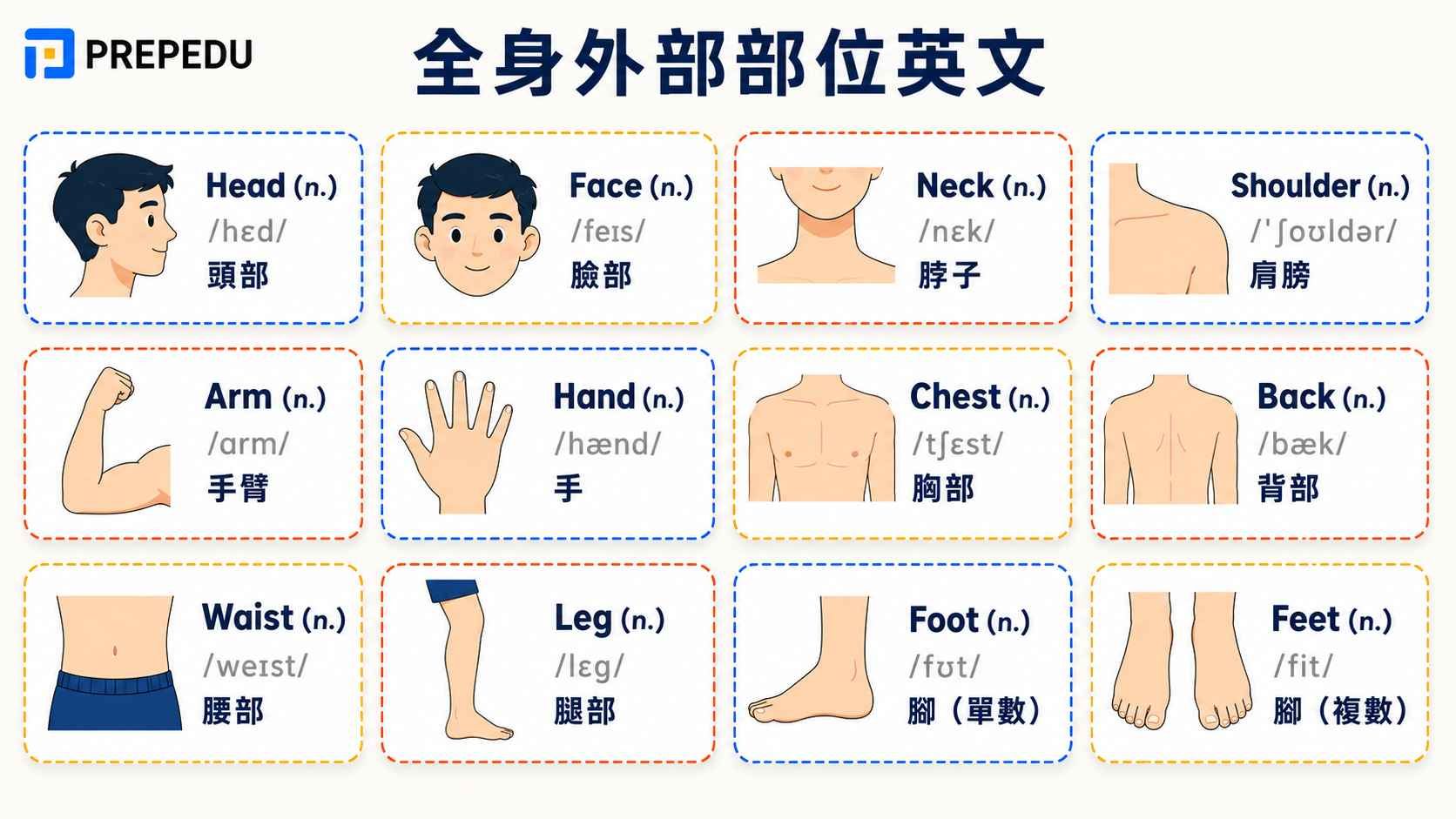
以下是日常出現頻率最高的核心身體部位的英文,務必先熟練這一組——它們是後續細部詞彙的骨架。注意 foot(腳)的複數是不規則變化 feet,這是英語少數不規則複數名詞之一。
|
身體部位英文詞彙 |
中文翻譯 |
例句 |
|
Head /hɛd/ (n.) |
頭部 |
She nodded her head in agreement. (她點頭表示同意。) |
|
Face /feɪs/ (n.) |
臉部 |
His face turned red with embarrassment. (他的臉因為尷尬而變紅。) |
|
Neck /nɛk/ (n.) |
脖子 |
The scarf wrapped around her neck kept her warm. (圍在她脖子上的圍巾讓她保持溫暖。) |
|
Shoulder /ˈʃoʊldər/ (n.) |
肩膀 |
He carried the bag on his left shoulder. (他把包背在左肩膀上。) |
|
Arm /ɑrm/ (n.) |
手臂 |
She broke her arm in a skiing accident. (她在滑雪意外中弄斷了手臂。) |
|
Hand /hænd/ (n.) |
手 |
Please raise your hand if you have a question. (如果有問題請舉手。) |
|
Chest /tʃɛst/ (n.) |
胸部 |
The doctor listened to his chest with a stethoscope. (醫生用聽診器聽他的胸部。) |
|
Back /bæk/ (n.) |
背部 |
My back aches from sitting too long. (我的背部因為坐太久而痠痛。) |
|
Waist /weɪst/ (n.) |
腰部 |
The dress fits perfectly around her waist. (這件洋裝在她的腰部非常合身。) |
|
Leg /lɛg/ (n.) |
腿部 |
He injured his leg during the marathon. (他在馬拉松比賽中傷到了腿部。) |
|
Foot /fʊt/ (n.) |
腳 (單數) |
She stepped on a sharp stone with her bare foot. (她光著的腳踩到了尖銳的石頭。) |
|
Feet /fit/ (n.) |
腳 (複數) |
His feet were sore after the long walk. (長途步行後他的腳很痠痛。) |
2. 人體各部位的英文詞彙詳解
掌握基礎詞彙後,下一步是學習更精確的表達。將人體分為「頭臉、軀幹、四肢」三大區域,能建立清晰的知識架構,在描述身體狀況或醫療諮詢時快速定位所需詞彙。
2.1. 頭部與臉部
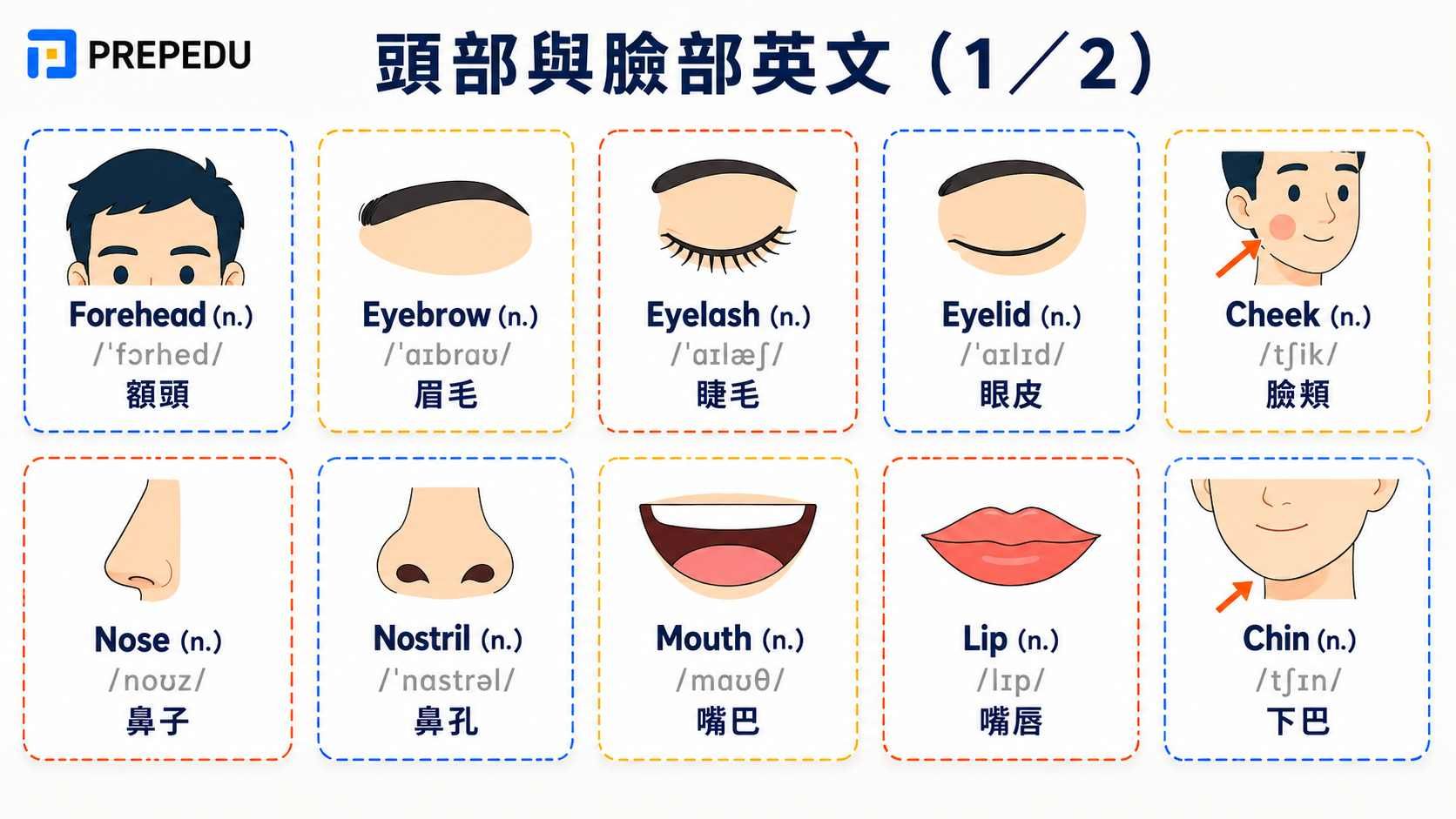
頭臉部位的身體部位英文在描述外貌、表達情感、討論健康時使用頻率極高,也常見於美容、化妝與社交對話。注意 temple 一詞:它既是「太陽穴」,也是「寺廟」,靠語境區分。
|
身體部位英文詞彙 |
中文翻譯 |
例句 |
|
Forehead /ˈfɔrhɛd/ (n.) |
額頭 |
She wiped the sweat from her forehead. (她擦掉額頭上的汗水。) |
|
Eyebrow /ˈaɪbraʊ/ (n.) |
眉毛 |
He raised his eyebrow in surprise. (他驚訝地挑起眉毛。) |
|
Eyelash /ˈaɪlæʃ/ (n.) |
睫毛 |
She applied mascara to her eyelashes. (她在睫毛上塗睫毛膏。) |
|
Eyelid /ˈaɪlɪd/ (n.) |
眼皮 |
His eyelids felt heavy after staying up late. (熬夜後他的眼皮感到沉重。) |
|
Cheek /tʃik/ (n.) |
臉頰 |
The baby's cheeks were rosy from the cold. (嬰兒的臉頰因為寒冷而紅潤。) |
|
Nose /noʊz/ (n.) |
鼻子 |
She wrinkled her nose at the bad smell. (她因為難聞的氣味而皺起鼻子。) |
|
Nostril /ˈnɑstrəl/ (n.) |
鼻孔 |
The doctor examined his nostrils for any blockage. (醫生檢查他的鼻孔是否有阻塞。) |
|
Mouth /maʊθ/ (n.) |
嘴巴 |
She opened her mouth to speak. (她張開嘴巴要說話。) |
|
Lip /lɪp/ (n.) |
嘴唇 |
His lips were dry from the winter air. (他的嘴唇因為冬天的空氣而乾燥。) |
|
Chin /tʃɪn/ (n.) |
下巴 |
He stroked his chin thoughtfully. (他若有所思地撫摸著下巴。) |
|
Jaw /dʒɔ/ (n.) |
下顎 |
She clenched her jaw in determination. (她堅決地咬緊下顎。) |
|
Ear /ɪr/ (n.) |
耳朵 |
The loud music hurt his ears. (吵雜的音樂讓他的耳朵不舒服。) |
|
Temple /ˈtɛmpəl/ (n.) |
太陽穴 |
She massaged her temples to relieve the headache. (她按摩太陽穴來緩解頭痛。) |
|
Scalp /skælp/ (n.) |
頭皮 |
A healthy scalp promotes hair growth. (健康的頭皮促進頭髮生長。) |
|
Hair /hɛr/ (n.) |
頭髮 |
She brushed her long hair before going out. (她出門前梳理了長頭髮。) |
|
Beard /bɪrd/ (n.) |
鬍鬚 |
He trimmed his beard every week. (他每週修剪鬍鬚。) |
|
Mustache /ˈmʌstæʃ/ (n.) |
小鬍子 |
His mustache was perfectly groomed. (他的小鬍子修剪得很完美。) |
|
Dimple /ˈdɪmpəl/ (n.) |
酒窩 |
Her smile revealed a cute dimple on her cheek. (她的微笑露出臉頰上可愛的酒窩。) |
|
Wrinkle /ˈrɪŋkəl/ (n.) |
皺紋 |
Age spots and wrinkles are signs of aging. (老人斑和皺紋是衰老的跡象。) |
延伸閱讀(外貌與髮型):頭臉部位詞彙是「描述一個人長相」的基礎。若你想更完整地用英文描述外貌與髮型,可參考 PREPEDU 兩篇專文:如何用英文描述外貌?50+ 最常用外貌描述詞彙(從臉型、五官到身材的形容詞),以及髮型英文怎麼說?各種髮型、形容髮型必備用語(搭配本節的 hair、beard、mustache 一起學,效果最佳)。
2.2. 身體軀幹
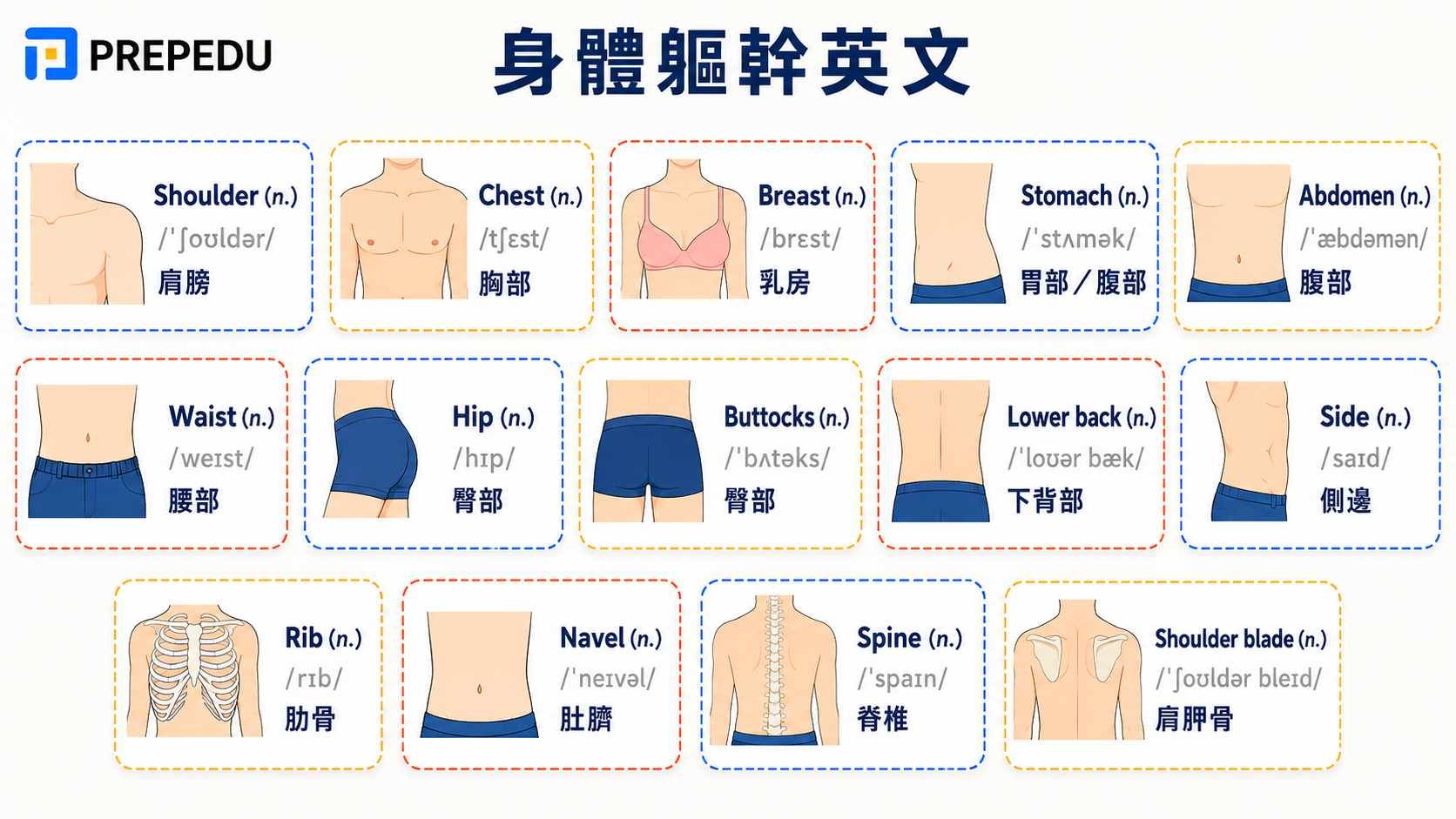
軀幹(torso)詞彙在健身、醫療諮詢與服裝購買時經常使用。準確掌握能幫你精確描述疼痛位置或進行體能訓練。注意 stomach 與 abdomen 的差異:stomach 口語中泛指「肚子」也指「胃」這個器官;abdomen 則是較正式的「腹部」解剖學用語。
|
身體部位英文詞彙 |
中文翻譯 |
例句 |
|
Shoulder /ˈʃoʊldər/ (n.) |
肩膀 |
The heavy bag strained her shoulder muscles. (沉重的包包讓她的肩膀肌肉緊繃。) |
|
Chest /tʃɛst/ (n.) |
胸部 |
He felt chest pain and went to see a doctor. (他感到胸部疼痛,於是去看醫生。) |
|
Breast /brɛst/ (n.) |
乳房 |
Regular breast examinations are important for women's health. (定期乳房檢查對女性健康很重要。) |
|
Stomach /ˈstʌmək/ (n.) |
胃部/腹部 |
Her stomach rumbled because she was hungry. (她的胃部因為飢餓而咕嚕作響。) |
|
Abdomen /ˈæbdəmən/ (n.) |
腹部 |
The doctor pressed gently on his abdomen. (醫生輕壓他的腹部。) |
|
Waist /weɪst/ (n.) |
腰部 |
She measured her waist before buying the dress. (她在買洋裝前測量了腰部。) |
|
Hip /hɪp/ (n.) |
臀部 |
She placed her hands on her hips and sighed. (她把手放在臀部上嘆了口氣。) |
|
Buttocks /ˈbʌtəks/ (n.) |
臀部 |
Sitting for long periods can cause buttocks numbness. (長時間坐著會導致臀部麻木。) |
|
Lower back /ˈloʊər bæk/ (n.) |
下背部 |
Many office workers suffer from lower back pain. (許多上班族都有下背部疼痛的問題。) |
|
Side /saɪd/ (n.) |
側邊 |
He felt a sharp pain in his side after running. (跑步後他感到側邊一陣劇痛。) |
|
Rib /rɪb/ (n.) |
肋骨 |
The doctor examined his ribs for any fractures. (醫生檢查他的肋骨是否有骨折。) |
|
Navel /ˈneɪvəl/ (n.) |
肚臍 |
The navel is also called the belly button. (肚臍也被稱為肚臍眼。) |
|
Spine /spaɪn/ (n.) |
脊椎 |
Good posture keeps your spine aligned. (良好的姿勢保持脊椎對齊。) |
|
Shoulder blade /ˈʃoʊldər bleɪd/ (n.) |
肩胛骨 |
Tension often builds up around the shoulder blades. (緊張感經常在肩胛骨周圍累積。) |
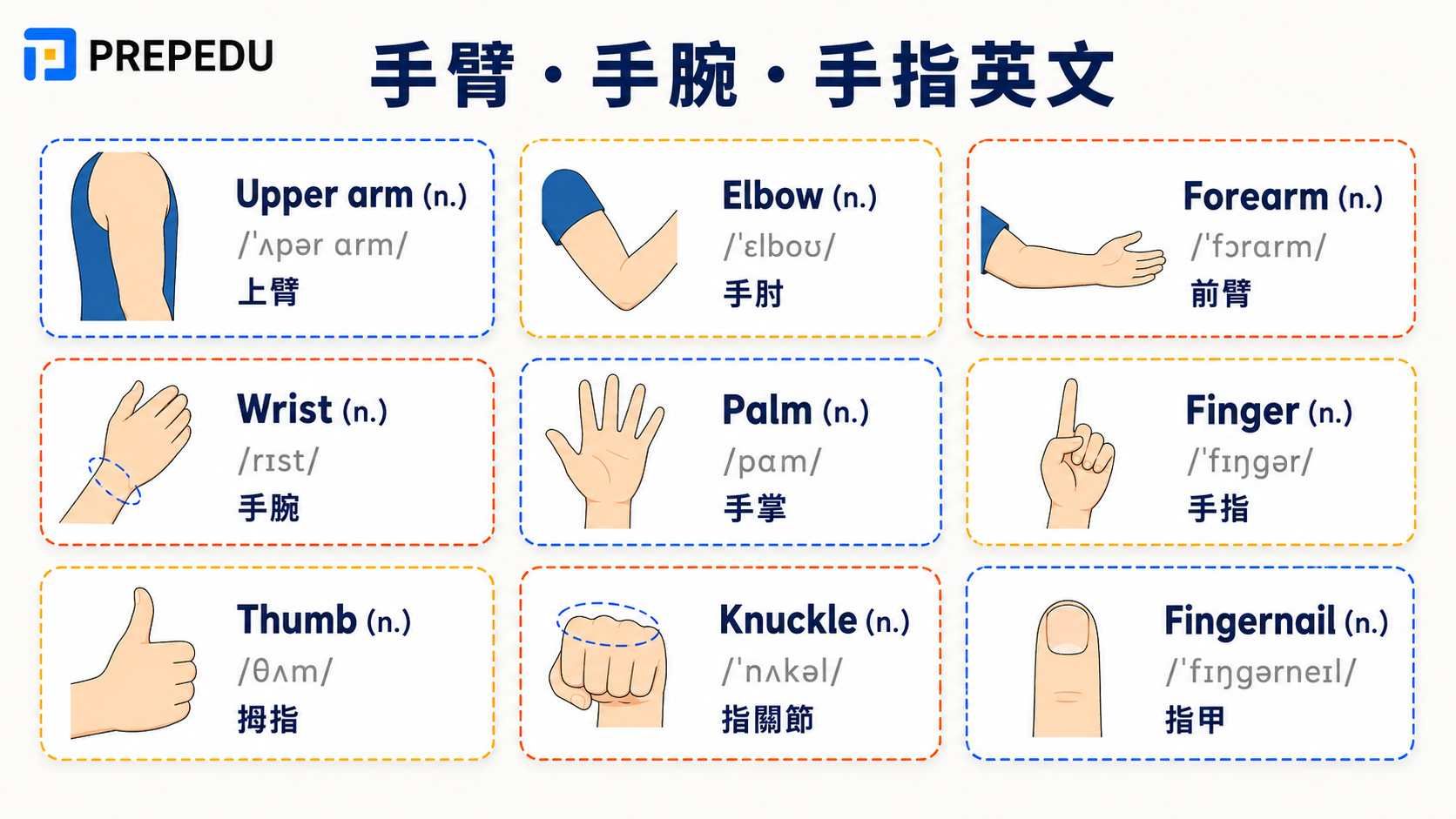
2.3. 手臂與腿部
四肢詞彙在運動、醫療與日常生活中極為重要。這裡有一組最容易搞混的字:shin(小腿前側,骨頭明顯處)與 calf(小腿肚,肌肉隆起處)——在描述運動傷害時用錯,醫生可能會誤判位置。
|
身體部位英文詞彙 |
中文翻譯 |
例句 |
|
手臂、手腕到手指的細節 |
||
|
Upper arm /ˈʌpər ɑrm/ (n.) |
上臂 |
The vaccination is usually given in the upper arm. (疫苗通常注射在上臂。) |
|
Elbow /ˈɛlboʊ/ (n.) |
手肘 |
He bumped his elbow against the door frame. (他的手肘撞到了門框。) |
|
Forearm /ˈfɔrɑrm/ (n.) |
前臂 |
The tennis player had strong forearm muscles. (這位網球選手有強壯的前臂肌肉。) |
|
Wrist /rɪst/ (n.) |
手腕 |
She wore a beautiful bracelet around her wrist. (她的手腕上戴著一個美麗的手鐲。) |
|
Palm /pɑm/ (n.) |
手掌 |
He held the small bird in his palm. (他把小鳥捧在手掌中。) |
|
Finger /ˈfɪŋgər/ (n.) |
手指 |
She pointed with her index finger. (她用食指指著。) |
|
Thumb /θʌm/ (n.) |
拇指 |
He gave a thumbs up with his thumb. (他用拇指比了個讚。) |
|
Knuckle /ˈnʌkəl/ (n.) |
指關節 |
He cracked his knuckles before typing. (他在打字前活動了指關節。) |
|
Fingernail /ˈfɪŋgərneɪl/ (n.) |
指甲 |
She painted her fingernails bright red. (她把指甲塗成鮮紅色。) |
|
大腿、膝蓋到腳趾的細節 |
||
|
Thigh /θaɪ/ (n.) |
大腿 |
The runner felt pain in his thigh muscle. (跑者感到大腿肌肉疼痛。) |
|
Knee /ni/ (n.) |
膝蓋 |
She scraped her knee when she fell. (她跌倒時擦傷了膝蓋。) |
|
Kneecap /ˈnikæp/ (n.) |
膝蓋骨 |
The X-ray showed a fracture in the kneecap. (X光顯示膝蓋骨有骨折。) |
|
Shin /ʃɪn/ (n.) |
小腿前側 |
He kicked the ball with his shin by accident. (他意外地用小腿前側踢到球。) |
|
Calf /kæf/ (n.) |
小腿肚 |
Her calf muscles cramped after the long run. (長跑後她的小腿肚肌肉抽筋。) |
|
Ankle /ˈæŋkəl/ (n.) |
腳踝 |
She twisted her ankle while hiking. (她在健行時扭到了腳踝。) |
|
Heel /hil/ (n.) |
腳跟 |
The new shoes gave her blisters on her heels. (新鞋子讓她的腳跟起了水泡。) |
|
Toe /toʊ/ (n.) |
腳趾 |
He stubbed his toe on the table leg. (他的腳趾撞到了桌腳。) |
|
Big toe /bɪg toʊ/ (n.) |
大腳趾 |
The doctor examined his infected big toe. (醫生檢查他感染的大腳趾。) |
|
Toenail /ˈtoʊneɪl/ (n.) |
腳趾甲 |
She trimmed her toenails before going to the beach. (她在去海灘前修剪了腳趾甲。) |
💡 muscle(肌肉)的字源是「小老鼠」。muscle 源自拉丁文 musculus,意思是「小老鼠」——古羅馬人覺得肌肉在皮膚下滑動鼓起的樣子,像一隻小老鼠在皮下跑動。這個比喻至今藏在英文裡:mussel(淡菜、貽貝)和 muscle 同源,因為貝殼的形狀也像小老鼠。下次健身練 biceps(二頭肌)時,可以想想你正在養一隻「小老鼠」。(Oxford English Dictionary, 2024)
II. 人體內部器官與骨骼系統
認識外部部位後,內部器官、骨骼與體液的英文同樣重要——尤其在看醫生、閱讀健康類文章(IELTS 高頻主題)時不可或缺。本節分為核心器官、骨骼關節、體液三類。
1. 核心內部器官英文圖解
內臟器官的英文在醫療情境中至關重要。注意 heart(心臟)、liver(肝)、lung(肺)、kidney(腎)這四個核心器官,是健康類英文文章與看醫生對話的最高頻詞。
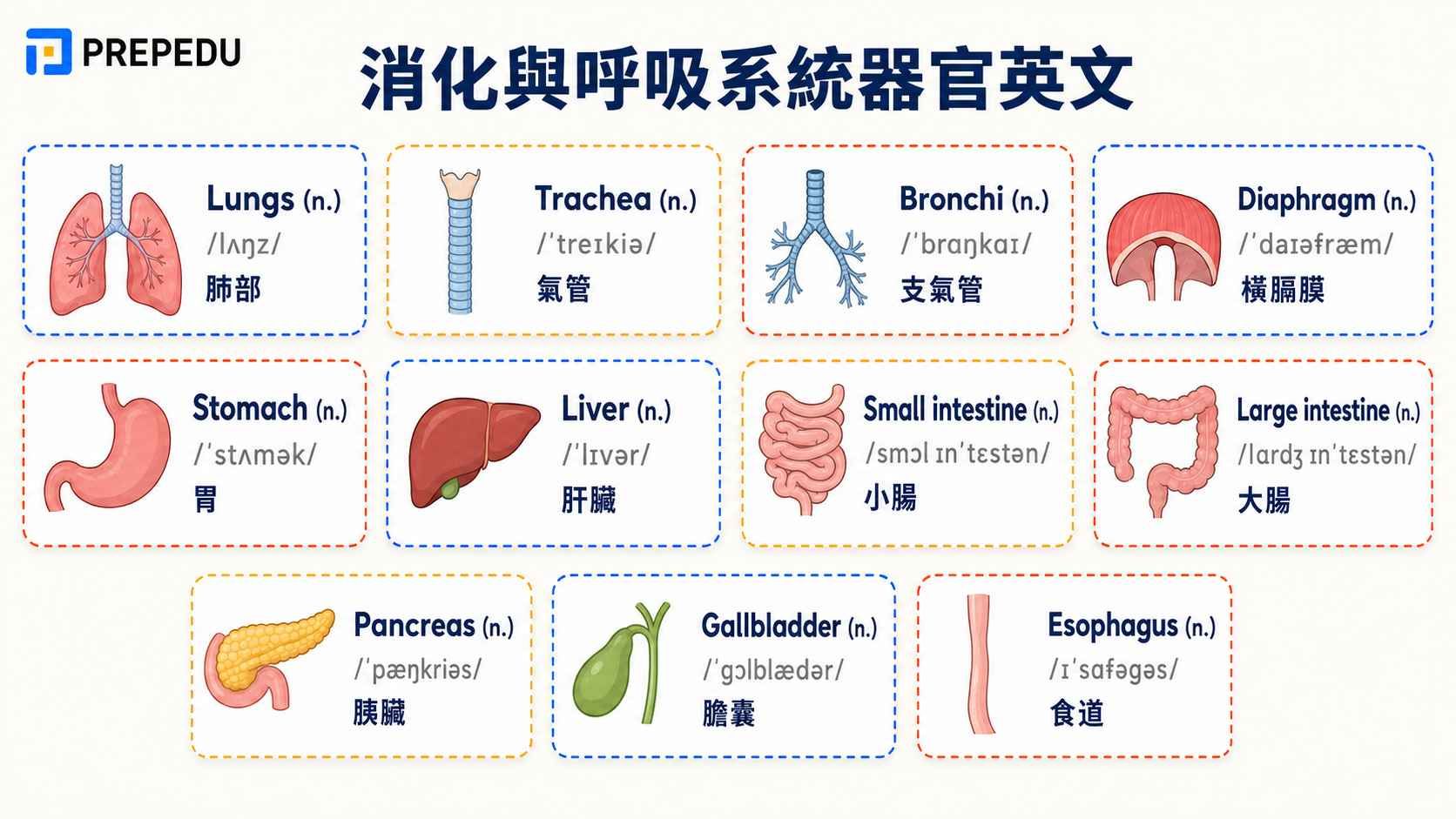
1.1. 消化與呼吸系統
消化系統和呼吸系統的器官名稱在健康飲食、疾病預防和醫療諮詢中經常被提及。以下是關鍵器官的詳細詞彙:
|
身體部位英文詞彙 |
中文翻譯 |
例句 |
|
Lungs /lʌŋz/ (n.) |
肺部 |
The lungs exchange oxygen and carbon dioxide. (肺部進行氧氣和二氧化碳的交換。) |
|
Trachea /ˈtreɪkiə/ (n.) |
氣管 |
The trachea carries air to and from the lungs. (氣管將空氣輸送到肺部和從肺部輸送出來。) |
|
Bronchi /ˈbrɑŋkaɪ/ (n.) |
支氣管 |
The bronchi branch into smaller airways in the lungs. (支氣管在肺部分支成更小的氣道。) |
|
Diaphragm /ˈdaɪəfræm/ (n.) |
橫膈膜 |
The diaphragm is the main muscle used for breathing. (橫膈膜是呼吸時使用的主要肌肉。) |
|
Stomach /ˈstʌmək/ (n.) |
胃 |
The stomach produces acid to digest food. (胃產生酸來消化食物。) |
|
Liver /ˈlɪvər/ (n.) |
肝臟 |
The liver filters toxins from the blood. (肝臟過濾血液中的毒素。) |
|
Small intestine /smɔl ɪnˈtɛstən/ (n.) |
小腸 |
The small intestine absorbs nutrients from food. (小腸吸收食物中的營養。) |
|
Large intestine /lɑrdʒ ɪnˈtɛstən/ (n.) |
大腸 |
The large intestine processes waste before elimination. (大腸在排泄前處理廢物。) |
|
Pancreas /ˈpæŋkriəs/ (n.) |
胰臟 |
The pancreas produces insulin and digestive enzymes. (胰臟產生胰島素和消化酵素。) |
|
Gallbladder /ˈgɔlblædər/ (n.) |
膽囊 |
The gallbladder stores bile produced by the liver. (膽囊儲存肝臟產生的膽汁。) |
|
Esophagus /ɪˈsɑfəgəs/ (n.) |
食道 |
Food travels down the esophagus to reach the stomach. (食物通過食道到達胃部。) |
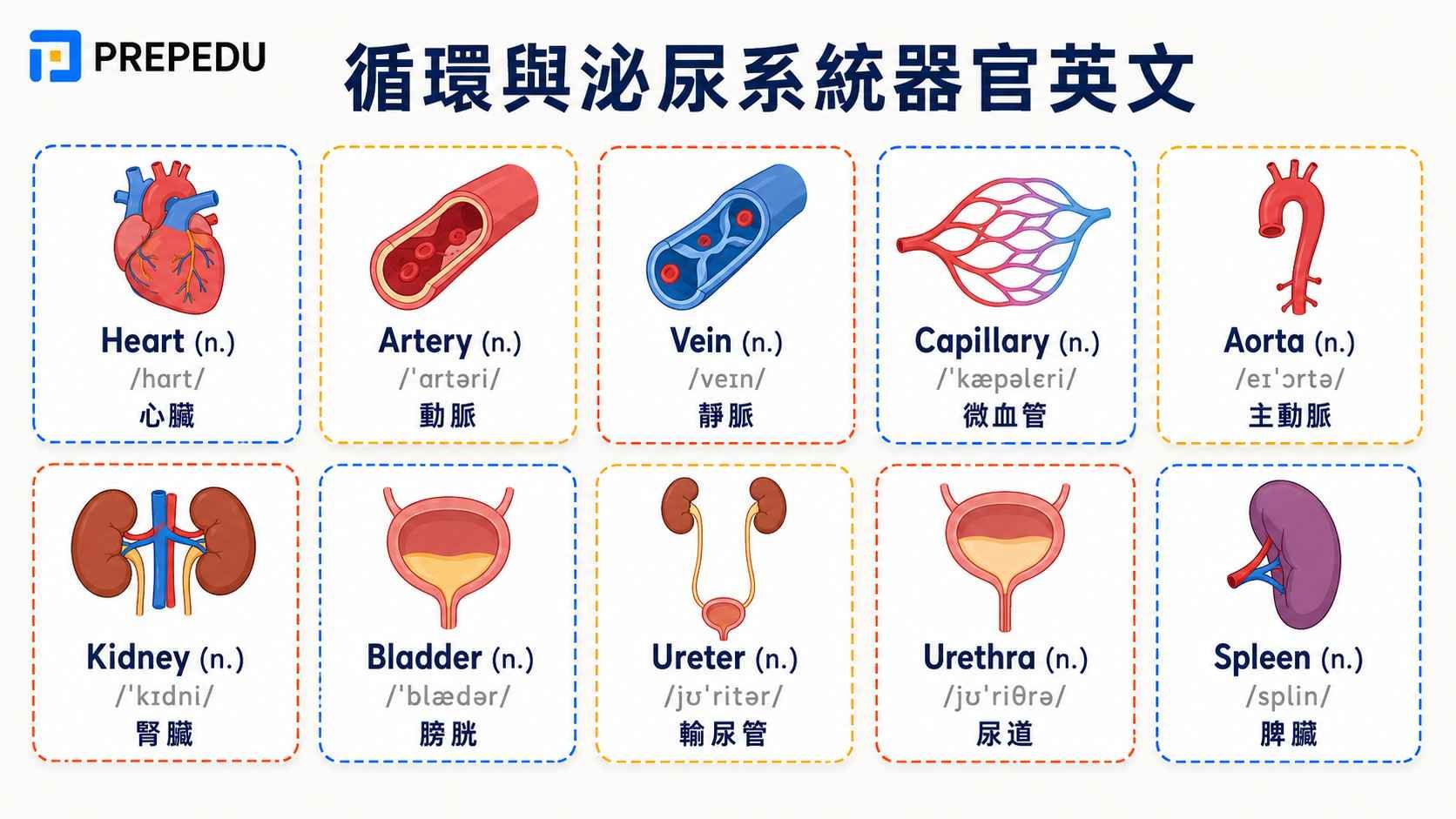
1.2. 循環與泌尿系統
循環系統和泌尿系統負責血液輸送和廢物排除,這些系統的正常運作對維持體內環境平衡至關重要:
|
身體部位英文詞彙 |
中文翻譯 |
例句 |
|
Heart /hɑrt/ (n.) |
心臟 |
The heart pumps blood throughout the body. (心臟將血液輸送到全身。) |
|
Artery /ˈɑrtəri/ (n.) |
動脈 |
The artery carries oxygenated blood from the heart. (動脈運送含氧血液離開心臟。) |
|
Vein /veɪn/ (n.) |
靜脈 |
The vein returns deoxygenated blood to the heart. (靜脈將缺氧血液送回心臟。) |
|
Capillary /ˈkæpəlɛri/ (n.) |
微血管 |
Capillaries connect arteries and veins. (微血管連接動脈和靜脈。) |
|
Aorta /eɪˈɔrtə/ (n.) |
主動脈 |
The aorta is the largest artery in the body. (主動脈是人體最大的動脈。) |
|
Kidney /ˈkɪdni/ (n.) |
腎臟 |
The kidneys filter waste from the blood. (腎臟過濾血液中的廢物。) |
|
Bladder /ˈblædər/ (n.) |
膀胱 |
The bladder stores urine until it's released. (膀胱儲存尿液直到排出。) |
|
Ureter /jʊˈritər/ (n.) |
輸尿管 |
The ureter carries urine from kidney to bladder. (輸尿管將尿液從腎臟輸送到膀胱。) |
|
Urethra /jʊˈriθrə/ (n.) |
尿道 |
Urine exits the body through the urethra. (尿液通過尿道排出體外。) |
|
Spleen /splin/ (n.) |
脾臟 |
The spleen filters blood and supports immune function. (脾臟過濾血液並支持免疫功能。) |
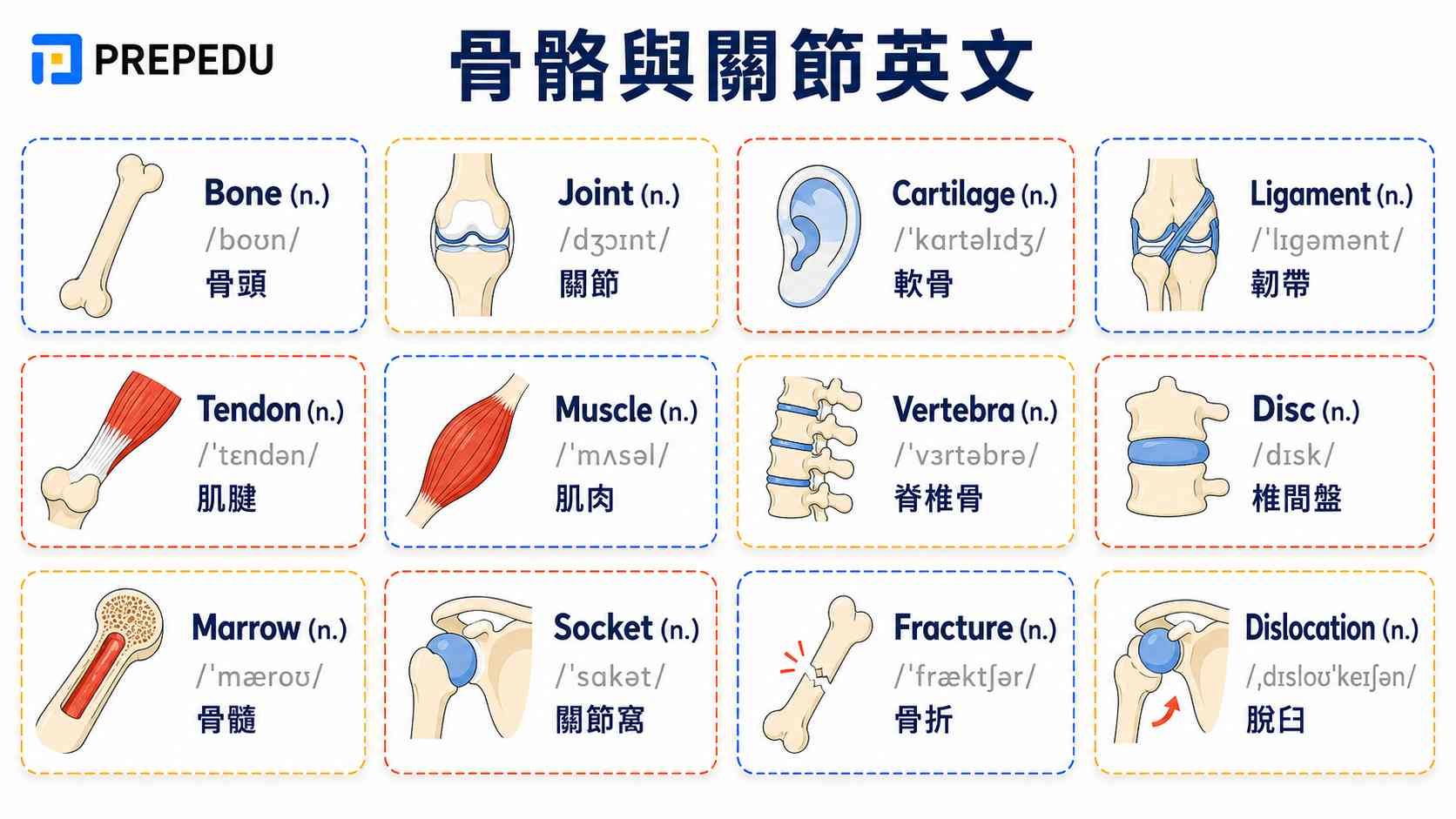
2. 骨骼與關節相關詞彙
骨骼系統詞彙在描述運動傷害、骨折或關節問題時必備。注意 joint(關節)是描述「連接處」的通用詞,而 skull(頭骨)、spine(脊椎)、pelvis(骨盆)是三個結構性主幹詞。
|
身體部位英文詞彙 |
中文翻譯 |
例句 |
|
Bone /boʊn/ (n.) |
骨頭 |
The X-ray showed a crack in the bone. (X光顯示骨頭有裂縫。) |
|
Joint /dʒɔɪnt/ (n.) |
關節 |
His knee joint was swollen after the injury. (受傷後他的膝關節腫脹。) |
|
Cartilage /ˈkɑrtəlɪdʒ/ (n.) |
軟骨 |
The cartilage in his knee was damaged. (他膝蓋的軟骨受損了。) |
|
Ligament /ˈlɪgəmənt/ (n.) |
韌帶 |
She tore her ligament playing soccer. (她踢足球時撕裂了韌帶。) |
|
Tendon /ˈtɛndən/ (n.) |
肌腱 |
The Achilles tendon connects the calf muscle to the heel. (阿基里斯肌腱連接小腿肌肉和腳跟。) |
|
Muscle /ˈmʌsəl/ (n.) |
肌肉 |
Regular exercise strengthens your muscles. (定期運動能強化你的肌肉。) |
|
Vertebra /ˈvɜrtəbrə/ (n.) |
脊椎骨 |
The doctor pointed to the damaged vertebra on the scan. (醫生指著掃描影像上受損的脊椎骨。) |
|
Disc /dɪsk/ (n.) |
椎間盤 |
A herniated disc can cause severe back pain. (椎間盤突出會導致嚴重的背痛。) |
|
Marrow /ˈmæroʊ/ (n.) |
骨髓 |
Bone marrow produces blood cells. (骨髓製造血球細胞。) |
|
Socket /ˈsɑkət/ (n.) |
關節窩 |
The shoulder socket allows for a wide range of motion. (肩膀關節窩允許大幅度的活動。) |
|
Fracture /ˈfræktʃər/ (n.) |
骨折 |
The fracture will take six weeks to heal. (這個骨折需要六週才能癒合。) |
|
Dislocation /ˌdɪsloʊˈkeɪʃən/ (n.) |
脫臼 |
The dislocation of his shoulder was very painful. (他肩膀脫臼非常疼痛。) |
3. 體液相關詞彙
體液詞彙在醫療檢查、健康討論中經常出現,例如 blood(血液)、saliva(唾液)、sweat(汗)。這類詞在 IELTS 科學類閱讀與看醫生情境聽力中都可能登場。
|
身體部位英文詞彙 |
中文翻譯 |
例句 |
|
Blood /blʌd/ (n.) |
血液 |
The doctor took a blood sample for testing. (醫生抽取血液樣本進行檢驗。) |
|
Plasma /ˈplæzmə/ (n.) |
血漿 |
Plasma makes up about 55% of blood volume. (血漿約佔血液總體積的55%。) |
|
Saliva /səˈlaɪvə/ (n.) |
唾液 |
Saliva helps digest food and keeps the mouth moist. (唾液幫助消化食物並保持口腔濕潤。) |
|
Tears /tɪrz/ (n.) |
眼淚 |
Tears protect the eyes from dust and bacteria. (眼淚保護眼睛免受灰塵和細菌侵害。) |
|
Sweat /swɛt/ (n.) |
汗水 |
Exercise causes the body to produce sweat. (運動會讓身體產生汗水。) |
|
Urine /ˈjʊrən/ (n.) |
尿液 |
The urine test showed no signs of infection. (尿液檢查顯示沒有感染跡象。) |
|
Bile /baɪl/ (n.) |
膽汁 |
Bile helps digest fats in the small intestine. (膽汁幫助在小腸中消化脂肪。) |
|
Mucus /ˈmjukəs/ (n.) |
黏液 |
The nose produces mucus to trap particles. (鼻子產生黏液來捕捉顆粒。) |
|
Lymph /lɪmf/ (n.) |
淋巴液 |
Lymph carries white blood cells throughout the body. (淋巴液將白血球輸送到全身。) |
|
Cerebrospinal fluid /ˌsɛrəbroʊˈspaɪnəl ˈfluɪd/ (n.) |
腦脊髓液 |
Cerebrospinal fluid protects the brain and spinal cord. (腦脊髓液保護大腦和脊髓。) |
|
Synovial fluid /sɪˈnoʊviəl ˈfluɪd/ (n.) |
關節滑液 |
Synovial fluid lubricates the joints. (關節滑液潤滑關節。) |
|
Gastric juice /ˈgæstrɪk dʒus/ (n.) |
胃液 |
Gastric juice contains acids that break down food. (胃液含有分解食物的酸性物質。) |
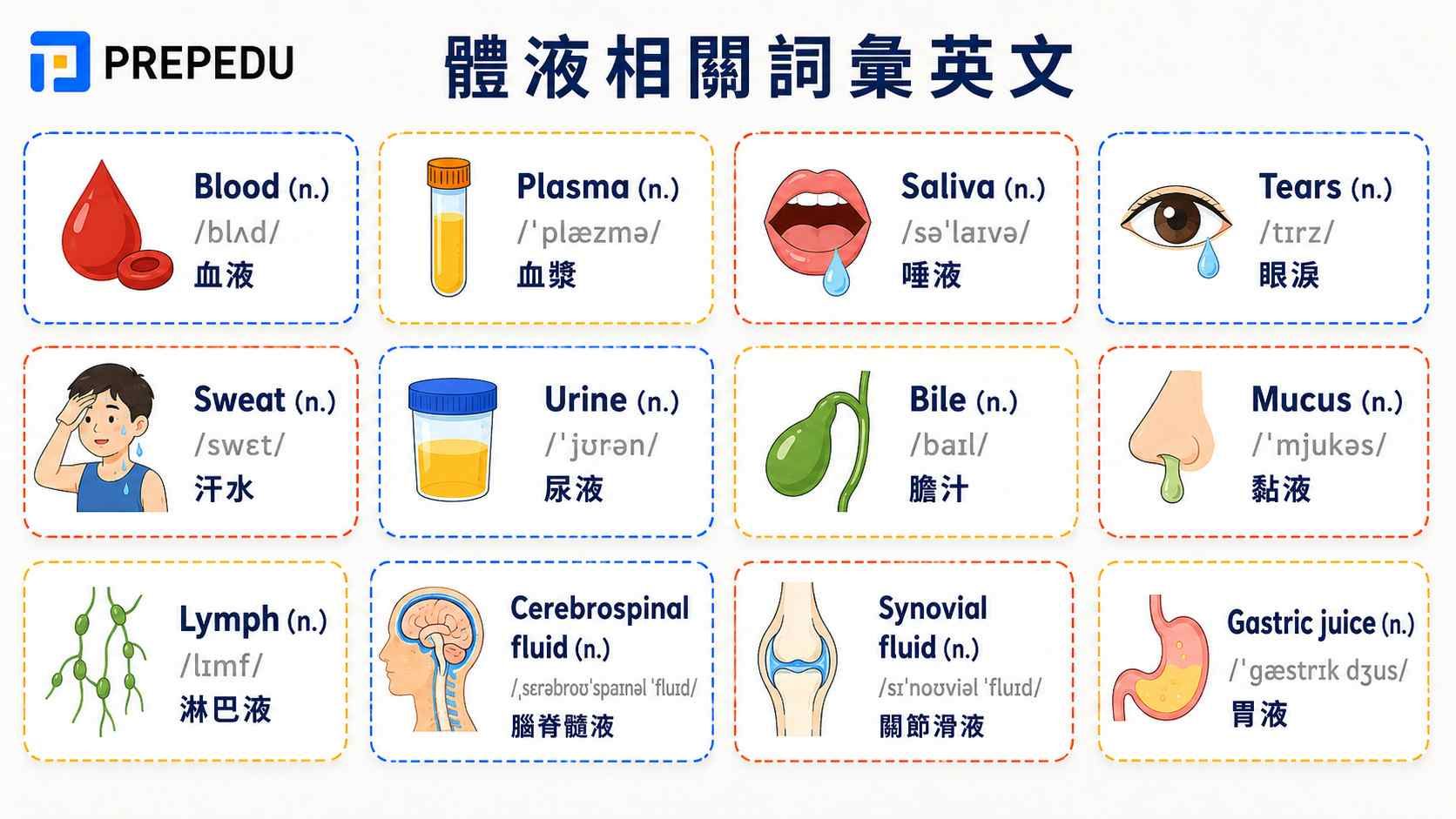
延伸閱讀(醫療情境):學會身體部位與器官的英文後,下一步是把這些詞用在真實的看醫生情境。當你需要描述身體不適時,以下三篇 PREPEDU 專文能直接派上用場:
-
想表達哪裡生病、得了什麼病:疾病英文單字列表及其在實際中的應用
-
想說「我不舒服」卻不知道怎麼開口:不舒服英文怎麼說?身體、情緒與醫療情境完整整理
-
最常見的小病——感冒,英文怎麼講才道地:我感冒了英文怎麼講才正確?
III. 身體部位英文的慣用語
身體部位不只用來描述生理——英文中有大量以身體部位構成的慣用語(idioms),這些表達在母語者的日常對話中無處不在,也是 IELTS 口說展現道地度的加分項。以下為身體部位英文的慣用語,每個都附有字面與實際意義的對照。
|
英文慣用語 |
意思 |
例句 |
|
Head over heels |
神魂顛倒、深深愛上 |
She fell head over heels for him.(她徹底愛上了他。) |
|
Keep your head |
保持冷靜 |
Even in a crisis, she managed to keep her head.(即使在危機中,她仍保持冷靜。) |
|
Off the top of my head |
不假思索、隨口一說 |
Off the top of my head, I'd say about fifty people came.(我隨口估計,大約來了五十人。) |
|
See eye to eye |
意見一致 |
The two managers don't always see eye to eye.(兩位經理意見並非總是一致。) |
|
Keep an eye on |
留意、看顧 |
Could you keep an eye on my bag for a minute?(你能幫我看一下包包嗎?) |
|
Turn a blind eye |
視而不見、睜一隻眼閉一隻眼 |
The teacher turned a blind eye to the small mistake.(老師對這個小錯誤睜一隻眼閉一隻眼。) |
|
All ears |
洗耳恭聽 |
Tell me what happened—I'm all ears.(告訴我發生了什麼,我洗耳恭聽。) |
|
Play it by ear |
見機行事、隨機應變 |
We don't have a plan; let's just play it by ear.(我們沒有計畫,就見機行事吧。) |
|
Pay through the nose |
付出高昂代價、花大錢 |
We paid through the nose for those concert tickets.(我們花大錢買了那些演唱會門票。) |
|
Stick your nose in |
多管閒事 |
Stop sticking your nose into my business.(別再插手我的事了。) |
|
Bite your tongue |
忍住不說、話到嘴邊又吞回 |
I wanted to argue, but I bit my tongue.(我本想反駁,但還是忍住了。) |
|
Get something off your chest |
一吐為快、把心事說出來 |
Talking to her helped me get it off my chest.(跟她聊過後我一吐為快。) |
|
By the skin of your teeth |
險勝、僥倖逃過 |
He passed the exam by the skin of his teeth.(他驚險地通過了考試。) |
|
Pull someone's leg |
開某人玩笑、捉弄 |
Don't worry, I'm just pulling your leg.(別擔心,我只是在跟你開玩笑。) |
|
Cost an arm and a leg |
非常昂貴 |
That designer bag costs an arm and a leg.(那個名牌包貴得驚人。) |
|
Give someone a hand |
幫忙 |
Could you give me a hand with these boxes?(你能幫我搬這些箱子嗎?) |
|
Get cold feet |
臨陣退縮、打退堂鼓 |
He got cold feet before the wedding.(他在婚禮前打了退堂鼓。) |
|
Put your foot in your mouth |
說錯話、失言 |
I really put my foot in my mouth at the party.(我在派對上真的說錯話了。) |
|
Twist someone's arm |
說服、勸誘 |
I didn't want to go, but they twisted my arm.(我本不想去,但被他們說服了。) |
|
Have a green thumb |
擅長園藝 |
My grandmother has a green thumb; her garden is beautiful.(我祖母擅長園藝,她的花園很美。) |
|
Rule of thumb |
經驗法則 |
As a rule of thumb, drink eight glasses of water a day.(按經驗法則,一天喝八杯水。) |
|
A pain in the neck |
討厭的人或事、麻煩 |
Filling out all these forms is a pain in the neck.(填這些表格真麻煩。) |
|
Stick your neck out |
冒險、挺身而出 |
She stuck her neck out to defend her colleague.(她挺身而出為同事辯護。) |
|
Break a leg |
祝好運(演出前用語) |
Break a leg in your performance tonight!(祝你今晚演出順利!) |
|
Have a sweet tooth |
愛吃甜食 |
I have a sweet tooth, so I can't resist cake.(我愛吃甜食,無法抗拒蛋糕。) |
|
Get under your skin |
惹惱、令人煩躁 |
His constant complaining really gets under my skin.(他不停抱怨真的惹惱了我。) |
|
Cross your fingers |
祈求好運 |
I'm crossing my fingers that I get the job.(我祈求自己能得到這份工作。) |
|
Lend an ear |
傾聽、聆聽 |
Whenever I need to talk, she lends an ear.(每當我需要傾訴,她都願意聆聽。) |
|
Keep your chin up |
振作、別氣餒 |
Keep your chin up; things will get better.(振作起來,情況會好轉的。) |
|
Shake a leg |
快一點、趕快 |
Shake a leg, or we'll miss the train!(快一點,不然我們會錯過火車!) |
💡身體慣用語幾乎每種語言都有,但「對應的部位」常不同。中文說「眼紅」(嫉妒),英文卻說 green with envy(嫉妒到發綠);中文「鐵齒」(嘴硬),英文用 stubborn as a mule(像騾子一樣固執)。同樣是「沒膽量」,中文說「沒種」,英文說 cold feet(冷腳)。這說明慣用語是文化的鏡子——學身體慣用語,不只是背片語,而是在理解英語母語者如何用身體比喻情緒。(Cambridge Dictionary, 2024)
IV. 身體部位英文詞彙的常見問題 FAQ
1. 同樣是「痛」,Ache、Pain、Sore 的根本區別是什麼?
這三個字都表示「痛」,但用法不同。
-
Ache 指持續的鈍痛,常與身體部位組成複合詞(headache 頭痛、toothache 牙痛、stomachache 胃痛)。
-
Pain 是最廣義的「疼痛」,可指任何強度與類型,也可抽象地指「痛苦」(emotional pain)。
-
Sore 是「痠痛、觸痛」,多指肌肉使用過度或發炎,例如運動後的 muscle soreness,或喉嚨痛 sore throat。
簡單記:持續鈍痛用 ache、廣義疼痛用 pain、痠痛、觸痛用 sore。在看醫生時,精準使用這三個字,能幫醫生更快判斷你的狀況。
2. Belly 和 Stomach 在日常對話中可以完全互換使用嗎?
大致可以,但有細微差別。 Stomach 較中性、適用於所有場合,且在醫學上特指「胃」這個器官(The food is in your stomach)。Belly 較口語、親切,多指外部的「肚子」(beer belly 啤酒肚、belly button 肚臍)。
在正式或醫療場合用 stomach 較安全;和朋友、小孩說話時 belly 更自然親切。另外 ,abdomen 是最正式的解剖學用語,出現在醫療報告中。
3. 除了 Eye 和 Ear,英文中的「五官」(The Five Senses) 還對應哪些身體部位?
這裡有一個常見誤解需要澄清:中文的「五官」和英文的 the five senses 不是同一個概念。 中文「五官」指臉上的五個器官(眼、耳、鼻、舌、眉/口),而 the five senses 指「五種感覺」及其對應器官:
|
感覺(Sense) |
對應器官 |
|
Sight(視覺) |
Eyes(眼睛) |
|
Hearing(聽覺) |
Ears(耳朵) |
|
Smell(嗅覺) |
Nose(鼻子) |
|
Taste(味覺) |
Tongue(舌頭) |
|
Touch(觸覺) |
Skin(皮膚) |
注意最後一項:觸覺對應的是 skin(皮膚),而非臉上的器官——這正是「五感」與中文「五官」最大的不同。英文裡並沒有與中文「五官」完全對應的單一詞彙。
4. 英文中的「Torso」(軀幹) 到底是指哪個具體範圍?
Torso(/ˈtɔrsoʊ/)指人體的「軀幹」,即除去頭部、頸部與四肢後的中央軀體,涵蓋胸部(chest)、背部(back)、腹部(abdomen)與腰部(waist)。
這個詞在三個場合常見:健身(core training 核心訓練主要鍛鍊 torso)、藝術(人體素描、雕塑常以 torso 為主體)、以及醫療(描述軀幹部位的傷勢)。torso 源自義大利文,原意是「果核、莖幹」,引申為身體的「主幹」部分——記住這個字根英文,就能理解為什麼它不包含四肢。
總結
身體部位英文是英語學習中應用最廣的基礎詞彙之一——從日常的 My head hurts 到看醫生的精確描述,從健身房的核心訓練到 IELTS 口說的外貌描述,這些詞無處不在。掌握的關鍵不只是記單字,更要分辨容易混淆的組合:stomach 與 belly 的正式度差異、shin 與 calf 的位置區別、「五官」與 five senses 的概念落差。
本文整理了從頭到腳七大類 200+ 詞彙(全身、頭臉、軀幹、四肢、內臟、骨骼、體液),搭配十個道地慣用語與 IPA 發音。其中 ache/pain/sore 的辨析、torso 的確切範圍,都是台灣與香港學習者在醫療與正式場合最容易出錯的細節——而精準的身體部位表達,在海外就醫時甚至是「自我保護」的重要能力。

你好!我叫黃秋賢,現在在 prepedu.com 擔任內容企劃。我有超過5年的英語與韓語自學經歷,親身備考 IELTS、TOEIC 與 TOPIK,累積了大量第一手的學習者視角——包括哪些語法規則最讓台灣與香港學習者混淆,以及如何在有限的備考時間內最有效地修正這些錯誤。目前已在 prepedu.com 撰寫超過 1000 篇英語學習文章,內容涵蓋語法、詞彙與考試策略,累積協助數千位學習者解決自學過程中的語法疑問。
評論












統一企業編號:202227322W
地址:114 LAVENDER STREET, #11-83 CT HUB 2, SINGAPORE (338729)