雞同鴨講英文怎麼說?最道地表達+例句解析
「雞同鴨講英文怎麼說」是許多英語學習者在表達溝通障礙時最常搜尋的問題之一。最道地的說法是 talk past each other,意指兩人各說各話、完全無法理解彼此,語義與「雞同鴨講」高度吻合。除此之外,英文中還有 talking at cross purposes、not on the same page、it's like we're speaking different languages 等多種表達,各自對應不同程度與情境的溝通失靈。
「雞同鴨講」源自粵語,後來廣泛流通於整個華語圈,成為描述溝通無效的經典比喻。有趣的是,英語世界中並沒有完全對等的單一成語,而是發展出一組語義相近但各有側重的片語,反映出兩種語言對「誤解」這件事截然不同的詮釋角度。這正是學習英語表達時最值得深挖的地方。
本文整理六種最實用的雞同鴨講英文說法,涵蓋使用時機、語氣差異與快速對照表,並附有職場、家庭與朋友情境的完整雙語對話,讀完這篇文章,你不只能開口說,更能在對的場合用對的方式表達。

I. 雞同鴨講英文是什麼?最標準的核心說法
「雞同鴨講」源自粵語,描述兩人對話時完全無法理解彼此,就像雞和鴨同處一室,各自鳴叫卻毫無交集。這種溝通失靈的處境,在英文中有精準到位的表達方式。
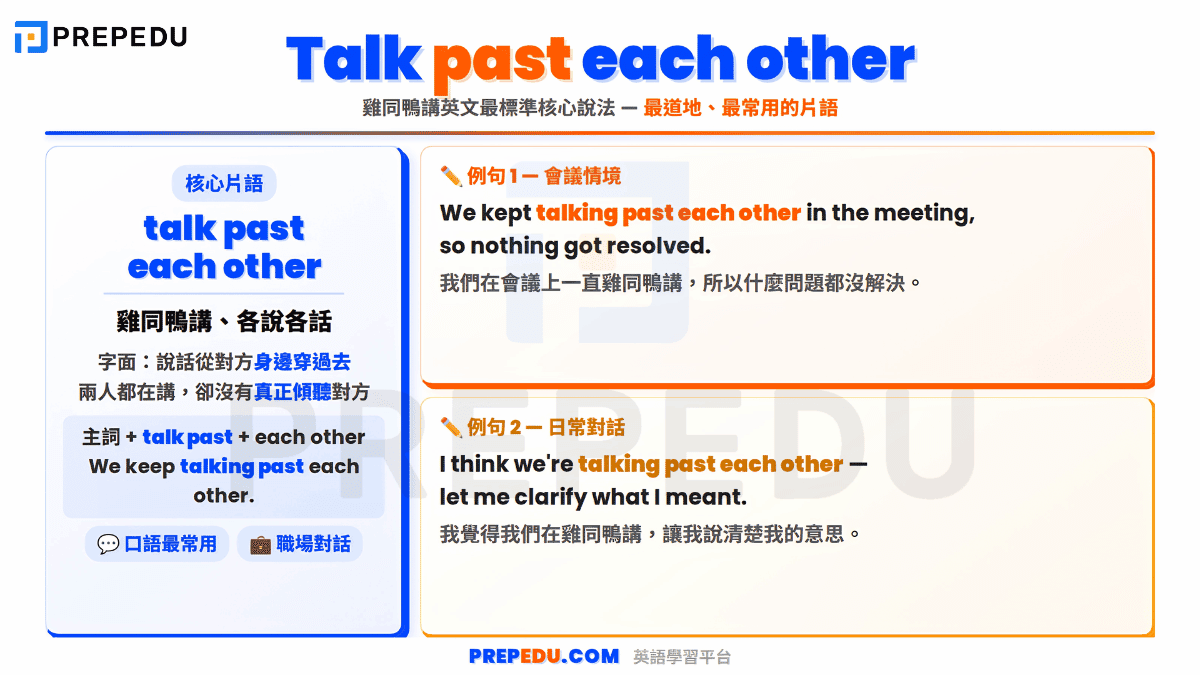
當你想說「雞同鴨講英文」怎麼表達,最道地、最常用的說法是 talk past each other。這個英文片語字面上的意思是「說話從對方身邊穿過去」,生動地勾勒出兩人各說各話、言語完全沒有交集的狀態。它不只描述語言不通,更強調雙方都在講話,卻沒有真正在傾聽或回應對方的核心意思——這正是「雞同鴨講」最精髓的語義所在。
-
We kept talking past each other in the meeting, so nothing got resolved.(我們在會議上一直雞同鴨講,所以什麼問題都沒解決。)
-
I think we're talking past each other — let me clarify what I meant.(我覺得我們在雞同鴨講,讓我說清楚我的意思。)
-
No matter how long they argued, they just talked past each other.(不管爭了多久,他們就是雞同鴨講,毫無共識。)
II. 雞同鴨講英文的其他5種常見說法
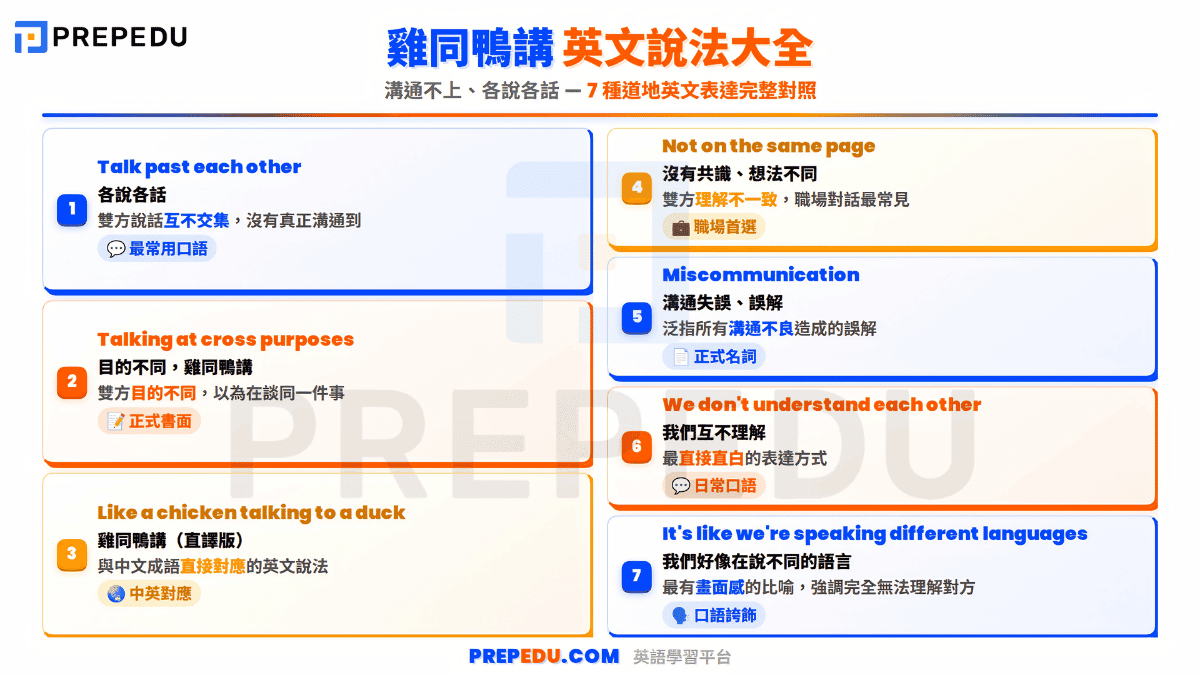
除了 talk past each other,英文中還有多種說法可以表達「雞同鴨講」的概念,各自帶有細微的語義差異與使用情境。掌握這些表達,能讓你在溝通時更靈活、更精準。
1. Talking at cross purposes
Talking at cross purposes 指兩人對話時各自在討論不同的事情,卻以為彼此在談同一件事,因而產生誤解。這個說法比 talk past each other 更強調「目標不一致」的狀態,常用於正式或半正式場合。在 TOEIC 職場英語或 IELTS 口說討論題中,這個片語能有效展示你對細膩語義差異的掌握。 例句:
-
I think we've been talking at cross purposes — I meant the budget for next quarter, not this one.(我想我們是在雞同鴨講,我說的是下一季的預算,不是這一季。)
-
They spent an hour talking at cross purposes before realizing they wanted the same thing.(他們雞同鴨講說了一個小時,才發現兩人其實要的是同一件事。)
-
It's easy to talk at cross purposes when the terms aren't clearly defined.(當術語沒有明確定義時,很容易就會雞同鴨講。)
2. Like a chicken talking to a duck
Like a chicken talking to a duck 直接借用了中文「雞同鴨講」的意象,在英語中雖非正式的標準慣用語,但在對話或寫作中使用時,對方通常能立刻領會其幽默而傳神的意涵。注意:這個說法較為創意性,在英語母語者之間不屬於慣用表達,適合輕鬆非正式語境,不建議在 IELTS 寫作或正式報告中使用。 例句:
-
Trying to explain the software to my grandma felt like a chicken talking to a duck.(試著向我阿嬤解釋這個軟體,感覺就像雞同鴨講一樣。)
-
Every time we discuss politics, it's like a chicken talking to a duck.(每次我們討論政治,就像雞同鴨講。)
-
They come from such different backgrounds that their conversations often feel like a chicken talking to a duck.(他們背景差異太大,對話常常像是雞同鴨講。)
3. Not on the same page
Not on the same page 是現代英語中極為常用的表達,意指兩人或多人對同一件事有不同的理解或期待。它的語氣比較中性,常見於職場、團隊討論或人際溝通的情境中,不帶強烈的負面意涵。相較於 talk past each other 強調「各說各話的動態過程」,not on the same page 更聚焦在「理解不一致的現況」。 例句:
-
It seems like we're not on the same page about the project timeline.(我們在專案時程這件事上似乎沒有共識。)
-
Let's make sure we're on the same page before moving forward.(在繼續之前,我們先確認彼此的理解一致。)
-
The two departments are clearly not on the same page, which is causing delays.(兩個部門顯然沒有共識,這正是造成延誤的原因。)
4. Miscommunication
Miscommunication 是一個英文名詞,直接指稱「溝通不良」或「誤解」的事實。它常用來事後描述一段雞同鴨講的溝通結果,語氣客觀,適合用於報告、道歉或分析問題的場合。與前面幾個片語不同,miscommunication 是一個獨立名詞,不需要搭配主詞英文和動詞英文的完整片語結構。 例句:
-
The whole conflict started from a miscommunication about the deadline.(整個衝突源於對截止日期的溝通誤解。)
-
There was a serious miscommunication between the client and the design team.(客戶與設計團隊之間出現了嚴重的溝通不良。)
-
We need to avoid miscommunication by setting clearer expectations from the start.(我們需要從一開始就設定更明確的期望,以避免溝通失誤。)
5. We don't understand each other
We don't understand each other 是最直接、最口語化的說法,適合在日常對話中坦白表達溝通困難的處境。它沒有隱喻,直接點明「我們無法理解彼此」,語氣誠懇,有時帶有一絲無奈或疲憊。這是六種說法中情感表達最直接的一種,適合在親密關係或情緒化的對話場景中使用。 例句:
-
I don't think we understand each other at all in this conversation.(我覺得我們在這段對話中完全無法理解彼此。)
-
We just don't understand each other — maybe we need a mediator.(我們就是無法理解彼此,或許需要一個調解人。)
-
Sometimes I feel like we don't understand each other, no matter how hard we try.(有時候我覺得不管我們多努力,就是無法理解彼此。)
6. It's like we're speaking different languages
It's like we're speaking different languages 是極具畫面感的比喻,意指兩人雖然用同一種語言交談,卻完全無法溝通,彷彿在說兩種截然不同的語言。它帶有強烈的情感色彩,常用於描述深層的理解鴻溝,不論是文化差異、價值觀衝突還是世代隔閡,都可以用這句話來形容。這是六種說法中語氣最強烈的一種,傳遞的是深層的無力感而非單純的誤解。 例句:
-
Whenever I talk to my boss about creativity, it's like we're speaking different languages.(每當我和老闆談到創意,就像我們在說兩種完全不同的語言。)
-
It's like we're speaking different languages — I can't get my point across no matter what I say.(就像我們在說不同的語言,不管我說什麼都無法表達我的意思。)
-
After years apart, it felt like they were speaking different languages when they finally reunited.(多年分離後,當他們終於重聚,感覺就像在說不同的語言。)
6種雞同鴨講英文說法的語氣、正式程度與適用場合各有不同,以下表格方便快速查詢與比較:
|
雞同鴨講英文說法 |
語氣特質 |
正式程度 |
最適情境 |
使用注意 |
|
Talk past each other |
客觀、描述動態 |
正式~非正式 |
所有場合通用 |
✅ 核心說法,最安全 |
|
Talking at cross purposes |
分析性、目標不一致 |
偏正式 |
職場、TOEIC/IELTS |
✅ 強調雙方目的不同 |
|
Like a chicken talking to a duck |
幽默、畫面感 |
非正式 |
輕鬆對話、自嘲 |
⚠️ 非標準英語慣用語 |
|
Not on the same page |
中性、現況描述 |
非正式 |
職場、團隊討論 |
✅ 最常見於現代職場 |
|
Miscommunication |
客觀、名詞形式 |
正式 |
報告、道歉、問題分析 |
✅ 事後描述最合適 |
|
We don't understand each other |
直接、情感誠懇 |
非正式 |
親密關係、情緒對話 |
⚠️ 語氣較強,帶無奈感 |
|
It's like we're speaking different languages |
強烈、情感深度 |
非正式 |
深層誤解、文化/世代差異 |
⚠️ 語氣最重,傳遞強烈無力感 |
III. 雞同鴨講英文情境對話:3個真實場景
以下三段情境對話涵蓋職場、家庭與朋友之間的溝通場景,幫助你感受這些說法在真實對話中的自然節奏。
1. 情境一:職場會議中的溝通卡關
|
雞同鴨講對話 |
中文翻譯 |
|
Xiaomei: I keep explaining the timeline, but the team just doesn't seem to get it. |
小美: 我一直在解釋時程,但團隊似乎就是不明白。 |
|
Xiaowang: Maybe you're talking past each other. Have you tried using a visual chart instead? |
小王: 也許你們在雞同鴨講。你有沒有試過改用視覺圖表來說明? |
|
Xiaomei: That's a good point. I think we've also been talking at cross purposes — they thought I meant this quarter's budget, not next quarter's. |
小美: 說得有道理。我也覺得我們目標根本不一致——他們以為我說的是這一季的預算,不是下一季的。 |
|
Xiaowang: That's a classic miscommunication. Let's set up a short alignment meeting before the next presentation. |
小王: 這是典型的溝通失誤。我們在下次報告前先開個短暫的對齊會議吧。 |
|
Xiaomei: Good idea. I'll make sure everyone is on the same page before we start. |
小美: 好主意。我會確認所有人在開始之前達成共識。 |
2. 情境二:與父母之間的世代溝通
|
雞同鴨講對話 |
中文翻譯 |
|
Xiao Lan: Every time I try to talk to my parents about my career, it feels like we're speaking different languages. |
小蘭: 每次我試著和父母談我的職涯規劃,感覺就像在說兩種不同的語言。 |
|
Xiaowang: I totally understand. Generational gaps can make communication really difficult. |
小王: 我完全理解。世代差距真的會讓溝通變得非常困難。 |
|
Xiao Lan: I just wish we were on the same page, even just once. |
小蘭: 我只希望我們哪怕有一次能達成共識。 |
|
Xiaowang: Maybe the problem is that you're talking at cross purposes — you're talking about fulfillment, and they're talking about stability. They're not the same goal. |
小王: 也許問題在於你們目標根本不同——你在談的是成就感,他們在談的是穩定性。這是兩件事。 |
|
Xiao Lan: That's actually a really good way to put it. Maybe if I reframe the conversation, we'll stop talking past each other. |
小蘭: 這個說法真的很準確。也許如果我換個方式切入,我們就不會再雞同鴨講了。 |
3. 情境三:朋友之間的誤解
|
雞同鴨講對話 |
中文翻譯 |
|
Xiaomei: I tried to explain why I was upset, but he didn't get it at all. We just don't understand each other. |
小美: 我試著解釋我為什麼難過,但他完全聽不懂。我們就是無法理解彼此。 |
|
Xiaowang: Sounds like there was a major miscommunication. Did you two actually listen to each other? |
小王: 聽起來是嚴重的溝通不良。你們有沒有真的在聆聽對方說話? |
|
Xiaomei: Honestly, it was like a chicken talking to a duck the whole time. |
小美: 老實說,整個過程就像雞同鴨講。 |
|
Xiaowang: That happens when both sides are trying to be heard but not trying to understand. It's like you were both talking past each other. |
小王: 當雙方都只想被聽見、卻不想理解對方時,就會發生這種事。你們等於是各說各話。 |
|
Xiaomei: You're right. Maybe I need to listen first instead of just explaining myself. |
小美: 你說得對。也許我需要先聆聽,而不是只是一直解釋自己。 |
IV. 雞同鴨講英文常見問題 FAQ
1. Talk past each other 和 talking at cross purposes 有什麼不同?
Talk past each other 描述的是「各說各話的動態過程」——雙方都在開口說話,但沒有真正在聽對方說什麼,對話沒有交集。Talking at cross purposes 則強調「目標不一致」的狀態——雙方以為在討論同一件事,實際上卻各自指向不同的目標。簡單說:前者是「沒有在聽」,後者是「方向本來就不同」。在 TOEIC 職場英語情境中,能分辨這兩種語感,是表達溝通問題時展示詞彙深度的關鍵。
2. Not on the same page 可以用在正式場合嗎?
可以,但需要謹慎。Not on the same page 在現代職場英語中已被廣泛接受,在工作電郵、會議討論或一般商業溝通中使用完全沒問題。不過在高度正式的法律文件、學術論文或政府報告中,建議改用更正式的表達,例如「there is a discrepancy in understanding」或「both parties hold different interpretations」。
3. Like a chicken talking to a duck」可以說給英語母語者聽嗎?
可以,但需要了解其限制。這個說法直接翻譯自中文「雞同鴨講」,在英語中屬於創意性表達,不是標準的英語慣用語。英語母語者通常能從字面意義理解你的意思,而且會覺得有趣或有文化特色。但在 IELTS 寫作、TOEIC 考試或正式場合中,請改用 talk past each other 或 talking at cross purposes,避免讓對方認為你混淆了中英文語法。
4. 如何在 IELTS 口說中自然地使用這些表達?
在 IELTS 口說 Part 3 的社會議題討論中,這些表達可以有效展示你的詞彙多樣性。例如回答「Why do people often misunderstand each other?」時,可以說:「People often talk past each other because they assume shared understanding without checking. Sometimes they're simply not on the same page about the core issue.」這樣的回答結合了兩個地道表達,同時展示了你對語義差異的掌握,符合 IELTS Lexical Resource 的高分要求。
結論
「雞同鴨講英文」的核心說法只有一個:talk past each other。但真正讓你的英文表達脫穎而出的,是能依據語境精準選擇——用 talking at cross purposes 點出目標不一致的職場誤解,用 not on the same page 在團隊會議中中性地提醒共識差距,用 it's like we're speaking different languages 傳達深層的文化或世代鴻溝。
本文整理了六種雞同鴨講英文說法,涵蓋快速對照表、使用注意事項、三段完整雙語情境對話,以及針對常見混淆點的 FAQ 解析。這些說法背後有一個共同邏輯:越客觀的說法越適合職場與正式場合,越帶情感的說法越適合描述人際之間深層的理解鴻溝。掌握這個原則,你就能在任何場景精準選用。
PREPEDU 提供完整的英語學習資源,從日常慣用語到 IELTS 與 TOEIC 考試技巧,幫助你建立真正的語感與表達自信。下一步,可以進一步學習英文溝通與表達意見的完整句型系統,讓你的英文在每一個場合都更加到位。

你好!我叫黃秋賢,現在在 prepedu.com 擔任內容企劃。我有超過5年的英語與韓語自學經歷,親身備考 IELTS、TOEIC 與 TOPIK,累積了大量第一手的學習者視角——包括哪些語法規則最讓台灣與香港學習者混淆,以及如何在有限的備考時間內最有效地修正這些錯誤。目前已在 prepedu.com 撰寫超過 1000 篇英語學習文章,內容涵蓋語法、詞彙與考試策略,累積協助數千位學習者解決自學過程中的語法疑問。
評論












統一企業編號:202227322W
地址:114 LAVENDER STREET, #11-83 CT HUB 2, SINGAPORE (338729)