比較級英文(Comparative)全攻略:從變化規則、句型到常見陷阱(附不規則變化表與練習題)
英文比較級是什麼?如何正確使用?比較級(Comparative)是英文中用來比較兩個人、事物或程度差異的文法結構,透過在形容詞或副詞後加 -er(如 taller)或前面加 more(如 more beautiful),再搭配 than 來表達「A 比 B 更...」的概念。掌握比較級不僅能讓你在日常對話中精準表達,更是 IELTS、TOEIC 等國際英語考試的必考重點。
想像你正在台北東區逛街,想向朋友描述「這家餐廳比那家貴」或「捷運比公車快」,這些生活中隨處可見的比較場景,都需要用到比較級。然而,許多學習者常在「什麼時候加 -er?什麼時候用 more?」、「good 的比較級為什麼是 better?」等問題上感到困惑。事實上,比較級的變化規則雖有系統,但不規則變化和特殊用法常成為學習者的絆腳石。
PREPEDU 整理出這份最完整的比較級英文全攻略。本文將帶你從基礎的 5 大拼寫規則、多音節判斷標準,到進階的雙重比較句型、副詞比較級用法,並附上不規則變化表和 30 題實戰練習,讓你一次徹底搞懂英文比較級的所有眉角。

- I. 比較級英文是什麼?認識形容詞比較級與用法邏輯
- II. 英文比較級的基本結構:短形容詞與長形容詞的區別
- III. 短形容詞/副詞公式:掌握後綴 -er 的 5 大拼寫規則
- IV. 比較級什麼時候要加 more?多音節與長單字的用法規則
- V. 必背比較級單字表與不規則變化
- VI. 比較級中的特殊單字:兩者皆可、絕對形容詞與例外
- VII. 比較級句型全解析:than、劣等比較與倍數表達法
- VIII. 進階變體:The + 比較級... the + 比較級與趨勢描述
- IX. 什麼時候用副詞比較級?動詞修飾與狀態對比的關鍵
- X. 實戰演練:形容詞比較級學習單(附題目與答案)
- XI. 補充資訊:關於比較級的深度常見問題
- 結論
I. 比較級英文是什麼?認識形容詞比較級與用法邏輯
英文的比較級(Comparative)用於對比兩個實體在性質、數量或程度上的差異,通常在英文形容詞或英文副詞後加上 -er 或前面加上 more,並搭配 than 使用。當你想表達「A 比 B 更...」的概念時,就需要使用比較級。比較級是英文中最實用的文法工具之一,掌握它能讓你的英語表達更精準、更有層次。
基本結構:
A + 動詞 + 形容詞/副詞比較級 + than + B
範例說明:
-
This bubble tea shop in Taipei is more popular than that one in Taichung.(台北這家手搖飲店比台中那家更受歡迎。)
-
The train from Taipei to Kaohsiung is faster than the bus.(從台北到高雄的火車比巴士快。)
理解比較級的用法邏輯,你就能在描述任何比較情境時都得心應手,無論是學術寫作還是日常對話。
II. 英文比較級的基本結構:短形容詞與長形容詞的區別
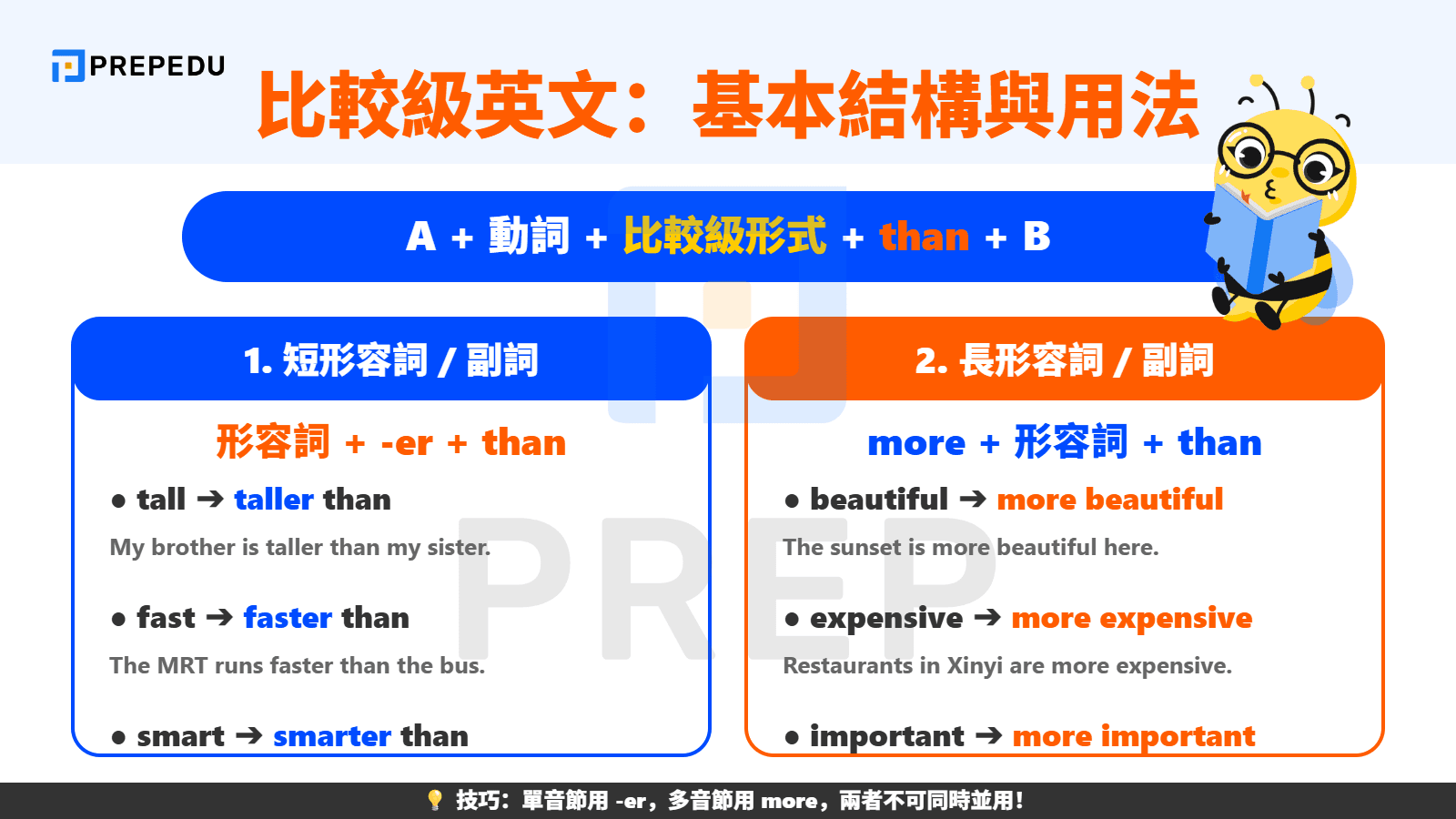
理解比較級怎麼用,首先要掌握英文短形容詞和長形容詞的結構差異。比較級的形成方式主要分為兩種:短音節單字加 -er,多音節單字用 more。這個規則決定了你如何正確表達比較概念。
1. 短形容詞/副詞的比較級結構
結構公式:
形容詞/副詞 + -er + than
|
原級 |
比較級 |
例句 |
|
tall |
taller |
My brother is taller than my sister.(我哥哥比我妹妹高。) |
|
fast |
faster |
The MRT in Taipei runs faster than the bus system.(台北捷運比公車系統快。) |
|
old |
older |
This temple in Tainan is older than that pagoda in Taipei.(台南這座廟比台北那座塔舊。) |
|
smart |
smarter |
Lisa from Hong Kong is smarter than most students in her class.(來自香港的麗莎比班上大多數學生聰明。) |
2. 長形容詞/副詞的比較級結構
結構公式:
more + 形容詞/副詞 + than
|
原級 |
比較級 |
例句 |
|
beautiful |
more beautiful |
The sunset in Kenting is more beautiful than in Taipei city.(墾丁的夕陽比台北市區更美。) |
|
important |
more important |
Health is more important than wealth according to recent surveys.(根據近期調查,健康比財富重要。) |
|
carefully |
more carefully |
Amy from Taichung drives more carefully than her husband.(來自台中的艾美開車比她先生更小心。) |
|
expensive |
more expensive |
Restaurants in Xinyi District are more expensive than those in Wanhua.(信義區的餐廳比萬華區的貴。) |
掌握這兩種基本結構後,你就能在比較級的用法上更加自信。接下來我們將深入探討具體的拼寫規則。
III. 短形容詞/副詞公式:掌握後綴 -er 的 5 大拼寫規則
當你需要使用比較級時,短音節的形容詞和副詞通常會在字尾加上 -er。然而,不同的字尾結構會影響拼寫方式,掌握這五大規則能幫助你正確書寫每一個比較級單字。這些規則是比較級文法的核心基礎。
1. 規則一:單音節直接加 -er
大多數單音節單字直接在字尾加上 -er 即可,這是最基本也最常見的變化方式。
|
原級 |
比較級 |
例句 |
|
tall |
taller |
Taipei 101 is taller than any building in Taichung.(台北101比台中的任何建築都高。) |
|
small |
smaller |
My apartment in Hong Kong is smaller than my parents' house in Taipei.(我在香港的公寓比我父母在台北的房子小。) |
|
fast |
faster |
The High Speed Rail runs faster than regular trains between cities.(高鐵在城市間行駛比普通火車快。) |
|
young |
younger |
Chen is younger than his sister Lisa by five years.(小陳比他姐姐麗莎小五歲。) |
2. 規則二:字尾是 e 僅加 -r
當單字本身已經以字母 e 結尾時,只需要加上 r 就能形成比較級,避免重複拼寫。這個規則適用於所有以 e 結尾的形容詞。
|
原級 |
比較級 |
例句 |
|
large |
larger |
The dining room in this Taipei restaurant is larger than the bedroom.(這家台北餐廳的用餐區比臥室大。) |
|
nice |
nicer |
The weather in Taipei today is nicer than it was yesterday.(台北今天的天氣比昨天好。) |
|
safe |
safer |
This neighborhood in Daan District is safer than that area in Ximending.(大安區這個社區比西門町那個區域安全。) |
|
wise |
wiser |
My father in Hong Kong is wiser than most people I know.(我在香港的父親比我認識的大多數人都有智慧。) |
|
close |
closer |
My office in Xinyi is closer to the MRT station than yours.(我在信義區的辦公室比你的更靠近捷運站。) |
3. 規則三:CVC 結構重複字尾加 -er(重點規則)
這是許多學習者容易忽略的重點。當單字符合「子音 + 母音 + 子音」(CVC)結構,且重音在最後一個音節時,必須重複最後一個子音字母再加 -er。這個規則能確保發音的準確性。
|
原級 |
比較級 |
例句 |
|
big |
bigger |
The department store in Xinyi District is bigger than the one in Shilin.(信義區的百貨公司比士林的那家大。) |
|
fat |
fatter |
This pork belly from Tainan is fatter than the lean meat.(這塊來自台南的五花肉比瘦肉更肥。) |
|
hot |
hotter |
Summer in Kaohsiung is hotter than in Taipei by several degrees.(高雄的夏天比台北熱好幾度。) |
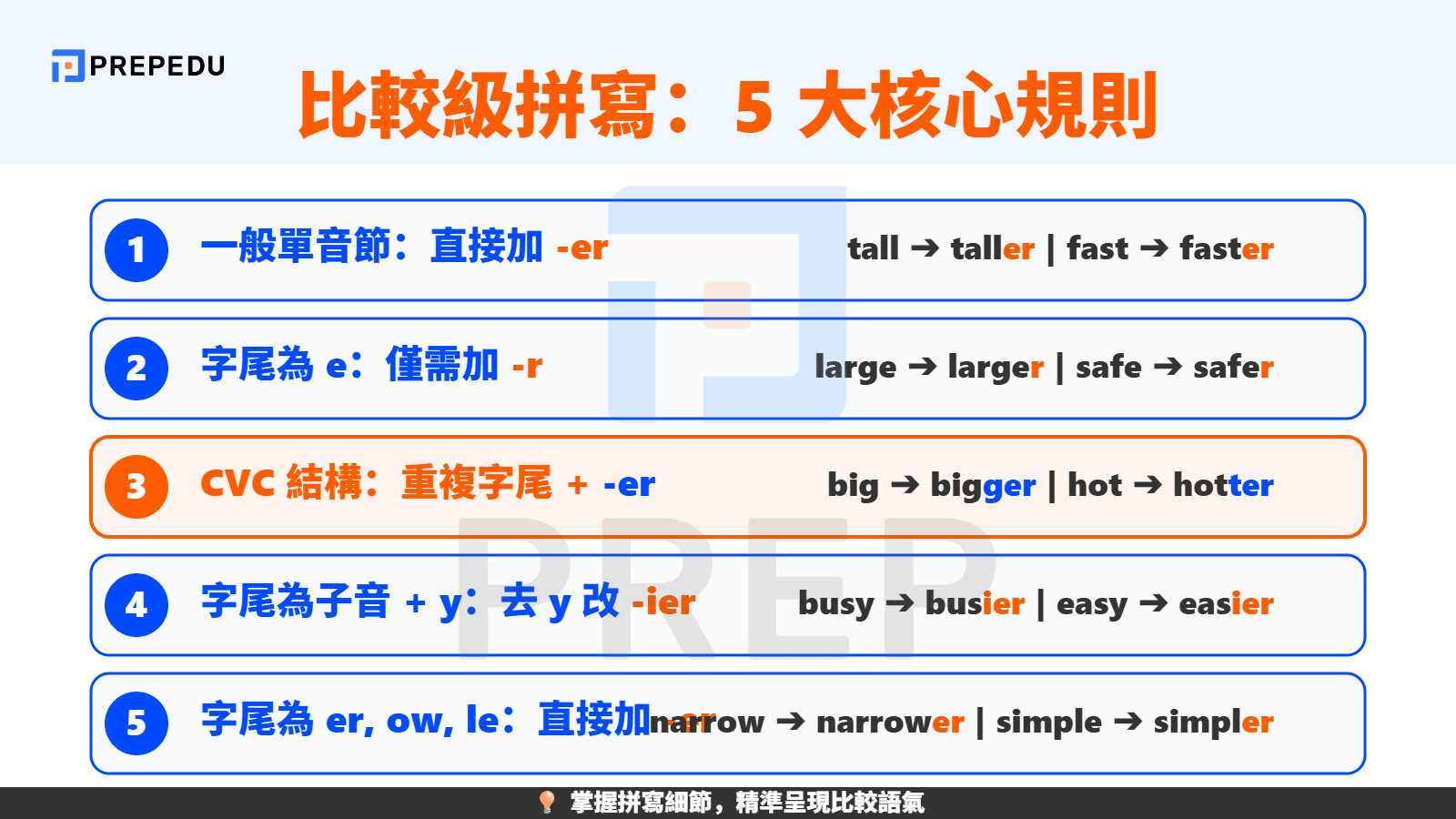
4. 規則四:字尾是 y 去 y 加 -ier
當單字以「子音 + y」結尾時,需要將 y 改為 i 再加上 -er。這個規則適用於許多常見的雙音節形容詞,是比較級變化中最常見的特殊規則之一。
|
原級 |
比較級 |
例句 |
|
happy |
happier |
Lisa from Taipei feels happier now than she did in Hong Kong.(來自台北的麗莎現在比在香港時更快樂。) |
|
easy |
easier |
This English exam at Taiwan University is easier than the last one.(台灣大學這次英文考試比上次簡單。) |
|
busy |
busier |
Monday mornings at this Taipei cafe are busier than Friday afternoons.(這家台北咖啡廳週一早上比週五下午更忙碌。) |
|
early |
earlier |
Chen from Kaohsiung arrived earlier than Wang from Taipei at the meeting.(來自高雄的小陳比來自台北的小王更早到達會議。) |
|
heavy |
heavier |
My backpack from Hong Kong is heavier than my laptop bag.(我從香港帶來的背包比我的電腦包重。) |
5. 規則五:特定雙音節字尾加 -er
某些以 -er、-ow、-le 結尾的雙音節單字,可以直接加上 -er 形成比較級,不需要使用 more。這些單字雖然是雙音節,但遵循短單字的變化規則。
|
原級 |
比較級 |
例句 |
|
clever |
cleverer |
Amy's marketing solution is cleverer than mine at the company.(艾美在公司的行銷方案比我的更聰明。) |
|
narrow |
narrower |
The alley in Dadaocheng is narrower than the main street in Xinyi.(大稻埕的巷子比信義區主要街道窄。) |
|
gentle |
gentler |
The breeze in Tamsui riverside is gentler than the wind in Kenting.(淡水河邊的微風比墾丁的風更溫和。) |
|
simple |
simpler |
This grammar rule for comparatives is simpler than the previous one.(這個比較級文法規則比上一個簡單。) |
掌握這五大拼寫規則後,你就能正確處理大部分英文比較級的變化情況,讓你的書寫和口語表達都更加準確。
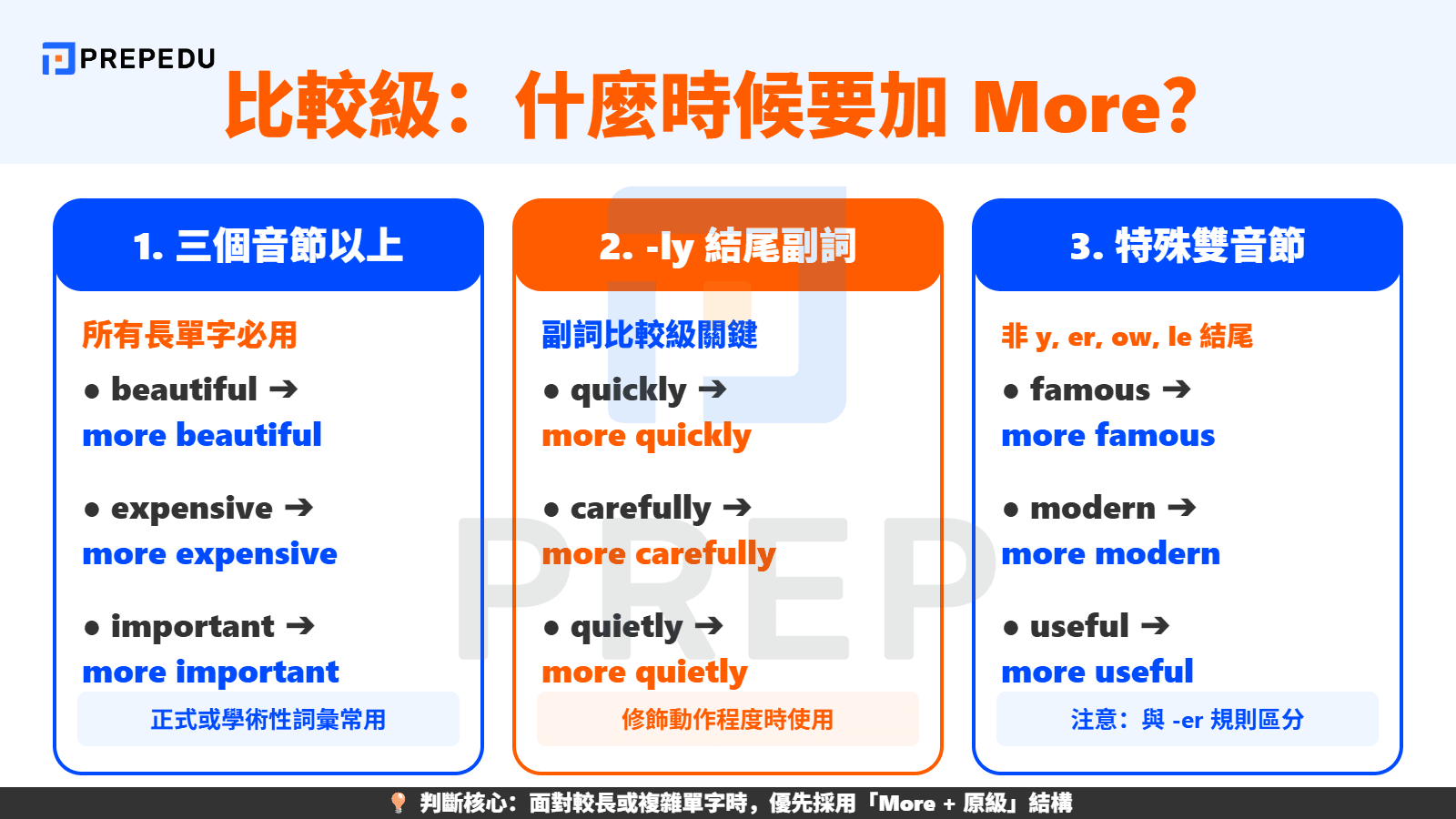
IV. 比較級什麼時候要加 more?多音節與長單字的用法規則
許多學習者經常問:「比較級什麼時候要加 more?」答案很簡單:當面對較長或較複雜的單字時,需要採用「more + 原級」的結構來形成比較級。理解這個判斷標準,你就能在需要使用比較級時做出正確選擇。
1. 三個音節以上的形容詞必須用 more
所有三個音節(或以上)的形容詞,都必須在前面加上 more,而非使用 -er 後綴。這些通常是較為正式或學術性的詞彙,在 IELTS 考試和 TOEIC 考試中經常出現。
|
原級 |
比較級 |
例句 |
|
beautiful |
more beautiful |
The National Palace Museum in Taipei is more beautiful than I expected.(台北故宮博物院比我預期的更美。) |
|
important |
more important |
Family is more important than career for many people in Taiwan.(對許多台灣人來說,家庭比事業重要。) |
|
expensive |
more expensive |
Imported fruits in Taipei are more expensive than local produce.(台北的進口水果比本地產品貴。) |
|
comfortable |
more comfortable |
This hotel in Kaohsiung is more comfortable than the one in Taichung.(高雄這間飯店比台中那間舒適。高雄這間飯店比台中那間舒適。) |
|
intelligent |
more intelligent |
Chen from National Taiwan University is more intelligent than most students.(來自台灣大學的小陳比大多數學生聰明。) |
2. 大部分 -ly 結尾的副詞用 more
副詞比較級的形成方式與形容詞略有不同。多數由形容詞加上 -ly 形成的副詞,其比較級都需要在前面加上 more。這是判斷什麼時候用副詞比較級的關鍵規則。
|
原級 |
比較級 |
例句 |
|
quickly |
more quickly |
Wang from Taipei types more quickly than his colleagues at the office.(來自台北的小王在辦公室打字比他的同事快。) |
|
carefully |
more carefully |
Amy from Taichung drives more carefully than her husband on mountain roads.(來自台中的艾美在山路上開車比她先生更小心。) |
|
easily |
more easily |
Students from international schools learn English more easily than others.(國際學校的學生比其他人更容易學英語。) |
|
quietly |
more quietly |
Please speak more quietly in the Taipei library than in the cafe.(請在台北圖書館比在咖啡廳更安靜地說話。) |
|
slowly |
more slowly |
The elderly in Taipei streets walk more slowly than young people.(台北街道上的老年人走得比年輕人慢。) |
3. 雙音節形容詞的判斷方法
雙音節形容詞是最容易混淆的類別。一般來說,如果雙音節形容詞不是以 -y、-er、-ow、-le 結尾,就應該使用 more。這個判斷標準能幫助你在比較級用法上做出正確選擇。
|
原級 |
比較級 |
例句 |
|
famous |
more famous |
Taipei 101 is more famous than other buildings in Asia.(台北101比亞洲其他建築更有名。) |
|
active |
more active |
Young people in Taipei are more active on social media than older generations.(台北的年輕人在社群媒體上比老一輩更活躍。) |
|
useful |
more useful |
This language learning app is more useful than that website for studying English.(這個語言學習應用程式比那個網站更適合學英語。) |
|
modern |
more modern |
The MRT system in Taipei is more modern than in many Asian cities.(台北的捷運系統比許多亞洲城市更現代化。) |
|
common |
more common |
Online shopping in Taiwan is more common now than five years ago.(現在台灣網購比五年前更普遍。) |
重要提醒: 有些雙音節形容詞既可以加 -er,也可以用 more(例如:common 可以是 commoner 或 more common)。然而,為了避免混淆,建議初學者優先記住「兩個音節以上且非 y 字尾者使用 more」的原則。
記住這個判斷標準,你就能在日常溝通中快速選擇正確的比較級形式,無論是書寫還是口語表達都更加準確。
V. 必背比較級單字表與不規則變化
英文中有一些常用單字的比較級變化完全不遵循規則,這些不規則變化必須透過記憶來掌握。這些單字在日常對話和考試中的出現頻率極高,是比較級學習的重點。以下是你需要優先背誦的比較級單字表:
核心不規則變化表
|
原級 |
比較級 |
最高級 |
例句 |
|
good |
better |
best |
This restaurant in Taipei serves better food than the one in Taichung.(台北這家餐廳的食物比台中那家好。) |
|
well |
better |
best |
Chen from Hong Kong speaks English better than Wang from Taipei.(來自香港的小陳英語說得比來自台北的小王好。) |
|
bad |
worse |
worst |
The traffic in Taipei during rush hour is worse than in Tainan.(尖峰時段台北的交通比台南糟。) |
|
badly |
worse |
worst |
My team from Kaohsiung performed worse than expected in the competition.(我來自高雄的團隊在比賽中表現得比預期差。) |
|
many |
more |
most |
There are more tourists in Taipei than in Hualien during summer vacation.(暑假期間台北的遊客比花蓮多。) |
|
much |
more |
most |
Amy from Taichung earns more money than her brother does.(來自台中的艾美賺的錢比她哥哥多。) |
|
little |
less |
least |
I have less time than you to prepare for the TOEIC exam.(我準備多益考試的時間比你少。) |
|
far |
farther / further |
farthest / furthest |
Kaohsiung is farther from Taipei than Taichung is by train.(搭火車的話高雄離台北比台中遠。) |
這些比較級最高級英文的不規則變化是日常對話中使用頻率最高的詞彙,必須熟記到能直覺反應的程度。
特別注意:far 的兩種比較級 →「far」這個單字有兩組比較級和最高級,它們的使用情境不同,這是比較級用法中需要特別掌握的重點:
|
farther / farthest |
主要用於描述實際的物理距離。 例如:「The East Coast of Taiwan is farther from Taipei than the West Coast.」(台灣東海岸比西海岸離台北更遠。)這個用法強調的是可以測量的距離,通常以公里(kilometers)或英里(miles)為單位。 |
|
further / furthest |
則多用於抽象概念或程度上的延伸。 例如:「We need further discussion on this project proposal at the Taipei office.」(我們需要在台北辦公室對這個專案提案進行更深入的討論。)在學術寫作或商業溝通中,further 的使用頻率往往高於 farther。 |
量詞的比較級變化 → 表示數量的單字也有特殊的比較級形式,這在描述數據和統計時特別重要。「many」和「much」的比較級都是「more」,但使用時機不同:
|
many 用於可數名詞 |
much 用於不可數名詞 |
|
|
同樣地,「little」的比較級「less」也需要搭配不可數名詞使用(less time for preparation - 更少準備時間,less money in the budget - 預算裡更少錢),可數名詞則應使用「fewer」(fewer books on the shelf - 架上更少書籍,fewer students in class - 課堂上更少學生)。
掌握這些不規則變化後,你的比較級用法將更加準確和道地,在 IELTS 和 TOEIC 考試中也能展現出更高的語言水平。
VI. 比較級中的特殊單字:兩者皆可、絕對形容詞與例外
在比較級文法中,有一些特殊情況需要你額外留意。這些例外情況雖然不常見,但了解它們能展現你對英文的深度理解,讓你在使用比較級時更加精準。
1. 兩者皆可的雙音節形容詞
某些雙音節形容詞既可以加 -er,也可以使用 more,兩種形式在語意上沒有差異,只是在正式程度上略有不同。使用 more 的形式通常顯得更正式,而 -er 形式則較為口語化。
|
原級 |
比較級(兩種形式) |
例句 |
|
simple |
simpler / more simple |
This English grammar rule is simpler than the previous one we learned.(這個英文文法規則比我們之前學的更簡單。) |
|
clever |
cleverer / more clever |
Wang from Taipei is cleverer than his colleagues at solving problems.(來自台北的小王比他的同事更擅長解決問題。) |
|
quiet |
quieter / more quiet |
The library in National Taiwan University is quieter than the cafe.(台灣大學的圖書館比咖啡廳更安靜。) |
|
narrow |
narrower / more narrow |
This street in old Taipei is narrower than modern boulevards.(台北老街區的這條街比現代化大道更窄。) |
|
common |
commoner / more common |
Bubble tea is commoner in Taiwan than in most other countries.(手搖飲在台灣比大多數其他國家更普遍。) |
在 IELTS 或 TOEIC 等考試寫作中,兩種形式都被視為正確答案,你可以根據句子的節奏感和整體風格來選擇。一般建議在正式寫作中使用 more,口語表達則可以選擇 -er。
2. 絕對形容詞不能加比較級
有些形容詞本身就表達了「絕對」或「極端」的概念,理論上不應該再有程度上的比較。這些被稱為「絕對形容詞」(Absolute Adjectives),在使用比較級時需要特別注意避免這些詞。
|
絕對形容詞 |
中文 |
錯誤示範 |
正確表達 |
|
unique |
獨特的 |
more unique(錯誤) |
distinctive / unusual(獨特的) |
|
perfect |
完美的 |
more perfect(錯誤) |
more nearly perfect(更接近完美) |
|
dead |
死的 |
deader(錯誤) |
completely dead(完全死亡) |
|
empty |
空的 |
emptier(錯誤) |
more nearly empty(更接近空的) |
|
full |
滿的 |
fuller(錯誤) |
more completely full(更完全滿的) |
|
impossible |
不可能的 |
more impossible(錯誤) |
even less possible(更不可能) |
|
essential |
必要的 |
more essential(錯誤) |
more critical / important(更關鍵的) |
|
absolute |
絕對的 |
more absolute(錯誤) |
more strictly absolute(更嚴格絕對的) |
邏輯上來說,一件事物要嘛是獨特的,要嘛不是,不存在「更獨特」的說法。因此,在學術寫作或正式場合中使用比較級時,應避免使用這類絕對形容詞,改用其他替代詞彙來表達。
重要提醒: 然而,在非正式英語或口語中,你有時會聽到母語人士說「more perfect」,這種用法是為了強調「更接近完美」的概念。但在學術寫作、IELTS 或 TOEIC 正式考試中,建議避免這種用法。
3. 短音節副詞的例外
雖然我們說過大部分副詞的比較級需要加 more,但有些單音節副詞卻是例外。這些副詞同時也是形容詞,因此遵循形容詞的變化規則。
|
副詞原級 |
比較級 |
例句 |
|
fast |
faster |
Chen from Kaohsiung runs faster than his teammates in the race.(來自高雄的小陳在比賽中跑得比他的隊友快。) |
|
hard |
harder |
Amy from Taipei works harder than anyone else in her department.(來自台北的艾美工作比她部門的任何人都努力。) |
|
early |
earlier |
The train from Taipei arrives earlier than the bus from Taichung.(從台北開來的火車比從台中開來的公車更早到達。) |
|
late |
later |
Wang from Hong Kong finished his homework later than Lisa from Taiwan.(來自香港的小王比來自台灣的麗莎更晚完成作業。) |
特別注意: 「hardly」是個完全不同的副詞,意思是「幾乎不」,不是 hard 的副詞形式。「He hardly works.」的意思是「他幾乎不工作」,而非「他工作很努力」。這是許多學習者在使用比較級時容易混淆的地方。
另一個容易混淆的是「well」和「good」。「well」作為副詞時,它的比較級是「better」(與形容詞 good 的比較級相同),而非「more well」。例如:「She speaks English better than her classmates.」(她英語說得比同學們好。)
掌握這些特殊情況和例外後,你在使用比較級時就能避免常見錯誤,展現更專業的英文能力。
VII. 比較級句型全解析:than、劣等比較與倍數表達法
掌握比較級的變化規則後,接下來要學習如何在句子中靈活運用。比較級句型的變化多樣,能讓你的表達更加豐富和精確。這一節將回答「比較級前面可以加什麼?」這個常見問題。
1. 基礎比較句型:A + be/V + 比較級 + than + B
最基本的比較級句型:
A + be/V + 比較級 + than + B
例句:
-
This book about Taipei history is more interesting than that one about Kaohsiung.(這本關於台北歷史的書比那本關於高雄的更有趣。)
-
She speaks English better than her classmates at Taiwan University.(她在台灣大學英語說得比同學們好。)
-
The new MRT line runs faster than the old system in Taipei.(新的捷運線比台北舊系統跑得快。)
2. 比較級的修飾語:回答「比較級前面可以加什麼?」
當你想強調兩者之間的差距程度時,可以在比較級前面加上修飾語。這是回答「比較級前面可以加什麼?」這個常見疑問的關鍵。常用的修飾語包括:
|
強調差距大的修飾語 |
|
|
強調差距小的修飾語 |
|
重要原則:比較級前面絕對不能使用「very」。 「very bigger」或「very more important」都是錯誤的說法。正確的表達應該是「much bigger」或「far more important」。
3. 劣等比較:less... than
當你想表達「A 不如 B」或「A 比 B 更不...」時,可以使用「less + 原級 + than」的結構。這種比較級句型在學術寫作中特別常見。
例句:
-
This method is less effective than the traditional approach used in Taiwan.(這個方法不如台灣使用的傳統方法有效。)
-
He is less confident than his sister when speaking English.(他說英語時不如他姐姐有自信。)
-
Online courses are less interactive than face-to-face classes at Taipei universities.(線上課程不如台北大學的面對面課程互動性強。)
需要注意的是: less 後面接的是形容詞或副詞的原級,而非比較級。「less better」是錯誤的,應該直接說「worse」。
4. 倍數比較表達
當你需要表達「A 是 B 的幾倍」時,可以使用以下兩種結構,這在商業報告和數據分析中經常出現:
結構 A:
A + be + 倍數 + as + 原級 + as + B
例句:
-
This house in Taipei is three times as expensive as that one in Tainan.(這棟台北的房子價格是台南那棟的三倍。)
-
The new factory produces twice as many products as the old one.(新工廠生產的產品是舊工廠的兩倍。)
結構 B:
A + be + 倍數 + 比較級 + than + B
例句:
-
This apartment in Xinyi District is three times more expensive than that one in Wanhua.(信義區這間公寓比萬華那間貴三倍。)
-
Sales in Taipei increased twice more rapidly than in Kaohsiung last year.(去年台北的銷售額增長速度是高雄的兩倍。)
常用的倍數詞彙:
-
twice(兩倍)、three times(三倍)、four times(四倍)
-
half(一半)、double(雙倍)、triple(三倍)
這些比較級句型能讓你的英語表達更加精確,在商業溝通和學術寫作中特別有用。
VIII. 進階變體:The + 比較級... the + 比較級與趨勢描述
當你的英語水平提升到中高級階段,需要掌握一些更複雜的比較級結構來表達因果關係和動態變化。這些進階用法能讓你的英文表達更有邏輯層次。
1. 愈...愈...的雙重比較:The + 比較級..., the + 比較級...
「The + 比較級..., the + 比較級...」是表達「愈...就愈...」的經典句型,用來說明兩個因素之間的正比或反比關係。這個結構在英語中使用頻率很高,能讓你的表達更有邏輯層次。
句型結構:
The + 比較級 + 主詞 + 動詞,the + 比較級 + 主詞 + 動詞
實用範例:
-
The more you practice English, the better you will speak in conversations.(你練習英語愈多,對話時就說得愈好。)
-
The sooner we leave for Kaohsiung, the earlier we can arrive at the destination.(我們愈早出發去高雄,就能愈早到達目的地。)
簡化版本(常在口語中使用):
-
The sooner, the better.(愈快愈好。)
-
The more, the merrier.(愈多愈開心。)
-
The bigger, the better.(愈大愈好。)
-
The cheaper, the better.(愈便宜愈好。)
這些慣用語省略了主詞和動詞,但仍然遵循相同的比較級邏輯,在日常對話中使用頻率很高。
2. 比較級 + and + 比較級:表達「愈來愈...」
當你想描述某個特質「愈來愈...」的持續變化或趨勢時,可以使用「比較級 + and + 比較級」的重複結構。這種句型特別適合描述氣候變化、經濟趨勢、個人成長等逐漸演變的情況。
句型結構:
比較級 + and + 比較級
|
單音節形容詞的例句 |
多音節形容詞的例句 |
|
|
規則提醒:
-
對於單音節單字,直接重複比較級即可(faster and faster 愈來愈快)
-
對於多音節單字,則重複「more and more + 原級」(more and more beautiful 愈來愈美麗)
這個句型能有效傳達動態變化的感覺,讓你的描述更生動,在IELTS 和 TOEIC 寫作中經常使用。
IX. 什麼時候用副詞比較級?動詞修飾與狀態對比的關鍵
許多學習者在形容詞比較級和副詞比較級之間感到困惑,經常問:「什麼時候用副詞比較級?」理解兩者的差異,是精確使用比較級的關鍵。
核心差異:修飾對象不同
-
形容詞比較級用來修飾名詞,描述人或事物的特質。例如:「He is taller.」(他更高)這裡的 taller 修飾的是主詞 he。
-
副詞比較級則用來修飾動詞、形容詞或其他副詞,描述動作或狀態的方式和程度。例如:「He runs faster.」(他跑得更快)這裡的 faster 修飾的是動詞 runs。
判斷方法:看修飾的對象
|
類型 |
修飾對象 |
例句 |
說明 |
|
形容詞比較級 |
名詞 |
She is smarter than him.(她比他聰明。) |
smarter 描述「她」這個人的特質 |
|
副詞比較級 |
動詞 |
She works harder than him.(她工作比他努力。) |
harder 描述「工作」這個動作的方式 |
|
形容詞比較級 |
名詞 |
This is a better solution for the company.(這對公司來說是更好的解決方案。) |
better 修飾名詞 solution |
|
副詞比較級 |
動詞 |
He speaks English better at presentations.(他在簡報時英語說得更好。) |
better 修飾動詞 speaks |
同形異義的特殊詞彙
有些單字的形容詞和副詞形式完全相同,這時候只能透過上下文來判斷它的功能。最常見的例子是「fast」和「hard」。
|
形容詞 |
副詞 |
|
|
fast 的例子 |
He is a fast runner in the Taipei Marathon.(他是台北馬拉松中跑得快的選手。)→ 形容詞,修飾 runner |
He runs fast in every race.(他每場比賽都跑得快。)→ 副詞,修飾 runs |
|
hard 的例子 |
This is a hard question on the TOEIC exam.(這是多益考試中的難題。)→ 形容詞,修飾 question |
Chen from Taipei works hard at his job every day.(來自台北的小陳每天工作很努力。)→ 副詞,修飾 works |
特別注意: 「hardly」是個完全不同的副詞,意思是「幾乎不」,不是 hard 的副詞形式。這是回答「什麼時候用副詞比較級」時常見的誤解:
-
❌ 錯誤:He works hardly.(錯誤用法)
-
✅正確:He hardly works.(他幾乎不工作。)
-
✅正確:He works hard.(他工作努力。)
-
比較級:He works harder than before.(他工作比以前更努力。)
well 和 good 的區別:
另一個容易混淆的是「well」和「good」。「well」作為副詞時,它的比較級是「better」(與形容詞 good 的比較級相同),而非「more well」。
-
形容詞:She is a good English teacher in Taipei.(她是台北一位好的英語老師。)
-
副詞:She teaches English well at the school.(她在學校英語教得很好。)
-
比較級:She teaches English better than other teachers.(她英語教得比其他老師好。)
掌握形容詞與副詞比較級的區別後,你就能在描述人物特質和行為方式時做出精確的選擇,這對於 IELTS 和 TOEIC 考試的口語和寫作部分特別重要。
X. 實戰演練:形容詞比較級學習單(附題目與答案)
理論學習之後,讓我們透過實際練習來鞏固你對比較級最高級題目的掌握。以下三組練習涵蓋了從基礎到進階的各種題型,是完整的形容詞比較級學習單。
1. Part A:單字變換
將下列形容詞或副詞改為正確的比較級形式:
-
strong → __________
-
beautiful → __________
-
good → __________
-
happy → __________
-
far (距離) → __________
-
thin → __________
-
careful → __________
-
bad → __________
-
early → __________
-
expensive → __________
2. Part B:選擇題
選出正確的比較級形式:
-
This TOEIC exam is __________ than the last one at the testing center. (A) more difficult (B) difficulter (C) more difficulter
-
My brother in Taipei runs __________ than me in races. (A) more fast (B) faster (C) more faster
-
She is __________ person I know at Taiwan University. (A) kindest (B) more kind (C) kinder
-
The traffic situation in Taipei is getting __________. (A) worse and worse (B) more bad and more bad (C) badder and badder
-
This English learning method is __________ effective than that one. (A) less (B) lesser (C) few
-
Chen from Kaohsiung arrived __________ than expected at the meeting. (A) more early (B) earlier (C) more earlier
-
Hong Kong is __________ from Taipei than Kaohsiung is. (A) further (B) more far (C) farer
-
This grammar problem is __________ serious than we thought. (A) very (B) much (C) more much
-
Wang from Hong Kong speaks English __________ than his classmates. (A) good (B) better (C) more good
-
The weather in Taipei is __________ today than yesterday. (A) more hot (B) hotter (C) more hotter
3. Part C:改錯題
找出句中的錯誤並改正:
-
This grammar problem is more easier than that one.
-
Chen from Taipei is more stronger than his brother from Taichung.
-
She sings more better than before at the competition.
-
My apartment in Hong Kong is expensiver than yours in Taiwan.
-
The movie about Taipei was more boring than I thought.
-
This is the most unique design I've ever seen in Taiwan.
-
Amy from Kaohsiung is much more taller than her sister.
-
Wang works very harder than his colleagues at the company.
-
This solution is lesser effective than the previous one we tried.
-
The weather in Taiwan is getting more cold and more cold.
4. 完整解答與詳解
Part A 答案:
-
stronger(單音節加 -er)
-
more beautiful(三音節用 more)
-
better(不規則變化)
-
happier(y 字尾去 y 加 -ier)
-
farther(距離用 farther)
-
thinner(CVC 重複字尾加 -er)
-
more careful(三音節用 more)
-
worse(不規則變化)
-
earlier(y 字尾變化)
-
more expensive(三音節用 more)
Part B 答案:
-
(A) more difficult - 四音節單字使用 more
-
(B) faster - fast 是單音節,直接加 -er
-
(C) kinder - 題目要求比較級而非最高級
-
(A) worse and worse - bad 的比較級是 worse,重複表示愈來愈...
-
(A) less - 劣等比較使用 less + 原級
-
(B) earlier - early 的比較級是 earlier
-
(A) further - 距離和程度都可用 further(farther 也可接受)
-
(B) much - 比較級前用 much 表示「...得多」,不用 very
-
(B) better - well/good 的比較級都是 better
-
(B) hotter - hot 是 CVC 結構,重複 t 加 -er
Part C 答案與解析:
-
錯誤: more easier → 正確: easier(easy 已經是比較級,不需要 more)
-
錯誤: more stronger → 正確: stronger(strong 是單音節,不用 more)
-
錯誤: more better → 正確: better(better 本身就是比較級)
-
錯誤: expensiver → 正確: more expensive(三音節用 more)
-
正確(boring 是雙音節以上,使用 more 是對的)
-
錯誤: most unique → 正確: unique(unique 是絕對形容詞,不加比較級)
-
錯誤: more taller → 正確: much taller(tall 已是比較級,用 much 強調)
-
錯誤: very harder → 正確: much harder(比較級不用 very,用 much)
-
錯誤: lesser → 正確: less(表示「更少」用 less,不是 lesser)
-
錯誤: more cold and more cold → 正確: colder and colder(單音節重複比較級)
透過這些形容詞比較級學習單的練習,你應該能更清楚地掌握各種變化規則和常見錯誤,在 IELTS 和 TOEIC 考試中能夠靈活運用比較級。
XI. 補充資訊:關於比較級的深度常見問題
以下整理了四個最常被問到的深度問題,幫助你建立更完整的比較級知識體系。
1. 比較級前面一定要加 than 嗎?
答案是不一定。當上下文語意已經非常清楚時,than 及其後的比較對象可以省略。這種省略在日常對話中很常見,能讓表達更簡潔有力。
例如:
-
Which phone do you prefer, the one from Taipei or Hong Kong?(你喜歡哪支手機,台北的還是香港的?)
-
I like this one from Taipei. It's faster.」(我喜歡這支台北的,它更快。)
➡️ 這裡的 faster 雖然沒有接 than,但從對話脈絡可以清楚知道是在與另一支手機比較。
在廣告文案中,這種省略特別常見:
-
「New formula for Taipei customers - works better!」(台北顧客專用新配方,效果更好!)
-
「Choose the smarter option for your business.」(為你的生意選擇更聰明的選項。)
這些表達雖然沒有明確的比較對象,但暗示著與舊版本或其他選項的對比。
2. 什麼是「隱含比較」?
隱含比較(Implicit Comparison)指的是在句子中沒有明確使用比較級形式,但透過特定詞彙或結構暗示出比較的關係。理解隱含比較能幫助你更深入地掌握英文的比較邏輯。
常見的隱含比較詞彙包括:
-
prefer(更喜歡): I prefer Taipei bubble tea to Hong Kong coffee.(我更喜歡台北手搖飲勝過香港咖啡。)
-
superior to(優於): This product from Taiwan is superior to its competitors from other countries.(這個台灣產品優於其他國家的競爭對手。)
-
inferior to(劣於): The old model is inferior to the new version in terms of performance.(舊型號在性能上劣於新版本。)
-
senior to(資深於): Wang from Taipei is senior to Chen from Kaohsiung in the company.(來自台北的小王在公司資歷比來自高雄的小陳深。)
-
junior to(資淺於): Amy is junior to Lisa at Taiwan University by two years.(艾美在台灣大學比麗莎資淺兩年。)
另一種隱含比較出現在使用「compared to」或「in comparison with」的句子中。例如:「Compared to last year, our sales in Taiwan have increased significantly.」(與去年相比,我們在台灣的銷售額大幅增加。)雖然沒有使用 higher 或 greater,但比較關係已經透過 compared to 建立起來。
在 IELTS 寫作或學術論文中,適當使用隱含比較能讓你的表達更有變化,避免重複使用相同的比較級結構。
3. Happy, Simple, Modern 這些字要加 -er 還是 more?
這是許多學習者感到困擾的問題,因為這些雙音節單字位於「灰色地帶」。讓我逐一分析:
-
Happy: 必須用 happier(去 y 加 -ier),不能用 more happy。這是因為 happy 以「子音 + y」結尾,遵循明確的拼寫規則。例如:「Lisa from Taipei is happier now than before.」(來自台北的麗莎現在比以前更快樂。)類似的還有 lucky(luckier)、pretty(prettier)、silly(sillier)。
-
Simple: 兩種形式都可以接受 - simpler 或 more simple。在英式英語中,simpler 較常見;在美式英語中,兩者使用頻率相當。例如:「This English grammar rule is simpler than the previous one.」或「This English grammar rule is more simple than the previous one.」都正確。如果你希望表達聽起來更正式,可以選擇 more simple;若想讓語氣更輕鬆口語,則用 simpler。
-
Modern: 只能用 more modern,不能用 moderner。雖然 modern 是雙音節,但它不屬於可以加 -er 的特殊字尾類別(-er, -ow, -le, -y)。例如:「The MRT system in Taipei is more modern than in many cities.」(台北的捷運系統比許多城市更現代化。)類似的還有 famous(more famous)、useful(more useful)、careful(more careful)。
判斷原則總結:
-
以 -y 結尾的雙音節詞用 -ier
-
以 -er, -ow, -le 結尾的可用 -er 或 more
-
其他雙音節詞優先使用 more
當你不確定時,使用 more 通常是較安全的選擇,因為即使某個詞可以加 -er,用 more 也不會被視為錯誤,只是較為正式。
4. 比較級與最高級在 IELTS 或學術寫作中如何運用?
在 IELTS 寫作或學術報告中,正確運用比較級能顯著提升你的文法分數和表達精確度。以下是幾個實用的運用策略:
|
策略 1:數據描述中的比較 |
當你需要分析圖表或統計數據時,比較級是不可或缺的工具。 例如:「The unemployment rate in Taiwan in 2023 was significantly higher than in 2022, increasing from 3.8% to 4.5%.」(2023 年台灣的失業率顯著高於 2022 年,從 3.8% 上升到 4.5%。)這種描述既精確又專業。 |
|
策略 2:論點對比 |
在論述不同觀點時,使用比較級能讓你的邏輯更清晰。 例如:「While online learning offers greater flexibility for students in Taiwan, traditional classroom education provides more effective face-to-face interaction for language learning.」(雖然線上學習為台灣學生提供了更大的彈性,但傳統課堂教育為語言學習提供了更有效的面對面互動。) |
|
策略 3:趨勢描述 |
使用「比較級 + and + 比較級」來描述變化趨勢:「As globalization continues in Taiwan, international communication is becoming increasingly important for business professionals.」(隨著全球化在台灣持續,國際溝通對商業專業人士變得愈來愈重要。)或是「The gap between urban and rural areas in Taiwan is growing wider and wider.」(台灣城鄉差距正變得愈來愈大。) |
|
策略 4:避免絕對化表達 |
學術寫作強調客觀性,使用比較級比使用最高級更為謹慎。 與其說「This is the best solution for Taiwan's economy」(這是台灣經濟的最好解決方案),不如說「This approach appears to be more effective than traditional methods for Taiwan's economic development」(這個方法似乎比傳統方法對台灣的經濟發展更有效)。 |
在 TOEIC 的商業情境中,比較級也經常出現在報告、提案和商業信函裡。例如:「Our new product line performed better than competitors in the Taiwan market, achieving 35% higher sales in Q4.」(我們的新產品線在台灣市場表現優於競爭對手,第四季銷售額提高了35%。)
掌握專業的比較級表達,能讓你在職場溝通中更有說服力,在 IELTS 和 TOEIC 考試中也能獲得更高的分數。
結論
掌握比較級的完整體系需要時間和練習,但這項投資絕對值得。從基本的 -er 變化規則,到複雜的雙重比較句型,每個層次的知識都會讓你的英語表達更準確、更有層次。記住,比較級不只是文法規則,更是一種思考和表達邏輯的方式。
當你在日常對話、考試寫作或商業溝通中需要使用比較級時,回想本文整理的原則:單音節加 -er、多音節用 more、記住不規則變化、注意形容詞與副詞的差異、掌握比較級前面可以加什麼修飾語。透過持續練習和實際運用,你會發現比較級逐漸成為你英語表達的自然組成部分。
您是否曾懷疑自己能否達到目標分數?PREPEDU.COM 的 Test Practice 不僅協助您練習考題,更能根據目前成績精準預測達分可能性。
憑藉數千名成功學員的資料庫,系統分析分數趨勢並提供符合各項具體目標的個人化學習路徑。無論您的目標是雅思 6.5 分或多益 850 分,每個目標都有專屬策略。
視覺化進度追蹤功能顯示您目前的位置,以及達成目標還需多長時間。許多學員在持續練習 4-6 週後,雅思成績提升 0.5-1.0 分,多益成績增加 100-200 分。
成功並非來自運氣,而是源於周全的準備。讓 PREP Test Practice 成為連結現在與夢想的橋樑!

你好!我叫黃秋賢,現在在 prepedu.com 擔任內容企劃。我有超過5年的英語與韓語自學經歷,親身備考 IELTS、TOEIC 與 TOPIK,累積了大量第一手的學習者視角——包括哪些語法規則最讓台灣與香港學習者混淆,以及如何在有限的備考時間內最有效地修正這些錯誤。目前已在 prepedu.com 撰寫超過 1000 篇英語學習文章,內容涵蓋語法、詞彙與考試策略,累積協助數千位學習者解決自學過程中的語法疑問。
評論












統一企業編號:202227322W
地址:114 LAVENDER STREET, #11-83 CT HUB 2, SINGAPORE (338729)