植樹節英文怎麼說?Arbor Day 與 Tree Planting Day 用法完整解析
植樹節英文怎麼說?最標準的說法是 Arbor Day,在某些情境下也可以使用 Tree Planting Day。其中 Arbor Day 是國際間較正式且歷史悠久的名稱,而 Tree Planting Day 則偏向直譯與活動描述。了解植樹節英文的正確用法,不僅能幫助你在英文作文與口說中表達更準確,也能避免將其誤翻為一般的 environmental festival。
當你在課堂報告或國際交流中介紹這個節日時,是否曾猶豫該用哪一個名稱?其實,Arbor Day 強調的是植樹的紀念性與教育意義,而 Tree Planting Day 更著重於實際種樹行動。這樣的語境差異,往往是許多學習者容易忽略的細節。
在本篇文章中,PREPEDU 將完整解析 Arbor Day 與 Tree Planting Day 的字源背景、使用情境與常見例句,並整理相關環保單字與英文介紹範例,幫助你在寫作、簡報與日常對話中更自信地使用植樹節英文。

I. 植樹節英文怎麼說?最標準的說法
說起「植樹節英文」,許多人第一個想到的是直接翻譯 Tree Planting Day;然而在國際場合,尤其是英語母語環境,最通行的說法其實是 Arbor Day。這兩個詞都能指稱植樹節,但背後的語源、歷史脈絡與使用情境截然不同,理解這一點,你的英文表達就會更精確,也更具說服力。
1. Arbor Day
Arbor Day 源自拉丁語 arbor,意為「樹木」。1872 年,美國內布拉斯加州(Nebraska)的農業倡導者 J. Sterling Morton 首創這個節日,鼓勵民眾在當天種植樹木,以改善大草原地區的生態環境。這一倡議迅速擴展至全球,如今成為英語世界最具代表性的植樹節稱呼。
在使用情境上,Arbor Day 常見於英語新聞報導、國際環保組織的聲明、以及與英語母語者的正式交流。若你要撰寫 IELTS 作文討論環境議題,或進行 TOEIC 商務英語簡報,使用 Arbor Day 會更貼近國際讀者的認知框架。例如:
-
On Arbor Day, volunteers gathered in the park to plant over 500 native trees.(在植樹節當天,志工齊聚公園,種下超過 500 棵原生樹種。)
-
The Arbor Day Foundation has helped plant more than 500 million trees worldwide.(植樹節基金會已在全球協助種植超過 5 億棵樹木。)
-
Schools across the country hold special programs to mark Arbor Day each spring.(全國各地學校每年春天都舉辦特別活動,慶祝植樹節。)
2. Tree Planting Day
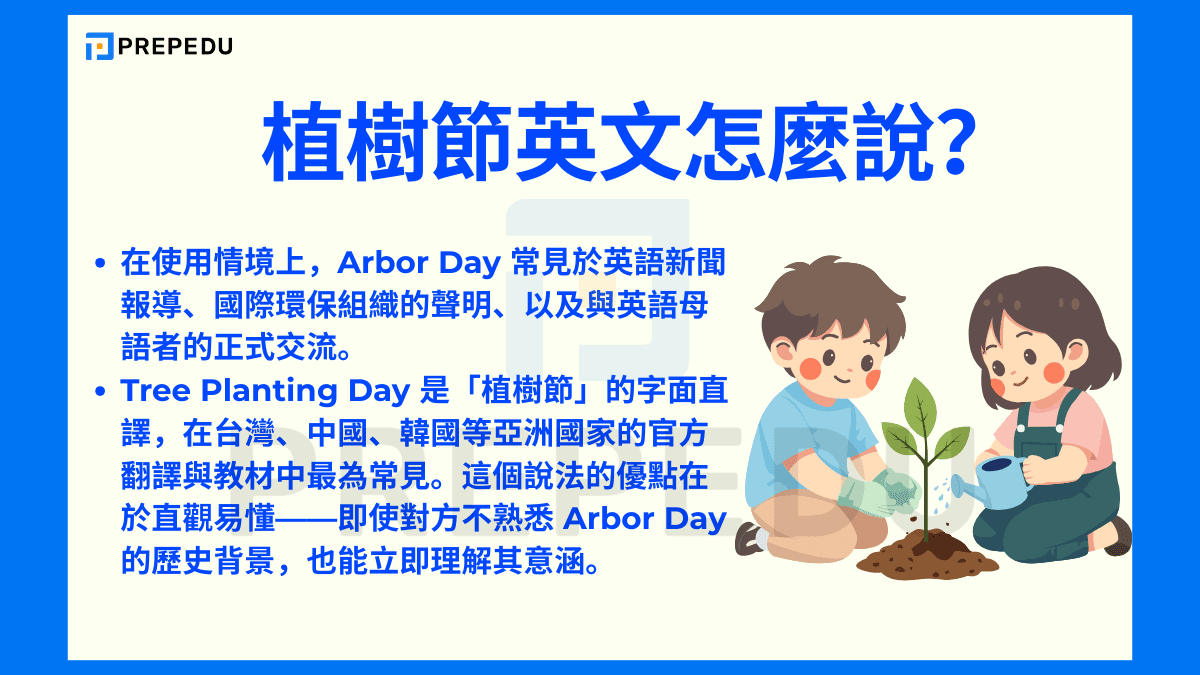
Tree Planting Day 是「植樹節」的字面直譯,在台灣、中國、韓國等亞洲國家的官方翻譯與教材中最為常見。這個說法的優點在於直觀易懂——即使對方不熟悉 Arbor Day 的歷史背景,也能立即理解其意涵。
在台灣,政府官方文件及學校課程通常以 Tree Planting Day 作為「植樹節」的英文對應詞。若你在撰寫學校作文、說明台灣或亞洲各國的節慶,Tree Planting Day 是更自然、更貼近在地語境的選擇。兩個詞互補使用,能讓你的植樹節英文表達靈活而全面。例如:
-
Taiwan celebrates Tree Planting Day on March 12th every year.(台灣每年在 3 月 12 日慶祝植樹節。)
-
The community organized a Tree Planting Day event to restore the local forest.(社區舉辦了植樹節活動,以恢復當地的森林。)
-
Students participated in Tree Planting Day by planting saplings on campus.(學生透過在校園種植樹苗參與了植樹節活動。)
II. 植樹節相關英文單字整理
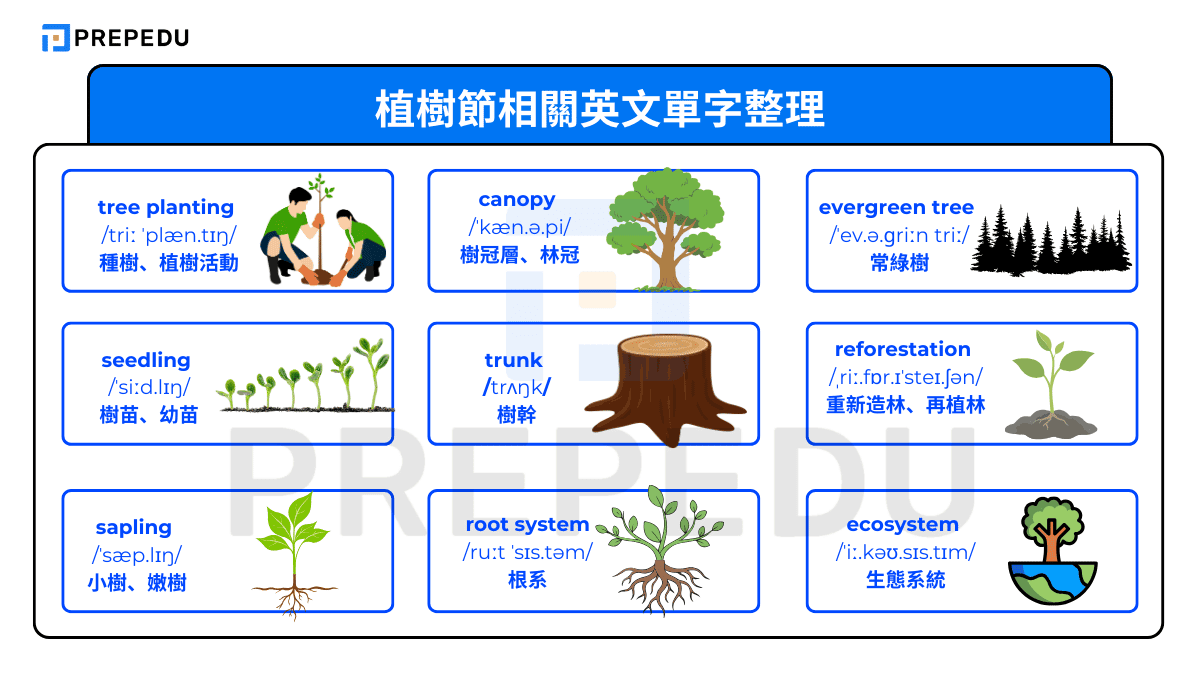
掌握植樹節英文,不能只停留在名稱本身。以下整理了與植樹、環境保護及永續發展密切相關的核心詞彙,涵蓋名詞、形容詞、動詞與常用片語搭配詞四大類別,並附有 IPA 音標與實用例句,幫助你在學術寫作、口語表達,乃至 IELTS 和 TOEIC 各種英語情境下精準傳遞想法。
|
植樹節英文詞彙 |
中文翻譯 |
例句 |
|
Arbor Day /ˈɑːr.bər deɪ/ |
植樹節(美國及國際通行正式名稱) |
Arbor Day is celebrated on the last Friday of April in the United States.(美國植樹節在每年四月的最後一個星期五慶祝。) |
|
tree planting /triː ˈplæn.tɪŋ/ |
種樹、植樹活動 |
The school organized a tree planting event to mark World Environment Day.(學校舉辦了植樹活動,以紀念世界環境日。) |
|
seedling /ˈsiːd.lɪŋ/ |
樹苗、幼苗 |
Each student received a seedling to plant in the school garden.(每位學生都領到一株樹苗,種在學校的花園裡。) |
|
sapling /ˈsæp.lɪŋ/ |
小樹、嫩樹(比 seedling 更大) |
The volunteers carefully dug holes for each sapling before planting.(志工在種植前,仔細地為每棵小樹挖洞。) |
|
canopy /ˈkæn.ə.pi/ |
樹冠層、林冠 |
A dense forest canopy helps regulate the local temperature.(茂密的森林林冠有助於調節當地氣溫。) |
|
trunk /trʌŋk/ |
樹幹 |
The ancient tree had a trunk so wide that three people could not wrap their arms around it.(這棵古樹的樹幹如此粗壯,三個人合抱都圍不過來。) |
|
root system /ruːt ˈsɪs.təm/ |
根系 |
A healthy root system anchors the tree and absorbs nutrients from the soil.(健全的根系能固定樹木,並從土壤中吸收養分。) |
|
deciduous tree /dɪˈsɪdʒ.u.əs triː/ |
落葉樹 |
Deciduous trees shed their leaves in autumn to conserve energy during winter.(落葉樹在秋天落葉,以便在冬天節省能量。) |
|
evergreen tree /ˈev.ə.ɡriːn triː/ |
常綠樹 |
Evergreen trees retain their leaves throughout the year, providing year-round shade.(常綠樹全年保留葉片,提供全年不間斷的樹蔭。) |
|
native species /ˈneɪ.tɪv ˈspiː.ʃiːz/ |
原生物種 |
Conservationists recommend planting native species to restore the original habitat.(保育人士建議種植原生物種,以恢復原有的棲地環境。) |
|
invasive species /ɪnˈveɪ.sɪv ˈspiː.ʃiːz/ |
入侵物種、外來種 |
Invasive species can outcompete native plants and disrupt the entire ecosystem.(入侵物種可能壓制原生植物,破壞整個生態系統。) |
|
reforestation /ˌriː.fɒr.ɪˈsteɪ.ʃən/ |
重新造林、再植林 |
Reforestation programs are crucial to restoring biodiversity.(重新造林計畫對於恢復生物多樣性至關重要。) |
|
afforestation /əˌfɒr.ɪˈsteɪ.ʃən/ |
新植造林(在原無森林處種樹) |
Afforestation projects in desert regions help prevent further soil erosion.(沙漠地區的新植造林計畫有助於防止進一步的土壤侵蝕。) |
|
deforestation /dɪˌfɒr.ɪˈsteɪ.ʃən/ |
濫伐森林、森林砍伐 |
Deforestation in the Amazon rainforest accelerates climate change at a global scale.(亞馬遜雨林的森林砍伐在全球規模上加速了氣候變遷。) |
|
carbon footprint /ˈkɑːr.bən ˈfʊt.prɪnt/ |
碳足跡 |
Planting trees is one of the most effective ways to reduce your carbon footprint.(種樹是減少碳足跡最有效的方法之一。) |
|
carbon sequestration /ˈkɑːr.bən ˌsiː.kwɪˈstreɪ.ʃən/ |
碳封存、碳固定 |
Forests play a vital role in carbon sequestration, absorbing CO₂ from the atmosphere.(森林在碳封存方面扮演關鍵角色,能從大氣中吸收二氧化碳。) |
|
ecosystem /ˈiː.kəʊ.sɪs.tɪm/ |
生態系統 |
Urban tree planting strengthens the local ecosystem and supports wildlife habitats.(都市植樹活動能強化當地的生態系統,並支持野生動物棲地。) |
|
biodiversity /ˌbaɪ.əʊ.daɪˈvɜːr.sɪ.ti/ |
生物多樣性 |
Protecting old-growth forests is essential for maintaining biodiversity.(保護原始森林對於維護生物多樣性至關重要。) |
|
habitat /ˈhæb.ɪ.tæt/ |
棲地、自然棲息地 |
Planting trees creates new habitats for birds, insects, and small mammals.(種樹為鳥類、昆蟲及小型哺乳動物創造了新的棲地。) |
|
photosynthesis /ˌfəʊ.təʊˈsɪn.θɪ.sɪs/ |
光合作用 |
Through photosynthesis, trees convert sunlight and CO₂ into oxygen and energy.(透過光合作用,樹木將陽光和二氧化碳轉化為氧氣和能量。) |
|
soil erosion /sɔɪl ɪˈrəʊ.ʒən/ |
土壤侵蝕、水土流失 |
Tree roots bind the soil and significantly reduce the risk of soil erosion.(樹根能固定土壤,大幅降低水土流失的風險。) |
|
watershed /ˈwɔː.tər.ʃed/ |
集水區、分水嶺 |
Forests in the watershed protect water quality for millions of people downstream.(集水區的森林保護了下游數百萬人的水質。) |
|
urban forest /ˈɜːr.bən ˈfɒr.ɪst/ |
都市森林 |
Expanding the urban forest reduces heat island effects in densely populated cities.(擴大都市森林有助於降低人口密集城市的熱島效應。) |
|
old-growth forest /ˈəʊld ɡrəʊθ ˈfɒr.ɪst/ |
原始森林、老齡林 |
Old-growth forests store significantly more carbon than younger plantations.(原始森林所儲存的碳遠多於較年輕的人工林。) |
|
compost /ˈkɒm.pɒst/ |
堆肥 |
Adding compost to the soil before planting improves nutrient absorption for young trees.(在種植前將堆肥加入土壤,能改善幼樹的養分吸收。) |
|
mulch /mʌltʃ/ |
覆根物、護根材料 |
Spread mulch around the base of newly planted trees to retain moisture.(在新種植的樹木根部周圍鋪上覆根物,有助於保持水分。) |
|
greenhouse gas /ˈɡriːn.haʊs ɡæs/ |
溫室氣體 |
Reducing greenhouse gas emissions is a shared responsibility for all nations.(減少溫室氣體排放是所有國家的共同責任。) |
|
climate change /ˈklaɪ.mɪt tʃeɪndʒ/ |
氣候變遷 |
Planting trees is one of the most accessible solutions to combat climate change.(種樹是應對氣候變遷最容易實踐的解決方案之一。) |
|
conservation /ˌkɒn.səˈveɪ.ʃən/ |
自然保育、環境保護 |
Wildlife conservation depends heavily on protecting and expanding forest cover.(野生動物保育在很大程度上依賴保護並擴大森林覆蓋範圍。) |
|
sustainability /səˌsteɪ.nəˈbɪl.ɪ.ti/ |
永續性、可持續發展 |
Corporate sustainability goals now commonly include zero-deforestation commitments.(企業永續發展目標現在普遍包含零森林砍伐的承諾。) |
|
reforestation campaign /ˌriː.fɒr.ɪˈsteɪ.ʃən kæmˈpeɪn/ |
植林運動、造林推廣活動 |
The government launched a nationwide reforestation campaign to restore degraded land.(政府發起了全國性植林運動,以恢復退化的土地。) |
|
green infrastructure /ɡriːn ˈɪn.frə.strʌk.tʃər/ |
綠色基礎設施 |
Green infrastructure, including street trees and parks, improves urban air quality.(包括行道樹和公園在內的綠色基礎設施,能改善城市空氣品質。) |
|
sustainable /səˈsteɪ.nə.bəl/ |
永續的、可持續的 |
Sustainable forestry ensures that trees are replanted after every harvest.(永續林業確保每次採伐後都重新種植樹木。) |
|
eco-friendly /ˌiː.kəʊˈfrend.li/ |
環保的、對環境友善的 |
Choosing eco-friendly packaging reduces the demand for wood-based materials.(選擇環保包裝能減少對木材原料的需求。) |
|
indigenous /ɪnˈdɪdʒ.ɪ.nəs/ |
原生的、本土的 |
Planting indigenous trees strengthens the resilience of the local ecosystem.(種植本土樹木能增強當地生態系統的韌性。) |
|
resilient /rɪˈzɪl.i.ənt/ |
具韌性的、抗壓的 |
A resilient urban forest can withstand extreme weather events more effectively.(具韌性的都市森林能更有效地承受極端天氣事件。) |
|
perennial /pəˈren.i.əl/ |
多年生的、長期存在的 |
Perennial plants require less replanting effort and provide stable ground cover.(多年生植物不需頻繁重新種植,能提供穩定的地面覆蓋。) |
|
arid /ˈær.ɪd/ |
乾旱的、乾燥的 |
Drought-resistant tree species are essential for afforestation in arid regions.(耐旱樹種對於乾旱地區的新植造林至關重要。) |
|
fertile /ˈfɜːr.taɪl/ |
肥沃的、有生產力的 |
Trees improve soil structure, gradually turning degraded land into fertile ground.(樹木能改善土壤結構,逐漸將退化的土地轉變為肥沃的土壤。) |
|
carbon-neutral /ˈkɑːr.bən ˈnjuː.trəl/ |
碳中和的 |
The company aims to become carbon-neutral by planting one tree for every product sold.(該公司計畫每賣出一件產品就種一棵樹,以實現碳中和。) |
|
drought-resistant /draʊt rɪˈzɪs.tənt/ |
耐旱的 |
Selecting drought-resistant species is critical for long-term reforestation success.(選擇耐旱物種對於長期植林成效至關重要。) |
|
biodiverse /ˌbaɪ.əʊ.daɪˈvɜːrs/ |
生物多樣性豐富的 |
A biodiverse forest is far more resilient to disease and climate stress than a monoculture.(生物多樣性豐富的森林比單一栽培林更能抵抗病害和氣候壓力。) |
|
photosynthetic /ˌfəʊ.təʊ.sɪnˈθet.ɪk/ |
光合作用的、能進行光合的 |
Photosynthetic activity peaks on sunny days, maximizing oxygen production.(光合作用在晴天時達到高峰,使氧氣生產量達到最大值。) |
|
plant (trees) /plɑːnt/ |
種植(樹木) |
Volunteers planted more than 1,000 trees along the riverbank in a single morning.(志工在一個上午內,在河岸邊種下了超過 1,000 棵樹木。) |
|
conserve /kənˈsɜːrv/ |
保育、保護 |
We must act now to conserve the remaining old-growth forests before it is too late.(我們必須立即採取行動,在為時已晚之前保育現存的原始森林。) |
|
sequester (carbon) /sɪˈkwes.tər/ |
封存(碳) |
Mature trees can sequester several tonnes of carbon dioxide over their lifetime.(成熟樹木在其一生中能封存數噸的二氧化碳。) |
|
cultivate /ˈkʌl.tɪ.veɪt/ |
栽培、耕作 |
Local farmers cultivate fruit trees to improve both their income and the landscape.(當地農民栽培果樹,同時改善收入與景觀環境。) |
|
prune /pruːn/ |
修剪(樹枝) |
Prune young trees regularly to encourage healthy and upright growth.(定期修剪幼樹,有助於促進健康而直立的生長。) |
|
transplant /trænsˈplɑːnt/ |
移植(植物) |
The team transplanted 50 mature trees to the new park without damaging their root systems.(團隊在不破壞根系的情況下,將 50 棵成熟樹木移植到新公園。) |
|
restore /rɪˈstɔːr/ |
恢復、復育 |
The NGO worked for three years to restore the degraded hillside with native vegetation.(這個非政府組織花了三年時間,用原生植被恢復退化的山坡地。) |
|
replenish /rɪˈplen.ɪʃ/ |
補充、補植 |
After the wildfire, authorities moved quickly to replenish the forest with young saplings.(野火後,當局迅速補植年幼樹苗以恢復森林。) |
|
irrigate /ˈɪr.ɪ.ɡeɪt/ |
灌溉 |
Newly planted trees must be irrigated regularly during the first dry season.(新種植的樹木在第一個旱季期間必須定期灌溉。) |
|
mitigate /ˈmɪt.ɪ.ɡeɪt/ |
減輕、緩解 |
Strategic tree planting can mitigate the effects of urban heat islands.(策略性的植樹能緩解都市熱島效應的影響。) |
|
absorb /əbˈzɔːrb/ |
吸收 |
Trees absorb CO₂ and release oxygen, making them nature's most efficient air purifiers.(樹木吸收二氧化碳並釋放氧氣,是大自然最有效率的空氣淨化器。) |
|
erode /ɪˈrəʊd/ |
侵蝕、剝蝕 |
Without sufficient tree cover, heavy rain quickly erodes the topsoil.(若缺乏足夠的樹木覆蓋,大雨會迅速侵蝕表層土壤。) |
|
protect /prəˈtekt/ |
保護 |
Environmental laws were enacted to protect ancient trees from urban development.(環境法規的制定是為了保護古樹免受城市開發的威脅。) |
|
advocate (for) /ˈæd.və.keɪt/ |
倡導、支持 |
The foundation continues to advocate for stronger forest protection policies worldwide.(該基金會持續倡導在全球推動更強力的森林保護政策。) |
|
片語與搭配詞 |
||
|
go green /ɡəʊ ɡriːn/ |
推行環保、綠化行動 |
The city council pledged to go green by doubling its urban tree cover by 2030.(市議會承諾在 2030 年前將都市樹木覆蓋率提高一倍,以推行環保。) |
|
net-zero emissions /net zɪərəʊ ɪˈmɪʃ.ənz/ |
淨零排放 |
Planting forests at scale is a key strategy for achieving net-zero emissions.(大規模植林是實現淨零排放的關鍵策略。) |
|
leave no trace /liːv nəʊ treɪs/ |
不留痕跡(環保行動準則) |
Volunteers followed the leave no trace principle during the Arbor Day planting event.(志工在植樹節種樹活動中遵循不留痕跡的環保準則。) |
|
tree cover /triː ˈkʌv.ər/ |
樹木覆蓋率 |
Increasing tree cover in cities reduces energy costs and improves public health.(提高城市樹木覆蓋率能降低能源成本並改善公共健康。) |
|
carbon offset /ˈkɑːr.bən ˈɒf.set/ |
碳抵消、碳補償 |
Many corporations purchase carbon offsets by funding reforestation projects.(許多企業透過資助植林計畫來購買碳抵消額度。) |
|
environmental stewardship /ɪnˌvaɪ.rən.ˈmen.tl ˈstjuː.ərd.ʃɪp/ |
環境管理責任、環境守護 |
Environmental stewardship means taking long-term responsibility for the land we use.(環境管理責任意指對我們所使用的土地承擔長期責任。) |
|
green belt /ɡriːn belt/ |
綠化帶、綠帶 |
Establishing a green belt around the city prevents urban sprawl and preserves open land.(在城市周圍建立綠化帶能防止都市蔓延並保留開放空間。) |
|
tree canopy coverage /triː ˈkæn.ə.pi ˈkʌv.ər.ɪdʒ/ |
樹冠覆蓋率 |
The city targets 30% tree canopy coverage to improve residents' quality of life.(該市以 30% 的樹冠覆蓋率為目標,以提升居民的生活品質。) |
看更多文章:
III. 植樹節英文例句與會話示範
學習植樹節英文,最實際的方式就是在真實情境中練習。以下提供三段英文對話示範,分別模擬學校活動、環境教育課堂,以及社群討論三種場景,讓你的英文表達更生動自然。每段對話後附有常用句型,供你直接套用。
1. 對話一:學校植樹節活動
|
角色 |
植樹節英文對話 |
中文翻譯 |
|
老師 Ms. Chen |
Class, tomorrow is Arbor Day. We'll be planting trees in the school garden. Has everyone brought their gloves? |
同學們,明天是植樹節。我們將在學校花園種樹,大家有帶手套嗎? |
|
學生 Jay |
Yes, Ms. Chen! Which type of tree are we planting this year? |
有的,陳老師!我們今年要種哪種樹? |
|
老師 Ms. Chen |
We'll be planting indigenous species—specifically a native oak seedling. Planting local trees helps support biodiversity and strengthens the local ecosystem. |
我們將種植原生物種,具體來說是一種本土橡樹幼苗。種植本地樹木有助於支持生物多樣性,並強化當地的生態系統。 |
2. 對話二:環境教育課堂討論
|
角色 |
植樹節英文對話 |
中文翻譯 |
|
老師 Mr. Lin |
Can anyone tell me why Tree Planting Day is important for combating climate change? |
誰能告訴我,植樹節對於應對氣候變遷為什麼重要? |
|
學生 Mei |
Because trees sequester carbon dioxide, which helps reduce our overall carbon footprint. |
因為樹木能封存二氧化碳,有助於減少我們整體的碳足跡。 |
|
老師 Mr. Lin |
Exactly. And reforestation programs go even further—they restore entire ecosystems, not just individual trees. |
說得對。重新造林計畫的作用更深遠——它們能恢復整個生態系統,而不只是個別的樹木。 |
3. 對話三:社群媒體貼文討論
|
角色 |
植樹節英文對話 |
中文翻譯 |
|
Emma |
Happy Arbor Day, everyone! I just planted an eco-friendly garden in my backyard. Small steps matter! |
大家植樹節快樂!我剛在後院種了一個環保花園,小行動也有大意義! |
|
Tom |
That's wonderful! Did you plant any indigenous species? They're easier to maintain and better for local wildlife. |
太棒了!你有種植原生植物嗎?它們更易於維護,對當地野生動物也更有益。 |
|
Emma |
Yes, I chose two native tree species. Together, we can make every day an Arbor Day! |
有的,我選了兩種本土樹種。一起努力,讓每天都是植樹節! |
IV. 植樹節英文祝福語與標語
無論是社群媒體貼文、學校環保活動,還是 TOEIC 寫作練習,掌握一套簡潔有力的植樹節英文祝福語和標語,能讓你的表達更鮮明、更有感染力。以下整理了實用句型,涵蓋正式場合與輕鬆的社群用語,直接套用即可。
|
植樹節英文標語/祝福語 |
中文翻譯 |
|
Happy Arbor Day! Let's grow a greener tomorrow together. |
植樹節快樂!讓我們一起種出更綠色的明天。 |
|
Every tree planted is a promise to the future. |
每種下一棵樹,就是對未來許下的一個承諾。 |
|
On Tree Planting Day, small actions grow into lasting change. |
在植樹節這天,微小的行動將成長為持久的改變。 |
|
Plant a tree, plant a future. |
種下一棵樹,就是種下一個未來。 |
|
Trees are the lungs of the Earth. Protect them, plant them, cherish them. |
樹木是地球的肺。保護它們、種植它們、珍愛它們。 |
|
This Arbor Day, let's commit to a more sustainable world. |
這個植樹節,讓我們許下打造更永續世界的承諾。 |
|
One person, one tree, one step toward a healthier planet. |
一個人、一棵樹,邁向更健康地球的一步。 |
|
Go green, plant a tree — because the Earth deserves better. |
行動環保、種下一棵樹——因為地球值得更好的對待。 |
|
A forest begins with a single seedling. Start today. |
一片森林始於一株樹苗。從今天開始吧。 |
|
Celebrate Tree Planting Day: reduce your carbon footprint, one tree at a time. |
慶祝植樹節:一次種一棵樹,逐步減少你的碳足跡。 |
結論
「植樹節英文」的答案不是非此即彼,而是因情境而定。Arbor Day 是歷史悠久、國際通行的正式說法;Tree Planting Day 則更貼近台灣與亞洲的在地語境。兩者搭配使用,能讓你的英文表達既精準又靈活。PREPEDU 建議你將本文的詞彙、例句與對話融入日常練習,無論是備考 IELTS、TOEIC,還是提升職場英語溝通力,從植樹節這個主題出發,就是一個很好的起點。
對 IELTS 或 TOEIC 考試結構感到陌生?考試當天的不確定感會影響你的表現。PREPEDU 的 Test Practice 提供真實模擬環境,讓你在實戰前熟悉題型和時間限制。
系統收錄超過 1,000 道練習題,定期更新以反映最新考試趨勢。AI 引擎分析你的錯誤,針對弱點提供改進方案。進度追蹤系統將你的成長數據化,讓進步一目了然。
現在開始練習,在考試中展現實力。立即體驗 PREPEDU 的雅思真題和多益測驗試題。

你好!我叫黃秋賢,現在在 prepedu.com 擔任內容企劃。我有超過5年的英語與韓語自學經歷,親身備考 IELTS、TOEIC 與 TOPIK,累積了大量第一手的學習者視角——包括哪些語法規則最讓台灣與香港學習者混淆,以及如何在有限的備考時間內最有效地修正這些錯誤。目前已在 prepedu.com 撰寫超過 1000 篇英語學習文章,內容涵蓋語法、詞彙與考試策略,累積協助數千位學習者解決自學過程中的語法疑問。
評論












統一企業編號:202227322W
地址:114 LAVENDER STREET, #11-83 CT HUB 2, SINGAPORE (338729)