Advantages and Disadvantages Essay: dàn ý, cách viết chi tiết và bài mẫu
Advantages and Disadvantages là một trong những dạng phổ biến nhất trong IELTS Writing Task 2, yêu cầu thí sinh phân tích cả mặt lợi và hại của một vấn đề. Trong bài viết này, Prep sẽ hướng dẫn bạn dạng đề, dàn ý, cách viết Advantages and Disadvantages trong IELTS Writing Task 2 chi tiết từ A-Z, kèm ví dụ và bài mẫu band 7+.
I. Advantages and Disadvantages Essay là gì?
Advantages and Disadvantages Essay là dạng bài yêu cầu bạn phân tích về Lợi ích (Ưu điểm) và Bất lợi (Nhược điểm) của một vấn đề, sự việc hoặc một xu hướng nào đó. Bạn sẽ thấy các dạng câu hỏi như:
-
What are the advantages and disadvantages of this trend?
-
Do the advantages outweigh the disadvantages?
-
Discuss the advantages and disadvantages and give your opinion.
Ví dụ đề bài: Some people think that good health is very important to every person, so medical services should not be run by profit-making companies. Do the advantages of private health care outweigh the disadvantages? (Đề ngày 17.10.2025)

Tham khảo thêm:
II. Các dạng đề Advantages and Disadvantages essay
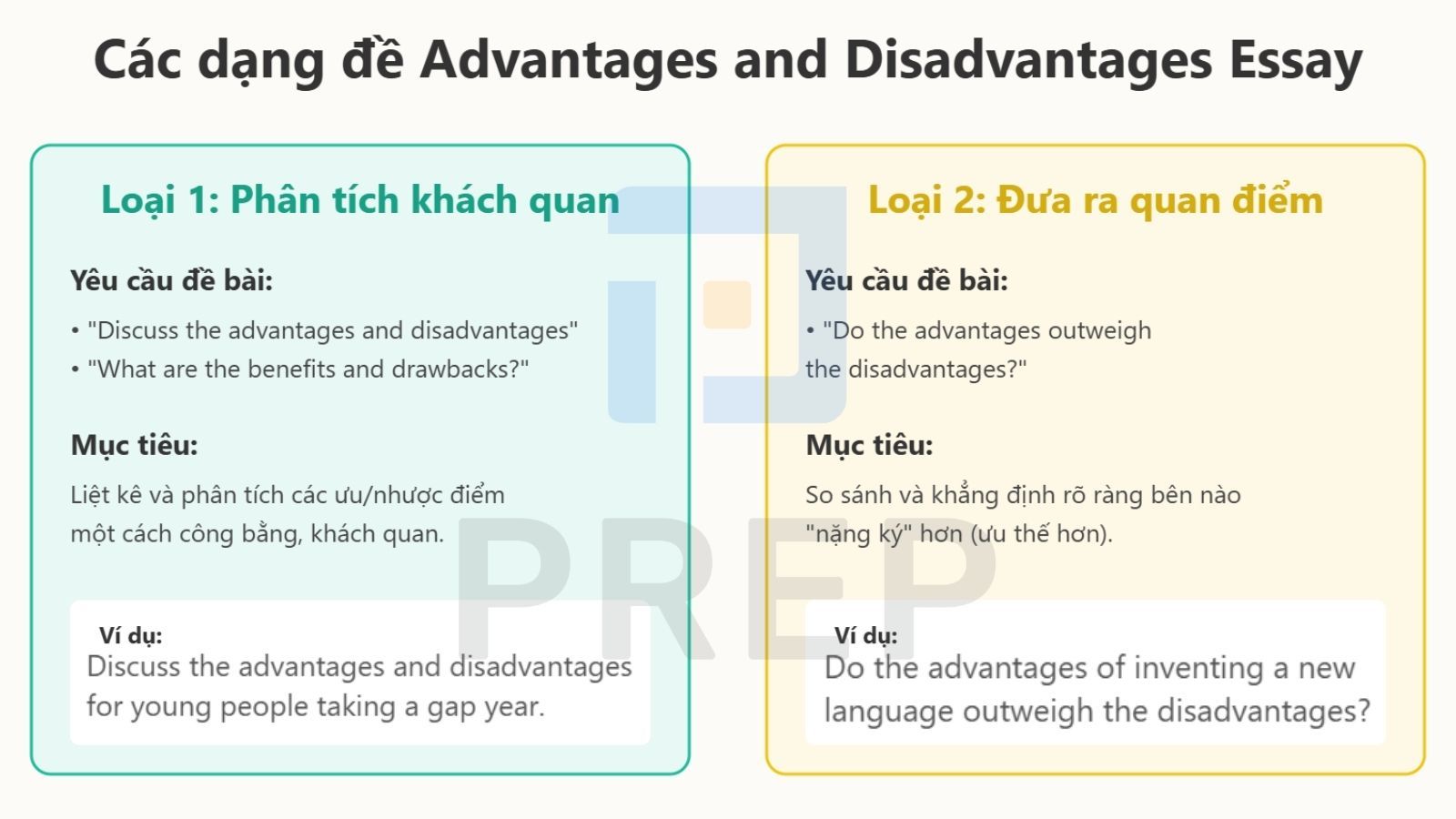
Dạng bài Advantages and Disadvantages essay thường chia làm 2 loại chính với cách tiếp cận hơi khác nhau:
|
Loại 1: Phân tích khách quan |
Loại 2: Đưa ra quan điểm |
|
|
Yêu cầu đề bài |
Đề bài thường hỏi: "Discuss the advantages and disadvantages" hoặc "What are the benefits and drawbacks?" |
Đề bài thường hỏi: "Do the advantages outweigh the disadvantages?" (Lợi ích có lớn hơn bất lợi không?) |
|
Mục tiêu |
Bạn chỉ cần liệt kê và phân tích các ưu/nhược điểm một cách công bằng. |
Bạn phải so sánh và khẳng định bên nào "nặng ký" hơn. |
|
Ví dụ |
In some countries, young people are encouraged to work or travel for a year between finishing high school and starting university studies. Discuss the advantages and disadvantages for young people who decide to do this. (Đề ngày 12.04.2025) |
Some believe that we should invent a new language for international communication. Do the advantages of this outweigh the disadvantages? (Đề ngày 24.08.2025) |
III. Dàn ý cho từng dạng đề Advantages and Disadvantages
1. Dạng 1: Phân tích khách quan
Dạng bài này sẽ có đề: "Discuss the advantages and disadvantages of..." hoặc "What are the benefits and drawbacks of..." Đây là dạng bài "trung lập", bạn chỉ cần liệt kê và giải thích các mặt tốt/xấu mà không cần đứng về bên nào.
Dàn ý cho dạng này như sau:
|
Introduction (Mở bài) |
|
|
Body Paragraph 1: Advantages (Ưu điểm) |
|
|
Body Paragraph 2: Disadvantages (Nhược điểm) |
|
|
Conclusion (Kết bài) |
|

2. Dạng 2: Đưa ra quan điểm
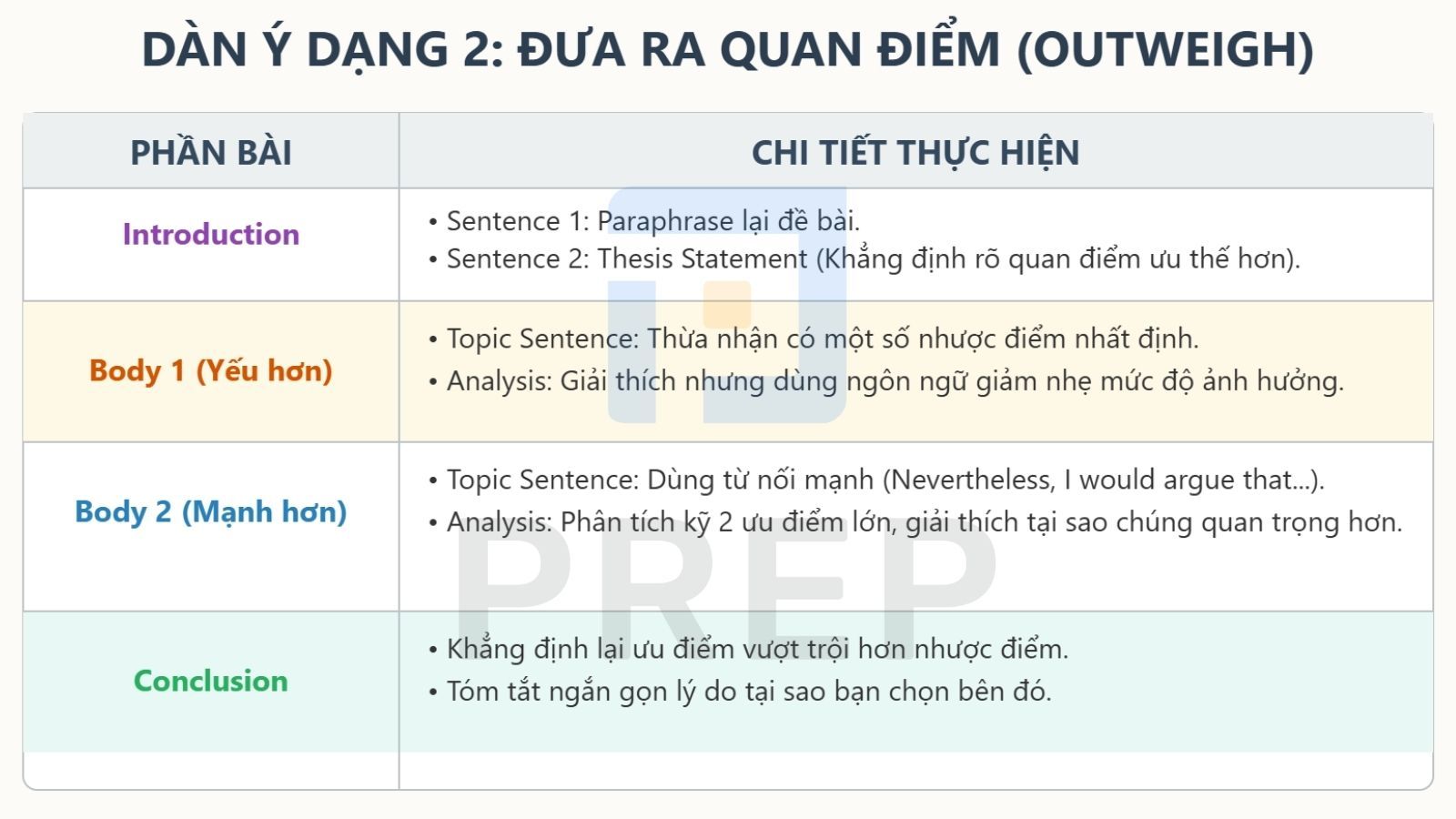
Dạng này sẽ có đề "Do the advantages of (Topic outweigh the disadvantages?" Dạng này yêu cầu bạn phải so sánh và khẳng định bên nào quan trọng hơn. Dàn ý dưới đây dành cho trường hợp bạn thấy Ưu điểm > Nhược điểm (bạn có thể thay đổi ngược lại):
|
Introduction (Mở bài) |
|
|
Body Paragraph 1: The Side You Disagree With (Mặt yếu hơn) |
|
|
Body Paragraph 2: The Side You Agree With (Mặt mạnh hơn) |
|
|
Conclusion (Kết bài) |
|
IV. Cách viết Writing Task 2 Advantages And Disadvantages
1. Phân tích đề bài (Task Analysis)
Đừng vội viết bài ngay. Bạn hãy dành 2 phút để xác định:
-
Chủ đề (Topic): Đề bài đang nói về hiện tượng gì? (Ví dụ: Học trực tuyến, Sống ở thành phố lớn).
-
Dạng câu hỏi:
-
Dạng 1 (Khách quan): Discuss the advantages and disadvantages. (Chỉ cần liệt kê).
-
Dạng 2 (Quan điểm): Do the advantages outweigh the disadvantages? (Phải khẳng định bên nào quan trọng hơn).
-
Ví dụ: Some believe that we should invent a new language for international communication. Do the advantages of this outweigh the disadvantages? (Đề ngày 24.08.2025)
➨ Phân tích:
Chủ đề (Topic): Việc phát minh và sử dụng một ngôn ngữ mới (như Esperanto) để giao tiếp toàn cầu thay vì dùng các ngôn ngữ hiện có (như tiếng Anh).
Dạng câu hỏi: Dạng 2 (Quan điểm - Outweigh). Bạn cần khẳng định bên nào nặng ký hơn.
Lựa chọn: Nhược điểm vượt trội hơn ưu điểm (Disadvantages outweigh advantages) vì việc tạo ra một ngôn ngữ mới cực kỳ tốn kém và khó phổ cập.
2. Lên ý tưởng
Đừng tham đưa tất cả ý tưởng vào. Hãy chọn 1 ưu điểm và 1 nhược điểm mà bạn có đủ vốn từ để giải thích sâu nhất.
➨ Ví dụ:
Ưu điểm (Advantage): Tính công bằng (Neutrality). Không quốc gia nào có lợi thế hơn quốc gia nào vì đó là ngôn ngữ chung, không thuộc về riêng ai.
Nhược điểm (Disadvantage): Tính thực tế thấp và chi phí khổng lồ (Practicality & Cost). Việc đào tạo hàng tỷ người học một ngôn ngữ mới từ đầu là điều bất khả thi.
3. Viết Mở bài (Introduction)
Mở bài cần 2 phần rõ rệt:
-
Paraphrase: Viết lại đề bài.
-
Thesis Statement: Trả lời trực tiếp câu hỏi.
➨ Áp dụng vào đề bài mẫu:
Paraphrase: In today’s globalized world, effective international communication has become increasingly important. Some people argue that creating a new universal language would facilitate communication across nations.
Thesis Statement: While this idea offers certain benefits, I believe that the drawbacks are more significant.
4. Triển khai Thân bài
Cấu trúc mỗi đoạn thân bài nên đi theo mô hình P.E.E.R (Point - Explanation - Example - Result).
➨ Áp dụng vào ví dụ đề thi 24/08/2025:
|
Đoạn 1: Phân tích Ưu điểm |
Đoạn 2: Phân tích Nhược điểm |
|
|
Bài mẫu:
On the one hand, the primary benefit of creating a new international language is the promotion of cultural and political neutrality. Currently, dominant languages like English give native speakers an unfair advantage in global trade, diplomacy, and academia. By inventing a completely new, artificial language, no single nation would hold linguistic or cultural supremacy over others. For instance, Esperanto was specifically designed to be a "universal second language" that belongs to no one, thereby fostering a sense of global equality. Consequently, this would create a more level playing field where international communication is based on mutual respect rather than historical or economic power.
On the other hand, I would argue that the logistical and financial hurdles of such a project far outweigh its theoretical benefits. To implement a new global language effectively, every country would need to overhaul its national education system, which involves retraining millions of teachers and rewriting countless textbooks. This would require an astronomical amount of investment that most developing nations simply cannot afford. Furthermore, history has shown that languages are not just tools but are deeply rooted in culture and centuries of evolution. Artificial languages, no matter how logical, often lack the cultural depth and "soul" that drive people to adopt them. As a result, the attempt to enforce a new language would likely end in a colossal waste of resources with very little practical adoption.
5. Viết kết luận
Phần kết luận bạn nên đề cập đến các vấn đề sau:
-
Tóm tắt: Nhắc lại ưu điểm và nhược điểm.
-
Khẳng định: Chốt lại lần cuối là lợi ích vẫn lớn hơn (hoặc ngược lại) nếu đề bài yêu cầu
-
Mở rộng (nếu thiếu chữ): Đưa ra dự đoán hoặc lời khuyên về vấn đề.
➨ Áp dụng vào ví dụ:
In conclusion, although the invention of a new global language could potentially eliminate linguistic bias and promote equality, I believe that these merits are eclipsed by the immense practical challenges involved. The staggering costs of worldwide implementation and the inherent difficulty of replacing established natural languages make this proposal highly unrealistic. Instead of striving for a new artificial tongue, the world should perhaps focus on improving translation technologies and enhancing the teaching of existing international languages to bridge the communication gap.
Tìm hiểu thêm: 3000+ từ vựng IELTS theo 35 chủ đề khác nhau
V. Bài mẫu IELTS Writing Task 2 Advantages and Disadvantages (Band 7+)
Một số bài mẫu dạng bài Advantages and Disadvantages Band 7+ giúp bạn luyện thi IELTS hiệu quả sẽ được PREP chia sẻ ở nội dung sau.
1. Đề bài IELTS Writing Task 2
1.1. Đề bài

“In some countries, more and more adults are continuing to live with their parents even after they have completed education and found jobs. Do the advantages outweigh the disadvantages?”
1.2. Bài mẫu Advantages and Disadvantages chi tiết
In many countries today, it is increasingly common for working adults to remain in the family home even after completing their education. While this lifestyle choice may offer financial and emotional benefits, it also raises concerns about independence and family dynamics. This essay will examine both the advantages and disadvantages of this trend and argue that the drawbacks outweigh the benefits.
One clear advantage of living with parents as an adult is the financial benefit. Instead of spending a large portion of their salary on rent and bills, young workers can save money for future investments such as buying a home or starting a family. Additionally, staying in the parental home can provide emotional support and reduce stress, especially in the early years of a person’s career, which can often be unstable and demanding.
However, the disadvantages of this trend should not be overlooked. Firstly, living with parents may prevent young adults from developing independence and essential life skills such as cooking, budgeting, and household management. Secondly, this situation can lead to tension within the household due to differing lifestyles and expectations. For example, adults may want more privacy or freedom, which could conflict with traditional family rules. In the long term, such arrangements might hinder personal growth and delay important life milestones.
In conclusion, while living with parents can provide short-term financial relief and emotional comfort, it can also create barriers to independence and personal development. Therefore, I believe that the disadvantages of this trend outweigh its advantages in the long run.
2. Đề bài IELTS Writing Task 2
2.1. Đề bài

“Some students prefer to take a gap year between high school and university, to work or to travel. Do the advantages of this outweigh the disadvantages?”
2.2. Bài mẫu Advantages and Disadvantages chi tiết
In today’s world, there has been an accelerating trend of students taking a break from studying before pursuing tertiary education. While this trend is beneficial in some respects, its shortcomings are more significant for the followers of this trend.
A gap year may enable students to enrich themselves with real-life experiences that are beneficial to their future. These may include having a paid job, from which those who have just entered adulthood may learn many working skills, such as communication, teamwork and following orders. The youngsters taking a gap year, as a result, are better prepared for their future jobs. Some gap-year-takers may also travel the world and absorb knowledge of diverse cultural settings and from different geographical contexts. In this globalised world, such knowledge is essential for developing a successful career.
Nevertheless, the disadvantages of taking a gap year for recent high-school graduates are serious, far outweighing the advantages. The primary reason is that the young can be overwhelmed by the unwanted difficulties of life outside of school campus. A physically demanding job, for example, can be exhausting for most high-school-leavers. Another significant reason is that to some youngsters without firm academic goals, earning money and living without the discipline of formal schooling could be more appealing than returning to school after the gap year. If they choose not to go back to school, they may lose the chance of obtaining academic knowledge and university degrees, which may help them earn even more money in the future.
In summary, despite potential gains, there are more serious drawbacks associated with a gap year such as the overwhelming difficulties when starting to work too soon and the prospect of not acquiring any university knowledge and degrees. It is recommended that students should take a university course right after they finish their high school.
Tham khảo thêm: Bài mẫu Essay Advantages and Disadvantages (liên tục update)
Dạng bài IELTS Writing Task 2 Advantages and Disadvantages tuy quen thuộc nhưng vẫn đòi hỏi thí sinh phải viết một cách rõ ràng, mạch lạc và có lập luận chặt chẽ. Để đạt band điểm cao, bạn cần luyện tập thường xuyên với đa dạng đề bài, biết cách paraphrase hiệu quả, sử dụng ví dụ thực tế và trình bày bài viết đúng cấu trúc. Đừng quên áp dụng các bí quyết viết đơn giản nhưng logic như phong cách của Simon để ghi điểm với giám khảo.
PREP là nền tảng duy nhất mang đến cho bạn quy trình chấm bài Writing qua hai lớp chuyên sâu. Lớp 1, sử dụng công nghệ AI, sẽ tự động phát hiện và sửa lỗi sai về từ vựng và ngữ pháp. Lớp 2, với sự hỗ trợ từ các thầy cô hạng A, sẽ chỉ ra những lỗi sai nghiêm trọng có thể khiến bạn mất điểm trong bài thi. Dựa trên bộ tiêu chí chấm điểm độc quyền, bao gồm 4 tiêu chí chính và 11 tiêu chí phụ, thầy cô sẽ giúp bạn nhận diện các lỗi dễ mắc phải, phân tích và đưa ra giải pháp sửa chữa chi tiết với giao diện dễ theo dõi.
Ngoài việc chỉ ra lỗi, thầy cô cũng ghi nhận những điểm mạnh của bạn về từ vựng, cấu trúc ngữ pháp và ý tưởng, để bạn có thể phát huy chúng trong các bài thi sau. Với những tiêu chí còn yếu, thầy cô sẽ đưa ra kế hoạch ôn luyện cụ thể, giúp bạn cải thiện từng bước và nâng band điểm hiệu quả.
Click TẠI ĐÂY để ghi danh nhanh chóng hoặc gọi HOTLINE 0931428899 và nhận tư vấn về lộ trình học hiệu quả.
Tải app PREP để học IELTS ngay tại nhà, trải nghiệm chương trình luyện thi online chất lượng và đạt điểm cao như mong muốn.

Chào bạn! Mình là Hiền Hoàng, hiện đang đảm nhận vai trò quản trị nội dung sản phẩm tại Blog của website prepedu.com.
Với hơn 5 năm tự học các ngoại ngữ như tiếng Anh, tiếng Trung và ôn luyện một số kỳ thi IELTS, TOEIC, HSK, mình đã tự đúc rút được nhiều kinh nghiệm để hỗ trợ hàng nghìn người đang gặp khó khăn trong việc học ngoại ngữ. Hy vọng rằng những chia sẻ phía trên sẽ giúp ích cho bạn trong quá trình tự ôn luyện thi hiệu quả tại nhà!
Bình luận
Nội dung premium
Xem tất cả




Lộ trình cá nhân hoá










Có thể bạn quan tâm

Kết nối với Prep





MSDN: 0109817671.
Địa chỉ liên hệ: Tòa nhà Vinaconex, 34 Láng Hạ, phường Láng, TP Hà Nội.
Trung tâm CSKH tại HN: Số 39, ngõ 12 Trần Kim Xuyến, phường Yên Hoà, Cầu Giấy
Trung tâm CSKH tại HCM: 145A-147Bis Trần Quang Khải, phường Tân Định, TP HCM
Trụ sở Công ty: Số nhà 20, ngách 234/35 đường Hoàng Quốc Việt, phường Nghĩa Đô, TP Hà Nội.
Phòng luyện ảo - Trải nghiệm thực tế - Công nghệ hàng đầu.
Hotline: 0907048899
Trụ sở Công ty: Số nhà 20, ngách 234/35 đường Hoàng Quốc Việt, phường Nghĩa Đô, TP Hà Nội.
Giấy chứng nhận hoạt động đào tạo, bồi dưỡng số 1309/QĐ-SGDĐT ngày 31 tháng 07 năm 2023 do Sở Giáo dục và Đào tạo Hà Nội cấp.