IELTS Task 2: Work or Travel Before Starting University
This guide helps you master IELTS Writing Task 2 on whether students should work or travel after finishing school and before university. You will learn how to analyse the question, generate strong ideas, use advanced vocabulary, and follow high-band essay structures.

I. Understanding the IELTS Topic: Work or Travel Before University
This is a common IELTS Writing Task 2 topic that asks candidates to discuss whether students should travel or work after finishing high school but before entering university. It typically appears in the form of an Opinion or Discussion essay. Understanding what the question requires is essential to formulating a strong, focused response.
The key phrase in the prompt is "work or travel after leaving school and before going to university," which relates to what is commonly known as a "gap year." Examiners expect you to analyze the potential benefits and drawbacks of this idea or to clearly express and support one side of the argument.
Depending on how the question is phrased, you might be asked to:
-
Present your opinion and support it with relevant reasons and examples.
-
Discuss both views before stating your opinion.
-
Write about the advantages and disadvantages of taking a gap year.
This topic is popular in the IELTS exam because it reflects real situations that many young people face. It allows you to explore important themes such as personal development, education, career planning, independence, and maturity. Therefore, mastering this topic not only helps you perform better in your writing but also prepares you to think critically about relevant societal issues.
Understanding common IELTS Writing Task 2 question types allows you to choose the most appropriate structure for your response.
1. How to Approach This IELTS Writing Task 2 Topic
Before writing your essay, it is vital to approach the topic with a clear plan. This involves breaking down the question, generating relevant ideas, and deciding on a position that you can support with logical arguments and examples.
Begin by identifying the key terms in the prompt. In this case, "work or travel" and "before university" point to the concept of a gap year, and your task is to evaluate whether it is beneficial for students to take one. You may be asked to discuss both perspectives, provide advantages and disadvantages, or take a clear stance depending on the question type.
Start your planning with effective brainstorming:
-
Think of reasons why working after school could be helpful: gaining job experience, earning money for tuition, learning responsibility, etc.
-
Consider benefits of traveling: cultural exposure, increased independence, self-discovery, language learning, and global awareness.
-
Also reflect on possible disadvantages: losing academic momentum, financial costs, time management issues, or difficulty transitioning back to study.
Once you have your ideas, decide whether to discuss both sides or support one clear viewpoint. Structure your essay logically, ensuring that each paragraph presents one main idea supported by explanations or real-life examples.
Finally, remember to stay on topic. Many candidates lose marks by drifting too far from the actual question or failing to develop their points adequately. Making a strong outline before you start writing is one of the most powerful tools to achieve clarity and coherence in your response.
Applying techniques from how to develop ideas in writing task 2 can help you expand each argument more logically and effectively.
2. Essay Structure for This Topic (Band 7–9)
A well-structured essay is essential for achieving a high band score in IELTS Writing Task 2. Examiners look for logical organization, clear progression of ideas, and appropriately developed arguments. For the topic "Work or Travel Before University," the most suitable task type is usually either an Opinion Essay or a Discussion Essay, depending on the exact question wording.
Here is a suggested structure that can help you meet the criteria for a Band 7–9 response:
1. Introduction
-
Paraphrase the question in your own words, maintaining the original meaning.
-
Clearly state your main opinion or briefly outline both views, depending on the task type.
-
Include a clear thesis statement that outlines your essay's direction.
2. Body Paragraph 1 – First Main Idea
-
Present one argument (e.g., benefits of working after high school).
-
Support it with logical reasoning and relevant examples.
-
Use clear topic sentences and linking devices to enhance cohesion.
3. Body Paragraph 2 – Second Main Idea
-
Present an opposing argument (e.g., advantages of traveling).
-
Or, continue defending your main opinion if it’s a one-sided essay.
-
Provide analysis and specific examples to show depth of thought.
4. Optional Body Paragraph 3 – Balanced View or Additional Point
-
Use this only if you have a third strong idea or if you're writing a more complex, balanced discussion.
-
Ensure coherence and avoid overcomplicating the structure if you're aiming for clarity.
5. Conclusion
-
Summarize the main points discussed.
-
Restate your opinion clearly (if required).
-
Avoid adding new ideas.
Tips for Band 7–9:
-
Maintain clear logic and progression throughout the essay.
-
Use a wide range of sentence structures and topic-specific vocabulary.
-
Develop each idea fully with explanations and examples, not just listing points.
By following a consistent structure like this and maintaining a strong focus on task achievement, coherence, and language use, you’ll be well-positioned to reach a high IELTS band score on this topic.
Writing a strong topic sentence in IELTS Writing Task 2 helps ensure each paragraph stays focused and directly supports your position.
3. Vocabulary and Useful Language for the Gap Year Topic
Using topic-specific and high-level vocabulary is essential for achieving a high band in the Lexical Resource criterion of IELTS Writing Task 2. The topic of taking a gap year — working or traveling after finishing school and before university — offers many opportunities to demonstrate a wide range of lexical choices.
Below are categorized vocabulary and phrases that you can apply effectively in your essay.
Vocabulary Related to Employment and Work Experience
-
gain hands-on experience
-
develop transferable skills
-
enter the workforce
-
professional exposure
-
time management / communication skills
-
build a career foundation
-
earn an income to support future studies
Vocabulary Related to Travel and Personal Development
-
broaden one’s horizons
-
immerse oneself in a foreign culture
-
enhance intercultural awareness
-
foster independence and maturity
-
embark on a journey of self-discovery
-
overcome language and cultural barriers
-
gain a global perspective
Advanced Collocations and Academic Phrases for Argumentation
-
advocates of taking a gap year argue that...
-
detractors may point out that...
-
it is widely believed that...
-
one compelling reason is that...
-
from an academic standpoint...
-
long-term benefits often outweigh the short-term drawbacks
-
a gap year can be a double-edged sword
Caution with Informal Language
Avoid overly casual terms like "cool experience" or "fun trip." Instead, use precise and formal expressions such as “enriching experience” or “meaningful exposure,” which better reflect academic tone.
By incorporating this type of vocabulary thoughtfully into your writing — and ensuring it is contextually appropriate — you improve not only your word choice but also the clarity and persuasiveness of your arguments. Practice using these terms in multiple essays to internalize them and write with greater fluency.
II. Band 7–9 Sample Essay (Work or Travel Before University)
One of the recurring topics in IELTS Writing Task 2 is whether young people should take a break to work or travel after high school and before entering university. This essay topic not only evaluates a candidate’s ability to present balanced arguments, but also tests their skill in organizing structure, using academic language, and presenting critical thinking.
1. Band 7 Sample Essay: Work or Travel Before University
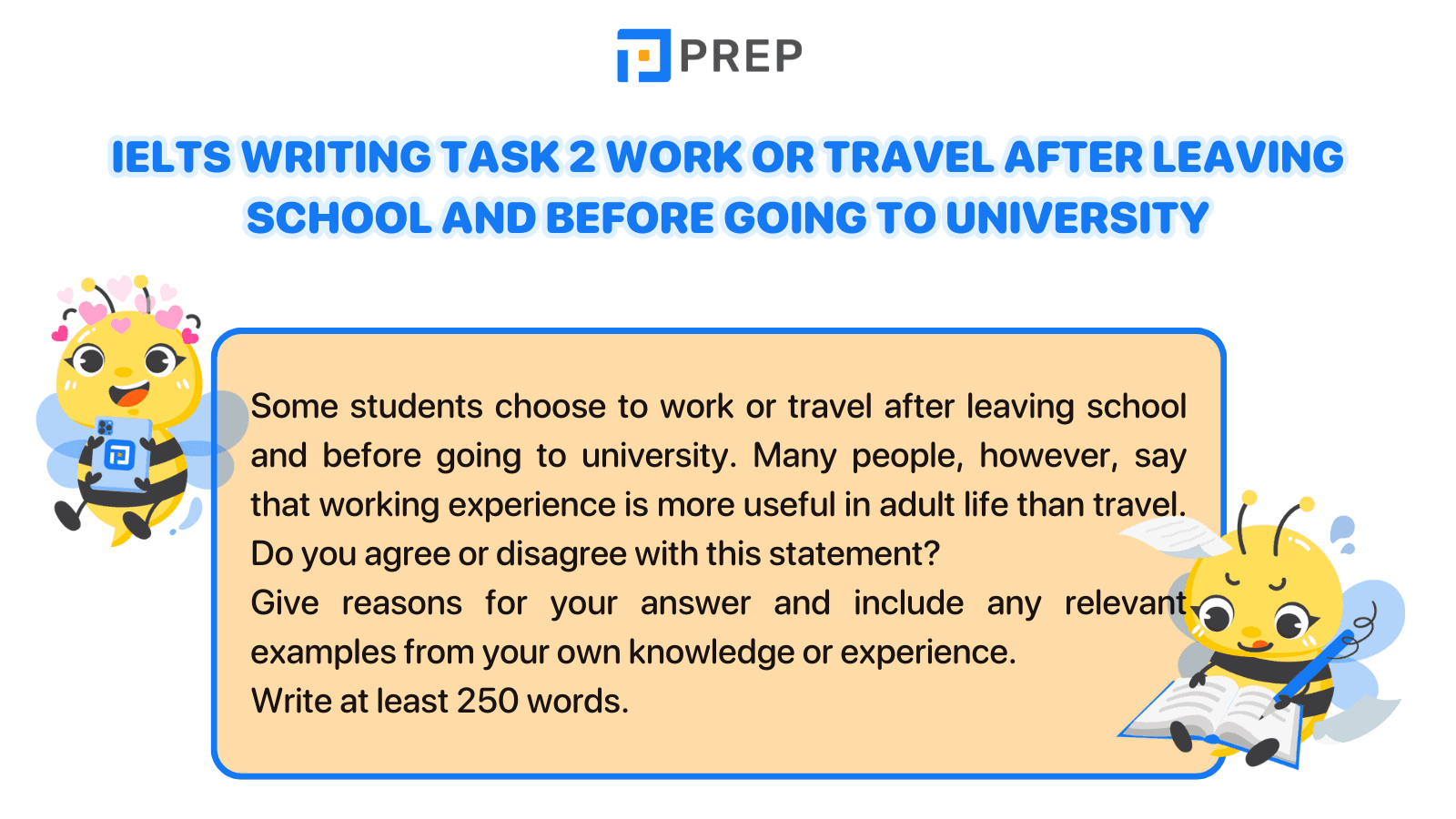
Question: Some people think that young people should work or travel for a year between finishing school and starting university studies. Discuss the advantages and disadvantages of this.
Essay:
After finishing high school, many students consider taking a year off before going to university. This year is often spent working or travelling. Some people support the idea, while others think it may not be a good choice. This essay will discuss both the advantages and disadvantages of this topic.
There are several benefits if students decide to take a gap year. One important advantage is that working can help students develop key skills such as responsibility and teamwork. Earning money before university can also reduce financial stress later. Furthermore, travelling can give students a chance to experience different cultures and learn more about the world. This broadens their minds and helps them become more mature before entering higher education.
However, there are also some disadvantages. Some students may lose motivation for studying after taking a long break. They may find it difficult to return to academic life and concentrate on their university work. Another problem is that not everyone uses their gap year effectively. Some people just relax or waste time without gaining any real experience or benefit.
In conclusion, a gap year can be a good experience if it is planned well. Students can learn useful life skills and grow as individuals. However, if it is not used properly, it might cause problems in the future. It is important for each person to think carefully before deciding whether to work or travel before university.
Why This Essay Scores Band 7
Task Response (Band 7):
-
Covers all parts of the task and gives a clear opinion.
-
Ideas are relevant but not fully extended or supported with detailed examples.
Coherence and Cohesion (Band 7):
-
Logical structure with clear paragraphing.
-
Uses common cohesive devices (e.g., however, furthermore) but may be repetitive or mechanical.
Lexical Resource (Band 7):
-
Vocabulary is appropriate for the topic but lacks flexibility or precision (good experience, help students, waste time).
-
Some repetition and limited variety in word choice.
Grammatical Range and Accuracy (Band 7):
-
Good control of simple and some complex structures.
-
Occasional errors with article use, word form, and sentence structure, but meaning remains clear.
2. Sample Essay: Band 8
Essay:
Taking a gap year to gain work experience or travel has become an increasingly popular option for students finishing secondary school. While some believe this time can offer valuable life experience, others argue it may disrupt academic momentum. This essay will examine both the benefits and drawbacks of this trend.
On the one hand, a structured year off can bring many advantages. Firstly, working before university allows students to develop real-world skills such as time management, teamwork, and financial responsibility. These experiences not only enhance personal growth but also help students appreciate the value of higher education once they begin formal studies. Secondly, travelling to different cultures provides broad exposure and fosters maturity, independence, and open-mindedness — traits that are essential for both academic and personal success.
On the other hand, several disadvantages are worth considering. A major concern is the risk of losing academic motivation or study habits during a gap year, which can make it harder to readjust to university life. For some students, a year of earning money or enjoying travel could reduce their desire to return to structured learning. In addition, not all gap year plans are purposeful; time spent without clear goals may result in wasted opportunities and lost time.
In conclusion, taking a year off to work or travel before university can offer significant personal and educational benefits if planned thoughtfully. However, without clear objectives, it may hinder academic progress. Therefore, the effectiveness of a gap year depends greatly on how it is structured and what the individual hopes to gain from the experience.
Why This Essay Scores Band 8?
Task Response (Band 8):
-
Addresses all parts of the task with a clear position throughout.
-
Arguments are well developed and supported by relevant examples.
Coherence and Cohesion (Band 8):
-
Ideas are logically organized with clear progression.
-
Uses cohesive devices effectively, though occasionally mechanically.
Lexical Resource (Band 8):
-
Wide range of vocabulary (e.g., real-world skills, academic momentum, fosters maturity) used with precision.
-
Collocations and idiomatic expressions are natural and varied.
Grammatical Range and Accuracy (Band 8):
-
Excellent control of complex sentence structures.
-
Few grammatical errors; punctuation and tense are consistent.
3. Band 9 Sample Essay: Work or Travel Before University
Essay:
In recent years, taking a "gap year" between high school graduation and the commencement of university studies has become an increasingly common choice for young individuals. While this period offers unique opportunities for growth, it also presents potential drawbacks. This essay will explore both perspectives and provide a balanced evaluation.
One of the primary advantages of a gap year is its potential to foster significant personal development. Students who choose to work gain exposure to real-world professional environments, acquire transferable skills such as communication and time management, and often develop a renewed appreciation for higher education. Earning an income may also enable them to contribute to future tuition costs, thus reducing financial pressure during university. Alternatively, travelling provides cultural enrichment, expands one’s worldview, and nurtures qualities such as resilience and adaptability — all of which are increasingly important in today’s globalized society.
However, gap years are not without their challenges. A notable risk is the loss of academic momentum; after an extended break, some students may struggle to reacclimate to the rigours of academic life. Furthermore, without clear objectives or structure, the year can easily become unproductive, turning into a prolonged vacation rather than a transformative experience. In some cases, young people may delay their studies indefinitely, opting to pursue short-term pleasures or income instead of long-term educational goals.
Nevertheless, it is important to recognize that the success of a gap year largely depends on planning and intention. When approached purposefully — with specific goals to work in a particular field or participate in a cultural exchange — the benefits often outweigh the disadvantages. Educational institutions and families can also play a vital role in helping students structure this period meaningfully.
In conclusion, taking a year off between school and university can serve as a valuable bridge between adolescence and adulthood. Though it carries certain risks, thoughtful planning can maximize its advantages. Ultimately, the decision should be tailored to the individual’s maturity, career goals, and learning style.
Why This Essay Scores Band 9?
Task Response (Band 9):
-
Fully addresses all parts of the task with subtle and nuanced discussion.
-
Presents a balanced position and consistently maintains it with relevant, well-developed ideas.
Coherence and Cohesion (Band 9):
-
Seamless flow of ideas with sophisticated cohesion.
-
Paragraphing is logical; transitions feel natural and unobtrusive.
Lexical Resource (Band 9):
-
Rich, precise academic vocabulary: reacclimate, resilience, enrichment, transformative experience.
-
Excellent collocation and variation; lexical choices feel purposeful and appropriate to context.
Grammatical Range and Accuracy (Band 9):
-
Wide variety of complex structures used with native-like accuracy.
-
No noticeable errors; punctuation, tense, and syntax are consistently correct.
III. Final Tips to Score Band 7+ on This Topic
Mastering a specific IELTS Writing Task 2 topic requires more than just knowing the format — it demands focused preparation, critical thinking, and advanced control of language. Below are several key tips that will help you meet or exceed Band 7 on the "work or travel before university" topic.
Don’t Sit on the Fence
Choose a clear position and communicate it confidently. Whether the task asks you to discuss both views or give your opinion, avoid being vague or indecisive. A well-defined stance strengthens the unity and coherence of your essay.
-
If the prompt is opinion-based, state your viewpoint in the introduction and reinforce it in the conclusion.
-
Do not say "both are good" without deeper analysis. Take a stand and explain why.
Plan Before You Write
Many candidates make the mistake of starting to write immediately. However, investing just 5–7 minutes in planning can improve structure, coherence, and idea development.
-
Brainstorm 2–3 strong arguments.
-
Write a simple outline: what goes in each paragraph, what example to use.
-
This prevents repetition, missing key points, or losing focus mid-essay.
Review and Edit Your Work
Set aside time at the end to proofread. Even strong essays lose marks due to avoidable mistakes.
-
Scan for grammar and spelling errors, especially verb tense and article usage.
-
Replace repeated vocabulary with synonyms or academic terminology.
-
Ensure every sentence contributes meaningfully to your argument.
Common Mistakes and How to Avoid Them
Understanding common pitfalls can help you prevent them in your own writing. Here are a few:
-
Misinterpreting the question: Read the prompt carefully and identify if it asks for discussion, opinion, or both.
-
Lack of development: Don’t just list advantages/disadvantages — explain how and why with examples.
-
Overusing basic vocabulary: Instead of saying “good experience,” aim for “valuable exposure” or “enriching opportunity.”
-
Poor paragraphing: Stick to one idea per paragraph. Start each with a topic sentence and develop it fully.
By applying these strategies, you can improve the quality and clarity of your writing, build stronger arguments, and demonstrate the lexical and grammatical range needed to reach Band 7+. Practice writing on this topic several times under timed conditions and seek feedback when possible — incremental improvements over time will produce significant score gains.
These priorities align closely with the Formula for IELTS Writing Band 7, which emphasizes clarity, structure, and idea development.
The above is the sample IELTS Writing Task 2 work or travel after leaving school and before going to university scored at band 7.0+, compiled by teacher Nhat Pham - a top-tier teacher at PREP. Review it thoroughly to effectively practice IELTS Writing at home. And don't forget to dedicate time each day to practice with PREP's virtual Writing room to quickly improve your skills and gain confidence for the actual exam!

Hi I'm Chloe, and I am currently serving as an Product Content Administrator at Prep Education. With over five years of experience in independent online IELTS study and exam preparation, I am confident in my ability to support learners in achieving their highest possible scores.
Comment
Premium content
View all



Personalized roadmap


Most read



UEN: 202227322W
Address: 114 LAVENDER STREET, #11-83 CT HUB 2, SINGAPORE (338729)