How to Describe a Volcano Eruption in IELTS Task 1
This guide explains how to describe a volcano eruption diagram in IELTS Writing Task 1 by identifying key elements, applying an effective report structure, and using accurate grammar and vocabulary. You will also find Band 6 and Band 8 outlines, plus common mistakes and practical tips to improve clarity and logic.
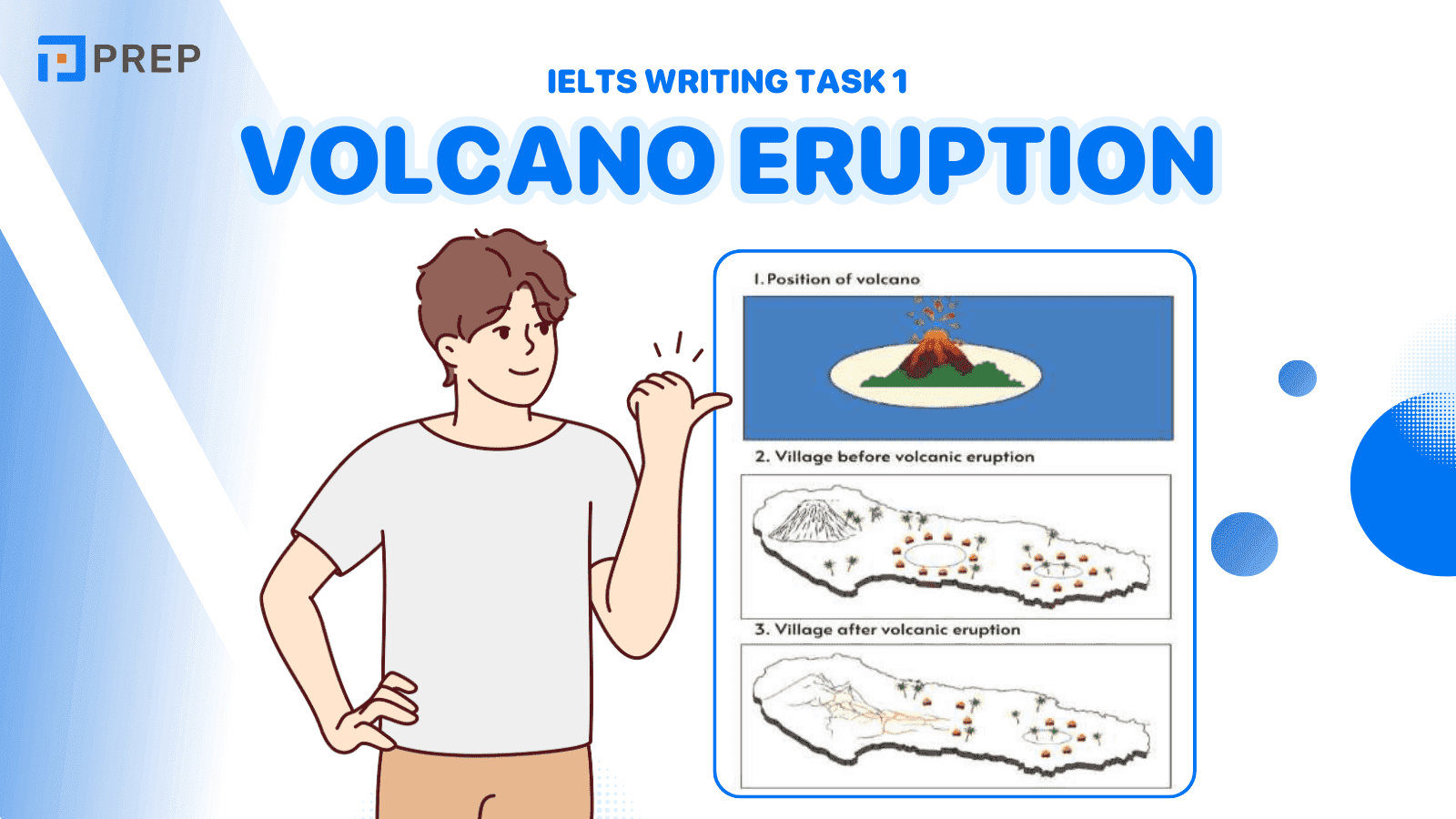
I. Understanding the Volcano Eruption Diagram in IELTS Task 1
In IELTS Writing Task 1 (Academic), process diagrams test your ability to describe how something works or how something happens over time. The Volcano Eruption diagram is a common example of a natural process, where you are expected to describe the physical sequence of events that lead to a volcanic eruption. Unlike charts or tables, this diagram contains no numbers—only visual elements that represent stages, components, and movement.
Understanding the Nature of a Process Diagram
A volcano eruption process diagram typically illustrates a static, one-directional sequence. It explains how magma rises from within the earth, breaks through the surface, and creates a volcanic eruption. This is not a cyclical process like the water cycle, but rather a linear sequence of physical changes that occur from underground to the surface.
Key characteristics of a Task 1 process diagram:
-
There are no statistics (percentages, units, or measurements)
-
The writing is non-interpretative – describe what is shown, not why it happens
-
You must use chronological logic to explain what occurs first, next, and last
In this case, the figure often includes the build-up of pressure underground, the path of magma, the exit through a vent, and the dispersal of materials like ash and lava.
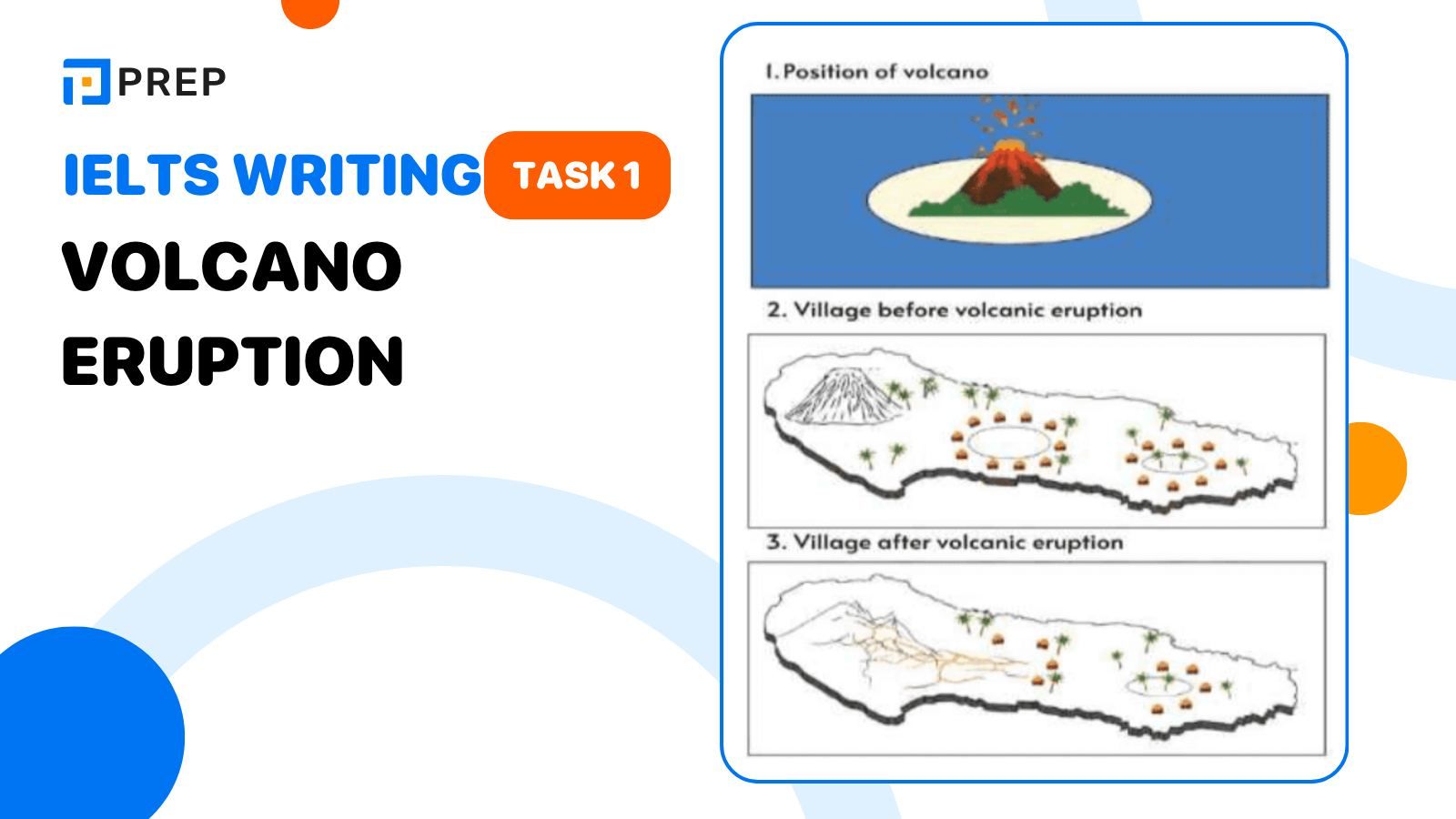
This structure follows the principles of IELTS writing task 1 process, where candidates describe stages in a clear, one-directional sequence.
Key Elements You Must Identify Before Writing
Before starting your response, take 1–2 minutes to examine the visual carefully. Identify and label the main parts of the volcano and the sequence of eruption. The most common elements shown in this diagram include:
-
Magma chamber: The source of molten rock beneath the earth’s surface
-
Main vent / pipe: The vertical passage through which magma rises
-
Crater: The opening at the top of the volcano
-
Lava flow: Molten rock that moves down after eruption
-
Ash cloud: Material ejected into the atmosphere during eruption
-
Layers of rock: Sometimes shown to indicate repeated eruptions
Additionally, arrows may be used to indicate movement (e.g., lava rising, ash spreading), and sometimes pressure build-up is illustrated.
When identifying process elements, ask:
-
Where does the process start?
-
What moves from one stage to the next?
-
How many visually distinct stages are there?
-
Are there any outcomes after the eruption?
Understanding the spatial relationships between these components helps you write logically and clearly, with accurate sequencing.
These observations are essential for writing an effective IELTS writing task 1 overview that summarizes the process clearly.
II. How to Structure Your Task 1 Response for a Volcano Eruption
When writing about a volcano eruption diagram in IELTS Writing Task 1, it’s crucial to follow a clear and logical structure. Unlike statistical charts, which involve numbers and comparisons, process diagrams assess your ability to describe a sequence of events, often involving movement or transformation. Your response should guide the reader through the stages of the eruption in a coherent and academic manner.
Recommended Paragraph Structure for Task 1
A solid response should follow a 4-paragraph format:
-
Introduction
-
Paraphrase the question using different words.
-
State what the diagram illustrates.
-
-
Example:
The diagram demonstrates the stages involved in a volcanic eruption, showing how magma rises through the Earth and erupts onto the surface. -
Overview
-
Provide a general summary of the process.
-
Mention how it begins and ends, or highlight the overall flow.
-
-
Example:
Overall, the process begins with pressure building underground and concludes with the release of volcanic materials through the surface vent. -
Body Paragraph 1
-
Describe the initial stages of the process (underground activity).
-
Use passive voice and sequence markers.
-
-
Example:
First, magma is formed deep within the Earth's crust and is stored in a magma chamber beneath the surface. -
Body Paragraph 2
-
Explain the later stages (eruption and aftermath).
-
Include details like ash cloud or lava flow and their path.
-
-
Example:
Subsequently, pressure forces the magma upward through a central vent. When it breaks through, lava and gases are released, and a dense ash cloud forms above the crater.
This structure ensures logical flow, complete coverage of stages, and alignment with IELTS assessment criteria.
Guidance on organizing early-stage details can be found in IELTS writing task 1 body paragraph, especially for process diagrams.
Grammar Rules for Describing a Volcano Eruption
To meet the expectations of IELTS Task 1, your grammar must be accurate, varied, and appropriate to the context. Since process diagrams focus on actions without a clear subject, the passive voice and present simple tense are commonly used.
Use the present simple passive because the diagram describes general natural behavior:
-
Magma is stored…
-
Gas is released…
-
An ash cloud is formed…
Avoid:
-
Personal pronouns (“I,” “we”)
-
Explanations of “why” the process occurs
-
Overuse of active voice (unless the subject is visible, which it often isn’t)
Using appropriate grammatical forms helps convey a formal and objective tone consistent with academic writing standards.
Vocabulary and Linking Expressions for Process Writing
Using varied and accurate vocabulary not only helps with Lexical Resource scoring but also makes your writing easier to follow. Here are some useful word groups and transitions:
Vocabulary for Volcano Diagrams:
-
Nouns: magma chamber, crater, vent, chamber, lava, ash cloud, eruption
-
Verbs: rise, escape, is formed, is pushed, is released, flows, erupts
Linking expressions:
-
To show sequence: first, then, afterwards, subsequently, eventually, finally
-
To add explanation: as a result, which leads to, thereby allowing
-
To show cause and effect (used cautiously): due to pressure buildup, resulting in the eruption
Example sentence:
Next, the magma is pushed upwards through the vent, resulting in a powerful eruption and the release of ash and gas into the atmosphere.
To sound more academic, avoid overly basic verbs such as "goes up" and "comes out"—replace them with "rises," "erupts," or "is expelled."
By structuring your essay effectively, applying process-appropriate grammar, and using precise vocabulary, you set a strong foundation for a high-scoring IELTS Writing Task 1 response. In the next section, we’ll examine sample responses at different band levels to illustrate how these techniques are applied in practice.
Mastering these elements has a direct impact on IELTS writing band scores, especially in Task Achievement and Coherence.
III. Practical Examples: Band 6 vs Band 8 Volcano Eruption Descriptions
Seeing how the same IELTS Task 1 question can produce very different results depending on writing quality is one of the fastest ways to improve your own performance. This section compares a Band 6 and a Band 8 response to a volcano eruption diagram—a common example of a natural process in IELTS Writing Task 1.
Key Differences Between Band 6 and Band 8
|
Criteria |
Band 6 |
Band 8 |
|
Task Achievement |
Basic description of stages; may omit details or overview |
Fully addresses all major stages; includes a clear overview |
|
Coherence & Cohesion |
Occasional repetition or unclear sequence |
Logical flow with clear sequencing and cohesion |
|
Lexical Resource |
Limited, repetitive vocabulary |
Varied, topic-specific and academic vocabulary |
|
Grammatical Range |
Simple sentences; errors in tense or form |
Accurate use of present passive, with complex structures |
Sample Volcano Diagram Prompt (Paraphrased)
The diagram shows the process of a volcanic eruption, starting from the buildup of pressure underground through to the moment the volcano erupts.
Band 6 Sample – Basic Description
The diagram shows how a volcano erupts. First, hot stuff is under the ground. It goes up because of pressure. Then it comes out of the top. Lava and smoke go up into the sky. The eruption happens when there is enough pressure.
What’s missing or weak:
-
Vague and informal vocabulary ("hot stuff", "goes up", "comes out")
-
No clear overview or grouping of stages
-
Poor sequencing and little use of linking phrases
-
Inappropriate verb choice and missed opportunity to use passive voice
Band 8 Sample – High-Scoring Response
The diagram illustrates the sequence of events that lead to a volcanic eruption.
Overall, the process begins deep underground with the formation of magma and concludes with the release of molten material and gases through the volcano’s crater.
Initially, magma accumulates in a chamber beneath the Earth's crust. As pressure builds, it is forced upward through a central vent. Once the pressure reaches a critical point, the surface is ruptured, and lava flows out alongside ash and gas.
In the final stage, an ash cloud is expelled into the atmosphere while lava streams down the sides of the volcano.
Strengths:
-
Formal, precise vocabulary: "accumulates," "is expelled," "critical point"
-
Clear overview summarizing the process
-
Passive voice used correctly where needed
-
Logical grouping of stages and varied sentence structures
-
Accurate and sequenced explanation with high clarity
Summary: What Elevates a Response from Band 6 to Band 8
|
Band 6 Limitations |
Band 8 Improvements |
|
Informal language ("goes up", "hot stuff") |
Academic tone and specific vocabulary ("erupts", "magma") |
|
Missing overview |
Concise and accurate general statement early on |
|
Minimal structure; steps treated separately |
Cohesive flow using transition phrases |
|
Basic grammar, mostly active verbs |
Mix of active and passive, correctly used |
By studying these sample responses and understanding what separates basic from advanced performance, you can begin applying similar improvements in your own writing. Mastering vocabulary precision, structural clarity, and task-appropriate grammar is key to scoring Band 7 and above.
IV. Common Mistakes to Avoid When Describing a Volcano Diagram
Describing a process diagram involving a volcanic eruption may seem straightforward, but many candidates lose marks due to common and avoidable mistakes. While this type of diagram does not contain numbers or comparisons, it still requires a well-structured and linguistically accurate explanation of a linear process.
1. Failing to Provide a Clear Overview
-
Many candidates jump directly into describing each stage without summarizing the full process.
-
IELTS examiners expect a brief overview describing how the process begins and ends.
-
This omission limits your score under Task Achievement.
Tip: In the second paragraph, always provide a one- or two-sentence summary of the entire process. Focus on the starting point (magma formation) and the final result (lava and ash released).
2. Listing Steps without Logical Flow
-
A common error is listing each stage separately without using proper sequencing or transitions.
-
This makes the writing feel disconnected and mechanical.
-
It also weakens Coherence and Cohesion.
Tip: Use clear sequence markers like Initially, Subsequently, At this stage, Finally to guide the reader through the steps.
3. Using Informal or Inaccurate Vocabulary
-
General or casual terms like “hot stuff,” “it goes up,” or “blows everywhere” are inappropriate in academic writing.
-
Mislabeling components of the volcano (e.g. calling the “vent” a “tube”) reduces lexical accuracy.
Tip: Learn and use process-specific and geological terms such as magma chamber, vent, crater, eruption, lava flow, and ash cloud. These improve your Lexical Resource score.
4. Ignoring the Passive Voice
-
Because process diagrams do not show who performs the action, passive voice is the most appropriate structure to use.
-
Candidates who rely only on active voice may appear informal or overly simplistic.
Tip: Use present simple passive to describe steps.
For example:
-
Magma is generated beneath the Earth's surface.
-
Lava is pushed upwards through the central vent.
5. Incorrect Tense Usage
-
Some students use past simple tense, assuming the process has already happened.
-
This is inappropriate, especially when describing a universal or typical natural process.
Tip: Use present simple tense consistently throughout your report—this applies to both active and passive constructions.
6. Over-Describing or Speculating
-
Examiners expect you to describe what is shown, not to explain scientific causes, speculate, or provide background knowledge.
Mistake Example:
“Because the earth's temperature increases, magma is created…”
Tip: Stick to what the diagram visually presents. Your task is description, not explanation.
7. Lack of Paragraphing or Imbalanced Paragraphs
-
Giving all details in one long paragraph or dividing the process poorly leads to confusion.
-
Overloading one paragraph while underdeveloping another affects structure.
Tip: Follow a logical structure:
-
Paragraph 1: Introduction (paraphrase the question)
-
Paragraph 2: Overview sentence(s)
-
Paragraph 3: Early stages (underground)
-
Paragraph 4: Final stages (eruption and above-ground activity)
Avoiding these common mistakes will help you write more clearly, logically, and academically—improving your score across all four IELTS Writing criteria. Focus on using accurate vocabulary, proper grammar, and structured progression from start to finish.
Consistent practice with these techniques will help learners improve IELTS Writing and Reading skills across task types.
Above is the full article by PREP on how to describe a volcano eruption diagram in IELTS Writing Task 1. We hope this guide helps you understand the overall structure, apply academic language accurately, and feel more confident when presenting natural process diagrams. Keep practicing with PREP to improve your writing skills—step by step.

Hi I'm Chloe, and I am currently serving as an Product Content Administrator at Prep Education. With over five years of experience in independent online IELTS study and exam preparation, I am confident in my ability to support learners in achieving their highest possible scores.
Comment
Premium content
View all



Personalized roadmap


Most read




UEN: 202227322W
Address: 114 LAVENDER STREET, #11-83 CT HUB 2, SINGAPORE (338729)