Get Rid Of in English: Meaning, Usage and Examples
Understanding how to use “get rid of” is essential for clear and natural English communication. This guide explains its meaning, structure, synonyms, and practical contexts, supported by real examples for everyday use, academic writing, and IELTS preparation.

I. What is Get Rid Of in English?
“Get rid of” is an idiomatic expression in English that means to remove, eliminate, or dispose of something unwanted. It is used to describe the action of intentionally discarding, stopping, or freeing oneself from something — whether it's a physical object, a bad habit, a problem, or even a person in certain contexts.
Grammatically, “get rid of” functions as a fixed phrase and is commonly followed by a noun or pronoun. It serves as a verb phrase that conveys an intentional act of separation.
Depending on the context, the meaning slightly shifts:
-
When used with objects: it often implies throwing something away or no longer keeping it (e.g. “I need to get rid of old clothes.”)
-
When used with habits or problems: it refers to overcoming or eliminating something negative (e.g. “She’s trying to get rid of her fear of speaking.”)
-
When used about people or situations (informally): it may mean ending a relationship or disengaging from an obligation (e.g. “They finally got rid of that difficult client.”)
This expression is frequently used in both spoken and written English, especially in informal or conversational situations. Though natural and common, learners should note that its tone can sound blunt or casual, so choosing appropriate contexts is key.
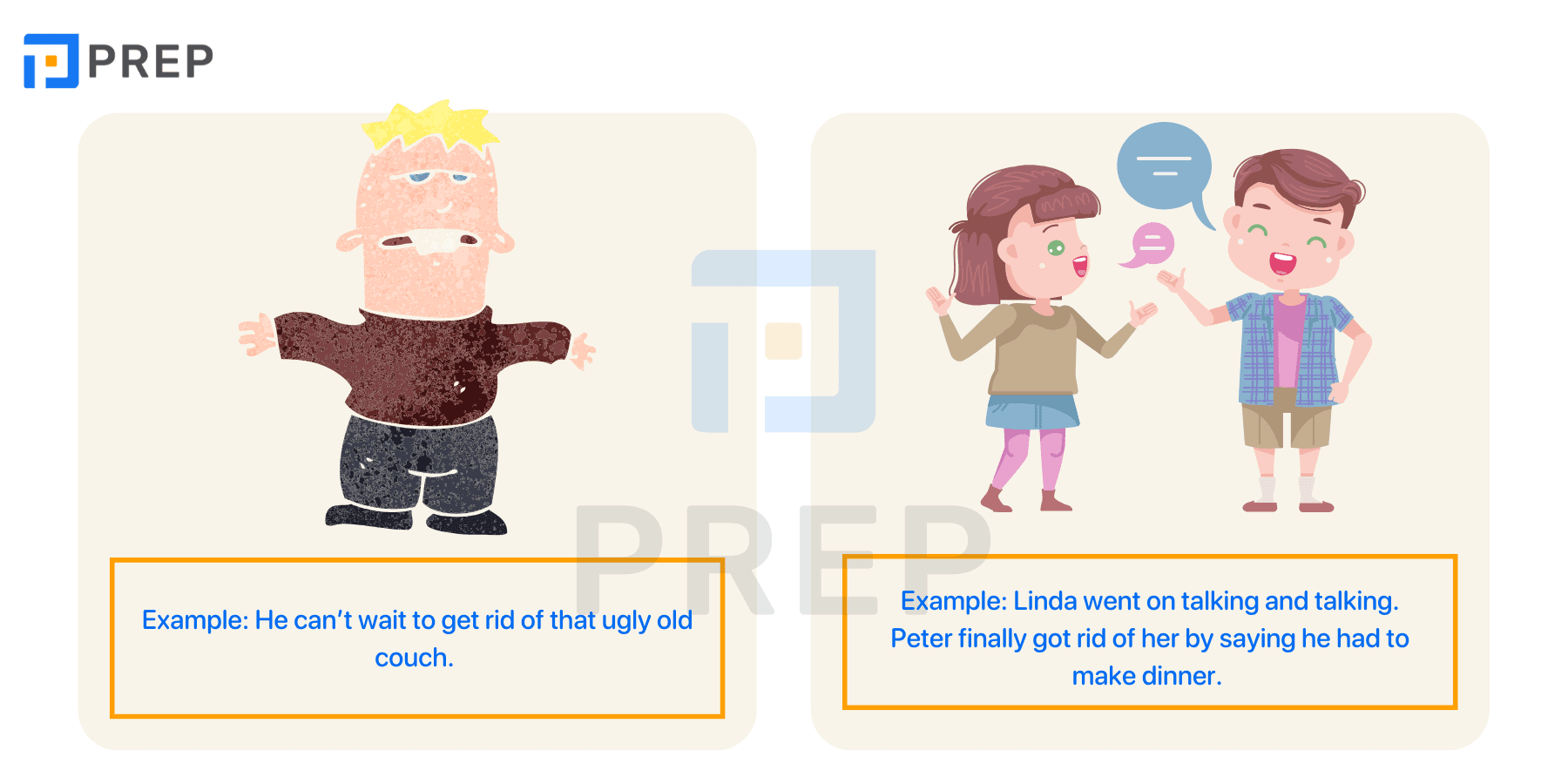
1. How to Use Get Rid Of in English Sentences
The expression “get rid of” is typically used with the following structure:
Subject + get + rid + of + object
In most cases, it's conjugated with the verb “get” to match the subject and tense. For example:
-
Present simple: I get rid of unnecessary files regularly.
-
Past simple: She got rid of her old phone last week.
-
Present perfect: We have gotten rid of all the paperwork.
It’s important to remember that “get rid of” is not separable — the phrase should stay together, and you cannot insert words between its components.
To compare with similar causative patterns, see causative verbs in English.
Here are some of the most common contexts in which this phrase is used:
-
Removing physical objects: “He got rid of the broken chair.”
-
Eliminating negative emotions or habits: “She’s trying to get rid of her anxiety before the test.”
-
Dealing with unwanted people or responsibilities (informal): “How can I get rid of this annoying task?”
This phrase is especially common in spoken English, but it appears in written forms too — particularly in informal writing such as personal emails or blogs. In more formal documents, learners may want to replace it with alternatives like eliminate or remove, depending on the tone.
Understanding the tense, tone, and context will help learners use “get rid of” more naturally and appropriately in different types of communication.
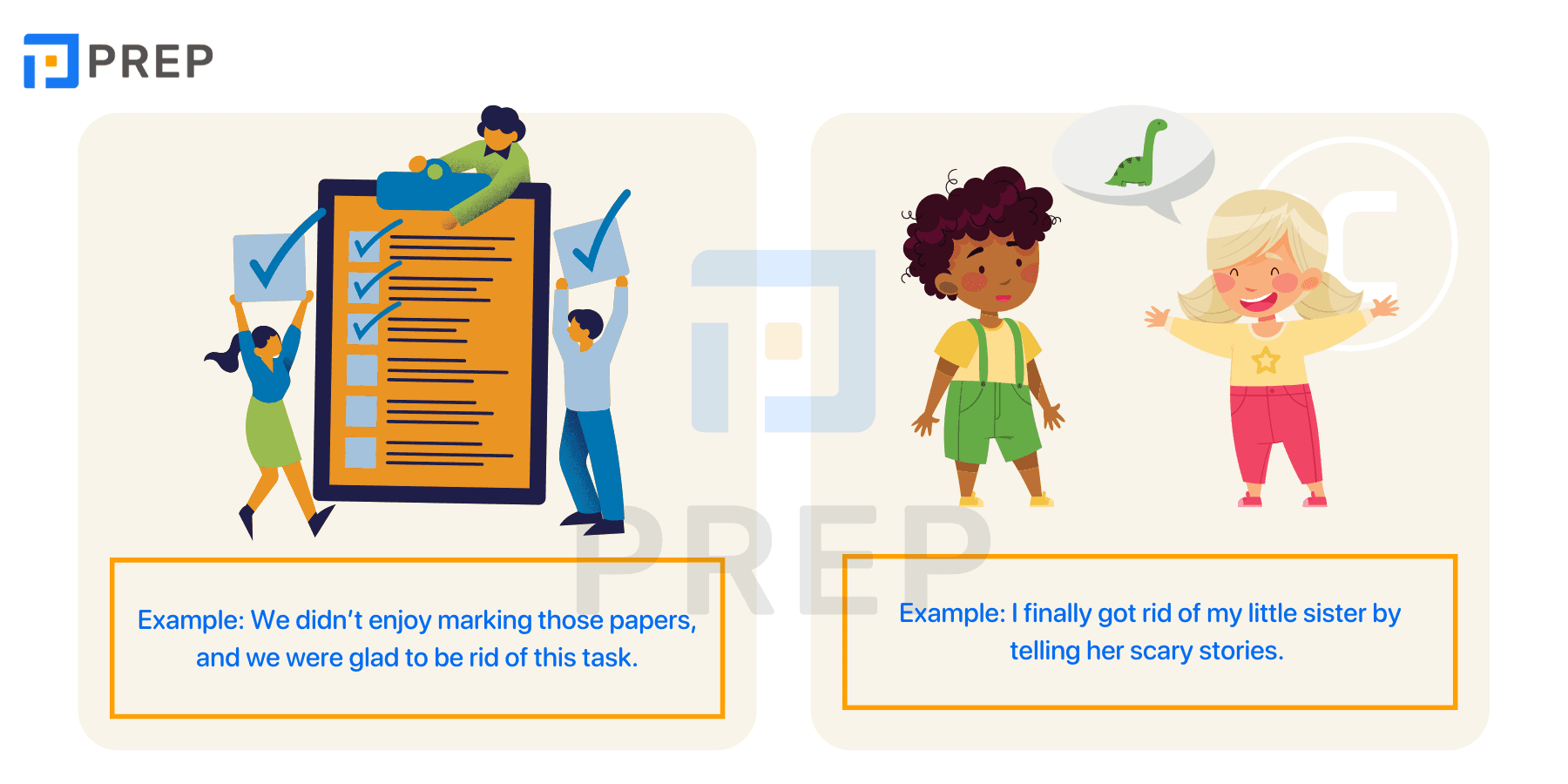
-
For a wider grammar foundation, review learn English grammar.
2. Synonyms and Related Expressions for “Get Rid Of”
While “get rid of” is widely used in both spoken and written English, especially in informal contexts, there are many alternative expressions that can be used depending on tone, formality, and context. Here are some common synonyms and related phrases, grouped by usage:
Informal Synonyms for “Get Rid Of”
|
Expression |
Formality |
Usage Context |
Example Sentence |
|
Throw away |
Informal |
Physical items, trash |
I threw away the empty bottles. |
|
Throw out |
Informal |
Disposing of something unwanted |
She threw out all his old clothes. |
|
Chuck |
Very informal |
British/Australian slang, casual |
Just chuck that broken lamp in the bin. |
Formal and Neutral Alternatives
|
Expression |
Formality |
Usage Context |
Example Sentence |
|
Remove |
Neutral |
Objects, information, people |
Please remove the unnecessary sections. |
|
Eliminate |
Formal |
Problems, risks, inefficiencies |
The team aims to eliminate all errors. |
|
Dispose of |
Formal |
Waste, equipment, harmful objects |
You must dispose of chemicals properly. |
Context-Specific Related Expressions
|
Expression |
Formality |
Typical Usage |
Example Sentence |
|
Cut out |
Neutral |
Habits, diet, negative behavior |
I'm trying to cut out caffeine completely. |
|
Phase out |
Formal |
Business, policy (gradual removal) |
They plan to phase out single-use plastics. |
|
Do away with |
Formal |
Regulations, systems |
The company did away with annual reviews. |
Understanding these alternatives helps learners adapt their vocabulary to different levels of formality, making their English more flexible and precise across both casual and professional settings.

-
To expand topic-based vocabulary sets, see english vocabulary by topics.
II. Examples of “Get Rid Of” in Real English
The phrase “get rid of” is highly versatile in English and appears across various real-life contexts — from daily conversation to academic writing and standardized test settings like IELTS. Here are examples that demonstrate how the expression is naturally used by native speakers.
Everyday Spoken English
|
Context |
Example Sentence |
|
Cleaning/Decluttering |
I need to get rid of all this junk in the garage. |
|
Breaking habits |
He’s trying to get rid of his smoking addiction. |
|
Avoiding people |
I can’t get rid of that salesman — he keeps calling me! |
|
Emotions/Thoughts |
She wants to get rid of the guilt she’s been carrying. |
These uses are common in casual conversations and are often said in the present simple, past simple, or present continuous tense.
Academic and Professional Use
|
Context |
Example Sentence |
|
Process improvement |
The company aims to get rid of unnecessary procedures. |
|
Scientific context |
The study seeks to get rid of bias in the evaluation process. |
|
Workplace communication |
We need to get rid of outdated files on the server. |
In professional or academic contexts, “get rid of” may sound slightly casual — it’s acceptable in speech or informal writing, but in formal documents, consider alternatives like eliminate or remove.
IELTS and Test-Oriented Usage (Speaking & Writing)
IELTS Speaking Part 1 / 2 Examples:
-
“To stay healthy, I try to get rid of fast food from my diet.”
-
“Last summer, I got rid of a lot of old clothes I didn’t wear anymore.”
IELTS Writing Task 2 Example (less formal tone):
-
“In order to reduce urban congestion, cities should get rid of inefficient public transport systems.”
Note: While “get rid of” may appear in IELTS Speaking or Writing (Task 1 informal letters or Task 2 essays with conversational tone), test takers should balance idiomatic usage with clarity and appropriateness.
-
To strengthen your everyday vocabulary base, see 1000 frequently-used English vocabulary.
The article above has provided you with detailed information about the meaning, usage with examples of Get rid of. In addition, if you know any other interesting information about Get rid of or synonymous terms, don't hesitate to share them in the comments below!

Hi I'm Chloe, and I am currently serving as an Product Content Administrator at Prep Education. With over five years of experience in independent online IELTS study and exam preparation, I am confident in my ability to support learners in achieving their highest possible scores.
Comment
Premium content
View all



Personalized roadmap


Most read




UEN: 202227322W
Address: 114 LAVENDER STREET, #11-83 CT HUB 2, SINGAPORE (338729)