40 Repeated Phrases in English You Should Know
Repeated phrases like bit by bit, again and again, or shoulder to shoulder are part of natural English. This article explores 40+ common, useful expressions that add rhythm, clarity, and fluency to your writing and speaking. Master them for a more authentic voice.
I. What Are Repeated Phrases in English?
Repeated phrases in English are word combinations where the same or similar elements appear in a structured, rhythmic way—often enhancing clarity, emphasis, and memorability. These expressions are not mistakes or redundancy. On the contrary, they’re an essential part of natural, idiomatic English.
Typically, repeated phrases follow patterns like:
-
Word + and + word (e.g., again and again, more and more)
-
Word + by + word (e.g., step by step, bit by bit)
-
Word + to + word (e.g., face to face, toe to toe)
These patterns are found everywhere—from everyday conversations to business presentations, from storytelling to journalism. They play a vital role in helping speakers:
-
Emphasize an idea naturally
-
Add rhythm and cohesion to their speech or writing
-
Create a tone that is more emotional, persuasive, or memorable
It’s important to distinguish between useful repetition—which serves a communicative or stylistic function—and careless repetition due to limited vocabulary. This article focuses on the former: the useful, accepted, and often beautiful repeated phrases that help learners sound more fluent and natural.
In many cases, improving sentence structure through proper word order in English can help reduce unnecessary repetition without losing clarity.
II. Common Repeated Phrases in English Writing
In the table below, you'll find a curated list of useful repeated phrases. Some of these phrases have become fixed expressions through frequent use in both spoken and written English. They are especially helpful in narrative writing, dialogue, persuasive texts, and informal communication, but many are also suitable for emails, opinion paragraphs, and public speaking.
|
No. |
Common repeated words in English |
Meaning |
Example |
|
1 |
Again and again /əˈɡɛn ənd əˈɡɛn/ |
Repeatedly, many times |
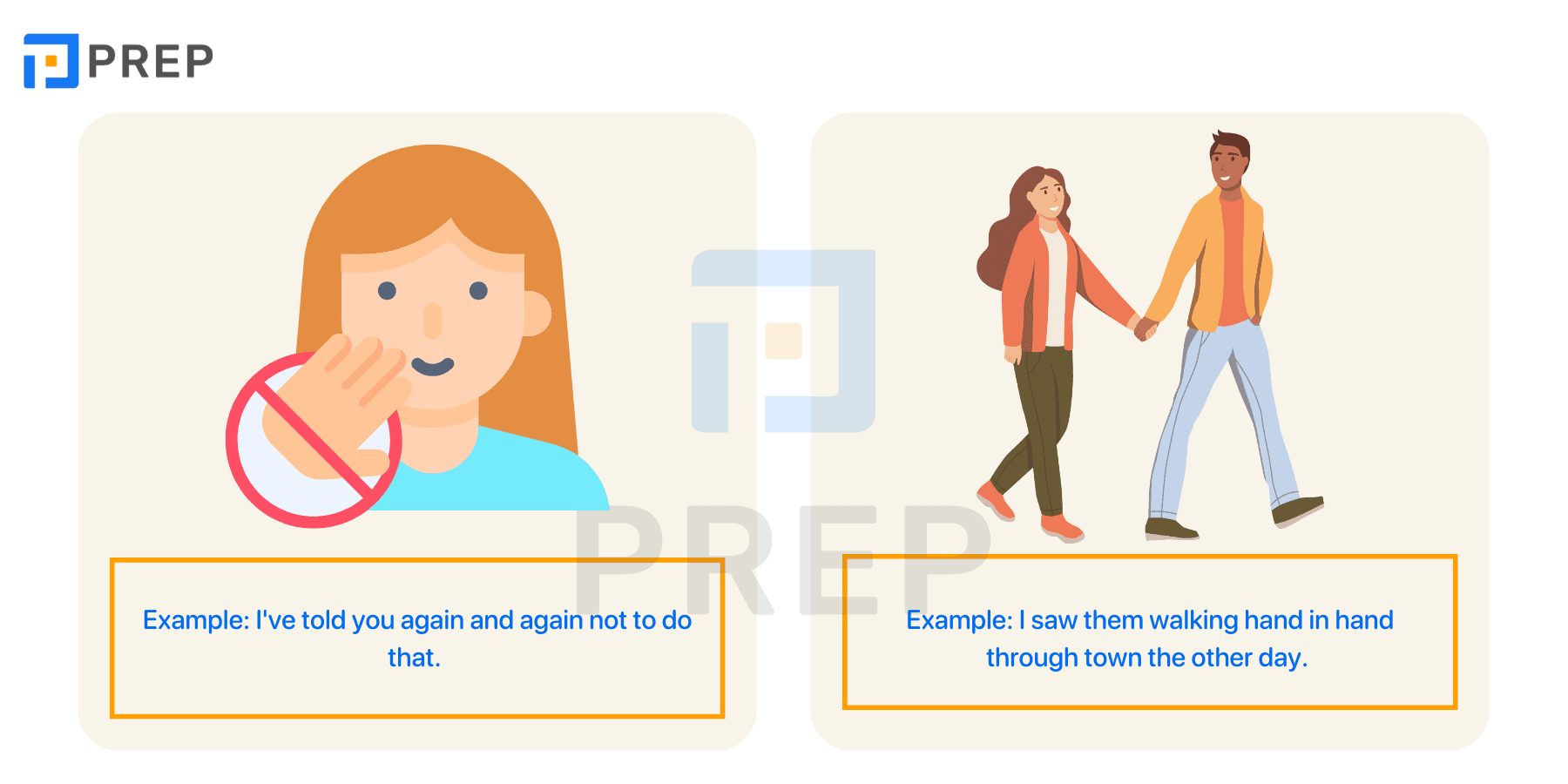
Jack tried again and again, but he couldn't solve the puzzle. |
|
2 |
All in all /ɔl ɪn ɔl/ |
considering all the different parts of the situation together |
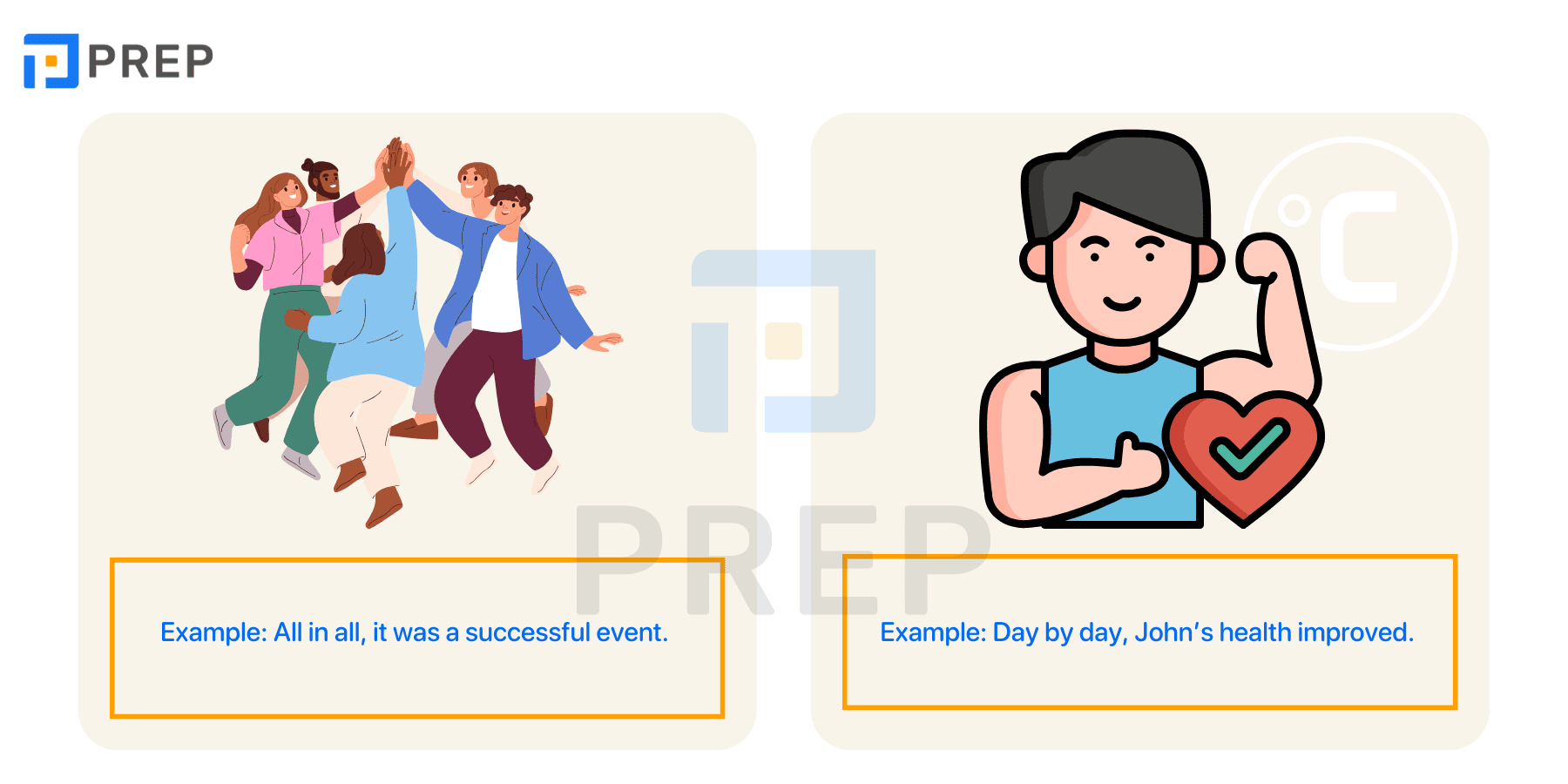
All in all, it was a successful event. |
|
3 |
Arm in arm /ɑrm ɪn ɑrm/ |
When two people are arm in arm, they both have one arm bent at the elbow and passing around and supporting, or being supported by, the arm of the other person |
They walked arm in arm along the beach. |
|
4 |
Back to back /bæk tə bæk/ |
close together and facing in opposite directions |
They scheduled meetings back to back all day. The office was full of computers, and we had to sit back to back in long rows. |
|
5 |
Bit by bit /bɪt baɪ bɪt/ |
gradually |
Bit by bit, Anna saved enough money for a new car. |
|
6 |
Day by day /deɪ baɪ deɪ/ |
every day, or more and more as each day passes |
Day by day, John’s health improved. |
|
7 |
Day to day /deɪ tə deɪ/ |
happening every day as a regular part of your job or life |
Jennie handles problems on a day to day basis. |
|
8 |
End to end /ɛnd tu ɛnd/ |
arranged with one end of next to the end of something else |
The cars were lined up end to end. |
|
9 |
Enough is enough /ɪˈnʌf ɪz ɪˈnʌf/ |
something you say when you want something to stop |
I've had enough of his excuses; enough is enough. |
|
10 |
An eye for an eye /ən aɪ fər ən aɪ/ |
the idea that a person who causes another person to suffer should suffer in an equal amount |
Richard believes in an eye for an eye when it comes to justice. |
|
11 |
Eye to eye /aɪ tə aɪ/ |
If two people see eye to eye, they agree with each other |
They didn't see eye to eye on the issue. |
|
12 |
Face to face /feɪs tə feɪs/ |
directly, meeting someone in the same place |
They had a face to face meeting to resolve the conflict. |
|
13 |
Hand in hand /hænd ɪn hænd/ |
holding each other's hand |
They walked hand in hand through the park. |
|
14 |
Head to head /hɛd tə hɛd/ |
involving a direct competition between two people or teams |
The two teams went head to head in the final match. |
|
15 |
Heart to heart /hɑrt tə hɑrt/ |
a serious conversation between two people, usually close friends, in which they talk honestly about their feelings |
They had a heart to heart conversation about their future. |
|
17 |
Less and less /lɛs ənd lɛs/ |
If something happens less and less, it becomes gradually smaller in amount or happens less often |
Robert spends less and less time at home. |
|
18 |
Little by little /ˈlɪtəl baɪ ˈlɪtəl/ |
slowly or gradually |
Little by little, Lenny learned to speak the Spanish language. |
|
19 |
Lose-lose /luz luz/ |
A lose-lose situation or result is one that is bad for everyone who is involved |
The negotiation turned into a lose-lose situation. |
|
20 |
More and more /mɔr ənd mɔr/ |
increasingly |
More and more people are working from home. |
|
21 |
Mouth-to-mouth (resuscitation) /ˌmaʊθ.təˈmaʊθ/ |
the act of forcing air in and out of the lungs of a person who has stopped breathing by blowing into their mouth and pressing their chest |
Staff are trained in the techniques of mouth-to-mouth resuscitation. |
|
22 |
Neck and neck /nɛk ənd nɛk/ |
If two competitors are neck and neck, they are level with each other and have an equal chance of winning |
The racers were neck and neck as they approached the finish line. |
|
23 |
Never say never /ˈnɛvər seɪ ˈnɛvər/ |
used to say that a person should not say that he or she will never do something because people change their minds |
I might travel to Antarctica someday; never say never. |
|
24 |
A no-no /ə noʊ noʊ/ |
something that is thought to be unsuitable or unacceptable |
Wearing jeans to a formal event is a no-no. |
|
25 |
On and on /ɔn ənd ɔn/ |
continuing for a long time |
Peter talked on and on about his new car. |
|
26 |
One by one /wʌn baɪ wʌn/ |
separately, one after the other |
One by one, the students presented their projects. |
|
27 |
One on one /wʌn ɑn wʌn/ |
A one-on-one activity involves two people talking directly, usually with one teaching or giving information to the other |
Emi prefers one on one meetings with her team members. |
|
28 |
Out and out /aʊt ənd aʊt/ |
complete or in every way; used to emphasize an unpleasant quality of a person or thing |
It was an out and out lie. |
|
29 |
Over and over /ˈoʊvər ənd ˈoʊvər/ |
repeating many times |
Anne practiced the song over and over until it was perfect. |
|
30 |
Shoulder to shoulder /ˈʃoʊldər tə ˈʃoʊldər/ |
If people are shoulder to shoulder, they are close together and next to each other |
They stood shoulder to shoulder in the crowded room. |
|
31 |
Side by side /saɪd baɪ saɪd/ |
next to each other |
They worked side by side to complete the project. |
|
32 |
Side to side /saɪd tə saɪd/ |
from this side to the other, swaying, wobbling |
The boat rocked side to side in the storm. |
|
33 |
So-so /soʊ soʊ/ |
between average quality and low quality; not good or well |
The movie was so-so; not great, but not terrible. |
|
34 |
Step by step /stɛp baɪ stɛp/ |
dealing with one thing and then another thing in a fixed order |
Lona followed the recipe step by step. |
|
35 |
Through and through /θru ənd θru/ |
completely |
Smith was a loyal friend through and through. |
|
36 |
Time after time /taɪm ˈæftər taɪm/ |
again and again; repeatedly |
Time after time, Joe proved his loyalty. |
|
37 |
Time and time again /taɪm ənd taɪm əˈɡɛn/ |
Sarah warned him time and time again about the risks. |
|
|
38 |
Toe to toe /toʊ tə toʊ/ |
directly opposing or competing with each other |
The two boxers went toe to toe in the ring. |
|
39 |
Win-win /wɪn wɪn/ |
A win-win situation or result is one that is good for everyone who is involved |
Their partnership turned out to be a win-win situation. |
|
40 |
Word for word /wɜrd fər wɜrd/ |
using exactly the same words |
Bray repeated the instructions word for word. |
Many repeated expressions also appear in figurative usage, such as those found in idioms about time.
III. Repetition in English Writing: Common Mistakes to Avoid
While repeated phrases can enrich English writing by adding rhythm, emphasis, or natural flow, it's important to understand the fine line between useful repetition and unnecessary duplication. Not all repetition is stylistically helpful. In fact, when overused or misused, it can make writing feel dull, simplistic, or lacking in vocabulary range.
In formal writing—especially in academic, exam, or professional contexts—certain types of repetition may be seen as weak or redundant. Learners should know how to distinguish between fixed phrases that carry meaning (such as step by step or heart to heart), and accidental repetition of the same word or idea due to habit or limited vocabulary.
-
Repeating single words too often
Example (ineffective): It is very important to study very hard during very important exams.
Better: It is crucial to study hard during high-stakes exams. -
Using vague repeated expressions instead of precise ones
Overuse: a lot of, very good, nice, important
Alternatives: extensive, excellent, impressive, essential -
Repeating sentence structures without variation
When all sentences start the same way, the writing becomes mechanical.
Tip: Vary transitions and opening phrases to make your writing more engaging. -
Trying to create repetition for emphasis—but overdoing it
Emphasis should feel purposeful, not forced.
Example (awkward): He was sad, sad, sad.
Better: He felt a deep, growing sadness he couldn't hide.
While these mistakes are common among learners, they're also easy to fix with awareness and targeted practice. Don’t be afraid of repetition—just use it wisely. Learn to keep the powerful, expressive phrases (like little by little or again and again), and reduce the habit-driven, unintentional lặp lại that doesn’t add much value.
Misuse of similar reference words is common, which is why understanding structures like one another, other, the other, others is essential.
IV. Exercise on repeated words in English
The best way to learn and remember repeated phrases is through real-world usage and contextual practice. The exercises below are designed to help you recognize the meaning and tone of these expressions, apply them naturally in sentences, and use them comfortably in writing as well as conversation.
Exercise 1: Fill in the Blanks
Choose the correct repeated phrase to complete each sentence.
Word bank: bit by bit, again and again, step by step, more and more, little by little
-
She followed the instructions __________ and completed the sculpture in time.
-
The teacher explained the rule __________ until the whole class understood.
-
__________, his confidence grew as he practiced public speaking.
-
__________, the problem began to solve itself as we stayed calm and focused.
-
Online learning is becoming __________ popular among adult students.
Exercise 2: Match the Phrase with Its Meaning
Match each repeated phrase on the left with its correct meaning on the right.
|
Phrase |
Meaning |
|
A. One by one |
1. Competing directly |
|
B. Toe to toe |
2. Holding hands |
|
C. Hand in hand |
3. Gradually |
|
D. Bit by bit |
4. One person at a time |
Answers
[prep_collapse_expand open_text="View more" close_text="Show less"]
|
Exercise 1 |
Exercise 2 |
|
A → 4 B → 1 C → 2 D → 3 |
[/prep_collapse_expand]
By practicing with phrases like these, you not only improve your vocabulary and fluency—you also sound more authentic and confident when using English in real life. Don’t shy away from repetition when it adds rhythm, emphasis, or clarity.
When used deliberately, repetition can work alongside figurative devices like English metaphor to enhance expressive writing.
PREP hopes that through the article above, you have grasped the meaning of repeated words in English and completed the exercise provided. Let’s follow PREP regularly to stay updated on helpful English knowledge!

Hi I'm Chloe, and I am currently serving as an Product Content Administrator at Prep Education. With over five years of experience in independent online IELTS study and exam preparation, I am confident in my ability to support learners in achieving their highest possible scores.
Comment
Premium content
View all
Personalized roadmap


Most read


UEN: 202227322W
Address: 114 LAVENDER STREET, #11-83 CT HUB 2, SINGAPORE (338729)