Collocations with Reaction: Examples and Tips
This guide explains common collocations with the word “reaction” in English. You will learn useful phrases, meanings, and example sentences that help you use “reaction” naturally in conversations, academic writing, and English exams such as IELTS.

Keynote – Collocations with Reaction
Collocations with “reaction” are essential for describing responses, changes, or effects in personal, academic, and scientific contexts. These common pairings help you talk about emotions, chemical processes, or public opinion in a clear and natural way.
-
Key combinations: have a reaction, trigger a reaction, provoke a reaction, allergic reaction, emotional reaction, chemical reaction, positive/negative reaction.
-
Main contexts: daily conversation, news reports, academic essays, science classes, and IELTS exam tasks.
-
Common mistakes: using “make a reaction” instead of “have a reaction,” or confusing scientific and general uses. Mastering these collocations makes your English more precise, fluent, and effective.
I. What Is a Collocation with Reaction?
In English, a collocation is a natural pairing of words that often appear together and sound correct to native speakers. With the noun “reaction,” certain verbs, adjectives, and prepositions frequently combine to express specific responses, behaviors, or changes in various contexts—ranging from everyday conversation to science and business.
Key points about collocations with “reaction”:
-
A collocation with “reaction” is a set phrase in which “reaction” regularly goes with certain words, such as “have a reaction,” “trigger a reaction,” or “emotional reaction.”
-
These combinations help you describe human responses (emotional, physical, or social) or chemical processes more clearly and naturally in both spoken and written English.
-
Mastering reaction collocations allows you to express your ideas with accuracy—whether you are describing changes, expressing opinions, or reporting test results.
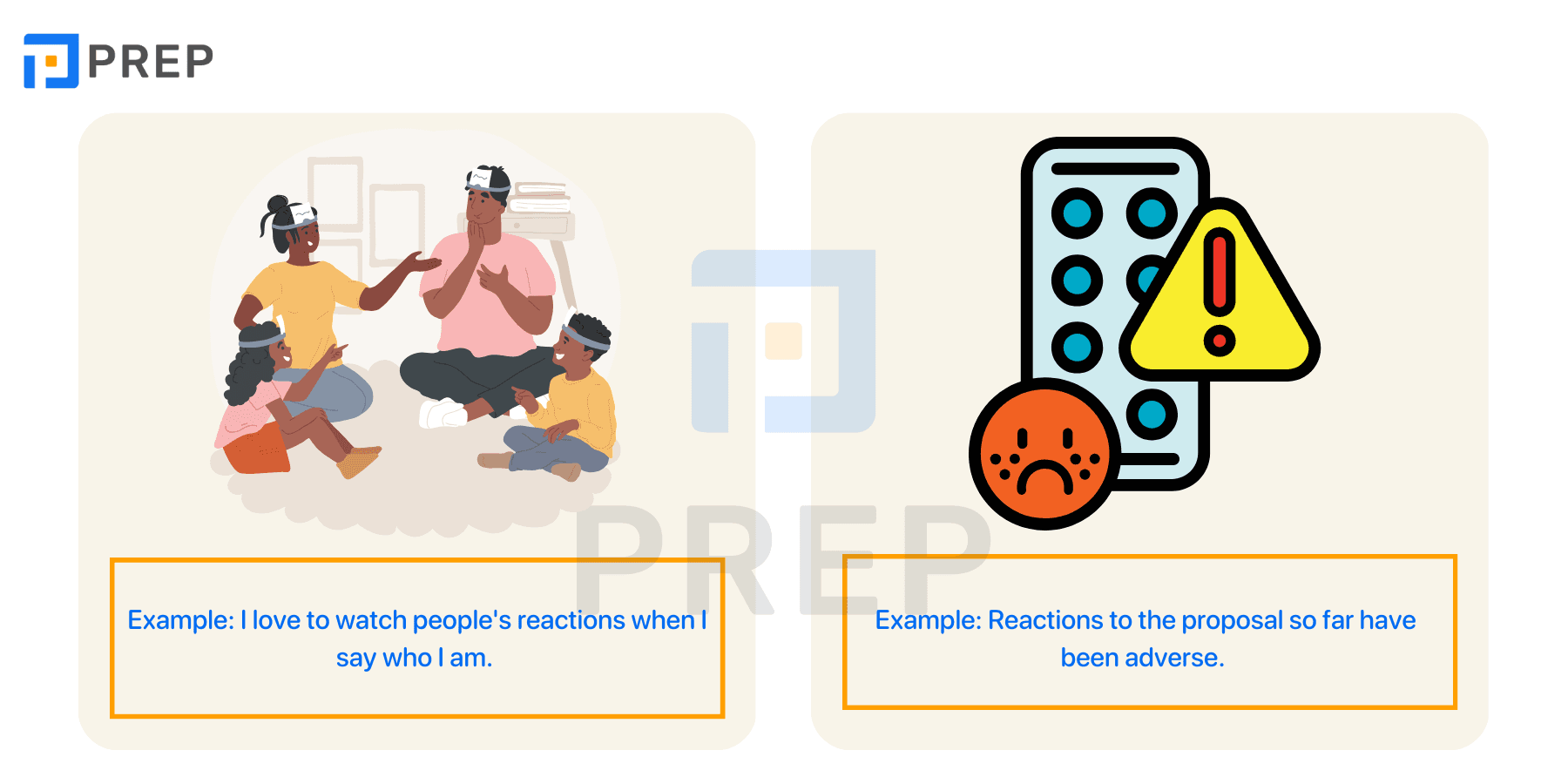
You can explore collocations with have to understand common verb patterns.
For example:
-
We say “cause a reaction” or “provoke a reaction” (not “make a reaction”).
-
In science, “chemical reaction” and “adverse reaction” are standard phrases.
-
Expressions like “initial reaction,” “public reaction,” or “allergic reaction” are used in news reports, academic writing, and everyday talk.
II. Common Collocation Patterns with Reaction
Collocations with “reaction” appear in several standard structures. Learning these combinations will help you describe responses and processes clearly and naturally, whether in informal conversation or formal writing.
Verb + Reaction Collocations
-
have a reaction
-
trigger a reaction
-
provoke a reaction
-
cause a reaction
-
elicit a reaction
-
get a reaction
-
observe a reaction
-
exaggerate a reaction
-
monitor a reaction
-
suppress a reaction
Example: “His remarks triggered a strong reaction from the audience.”
You can review collocations with solution for handling outcomes logically.
Adjective + Reaction Collocations
-
emotional reaction
-
allergic reaction
-
immediate reaction
-
initial reaction
-
adverse reaction
-
negative/positive reaction
-
automatic reaction
-
physical reaction
-
strong reaction
-
typical reaction
Example: “She had an allergic reaction to the medication.”
Reaction + Prepositional Phrase/Other Modifiers
-
reaction to (something): reaction to new policies
-
reaction from (someone/group): reaction from the public
-
reaction against: reaction against the law
-
chemical reaction
-
public reaction
-
market reaction
Example: “The market reaction to the news was unexpected.”
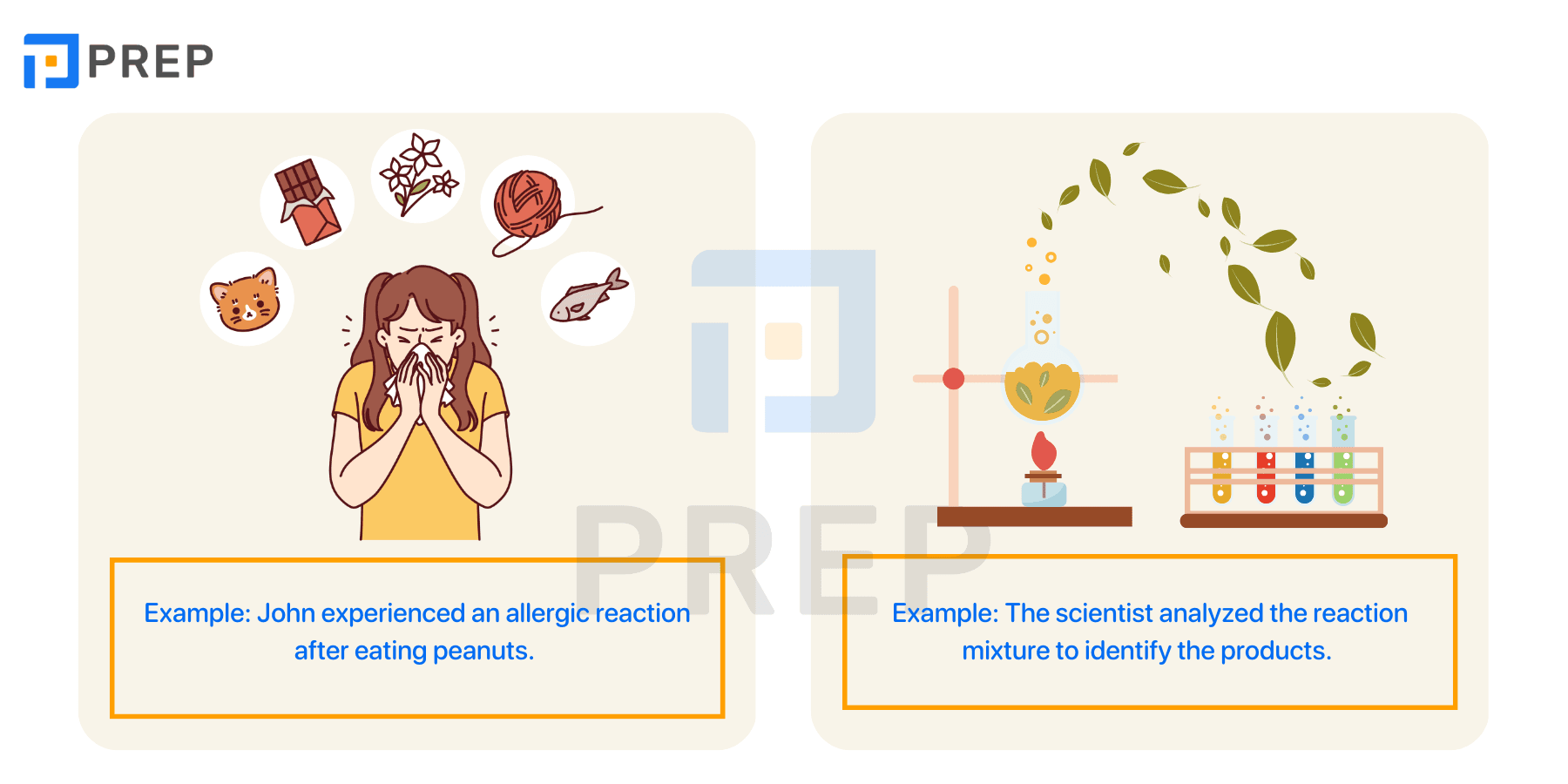
III. Collocations by Usage Context
“Reaction” collocations are used differently depending on whether you are speaking informally, writing formally, or discussing scientific or social topics. Choosing the correct expression for each context will help your English sound both accurate and natural.
Everyday Communication
These collocations are common when discussing personal feelings, opinions, or daily events.
|
Collocation |
Example Sentence |
|
strong reaction |
He had a strong reaction to the bad news. |
|
emotional reaction |
Her emotional reaction surprised everyone. |
|
initial reaction |
My initial reaction was to laugh. |
|
get a reaction |
Did you get any reaction to your suggestion? |
|
public reaction |
The public reaction was mostly positive. |
You can also explore collocations with education in formal topics.
Neutral & Written Contexts
You’ll find these collocations in news articles, business reports, academic writing, and scientific discussions.
|
Collocation |
Example Sentence |
|
provoke a reaction |
The politician’s statement provoked a heated reaction. |
|
cause an allergic reaction |
The drug may cause an allergic reaction in some patients. |
|
chemical reaction |
A color change indicates a chemical reaction has occurred. |
|
reaction to treatment |
We are monitoring her reaction to the new treatment. |
|
market reaction |
The market reaction was swift after the announcement. |
|
adverse reaction |
He suffered an adverse reaction to the vaccine. |
|
typical reaction |
Headache is a typical reaction to this medication. |
IV. Applying Collocations in IELTS Contexts
Using “reaction” collocations accurately in IELTS Speaking and Writing demonstrates your ability to express ideas about opinions, experiences, or even science and social issues in a natural and sophisticated way.
In IELTS Speaking
Family, society, emotions, news, and health are common topics in the Speaking test. Collocations with “reaction” will help you answer questions more fluently.
-
For personal or emotional topics:
“My initial reaction was surprise when I heard the news.”
“Some people have a strong reaction to criticism.” -
For describing social or public responses:
“Public reaction to the law was mixed.”
“Celebrities often get an emotional reaction from fans.”
Tips for IELTS Speaking:
-
Use collocations you can pronounce confidently and that fit your real-life experience.
-
Try to give a specific example: “When I tried spicy food for the first time, I had an immediate reaction.”
In IELTS Writing
Writing about reactions is common in Task 2 essays—especially when discussing effects, health, media, or policies.
-
For academic or formal discussion:
“The policy changes caused a negative reaction among the public.”
“Researchers observed an adverse reaction to the proposed drug.” -
For science and process description:
“A chemical reaction occurs when vinegar and baking soda are mixed.”
Tips for IELTS Writing:
-
Use formal collocations such as “provoke a reaction,” “negative reaction,” or “monitor reaction” to enhance your vocabulary range.
-
Integrate these phrases into both examples and explanations for higher lexical resource scores.
Mastering “reaction” collocations will make your answers sound more natural, precise, and sophisticated—helping you reach a higher band score in IELTS.
You can apply big words in IELTS for higher band scores.
V. Practice Exercises
Practicing “reaction” collocations will help you use them naturally and accurately in both speaking and writing. Complete the exercises below to test your understanding.
Exercise 1: Choose the correct collocation to complete each sentence.
-
The manager’s decision _________ a negative reaction from employees.
A. made
B. provoked
C. did -
She had a strong allergic _________ after eating seafood.
A. respond
B. reaction
C. respondence -
The market _________ to the new policy was immediate.
A. reaction
B. answer
C. respond -
I was surprised by his _________ reaction to the good news.
A. emotionally
B. emotional
C. emotion -
Scientists observed a _________ reaction when the chemicals were mixed.
A. chemist
B. chemical
C. chemistry
Exercise 2: Fill in the blank with a suitable collocation.
-
The patient is being monitored for any _________ reaction to the treatment.
-
Unexpected changes in temperature can _________ a reaction in the material.
-
My _________ reaction was fear, but I quickly calmed down.
-
The politician’s speech triggered a strong _________ from the audience.
-
This medication can sometimes _________ an adverse reaction.
Answer Key
[prep_collapse_expand open_text="View more" close_text="Show less"]
|
Exercise 1 |
Exercise 2 |
|
1. B |
6. adverse |
|
2. B |
7. trigger/cause/provoke (any of these is correct) |
|
3. A |
8. initial |
|
4. B |
9. reaction |
|
5. B |
10. cause/provoke/trigger (any of these is correct) |
[/prep_collapse_expand]
Practicing these collocations will help you express opinions, describe changes, and discuss results more naturally and fluently in English.
In addition to learning individual vocabulary words, improving and using appropriate collocations will help you enhance your English knowledge. Understanding and using collocations correctly is an important factor in helping you speak and write English naturally and accurately. Don't hesitate to apply these collocations in practice and enhance your skills through exercises. PREP hopes that after reading this article, you have accumulated 10 useful and common collocations with Reaction. Keep following PREP for more useful collocations!

Hi I'm Chloe, and I am currently serving as an Product Content Administrator at Prep Education. With over five years of experience in independent online IELTS study and exam preparation, I am confident in my ability to support learners in achieving their highest possible scores.
Comment
Premium content
View all



Personalized roadmap


Most read




UEN: 202227322W
Address: 114 LAVENDER STREET, #11-83 CT HUB 2, SINGAPORE (338729)