IELTS Speaking: Describe an Activity You Enjoy Doing
This guide explains how to confidently answer the IELTS Speaking cue card ‘Describe an activity you like doing.’ You will learn how to analyse the question, choose the right ideas, structure your response naturally, use effective vocabulary, and study high-band sample answers.
I. Understanding the Cue Card: Describe an Activity You Like Doing
One of the most common topics in IELTS Speaking Part 2 is describing an activity that you enjoy. This type of cue card falls under the broader theme of hobbies, routines, and personal interests, which are frequently used to assess candidates’ ability to speak fluently about familiar, everyday topics.
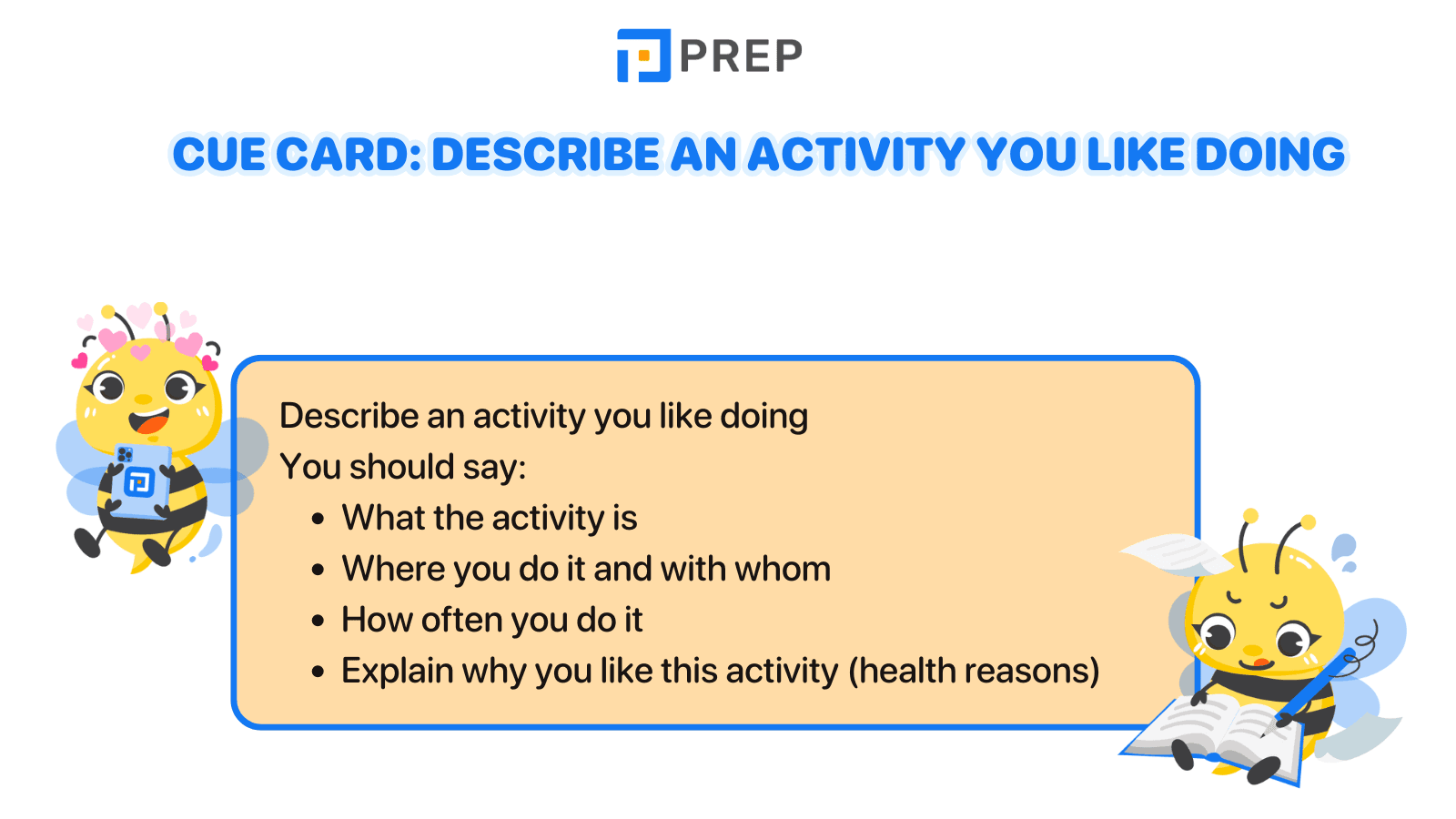
Typically, this cue card will provide prompts such as:
-
What the activity is
-
When and where you do it
-
Who you do it with (if anyone)
-
Why you enjoy doing it
The goal of your response is to develop each of these points clearly and naturally within one to two minutes. Remember that you will be given one minute to prepare your answer, during which you should make quick notes to structure your ideas.
Here is how to interpret this task correctly:
-
Choose one specific activity that you are comfortable talking about. It can be anything from painting, jogging, or playing a musical instrument to baking or journaling.
-
Think about the context: When did you start doing it? How often do you do it? Is it a solo or group activity?
-
Focus on the personal meaning: Why is it enjoyable or important to you? Does it help you relax, stay healthy, or express yourself?
Additionally, it is important to understand how your performance will be assessed. Examiners evaluate your speaking based on four criteria:
-
Fluency and Coherence – Are your ideas organized and connected naturally?
-
Lexical Resource – Do you use appropriate and varied vocabulary?
-
Grammatical Range and Accuracy – Are your sentence structures diverse and grammatically correct?
-
Pronunciation – Is your speech clear and easy to understand, with natural stress and intonation?
Understanding the purpose and expectations of this cue card will help you avoid common mistakes, such as going off-topic, giving too short an answer, or overusing basic vocabulary. In the next sections, we will explore how to plan your answer effectively, use upgraded vocabulary, and review sample responses across different band levels.
To perform well in this criterion, candidates should spend time practicing techniques that help them improve English pronunciation in natural speaking contexts.
1. How to Approach This Topic Effectively?
Approaching this cue card effectively requires a combination of good idea selection, clear structure, and confident delivery. Since the topic is personal and open-ended, there is flexibility in what you can talk about — but clarity and relevance are key.
Choose an activity that is simple but rich in detail
Select an activity you are familiar with and can describe fluently. It does not have to be extraordinary — common hobbies such as reading, swimming, cooking, cycling, or gardening are perfectly acceptable if you can make them sound meaningful or enjoyable. Avoid choosing something you cannot explain well or have no personal connection with.
Use a clear and logical structure
Break your response into three main parts:
-
Introduction: Briefly name the activity and explain how it fits into your life.
-
Details: Describe when, where, how, and with whom you do it.
-
Personal response: Explain why you enjoy it, how it benefits you, and what role it plays in your routine or well-being.
This structure mirrors the bullet points often provided on the cue card and ensures that you cover all expected points within the time frame.
Analyze the strengths and weaknesses of different activity types
Some activities naturally lend themselves to rich vocabulary and deeper reflection. For example:
-
Creative activities (like painting or writing) allow you to express emotional and mental benefits.
-
Physical activities (like running or yoga) provide vocabulary related to health, discipline, and energy.
-
Social activities (like volunteering or playing in a team) let you highlight collaboration, community, and fulfillment.
Understanding what kind of language each activity invites will help you decide which one is easier and more strategic to develop under exam pressure.
2. Vocabulary and Useful Language for This Cue Card
In order to score well in the Lexical Resource criterion, it's essential to use a variety of topic-related vocabulary and natural expressions. When describing an activity you enjoy, you must be able to communicate not only the basic facts but also your feelings, opinions, and reflections — all in appropriate and flexible language.
Topic-specific vocabulary for describing common activities
Different types of activities come with different sets of vocabulary. Below are some examples based on activity categories:
-
Creative activities (e.g. drawing, writing, playing music):
a creative outlet, express myself, boost imagination, focus on fine details, emotionally rewarding -
Physical activities (e.g. jogging, swimming, hiking):
stay in shape, relieve stress, build stamina, energizing, improve mental clarity -
Social activities (e.g. team sports, community work):
team spirit, shared goals, strengthen relationships, feel a sense of belonging
Phrases to express enjoyment and personal connection
These expressions add depth and emotion to your answer:
-
I really look forward to doing it every week.
-
It helps me recharge and unwind after a long day.
-
Doing this activity gives me a strong sense of satisfaction and purpose.
-
It’s something I’m genuinely passionate about.
Higher-level connectors and fluency markers
Using advanced connectors helps your answer flow more smoothly:
-
Not only that, but it also...
-
What I like most about it is...
-
To be honest, I can’t imagine my life without this activity.
-
Another reason I enjoy it is because...
Common pronunciation challenges and how to deal with them
Some words related to activities may be tricky to pronounce clearly, especially under time pressure (e.g. routine, discipline, achievement, enthusiastic).
-
Practice saying these words out loud in full sentences.
-
Use online tools or repetition drills to ensure proper stress and intonation.
-
Don’t rush — clarity is more important than speed.
The key is not to memorize entire paragraphs, but to build a flexible bank of vocabulary and phrases that you can adapt to different cue cards. Practice using them in your own answers, and over time, they will begin to sound more natural.
Some words related to activities may be tricky to pronounce clearly, so learners should focus on strategies that help enhance pronunciation in English under time pressure.
II. Sample Answers for Describe an Activity You Like Doing
One of the most effective ways to prepare for an IELTS Speaking Part 2 cue card is by reading and analyzing sample answers across a range of band scores. Below, you’ll find three sample responses for the topic “Describe an activity you like doing,” each tailored to demonstrate the features of Band 6.0, Band 7.0, and Band 8.0–9.0 answers. After each sample, there is a short analysis explaining why the response fits that level, based on the official IELTS Speaking scoring criteria.
These samples will help you:
-
Understand how to organize your answer under exam conditions
-
Build appropriate vocabulary and grammar for different levels
-
Identify what examiners look for in fluency, coherence, word choice, and accuracy
1. Band 6.0 sample answer
Cue Card: Describe an activity you like doing.
You should say:
-
What the activity is
-
When and where you do it
-
Who you do it with
-
And explain why you enjoy it
Sample Answer:
One activity I really like is watching movies. I watch movies at home and sometimes in the cinema. I usually watch them in the evening, after I finish work or studying. I do this alone or with my friends, depends on the situation.
I like movies because it is relaxing and also interesting. There are many types of movies, like action, comedy, drama. My favorite is action movie, because they are exciting and have famous actors. Sometimes I also watch documentaries, to learn something new.
When I watch a movie, I feel happy and I forget about stress. It's a good way for me to spend my free time. I think watching movies is a fun activity that many people enjoy.
Why This Is a Band 6.0 Answer:
-
Fluency and Coherence: The speaker speaks at a steady pace and maintains the topic without long pauses, but the transitions between ideas are minimal or basic. Some sentences are disconnected or repetitive.
-
Lexical Resource: Vocabulary is quite limited (e.g. “interesting”, “famous”, “fun”). The speaker uses general words rather than precise or varied vocabulary.
-
Grammatical Range and Accuracy: Basic sentence structures are used correctly, but errors are noticeable (e.g. “depends” instead of “depending”, “action movie” instead of “action movies”). There is little variety in grammar.
-
Pronunciation: Generally intelligible, though minor mistakes may affect clarity if spoken. Intonation may be flat or unnatural.
Tips for Improvement:
-
Expand vocabulary with more descriptive adjectives and topic-specific terms (e.g. “cinematography”, “storyline”).
-
Use a wider variety of sentence forms: relative clauses, conditionals, comparisons.
-
Add linking phrases to improve coherence: One reason I enjoy this is because… / Another reason is that...
-
Provide a short personal story or memory related to the activity for higher engagement
2. Band 7.0 sample answer
Cue Card: Describe an activity you like doing.
You should say:
-
What the activity is
-
When and where you do it
-
Who you do it with
-
And explain why you enjoy it
Sample Answer:
One activity I truly enjoy is jogging in the early morning. I usually go jogging three to four times a week in a nearby park, which is around 10 minutes from my house. I prefer to go alone, as it gives me some quiet time to think and relax.
Jogging helps me stay in shape and clear my mind, especially before a stressful day. I started doing it regularly about a year ago when I realized I was spending too much time indoors. Since then, it has become a consistent part of my routine. I normally jog for about 30 minutes, listening to music or sometimes just enjoying the sound of nature.
What I love most about jogging is how fresh and energized I feel afterward. It improves both my physical and mental health, and even my productivity during the day. Although it’s a simple activity, it really has a positive impact on my lifestyle. I see it not just as a way to exercise, but also as a personal space where I can reflect.
Why This Is a Band 7.0 Answer:
-
Fluency and Coherence: The response is generally fluent with clear organization. Ideas are logically connected using linking devices like since then, what I love most, although. Some hesitation may naturally occur, but it does not interrupt the overall flow.
-
Lexical Resource: The vocabulary is appropriate and shows some range: clear my mind, stay in shape, consistent, productivity. Occasional phrasing is general (positive impact) but still accurate and effective.
-
Grammatical Range and Accuracy: A mix of simple and some complex structures is used effectively: I prefer to go alone, it has become a consistent part of my routine, what I love most about jogging is…. Minor errors may still occur but do not reduce clarity.
-
Pronunciation: Clear and mostly natural. Intonation likely helps convey meaning, with good rhythm and word stress overall.
Suggestions for Improvement:
-
Introduce slightly more complex grammar (e.g. conditionals, inversion) or idiomatic expressions to enhance depth.
-
Use more specific descriptive language to make the answer vivid (instead of nice or good, say refreshing, invigorating).
-
Add contrast or a short personal anecdote for more engagement.
3. Band 8.0–9.0 sample answer
Cue Card: Describe an activity you like doing.
You should say:
-
What the activity is
-
When and where you do it
-
Who you do it with
-
And explain why you enjoy it
Sample Answer:
One activity I genuinely enjoy and try to make time for regularly is journaling. I usually write in my journal late at night, just before going to bed. I do this at home, in a quiet corner of my room where I can reflect without distractions. It’s a solitary activity by nature, and I actually prefer doing it alone because it helps me focus more on my thoughts and feelings.
I started journaling a few years ago during a particularly stressful period in university. At first, it was just a way to vent and organize my thoughts, but over time it became much more than that. Now, it’s almost meditative — it allows me to slow down and make sense of what’s happened during the day, both externally and internally.
One of the main reasons I enjoy journaling is that it fosters mindfulness. Writing by hand forces me to be present with my thoughts, and I’ve found that this small daily habit has positively impacted my emotional well-being as well as my communication skills. There’s something deeply personal and liberating about putting your thoughts into words without fear of judgment.
In short, journaling has become more than just a hobby — it’s a self-care practice that grounds me, enhances my self-awareness, and brings clarity to both my personal and academic life.
Why This Is a Band 8.0–9.0 Answer:
-
Fluency and Coherence: The response flows naturally with clear progression of ideas and smooth transitions. There is no noticeable hesitation, and the answer feels structured yet conversational.
-
Lexical Resource: A rich range of precise vocabulary is used: reflect without distractions, vent, meditative, fosters mindfulness, emotional well-being, self-awareness. Word choice is accurate, varied, and idiomatic without being forced.
-
Grammatical Range and Accuracy: Wide variety of complex structures used naturally and accurately:
Now, it’s almost meditative...; One of the main reasons I enjoy...; There’s something deeply personal....
Sentences are complete, nuanced, and grammatically sound. -
Pronunciation (in spoken form): Would feature natural stress, rhythm, and intonation, contributing to effortless intelligibility and expressiveness.
Features That Push This Toward Band 9:
-
Depth of personal insight and reflection
-
Sophisticated vocabulary that goes beyond generic expressions
-
A smooth integration of storytelling and explanation
-
Precise grammar used with full control
III. Tips to Score High on This Topic
Scoring well on the IELTS Speaking Part 2 task, especially with cue cards like "Describe an activity you like doing," requires more than just answering all the bullet points. To reach Band 7 or higher, candidates need to demonstrate fluency, accurate and flexible language use, proper structure, and confident pronunciation. Below are practical tips to help you succeed on this topic.
Avoid Common Mistakes
Many candidates lose marks not because they lack ideas, but because they make avoidable errors. Common issues include:
-
Being too vague: Answers like “I like sports” without examples or explanation feel generic and underdeveloped.
-
Short answers: Speaking for less than one minute shows weak fluency and idea development.
-
Overusing simple vocabulary: Frequent repetition of words like “good,” “fun,” or “relaxing” limits lexical range.
-
Ignoring the cue card points: Skipping one of the bullet prompts can hurt your Coherence and Task Response.
Use Clear Structure and Linking Phrases
Organize your answer in three parts: Introduction → Explanation/Details → Personal Reflection. Using signposting phrases or sequencing expressions (e.g. First of all, what I enjoy most is, Another reason is that) will make your response easier to follow and more natural.
Build a Personal Connection with the Topic
Even if the activity is common, such as listening to music or walking, make it unique by sharing a memory, a routine, or a reason that’s meaningful to you. Personal stories enhance authenticity and fluency, and help you sound more engaged.
Apply Topic-Specific and Advanced Vocabulary
To boost your Lexical Resource score, use descriptive language fitted to the activity. For example:
-
“It helps me recharge and find balance after busy weekdays.”
-
“This activity fosters a sense of creativity and mindfulness.”
Practice using idiomatic expressions, collocations, and uncommon vocabulary related to hobbies, routines, or emotions.
Practice Speaking Under Real Conditions
Set a timer for 1-minute preparation and speak for 2 minutes. Record yourself and listen back. This will help you:
-
Identify hesitation or unnatural pauses
-
Fix pronunciation issues
-
Improve pacing and expression
Consider Getting Feedback from a Teacher or Partner
Self-assessment can be useful, but external feedback improves your awareness of grammar slips, vocabulary repetition, and coherence gaps.
By implementing these strategies, you’ll be able to transform a basic description of an activity into a fluent, engaging, and well-structured monologue — the kind that earns top scores in the IELTS Speaking test.
This article has provided sample responses, useful vocabulary, and practical tips for the IELTS Speaking Part 2 topic "Describe an activity you like doing." By analyzing answers across different band levels and learning how to approach this cue card strategically, you are now better equipped to speak confidently and naturally in the IELTS Speaking test. PREP wishes you productive self-study, consistency in practice, and the determination to reach your target band score!

Hi I'm Chloe, and I am currently serving as an Product Content Administrator at Prep Education. With over five years of experience in independent online IELTS study and exam preparation, I am confident in my ability to support learners in achieving their highest possible scores.
Comment
Premium content
View all
Personalized roadmap


Most read


UEN: 202227322W
Address: 114 LAVENDER STREET, #11-83 CT HUB 2, SINGAPORE (338729)