Describe a Place Where You Go to Relax: Guide
This guide explains how to answer the IELTS Speaking Part 2 topic “Describe a place where you go to relax.” You will learn how to organize your ideas, describe the place clearly, use natural vocabulary, and deliver a structured response that can help you achieve a higher band score.

I. Cue Card – Describe a Place Where You Go to Relax
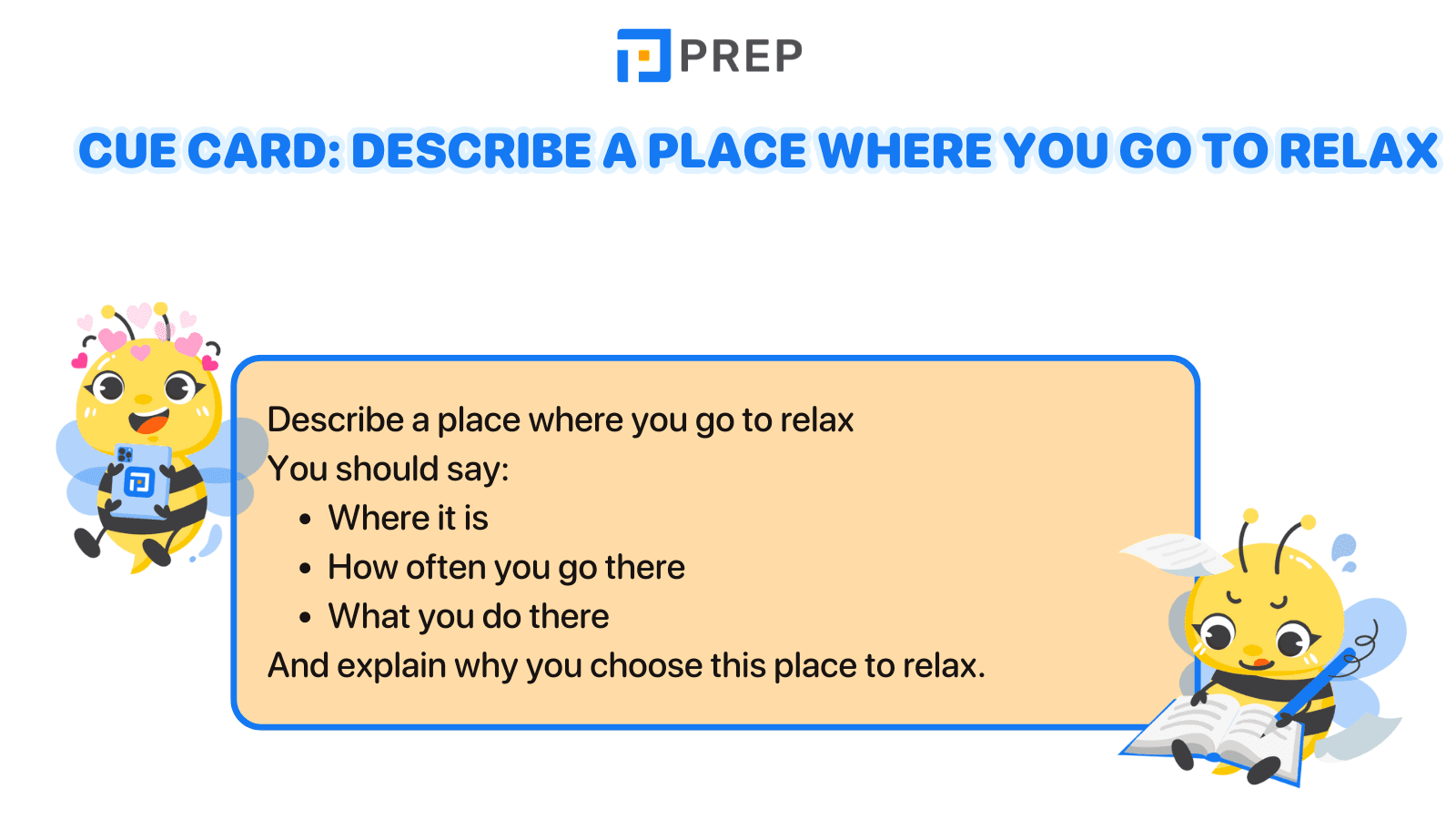
Cue Card – IELTS Speaking Part 2
Describe a place where you go to relax.
You should say:
-
Where this place is
-
What it is like
-
How often you go there
-
And explain why it helps you relax
To structure your response effectively, refer to answer speaking part 2 in IELTS.
How to Generate Ideas Quickly
To answer this cue card smoothly, organize your answer by thinking about these four points or using brainstorming diagrams in IELTS speaking.
-
Where: Name the place (park, garden, coffee shop, your bedroom, a beach, etc.)
-
What it’s like: Describe the setting (quiet, green, peaceful, has comfortable chairs, by a lake, etc.)
-
How often: Say whether you go every week, after work, only on weekends, when you are tired, etc.
-
Why relaxing: Explain what makes the place special (fresh air, no noise, safe, pretty scenery, good coffee, friendly people…)
Brainstorming Table (Optional)
|
Category |
Ideas (Examples) |
|
Place |
Small park near my house, local coffee shop, riverbank |
|
What it’s like |
Many trees, quiet, benches, sometimes birds singing |
|
How often |
About twice a week, whenever I need a break |
|
Why relaxing |
Calm, helps me forget stress, good place for fresh air or reading |
II. Band 5.0–6.0 Sample – Speaking Part 2 & 3
At Band 5.0–6.0 sample answers for the topic “Describe a place where you go to relax.” - The responses use clear, basic vocabulary, and you can learn how to expand answers in IELTS speaking to improve further.
1. Speaking Sample Answer – Part 2
Describe a place where you go to relax.
You should say:
-
Where this place is
-
What it is like
-
How often you go there
-
And explain why it helps you relax
Sample Answer (Band 5.0–6.0):
There is a small park near my house where I like to relax. The park has many green trees, some benches to sit on, and a small lake in the middle.
I usually go there two or three times a week, especially in the evening after school. The park is always quiet and not crowded. Sometimes I go there with my friend, but often I go alone to read a book or just listen to music.
I feel very comfortable and calm when I’m there because of the fresh air and the peaceful atmosphere. It helps me forget my stress and makes me feel better after a busy day.
2. Speaking Sample Answer – Part 3
At the Band 5.0–6.0 level, answers should be clear, direct to improve your fluency and coherence IELTS speaking.
Question 1: Why is it important for people to relax?
It is important because relaxing helps people feel less tired and stressed. If we relax, we have more energy and feel happier.
Question 2: What do people in your country often do to relax?
Many people go for a walk, listen to music, watch TV, or spend time with family. Some also meet friends at a café or go to a quiet park.
Question 3: Do people today have enough time to relax?
I think many people are busy with work or school, so they don’t always have enough time. But they try to relax when they can, even for a short moment after work.
You can improve your responses by learning answer speaking part 3 in IELTS.
3. Vocabulary Highlight
At the Band 5.0–6.0 level, using simple but effective vocabulary for real-life english conversation.
Vocabulary by Topic
|
Topic |
Useful Words & Phrases |
Example Sentence |
|
Places |
park, garden, coffee shop, bench, bedroom, lake, river |
There is a small park near my house. |
|
Nature |
green trees, fresh air, flowers, sunshine, birds singing |
I enjoy the fresh air and the sound of birds. |
|
Activities |
relax, sit, read, listen to music, walk, rest, enjoy |
I often sit on a bench and read my favorite book. |
|
Feelings |
calm, peaceful, comfortable, quiet, happy, less stressed |
I feel calm and peaceful in that place. |
|
Frequency/Time |
every day, after school, on weekends, evening, twice a week |
I go there two or three times a week. |
Common Sentence Starters
-
“There is a park near my house where…”
-
“I feel relaxed when…”
-
“I usually go there after…”
-
“The place is very quiet and comfortable.”
-
“I like to sit and enjoy the fresh air.”
4. Grammar and Structures
At the Band 5.0–6.0 level, students should use basic grammar patterns to express ideas clearly. Sentences mainly use present simple for routines and descriptions, and past simple for past experiences.
Tense Usage – Present Simple & Past Simple
|
Tense |
Usage |
Example |
|
Present Simple |
Describe routines, places, and feelings |
I go to the park when I feel tired. |
|
Past Simple |
Talk about past relaxing experiences |
I visited the lake last weekend to relax. |
Basic Sentence Structures
|
Type |
Structure |
Example |
|
Simple Sentence |
Subject + verb + object |
I sit on a bench and read my book. |
|
Compound Sentence |
Use and / but / because |
The park is quiet and green, so I enjoy being there. |
|
There is / There are |
Describe things in the place |
There are many trees and flowers in the garden. |
Common Sentence Starters
|
Expression |
Example |
|
I usually go... |
I usually go there after work. |
|
It is... |
It is a peaceful place for me. |
|
I feel... |
I feel comfortable and less stressed there. |
|
There are... |
There are lots of benches under the trees. |
|
Sometimes I... |
Sometimes I read or just listen to music. |
III. Band 7.0+ Sample – Speaking Part 2 & 3
At Band 7.0+, your answers should:
-
Fully develop each point on the cue card with extra explanation or reflection
-
Use topic-specific and expressive vocabulary
-
Include natural linking devices and a range of complex sentences
-
Balance descriptive detail with personal feelings
1. Speaking Sample Answer – Part 2
Describe a place where you go to relax.
You should say:
-
Where this place is
-
What it is like
-
How often you go there
-
And explain why it helps you relax
Sample Answer (Band 7.0+):
One place I often visit to unwind is a small botanical garden located about fifteen minutes from my home. The garden is filled with tall, shady trees, colorful flowers, and winding stone paths. There’s a quiet pond at the center, surrounded by benches and covered with lotus leaves in the summer.
I usually go there once or twice a week, especially after stressful days at work or when I need some quiet time alone. Sometimes I bring a book or a notebook to write, but often I just sit and listen to the sounds of nature—birds singing, leaves rustling, and distant water flowing.
What I love most about this garden is the peaceful atmosphere. The fresh air and beautiful scenery always help me clear my mind and regain my energy. Even the act of walking slowly along the paths makes me feel calm and balanced. For me, this place is essential whenever life gets overwhelming.
2. Speaking Sample Answer – Part 3 (Follow-up)
At Band 7.0+, Part 3 responses should be well-developed, logically structured, and supported with explanations or personal reflection. Linking devices and detailed vocabulary make answers more natural and convincing.
Question 1: How has the way people relax changed compared to the past?
Relaxation habits have changed significantly over time. In the past, people often spent time outdoors or gathered with family in the evenings. Nowadays, thanks to technology, many prefer to relax by watching movies, playing video games, or browsing social media. Despite these changes, some people still value quiet outdoor spaces for relaxation, so both traditional and modern habits exist side by side.
Question 2: Do you think it is important for cities to have relaxing places like parks or gardens?
Absolutely. Parks and gardens play a crucial role in urban areas. They provide a space for residents to unwind, exercise, and connect with nature. Without such places, city life would feel much more stressful and overwhelming. I believe local governments should prioritize creating and maintaining green spaces for public health and happiness.
Question 3: Can having a relaxing place make people more productive? Why or why not?
Yes, I believe so. When people have the chance to rest and recharge, they return to their tasks with greater focus and creativity. A relaxing environment can relieve mental fatigue and improve overall well-being, which, in turn, leads to higher productivity both at work and in personal life.
3. Vocabulary Highlight
At Band 7.0+, you should use a wide variety of descriptive, topic-specific, and even emotive vocabulary to describe relaxing places, feelings, and the role of relaxation in life.
Describing Places & Atmosphere
|
Vocabulary / Phrase |
Example Usage |
|
tranquil / serene |
The garden offers a tranquil environment. |
|
lush greenery |
I love the lush greenery and fresh air there. |
|
secluded spot |
It's a secluded spot far from city noise. |
|
landscaped |
The area is beautifully landscaped with flower beds. |
|
vibrant with life |
In spring, the place is vibrant with life. |
Activities & Experiences
|
Vocabulary / Phrase |
Example Usage |
|
unwind / recharge |
I go there to unwind and recharge after a long week. |
|
immerse myself in nature |
I can immerse myself in nature and forget all worries. |
|
clear my mind |
Walking through the park helps me clear my mind. |
|
mental fatigue |
It helps relieve mental fatigue from work. |
|
daily routine |
Escaping my daily routine is important for my well-being. |
Feelings & Effects
|
Vocabulary / Phrase |
Example Usage |
|
peace of mind |
The peaceful atmosphere gives me genuine peace of mind. |
|
sense of balance |
It restores my sense of balance when life feels stressful. |
|
rejuvenated |
After visiting, I always feel rejuvenated. |
|
emotionally grounding |
Quiet, natural places are emotionally grounding. |
|
enhance well-being |
Taking time to relax really enhances my overall well-being. |
4. Grammar and Structures
At Band 7.0+, strong responses feature varied and flexible grammar. Use a mix of sentence types and complex forms to express your ideas, experiences, and reflections smoothly and naturally.
Tense Usage – Flexible and Purposeful
|
Tense / Structure |
Usage |
Example |
|
Present Simple |
Talk about routines and general experiences |
I visit the botanical garden whenever I feel stressed. |
|
Past Simple |
Describe a specific relaxing experience in the past |
Last weekend, I spent an hour reading by the pond. |
|
Present Perfect |
Relate past experiences or repeated actions to the present |
I have found that being in nature always helps me relax. |
|
Conditionals (real/unreal) |
Discuss hypothetical or recommended actions |
If I didn’t have a quiet place to go, I would feel overwhelmed. |
|
Modals (can, should, might) |
Give suggestions, opinions, or talk about possibilities |
Everyone should have a place where they can unwind. |
Complex Sentence Structures
|
Structure Type |
Usage / Purpose |
Example |
|
Relative Clauses |
Add detail and variety |
The park, which is just a short walk from my home, is very peaceful. |
|
Cause & Effect/Contrast |
Explain why a place is relaxing or compare situations |
Although it’s in the city, the garden feels completely secluded. |
|
Embedded Clauses/Emphasis |
Reflect on feelings or observations |
What I appreciate most is the sense of calm I get every time I visit. |
|
Linking Devices |
Connect and expand ideas naturally |
In addition, As a result, On the other hand, Personally, I believe… |
Advanced Style Tips
-
Vary your sentence starters for rhythm (“Whenever I go there…”, “Even after a tiring day…”, “One reason I love it is…”).
-
Balance facts with reflection: “It’s not just the scenery that I enjoy, but also the quiet atmosphere that lets me clear my thoughts.”
-
Use conditionals and perfect tenses to express subtlety and nuance.
IV. Examiner’s Comments – What a Band 7 Answer Sounds Like
To reach Band 7.0 or above in IELTS Speaking—especially for a topic like “Describe a place where you go to relax”—it is not enough to simply list features. Examiners want to hear thoughtful, well-developed answers that combine vivid description, reflection, and a broad command of language.
What Makes a Real Band 7+ Answer?
-
Clearly addresses and develops each part of the cue card
-
Uses personal stories, feelings, and specific detail
-
Employs topic-focused vocabulary and complex grammar naturally
-
Reflects on the wider value of relaxation, not just describing the place
-
Shows natural pausing, linking, and an engaging “storytelling” tone
Tips for Achieving Band 7+
-
Expand on each idea and illustrate with a personal example or reflection
-
Don’t just say “it’s beautiful”—explain how it feels and what makes it different
-
Use advanced linking (“As a result…”, “What I appreciate most is…”, “One reason is…”)
-
Practice speaking at length and with variety until your answers sound smooth, not memorized
A Band 7+ answer not only describes a relaxing place, but makes the examiner “feel” why it is special and important—for you and for life in general.
This article has provided an IELTS Speaking Part 2 sample on the topic "Describe a place where you go to relax." If you want continuous support, PREP’s mentorship will guide you from start to finish
-
IELTS online coaching: Turn Your IELTS Goals Into Reality

Hi I'm Chloe, and I am currently serving as an Product Content Administrator at Prep Education. With over five years of experience in independent online IELTS study and exam preparation, I am confident in my ability to support learners in achieving their highest possible scores.
Comment
Premium content
View all


Personalized roadmap


Most read




UEN: 202227322W
Address: 114 LAVENDER STREET, #11-83 CT HUB 2, SINGAPORE (338729)