Describe a Town or City You Will Live in the Future
This guide helps you describe a town or city where you will live in the future in Speaking Part 2 and Part 3. It includes cue card guidance, band 5.0–6.0 and band 7.0+ sample answers, future-focused vocabulary, grammar structures, and examiner comments to improve fluency and coherence.

I. Cue Card – Describe a Town or City Where You Want to Live in the Future
Cue Card – IELTS Speaking Part 2
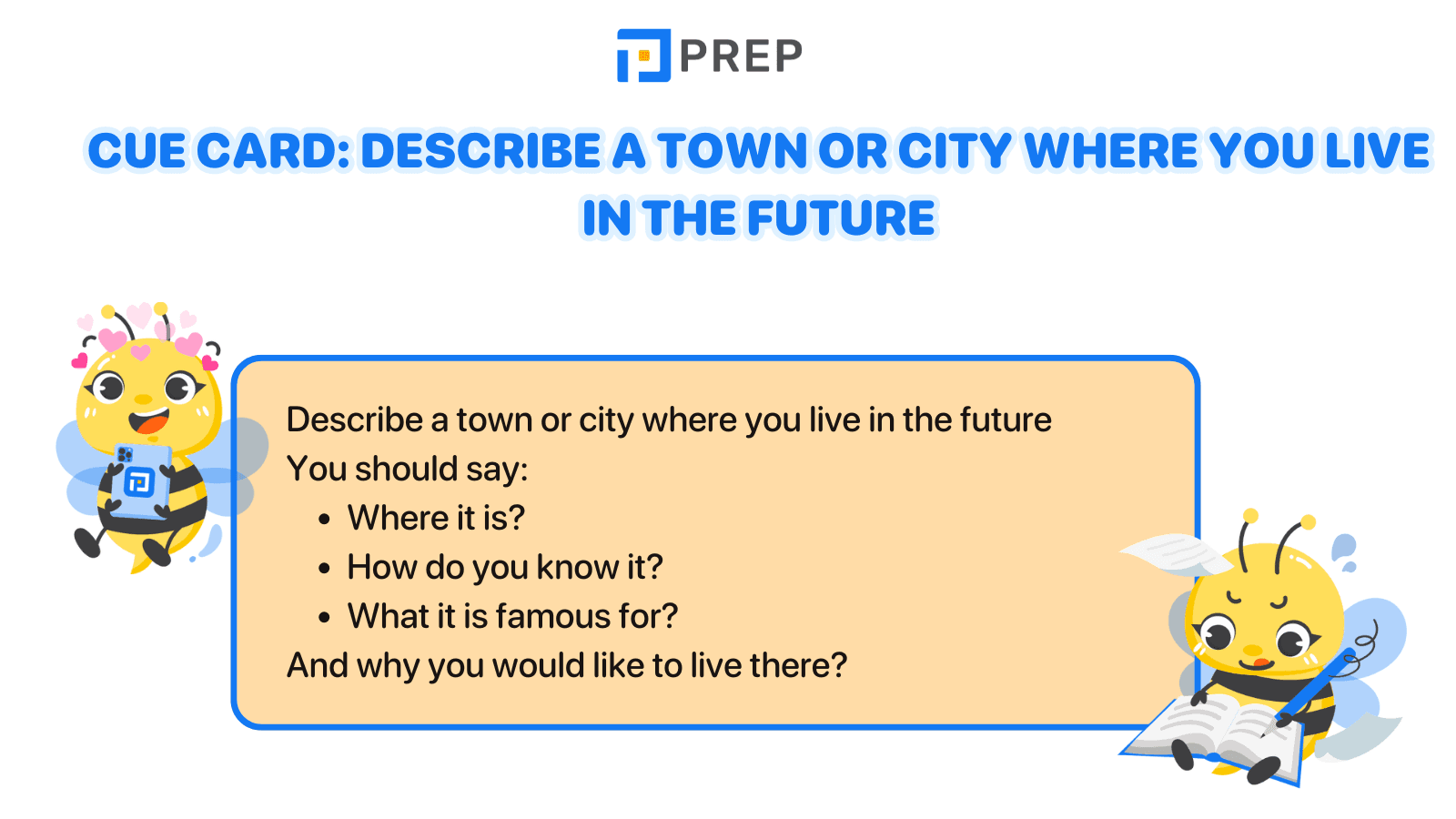
Describe a town or city where you would like to live in the future.
You should say:
-
Where it is
-
What it is like
-
What you can do there
-
And explain why you want to live there
To structure your answer effectively, refer to answer speaking part 2 in IELTS
How to Generate Ideas Quickly
This is an opinion-based “future + location” topic. You can also organize your ideas using brainstorming diagrams in IELTS speaking.
-
Place: Name a city/town — in your country or abroad
-
Features: What makes the city special? (weather, education, economy, safety…)
-
Lifestyle: What activities or life experiences would you enjoy there?
-
Personal reasons: Why does this place match your goals or personality?
You can choose a real city you've visited or one you've researched online — imagination and personal connection matter more than factual detail.
Brainstorming Table (Optional)
|
Category |
Ideas (Examples) |
|
City |
Da Nang (Vietnam), Melbourne (Australia), Kyoto (Japan) |
|
Features |
Clean, safe, near nature, modern, relaxed pace of life |
|
Activities |
Surfing, hiking, working remotely, attending cultural events |
|
Reason to live |
Balanced lifestyle, job opportunities, peaceful environment |
II. Band 5.0–6.0 Sample – Speaking Part 2 & 3
At this level, candidates are expected to use simple ideas, speak with logical order, and show basic control of tenses. The vocabulary used is familiar, and the grammar is mostly correct.
To improve your score, learn how to expand answers in IELTS speaking.
1. Speaking Sample Answer – Part 2
Describe a town or city where you would like to live in the future.
You should say:
-
Where it is
-
What it is like
-
What you can do there
-
And explain why you want to live there
Sample Answer (Band 5.0–6.0):
In the future, I would like to live in Da Nang. It is a city in central Vietnam, near the beach and mountains.
Da Nang is very clean and quiet. It has a lot of fresh air and nice views. I think it is a good place to relax and enjoy life.
If I live in Da Nang, I can go swimming, walk along the beach, or go hiking in the mountains. There are also many good restaurants and cafés to visit.
I want to live there because life in the city is not too busy. People are friendly, and I feel happy every time I go there. It’s a good place to work and have a peaceful life.
2. Speaking Sample Answer – Part 3
This section provides short, clear responses to common Part 3 questions related to the topic “cities and future living.” At the Band 5.0–6.0 level, answers are usually simple, use everyday vocabulary, and include a short reason or example.
Question 1: What makes a city a good place to live?
I think a good city should be clean and safe. It should also have jobs and hospitals. People want to live in a place that is comfortable and not too crowded.
Question 2: Why do some people move from the countryside to cities?
Because cities have more opportunities. People can find better jobs, go to good schools, and live a modern life. In villages, it’s harder to find these things.
Question 3: Do you think more people will live in cities in the future?
Yes, I think so. Cities are growing, and there are more buildings and services. Many young people want to live in cities because it’s easier to study and work there.
3. Vocabulary Highlight
At the Band 5.0–6.0 level, it’s important to use clear, basic vocabulary to describe cities, daily life, and reasons for choosing a place to live.
Vocabulary by Topic
|
Topic |
Useful Words & Phrases |
Example Sentence |
|
City Features |
clean, quiet, modern, big, friendly, safe |
The city is clean and people are very friendly. |
|
Activities |
relax, work, travel, study, meet people, enjoy nature |
I want to live near the beach so I can relax after work. |
|
City Life |
traffic, air, food, job, internet, shopping, weather |
The traffic is not bad and the air is fresh. |
|
Lifestyle Words |
peaceful, comfortable, busy, convenient, slow/fast-paced |
I prefer a city that is peaceful and not too busy. |
|
Reasons to Choose |
because of the environment / opportunity / weather |
I want to live there because it has good weather all year. |
Useful Speaking Phrases (Simple)
-
“I want to live in… because…”
-
“It’s a nice city with… (good food / clean streets / friendly people)”
-
“It’s not too crowded and not too quiet — just perfect.”
-
“There are many things to do there, like…”
-
“It’s a place where I can feel comfortable and enjoy life.”
4. Grammar and Structures
For this topic, the most important structures are present simple (to talk about your opinion or a city’s features) and future forms (to express plans or hopes).
Tense Usage – Present Simple & Future (will/want to)
|
Tense |
Usage |
Example |
|
Present Simple |
To talk about cities and your opinions now |
This city is clean and has good weather. |
|
“Want to” Future |
To talk about your future dream or plan |
I want to live in Da Nang because it’s peaceful. |
|
“Will” Future |
To predict or express plans |
I think I will move there after I finish university. |
Basic Sentence Structures
|
Structure Type |
Structure |
Example |
|
Simple Sentence |
Subject + verb + object |
The city has fresh air and friendly people. |
|
Compound Sentence |
Use and / but / because / so |
I like it because it is near the beach and the food is good. |
|
“There is / are” |
For describing places or features |
There are many parks and cafés in the town. |
Common Sentence Starters
-
I want to live in...
-
It’s a place where…
-
There are many things to do, like…
-
I like it because…
-
It’s not too… but not too…
III. Band 7.0+ Sample – Speaking Part 2 & 3
At this level, candidates are expected to:
-
Speak fluently and coherently with well-developed ideas by improving your fluency and coherence IELTS speaking.
-
Use a wide range of topic-specific and emotional vocabulary
-
Demonstrate grammatical flexibility with few noticeable mistakes
-
Offer personal insight, reasons, and reflections
1. Speaking Sample Answer – Part 2
Describe a town or city where you would like to live in the future.
You should say:
-
Where it is
-
What it is like
-
What you can do there
-
And explain why you want to live there
Sample Answer (Band 7.0+):
One city I would love to live in at some point in my life is Melbourne, in Australia. I’ve never been there, but I’ve seen plenty of videos and heard stories from friends who studied or worked there, and honestly, it sounds like a dream.
Melbourne is known for its relaxed lifestyle, clean environment, and diverse culture. The city has a perfect mix of modern living and green spaces, with lots of parks, cafés, bike lanes, and art galleries. Plus, the weather is mild compared to other parts of Australia — which is a big bonus for someone like me who doesn’t like extreme heat.
If I lived there, I think I would enjoy going to the beach in the morning, working during the day, and then spending evenings at local cafés or music events — there’s always something happening. I also heard public transport is reliable, and the city has great healthcare and education systems.
I want to live there because it fits the lifestyle I’m aiming for: calm, creative, and environmentally conscious. It seems like a place where I could grow both professionally and personally, while still having time to enjoy life.
2. Speaking Sample Answer – Part 3
At Band 7.0+, Part 3 responses should go beyond basic explanations. You're expected to show the ability to analyze, compare, and reflect. Answers should be well-organized, naturally linked, and supported with examples or reasoning.
Question 1: Why do people choose to move to a new city?
There are many reasons. For some, it’s about employment or educational opportunities — moving to a bigger city often means access to better jobs or universities. Others may move for lifestyle reasons, such as being closer to nature or having a more relaxed pace of life. Also, some people just want a fresh start after living in the same place for too long.
Question 2: What problems can big cities face as more people move there?
One of the biggest issues is overcrowding, which leads to increased traffic, pollution, and strain on infrastructure like public transport and hospitals. Housing can also become unaffordable. In some cities, this causes social inequality — where only the wealthy can live comfortably, and others struggle with high living costs.
Question 3: Do you think technology will change the way people choose where to live in the future?
Absolutely. With remote work becoming more common, people no longer have to live in big cities just to find good jobs. They can choose places based on quality of life instead — like cities with clean air, good internet, and green spaces. Technology will give people more freedom to prioritize mental health and lifestyle over location.
For more practice, explore answer speaking part 3 in IELTS.
3. Vocabulary Highlight
For the topic “a city you want to live in,” it helps to use words that describe urban design, lifestyle, personal values, and future aspirations.
Urban Life & Environment
|
Vocabulary / Phrase |
Usage Example |
|
livable city |
Melbourne is known as one of the most livable cities in the world. |
|
urban planning |
The city benefits from excellent urban planning and green spaces. |
|
pollution-free / low-emission |
I’m looking for a place that promotes a low-emission lifestyle. |
|
public transportation system |
The city has an efficient public transportation system. |
|
walkable / bike-friendly |
I love how walkable and bike-friendly the city is. |
Lifestyle & Opportunities
|
Vocabulary / Phrase |
Usage Example |
|
work–life balance |
The pace of life there helps people maintain a healthy work–life balance. |
|
job market |
The job market in that city is known to be quite dynamic and diverse. |
|
multicultural community |
It has a strong multicultural community, which creates an inclusive environment. |
|
creative scene / cultural vibe |
The local creative scene is very active — with art, music, and theater. |
|
quality of life |
The quality of life there is much higher than in many crowded cities. |
Expressing Values & Preferences
|
Expression / Collocation |
Usage Example |
|
environmentally conscious |
I’d like to live somewhere that’s more environmentally conscious. |
|
peaceful yet dynamic |
It’s peaceful yet dynamic — the perfect mix for me. |
|
attract like-minded people |
It tends to attract like-minded people who care about wellness. |
|
sense of community |
I’m drawn to places with a strong sense of community. |
|
long-term goal |
Living there has always been a long-term goal of mine. |
4. Grammar and Structures
For the topic “a city you want to live in,” you’ll often need to move between describing the present, imagining the future, and explaining reasons — all of which require a strong grammar foundation.
Tense Usage – Purposeful and Natural
|
Tense |
Usage |
Example |
|
Present Simple |
To describe the city and your current opinion |
The city offers a balance between nature and convenience. |
|
Future (will/to be going to) |
To talk about plans or dreams |
I’m going to move there once I graduate. |
|
Present Perfect |
To link past decisions with present impact |
I’ve thought about living there ever since I started university. |
|
Second Conditional |
To express imaginary or ideal situations |
If I could live anywhere in the world, it would be Melbourne. |
Complex Sentence Structures
|
Structure Type |
Usage / Purpose |
Example |
|
Relative Clauses |
Add details about a person/place/thing |
The city, which is located near the coast, has amazing weather all year round. |
|
Conditional Sentences |
Introduce possibilities or hypothetical ideas |
If the cost of living were lower, more people would choose to move there. |
|
Cause–Effect Clauses |
Explain reasons or outcomes |
Since public transport is reliable, most people don’t need a private car. |
|
Contrast Structures |
Present two sides of an opinion |
Although it’s a big city, it still maintains a relaxed lifestyle. |
Advanced Linking Devices
|
Function |
Examples |
|
Giving reasons |
That’s because…, The main reason is…, This is due to... |
|
Adding points |
Furthermore, In addition, Not only that, but also… |
|
Contrasting ideas |
On the other hand, However, While some people prefer… |
|
Concluding well |
In the end, All things considered, That’s why I’d love to live there. |
IV. Examiner’s Comments – What a Band 7 Answer Sounds Like
The topic “Describe a town or city where you want to live in the future” requires more than just naming a place and saying you like it.
What Examiners Look For is explained clearly in the IELTS speaking band scores.
-
Fluency and Coherence – Are your ideas linked logically and spoken with confidence?
-
Lexical Resource – Do you use a wide range of topic-specific language accurately?
-
Grammatical Range and Accuracy – Do you have control over complex sentence structures?
-
Pronunciation – Do you speak clearly with natural rhythm, stress, and intonation?
Band 7+ Sample Features (for this topic)
-
Detailed explanations: “It’s a place that supports the kind of lifestyle I value — calm, inclusive, and nature-connected.”
-
Clear cause–effect reasoning: “Because it promotes sustainability and innovation, I feel like I’d grow there personally and professionally.”
-
Emotional engagement: “I’ve always pictured myself waking up near the coast, working remotely, and having a simple, slow-paced routine.”
-
Use of advanced grammar/vocabulary naturally: “If I ever had the chance, I’d relocate in a heartbeat.”
Tips to Reach Band 7+ in This Topic, and you can improve further with ways to practice IELTS speaking.
-
Personalize your response: Speak less about the city’s facts and more about what it means to you.
-
Build your ideas: Use the structure Idea → Explanation → Example or Reflection.
-
Avoid safe words: Practice replacing “beautiful” with “picturesque,” or “quiet” with “peaceful and low-stress.”
-
Be consistent in tense usage: When discussing the future, your verbs should reflect your plan or possibility clearly.
A Band 7+ speaker doesn’t just “describe” a place — they explain why it matters on both a practical and emotional level. Speaking naturally, with meaning and depth, is the key to unlocking high scores in Speaking Part 2 & 3.

Hi I'm Chloe, and I am currently serving as an Product Content Administrator at Prep Education. With over five years of experience in independent online IELTS study and exam preparation, I am confident in my ability to support learners in achieving their highest possible scores.
Comment
Premium content
View all




Personalized roadmap


Most read




UEN: 202227322W
Address: 114 LAVENDER STREET, #11-83 CT HUB 2, SINGAPORE (338729)