IELTS Speaking Part 1完整指南與最新話題| 雅思口說第一部分
IELTS Speaking Part 1 是什麼?該如何準備才能在考試中脫穎而出?雅思口說第一部分是整個口說測驗的開端,採用考官一對一面試形式,時間約 4-5 分鐘,主要評估考生處理日常生活話題的基本英語溝通能力。這個看似簡單的環節,實則決定了整場口說測驗的基調,更是考官對你形成第一印象的關鍵時刻。許多考生誤以為 Part 1 只是暖身環節而掉以輕心,卻不知道這個部分已經開始正式評分,表現優劣直接影響後續部分的心理預期。
根據 IDP 教育與 British Council 官方統計,2025-2026 年度 IELTS Speaking Part 1 出現了顯著的話題多元化趨勢。除了傳統的工作、學習、家鄉等核心話題外,環保意識、數位生活、健康福祉等新興主題的出題頻率大幅上升,反映出語言測驗對當代生活議題的關注。掌握這些話題變化,了解評分標準的側重點,並建立有效的應答策略,是取得理想成績的必要條件。
本文由 PREPEDU 專業教學團隊整理,完整涵蓋雅思口說 Part 1 的考試形式、評分標準、25 個高頻話題分類、實戰應答技巧與高分範例解析,幫助你系統化準備,在考場上展現真實語言能力,為整個口說測驗奠定成功基礎。
I. IELTS Speaking Part 1 概述
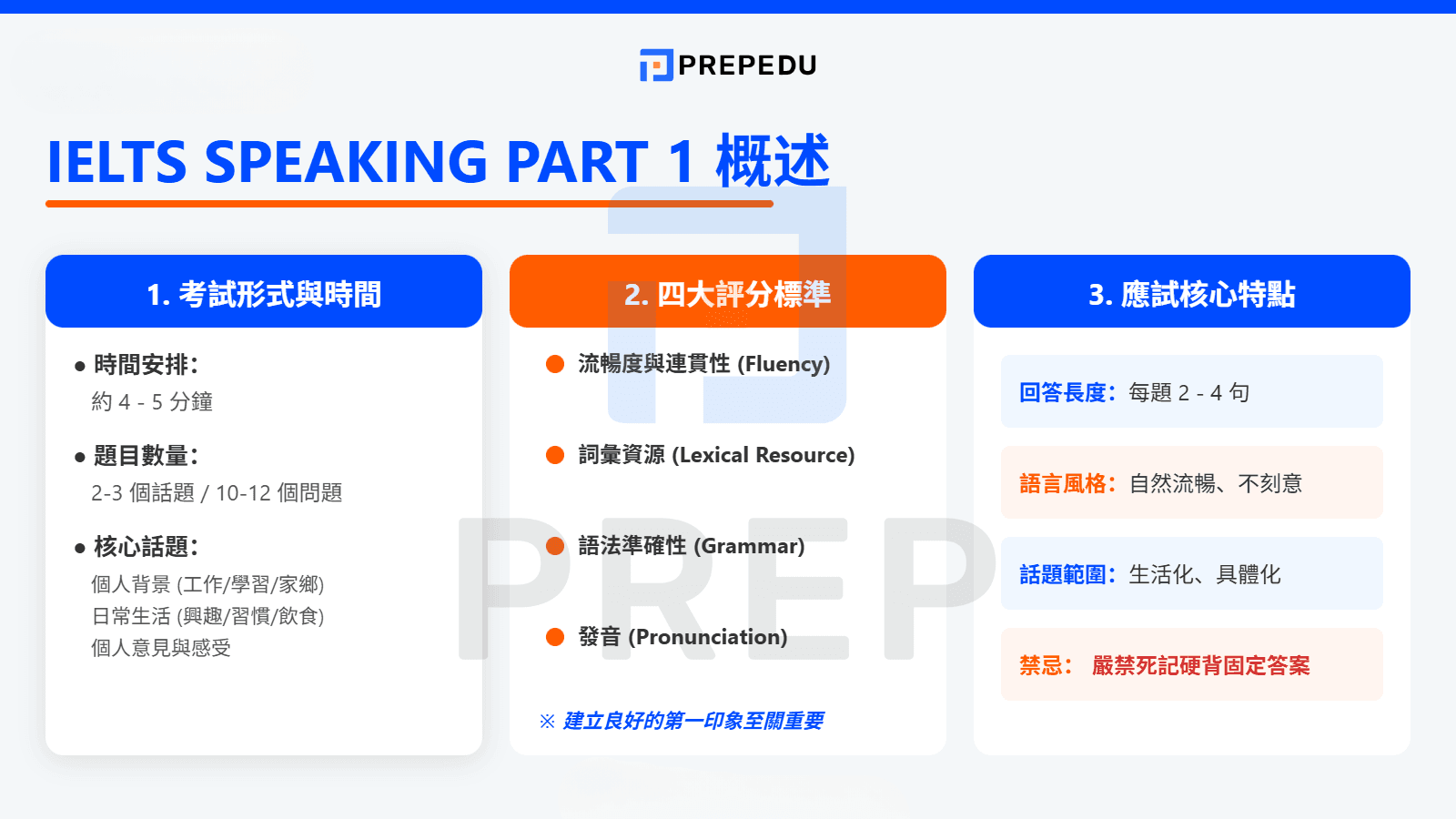
IELTS SPEAKING PART 1是整個口說測試的開端,它為考官提供了初步評估考生英語口語能力的機會。這部分雖然看似簡單,但對整體成績有著重要影響。
1. IELTS Speaking Part 1 是什麼?考試形式與時間安排
IELTS Speaking Part 1(雅思口說 Part 1)是雅思口說測驗的第一個環節,採用考官與考生一對一面試形式進行,時間約為 4-5 分鐘。根據 IDP 教育與 British Council 官方資料,這個部分主要評估考生處理日常話題的基本英語溝通能力,為整個口說測驗建立重要的第一印象。
在 IELTS Speaking Part 1 開始時,考官會先進行身分確認,要求考生出示有效身分證件並核對姓名。接著,考官會圍繞 2-3 個熟悉的話題進行提問,每個話題包含 3-5 個相關問題,總計約 10-12 個問題。這些問題主要涵蓋:
-
個人背景資訊:工作或學習狀況、家鄉、居住環境等基本資訊
-
日常生活話題:興趣愛好、日常習慣、飲食偏好、交通方式等
-
個人意見與感受:對某些事物的看法、喜好、經驗分享等
2. IELTS Speaking Part 1 的評分重點與考試目的
雅思口說第一部分的主要目的是讓考生放鬆並適應考試環境,同時依據雅思口說評分標準評估考生的基礎語言能力。根據官方雅思口說評分標準,考官會從四個維度進行評分:
-
流暢度與連貫性(Fluency and Coherence):能否自然流暢地表達想法,使用適當的連接詞
-
詞彙資源(Lexical Resource):詞彙範圍是否豐富,用詞是否準確得體
-
語法範圍與準確性(Grammatical Range and Accuracy):句型是否多樣,語法錯誤率如何
-
發音(Pronunciation):發音清晰度、語調自然度和重音位置準確性
需要特別注意的是,IELTS Speaking Part 1 雖然是三個部分中最簡單的,但它為整場口說測驗定下基調。考生在此階段的表現會影響考官的初步印象,進而影響後續評分的心理預期。因此,掌握 Part 1 的應答策略,展現自然、自信的交流能力至關重要。
3. IELTS Speaking Part 1 與其他部分的區別
相較於 IELTS Speaking Part 2 的個人演講和 IELTS Speaking Part 3 的深度討論,雅思口說 Part 1 具有以下特點:
-
話題範圍:聚焦於個人經驗和日常生活,較為具體且貼近實際
-
答案長度:建議每題回答 2-4 句,既要提供足夠資訊又要避免過度冗長
-
語言複雜度:不需要刻意使用複雜句型或高級詞彙,重點在於自然流暢
-
準備策略:可預先準備素材,但絕不能背誦固定答案,必須保持回答的真實性
了解這些基本特點後,考生就能更有針對性地準備 IELTS Speaking Part 1,在考場上從容應對,為取得理想成績奠定堅實基礎。
II. 考官如何客觀評估你的 IELTS SPEAKING PART 1表現
了解 IELTS SPEAKING PART 1 考試的評分標準對於有針對性地準備至關重要。考官會從多個維度評估考生的口語表現,每個評分點都同等重要。
1. 四大評分標準概覽:流暢連貫、詞彙、語法、發音缺一不可
雅思口說測驗採用四大標準全面評估考生表現:
-
流暢連貫性(Fluency and Coherence):評估語言輸出的自然流暢程度、思想連貫性及使用連接詞的能力
-
詞彙資源(Lexical Resource):評估詞彙範圍、精確性及靈活運用能力
-
語法範圍與準確性(Grammatical Range and Accuracy):評估句型多樣性及語法準確度
-
發音(Pronunciation):評估發音清晰度、語調控制及重音使用的自然程度
這四項標準共同構成了雅思口說測驗的全面評價體系,確保考生的語言能力得到客觀評估。
2. Part 1 評分側重點:自然交流優先,語言準確性為基石
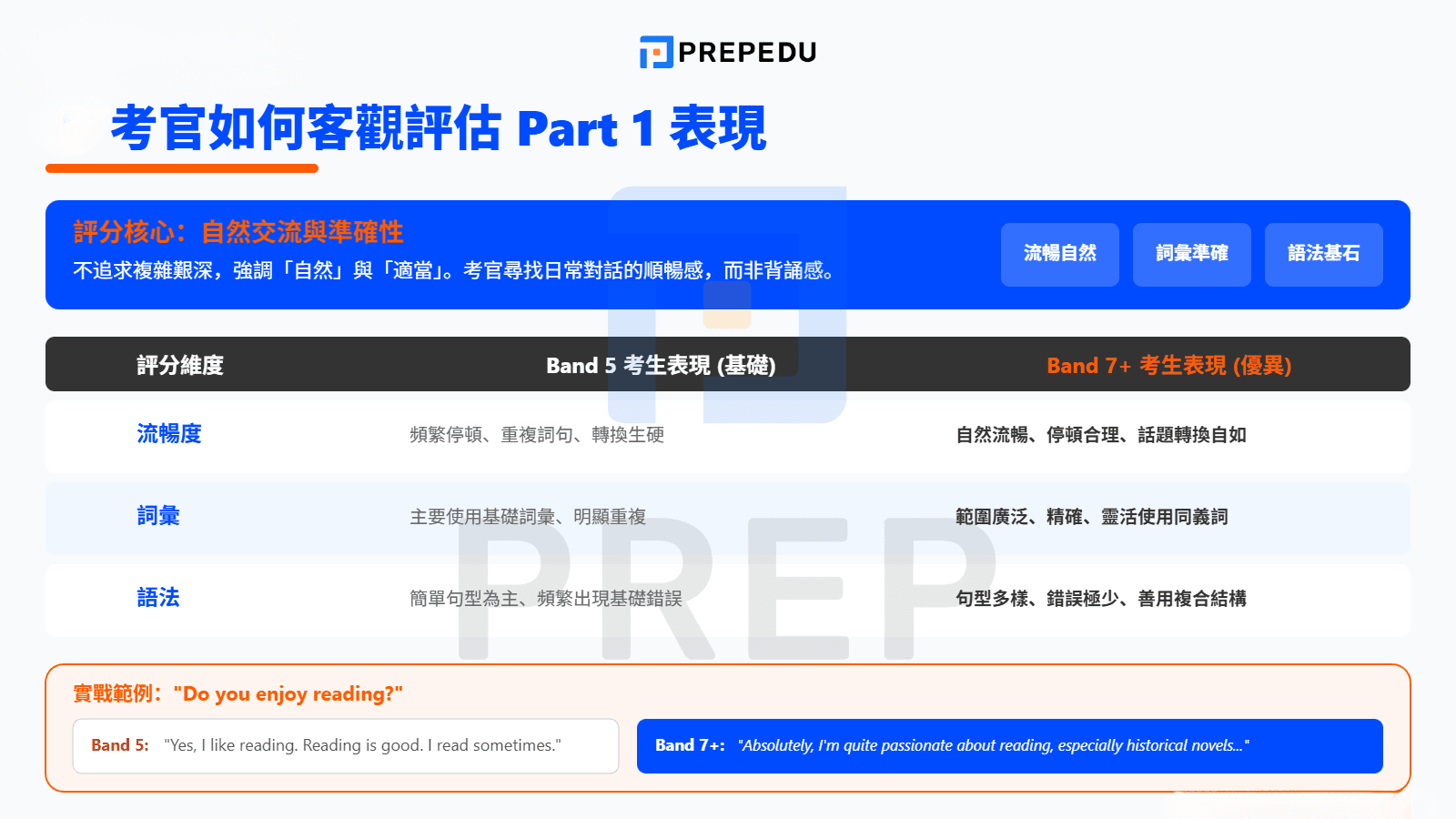
在 IELTS SPEAKING PART 1 中,考官側重評估考生是否能進行自然流暢的交流。此階段不要求複雜語言結構,而是強調「自然」與「適當」。考官期待考生能夠像日常對話般順暢回應,避免明顯不自然的停頓或背誦感。詞彙方面,考官尋找相關且準確的用詞,而非刻意堆砌高級詞彙。語法準確性是基石——雖然不要求全無錯誤,但頻繁的基礎語法錯誤會影響評分。發音需達到清晰可懂的標準,確保有效溝通,但不要求完美的母語式口音。全面而言,Part 1評分著重考生能否進行基本有效的日常溝通。
3. 具體差異:Band 5 vs. Band 7+ 在 Part 1 的關鍵表現分野
Band 5與Band 7+考生在 IELTS SPEAKING PART 1 中的表現差異明顯體現在多個方面:
|
評分標準 |
Band 5考生 |
Band 7+考生 |
|
流暢度 |
頻繁停頓、重複詞句尋找表達、話題轉換生硬 |
自然流暢、停頓位置合理、話題轉換順暢自如 |
|
詞彙 |
主要使用基礎詞彙、重複用詞現象明顯、缺乏精確性 |
詞彙範圍廣泛、用詞精確、能靈活使用同義表達 |
|
語法 |
主要使用簡單句型、頻繁出現基礎錯誤、時態混亂 |
句型多樣、錯誤較少、能正確使用複合句結構 |
|
發音 |
部分發音不清、語調單一、重音位置不當 |
發音清晰、語調自然、重音位置準確 |
例如,對於"Do you enjoy reading?"的問題
-
Band 5考生可能回答:"Yes, I like reading. Reading is good. I read sometimes.
-
Band 7+考生則可能說:"Absolutely, I'm quite passionate about reading, especially historical novels, as they transport me to different time periods and broaden my perspective on human experience."
明顯見到詞彙豐富度、句型複雜性及表達流暢度的差異。
III. IELTS Speaking Part 1 完整話題分類與高頻問題清單
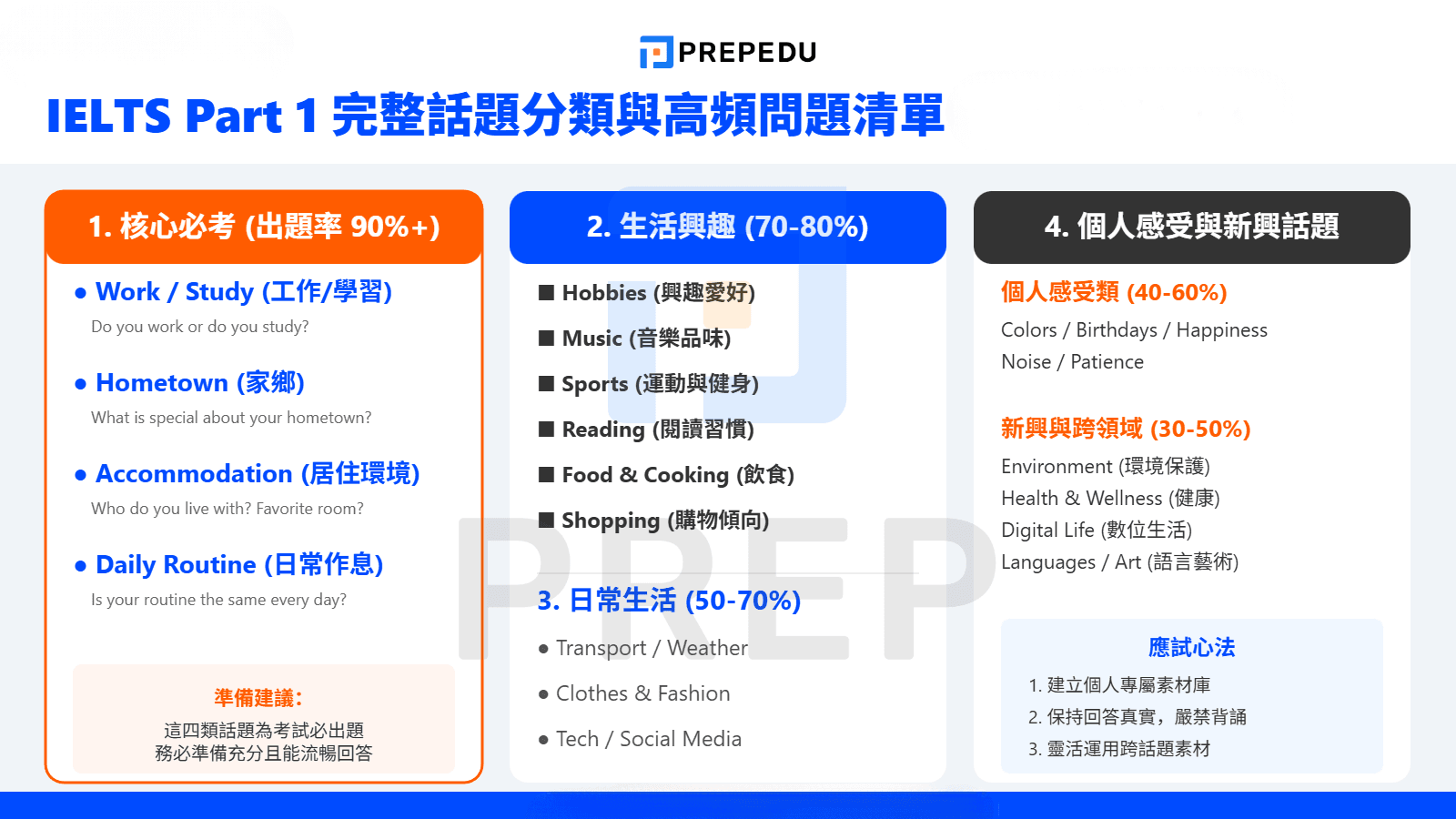
根據 2025-2026 年 IELTS 官方考試統計與全球考生反饋,以下是 IELTS Speaking Part 1 最常出現的話題分類與具體問題。每個話題都包含英文原題與繁體中文翻譯,幫助考生全面掌握考試方向。
1. 核心必考話題(出題率 90% 以上)
|
Work / Study(工作/學習) |
|
|
Hometown(家鄉) |
|
|
Home / Accommodation(居住環境) |
|
|
Daily Routine(日常作息) |
|
2. 生活興趣類話題(出題率 70-80%)
|
Hobbies(興趣愛好) |
|
|
Music(音樂) |
|
|
Sports & Exercise(運動與健身) |
|
|
Reading(閱讀) |
|
|
Food & Cooking(飲食與烹飪) |
|
|
Shopping(購物) |
|
3. 日常生活類話題(出題率 50-70%)
|
Transport(交通) |
|
|
Weather(天氣) |
|
|
Clothes & Fashion(服裝與時尚) |
|
|
Technology(科技) |
|
|
Internet & Social Media(網路與社交媒體) |
|
4. 個人感受類話題(出題率 40-60%)
|
Colors(顏色) |
|
|
Birthdays(生日) |
|
|
Happiness(快樂) |
|
|
Noise(噪音) |
|
|
Patience(耐心) |
|
5. 新興與跨領域話題(出題率 30-50%)
|
Environment(環境) |
|
|
Health & Wellness(健康與福祉) |
|
|
Digital Life(數位生活) |
|
|
Languages(語言) |
|
|
Art & Culture(藝術與文化) |
|
話題準備建議
掌握這 25 個 IELTS Speaking Part 1 話題後,考生需要採取系統化的準備策略:
-
優先準備核心話題:Work/Study、Hometown、Home、Daily Routine 這四個話題是考試必出題,務必準備充分且能流暢回答。
-
建立個人素材庫:針對每個話題準備 3-5 個真實的個人經驗或觀點,確保回答具有獨特性和真實感。
-
靈活運用素材:許多經驗可以跨話題使用,例如攝影興趣可以同時回答 Hobbies、Technology、Art 等話題。
-
保持答案真實:所有回答都應基於真實經驗,避免編造明顯不合理或過於完美的內容,考官能輕易識別背誦痕跡。
-
定期更新準備:關注個人生活變化和時事發展,確保回答內容保持時效性和相關性。
記住,IELTS Speaking Part 1 的核心始終圍繞「你」和「你的生活」。充分了解自己,真誠表達,自然就能在考場上從容應對各類問題。
IV. IELTS SPEAKING PART 1 核心應答策略與實戰技巧
1. 黃金法則:告別 Yes/No,有效拓展答案的藝術
在 IELTS SPEAKING PART 1 中,僅以"Yes"或"No"回答問題是失分陷阱。這種簡短回答無法展示語言能力,考官也無法評估詞彙範圍和語法掌握程度。高分答案需要適當拓展,包含原因、細節或個人經驗。拓展並非冗長,而是提供足夠的相關資訊,讓考官瞭解思考過程和表達能力。每個問題視為展示語言能力的機會,而非僅傳達資訊的工具。
2. 理想答案公式:掌握 2-4 句話的內容深度與平衡
理想的 IELTS SPEAKING PART 1 答案長度通常為2-4句。這個範圍提供足夠空間展示語言能力,又避免過度冗長導致主題偏離。以"Do you enjoy reading?"為例,適當回答可能是:"Yes, I'm quite fond of reading, especially fiction books. I find that novels help me relax after a long day and they also expand my vocabulary. I try to read for at least half an hour every evening before bed."這樣的回答包含充分資訊,展示詞彙能力,又保持簡潔相關,維持自然對話節奏。
3. 萬用答題結構解析與應用:直接回答 + 解釋/細節 + 範例/感受
高效萬用答題結構包含三個關鍵元素:
-
直接回答(Direct Answer):清晰回應核心問題
-
解釋/細節(Explanation/Details):提供原因或進一步說明
-
範例/感受(Example/Feeling):補充具體例子或個人感受
應用範例一:
-
問題:"Do you prefer to watch movies at home or in the cinema?" (你比較喜歡在家看電影還是在電影院看電影?)
-
答案:"I definitely prefer watching movies in the cinema (直接回答). The immersive experience with the big screen and surround sound creates a completely different atmosphere compared to watching at home (解釋/細節). Last month, I saw the latest action film in IMAX, and the visual effects were absolutely stunning – something I couldn't have experienced on my small TV screen (範例/感受)."
應用範例二:
-
問題:"Is cycling popular in your city?" (在你的城市,騎腳踏車普遍嗎?)
-
答案:"Cycling has become increasingly popular in my city over the past few years (直接回答). The local government has invested in building dedicated bike lanes and introduced a bike-sharing system that makes it convenient for everyone (解釋/細節). In fact, I've noticed that during rush hours, the bike lanes are often filled with commuters trying to avoid traffic congestion (範例/感受)."
這一結構提供清晰框架,確保回答全面而有層次,適用於絕大多數ielts speaking part 1問題。
4. 流暢度與連貫性提升秘訣
4.1. 自然連接詞與填充詞的妙用技巧
巧妙運用連接詞和填充詞能顯著提升流暢度:
連接詞使用技巧:
-
使用多樣連接詞(and, but, however, moreover, as a result)替代單一重複
-
運用因果連接(because, since, as, therefore)展示邏輯思維
-
添加時間連接詞(firstly, then, after that)組織順序性內容
自然填充詞範例:
-
表達觀點轉換:"Well, actually...", "To be honest...", "As far as I'm concerned..."
-
強調或肯定:"Absolutely", "Definitely", "Without a doubt"
-
引入新想法:"What's more", "On top of that", "I should also mention that..."
4.2. 爭取思考時間的優雅表達方式
面對需要思考的問題,可使用以下策略爭取時間:
-
重述問題技巧:"That's an interesting question about...", "Regarding whether I prefer..."
-
思考引導短語:"Let me think about this for a moment", "That's something I need to consider..."
-
個人經驗導入:"Based on my experience...", "If I recall correctly..."
避免明顯的"umm"、"err"等猶豫音,替換為有意義的過渡語句。
4.3. 控制語速與停頓的黃金比例練習
掌握語速與停頓對自然度至關重要:
-
保持中等語速:過快易導致發音不清,過慢顯得缺乏信心
-
有策略性停頓:句子間自然停頓,強調重點前微停
-
語調變化:避免單調平板,關鍵詞適當強調
練習方法:錄音自我分析、模仿播客對話、朗讀文章練習停頓控制。理想語速約為每分鐘150-170個詞,營造自然流暢感。
5. 詞彙資源(Lexical Resource)展現技巧
5.1. 按主題高效積累與活用詞彙庫
建立主題詞彙庫是提升詞彙資源的有效途徑:
主題詞彙積累方法:
-
創建主題分類表:工作、教育、娛樂、交通等常見話題
-
每個主題準備8-10個核心詞彙和表達
-
注重詞組搭配(collocations)而非單一詞彙
-
定期復習並使用新詞彙表達熟悉概念
例如,描述"興趣"主題可準備:passionate about, keen on, derive pleasure from, immersed in等表達,替代簡單的"like"或"enjoy"。
5.2. 同義替換與避免重複的表達策略
同義替換能有效展示詞彙範圍:
常見詞彙替換示例:
-
"Like" (喜歡) → enjoy, appreciate, be fond of, take pleasure in
-
"Important" (重要) → essential, crucial, significant, vital
-
"Good" (好) → excellent, outstanding, beneficial, valuable
-
"Interesting "(有趣) → fascinating, intriguing, captivating, engaging
實際應用中,注意替換詞的精確度與使用語境,確保表達貼切準確。
5.3. 運用自然片語與慣用語為答案增色
適當的片語與慣用語能提升答案質量:
實用片語舉例:
-
"kill two birds with one stone" (一舉兩得)
-
"hit the books" (專心學習)
-
"a piece of cake" (輕而易舉)
-
"in this day and age" (在當今時代)
使用原則:每個答案最多使用1-2個片語,避免過度使用顯得不自然;確保完全理解片語含義並在正確語境中使用。
6. 語法範圍與準確性(Grammar)攻略
6.1. 核心時態與基礎句型零失誤要點
Part 1中常用時態準確運用是基礎:
核心時態掌握要點:
-
現在簡單時:談論習慣、事實、偏好 ("I usually walk to work")
-
現在進行時:描述當前活動、階段性行為 ("I'm currently studying finance")
-
過去簡單時:談論過去特定經歷 ("I visited Beijing last year")
-
現在完成時:連接過去與現在 ("I have lived here for five years")
零失誤基礎:確保主謂一致,特別是第三人稱單數;正確使用be動詞形式;準確使用冠詞(a, an, the)。
6.2. 如何自然地運用複合句展現實力
適當使用複合句結構能展示語法範圍:
複合句模式示例:
-
使用and, but, so, because簡單連接: "I enjoy hiking because it helps me stay fit and it allows me to enjoy nature."
-
運用關係代詞(who, which, that): "My hometown, which is located in southern Taiwan, is famous for its tropical fruits."
-
嘗試if條件句: "If I have free time this weekend, I'll probably go cycling with my friends."
6.3. 常見華人考生語法錯誤自檢清單
華人考生常見錯誤及修正:
-
冠詞誤用:"I like playing basketball in weekend" → "I like playing basketball on the weekend"
-
單複數混淆:"I have many book" → "I have many books"
-
時態混亂:"I go to Thailand last year" → "I went to Thailand last year"
-
主謂不一致:"My father work in a bank" → "My father works in a bank"
-
介詞誤用:"I arrived to school" → "I arrived at school"
自我檢測技巧:錄音回放找出錯誤;準備個人錯誤清單重點練習;閱讀正確範例強化感知。
7. 發音(Pronunciation)清晰度與自然度優化
7.1. 關注關鍵音標與易混淆單字發音
華人考生常見發音問題及練習:
易混淆音對:
-
/θ/ vs /s/:"think" 與 "sink"
-
/v/ vs /w/:"very" 與 "worry"
-
/r/ vs /l/:"rice" 與 "lice"
-
長短元音區分:"ship" vs "sheep", "live" vs "leave"
練習方法:
-
找出個人易錯發音,重點練習
-
使用線上音標工具對照練習
-
模仿母語者發音,注意嘴型和舌位
7.2. 練習自然的語調起伏、句子重音與節奏感
自然語調與重音是高分關鍵:
語調技巧:
-
陳述句通常降調結束,疑問句升調結束
-
重要資訊處加重語氣,次要資訊可輕讀
-
句子重音通常落在內容詞(名詞、動詞、形容詞)而非功能詞
練習方法:
-
跟讀英語播客或TED演講
-
錄音自己回答問題,對比母語者發音
-
大聲朗讀英文文章,感受自然節奏
發音目標是清晰可懂而非完美口音,重點在有效溝通,避免理解障礙。
V. IELTS Speaking Part 1 熱門話題範例問答與高分示範
以下精選 5 個 IELTS Speaking Part 1 最高頻話題,每個話題提供 5 個常見問題及 Band 7+ 水準的範例回答。所有回答均附中文翻譯,幫助考生理解答題思路與語言運用技巧。
1. 話題一:Hometown(家鄉)
Question 1:Where is your hometown?
Band 7+ Answer:
|
My hometown is Tainan, which is located in the southern part of Taiwan. It's actually the oldest city on the island with a rich historical heritage dating back over 400 years. The city is famous for its ancient temples, traditional street food, and laid-back atmosphere that's quite different from the hustle and bustle of Taipei. |
[audio mp3="https://static-assets.prepcdn.com/content-management-system/ielts_speaking_part_1_1_dca2686e4e.mp3"][/audio]
中文翻譯:我的家鄉是台南,位於台灣南部。它實際上是台灣最古老的城市,擁有超過 400 年的豐富歷史遺產。這座城市以古老的廟宇、傳統街頭美食和悠閒的氛圍聞名,與台北的繁忙喧囂截然不同。
Question 2:What do you like most about your hometown?
Band 7+ Answer:
|
What I appreciate most about Tainan is definitely the food culture. The city is renowned throughout Taiwan for its authentic local cuisine, particularly street food like beef soup and milkfish congee. There's also a wonderful sense of community here – people are incredibly friendly and welcoming, which creates a warm, familial atmosphere that you don't always find in larger cities. |
[audio mp3="https://static-assets.prepcdn.com/content-management-system/ielts_speaking_part_1_2_95feb6cbd5.mp3"][/audio]
中文翻譯:我最欣賞台南的是它的美食文化。這座城市以其道地的本地料理聞名全台,特別是像牛肉湯和虱目魚粥這樣的街頭美食。這裡還有很棒的社區意識——人們非常友善且熱情,營造出一種溫暖的家庭氛圍,這是在大城市裡不常見的。
Question 3:Has your hometown changed much since you were a child?
Band 7+ Answer:
|
Yes, it has transformed quite significantly over the past two decades. When I was growing up, Tainan was much quieter and more traditional. Now, there's been considerable urban development with new shopping malls, modern residential areas, and improved public transportation. However, the city has managed to maintain its historical character by preserving old districts and traditional markets, which I think is a nice balance between progress and heritage. |
[audio mp3="https://static-assets.prepcdn.com/content-management-system/ielts_speaking_part_1_3_9ab6ffdb26.mp3"][/audio]
中文翻譯:是的,在過去二十年裡發生了相當大的變化。我成長的時候,台南更加安靜且傳統。現在,城市發展顯著,有了新的購物中心、現代住宅區和改善的公共交通。不過,這座城市成功保留了歷史特色,保存了舊城區和傳統市場,我認為這是進步與傳承之間的良好平衡。
Question 4:Would you recommend tourists to visit your hometown?
Band 7+ Answer:
|
Absolutely! Tainan offers a unique experience that combines history, culture, and gastronomy. Visitors can explore centuries-old temples like Koxinga Shrine and Chihkan Tower, wander through charming old streets, and enjoy some of the best traditional Taiwanese food you'll find anywhere. It's also less crowded than major tourist destinations, so people can have a more authentic and relaxed experience of Taiwanese culture. |
[audio mp3="https://static-assets.prepcdn.com/content-management-system/ielts_speaking_part_1_4_f50994a0e2.mp3"][/audio]
中文翻譯:絕對推薦!台南提供結合歷史、文化和美食的獨特體驗。遊客可以探索像延平郡王祠和赤崁樓這樣有數百年歷史的廟宇,漫步在迷人的老街上,享受全台最好的傳統台灣美食。它也比主要旅遊景點人少,所以人們可以有更真實、更放鬆的台灣文化體驗。
Question 5:Do you think your hometown is a good place for young people?
Band 7+ Answer:
|
It depends on what young people are looking for. If they value a slower pace of life, affordable living costs, and strong community bonds, then Tainan is excellent. However, if they're seeking abundant career opportunities in cutting-edge industries or a vibrant nightlife scene, they might find larger cities like Taipei or Kaohsiung more suitable. That said, with the rise of remote work and the city's growing tech sector, more young professionals are choosing to stay or return to Tainan. |
[audio mp3="https://static-assets.prepcdn.com/content-management-system/ielts_speaking_part_1_5_ff5c66e43a.mp3"][/audio]
中文翻譯:這取決於年輕人在尋找什麼。如果他們重視較慢的生活節奏、實惠的生活成本和緊密的社區聯繫,那麼台南非常適合。然而,如果他們尋求尖端產業的豐富職涯機會或充滿活力的夜生活,他們可能會發現台北或高雄這樣的大城市更合適。話雖如此,隨著遠程工作的興起和城市不斷發展的科技產業,越來越多年輕專業人士選擇留在或回到台南。
2. 話題二:Hobbies(興趣愛好)
Question 1:What do you like to do in your free time?
Band 7+ Answer:
|
In my spare time, I'm really into photography, particularly street and landscape photography. I find it incredibly rewarding to capture everyday moments and beautiful scenes that might otherwise go unnoticed. I usually dedicate my weekends to exploring different neighborhoods with my camera, and I've recently started experimenting with film photography, which adds an interesting challenge to the hobby. |
[audio mp3="https://static-assets.prepcdn.com/content-management-system/ielts_speaking_part_1_6_ec2f768396.mp3"][/audio]
中文翻譯:在空閒時間,我非常喜歡攝影,特別是街頭和風景攝影。我發現捕捉日常瞬間和美麗場景非常有成就感,這些可能會被忽視。我通常在週末帶著相機探索不同的社區,最近我開始嘗試底片攝影,這為興趣增添了有趣的挑戰。
Question 2:When did you start this hobby?
Band 7+ Answer:
|
I picked up photography about five years ago when a friend invited me to join a photography workshop. Initially, I just used my smartphone, but I was so captivated by the creative possibilities that I invested in a proper camera within a few months. What started as casual interest has gradually evolved into a serious passion, and I now spend considerable time learning new techniques and editing skills. |
[audio mp3="https://static-assets.prepcdn.com/content-management-system/ielts_speaking_part_1_7_1c817f41e3.mp3"][/audio]
中文翻譯:我大約五年前開始接觸攝影,當時一位朋友邀請我參加攝影工作坊。最初我只用智慧型手機,但我被創作可能性深深吸引,幾個月內就投資了一台專業相機。最初的隨意興趣逐漸發展成認真的熱情,我現在花相當多時間學習新技巧和編輯技能。
Question 3:Do you prefer doing hobbies alone or with others?
Band 7+ Answer:
|
I'd say it's a mix of both. When I'm out photographing, I generally prefer being alone because it allows me to be fully immersed in observing my surroundings without distractions. However, I really enjoy participating in photography meetups and online communities where I can share my work, exchange ideas, and learn from other enthusiasts. This combination of solitary practice and social interaction keeps the hobby both personally fulfilling and socially enriching. |
[audio mp3="https://static-assets.prepcdn.com/content-management-system/ielts_speaking_part_1_8_b4a1e28884.mp3"][/audio]
中文翻譯:我會說兩者兼而有之。當我外出拍照時,我通常喜歡獨自一人,因為這能讓我完全沉浸在觀察周圍環境中,不會分心。然而,我很享受參加攝影聚會和線上社群,在那裡我可以分享作品、交流想法並向其他愛好者學習。這種獨自實踐和社交互動的結合使興趣既能個人滿足又能社交豐富。
Question 4:What hobbies are popular in your country?
Band 7+ Answer:
|
In Taiwan, outdoor activities have become increasingly popular in recent years, especially hiking and cycling. Many people enjoy exploring the island's numerous mountain trails on weekends. Additionally, food-related hobbies are huge here – whether it's trying new restaurants, learning to cook, or even food photography for social media. Gaming and watching Korean dramas are also widespread, particularly among younger generations. |
[audio mp3="https://static-assets.prepcdn.com/content-management-system/ielts_speaking_part_1_9_8990cccf8a.mp3"][/audio]
中文翻譯:在台灣,戶外活動近年來變得越來越受歡迎,尤其是登山和騎自行車。許多人喜歡在週末探索島上眾多的山徑。此外,與食物相關的興趣在這裡很受歡迎——無論是嘗試新餐廳、學習烹飪,還是為社交媒體拍攝美食照片。遊戲和觀看韓劇也很普遍,特別是在年輕一代中。
Question 5:Do you think hobbies are important?
Band 7+ Answer:
|
Absolutely, I believe hobbies play a vital role in maintaining work-life balance and mental well-being. They provide an outlet for creativity and stress relief that's separate from professional obligations. Moreover, hobbies can help develop new skills, broaden perspectives, and even create social connections with like-minded people. In today's fast-paced world, having meaningful leisure activities is essential for overall quality of life. |
[audio mp3="https://static-assets.prepcdn.com/content-management-system/ielts_speaking_part_1_10_bcb749627f.mp3"][/audio]
中文翻譯:絕對重要,我相信興趣愛好在維持工作生活平衡和心理健康方面扮演關鍵角色。它們提供了與專業義務分離的創造力和壓力釋放出口。此外,興趣愛好可以幫助發展新技能、拓寬視野,甚至與志同道合的人建立社交聯繫。在當今快節奏的世界中,擁有有意義的休閒活動對整體生活品質至關重要。
3. 話題三:Work / Study(工作/學習)
Question 1:What do you do?Do you work or study?
Band 7+ Answer:
|
I'm currently working as a marketing specialist for a tech startup that focuses on educational technology solutions. I joined the company about two years ago after completing my degree in business administration. My role involves developing marketing strategies, managing social media campaigns, and analyzing user data to improve our outreach efforts. It's quite demanding but also very rewarding, especially seeing how our products help students learn more effectively. |
[audio mp3="https://static-assets.prepcdn.com/content-management-system/ielts_speaking_part_1_11_52569d4b45.mp3"][/audio]
中文翻譯:我目前在一家專注於教育科技解決方案的新創公司擔任行銷專員。我大約兩年前完成工商管理學位後加入這家公司。我的工作包括制定行銷策略、管理社交媒體活動,以及分析用戶數據以改善我們的推廣工作。工作相當具有挑戰性,但也非常有成就感,特別是看到我們的產品如何幫助學生更有效地學習。
Question 2:Why did you choose this job?
Band 7+ Answer:
|
I chose this position for several reasons. Firstly, I'm genuinely passionate about education and technology, so working at the intersection of both fields feels incredibly meaningful. Secondly, the startup environment offers tremendous learning opportunities and the chance to make a real impact, as opposed to being just another cog in a large corporation. Finally, the company culture emphasizes innovation and creativity, which aligns perfectly with my personal values and career aspirations. |
[audio mp3="https://static-assets.prepcdn.com/content-management-system/ielts_speaking_part_1_12_7769551d6c.mp3"][/audio]
中文翻譯:我選擇這個職位有幾個原因。首先,我真心熱愛教育和科技,所以在這兩個領域的交會處工作感覺非常有意義。其次,新創環境提供了巨大的學習機會和真正產生影響的機會,而不是在大公司中成為另一個螺絲釘。最後,公司文化強調創新和創造力,這與我的個人價值觀和職涯抱負完全吻合。
Question 3:Do you enjoy your job?
Band 7+ Answer:
|
Yes, I find it quite enjoyable overall. What I appreciate most is the variety in my daily tasks – no two days are exactly the same, which keeps things interesting and prevents monotony. I also work with a fantastic team of creative and dedicated people who make the workplace environment very positive. Of course, there are challenging moments, particularly when dealing with tight deadlines or complex projects, but those challenges actually help me grow professionally and keep me motivated. |
[audio mp3="https://static-assets.prepcdn.com/content-management-system/ielts_speaking_part_1_13_19ff41d7b2.mp3"][/audio]
中文翻譯:是的,整體來說我覺得很愉快。我最欣賞的是日常任務的多樣性——沒有兩天是完全相同的,這讓事情保持有趣並防止單調。我還與一個由富有創意和敬業的人組成的出色團隊合作,他們使工作環境非常積極正面。當然,也有具挑戰性的時刻,特別是在處理緊迫的截止日期或複雜專案時,但這些挑戰實際上幫助我專業成長並保持動力。
Question 4:What was your first day at work like?
Band 7+ Answer:
|
My first day was a mixture of excitement and nervousness, to be honest. The team organized a warm welcome with a company orientation session where I learned about the organizational structure and values. I was quite overwhelmed by the amount of information, but everyone was incredibly supportive and patient in answering my questions. By the end of the day, I felt much more confident and genuinely excited about being part of such an innovative and welcoming organization. |
[audio mp3="https://static-assets.prepcdn.com/content-management-system/ielts_speaking_part_1_14_353f06d6b3.mp3"][/audio]
中文翻譯:老實說,我的第一天是興奮和緊張的混合。團隊組織了熱情的歡迎會和公司介紹會,我在那裡了解了組織結構和價值觀。我對大量的資訊感到有些不知所措,但每個人都非常支持並耐心回答我的問題。到一天結束時,我感到更加自信,並真心為成為如此創新和友善組織的一員感到興奮。
Question 5:Do you plan to continue with your job in the future?
Band 7+ Answer:
|
In the short to medium term, yes, I definitely plan to stay with my current company. I still have a lot to learn in this role, and there are clear opportunities for advancement as the company grows. However, in the long run, I'm open to exploring different opportunities, perhaps taking on more senior leadership positions or even starting my own venture in the education technology space. I believe it's important to remain flexible and responsive to new possibilities while building solid experience in my current position. |
[audio mp3="https://static-assets.prepcdn.com/content-management-system/ielts_speaking_part_1_15_2e1d344886.mp3"][/audio]
中文翻譯:在短期到中期內,是的,我肯定計劃留在目前的公司。我在這個職位上還有很多要學習的,隨著公司成長,有明確的晉升機會。然而,從長遠來看,我願意探索不同的機會,也許承擔更高級的領導職位,甚至在教育科技領域創業。我相信在目前職位建立扎實經驗的同時,保持靈活性和對新可能性的回應能力是很重要的。
4. 話題四:Music(音樂)
Question 1:Do you like music?
Band 7+ Answer:
|
Absolutely, music plays a significant role in my daily life. I have quite eclectic tastes, ranging from classical piano pieces to contemporary indie rock. Music serves different purposes for me depending on the situation – it helps me concentrate while working, lifts my mood during commutes, and provides a way to unwind after stressful days. I genuinely can't imagine going through a single day without listening to some form of music. |
[audio mp3="https://static-assets.prepcdn.com/content-management-system/ielts_speaking_part_1_16_e055e30615.mp3"][/audio]
中文翻譯:絕對喜歡,音樂在我的日常生活中扮演重要角色。我的品味相當折衷,從古典鋼琴曲到當代獨立搖滾都有。音樂根據情況為我服務不同目的——它幫助我在工作時集中注意力,在通勤時提振心情,並在壓力大的日子後提供放鬆方式。我真的無法想像一整天不聽任何形式的音樂。
Question 2:What kind of music do you like most?
Band 7+ Answer:
|
I'm particularly drawn to alternative and indie music, especially artists who experiment with unconventional sounds and thoughtful lyrics. Bands like Radiohead and Arcade Fire have been longtime favorites because they blend complex musical arrangements with meaningful storytelling. That said, I also appreciate jazz for its improvisational nature and classical music for its emotional depth. My taste really depends on my mood and what I'm doing at the moment. |
[audio mp3="https://static-assets.prepcdn.com/content-management-system/ielts_speaking_part_1_17_7ef6e90cfa.mp3"][/audio]
中文翻譯:我特別喜歡另類和獨立音樂,尤其是那些嘗試非傳統聲音和深思熟慮歌詞的藝術家。像 Radiohead 和 Arcade Fire 這樣的樂隊長期以來一直是我的最愛,因為他們將複雜的音樂編排與有意義的故事敘述結合在一起。話雖如此,我也欣賞爵士樂的即興性和古典音樂的情感深度。我的品味真的取決於我的心情和當下在做什麼。
Question 3:Can you play any musical instruments?
Band 7+ Answer:
|
I learned to play the guitar during high school, though I have to admit I'm not particularly skilled at it. I can strum basic chords and play some simple songs, but I never progressed to an advanced level. However, the experience of learning an instrument gave me a much deeper appreciation for the complexity and artistry involved in music creation. I've recently been thinking about taking lessons again to improve my skills, as I find the process of making music incredibly therapeutic. |
[audio mp3="https://static-assets.prepcdn.com/content-management-system/ielts_speaking_part_1_18_9bbeb0acd5.mp3"][/audio]
中文翻譯:我在高中時學過彈吉他,不過我必須承認我並不特別熟練。我可以彈奏基本和弦和一些簡單的歌曲,但從未進步到高級水平。然而,學習樂器的經驗讓我對音樂創作所涉及的複雜性和藝術性有了更深的欣賞。我最近一直在考慮再次上課以提高技能,因為我發現製作音樂的過程非常具有療癒效果。
Question 4:Did you learn music at school?
Band 7+ Answer:
|
Yes, music was part of the compulsory curriculum at my school, though the classes were fairly basic. We learned fundamental music theory, practiced singing in a choir, and had some exposure to various instruments like the recorder. While the classes weren't particularly intensive, they did provide a good foundation for understanding musical concepts. Looking back, I wish the program had been more comprehensive and offered more opportunities for hands-on musical practice. |
[audio mp3="https://static-assets.prepcdn.com/content-management-system/ielts_speaking_part_1_19_73fe58532f.mp3"][/audio]
中文翻譯:是的,音樂是我學校必修課程的一部分,儘管課程相當基礎。我們學習了基本的音樂理論,在合唱團練習唱歌,並接觸了各種樂器,如直笛。雖然課程不是特別密集,但它們確實為理解音樂概念提供了良好的基礎。回想起來,我希望課程能夠更全面,並提供更多動手音樂實踐的機會。
Question 5:Do you think music is important?
Band 7+ Answer:
|
Definitely, music holds tremendous importance both individually and culturally. On a personal level, it's a powerful tool for emotional expression and stress management that's accessible to everyone regardless of background. Culturally, music serves as a universal language that connects people across different societies and generations, preserving traditions while also driving innovation. Research has also shown that musical education can enhance cognitive abilities and creativity in children, making it valuable from both educational and developmental perspectives. |
[audio mp3="https://static-assets.prepcdn.com/content-management-system/ielts_speaking_part_1_20_3c6c4707fc.mp3"][/audio]
中文翻譯:絕對重要,音樂在個人和文化層面都具有巨大意義。在個人層面上,它是一種強大的情感表達和壓力管理工具,無論背景如何,每個人都可以使用。在文化上,音樂作為一種普遍語言,連接不同社會和世代的人們,在推動創新的同時保存傳統。研究還表明,音樂教育可以增強兒童的認知能力和創造力,從教育和發展角度來看都很有價值。
5. 話題五:Food(飲食)
Question 1:What's your favourite food?
Band 7+ Answer:
|
My all-time favourite food has to be Japanese ramen, particularly the rich, creamy tonkotsu variety. I'm absolutely fascinated by how such a seemingly simple dish can have so many layers of flavor – the perfectly cooked noodles, the savory broth that's been simmered for hours, the tender pork, and all the toppings working together harmoniously. Every time I eat a good bowl of ramen, it's like a complete sensory experience that never gets old. |
[audio mp3="https://static-assets.prepcdn.com/content-management-system/ielts_speaking_part_1_21_c83c9e0e79.mp3"][/audio]
中文翻譯:我一直以來最喜歡的食物必須是日式拉麵,特別是濃郁、奶油般的豚骨拉麵。我對這種看似簡單的菜餚如何擁有如此多層次的風味感到著迷——完美煮熟的麵條、經過數小時熬煮的鮮美湯頭、軟嫩的豬肉,以及所有配料和諧地融合在一起。每次我吃一碗好拉麵時,就像是一次完整的感官體驗,永遠不會感到厭倦。
Question 2:Have your food preferences changed over time?
Band 7+ Answer:
|
Yes, quite significantly actually. As a child, I was quite a picky eater and mainly stuck to familiar comfort foods like fried rice and chicken nuggets. However, as I've grown older and traveled more, my palate has expanded considerably. I've developed an appreciation for diverse cuisines and more complex flavors, including foods I previously avoided like seafood and spicy dishes. I think exposure to different culinary traditions and a willingness to try new things have really transformed my relationship with food. |
[audio mp3="https://static-assets.prepcdn.com/content-management-system/ielts_speaking_part_1_22_1d9a6b6a24.mp3"][/audio]
中文翻譯:是的,變化其實相當顯著。小時候,我是個挑食的人,主要堅持熟悉的舒適食物,如炒飯和雞塊。然而,隨著年齡增長和旅行更多,我的味覺顯著擴展了。我培養了對多樣化料理和更複雜風味的欣賞,包括我以前避開的食物,如海鮮和辣菜。我認為接觸不同的烹飪傳統和願意嘗試新事物真的改變了我與食物的關係。
Question 3:Do you prefer eating at home or in restaurants?
Band 7+ Answer:
|
It really depends on the circumstances and my mood. I enjoy cooking at home because it's more economical, healthier, and allows me to experiment with recipes and ingredients. There's something deeply satisfying about preparing a meal from scratch. However, I also love dining out occasionally, especially at authentic ethnic restaurants that serve dishes I can't easily replicate at home. The restaurant experience offers not just the food itself, but also the ambiance, service, and social aspect of sharing a meal with others. |
[audio mp3="https://static-assets.prepcdn.com/content-management-system/ielts_speaking_part_1_23_46522918d0.mp3"][/audio]
中文翻譯:這真的取決於情況和我的心情。我喜歡在家做飯,因為它更經濟、更健康,並允許我嘗試食譜和食材。從頭開始準備一頓飯有一種深深的滿足感。然而,我也喜歡偶爾外出用餐,特別是在提供我無法輕易在家複製的菜餚的正宗異國餐廳。餐廳體驗不僅提供食物本身,還有氛圍、服務和與他人分享用餐的社交層面。
Question 4:Is there any food you dislike?
Band 7+ Answer:
|
I've never been a fan of overly sweet desserts, particularly those with excessive artificial flavoring or synthetic ingredients. While I appreciate well-made pastries and traditional desserts, I find many commercial sweets too cloying for my taste. Additionally, I'm not particularly fond of organ meats like liver or kidney, though I recognize they're considered delicacies in many cultures. I think texture plays a big role in my food preferences – I tend to avoid foods with slimy or rubbery consistencies. |
[audio mp3="https://static-assets.prepcdn.com/content-management-system/ielts_speaking_part_1_24_a7321c08b7.mp3"][/audio]
中文翻譯:我從來都不喜歡過甜的甜點,特別是那些含有過多人工調味料或合成成分的。雖然我欣賞製作精良的糕點和傳統甜點,但我發現許多商業甜食對我的口味來說太甜膩了。此外,我不是特別喜歡內臟,如肝或腎,儘管我認識到它們在許多文化中被視為美味佳餚。我認為質地在我的食物偏好中起著重要作用——我傾向於避免黏滑或橡膠狀的食物。
Question 5:Do you think it's important to have a healthy diet?
Band 7+ Answer:
|
Absolutely, maintaining a healthy diet is crucial for both physical and mental well-being. What we eat directly impacts our energy levels, immune system, mood, and long-term health outcomes. That said, I believe in balance rather than extreme restriction – it's about making nutritious choices most of the time while still allowing yourself to enjoy indulgent foods occasionally. In today's fast-paced world with so many processed food options, being mindful about nutrition requires conscious effort, but it's definitely worth it for overall quality of life. |
[audio mp3="https://static-assets.prepcdn.com/content-management-system/ielts_speaking_part_1_25_490e5c05d5.mp3"][/audio]
中文翻譯:絕對重要,保持健康飲食對身心健康都至關重要。我們吃的東西直接影響我們的能量水平、免疫系統、情緒和長期健康結果。話雖如此,我相信平衡而非極端限制——大部分時間做出營養選擇,同時仍然允許自己偶爾享受放縱的食物。在當今快節奏的世界中,有這麼多加工食品選擇,對營養保持警覺需要有意識的努力,但這絕對值得為整體生活品質付出。
VI. IELTS SPEAKING PART 1 常見錯誤及其應對策略
1. 風險識別:回答過短、過長或偏離主題的後果
常見答題錯誤及其影響:
過短回答風險:僅以"Yes/No"或單句回應,無法展示語言能力範圍,考官缺乏評估材料,可能導致各項指標得分偏低。
過長回答問題:超過30秒以上的冗長回答顯得準備不足或缺乏組織能力,可能導致考官打斷或轉換話題,失去展示更多能力的機會。
偏離主題陷阱:未直接回應問題核心,顯示理解能力不足;過度延伸至無關內容,浪費寶貴時間且顯得缺乏針對性。
修正策略:針對每個問題,確保直接回應核心,然後提供2-3句相關拓展,保持回答聚焦且信息充足。
2. 致命傷規避:為何死記硬背的模板答案是低分元兇
模板答案的嚴重問題在於其明顯的人工痕跡與缺乏真實性。考官經驗豐富,能迅速識別背誦痕跡,如不自然的語調、機械化的表達模式和過於完美的結構。更關鍵的是,模板答案缺乏真情實感,無法展現考生的真實語言能力和思維過程。當考官提出追問或稍微變化問題時,依賴模板的考生往往無法靈活應對,導致表現斷崖式下跌。
模板使用還會暴露發音和流暢度問題,因為背誦內容往往缺乏自然語調變化和停頓。考官評分標準明確要求自然交流,而非完美演講。高分考生始終保持答案的個性化和真實性,即便犯小錯誤,也比完美但明顯背誦的答案更受青睞。
3. 心理建設:克服緊張情緒與表達障礙的實用方法
應對考場緊張的實用策略:
-
深呼吸技巧:考前進行3-4次深呼吸,能顯著降低心率和緊張感。
-
放慢語速策略:緊張時自然加快語速,刻意放慢10-15%能提供思考空間並展現自信。
-
眼神交流技巧:與考官保持適度眼神接觸,展示自信並建立良好溝通氛圍,視考官為交談對象而非評判者。
-
專注溝通本質:將口說測驗視為日常對話而非考試,專注於「有效傳達想法」而非「完美表達」,減輕心理壓力。
-
積極自我暗示:考前告訴自己「這是展示所學的機會」而非「這是判斷我英語好壞的考試」,建立積極心理暗示。
這些策略結合使用,能幫助考生在緊張環境中保持冷靜,充分發揮真實語言能力。
VII. 高效備考路徑規劃:從準備到實戰的系統化練習步驟
1. 階段一:知己知彼 - 深入熟悉題庫與構思個性化答案素材
有效備考首先需要熟悉 IELTS SPEAKING PART 1 常見話題與問題類型。建立個人題庫清單,涵蓋核心主題(工作/學習、家鄉、興趣等)和拓展主題(科技、環保、文化等)。
關鍵步驟包括:閱讀官方資料了解評分標準;收集真題並分類整理;針對每類題目準備個人經歷和觀點素材。特別注意不是準備固定答案,而是準備能靈活組合的素材點,如對「家鄉」話題,可準備地理特點、文化特色、個人感受等幾個方面的素材點。
這一階段目標是建立全面的題型認知與內容儲備,為後續口頭練習奠定基礎。應投入至少2-3週時間於這一基礎建設階段。
2. 階段二:開口實踐 - 自我錄音評估與口說練習的重要性
知識轉化為能力需要大量練習。此階段核心是開口說英語,將準備的素材轉化為流暢表達。
實踐方法包括:使用手機錄音回答模擬問題;回放並評估自己的流暢度、詞彙、語法和發音;識別個人弱點並有針對性地改進;定期復習和重錄,追蹤進步。
特別注意避免「默讀」陷阱。許多考生錯誤地認為閱讀答案或默默思考等同於口說練習,實際上口腔肌肉和發音系統需要實際訓練才能在考場上靈活運用。每天堅持20-30分鐘的開口練習,效果遠優於數小時的默讀準備。
3. 階段三:互動提升 - 尋找語伴或專業指導進行模擬對練
口說能力的本質是互動交流,因此需進入模擬考試環境的互動練習階段。
有效途徑包括:尋找備考伙伴進行角色扮演練習;參加線上或線下英語角;尋求專業老師指導和反饋;參加模擬測試獲取客觀評分。
互動練習的關鍵價值在於:適應真實對話環境;練習自然反應能力;獲得即時反饋;發現自我評估中容易忽略的問題。如可能,錄制互動過程,事後分析自己在對話中的表現,特別是回答節奏、表達流暢度和應對能力。
4. 階段四:習慣養成 - 將英語口語融入日常生活的策略
真正的語言能力提升需要融入日常生活,形成語言習慣而非應試技巧。
實用策略包括:每日英語自言自語練習;用英語記錄日常活動和想法;收聽英語播客並跟讀重複;使用英語思考日常決策;找機會與外國人交流。
關鍵是頻率而非單次時長—每天15分鐘的口語練習,比週末集中3小時效果更佳。將英語表達變成自然反應而非刻意翻譯過程,考場上才能從容應對。理想狀態是達到「英語思維」,即直接用英語組織想法而非先想中文再翻譯。
VIII. 進階問答:釐清 Part 1 應考的模糊地帶 (FAQs & Expert Insights)
1. Part 1 的應答策略與 Part 3 有顯著不同嗎?側重點差異在哪裡?
Part 1與Part 3的應答策略確實存在明顯差異。Part 1側重於個人經驗和熟悉話題,回答應保持簡潔、直接且個人化,通常2-4句為宜。而Part 3探討抽象概念和社會議題,需要更深入的分析和論證,回答長度通常為4-6句,需包含更複雜的論點和例證。
Part 1強調自然流暢的交流,展示基礎語言能力;Part 3則考驗批判性思維和複雜概念表達能力。因此,在Part 1中過度使用學術性語言或深入分析反而不合適,而在Part 3中過於簡短或僅限於個人觀點則顯得不足。這種側重點差異正是雅思口說測驗全面評估語言能力的設計初衷。
2. 考官在 Part 1 中強調的「自然度 (Naturalness)」究竟包含哪些要素?
考官評估的「自然度」包含多個關鍵要素:首先是語調變化,自然對話中語調會隨情感和強調點變化,而非機械平板;其次是適當的停頓和猶豫,真實交流中包含思考時的自然停頓,過於流暢反而顯得背誦;第三是填充語的恰當使用,如"well"、"you know"、"actually"等;第四是情感投入,表現出對話題的真實興趣和反應。
此外,自然度還體現在語言的適切性—使用符合日常對話而非書面語言的表達方式。例如,使用縮略形式(I'm而非I am)、使用常見話語而非刻意堆砌的高級詞彙。總之,自然度是讓回答聽起來像真實對話,而非準備好的演講或念稿。
3. 除了典型話題,近年來可能出現哪些較「特殊」或「跨領域」的問題類別需要留意?
近兩年來,雅思口說Part 1呈現出話題多元化趨勢,出現了多個跨領域新話題。首當其衝的是數位生活相關問題,如遠程工作/學習體驗、數位社交習慣和線上購物偏好。其次是環保意識相關問題,包括個人減塑行為、可持續生活選擇和環保態度。
另一類值得注意的是文化融合話題,如對不同文化美食的接觸、跨文化交流經驗和語言學習動機。健康與福祉也成為新興焦點,包括運動習慣、心理健康維護和睡眠習慣。雖然這些話題看似「特殊」,但考官仍從個人經驗角度提問,而非要求專業知識,因此準備時應從日常生活層面思考這些話題。
4. 如果對某個問題真的毫無頭緒或個人經驗,直接誠實表達「不知道」是否會嚴重扣分?
直接表達I don't know確實會影響評分,但原因並非誠實本身,而是浪費了展示語言能力的機會。面對陌生話題,更佳策略是採用「技巧性坦白」—承認不熟悉但仍提供相關思考。
例如,若被問Do you collect stamps?而你從未接觸集郵,可以回答:I've never actually collected stamps myself, but I understand why people find it fascinating. I imagine it must be interesting to learn about different countries and their histories through these small pieces of art. Perhaps it's similar to how I enjoy collecting music albums, which gives me a sense of connection to different artists and eras.
這種回答承認缺乏直接經驗,但仍展示了詞彙、語法能力和思考深度,同時將話題轉向自己熟悉的相似領域,達到評分標準要求。
5. 獨特資訊]回答時眼神交流 (Eye Contact) 的重要性如何?與考官互動有哪些潛規則?
眼神交流在雅思口說測驗中扮演著重要但常被忽視的角色。適度的眼神接觸(約60-70%的談話時間)傳達自信和誠意,建立積極交流氛圍。不必持續凝視,但應在開始回答和表達關鍵點時主動對視,表明投入對話而非機械背誦。
與考官互動的潛規則包括:保持專業禮貌但不過分拘謹;回答時可輕微使用手勢增強表達但避免過度誇張;對考官提問表現出適度興趣但不過度奉承;如有聽不清的問題,可禮貌請求重複而非猜測回答。
值得注意的是,考官受過專業訓練,會保持中立表情,少有明顯贊同或否定的反饋,這是正常程序而非對你表現的評價,考生無需因此感到不安或調整回答方式。
6. Part 1 的表現對整體口說分數的實際影響權重大概是多少?
雖然官方未明確公布各部分權重,但專業分析表明,Part 1對整體口說分數的影響約佔25-30%。這一比例反映了其作為基礎溝通能力評估的定位—重要但非決定性。實務經驗顯示,Part 1表現優秀但Part 2/3較弱的考生,最終分數通常不會超過6.5分;反之,Part 1表現一般但後兩部分出色的考生,仍有機會獲得7分以上。
Part 1最關鍵的影響在於「第一印象效應」—它為考官建立對考生能力的初步評估框架,影響後續部分的心理期待。表現出色能建立積極基調,使考官更傾向於正面評價後續表現;表現欠佳則需在後續部分付出更多努力扭轉印象。
因此,雖然單個部分不會決定最終分數,但Part 1作為考試開端,在心理層面的影響不容忽視,值得認真準備。
結論
掌握知識只是第一步,真正的能力提升來自持續實踐。從今天開始,將本文學到的策略融入日常練習,每天至少進行15分鐘有針對性的口說訓練。記住,雅思口說不是一朝一夕的應試技巧,而是真實語言能力的體現。通過系統化練習,將知識轉化為直覺反應,最終達到在考場上自然流暢表達的境界。相信只要按照本攻略循序漸進地準備,你定能在IELTS SPEAKING PART 1中展現最佳水平,為整個口說考試奠定堅實基礎。
何必在分數上憑感覺?當您能獲得準確答案時!PREPEDU雅思Test Practice運用尖端AI科技,全面分析您各項技能的真實水準。平台除了提供評分外,還會明確標示出通往目標成績的改進重點。豐富題庫定期更新,確保您接觸到最前沿的練習內容。現在開始體驗免費雅思考古題——初次測試零收費!

你好!我叫黃秋賢,現在在 prepedu.com 擔任內容企劃。我有超過5年的英語與韓語自學經歷,親身備考 IELTS、TOEIC 與 TOPIK,累積了大量第一手的學習者視角——包括哪些語法規則最讓台灣與香港學習者混淆,以及如何在有限的備考時間內最有效地修正這些錯誤。目前已在 prepedu.com 撰寫超過 1000 篇英語學習文章,內容涵蓋語法、詞彙與考試策略,累積協助數千位學習者解決自學過程中的語法疑問。
評論











統一企業編號:202227322W
地址:114 LAVENDER STREET, #11-83 CT HUB 2, SINGAPORE (338729)