Kalimat Negatif dalam Bahasa Inggris: Rumus Lengkap, Contoh, dan Cara Membuatnya
Kalimat negatif dalam bahasa Inggris adalah komponen komunikasi yang muncul di hampir setiap percakapan, dari chat kantor hingga email bisnis ke klien internasional. Masalahnya: banyak pelajar Indonesia hanya mengenal satu pola, yaitu "don't" dan "doesn't", padahal bahasa Inggris punya 8 pola negasi yang masing-masing bekerja pada konteks berbeda.
Artikel ini membahas semua pola tersebut secara lengkap, mulai dari rumus kalimat negatif dengan To Be dan setiap tenses, lalu ke modal verbs, kata negasi absolut seperti "never" dan "nobody", hingga struktur lanjutan seperti negative adverbs dan double negation. Di bagian akhir tersedia dua set latihan lengkap dengan kunci jawaban.

- I. Apa Itu Kalimat Negatif dalam Bahasa Inggris?
- II. Rumus Kalimat Negatif dalam Bahasa Inggris
- 1. Rumus Kalimat Negatif dengan To Be
- 2. Rumus Kalimat Negatif dalam Setiap Tenses Bahasa Inggris
- 3. Rumus Kalimat Negatif dengan Modal Verbs
- 4. Rumus Kalimat Negatif dengan Any, Anybody, Anyone, Anything, dan Anywhere
- 5. Rumus Kalimat Negatif dengan No, Not, Never, None, Nobody
- 6. Rumus Kalimat Negatif dengan Kata Keterangan Negatif
- 7. Struktur Kalimat Negatif Ganda (Double Negation) dalam Bahasa Inggris
- 8. Contoh Kalimat Negatif Bahasa Inggris dari Struktur Lainnya
- III. Latihan Buat Kalimat Negatif dalam Bahasa Inggris
- Kesimpulan
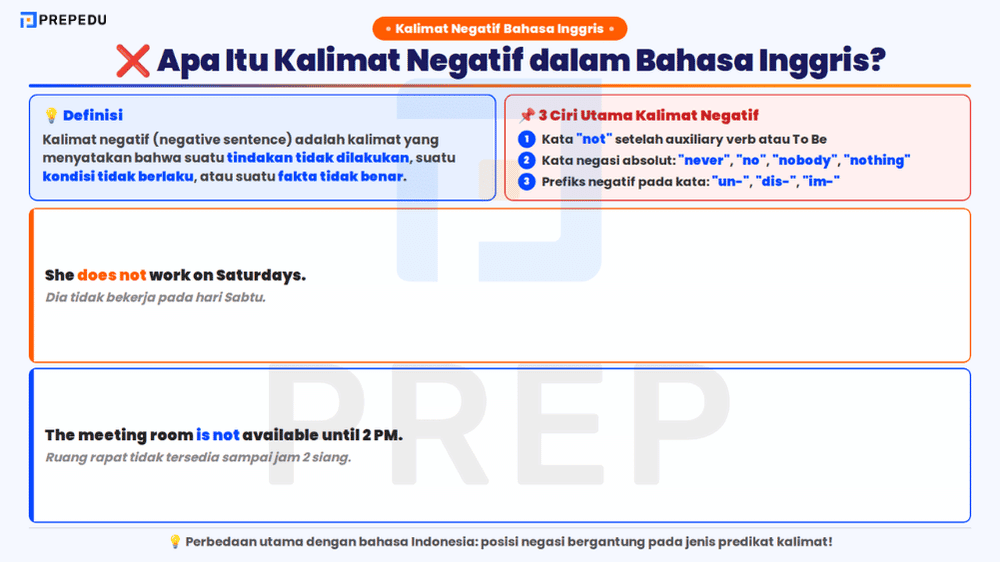
I. Apa Itu Kalimat Negatif dalam Bahasa Inggris?
Kalimat negatif (negative sentence) adalah kalimat yang menyatakan bahwa suatu tindakan tidak dilakukan, suatu kondisi tidak berlaku, atau suatu fakta tidak benar. Dalam bahasa Inggris, kalimat negatif ditandai oleh tiga ciri utama:
-
kehadiran kata "not" setelah auxiliary verb atau To Be
-
penggunaan kata negasi absolut seperti "never", "no", "nobody", atau "nothing"
-
prefiks negatif pada kata benda atau kata sifat seperti "un-", "dis-", atau "im-"
Perbedaan utama dengan bahasa Indonesia adalah posisi elemen negasi bergantung pada jenis predikat kalimat, bukan sekadar menambahkan "tidak" di sembarang tempat.
Contoh Kalimat Negatif dalam Bahasa Inggris:
-
She does not work on Saturdays. (Dia tidak bekerja pada hari Sabtu.)
-
The meeting room is not available until 2 PM. (Ruang rapat tidak tersedia sampai jam 2 siang.)
II. Rumus Kalimat Negatif dalam Bahasa Inggris
Ada 8 pola utama pembentukan kalimat negatif dalam bahasa Inggris. Setiap pola berlaku untuk konteks gramatikal yang berbeda. Memilih pola yang salah bukan hanya menghasilkan kalimat yang tidak gramatikal, tapi juga bisa mengubah makna yang dimaksud.
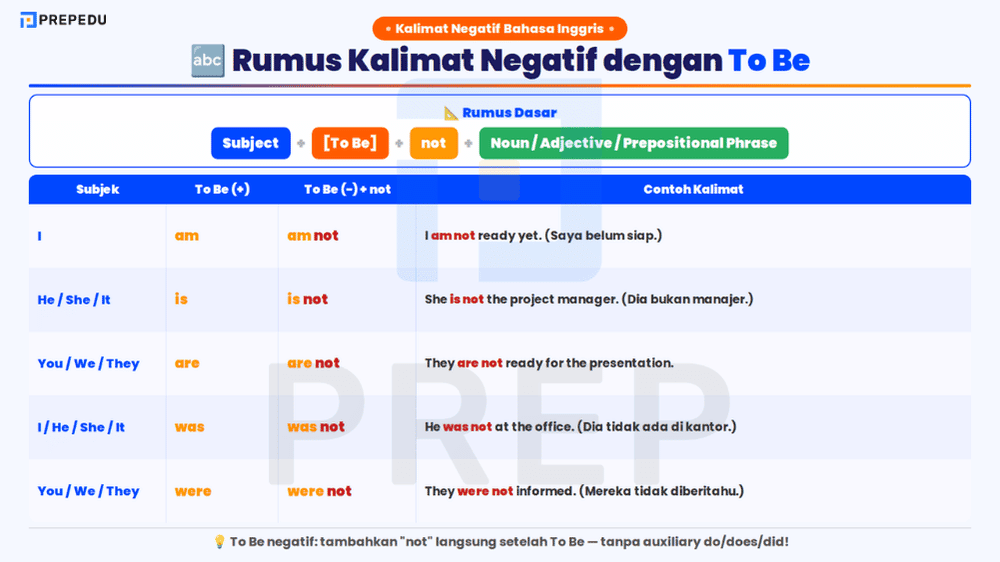
1. Rumus Kalimat Negatif dengan To Be
Kalimat negatif dengan To Be dibentuk dengan menambahkan "not" langsung setelah bentuk To Be yang digunakan, tanpa auxiliary do/does/did. Karena To Be muncul dalam banyak tenses dengan bentuk yang berbeda, tabel berikut mencakup seluruh bentuk To Be beserta versi negatif dan kontraksinya.
Subject + To Be + not + Noun / Adjective / Prepositional Phrase
|
To Be |
Bentuk Negatif |
Kontraksi |
Konteks |
|
am |
am not |
I'm not (hanya dalam kalimat penuh) |
I am not... |
|
is |
is not |
isn't |
He/She/It is not... |
|
are |
are not |
aren't |
You/We/They are not... |
|
was |
was not |
wasn't |
I/He/She/It was not... |
|
were |
were not |
weren't |
You/We/They were not... |
|
will be |
will not be |
won't be |
subject + won't be... |
|
is/are being |
is/are not being |
isn't/aren't being |
To Be + not + being... |
|
was/were being |
was/were not being |
wasn't/weren't being |
To Be + not + being... |
|
have been |
have not been |
haven't been |
I/You/We/They |
|
has been |
has not been |
hasn't been |
He/She/It |
|
had been |
had not been |
hadn't been |
semua subject |
|
be (modal) |
modal + not + be |
can't be / shouldn't be... |
can, should, must, dll. |
Contoh kalimat negatif dengan To Be:
-
She is not the project manager. (Dia bukan manajer proyek itu.)
-
They are not ready for the client presentation. (Mereka belum siap untuk presentasi klien.)
-
The system was not responding during the update. (Sistem tidak merespons selama pembaruan berlangsung.)
-
We will not be available for the meeting tomorrow. (Kami tidak akan tersedia untuk rapat besok.)
-
The proposal has not been approved yet. (Proposal itu belum disetujui.)
-
This task cannot be finished in one day. (Tugas ini tidak bisa diselesaikan dalam satu hari.)
Kesalahan yang wajib dihindari:
1: Menambahkan do/does sebelum To Be
❌ She doesn't is a doctor.
✅ She is not a doctor.
→ Kalimat dengan predikat nomina/adjektiva menggunakan To Be negatif, tanpa do/does.
2: Menggunakan dua auxiliary sekaligus
❌ He isn't doesn't work here.
✅ He doesn't work here.
→ Pilih satu jalur: To Be untuk kondisi/identitas, do/does untuk aksi.
2. Rumus Kalimat Negatif dalam Setiap Tenses Bahasa Inggris
Rumus kalimat negatif berbeda di setiap tenses. Aturan inti yang berlaku di semua tenses: setelah auxiliary verb, kata kerja utama selalu kembali ke bentuk dasar (base form).
|
Tenses |
Rumus Negatif |
Contoh Kalimat |
|
S + do/does + not + V (base) |
She doesn't attend the daily standup. |
|
|
S + did + not + V (base) |
He didn't submit the report on time. |
|
|
S + will + not + V (base) |
We won't reschedule the meeting. |
|
|
Be Going To |
S + am/is/are + not + going to + V |
They are not going to launch next month. |
|
S + am/is/are + not + V-ing |
I'm not working from home today. |
|
|
Past Continuous |
S + was/were + not + V-ing |
She wasn't waiting at the lobby. |
|
S + have/has + not + V (past participle) |
I haven't reviewed the contract yet. |
|
|
Past Perfect |
S + had + not + V (past participle) |
They hadn't finished before the deadline. |
|
Future Perfect |
S + will + not + have + V (past participle) |
She won't have left by 5 PM. |
Kesalahan yang wajib dihindari:
1: Menambahkan bentuk past tense pada kata kerja setelah "did"
❌ She didn't went to the client meeting.
✅ She didn't go to the client meeting.
→ "did" sudah menanggung penanda past tense. Kata kerja utama wajib kembali ke base form "go".
2: Menggunakan base form setelah have/has dalam Present Perfect
❌ I haven't go to that branch yet.
✅ I haven't gone to that branch yet.
→ Setelah have/has/had, gunakan past participle "gone", bukan base form "go".
3. Rumus Kalimat Negatif dengan Modal Verbs
Modal verbs (can, will, shall, may, might, must, should, would) membentuk kalimat negatif dengan satu rumus yang seragam: tambahkan "not" langsung setelah modal, tanpa auxiliary do/does/did, dan tanpa mengubah kata kerja utama.
Subject + Modal + not + Verb (Base Form) + ...
|
Modal |
Negatif Penuh |
Kontraksi |
Arti Negatif |
Contoh Kalimat |
|
can |
cannot / can not |
can't |
tidak bisa |
She can't join the call right now. |
|
will |
will not |
won't |
tidak akan |
He won't finish before Friday. |
|
shall |
shall not |
shan't |
tidak akan (formal) |
We shall not accept late submissions. |
|
may |
may not |
(jarang) |
mungkin tidak |
She may not be available tomorrow. |
|
might |
might not |
mightn't |
mungkin tidak |
The report might not be accurate. |
|
must |
must not |
mustn't |
tidak boleh |
You mustn't share this data externally. |
|
should |
should not |
shouldn't |
sebaiknya tidak |
You shouldn't ignore client feedback. |
|
would |
would not |
wouldn't |
tidak mau / tidak akan |
He wouldn't agree to the new terms. |
Catatan: Dalam TOEIC Writing Part 3 dan IELTS Writing Task 2, gunakan bentuk penuh (should not, cannot, will not). Hindari kontraksi di bagian tulisan formal.
Kesalahan yang wajib dihindari: Menambahkan "does/do" sebelum modal
❌ She doesn't can attend the meeting.
✅ She can't attend the meeting.
→ Modal sudah berfungsi sebagai auxiliary. Jangan tambahkan "does" atau "do" sebelum modal.
4. Rumus Kalimat Negatif dengan Any, Anybody, Anyone, Anything, dan Anywhere
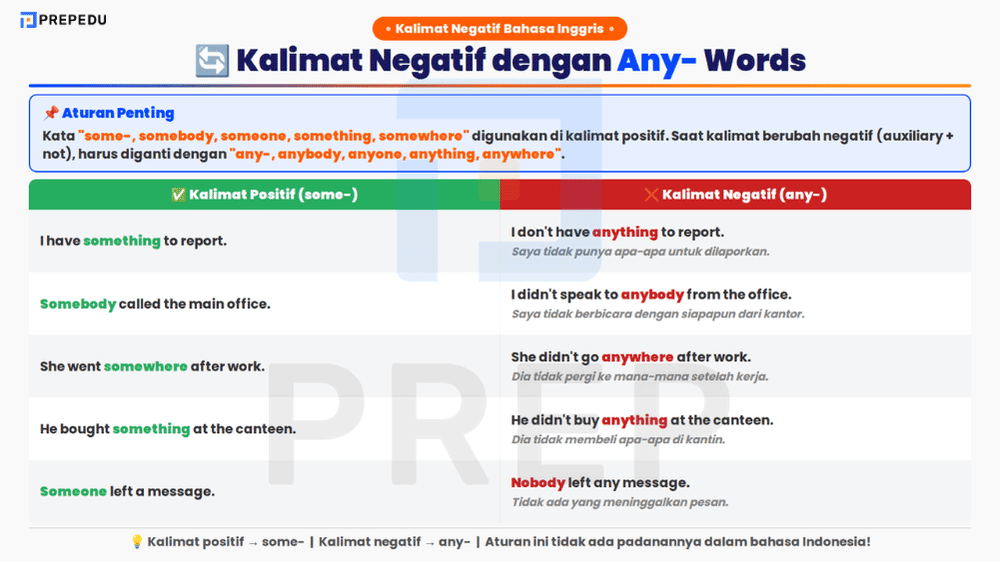
Dalam bahasa Inggris, kata "some, somebody, someone, something, somewhere" digunakan di kalimat positif. Ketika kalimat berubah menjadi negatif (dengan auxiliary + not), pasangannya harus diganti dengan "any, anybody, anyone, anything, anywhere". Ini adalah aturan yang tidak ada padanannya dalam bahasa Indonesia.
|
Kalimat Positif (some-) |
Kalimat Negatif (any-) |
|
I have something to report. |
I don't have anything to report. (Saya tidak punya apa-apa untuk dilaporkan.) |
|
Somebody called the main office. |
I didn't speak to anybody from the office. (Saya tidak berbicara dengan siapapun dari kantor.) |
|
She went somewhere after work. |
She didn't go anywhere after work. (Dia tidak pergi ke mana-mana setelah kerja.) |
|
He bought something at the canteen. |
He didn't buy anything at the canteen. (Dia tidak membeli apa-apa di kantin.) |
|
Someone left a message. |
Nobody left any message. (Tidak ada yang meninggalkan pesan.) |
5. Rumus Kalimat Negatif dengan No, Not, Never, None, Nobody
Setiap kata negasi dalam kelompok ini memiliki posisi dan fungsi gramatikal yang berbeda. Menggunakannya secara salah, atau menggabungkan dua kata negasi sekaligus, adalah salah satu kesalahan paling umum di TOEIC Part 5 dan IELTS.
|
Kata Negasi |
Posisi dalam Kalimat |
Contoh Benar |
|
no |
Sebelum noun (tanpa auxiliary) |
I have no time for this today. |
|
not |
Setelah auxiliary atau To Be |
She is not available until 3 PM. |
|
never |
Setelah subject, tanpa auxiliary |
He never misses a client deadline. |
|
none |
Sebagai pronoun pengganti noun |
None of the reports were submitted. |
|
nobody / nothing / nowhere |
Sebagai subject atau object |
Nobody in the team knew the answer. |
Perbedaan "no" dan "not":
Kedua kata ini sama-sama negatif, tetapi bekerja pada posisi gramatikal yang berbeda dan tidak bisa saling menggantikan:
-
I have no money : "no" menegasikan noun secara langsung, tanpa auxiliary
-
I do not have money: "not" menegasikan auxiliary "do"; makna sama tetapi "no" lebih ringkas
6. Rumus Kalimat Negatif dengan Kata Keterangan Negatif
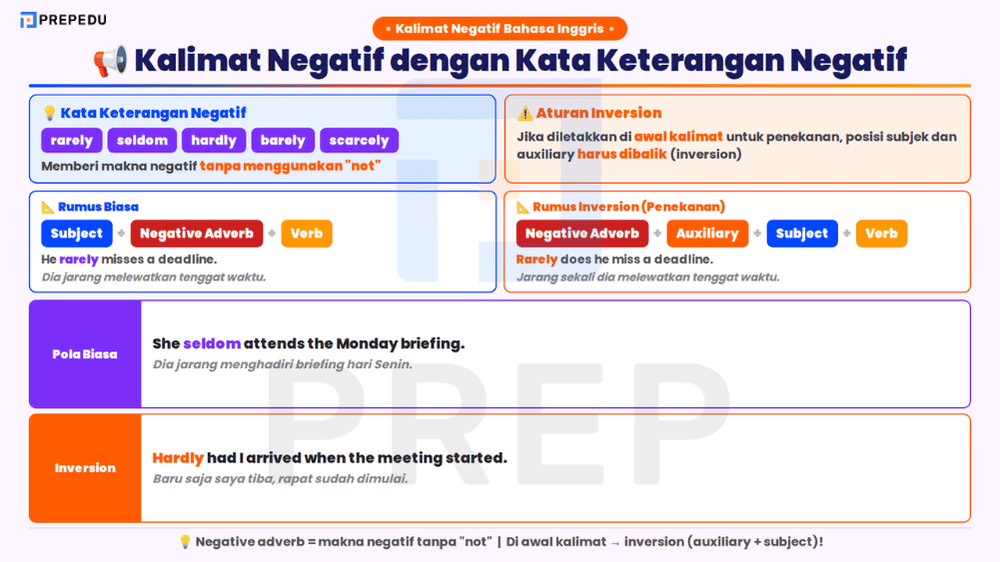
Kata keterangan negatif (negative adverbs) seperti "rarely", "seldom", "hardly", "barely", dan "scarcely" memberi makna negatif tanpa menggunakan "not":
Subject + Negative Adverb + Verb / Auxiliary + Verb (Base Form)
Ada satu aturan penting: ketika kata-kata ini diletakkan di awal kalimat untuk penekanan, posisi subject dan auxiliary harus dibalik (inversion):
Negative Adverb + Auxiliary + Subject + Verb (Base Form)
|
Kata Keterangan |
Arti |
Posisi Normal |
Dengan Inversion di Awal Kalimat |
|
rarely |
jarang |
She rarely submits late. |
Rarely does she submit late. |
|
seldom |
jarang |
He seldom works overtime. |
Seldom does he work overtime. |
|
hardly |
hampir tidak |
I hardly have time for lunch. |
Hardly do I have time for lunch. |
|
barely |
hampir tidak |
We barely met the quota. |
Barely did we meet the quota. |
|
scarcely |
hampir tidak |
She scarcely speaks in meetings. |
Scarcely does she speak in meetings. |
|
no sooner...than |
begitu...langsung |
He had no sooner arrived than the call ended. |
No sooner had he arrived than the call ended. |
7. Struktur Kalimat Negatif Ganda (Double Negation) dalam Bahasa Inggris
Double negation terjadi ketika dua elemen negatif digunakan dalam satu kalimat. Dalam bahasa Inggris baku, dua elemen negatif menghasilkan makna positif, bukan penguatan negatif. Logika ini berbeda dari bahasa Indonesia di mana "tidak tahu apa-apa" masih bermakna negatif.
Prinsip: negatif × negatif = positif (seperti aturan perkalian dalam matematika).
|
Double Negation (Salah) |
Bentuk Standar (Benar) |
Makna yang Dimaksud |
|
I don't know nothing. |
I don't know anything. / I know nothing. |
Saya tidak tahu apa-apa. |
|
She doesn't never come. |
She never comes. / She doesn't come. |
Dia tidak pernah datang ke rapat. |
|
Nobody didn't call the office. |
Nobody called the office. |
Tidak ada yang menelepon kantor. |
|
We don't have no budget left. |
We have no budget left. / We don't have any budget left. |
Kami tidak punya anggaran tersisa. |
Catatan: Double negation umum di beberapa dialek bahasa Inggris non-standar. Namun dalam ujian TOEIC Part 5 dan IELTS, double negation dianggap kesalahan gramatikal yang menurunkan skor.
8. Contoh Kalimat Negatif Bahasa Inggris dari Struktur Lainnya
Selain 7 pola di atas, bahasa Inggris memiliki 7 struktur negatif tambahan yang masing-masing punya fungsi dan konteks penggunaan spesifik. Memahami variasi ini akan membuat kalimat kamu terdengar lebih natural dan presisi, baik dalam percakapan sehari-hari maupun dalam ujian TOEIC dan IELTS.
8.1. Kalimat Tanya Negatif dalam Bahasa Inggris
Kalimat tanya negatif (negative question) dibentuk dengan memindahkan auxiliary + not ke posisi awal, sebelum subject. Pola ini digunakan untuk konfirmasi, ekspresi terkejut, atau tawaran sopan.
Auxiliary + not + Subject + Verb (Base Form) + ... ?
Contoh:
-
Isn't the client meeting scheduled for this afternoon? (Bukankah rapat klien dijadwalkan untuk sore ini?) : konfirmasi, pembicara mengharapkan jawaban "ya"
-
Don't you have the updated version of the contract? (Kamu tidak punya versi terbaru kontrak itu?) : ekspresi terkejut
-
Shouldn't we notify the team about the deadline change? (Bukankah kita seharusnya memberitahu tim soal perubahan deadline?) : saran atau tegoran halus
-
Didn't she send the invoice last week? (Bukankah dia sudah mengirim invoice minggu lalu?) : klarifikasi
8.2. Kalimat Perintah Negatif dalam Bahasa Inggris
Kalimat perintah negatif (negative imperative) selalu dimulai dengan "Don't" + kata kerja bentuk dasar. Subject "you" tidak disebutkan karena sudah tersirat, berlaku untuk 1 orang maupun sekelompok orang.
Don't + Verb (Base Form) + ...
Contoh:
-
Don't be late for the client presentation. (Jangan terlambat untuk presentasi klien.) : "Don't" + To Be dalam base form "be"
-
Don't share confidential data without authorization. (Jangan bagikan data rahasia tanpa otorisasi.) : konteks profesional
-
Don't forget to cc the manager in your reply. (Jangan lupa cc manajer dalam balasan kamu.) : instruksi email
8.3. Kalimat Negatif dengan Klausa Pembatas
Kalimat negatif dengan klausa pembatas menggunakan kata seperti "only", "just", "except", atau "but" untuk membatasi cakupan negasi. Posisi "only" dalam kalimat sangat menentukan makna.
Contoh:
-
I didn't understand only the last part; the rest was clear. (Saya tidak memahami hanya bagian terakhirnya; sisanya jelas.) : "only" membatasi apa yang tidak dipahami
-
She doesn't eat anything except salad and grilled fish. (Dia tidak makan apa-apa kecuali salad dan ikan bakar.) : "except" membatasi cakupan negasi
-
Nobody attended the seminar but the new interns. (Tidak ada yang menghadiri seminar itu kecuali para magang baru.) : "but" bermakna "except" setelah nobody/nothing
8.4. Kalimat Negatif Penekanan dalam Bahasa Inggris
Kalimat negatif penekanan (emphatic negation) menggunakan frasa seperti "absolutely not", "by no means", "not at all", atau "certainly not" untuk mempertegas penolakan dengan nada yang lebih kuat dari kalimat negatif biasa.
Contoh:
-
This decision is by no means final; we will revisit it next quarter. (Keputusan ini sama sekali belum final; kami akan meninjaunya kembali kuartal depan.) : "by no means" untuk penekanan formal
-
I do not agree with this proposal at all. (Saya sama sekali tidak setuju dengan proposal ini.) : "not...at all" untuk penekanan kuat
-
Absolutely not. This clause was not in the original agreement. (Sama sekali tidak. Klausul ini tidak ada dalam perjanjian aslinya.) : "Absolutely not" sebagai respons tegas
8.5. Kalimat Negatif dengan Prefiks dan Sufiks Negatif
Prefiks negatif (un-, dis-, im-, il-, ir-, non-, in-) dan sufiks (-less) mengubah makna kata menjadi negatif secara langsung tanpa membutuhkan auxiliary verb. Pola ini sangat umum di TOEIC Vocabulary dan IELTS Reading.
|
Prefiks / Sufiks |
Contoh Kata |
Contoh Kalimat |
|
un- |
unhappy, unclear, unavailable |
The manager is unavailable until 3 PM. (Manajer tidak tersedia sampai jam 3 sore.) |
|
dis- |
disagree, disconnect, dishonest |
I disagree with that assessment. (Saya tidak setuju dengan penilaian itu.) |
|
im- |
impossible, impolite, impatient |
Meeting that deadline is impossible. (Memenuhi deadline itu tidak mungkin.) |
|
il- |
illegal, illogical, illegible |
That clause is illegal under local law. (Klausul itu ilegal menurut hukum setempat.) |
|
ir- |
irrelevant, irresponsible |
This point is irrelevant to our discussion. (Poin ini tidak relevan dengan diskusi kita.) |
|
non- |
non-negotiable, non-refundable |
The deposit is non-refundable. (Deposit tidak dapat dikembalikan.) |
|
-less |
careless, useless, speechless |
The first draft was careless and incomplete. (Draf pertama itu ceroboh dan tidak lengkap.) |
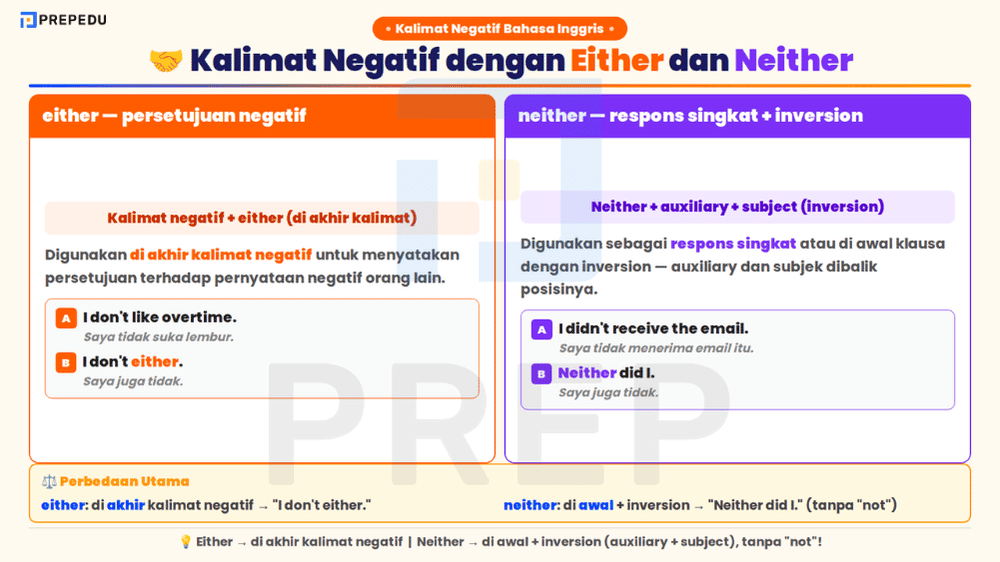
8.6. Kalimat Negatif dengan Either dan Neither
"Either" dan "neither" digunakan untuk menyatakan persetujuan dalam konteks negatif. Keduanya bekerja dengan cara yang berbeda dan sering tertukar oleh pelajar Indonesia.
|
Kata |
Cara Penggunaan |
Contoh |
|
either |
Di akhir kalimat negatif untuk persetujuan negatif |
I don't like overtime. (Saya tidak suka lembur.) I don't either. (Saya juga tidak.) |
|
neither |
Sebagai respons singkat atau di awal klausa dengan inversion |
I didn't receive the email. (Saya tidak menerima email itu.) Neither did I. (Saya juga tidak.) |
Kesalahan yang wajib dihindari: Menggunakan "Me too" sebagai respons kalimat negatif
❌ "I don't like the proposal." - "Me too."
✅ "I don't like the proposal." - "Me neither." / "I don't either."
→ "Me too" hanya digunakan untuk merespons kalimat positif. Untuk kalimat negatif, gunakan "Me neither" atau "...don't either".
Dalam kalimat negatif, kamu juga perlu memahami kapan menggunakan bahasa inggris atau (or/nor) sebagai kata penghubung yang tepat.
8.7. Kalimat Negatif dengan "I'm not sure" dan "I don't think"
"I'm not sure" dan "I don't think" adalah cara sopan dan natural untuk mengungkapkan ketidakpastian atau pendapat negatif yang diperhalus. Keduanya sangat umum dalam percakapan bisnis, TOEIC Part 3, dan email profesional.
Contoh:
-
I'm not sure whether the client has confirmed the meeting time. (Saya tidak yakin apakah klien sudah mengonfirmasi waktu rapat.) : "I'm not sure + whether/if" untuk ketidakpastian
-
I don't think the budget will be approved this quarter. (Saya rasa anggaran itu tidak akan disetujui kuartal ini.) : "I don't think + klausa positif" adalah cara sopan menyatakan pendapat negatif
Catatan: "I don't think it will work" lebih natural dari "I think it won't work". Meskipun keduanya berarti sama, native speakers lebih sering meletakkan negasi pada "think", bukan pada klausa anak.
III. Latihan Buat Kalimat Negatif dalam Bahasa Inggris
Pemahaman teori saja tidak cukup. Dua set latihan berikut dirancang untuk menguji kemampuan kamu menerapkan rumus kalimat negatif secara langsung, tanpa petunjuk tense yang eksplisit. Kerjakan terlebih dahulu, lalu periksa kunci jawaban di bagian bawah setiap latihan.
1. Latihan 1: Konjugasikan Kata Kerja dalam Kalimat Negatif Bahasa Inggris
Instruksi: Lengkapi setiap kalimat dengan auxiliary verb yang tepat dan konjugasikan kata kerja dalam kurung menjadi kalimat negatif yang benar.
-
She _____ (not be) available this afternoon; she has a client call.
-
I _____ (not finish) the quarterly report yet. I'll send it by tomorrow morning.
-
The new intern _____ (not know) how to use the project management software.
-
They _____ (not attend) the workshop last Tuesday because of the factory visit.
-
We _____ (not launch) the product next month; the testing phase is still ongoing.
-
He _____ (not work) in this department for the past three years.
-
The system _____ (not respond) properly since the last update.
-
You _____ (not worry) about the presentation format; focus on the content first.
-
Our team _____ (not submit) the proposal yet when the client called.
-
The manager _____ (not decide) on the new policy before consulting the HR team.
Kunci Jawaban Latihan 1:
-
She is not (isn't) available this afternoon.
-
I have not (haven't) finished the quarterly report yet.
-
The new intern does not (doesn't) know how to use the software.
-
They did not (didn't) attend the workshop last Tuesday.
-
We will not (won't) launch the product next month.
-
He has not (hasn't) worked in this department for the past three years.
-
The system has not (hasn't) been responding properly since the last update.
-
You should not (shouldn't) worry about the presentation format.
-
Our team had not (hadn't) submitted the proposal yet when the client called.
-
The manager did not (didn't) decide on the new policy before consulting the HR team.
2. Latihan 2: Ubah Kalimat Positif Menjadi Kalimat Negatif dalam Bahasa Inggris
Instruksi: Ubah setiap kalimat positif berikut menjadi kalimat negatif yang benar. Perhatikan tenses dan jenis predikat sebelum memilih rumus.
-
She is the head of the marketing division.
-
He submitted the invoice before the deadline.
-
They have signed the new contract.
-
The office opens at 7 AM every day.
-
We will attend the regional conference next month.
-
The team was preparing the presentation when the power went out.
-
You should agree to every term without reading carefully.
-
Somebody left feedback on the new product design.
-
The annual report is accurate and complete.
-
They had already informed the client before the meeting started.
Kunci Jawaban Latihan 2:
-
She is not (isn't) the head of the marketing division.
-
He did not (didn't) submit the invoice before the deadline.
-
They have not (haven't) signed the new contract.
-
The office does not (doesn't) open at 7 AM every day.
-
We will not (won't) attend the regional conference next month.
-
The team was not (wasn't) preparing the presentation when the power went out.
-
You should not (shouldn't) agree to every term without reading carefully.
-
Nobody left feedback on the new product design. / I didn't get any feedback from anybody on the new design.
-
The annual report is not (isn't) accurate or complete. (Catatan: "and" berubah menjadi "or" dalam kalimat negatif.)
-
They had not (hadn't) already informed the client before the meeting started.
Kesimpulan
Menguasai kalimat negatif dalam bahasa Inggris berarti memahami bahwa ada 8 pola negasi yang masing-masing bekerja pada konteks gramatikal berbeda. Untuk memverifikasi pemahaman kamu, kerjakan kedua set latihan di artikel ini. Langkah berikutnya: pelajari kalimat tanya dalam bahasa Inggris, karena sistem auxiliary yang kamu gunakan untuk membuat kalimat negatif adalah dasar yang sama untuk membentuk pertanyaan.

Halo! Nama saya Sari, saat ini saya bekerja sebagai Manajer Konten Produk di blog situs web prepedu.com.
Dengan pengalaman lebih dari 5 tahun dalam belajar mandiri bahasa asing seperti bahasa Inggris dan Mandarin serta mempersiapkan ujian IELTS dan TOEIC, saya telah mengumpulkan banyak pengetahuan untuk mendukung ribuan orang yang menghadapi kesulitan dalam belajar bahasa asing.
Semoga apa yang saya bagikan dapat membantu proses belajar mandiri di rumah secara efektif bagi semua orang!
Komentar


Peta pembelajaran yang dipersonalisasi




Paling banyak dibaca





UEN: 202227322W
Alamat: Galeon Square 8th Floor Jalan M.H. Thamrin No. 10 Jakarta Pusat 10230 Indonesia
Nomor Hotline : +65 3129 31111
Nomor WhatsApp Hotline : +62 822 9993 9692 / +62 815 307 7737 (For Business)
Email: halo@prepedu.com / partner.id@prepedu.com (for business)