16 Tenses dalam Bahasa Inggris: Rumus Lengkap, Contoh Kalimat, dan Cara Memilih Tenses yang Tepat
Bahasa Inggris memiliki 16 tenses yang terbentuk dari kombinasi 4 waktu dan 4 aspek gramatikal. Ini bukan sekadar daftar panjang yang harus dihafal, melainkan sebuah sistem yang logis dan bisa dipahami siapa pun.
Pelajar Indonesia sering mengalami kesulitan memilih tenses yang tepat bukan karena kemampuan mereka kurang. Ada satu alasan yang jarang dijelaskan secara langsung: bahasa Indonesia tidak memiliki tenses. Waktu dinyatakan melalui kata keterangan seperti kemarin, sedang, dan akan, tanpa perubahan bentuk kata kerja. Bahasa Inggris bekerja secara berbeda: kata kerja harus berubah bentuk bahkan ketika keterangan waktu sudah ada dalam kalimat.
Dalam artikel ini, kamu akan menemukan penjelasan lengkap 16 tenses bahasa Inggris, mulai dari definisi, rumus, contoh kalimat, hingga strategi memilih tenses yang tepat. Tersedia juga 160 soal latihan untuk setiap tenses dengan kunci jawaban, agar kamu bisa langsung mempraktikkan apa yang sudah dipelajari.
- I. Apa Itu Tenses dalam Bahasa Inggris dan Mengapa Penting untuk Dikuasai
- II. 16 Tenses Bahasa Inggris: Daftar Lengkap, Rumus, dan Contoh Kalimat
- III. Macam Macam Tenses dalam Bahasa Inggris: Penjelasan Lengkap 16 Tenses dan Contohnya
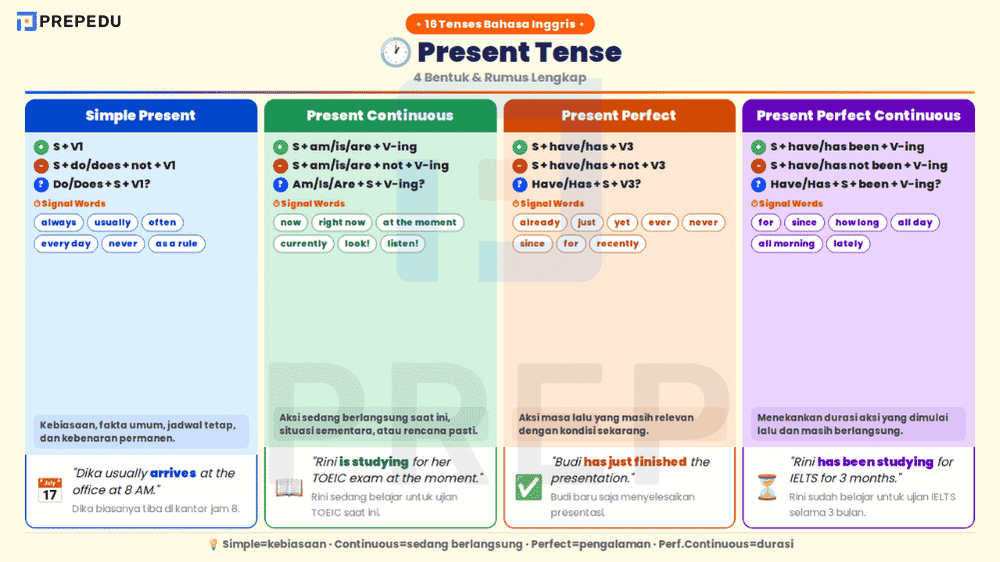
- 1. Simple Present Tense
- 2. Present Continuous Tense
- 3. Present Perfect Tense
- 4. Present Perfect Continuous Tense
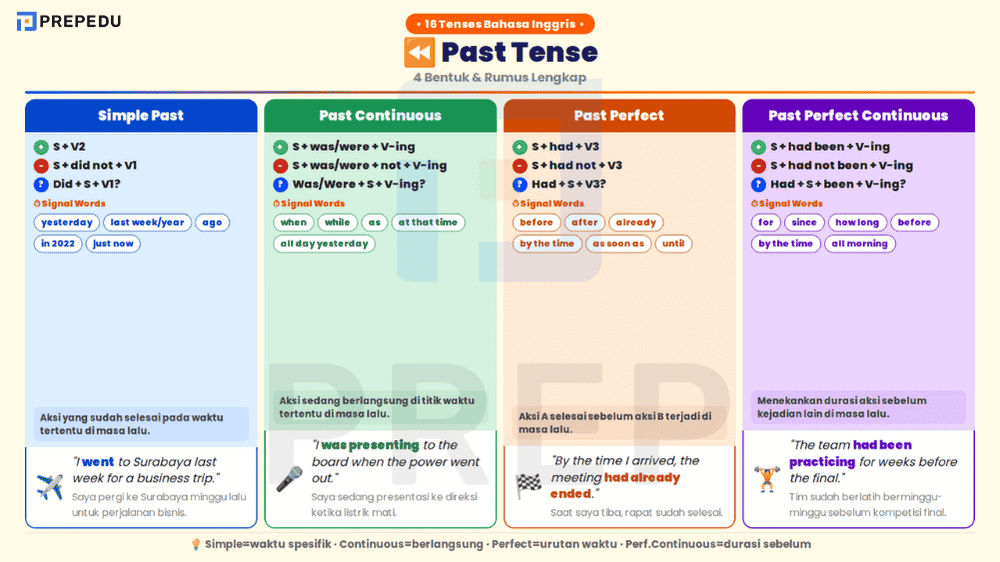
- 5. Simple Past Tense
- 6. Past Continuous Tense
- 7. Past Perfect Tense
- 8. Past Perfect Continuous Tense
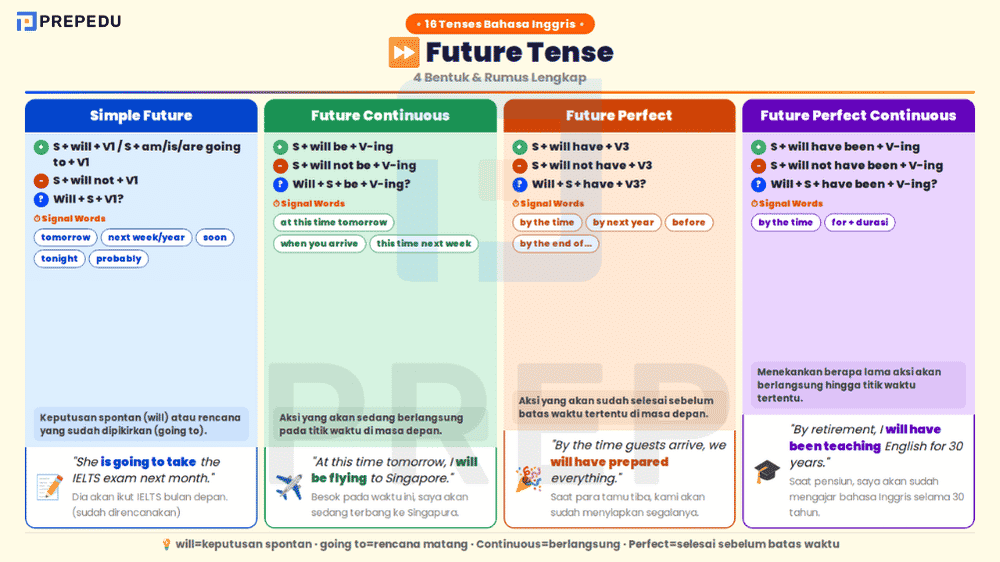
- 9. Simple Future Tense
- 10. Future Continuous Tense
- 11. Future Perfect Tense
- 12. Future Perfect Continuous Tense
- 13. Simple Past Future Tense
- 14. Past Future Continuous Tense
- 15. Past Future Perfect Tense
- 16. Past Future Perfect Continuous Tense
- IV. Cara Memilih Tenses Bahasa Inggris yang Tepat: 5 Pasang Tenses yang Paling Sering Tertukar
- 1. Simple Present vs. Present Continuous: Kapan Aksi Adalah Fakta, Kapan Aksi Sedang Berlangsung
- 2. Simple Past vs. Present Perfect: Mengapa "Sudah" Tidak Selalu Berarti Simple Past
- 3. Present Perfect vs. Present Perfect Continuous: Hasil Akhir vs. Durasi Proses
- 4. Past Continuous vs. Simple Past: Aksi yang Bersamaan vs. Aksi yang Berurutan
- 5. Simple Future (will) vs. Be Going To: Keputusan Spontan vs. Rencana yang Sudah Dipikirkan
- V. Cara Mudah Menghafal Rumus Tenses Bahasa Inggris Tanpa Hafalan Mati
- VI. Latihan Soal 16 Tenses dalam Bahasa Inggris dengan Kunci Jawaban
- 1. Latihan Soal Simple Present Tense
- 2. Latihan Soal Present Continuous Tense
- 3. Latihan Soal Present Perfect Tense
- 4. Latihan Soal Present Perfect Continuous Tense
- 5. Latihan Soal Simple Past Tense
- 6. Latihan Soal Past Continuous Tense
- 7. Latihan Soal Past Perfect Tense
- 8. Latihan Soal Past Perfect Continuous Tense
- 9. Latihan Soal Simple Future Tense
- 10. Latihan Soal Future Continuous Tense
- 11. Latihan Soal Future Perfect Tense
- 12. Latihan Soal Future Perfect Continuous Tense
- 13. Latihan Soal Simple Past Future Tense
- 14. Latihan Soal Past Future Continuous Tense
- 15. Latihan Soal Past Future Perfect Tense
- 16. Latihan Soal Past Future Perfect Continuous Tense
- VII. Pertanyaan Umum tentang Tenses dalam Bahasa Inggris
- Kesimpulan
I. Apa Itu Tenses dalam Bahasa Inggris dan Mengapa Penting untuk Dikuasai
Tenses dalam bahasa Inggris adalah sistem gramatikal yang menyatakan dua hal sekaligus: kapan suatu aksi terjadi (waktu) dan bagaimana aksi itu berlangsung (aspek). Ini berarti tenses bukan hanya soal "masa lalu" atau "masa depan", melainkan soal cara pandang terhadap sebuah aksi.
Bahasa Indonesia tidak memiliki sistem ini. Kalimat "Saya makan" bisa berarti saat ini, kemarin, atau setiap hari, tergantung konteks atau kata keterangan yang ditambahkan. Bahasa Inggris tidak memberikan ambiguitas seperti itu: bentuk kata kerja sendiri yang membawa
II. 16 Tenses Bahasa Inggris: Daftar Lengkap, Rumus, dan Contoh Kalimat
Tenses ada berapa dalam bahasa Inggris? Ini adalah salah satu pertanyaan pertama yang muncul bagi pelajar baru. Ada berapa tenses dalam bahasa Inggris? Jawabannya: tepat 16 tenses, yang terbentuk dari 4 waktu (Present, Past, Future, Past Future) dikombinasikan dengan 4 aspek (Simple, Continuous, Perfect, Perfect Continuous). Tabel berikut merangkum keseluruhan 16 tenses beserta rumus dasar dan contoh kalimatnya.
|
No. |
Tenses |
Rumus Positif |
Contoh Kalimat |
|
1 |
Simple Present |
S + V1 (s/es) |
She works at a bank. (Dia bekerja di bank.) |
|
2 |
Present Continuous |
S + is/am/are + V-ing |
I am studying now. (Saya sedang belajar sekarang.) |
|
3 |
Present Perfect |
S + have/has + V3 |
He has finished the report. (Dia sudah menyelesaikan laporan.) |
|
4 |
Present Perfect Continuous |
S + have/has been + V-ing |
She has been working here for 3 years. (Dia sudah bekerja di sini 3 tahun.) |
|
5 |
Simple Past |
S + V2 |
We met last Monday. (Kami bertemu Senin lalu.) |
|
6 |
Past Continuous |
S + was/were + V-ing |
I was cooking when she called. (Saya sedang memasak ketika dia menelepon.) |
|
7 |
Past Perfect |
S + had + V3 |
The meeting had ended when I arrived. (Rapat sudah selesai saat saya tiba.) |
|
8 |
Past Perfect Continuous |
S + had been + V-ing |
She had been waiting for 2 hours. (Dia sudah menunggu 2 jam.) |
|
9 |
Simple Future |
S + will + V1 |
He will attend the meeting tomorrow. (Dia akan hadir di rapat besok.) |
|
10 |
Future Continuous |
S + will be + V-ing |
I will be working at 9 AM. (Saya akan sedang bekerja jam 9.) |
|
11 |
Future Perfect |
S + will have + V3 |
By Friday, she will have finished the project. (Pada Jumat, dia akan sudah selesai.) |
|
12 |
Future Perfect Continuous |
S + will have been + V-ing |
By 2027, he will have been teaching for 10 years. (Pada 2027, dia sudah mengajar 10 tahun.) |
|
13 |
Simple Past Future |
S + would + V1 |
He said he would call me. (Dia bilang akan meneleponku.) |
|
14 |
Past Future Continuous |
S + would be + V-ing |
She said she would be waiting outside. (Dia bilang akan menunggu di luar.) |
|
15 |
Past Future Perfect |
S + would have + V3 |
If I had studied, I would have passed. (Kalau saya belajar, saya pasti lulus.) |
|
16 |
Past Future Perfect Continuous |
S + would have been + V-ing |
She would have been working there for 5 years. (Dia pasti sudah bekerja di sana 5 tahun.) |
III. Macam Macam Tenses dalam Bahasa Inggris: Penjelasan Lengkap 16 Tenses dan Contohnya
Memahami macam macam tenses dalam bahasa Inggris secara individual adalah langkah yang tidak bisa dilewati. Bagian ini menjelaskan setiap satu dari 16 tenses secara lengkap: definisi, fungsi, tanda pengenal (signal words), rumus, dan contoh kalimat beserta analisisnya.
1. Simple Present Tense
Definisi:
Simple Present Tense digunakan untuk menyatakan aksi yang bersifat kebiasaan, fakta umum, jadwal tetap, atau kebenaran yang berlaku secara permanen.
Fungsi:
-
Kebiasaan atau rutinitas: aksi yang dilakukan secara reguler.
-
Fakta umum dan kebenaran ilmiah: sesuatu yang selalu benar.
-
Jadwal atau program tetap: timetable yang sudah diputuskan.
-
Narasi langsung: komentar saat menonton pertandingan atau siaran langsung.
Tanda Pengenal: always, usually, often, sometimes, rarely, never, every day/week/month, in general, as a rule
Rumus:
(+) Positif: S + V1 (s/es untuk he/she/it)
(-) Negatif: S + do/does + not + V1
(?) Interogatif: Do/Does + S + V1?
Contoh Kalimat + Analisis:
|
Contoh Kalimat |
Analisis |
|
Dika usually arrives at the office at 8 AM. (Dika biasanya tiba di kantor jam 8.) |
usually = signal word untuk kebiasaan rutin |
|
Water boils at 100 degrees Celsius. (Air mendidih pada 100 derajat Celsius.) |
fakta ilmiah yang selalu benar, tanpa pengecualian |
|
The train to Bandung departs at 07.30 every morning. (Kereta ke Bandung berangkat jam 07.30 setiap pagi.) |
jadwal tetap, bukan aksi yang terjadi sekarang |
Perhatian: Verb Agreement untuk he/she/it
Untuk subjek he/she/it, kata kerja wajib ditambah -s atau -es. Contoh: She works here every day. ("she" = he/she/it, wajib pakai "works")
2. Present Continuous Tense
Definisi:
Present Continuous Tense menyatakan aksi yang sedang berlangsung pada saat ini, situasi sementara, atau rencana yang sudah pasti di masa depan yang dekat.
Fungsi:
-
Aksi yang sedang terjadi pada saat berbicara.
-
Situasi sementara yang kontras dengan kebiasaan.
-
Rencana yang sudah pasti dan terorganisir untuk masa depan dekat.
Tanda pengenal: now, right now, at the moment, currently, this week, look!, listen!
Rumus:
(+) Positif: S + am/is/are + V-ing
(-) Negatif: S + am/is/are + not + V-ing
(?) Interogatif: Am/Is/Are + S + V-ing?
Catatan penggunaan be:
-
am → I
-
is → he/she/it
-
are → you/we/they
Contoh Kalimat + Analisis:
|
Contoh Kalimat |
Analisis |
|
Rini is studying for her TOEIC exam at the moment. (Rini sedang belajar untuk ujian TOEIC saat ini.) |
at the moment = aksi berlangsung tepat sekarang |
|
We're meeting the client tomorrow at 3 PM. (Kami bertemu klien besok jam 3 sore.) |
rencana pasti yang sudah diatur, bukan Simple Future |
|
Listen! Someone is knocking on the door. (Dengarkan! Ada yang sedang mengetuk pintu.) |
Listen! = sinyal aksi berlangsung saat ini |
Stative Verbs: 8 Kata Kerja yang Tidak Boleh dalam Continuous
Kata kerja berikut menyatakan kondisi atau keadaan mental, bukan tindakan fisik, sehingga tidak bisa digunakan dalam bentuk -ing: know, want, need, like, love, hate, believe, understand. Contoh:
❌ I am knowing the answer.
✅ I know the answer.
3. Present Perfect Tense
Definisi:
Present Perfect Tense menghubungkan aksi di masa lalu dengan kondisi saat ini. Gunakan Present Perfect ketika waktu spesifik tidak disebutkan atau ketika aksi tersebut masih relevan dengan kondisi sekarang.
Fungsi:
-
Pengalaman atau hal yang pernah/belum pernah dilakukan (ever/never).
-
Aksi yang baru saja selesai dan hasilnya terasa sekarang (just, already).
-
Aksi yang dimulai di masa lalu dan masih berlanjut hingga sekarang (since, for).
-
Aksi yang mengubah kondisi saat ini (recently, lately).
Tanda pengenal: already, yet, just, ever, never, since, for, recently, lately, so far, up to now
Rumus:
(+) Positif: S + have/has + V3
(-) Negatif: S + have/has + not + V3
(?) Interogatif: Have/Has + S + V3?
Catatan:
-
have → I/you/we/they
-
has → he/she/it.
Contoh Kalimat + Analisis:
|
Contoh Kalimat |
Analisis |
|
Budi has just finished the presentation. (Budi baru saja menyelesaikan presentasi.) |
just = aksi baru selesai, hasilnya terasa sekarang |
|
I have lived in Jakarta for 5 years. (Saya sudah tinggal di Jakarta selama 5 tahun.) |
for + durasi = masih berlangsung hingga sekarang |
|
She has never tried soto Betawi before. (Dia belum pernah mencoba soto Betawi.) |
never = pengalaman yang belum pernah dilakukan, waktu tidak penting |
4. Present Perfect Continuous Tense
Definisi:
Present Perfect Continuous Tense menekankan durasi aksi yang dimulai di masa lalu dan masih berlangsung hingga sekarang, atau baru saja berhenti dengan dampak yang masih terasa.
Fungsi:
-
Durasi aksi yang dimulai di masa lalu dan masih berlanjut sekarang.
-
Aksi yang baru saja berhenti dan meninggalkan bukti atau dampak yang terlihat.
Tanda pengenal: for, since, how long, all day, all morning, lately, recently (nuansa: baru saja selesai)
Rumus:
(+) Positif: S + have/has been + V-ing
(-) Negatif: S + have/has not been + V-ing
(?) Interogatif: Have/Has + S + been + V-ing?
Contoh Kalimat + Analisis:
|
Contoh Kalimat |
Analisis |
|
Rini has been studying for her IELTS exam for 3 months. (Rini sudah belajar untuk ujian IELTS selama 3 bulan.) |
for 3 months = durasi, proses masih berlangsung |
|
You look tired. Have you been running? (Kamu terlihat lelah. Apakah kamu baru saja berlari?) |
aksi baru berhenti, dampaknya masih terlihat sekarang |
|
The team has been discussing this proposal since this morning. (Tim sudah mendiskusikan proposal ini sejak tadi pagi.) |
since this morning = titik awal yang spesifik, diskusi masih berlangsung |
5. Simple Past Tense
Definisi:
Simple Past Tense menyatakan aksi yang sudah selesai pada waktu tertentu di masa lalu. Waktu kejadian disebutkan secara eksplisit atau jelas dari konteks.
Fungsi:
-
Aksi tunggal yang selesai di masa lalu dengan waktu yang spesifik.
-
Serangkaian aksi berurutan di masa lalu.
-
Kondisi atau situasi yang berlaku di masa lalu tetapi sudah tidak berlaku sekarang.
Tanda pengenal: yesterday, last week/month/year, ago, in 2022, just now, when + waktu spesifik, this morning (yang sudah lewat)
Rumus:
(+) Positif: S + V2 (regular: tambah -ed; irregular: bentuk khusus)
(-) Negatif: S + didn't + V1
(?) Interogatif: Did + S + V1?
Contoh Kalimat + Analisis:
|
Contoh Kalimat |
Analisis |
|
I went to Surabaya last week for a business trip. (Saya pergi ke Surabaya minggu lalu untuk perjalanan bisnis.) |
last week = waktu spesifik di masa lalu |
|
She sent the email, waited for a reply, and then called the client. (Dia mengirim email, menunggu balasan, lalu menelepon klien.) |
tiga aksi berurutan di masa lalu, semua Simple Past |
|
We didn't know about the policy change until Tuesday. (Kami tidak tahu perubahan kebijakan itu sampai Selasa.) |
until Tuesday = batas waktu yang sudah berlalu |
15 Irregular Verbs yang Paling Sering Digunakan:
|
V1 |
V2 (Simple Past) |
Arti |
|
go |
went |
pergi |
|
come |
came |
datang |
|
take |
took |
mengambil |
|
make |
made |
membuat |
|
give |
gave |
memberi |
|
get |
got |
mendapat |
|
have |
had |
memiliki |
|
see |
saw |
melihat |
|
know |
knew |
mengetahui |
|
think |
thought |
berpikir |
|
say |
said |
mengatakan |
|
tell |
told |
memberitahu |
|
buy |
bought |
membeli |
|
write |
wrote |
menulis |
|
send |
sent |
mengirim |
6. Past Continuous Tense
Definisi:
Past Continuous Tense menyatakan aksi yang sedang berlangsung pada titik waktu tertentu di masa lalu. Tenses ini sering berpasangan dengan Simple Past untuk menunjukkan satu aksi yang menginterupsi aksi lain yang sedang berlangsung.
Fungsi:
-
Aksi yang sedang berlangsung di titik waktu tertentu di masa lalu.
-
Dua aksi paralel yang berlangsung bersamaan di masa lalu (while).
-
Latar belakang sebuah cerita atau narasi.
Tanda pengenal: when, while, as, at [waktu spesifik] yesterday, at that time, all day yesterday
Rumus:
(+) Positif: S + was/were + V-ing
(-) Negatif: S + was/were + not + V-ing
(?) Interogatif: Was/Were + S + V-ing?
Catatan:
was → I/he/she/it
were → you/we/they
Contoh Kalimat + Analisis:
|
Contoh Kalimat |
Analisis |
|
I was presenting to the board when the power went out. (Saya sedang presentasi ke direksi ketika listrik mati.) |
Past Continuous + when + Simple Past: aksi berlangsung, lalu diinterupsi |
|
While she was cooking dinner, her phone rang. (Sementara dia memasak makan malam, teleponnya berbunyi.) |
while + Past Continuous: dua peristiwa, satu berlangsung saat yang lain terjadi |
|
It was raining and the traffic was terrible when we left the office. (Hujan turun dan lalu lintas padat ketika kami meninggalkan kantor.) |
latar belakang situasi saat aksi utama terjadi |
Perbedaan makna yang sering tertukar:
❌ I read when she arrived. (makna: membaca SELESAI lalu dia tiba, dua aksi berurutan)
✅ I was reading when she arrived. (makna: sedang membaca saat dia tiba, aksi berlangsung dan diinterupsi)
7. Past Perfect Tense
Definisi:
Past Perfect Tense menunjukkan bahwa satu aksi di masa lalu terjadi lebih awal dari aksi lain di masa lalu. Tenses ini menciptakan urutan waktu yang jelas antara dua kejadian.
Fungsi:
-
Menunjukkan bahwa aksi A selesai sebelum aksi B terjadi di masa lalu.
-
Menyatakan kondisi yang sudah terpenuhi sebelum suatu kejadian lain.
Tanda pengenal: before, after, when (dalam konteks urutan), already, by the time, as soon as, until
Rumus:
(+) Positif: S + had + V3 (sama untuk semua subjek)
(-) Negatif: S + hadn't + V3
(?) Interogatif: Had + S + V3?
Contoh Kalimat + Analisis:
|
Contoh Kalimat |
Analisis |
|
By the time I arrived, the meeting had already ended. (Saat saya tiba, rapat sudah selesai.) |
Past Perfect (sudah selesai lebih dulu) + Simple Past (tiba belakangan) |
|
She had worked at three companies before joining this startup. (Dia sudah bekerja di tiga perusahaan sebelum bergabung dengan startup ini.) |
before + Simple Past menunjukkan urutan kejadian masa lalu |
|
He hadn't eaten since morning when he finally had lunch at 3 PM. (Dia belum makan sejak pagi ketika akhirnya makan siang jam 3.) |
kondisi yang berlaku dari pagi hingga jam 3 siang |
8. Past Perfect Continuous Tense
Definisi:
Past Perfect Continuous Tense menekankan durasi aksi yang berlangsung terus-menerus sebelum kejadian lain di masa lalu. Tenses ini menjawab pertanyaan "sudah berapa lama aksi itu berlangsung sebelum...?"
Fungsi:
-
Menekankan lamanya durasi aksi sebelum kejadian lain di masa lalu.
-
Menjelaskan penyebab kondisi yang ditemukan di masa lalu.
Tanda pengenal: for, since, how long, before, when, by the time, all morning/evening (di masa lalu)
Rumus:
(+) Positif: S + had been + V-ing
(-) Negatif: S + hadn't been + V-ing
(?) Interogatif: Had + S + been + V-ing?
Contoh Kalimat + Analisis:
|
Contoh Kalimat |
Analisis |
|
The team had been practicing for weeks before the final competition. (Tim sudah berlatih selama berminggu-minggu sebelum kompetisi final.) |
durasi berlatih (Past Perf. Cont.) mendahului peristiwa kompetisi (Simple Past) |
|
I was exhausted because I had been working for 10 hours straight. (Saya kelelahan karena sudah bekerja 10 jam tanpa henti.) |
alasan kondisi kelelahan = durasi bekerja sebelumnya |
|
She had been looking for a job for a year when she finally found one. (Dia sudah mencari pekerjaan selama setahun ketika akhirnya mendapatkannya.) |
for a year = durasi mencari sebelum akhirnya berhasil |
9. Simple Future Tense
Definisi:
Simple Future Tense menyatakan aksi yang akan terjadi di masa depan. Ada dua bentuk utama: will + V1 untuk keputusan spontan atau prediksi umum, dan be going to + V1 untuk rencana yang sudah dipikirkan sebelumnya atau prediksi berdasarkan bukti yang terlihat.
Fungsi:
-
Keputusan spontan yang dibuat saat berbicara (will).
-
Prediksi umum tanpa bukti konkret (will).
-
Rencana yang sudah diputuskan sebelum percakapan (be going to).
-
Prediksi berdasarkan bukti yang terlihat (be going to).
Tanda pengenal: tomorrow, next week/month/year, soon, in the future, tonight, I think, probably
Rumus:
(+) will: S + will + V1
(-) will: S + won't + V1
(?) will: Will + S + V1?
(+) be going to: S + am/is/are going to + V1
(-) be going to: S + am/is/are not going to + V1
(?) be going to: Am/Is/Are + S + going to + V1?
Contoh Kalimat + Analisis:
|
Contoh Kalimat |
Analisis |
|
A: 'We need more coffee.' B: 'I'll get some.' (A: 'Kita butuh kopi lagi.' B: 'Saya ambilkan.') |
will = keputusan spontan, baru dibuat saat berbicara |
|
Look at those clouds. It's going to rain! (Lihat awan itu. Hujan akan turun!) |
be going to = prediksi berdasarkan bukti yang terlihat langsung |
|
She's going to take the IELTS exam next month. She registered last week. (Dia akan ikut IELTS bulan depan. Sudah daftar minggu lalu.) |
be going to = rencana yang sudah diputuskan jauh sebelum percakapan ini |
10. Future Continuous Tense
Definisi:
Future Continuous Tense menyatakan aksi yang akan sedang berlangsung pada titik waktu tertentu di masa depan.
Fungsi:
-
Aksi yang akan sedang berlangsung pada waktu spesifik di masa depan.
-
Rencana yang sudah pasti, tanpa nuansa keputusan yang baru dibuat.
Tanda pengenal: at this time tomorrow, at [jam] tonight, when you arrive, this time next week, all day tomorrow
Rumus:
(+) Positif: S + will be + V-ing
(-) Negatif: S + won't be + V-ing
(?) Interogatif: Will + S + be + V-ing?
Contoh Kalimat + Analisis:
|
Contoh Kalimat |
Analisis |
|
At this time tomorrow, I'll be flying to Singapore for the conference. (Besok pada waktu ini, saya akan sedang terbang ke Singapura.) |
at this time tomorrow = titik waktu masa depan, aksi sedang berlangsung pada saat itu |
|
Don't call me at 2 PM. I'll be having lunch with a client. (Jangan hubungi saya jam 2. Saya akan sedang makan siang dengan klien.) |
Future Continuous sebagai rencana pasti yang tidak bisa diganggu |
|
They'll be waiting for us when we arrive at the hotel. (Mereka akan sedang menunggu kami ketika kami tiba di hotel.) |
when + Simple Present: dua aksi paralel di masa depan |
11. Future Perfect Tense
Definisi:
Future Perfect Tense menyatakan aksi yang akan sudah selesai sebelum titik waktu tertentu di masa depan.
Fungsi:
-
Aksi yang akan selesai sebelum batas waktu tertentu di masa depan.
-
Perkiraan tentang selesainya sesuatu pada waktu tertentu.
Tanda pengenal: by [waktu], by the time, before, by next year, by the end of [periode]
Rumus:
(+) Positif: S + will have + V3
(-) Negatif: S + won't have + V3
(?) Interogatif: Will + S + have + V3?
Contoh Kalimat + Analisis:
|
Contoh Kalimat |
Analisis |
|
By the time the guests arrive, we will have prepared everything. (Saat para tamu tiba, kami akan sudah menyiapkan segalanya.) |
by the time + Simple Present: aksi yang lebih dulu selesai dinyatakan dengan Future Perfect |
|
She will have saved enough money to study abroad by graduation day. (Dia akan sudah menabung cukup uang untuk kuliah di luar negeri pada hari wisuda.) |
by graduation day = batas waktu yang spesifik di masa depan |
|
By 2027, this company will have operated for 10 years. (Pada 2027, perusahaan ini akan sudah beroperasi selama 10 tahun.) |
by 2027 = batas waktu masa depan yang konkret |
12. Future Perfect Continuous Tense
Definisi:
Future Perfect Continuous Tense menekankan durasi aksi yang akan berlangsung terus hingga titik waktu tertentu di masa depan. Tenses ini lebih umum dalam tulisan akademik dan soal ujian daripada percakapan sehari-hari.
Fungsi: Menekankan berapa lama aksi akan berlangsung hingga titik waktu tertentu di masa depan.
Tanda pengenal: by [waktu], by the time, for + durasi (di masa depan)
Rumus:
(+) Positif: S + will have been + V-ing
(-) Negatif: S + won't have been + V-ing
(?) Interogatif: Will + S + have been + V-ing?
Contoh Kalimat + Analisis:
|
Contoh Kalimat |
Analisis |
|
By the time I retire, I will have been teaching English for 30 years. (Saat saya pensiun, saya akan sudah mengajar bahasa Inggris selama 30 tahun.) |
by the time + Simple Present: durasi yang berlangsung hingga titik masa depan |
|
By next week, the team will have been working on this project for 6 months. (Minggu depan, tim akan sudah mengerjakan proyek ini selama 6 bulan.) |
menekankan DURASI, bukan sekadar fakta selesai atau belum |
13. Simple Past Future Tense
Definisi:
Simple Past Future Tense menggunakan would + V1 dan muncul dalam dua situasi utama:
(1) reported speech, yaitu melaporkan ucapan masa lalu yang mengandung "will".
(2) Conditional sentence type 2, yaitu kondisi hipotetis di masa kini atau masa depan yang tidak nyata.
Fungsi:
-
Reported speech: melaporkan rencana atau janji yang diucapkan di masa lalu.
-
Conditional Type 2: kondisi yang tidak nyata atau sangat tidak mungkin terjadi sekarang atau di masa depan.
Tanda pengenal: said (that), told (that), promised (that), If + Simple Past ... would + V1
Rumus:
(+) Positif: S + would + V1
(-) Negatif: S + wouldn't + V1
(?) Interogatif: Would + S + V1?
Contoh Kalimat + Analisis:
|
Contoh Kalimat |
Analisis |
|
He told me he would call back in 5 minutes. (Dia bilang akan menelepon balik dalam 5 menit.) |
reported speech: "will call" bergeser menjadi "would call" setelah told |
|
If I had more free time, I would study Japanese. (Jika saya punya lebih banyak waktu luang, saya akan belajar bahasa Jepang.) |
Conditional Type 2: kondisi tidak nyata di masa kini |
|
She promised she would not resign before the project was completed. (Dia berjanji tidak akan mengundurkan diri sebelum proyek selesai.) |
reported promise menggunakan would not |
14. Past Future Continuous Tense
Definisi:
Past Future Continuous Tense menggunakan would be + V-ing dan terutama dipakai dalam reported speech saat melaporkan bahwa seseorang berencana melakukan aksi yang akan sedang berlangsung, atau dalam kondisi hipotetis yang menekankan proses.
Fungsi:
-
Reported speech: melaporkan aksi yang akan sedang berlangsung dari sudut pandang masa lalu.
-
Conditional hipotetis yang menekankan proses atau durasi.
Tanda pengenal: said (that), told (that), If + Simple Past ... would be + V-ing
Rumus:
(+) Positif: S + would be + V-ing
(-) Negatif: S + wouldn't be + V-ing
(?) Interogatif: Would + S + be + V-ing?
Contoh Kalimat + Analisis:
|
Contoh Kalimat |
Analisis |
|
The manager said the team would be working overtime this weekend. (Manajer bilang tim akan bekerja lembur akhir pekan ini.) |
reported speech tentang rencana yang akan berlangsung |
|
She told me she would be traveling to Surabaya the following week. (Dia bilang akan bepergian ke Surabaya minggu berikutnya.) |
would be traveling = backshift dari "will be traveling" dalam reported speech |
15. Past Future Perfect Tense
Definisi:
Past Future Perfect Tense menggunakan would have + V3 dan paling sering muncul sebagai bagian dari Conditional Type 3, yaitu menyatakan hasil yang tidak terjadi karena kondisi di masa lalu tidak terpenuhi.
Fungsi:
-
Conditional Type 3: hasil hipotetis di masa lalu yang tidak bisa diubah.
-
Reported speech: melaporkan aksi yang seharusnya sudah selesai.
Tanda pengenal: If + had + V3 ... would have + V3, should have, could have, might have
Rumus:
(+) Positif: S + would have + V3
(-) Negatif: S + wouldn't have + V3
(?) Interogatif: Would + S + have + V3?
Rumus Conditional Type 3 lengkap: If + S + had + V3, S + would have + V3
Contoh Kalimat + Analisis:
|
Contoh Kalimat |
Analisis |
|
If the weather had been better, we would have gone to Ancol Beach. (Kalau cuacanya lebih baik, kami pasti sudah pergi ke Pantai Ancol.) |
Conditional Type 3: cuaca tidak baik → aksi pergi tidak terjadi |
|
She would have gotten the promotion if she had stayed at that company. (Dia pasti sudah mendapat promosi jika tetap di perusahaan itu.) |
kondisi di masa lalu tidak terpenuhi → hasil yang seharusnya ada tidak terjadi |
|
He said he would have called earlier if he had known about the problem. (Dia bilang pasti sudah menelepon lebih awal jika tahu ada masalah.) |
reported speech + kondisi hipotetis: would have + V3 |
Perbedaan Conditional Type 2 vs. Type 3:
❌ If I studied harder, I would pass the exam. (ini Conditional Type 2, bukan Type 3)
✅ If I had studied harder, I would have passed the exam. (Type 3: kejadian di masa lalu yang tidak bisa diubah)
16. Past Future Perfect Continuous Tense
Definisi:
Past Future Perfect Continuous Tense menggunakan would have been + V-ing dan menekankan durasi aksi yang seharusnya berlangsung di masa lalu, tetapi tidak terjadi karena kondisinya tidak terpenuhi.
Fungsi: Conditional hipotetis yang menekankan durasi aksi yang tidak terjadi di masa lalu.
Tanda pengenal: If + had + V3 ... would have been + V-ing, by now (dalam kondisi hipotetis)
Rumus:
(+) Positif: S + would have been + V-ing
(-) Negatif: S + wouldn't have been + V-ing
(?) Interogatif: Would + S + have been + V-ing?
Contoh Kalimat + Analisis:
|
Contoh Kalimat |
Analisis |
|
If she hadn't quit, she would have been working there for 10 years by now. (Kalau dia tidak berhenti, dia pasti sudah bekerja di sana 10 tahun sekarang.) |
durasi hipotetis: proyek dibatalkan, durasi kerja tidak terjadi |
|
If he had taken the scholarship, he would have been studying in Australia right now. (Jika dia menerima beasiswa, dia pasti sedang belajar di Australia sekarang.) |
kondisi hipotetis yang menekankan PROSES yang sedang berlangsung |
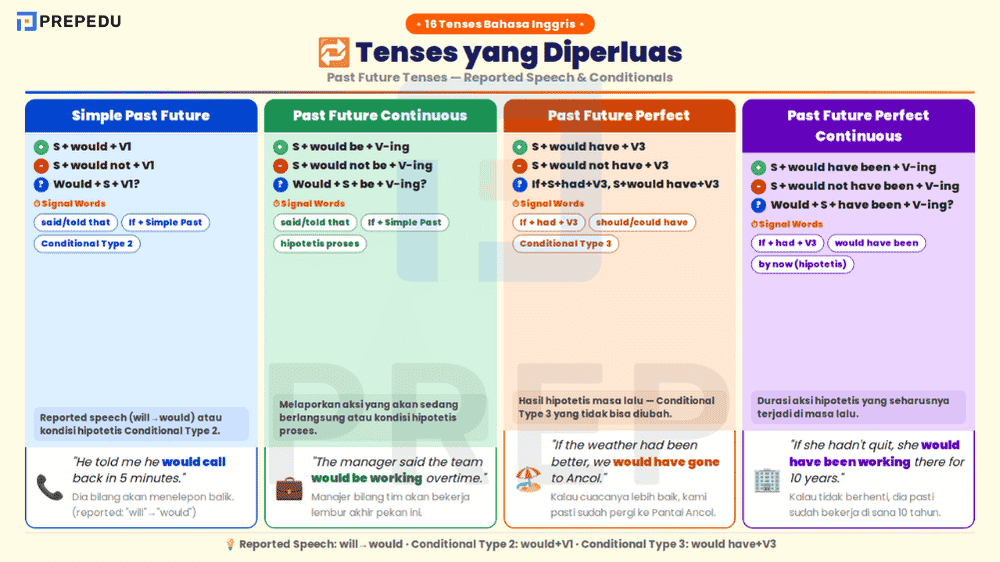
Setiap tenses menggunakan bentuk kata kerja yang berbeda, lihat contoh regular verb v1 v2 v3 ving dan artinya agar kamu tidak bingung saat menggunakannya.
IV. Cara Memilih Tenses Bahasa Inggris yang Tepat: 5 Pasang Tenses yang Paling Sering Tertukar
Dengan 16 tenses dalam bahasa Inggris, wajar jika beberapa di antaranya terasa tumpang tindih, terutama bagi pelajar yang baru memulai. Kuncinya adalah menguasai satu pertanyaan diagnostik per pasangan, sehingga pilihan tenses menjadi lebih sistematis.
1. Simple Present vs. Present Continuous: Kapan Aksi Adalah Fakta, Kapan Aksi Sedang Berlangsung
Pertanyaan diagnostik: Apakah ini aksi yang selalu terjadi (kebiasaan/fakta), atau hanya berlangsung saat ini (sementara)?
Simple Present untuk aksi permanen, kebiasaan, dan fakta. Present Continuous untuk aksi yang berlangsung tepat saat ini atau situasi sementara.
|
Simple Present (kebiasaan / fakta / jadwal) |
Present Continuous (sedang berlangsung / sementara) |
|
She teaches at a language school. (pekerjaan tetap) |
She is teaching an online class right now. (berlangsung sekarang) |
|
I usually take the MRT to work. (kebiasaan) |
Today I am taking a taxi because the MRT is full. (situasi sementara) |
|
He drinks coffee every morning. (rutinitas) |
He is drinking green tea today. (berbeda dari biasanya) |
|
The office opens at 8 AM. (jadwal tetap) |
The office is opening early today for the audit. (pengecualian) |
❌ I am working as a financial analyst. (jika dimaksud sebagai fakta permanen, harus Simple Present)
✅ I work as a financial analyst. (pekerjaan tetap = Simple Present)
2. Simple Past vs. Present Perfect: Mengapa "Sudah" Tidak Selalu Berarti Simple Past
Pertanyaan diagnostik: Apakah ada keterangan waktu spesifik (yesterday, last week, in 2022)? Jika ya → Simple Past. Apakah aksi masih relevan atau berdampak sekarang, atau waktunya tidak penting? → Present Perfect.
Ini adalah kebingungan paling umum bagi pelajar Indonesia, karena kata "sudah" digunakan untuk keduanya tanpa pembedaan gramatikal dalam bahasa Indonesia.
|
Simple Past (waktu spesifik disebutkan) |
Present Perfect (relevansi ke sekarang) |
|
I ate lunch at 12. (waktu: jam 12) |
I have eaten lunch. (masih kenyang, tidak perlu makan lagi) |
|
She submitted the report yesterday. |
She has just submitted the report. |
|
He worked at Bank BCA from 2015 to 2020. |
He has worked at Bank BCA for 5 years. (masih bekerja di sana) |
|
Did you see that movie? (kapan spesifik/implisit) |
Have you ever seen that movie? (pengalaman, waktu tidak penting) |
❌ I already ate. (salah: 'already' mengunci Present Perfect, bukan Simple Past)
✅ I have already eaten. (already = signal word Present Perfect)
3. Present Perfect vs. Present Perfect Continuous: Hasil Akhir vs. Durasi Proses
Pertanyaan diagnostik: Yang ingin saya tekankan: hasil atau pengalaman (Perfect), atau berapa lama proses itu berlangsung (Continuous)?
|
Present Perfect (hasil / pengalaman) |
Present Perfect Continuous (durasi / proses) |
|
Fokus: aksi SELESAI atau PERNAH dilakukan |
Fokus: aksi berlangsung SELAMA BERAPA LAMA |
|
I have written three reports today. (3 laporan sudah jadi) |
I have been writing reports since 9 AM. (masih menulis, menekankan lamanya) |
|
She has read the proposal. (sudah baca, selesai) |
She has been reading the proposal for 2 hours. (sedang membaca, belum tentu selesai) |
|
He has lived in Jakarta. (pengalaman pernah tinggal) |
He has been living in Jakarta for 5 years. (masih tinggal, sudah 5 tahun) |
4. Past Continuous vs. Simple Past: Aksi yang Bersamaan vs. Aksi yang Berurutan
Pertanyaan diagnostik: Apakah satu aksi berlangsung sementara aksi lain menginterupsi (Past Continuous + Simple Past), atau dua aksi terjadi berurutan satu setelah yang lain (Simple Past + Simple Past)?
Pola kunci:
Past Continuous + when + Simple Past = aksi yang sedang berlangsung, lalu diinterupsi.
Dua Simple Past = aksi A selesai, lalu aksi B terjadi.
❌ I cooked when she arrived. (artinya: saya selesai memasak lalu dia tiba, dua aksi berurutan)
✅ I was cooking when she arrived. (artinya: saya sedang memasak ketika dia tiba, berlangsung dan diinterupsi)
|
Contoh Kalimat |
Analisis |
|
While I was presenting to the client, my laptop ran out of battery. (Saat saya sedang presentasi ke klien, baterai laptop habis.) |
while + Past Continuous = berlangsung; Simple Past = menginterupsi |
|
She finished the call and then sent the follow-up email. (Dia menyelesaikan panggilan lalu mengirim email tindak lanjut.) |
dua Simple Past = dua aksi berurutan, tidak ada yang menginterupsi |
5. Simple Future (will) vs. Be Going To: Keputusan Spontan vs. Rencana yang Sudah Dipikirkan
Pertanyaan diagnostik: Apakah keputusan ini baru dibuat saat berbicara (will), atau sudah ada rencana atau bukti sebelumnya (be going to)?
|
will (keputusan spontan / prediksi umum) |
be going to (rencana pasti / prediksi berdasarkan bukti) |
|
Keputusan baru dibuat saat berbicara |
Rencana sudah diputuskan sebelum percakapan |
|
Prediksi tanpa bukti konkret |
Prediksi berdasarkan bukti yang terlihat sekarang |
|
"The phone is ringing." "I'll get it!" |
"I registered last week. I'm going to take the TOEIC." |
|
I think it will rain tomorrow. |
Look at those clouds! It's going to rain! |
❌ I'll attend the IELTS exam next month. I registered last week. (❌ rencana sudah ada sebelumnya, harus be going to)
✅ I'm going to attend the IELTS exam next month. I registered last week. (rencana sudah ada sebelumnya = be going to)
V. Cara Mudah Menghafal Rumus Tenses Bahasa Inggris Tanpa Hafalan Mati
Setelah bertahun-tahun mendampingi pelajar Indonesia mempersiapkan diri untuk TOEIC dan IELTS, satu pola yang selalu terulang adalah: pelajar yang mencoba menghafal 16 rumus tenses secara linier hampir selalu kehabisan energi di minggu ketiga. Mereka yang berhasil adalah mereka yang belajar dalam kelompok pola, bukan dalam urutan nomor. Ada 3 strategi yang terbukti jauh lebih efektif berdasarkan pengalaman mendampingi ratusan pelajar bahasa Inggris.
1. Belajar Berdasarkan Momen Waktu: Past – Present – Future
Kelompokkan 16 tenses ke dalam 4 momen waktu, lalu pelajari semua 4 aspeknya dalam satu momen sebelum berpindah ke momen berikutnya. Selesaikan satu "kolom waktu" hingga kamu bisa menulis semua 4 rumusnya tanpa melihat catatan.
|
Momen Waktu |
Simple |
Continuous |
Perfect + Perfect Continuous |
|
PRESENT |
V1(s/es) |
am/is/are + V-ing |
have/has + V3 have/has been + V-ing |
|
PAST |
V2 |
was/were + V-ing |
had + V3 had been + V-ing |
|
FUTURE |
will + V1 |
will be + V-ing |
will have + V3 will have been + V-ing |
|
PAST FUTURE |
would + V1 |
would be + V-ing |
would have + V3 would have been + V-ing |
Tips: Hafal baris PRESENT terlebih dahulu sampai otomatis. Baru pindah ke baris PAST. Polanya hampir sama, tinggal ganti auxiliary verb-nya.
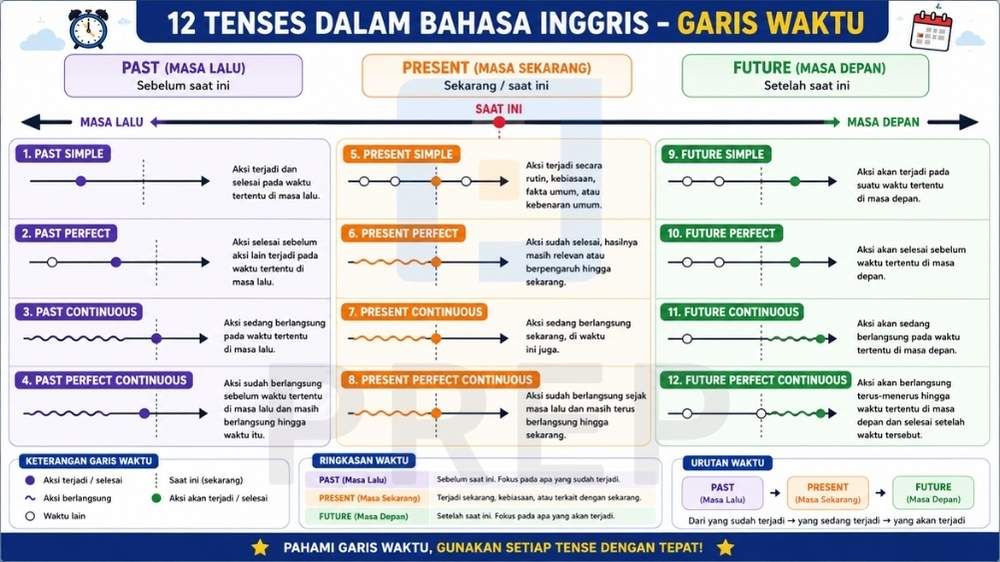
2. Belajar dalam Kelompok: Simple – Continuous – Perfect – Perfect Continuous
Pendekatan kedua: pelajari satu aspek di semua 4 waktu sekaligus. Misalnya, pelajari semua Continuous tenses bersama karena pola auxiliary verb-nya konsisten:
-
Semua Continuous: be + V-ing (am/is/are, was/were, will be, would be)
-
Semua Perfect: have/has/had + V3 (have/has, had, will have, would have)
-
Semua Perfect Continuous: have/has/had been + V-ing
Keuntungan: kamu hanya perlu menghafal 4 pola utama, bukan 16 rumus yang berbeda-beda. Ubah auxiliary verb-nya saja untuk berpindah momen waktu.
3. Hafal Tanda Pengenal Khas Setiap Tenses dengan Teknik Signal Words
Signal words adalah cara tercepat memilih tenses yang tepat dalam soal ujian. Dalam TOEIC Part 5 dan TOEIC Part 6, identifikasi signal word terlebih dahulu sebelum membaca pilihan jawaban.
|
Signal Word |
Tenses yang Dikunci |
Contoh |
|
yesterday / last week / ago / in 2022 |
Simple Past |
She left yesterday. |
|
now / right now / at the moment |
Present Continuous |
He is working now. |
|
always / usually / every day |
Simple Present |
I always take the MRT. |
|
already / just / yet / ever / never |
Present Perfect |
I have already eaten. |
|
since / for (+ durasi) |
Present Perfect atau Perf. Continuous |
She has been here for 5 years. |
|
when + Past (menginterupsi) |
Past Continuous + Simple Past |
I was reading when she called. |
|
by [waktu masa depan] |
Future Perfect |
By Friday, it will have ended. |
|
at this time tomorrow / when you arrive |
Future Continuous |
I will be sleeping then. |
|
if + had + V3 |
Past Future Perfect |
I would have gone if invited. |
|
said / told + that |
Simple Past Future (would) |
He said he would help. |
VI. Latihan Soal 16 Tenses dalam Bahasa Inggris dengan Kunci Jawaban
Cara paling efektif untuk menguasai 16 tenses dalam bahasa Inggris bukan membaca ulang rumusnya, melainkan melatih penggunaannya dalam kalimat nyata. Setiap latihan di bawah ini terdiri dari 10 soal isian dengan kunci jawaban untuk evaluasi mandiri.
Petunjuk: Isi bagian yang kosong dengan bentuk kata kerja yang tepat dari kata kerja dalam kurung.
1. Latihan Soal Simple Present Tense
1. She _____ (work) at a bank in Sudirman, Jakarta.
2. My father _____ (not / eat) rice for breakfast every day.
3. _____ your brother _____ (study) at Universitas Indonesia?
4. The sun _____ (rise) in the east.
5. Dika always _____ (take) the TransJakarta to the office.
6. _____ it _____ (rain) a lot in Jakarta in December?
7. Putri _____ (not / like) spicy food.
8. The employees _____ (start) work at 8 AM every Monday.
9. _____ your manager _____ (speak) English fluently?
10. The train to Bandung _____ (depart) at 07.30 every morning.
Kunci Jawaban:
|
1. works |
2. doesn't eat |
|
3. Does ... study? |
4. rises |
|
5. takes |
6. Does ... rain? |
|
7. doesn't like |
8. start |
|
9. Does ... speak? |
10. departs |
2. Latihan Soal Present Continuous Tense
1. She _____ (study) for her TOEIC exam right now.
2. They _____ (not / work) at the moment. It's a holiday.
3. _____ Dika _____ (use) the laptop now?
4. Listen! Someone _____ (knock) on the door.
5. We _____ (plan) a team trip to Bali next month.
6. The team _____ (not / prepare) for the presentation yet.
7. _____ the manager _____ (attend) the meeting right now?
8. I _____ (currently / read) a book about business English.
9. Rini _____ (teach) at the language center this semester.
10. The students _____ (wait) for the teacher outside the classroom.
Kunci Jawaban:
|
1. is studying |
2. aren't working |
|
3. Is ... using? |
4. is knocking |
|
5. are planning |
6. isn't preparing |
|
7. Is ... attending? |
8. am currently reading |
|
9. is teaching |
10. are waiting |
3. Latihan Soal Present Perfect Tense
1. She _____ (finish) her report just now.
2. Budi _____ never _____ (visit) Singapore before.
3. Have you ever _____ (eat) sate Madura?
4. I _____ (live) in Jakarta for 5 years.
5. The team _____ already _____ (complete) the project.
6. _____ the manager _____ (approve) the proposal yet?
7. She _____ just _____ (send) the email.
8. We _____ (work) at this company since 2020.
9. He _____ never _____ (be) to Lombok.
10. _____ you _____ (submit) your application form?
Kunci Jawaban:
|
1. has finished |
2. has never visited |
|
3. eaten |
4. have lived |
|
5. has already completed |
6. Has ... approved? |
|
7. has just sent |
8. have worked |
|
9. has never been |
10. Have ... submitted? |
4. Latihan Soal Present Perfect Continuous Tense
1. She _____ (study) English for 3 years.
2. Adi _____ (work) on this report since this morning.
3. How long _____ you _____ (wait) here?
4. They _____ (discuss) the project for 2 hours now.
5. I _____ (not / feel) well lately.
6. _____ the team _____ (practice) for the presentation all week?
7. Reni _____ (learn) to drive for 6 months.
8. The company _____ (expand) its business since 2022.
9. She _____ (not / sleep) well for several days.
10. We _____ (try) to contact the client for days.
Kunci Jawaban:
|
1. has been studying |
2. has been working |
|
3. have ... been waiting? |
4. have been discussing |
|
5. haven't been feeling |
6. Has ... been practicing? |
|
7. has been learning |
8. has been expanding |
|
9. hasn't been sleeping |
10. have been trying |
5. Latihan Soal Simple Past Tense
1. Dika _____ (go) to Surabaya last week.
2. She _____ (not / attend) the seminar yesterday.
3. _____ you _____ (meet) the client on Monday?
4. They _____ (sign) the contract in 2022.
5. I _____ (wake up) late this morning.
6. _____ the manager _____ (approve) your request?
7. Rina _____ (send) the report yesterday afternoon.
8. We _____ (not / know) about the problem until Tuesday.
9. The team _____ (win) the regional competition last year.
10. He _____ (study) in Bandung for 4 years.
Kunci Jawaban:
|
1. went |
2. didn't attend |
|
3. Did ... meet? |
4. signed |
|
5. woke up |
6. Did ... approve? |
|
7. sent |
8. didn't know |
|
9. won |
10. studied |
6. Latihan Soal Past Continuous Tense
1. She _____ (read) when I called her.
2. What _____ you _____ (do) at 8 PM last night?
3. The team _____ (have) a meeting when the power went out.
4. I _____ (walk) to the office when it started raining.
5. While Rini _____ (cook), her phone rang.
6. They _____ (not / work) when the manager arrived.
7. _____ Adi _____ (study) all evening yesterday?
8. She _____ (sleep) when the earthquake happened.
9. We _____ (drive) to Bandung when the tire went flat.
10. The children _____ (play) in the yard at that time.
Kunci Jawaban:
|
1. was reading |
2. were ... doing? |
|
3. was having |
4. was walking |
|
5. was cooking |
6. weren't working |
|
7. Was ... studying? |
8. was sleeping |
|
9. were driving |
10. were playing |
7. Latihan Soal Past Perfect Tense
1. By the time I arrived, the meeting _____ already _____ (end).
2. She _____ (finish) her work before she left the office.
3. He _____ never _____ (try) soto Betawi before that day.
4. When Dika called, I _____ already _____ (leave) the office.
5. _____ they _____ (discuss) this before the meeting started?
6. The students _____ (not / submit) their assignments before the deadline.
7. She _____ (wait) for 2 hours before the doctor arrived.
8. We _____ (prepare) everything before the guests arrived.
9. _____ you _____ (eat) before the presentation?
10. The train _____ already _____ (depart) when she reached the station.
Kunci Jawaban:
|
1. had already ended |
2. had finished |
|
3. had never tried |
4. had already left |
|
5. Had ... discussed? |
6. hadn't submitted |
|
7. had waited |
8. had prepared |
|
9. Had ... eaten? |
10. had already departed |
8. Latihan Soal Past Perfect Continuous Tense
1. She _____ (study) for hours before she finally passed out.
2. I _____ (work) for 10 hours straight before they let me go home.
3. How long _____ he _____ (wait) before the doctor arrived?
4. We _____ (travel) for 8 hours when we finally reached the hotel.
5. The team _____ (practice) for weeks before the competition.
6. She _____ (not / sleep) well before she got sick.
7. _____ they _____ (argue) long before the manager intervened?
8. Dika _____ (teach) at that school for 5 years when he resigned.
9. The company _____ (lose) money for months before the new CEO arrived.
10. She _____ (look for) a job for a year before she finally found one.
Kunci Jawaban:
|
1. had been studying |
2. had been working |
|
3. had he been waiting? |
4. had been traveling |
|
5. had been practicing |
6. hadn't been sleeping |
|
7. Had ... been arguing? |
8. had been teaching |
|
9. had been losing |
10. had been looking for |
9. Latihan Soal Simple Future Tense
1. She _____ (attend) the IELTS seminar next Saturday.
2. I think it _____ (rain) heavily tomorrow evening.
3. _____ you _____ (help) me finish this report?
4. Dika _____ not _____ (be) at the office on Monday.
5. We _____ (have) a team evaluation meeting next Friday.
6. _____ she _____ (submit) the application before the deadline?
7. I promise I _____ (not / be) late to the next meeting.
8. The new branch office in Surabaya _____ (open) next month.
9. _____ they _____ (announce) the results this afternoon?
10. He _____ (probably / call) you this afternoon about the contract.
Kunci Jawaban:
|
1. will attend |
2. will rain |
|
3. Will ... help? |
4. will not be |
|
5. will have |
6. Will ... submit? |
|
7. will not be |
8. will open |
|
9. Will ... announce? |
10. will probably call |
10. Latihan Soal Future Continuous Tense
1. At 9 AM tomorrow, she _____ (present) to the board of directors.
2. I _____ (travel) to Bali this time next week.
3. _____ you _____ (work) late again tonight?
4. They _____ (wait) for us when we arrive at the airport.
5. She _____ (not / study) at 10 PM. She'll be asleep by then.
6. At this time tomorrow, the team _____ (discuss) the new quarterly targets.
7. _____ he _____ (use) the meeting room at 3 PM?
8. I _____ (have) lunch with a client when you arrive at noon.
9. The staff _____ (still / work) when the manager leaves at 6 PM.
10. She _____ (take) the TOEIC test next Saturday morning.
Kunci Jawaban:
|
1. will be presenting |
2. will be traveling |
|
3. Will ... be working? |
4. will be waiting |
|
5. won't be studying |
6. will be discussing |
|
7. Will ... be using? |
8. will be having |
|
9. will still be working |
10. will be taking |
11. Latihan Soal Future Perfect Tense
1. By Friday, she _____ (finish) the entire project.
2. I _____ (complete) my IELTS preparation by the end of this month.
3. By the time you arrive, we _____ (eat) dinner.
4. _____ they _____ (sign) the new contract by Monday?
5. She _____ not _____ (submit) her thesis by tomorrow morning.
6. By next year, he _____ (work) here for exactly 10 years.
7. By the time the meeting starts, I _____ (read) all the background documents.
8. _____ the team _____ (complete) the training program by Thursday?
9. She _____ (save) enough money to study abroad by graduation day.
10. By 2028, the new MRT line _____ (be) completed.
Kunci Jawaban:
|
1. will have finished |
2. will have completed |
|
3. will have eaten |
4. Will ... have signed? |
|
5. will not have submitted |
6. will have worked |
|
7. will have read |
8. Will ... have completed? |
|
9. will have saved |
10. will have been |
12. Latihan Soal Future Perfect Continuous Tense
1. By next December, she _____ (study) here for 3 years.
2. By the time I retire, I _____ (teach) English for 30 years.
3. _____ they _____ (work) on this project for 6 months by the deadline?
4. By 2025, he _____ (live) in Jakarta for a full decade.
5. By the time the guests arrive, the chef _____ (cook) for 4 hours.
6. She _____ (practice) her presentation for 2 weeks by the time the big day comes.
7. _____ you _____ (wait) for more than an hour by the time she arrives?
8. By next week, I _____ (not / sleep) well for 10 days.
9. By the time the semester ends, students _____ (learn) all 16 tenses.
10. He _____ (drive) for 8 hours straight by the time they reach Surabaya.
Kunci Jawaban:
|
1. will have been studying |
2. will have been teaching |
|
3. Will ... have been working? |
4. will have been living |
|
5. will have been cooking |
6. will have been practicing |
|
7. Will ... have been waiting? |
8. won't have been sleeping |
|
9. will have been learning |
10. will have been driving |
13. Latihan Soal Simple Past Future Tense
1. He told me he _____ (call) me back the next day.
2. She promised she _____ (come) to the meeting.
3. They said they _____ (not / be) late.
4. _____ you _____ (help) me if I asked you?
5. He said he _____ (finish) the report by Monday morning.
6. If I had more time, I _____ (study) harder.
7. She told her manager she _____ (not / resign) before the project ended.
8. I knew she _____ (pass) the TOEIC exam easily.
9. _____ he _____ (come) if you invited him personally?
10. They announced they _____ (launch) the product in Q3.
Kunci Jawaban:
|
1. would call |
2. would come |
|
3. wouldn't be |
4. Would ... help? |
|
5. would finish |
6. would study |
|
7. wouldn't resign |
8. would pass |
|
9. Would ... come? |
10. would launch |
14. Latihan Soal Past Future Continuous Tense
1. She said she _____ (wait) for us at the Blok M cafe.
2. He told us he _____ (work) all day Saturday.
3. They said they _____ (not / use) the meeting room at that time.
4. _____ she _____ (practice) when we arrived?
5. I knew the team _____ (prepare) for the investor presentation.
6. He told me he _____ (travel) to Surabaya the following Monday.
7. She said she _____ (not / attend) the company event at that hour.
8. We knew they _____ (wait) when we finally arrived.
9. _____ he _____ (study) at midnight as usual?
10. The manager said the new hires _____ (work) overtime that week.
Kunci Jawaban:
|
1. would be waiting |
2. would be working |
|
3. wouldn't be using |
4. Would ... be practicing? |
|
5. would be preparing |
6. would be traveling |
|
7. wouldn't be attending |
8. would be waiting |
|
9. Would ... be studying? |
10. would be working |
15. Latihan Soal Past Future Perfect Tense
1. If I had studied harder, I _____ (pass) the TOEIC.
2. She _____ (finish) the report earlier if she had started on time.
3. He _____ (not / make) that mistake if he had been more careful.
4. If they had asked me, I _____ (help) them with the presentation.
5. _____ you _____ (attend) if you had known about the event?
6. She told me she _____ (call) me if she had known my number.
7. If the weather had been better, we _____ (go) to Pantai Ancol.
8. He _____ (get) the promotion if he had worked harder that quarter.
9. _____ she _____ (accept) the offer if the salary had been higher?
10. If I had left home earlier, I _____ (not / miss) the KRL.
Kunci Jawaban:
|
1. would have passed |
2. would have finished |
|
3. wouldn't have made |
4. would have helped |
|
5. Would ... have attended? |
6. would have called |
|
7. would have gone |
8. would have gotten |
|
9. Would ... have accepted? |
10. wouldn't have missed |
16. Latihan Soal Past Future Perfect Continuous Tense
1. If she hadn't quit, she _____ (work) there for 10 years by now.
2. He _____ (study) for 3 hours by now if he had started earlier.
3. If the project hadn't been cancelled, we _____ (work) on it for months.
4. She _____ (wait) for over an hour if they hadn't called to cancel.
5. If I hadn't taken a break, I _____ (drive) for 6 hours straight.
6. He _____ (not / work) that long if the deadline hadn't been moved.
7. _____ they _____ (discuss) this for days if the manager hadn't made a decision?
8. She _____ (teach) here for 5 years if she hadn't moved to Singapore.
9. If the contract hadn't been signed late, we _____ (negotiate) for months.
10. If he had taken the job in Jakarta, he _____ (live) there for years by now.
Kunci Jawaban:
|
1. would have been working |
2. would have been studying |
|
3. would have been working |
4. would have been waiting |
|
5. would have been driving |
6. wouldn't have been working |
|
7. Would ... have been discussing? |
8. would have been teaching |
|
9. would have been negotiating |
10. would have been living |
VII. Pertanyaan Umum tentang Tenses dalam Bahasa Inggris
Berikut adalah jawaban atas empat pertanyaan yang paling sering diajukan pelajar Indonesia ketika mulai mempelajari tenses dalam bahasa Inggris.
1. Apakah semua 16 tenses digunakan dalam percakapan sehari-hari?
Tidak. Dalam percakapan sehari-hari, hanya 5 hingga 6 tenses yang sering digunakan: Simple Present, Simple Past, Present Continuous, Present Perfect, Simple Future, dan kadang Past Continuous.
Tenses yang lebih kompleks seperti Future Perfect Continuous, Past Future Perfect, dan Past Future Perfect Continuous lebih umum ditemukan dalam tulisan akademik, laporan formal, dan soal ujian TOEIC / IELTS, bukan dalam percakapan spontan.
2. Tenses apa saja yang paling sering diuji di TOEIC dan IELTS?
Ada 5 tenses yang mendominasi soal TOEIC Part 5 hingga Part 6 dan IELTS Writing: Simple Present, Simple Past, Present Perfect, Present Continuous, dan Simple Future.
Simple Present dan Simple Past mencakup lebih dari separuh soal grammar TOEIC. Present Perfect adalah sumber kesalahan paling umum karena sering disamakan dengan Simple Past. Untuk IELTS Writing Task 1, Simple Past dan Present Perfect dibutuhkan untuk mendeskripsikan tren historis, sementara IELTS Writing Task 2 membutuhkan Simple Present, Present Perfect, dan Conditional.
Strategi: Kuasai kelima tenses ini terlebih dahulu hingga penggunaannya otomatis, kemudian perluas ke tenses yang muncul lebih jarang, seperti Past Continuous dan Future Perfect.
Kesimpulan
Menguasai tenses dalam bahasa Inggris bukan tentang menghafal 16 rumus sekaligus, melainkan tentang memahami sistem 4 waktu dan 4 aspek yang bekerja secara konsisten.
Mulailah dari 5 tenses prioritas, gunakan signal words sebagai panduan, dan latih dengan soal nyata. Semua alat yang kamu butuhkan sudah ada dalam artikel ini.
Untuk belajar lebih terstruktur dengan panduan AI yang personal, kunjungi Prep Edu di prepedu.com/id. Make It Happen.

Halo! Nama saya Sari, saat ini saya bekerja sebagai Manajer Konten Produk di blog situs web prepedu.com.
Dengan pengalaman lebih dari 5 tahun dalam belajar mandiri bahasa asing seperti bahasa Inggris dan Mandarin serta mempersiapkan ujian IELTS dan TOEIC, saya telah mengumpulkan banyak pengetahuan untuk mendukung ribuan orang yang menghadapi kesulitan dalam belajar bahasa asing.
Semoga apa yang saya bagikan dapat membantu proses belajar mandiri di rumah secara efektif bagi semua orang!
Komentar


Peta pembelajaran yang dipersonalisasi




Paling banyak dibaca




UEN: 202227322W
Alamat: Galeon Square 8th Floor Jalan M.H. Thamrin No. 10 Jakarta Pusat 10230 Indonesia
Nomor Hotline : +65 3129 31111
Nomor WhatsApp Hotline : +62 822 9993 9692 / +62 815 307 7737 (For Business)
Email: halo@prepedu.com / partner.id@prepedu.com (for business)