IELTS Writing Test Format: A Complete Guide for You
This guide provides a clear overview of the IELTS Writing test format for both Academic and General Training modules. You will learn how each task is structured, how examiners assess your writing, and the strategies needed to approach every question type effectively and confidently.
I. Overview of the IELTS Writing test structure
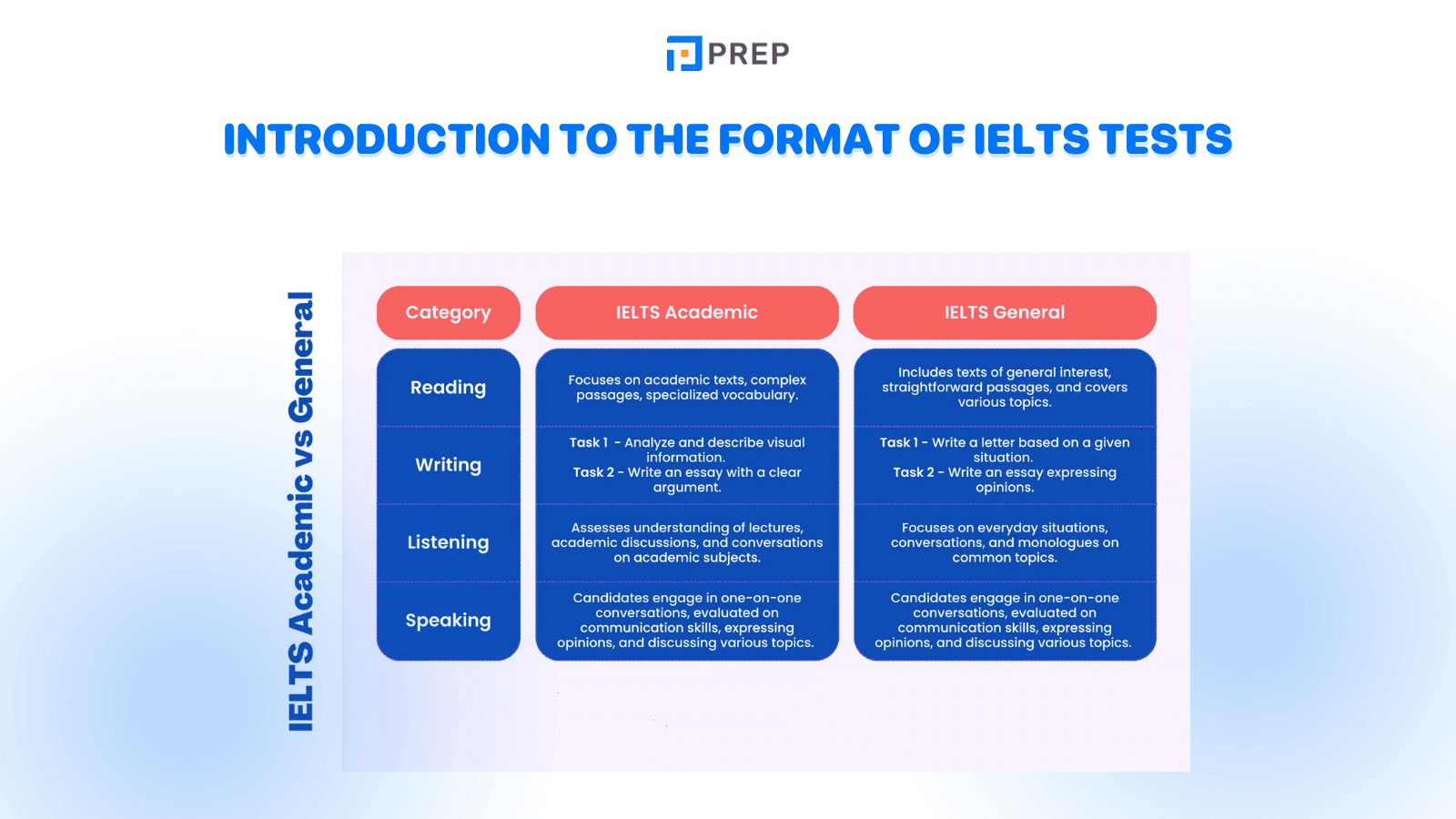
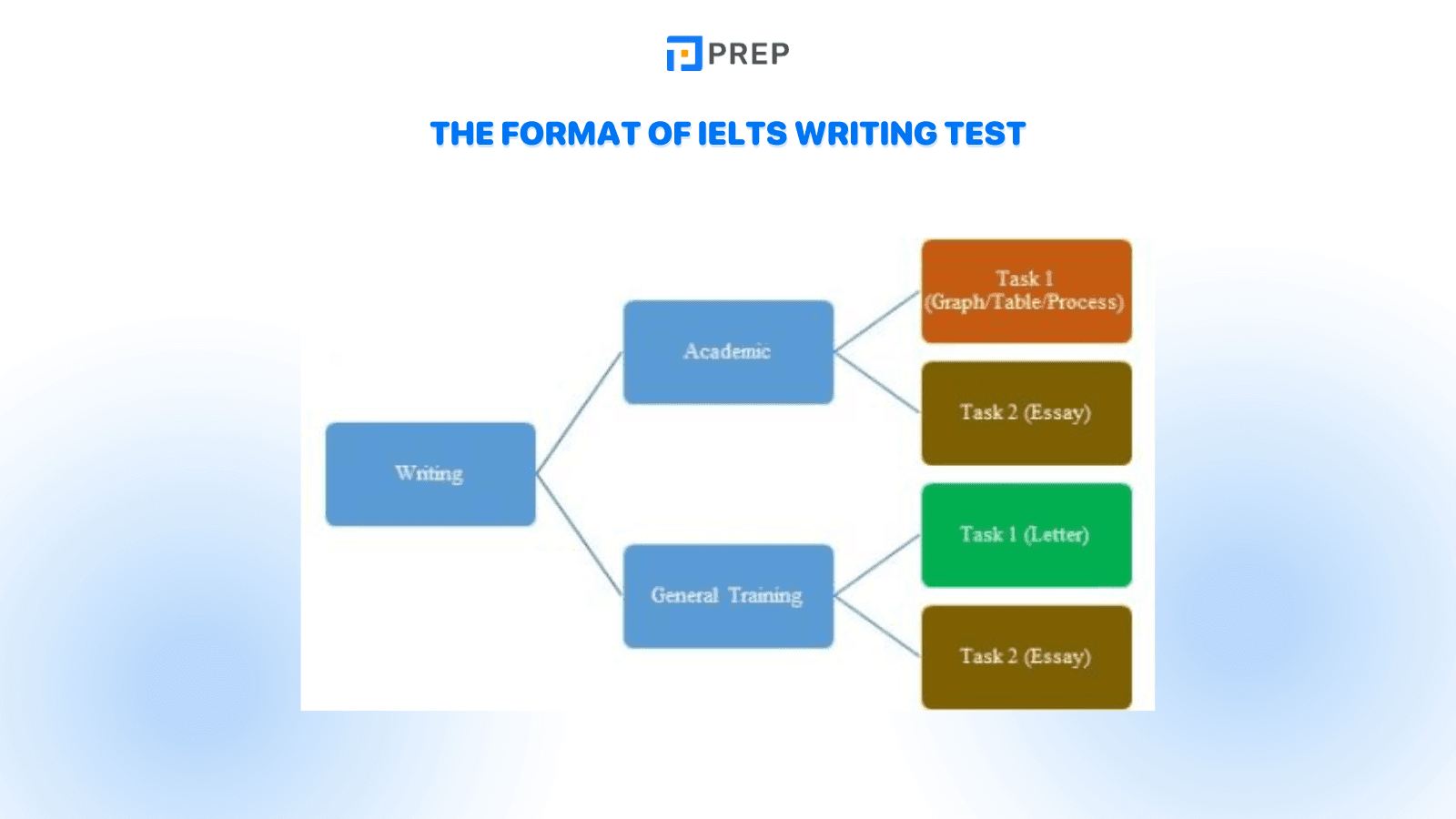
The IELTS Writing test is designed to assess how well you can express your ideas in written English within a set time and under a formal test environment. The test lasts for 60 minutes and consists of two separate tasks. Both Academic and General Training modules share the same structure, but the task types and writing style required differ significantly between the two formats.
Candidates must complete:
-
Task 1: A shorter piece of writing (minimum 150 words), based on either visual information (Academic) or a practical/email-style scenario (General Training).
-
Task 2: A longer, discursive essay (minimum 250 words), where you respond to a question or issue by presenting arguments, giving opinions, or discussing causes and solutions.
Key Differences Between Academic and General Writing
|
Feature |
Academic Module |
General Training Module |
|
Task 1 |
Describe visual data such as charts, graphs, tables, maps, or processes |
Write a letter that may be formal, semi-formal, or informal |
|
Task 2 |
Write an academic-style essay with a neutral or formal tone |
Write an essay that is less academic but still organized and well-supported |
Despite structural similarities, the tone, vocabulary, and communicative purpose differ. Academic writing requires a more formal register and data analysis, while General Training focuses on real-life communication skills.
Having a clear understanding of the test format is the first step toward developing an effective writing strategy. In the following sections, we’ll break down the Academic and General formats in more detail and show you how to tailor your approach to each.
1. IELTS Academic Writing Test Format
The Academic Writing test in IELTS is designed to evaluate your ability to present, organize, and support ideas using formal written English. It consists of two tasks that must be completed within 60 minutes, and it is mandatory for those applying to universities, graduate programs, or professional registrations in English-speaking countries.
Task 1 – Describe Visual Data (Minimum 150 Words)
In Task 1 of the Academic module, you are required to write a factual report based on visual information. This might include:
-
Line graphs, bar charts, or pie charts
-
Tables
-
Maps (comparing locations or changes over time)
-
Processes (describing a sequence of stages or a manufacturing procedure)
What you need to do:
-
Provide an objective summary—not personal opinions
-
Highlight key trends, comparisons, or significant changes
-
Organize your response into logical paragraphs: Introduction, Overview, Key Features
-
Avoid listing every detail; focus on grouping information meaningfully
Recommended time: ~20 minutes
This is a core requirement when writing an effective IELTS writing task 1 overview in the Academic module.
Task 2 – Write an Academic Essay (Minimum 250 Words)
Task 2 is more heavily weighted and requires you to write a formal, argumentative essay based on a problem, question, or point of view. This section is similar to university-level writing tasks and assesses your critical thinking and writing skills.
Common prompt types:
-
Agree/disagree
-
Discuss both views and give your opinion
-
Problem/solution
-
Advantages/disadvantages
-
Two-part questions
Key expectations:
-
Write in a formal register
-
Present a clear position throughout the essay
-
Support your ideas with explanations and relevant examples
-
Use a clear structure: Introduction – Body Paragraphs – Conclusion
Recommended time: ~40 minutes
Understanding these IELTS Writing Task 2 question types helps candidates choose the correct structure and argument strategy.
2. IELTS General Training Writing Test Format
The IELTS General Training Writing test is designed to assess your ability to communicate effectively in everyday written English. It is typically required for people who wish to work, migrate, or undertake non-academic training in English-speaking countries. Like the Academic module, the test includes two tasks to be completed in 60 minutes, but the types of writing and tone of response are different.
Task 1 – Write a Letter (Minimum 150 Words)
In Task 1, you are asked to write a letter in response to a given situation. This task tests your ability to organize information clearly, use appropriate tone and register, and express needs, opinions, or concerns in a structured letter format.
Types of letters you may be asked to write:
-
Formal – to someone you don’t know personally (e.g., job application, complaint to a company)
-
Semi-formal – to someone you know in a professional context (e.g., colleague, boss)
-
Informal – to a friend or family member
Your letter should include:
-
A clear greeting (Dear Sir/Madam, Dear John, etc.)
-
A brief introduction stating your reason for writing
-
Body paragraphs with supporting details
-
A suitable closing (Yours sincerely, Best regards, etc.)
Recommended time: ~20 minutes
Task 2 – Write an Essay (Minimum 250 Words)
Task 2 in the General Training module is structurally similar to that in the Academic test, but with less formal content and language. You will be asked to present an argument, give your opinion, or discuss a social issue relevant to daily life or work.
Possible topics include:
-
Job satisfaction
-
Work-life balance
-
Education systems
-
Community leadership
-
Environmental concerns
Expectations:
-
Organized essay with a clear position
-
Use of real-life examples and experiences to support points
-
Language may be slightly less academic but must still be formal and grammatically accurate
Recommended time: ~40 minutes
II. How Examiners Assess the IELTS Writing Test
To perform well in the IELTS Writing test, it’s not enough to simply write in English — you must write according to specific assessment criteria established by Cambridge English. Both Task 1 and Task 2 are evaluated independently but against the same four band descriptors. Understanding how examiners assess your writing allows you to write with focus and intentionality.
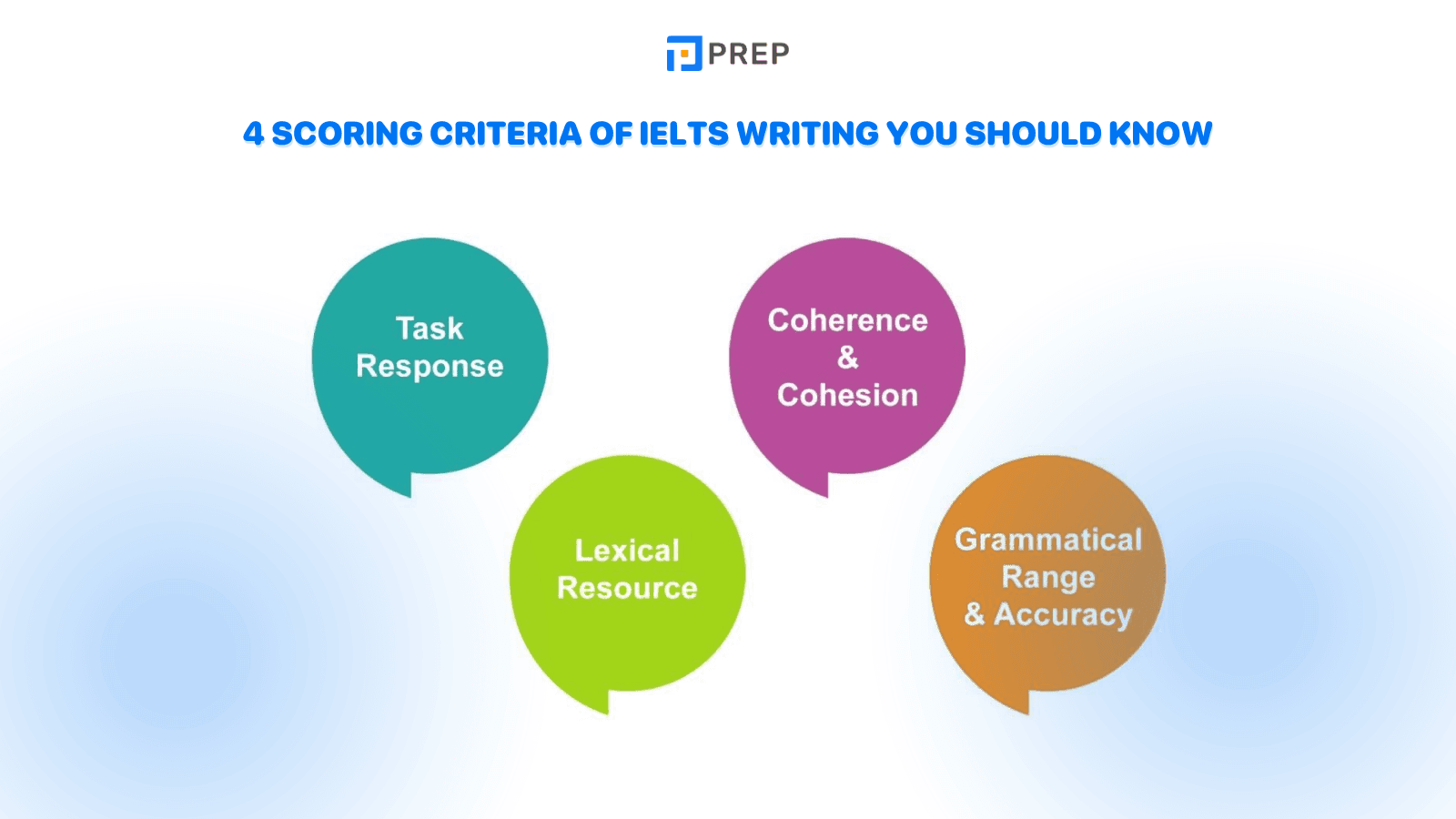
Each IELTS Writing task is scored based on the following four equally weighted criteria:
1. Task Achievement (Task 1) / Task Response (Task 2)
This criterion evaluates how well you answer the question:
-
Do you cover all parts of the task?
-
Are the ideas relevant and clearly presented?
-
In Task 2, have you offered a position and developed it effectively with examples and support?
-
In Task 1, have you provided an overview (Academic) or fulfilled the purpose of the letter (General)?
Common mistakes:
-
Not answering all parts of the question
-
Going off-topic
-
Writing an opinion when it isn’t required
2. Coherence and Cohesion
This relates to the organization and logical flow of your writing:
-
Are paragraphs well-structured and clearly separated?
-
Do ideas follow a logical order?
-
Are you using effective cohesive devices (e.g. linking words, referencing) without overuse?
What examiners look for:
-
Clear progression of ideas
-
Appropriate use of paragraphs
-
Smooth connections between sentences
3. Lexical Resource (Vocabulary)
This measures the range and accuracy of your vocabulary:
-
Do you use precise and varied word choices?
-
Are your collocations natural and topic-appropriate?
-
Can you paraphrase effectively without repeating the same words?
To score high:
-
Avoid repetition and basic vocabulary
-
Use topic-specific expressions and phrases
-
Check spelling and word form accuracy
4. Grammatical Range and Accuracy
Examiners assess your ability to use a variety of grammatical structures correctly:
-
Do you use both simple and complex sentence forms?
-
Are your sentences accurate and appropriately punctuated?
-
Is grammar used flexibly to support meaning?
Advice for improvement:
-
Don’t force complexity—clarity is more important
-
Pay attention to verb tenses, subject–verb agreement, and article use
-
Practice combining simple sentences into more complex ones naturally
In addition to checking what you write, examiners consider how well your writing fits the expected format:
-
For Task 1 Academic: a clear overview, no opinions, grouped data analysis
-
For Task 1 General Training: correct tone and purpose (formal/informal), structure of letters
-
For Task 2 (Both modules): structured essay, balanced argument, clear conclusion
By mastering the format of each task and aligning your writing with these four core scoring criteria, you set a strong foundation for Band 7 and above. In the next section, we’ll look at how to approach the format practically through planning, structure, and topic awareness.
These principles closely match the Formula for IELTS Writing Band 7, which emphasizes structure, clarity, and development.
III. How to Approach the IELTS Writing Test Format Effectively
Mastering the IELTS Writing test goes beyond knowing the structure — it involves learning how to plan, write, and refine your responses according to the specific format and expectations of each task. Whether you are preparing for the Academic or General Training module, a strategic approach to the format will help you save time, avoid common pitfalls, and meet examiner expectations.
Identify the Question Type Accurately
Each task in the IELTS Writing test carries a specific purpose and structure. Recognizing the type of question you’re facing is the first step to writing a relevant and well-targeted response.
In Task 1:
-
For Academic, ask yourself: Is this a chart, graph, map, or process?
-
For General Training, determine the purpose and tone: Is it a complaint, request, or apology? Formal or informal?
In Task 2:
-
Identify the essay type: Opinion, Discussion, Advantages/Disadvantages, Problem–Solution, or Two-part question.
-
Highlight key instruction words such as discuss, to what extent, or give your opinion.
Failing to identify the task type correctly often results in writing off-topic or in the wrong format — both of which are heavily penalized.
Structure Your Response Based on the Task Format
Once you understand the type of task, follow a clear and logical structure suited to that task.
Task 1 Academic – Suggested Structure:
-
Introduction (paraphrase the question)
-
Overview (describe main trends or changes)
-
Body Paragraphs (supporting data and comparisons)
Task 1 General Training – Suggested Structure:
-
Salutation (Dear Sir/Madam...)
-
Introduction (state the purpose of the letter)
-
Body (two to three short paragraphs for details)
-
Closing (sign-off)
Task 2 Essay – Suggested Structure:
-
Introduction (paraphrase + thesis)
-
Body Paragraph 1 (main idea + support + example)
-
Body Paragraph 2 (main idea + support + example)
-
Optional Body 3 or Counterpoint (if needed)
-
Conclusion (summary + opinion/final thought)
Keep transitions smooth and avoid mixing tones (especially in letters). Organizing your writing according to the correct format helps boost your Coherence & Cohesion score.
Use Writing Strategies That Match the Format
To work efficiently within the IELTS format, apply techniques that are format-aware and help maximize your performance:
-
Planning (3–5 mins): Outline your main ideas and examples before you start writing. This prevents repetition and maintains focus.
-
Time Allocation: Stick to ~20 minutes for Task 1 and ~40 minutes for Task 2 — this reflects their weight in scoring.
-
Paragraphing Strategy: One idea per paragraph, and each paragraph must connect to the task requirements.
-
Language register: Use formal language in essays and letters (unless the letter is informal).
By aligning your writing process with the IELTS test format — recognizing question types, applying task-specific structures, and using time wisely — you ensure each part of your response meets the exam’s scoring expectations. With consistency and practice, this approach will help improve your clarity, accuracy, and overall writing band score.
Following a format-aware strategy like this will help learners improve IELTS Writing and Reading skills over time.
IV. Master IELTS Skills for a High Band Score
These are helpful insights from PREP regarding the IELTS writing test format and important points to consider during the test to achieve a high band score. If your goal is to achieve a Band 7 or higher, these IELTS resources below are for you:
-
IELTS online course: Score Big in IELTS With Our Expert Tips!

Hi I'm Chloe, and I am currently serving as an Product Content Administrator at Prep Education. With over five years of experience in independent online IELTS study and exam preparation, I am confident in my ability to support learners in achieving their highest possible scores.
Comment
Premium content
View all


Personalized roadmap


Most read



UEN: 202227322W
Address: 114 LAVENDER STREET, #11-83 CT HUB 2, SINGAPORE (338729)