Take Out in English: Meaning, Grammar, and Usage
Take out is a common phrasal verb in English, but its meaning changes depending on context. This guide explains the main meanings of take out, essential grammar rules, useful synonyms, and other phrasal verbs with take, helping learners use the expression accurately and naturally in daily communication.
I. What Does “Take Out” Mean in English?
The phrase “take out” is a commonly used phrasal verb in English with multiple meanings, depending heavily on context. Its flexibility makes it widely used in both everyday communication and informal writing, particularly in American English.
You can strengthen this through improve vocabulary and pronunciation in english through reading.
Unlike single-word verbs that often have a fixed meaning, “take out” can mean several different things based on who is speaking, what is being described, and the surrounding situation. Understanding its various definitions — and being able to recognize them in context — is key to fluent and natural use.
|
Context |
Meaning |
Example Sentence |
|
Food-related |
To buy food from a restaurant to eat elsewhere |
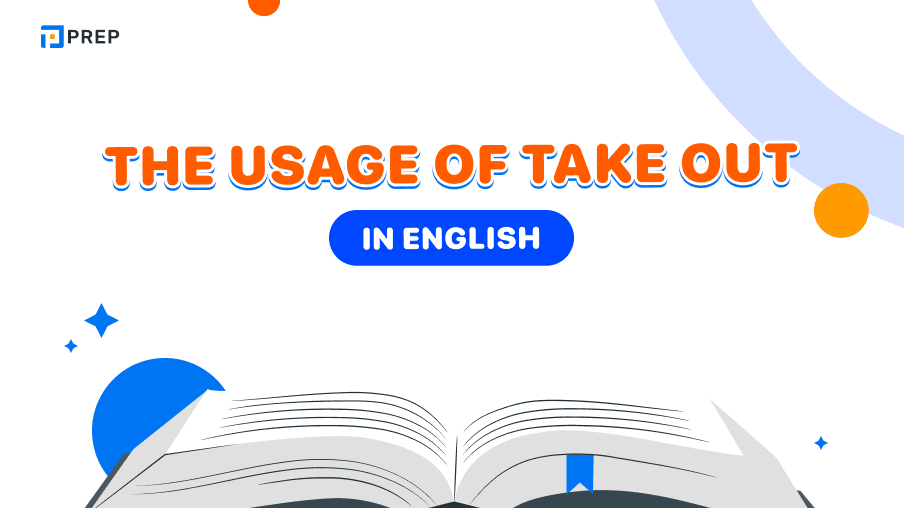
We decided to take out pizza for dinner instead of cooking. |
|
Remove or extract |
To remove something from a place or container |
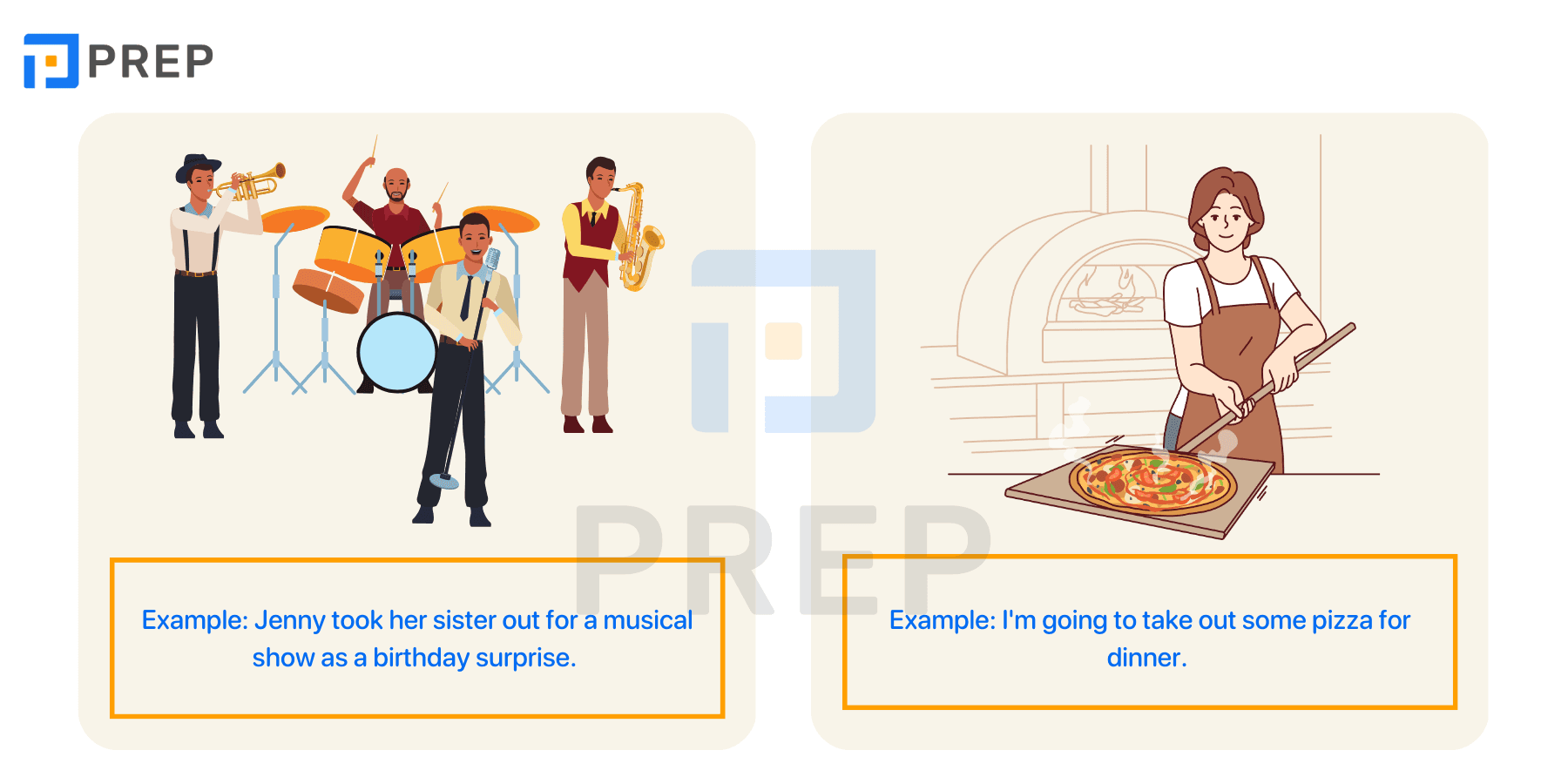
She took out her phone and started texting. |
|
Social invitation |
To invite someone on a date or to a social activity |
He took her out to a romantic dinner last night. |
|
Defeat or eliminate (figurative) |
To destroy, disable, or defeat someone or something, often in military or competitive contexts |
The sniper took out the target from a distance. |
It's important to highlight that the meaning of “take out” is determined by context, not by the phrase itself. The same words can imply completely different actions depending on how and where they are used.
Many of these meanings — especially the food-related and social interpretations — are more commonly used in spoken English, especially in the United States. For learners, becoming familiar with these nuances through real-life examples and dialogues will help avoid confusion and improve communication accuracy.
You can review usage of mean in english to better interpret meaning in context.
1. Grammar Rules for Take Out in English
“Take out” is a separable phrasal verb, which means the verb ("take") and the particle ("out") can be placed together or separated by an object. However, the position of the object — especially pronouns — follows specific rules.
Here are the three most common grammatical structures for using “take out”:
-
Verb + object + out
Example: She took the trash out. -
Verb + out + noun
Example: She took out the trash. -
Verb + pronoun + out (mandatory position when using a pronoun)
Example: She took it out. (Not: She took out it.)
Understanding the position of objects is crucial since misplacing a pronoun — such as saying "take out it" — is grammatically incorrect in English.
You can compare with usage of take over in english, another common phrasal verb with different structures.
Common grammar mistakes to avoid:
-
Misplacing pronouns
Incorrect: Take out it
Correct: Take it out -
Assuming “take out” is always inseparable
Many learners treat phrases like "take out food" as if "take out" cannot be split, which is only true when "takeout" is used as a noun (e.g., We ordered takeout.). But when used as a verb, it is separable (e.g., We took the food out.) -
Using the phrase in the wrong grammatical tense or structure
Learners sometimes confuse tense forms. It’s important to use the correct verb forms:-
Present simple: I take out the trash every night.
-
Past simple: He took out the trash yesterday.
-
Present perfect: She has taken out the trash already.
-
By mastering these structures and understanding how objects interact with “take out,” English learners can avoid errors and sound more natural in both writing and conversation.
2. Synonyms of Take out in English
“Take out” can have multiple meanings depending on the context, so its synonyms vary accordingly. There is no single word that replaces “take out” in all situations. Instead, different synonyms apply to specific meanings, and choosing the wrong one can make a sentence sound unnatural or incorrect.
|
Context |
Common Synonyms |
Original Sentence |
Synonym Version |
|
Food-related |
order food to go, get takeaway, buy food for takeout |
We took out Thai food last night. |
We ordered food to go from the Thai restaurant. |
|
Remove or extract |
remove, extract, pull out, get out |
She took out her notebook. |
She pulled out her notebook. |
|
Social context (invitations) |
invite, treat someone to, take someone on a date |
He took her out for a fancy dinner. |
He treated her to a fancy dinner. |
|
Figurative (defeat/eliminate) |
eliminate, defeat, neutralize, destroy |
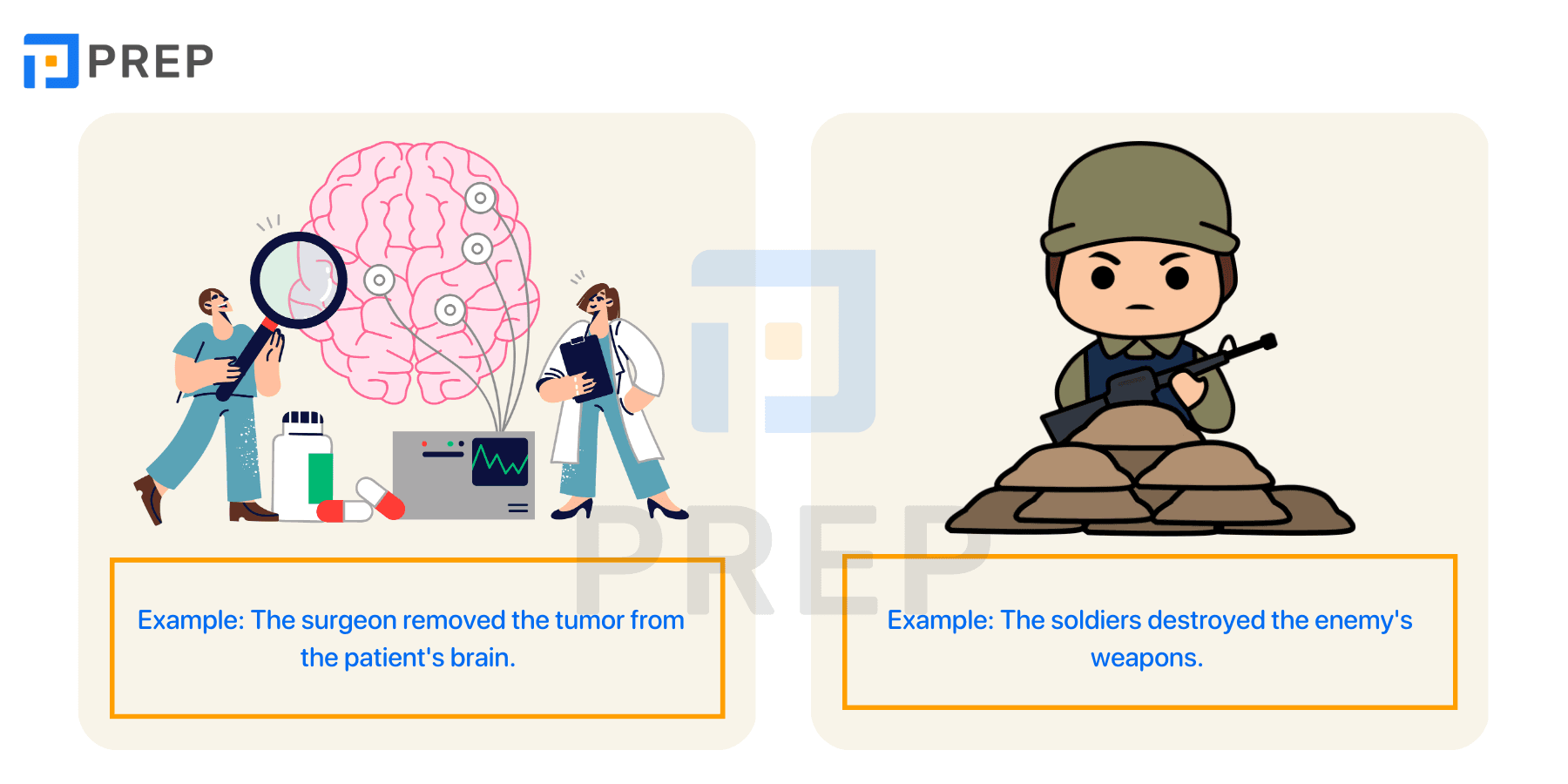
The troops took out the enemy tank. |
The troops destroyed the enemy tank. |
Important note for learners: While these synonyms reflect similar meanings, they are not always interchangeable. Some are more formal or informal, while others may not match the grammatical structure used with “take out.”
For example:
-
You can say “pull out a file” but not “pull out dinner”.
-
Using “treat someone” sounds more formal or polite than “take out” when referring to social plans.
Understanding subtle differences in tone, usage, and formality will help you use synonyms more effectively and avoid awkward or incorrect expressions. Always consider the context first before substituting.
You can compare this with usage of call off in english, which also changes meaning based on context.
II. Other phrasal verbs with Take
The verb “take” is one of the most commonly used in English and forms a wide range of phrasal verbs with different meanings. Like “take out,” these expressions often have meanings that go far beyond the literal, and they change significantly depending on the accompanying particle (on, off, up, over, etc.).
For English learners, mastering these phrasal verbs is essential for understanding both spoken and written English, especially since many of them appear frequently in informal conversation, media, and standardized tests.
|
Phrasal Verb |
Meaning |
Example Sentence |
|
Take off |
To remove something (e.g. clothing) or for an aircraft to become airborne |
He took off his jacket. / The plane took off on time. |
|
Take on |
To accept a responsibility, challenge, or task |
She took on a new role at work last month. |
|
Take over |
To assume control or responsibility |
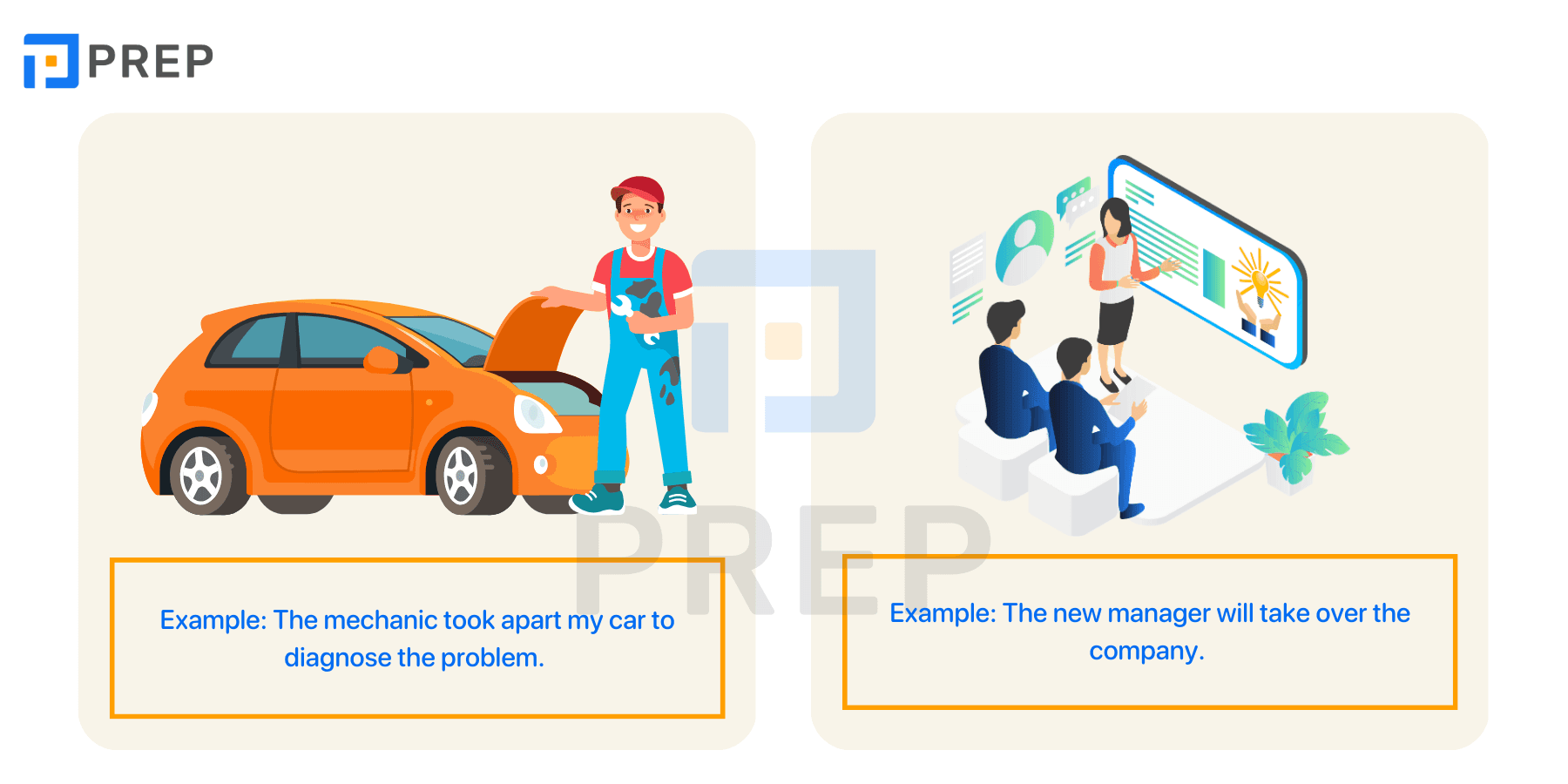
The company was taken over by a larger corporation. |
|
Take up |
To begin a new activity, habit, or hobby |
I’ve recently taken up yoga. |
|
Take back |
To retract something said or return something |
I take back what I said. / She took back the dress to the store. |
|
Take in |
To absorb or understand; to let someone stay in your home |
That was a lot of information to take in. / They took in a stray dog. |
|
Take apart |
To disassemble something into individual parts |
He took apart the clock to try to fix it. |
As with “take out,” these phrasal verbs often have both literal and figurative meanings, and the best way to learn them is by seeing how they function in real-life contexts. Avoid memorizing isolated definitions—instead, study them through example sentences or conversation scenarios to fully understand their usage and nuance.
You can explore english cut phrasal verbs to expand your knowledge of similar structures.
III. Achieve Your Dream IELTS Band Score
Now you know questions like "What is 'Take out'?" and "How to use 'Take out'?", right? This article has compiled all the theoretical knowledge about Take out in English and provided its common synonyms and phrasal verbs. If you’re looking for a trusted partner in your IELTS journey, PREP is your key to success.
-
IELTS preparation: Master Every Section of IELTS

Hi I'm Chloe, and I am currently serving as an Product Content Administrator at Prep Education. With over five years of experience in independent online IELTS study and exam preparation, I am confident in my ability to support learners in achieving their highest possible scores.
Comment
Premium content
View all

Personalized roadmap


Most read

UEN: 202227322W
Address: 114 LAVENDER STREET, #11-83 CT HUB 2, SINGAPORE (338729)