Even If in English: Meaning, Usage, and Examples Explained
“Even if” is a common English conjunction that confuses many learners. This guide explains its meaning, structure, and differences from phrases like “even though” and “if.” You’ll also learn how to use “even if” effectively in IELTS and TOEIC writing and speaking tasks.
I. What Does Even If in English Mean?
In English grammar, “even if” is classified as a subordinating conjunction. It is used to connect two clauses, typically when one clause (the condition) may or may not be true, but the other clause (the result or outcome) remains the same regardless of that condition.
“Even if” introduces a condition that does not affect the outcome. It emphasizes that a result will happen — or would happen — despite the possibility that the condition may not be true.
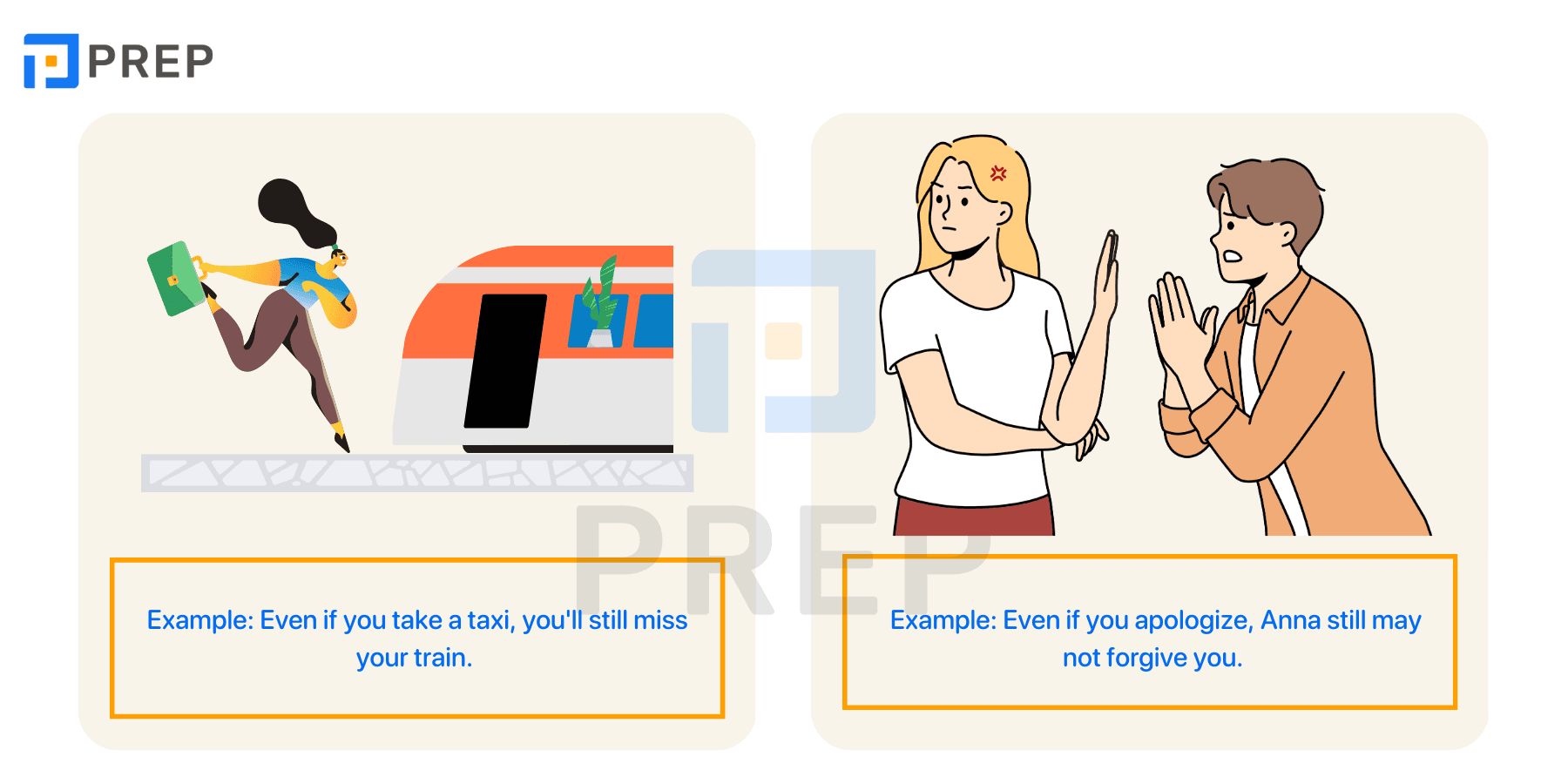
Example: Even if it rains, we will go hiking. → We will go hiking whether it rains or not.
This sentence suggests that the speaker has made a firm decision. Rain will not change the action.
Grammar Role:
- “Even if” joins a dependent clause (condition) with an independent clause (main idea).
- It shows contrast or irrelevance between the condition and the result.
- The “even” intensifies the idea that the condition is unlikely, extreme, or not important to the outcome.
Common Reasons to Use “Even If”:
- To express strong commitment or certainty
- To emphasize that a situation will happen regardless of obstacles or doubts
- To contrast reality with possibility, especially in persuasive or argumentative writing (such as IELTS essays)
Compare it with if and whether to understand subtle conditional differences.
1. How to Use Even If in English Sentences?
To use “even if” correctly, learners need to understand its grammatical structure, appropriate verb tenses, and possible positions in a sentence. As a subordinating conjunction, “even if” introduces a dependent clause (the condition), which is followed by an independent clause (the main result).
Sentence Structure
There are two common ways to structure sentences with "even if":
Even if + subject + verb, main clause
Main clause + even if + subject + verb
The meaning remains the same regardless of the placement.
Examples:
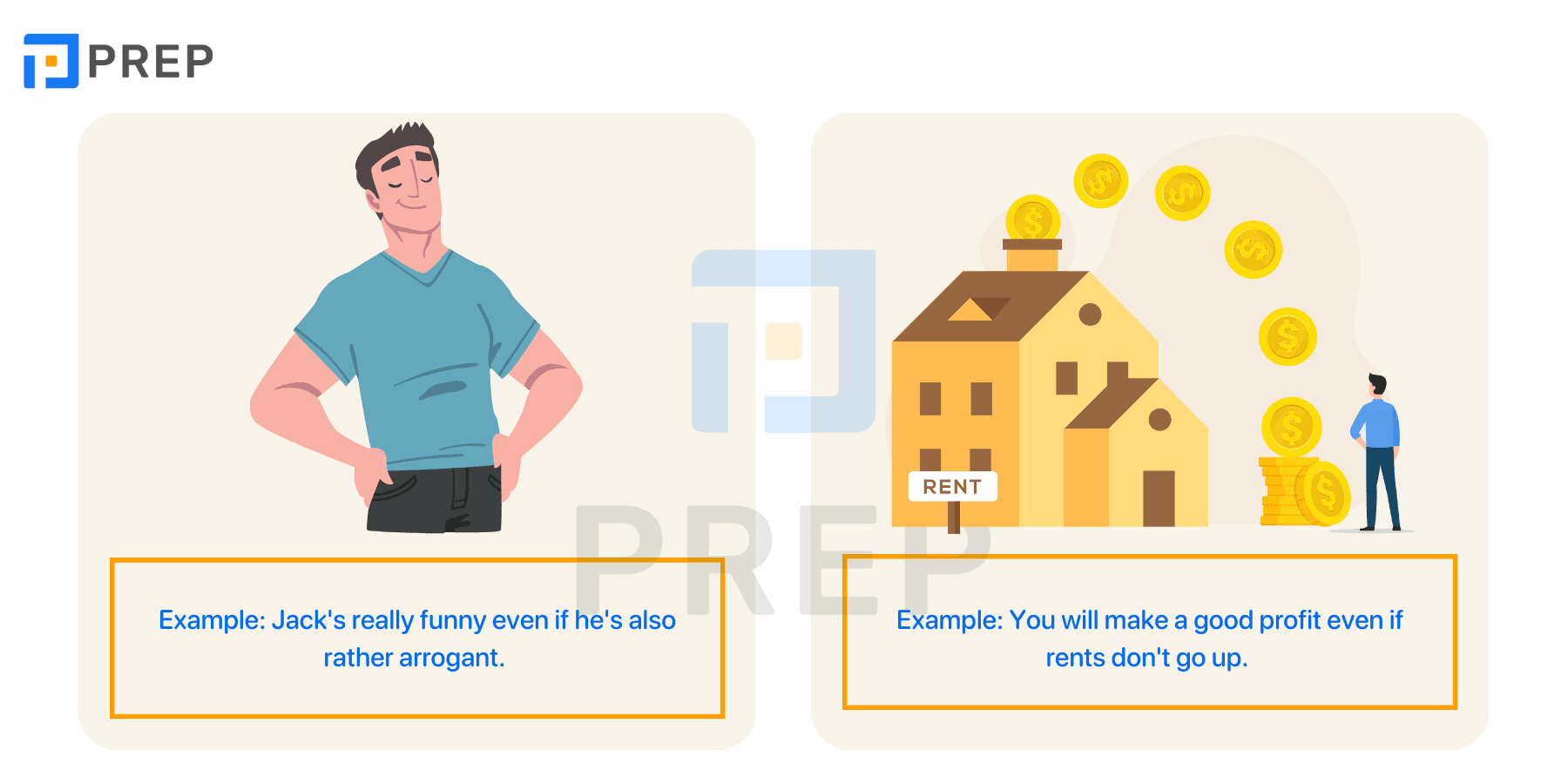
- Even if she studies hard, she might not pass the exam.
- He will attend the meeting even if he is sick.
These examples show that the result does not change, no matter whether the condition happens or not.
-
To connect additional ideas, practice using as well as in English.
Verb Tenses with "Even If"
The verb tense used after "even if" depends on whether the situation is real, unreal, present, or past. Here is a simple guideline:
|
Context |
Structure |
Example |
|
Real or likely situation |
Even if + present simple, will/can + base verb |
Even if it rains, we will still go to the beach. |
|
Unreal or unlikely |
Even if + past simple, would/could + base verb |
Even if I had time, I wouldn’t go to the party. |
|
Unreal in the past |
Even if + past perfect, would have + past participle |
Even if he had apologized, she wouldn’t have forgiven him. |
Note that “even if” is often used to express contrast between a possible condition and an unchanged result. It emphasizes that the outcome is not dependent on the condition.
Position in the Sentence
"Even if" can appear at either the beginning or the middle of a sentence.
- If "even if" is at the beginning, a comma is usually placed after the dependent clause.
- If it appears in the middle, usually no comma is needed.
Examples:
- Even if you invite him, he won’t come.
- She won’t come even if you invite her.
Both are correct and carry the same meaning.
Using "even if" correctly allows learners to express strong reasoning, hypothetical thinking, or commitment. This structure is especially useful in academic writing and formal speaking tasks such as IELTS Writing Task 2 or IELTS Speaking Part 3, where expressing complex ideas with confidence is essential.
-
Learn how the adverb works alone in even in English.
2. Differentiating Even if, Even though, Even so, Even when, and If
Many English learners find it difficult to distinguish between even if, even though, even so, even when, and if. These expressions may look similar on the surface, but they serve different grammatical roles and convey distinct meanings. Understanding how to use each correctly will improve both your writing and speaking accuracy.
|
Expression |
Part of Speech |
Core Meaning |
When to Use |
Example |
|
Even if |
Subordinating conjunction |
The result does not change, whether the condition is true or not |
Use it to express an imagined or uncertain condition that doesn’t affect the outcome |
Even if I’m tired, I’ll finish the project. |
|
Even though |
Subordinating conjunction |
The result contrasts with something that is known or true |
Use it when the condition is real, but the outcome is unexpected or contradictory |
Even though it was raining, they went hiking. |
|
Even so |
Conjunctive adverb (transition) |
However / Nonetheless |
Use it to contrast two complete sentences; typically follows a surprising result |
The task was difficult. Even so, she completed it on time. |
|
Even when |
Subordinating conjunction |
Describes a situation that happens repeatedly or unexpectedly |
Use it for habitual actions or general truths, emphasizing contrast |
He stays calm even when things go wrong. |
|
If |
Subordinating conjunction |
States a condition whose outcome depends on whether it’s true or not |
Use it for general conditions, real or imagined, that directly influence the result |
If you study hard, you will succeed. |
Misusing these expressions can change the entire meaning of your sentence. For example:
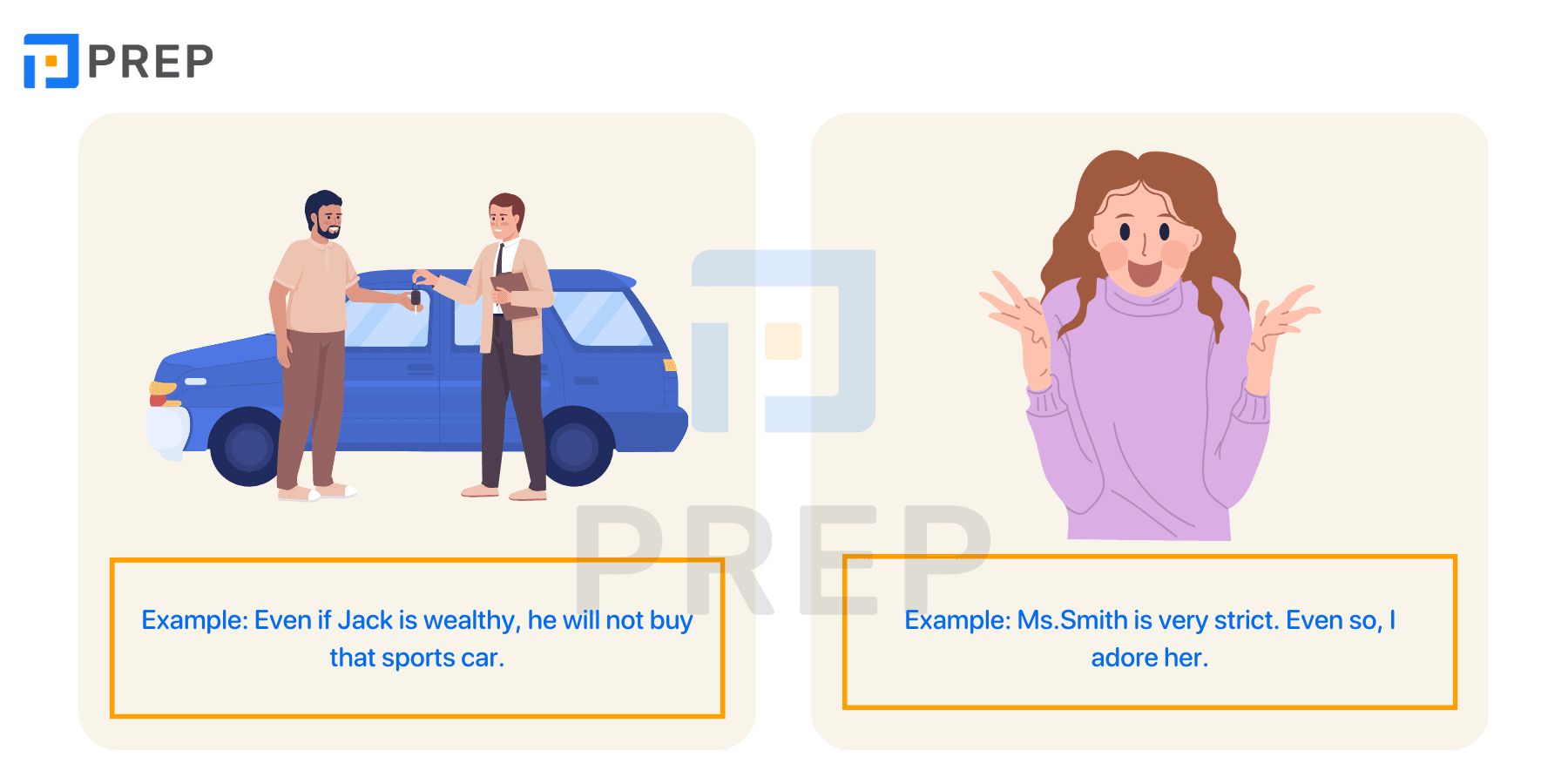
- Even if he apologizes, I won’t forgive him. (→ It may or may not happen; my decision is fixed.)
- Even though he apologizes, I won’t forgive him. (→ He already did, but I still won’t forgive him.)
For exams like IELTS, clearly distinguishing between contrastive and conditional expressions can help improve your coherence, grammar range, and accuracy. Whether you're writing an argumentative essay or giving a detailed speaking answer, selecting the right connector makes your ideas more logical and fluent.
II. Using Even If in IELTS and TOEIC Contexts
Mastering how to use “even if” can help you express stronger ideas, structure arguments more logically, and demonstrate advanced grammar knowledge—especially in high-stakes English exams like IELTS and TOEIC. Below are common ways “even if” appears in each section of these tests, along với hướng dẫn cụ thể để bạn ứng dụng hiệu quả.
Using “Even If” in IELTS Writing Task 2
In IELTS Writing Task 2, candidates are required to express opinions, add contrast, and strengthen arguments. “Even if” is a useful connector to emphasize that a result or opinion remains unchanged regardless of possible conditions.
Example (Opinion Essay): Even if governments invest in public transport, many people will still choose to drive their own cars for convenience.
→ This sentence shows inevitability despite a possible solution, and adds nuance to the argument.
Tips:
- Use “even if” to show limits of policies, counter-arguments, or concessions.
- Avoid confusing it with “even though” (which refers to known facts).
Using “Even If” in Speaking Answers
In the IELTS Speaking test (Part 2 or 3), “even if” helps you express personal conviction, contrast, or hypothetical reasoning. Using it correctly demonstrates lexical and grammatical range.
Example (Speaking Part 3): Even if I had more free time, I don’t think I would watch more TV. I’d rather go outside.
→ This shows a clear, thoughtful opinion and logical structure.
In TOEIC Speaking, “even if” is helpful when giving recommendations or handling problem-solving questions.
-
Combine this with IELTS Listening tips to build test comprehension.
Listening & Reading Recognition
In both IELTS and TOEIC, “even if” may appear in listening scripts or reading passages, especially when:
- A speaker wants to emphasize that an action or decision is not influenced by a possible situation.
- A writer shows contrast between a condition and its effect.
Example from Listening Context: Even if the meeting runs late, we’ll still have time for the client call.
→ Here, the speaker is showing that the plan will go ahead no matter what.
Example from Reading Context: Even if technology becomes more advanced, human interaction will always play a key role in healthcare.
→ This highlights an unchanging belief despite progress in another area.
How to Prepare
- Practice writing 2–3 sentences using “even if” in different tenses (present, past, hypothetical).
- In speaking, try using “even if” to answer practice questions about preferences, predictions, or hypothetical situations.
- When reading or listening, underline phrases like “even if” to better understand how ideas are contrasted and emphasized.
Using “even if” effectively not only adds depth and logic to your English but also demonstrates advanced control of contrast structures—something examiners appreciate in both productive skills (writing/speaking) and receptive skills (listening/reading).
PREP hopes that through this article, you have gained a clear understanding of "What is Even if in English?" its structure, usage, and the differences of Even if, Even though, Even so, Even when, and If. Keep following PREP to regularly update your English knowledge!

Hi I'm Chloe, and I am currently serving as an Product Content Administrator at Prep Education. With over five years of experience in independent online IELTS study and exam preparation, I am confident in my ability to support learners in achieving their highest possible scores.
Comment
Premium content
View all

Personalized roadmap


Most read



UEN: 202227322W
Address: 114 LAVENDER STREET, #11-83 CT HUB 2, SINGAPORE (338729)