Base On or Based On in English: Grammar Guide
This guide explains the difference between “base on” and “based on” in English. You will learn the correct structure, when to use each form, and how to avoid common mistakes. With clear examples and practical explanations, you can use this structure accurately in both daily communication and academic writing.

Keynote
The phrase "be based on" is the correct and natural English structure to express that something relies on, is built from, or is determined by a particular source, idea, or fact. Learners often make the common mistake of omitting “be,” writing “base on” instead, which is grammatically incorrect.
Key points to remember:
-
Always use "be based on" (to be + based + on + noun/pronoun) in both speaking and writing when you mean “dựa trên.”
-
Avoid using “base on” without the verb “be.”
-
This structure is essential in both casual and academic contexts for clearly showing what your result, information, or decision is founded upon.
-
Mastering the correct use of “be based on” will make your English sound clear, natural, and professional, especially in exams and formal writing.
I. What Does “Base On” Mean in English?
The phrase “base on” in English usually appears in the passive form: “be based on.” It means that something is formed, developed, or created by using certain facts, ideas, or sources as its foundation or starting point.
-
“Be based on” is used to show that one thing uses something else as its main support or reason.
-
Use “be based on” when you want to make clear that a statement, action, or object comes from or depends on something specific.
-
It helps avoid confusing, unclear, or informal expressions such as “base on” without the “be.”
Example:
-
This movie is based on a true story.
-
Admission decisions are based on exam results.
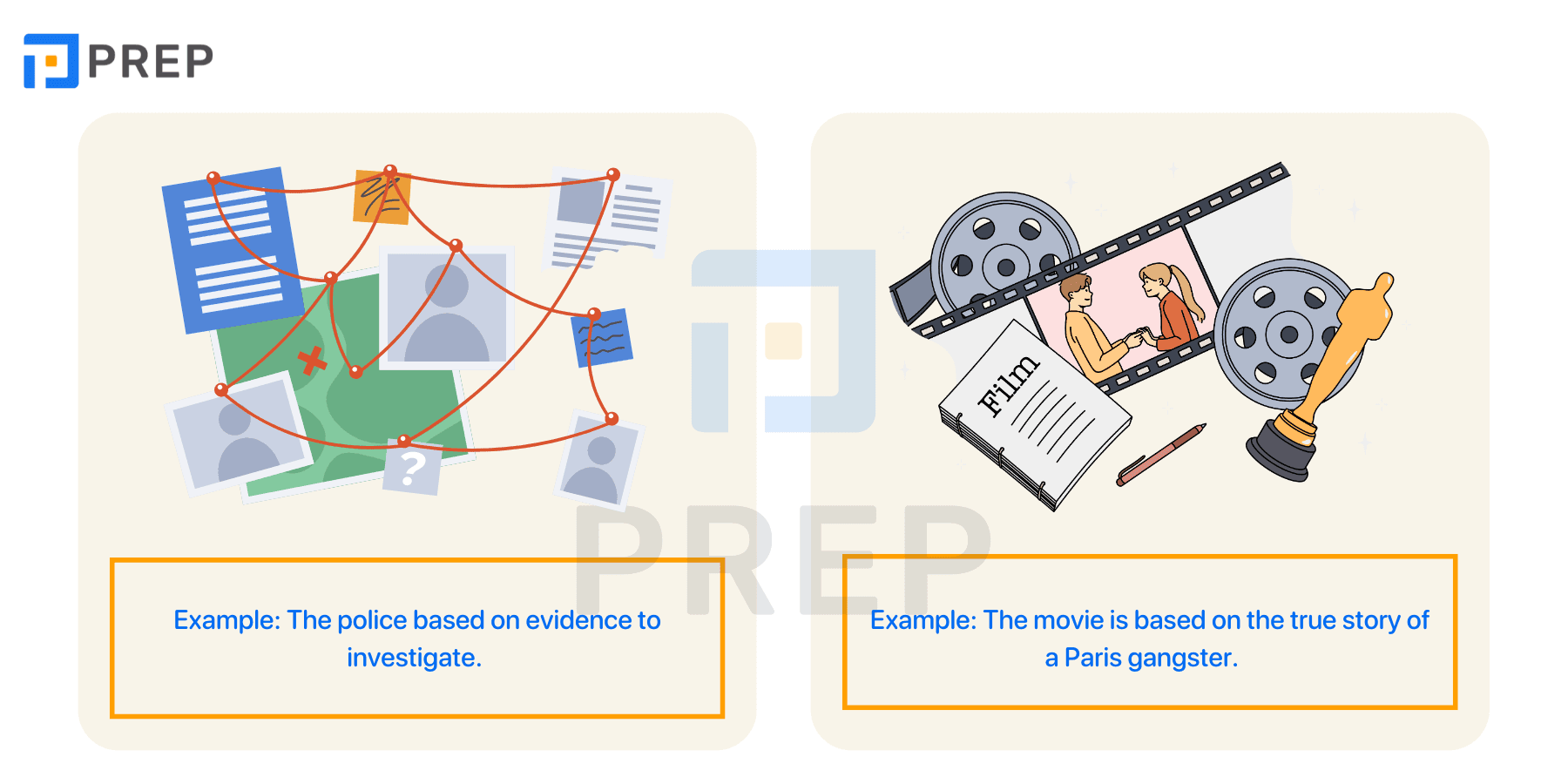
In daily conversation, "be based on" is common when talking about books, movies, decisions, plans, or rules that use specific sources or information. In academic writing, “be based on” helps express objective logic, evidence, or the foundation of research and arguments.
You can compare this with usage of be supposed to in english to understand similar structures.
1. Grammar Structure: “Be Based On” vs. “Base” (Active vs. Passive)
Understanding the difference between “be based on” (passive) and “base” (active) is essential for expressing the foundation or source of something accurately in English. Many learners confuse these structures, often omitting the verb “be” or using “base on” incorrectly.This section will clarify the correct form with clear explanations, examples, and a direct comparison.
The standard way to communicate in English is by using the passive structure “be based on”:
to be + based + on + noun/pronoun
Example:
-
All decisions are based on company policy.
-
The information is based on recent research.
When expressing that something depends or relies on another thing, always use this passive structure, not “base on” as an active phrase.
You can also explore usage of require in english for formal structures.
Passive vs. Active (“Base”)
|
Active Structure |
Passive Structure |
|
Subject + base(s) + object + on… |
Subject + be + based + on… |
|
The author bases the story on facts. |
The story is based on facts. |
|
They base their decisions on data. |
The decisions are based on data. |
|
She bases her opinion on experience. |
Her opinion is based on experience. |
-
In the active voice, “base” acts as a regular verb (base/bases/based/basing), typically showing who is doing the basing.
-
The passive structure “be based on” places emphasis on the result, source, or foundation, which is much more common in writing and conversation, especially in academic or formal English.

Exceptions and Special Notes
-
“Base” as a real verb: “Base” is used in active sentences to specify who bases something on a source.
Example: The company bases its operations in Singapore.
Example: The movie director bases the film on true events. -
Most situations: In most daily and academic use, “be based on” is preferred since the doer is usually unknown or unimportant, and the source or origin is emphasized.
Tip: Never say “this movie base on…” or “this law base on…”—always use “is based on”.
2. Examples of “Be Based On” in Real Contexts
Seeing “be based on” in different sentences is the best way to master its meaning and use. Below are examples from both everyday conversation and academic/formal writing.
Everyday Conversation Examples
-
This story is based on my childhood experiences.
-
Most of our company rules are based on customer feedback.
-
The price is based on the weight of the package.
-
Her decision was based on what her parents advised.
Academic and Writing Examples
-
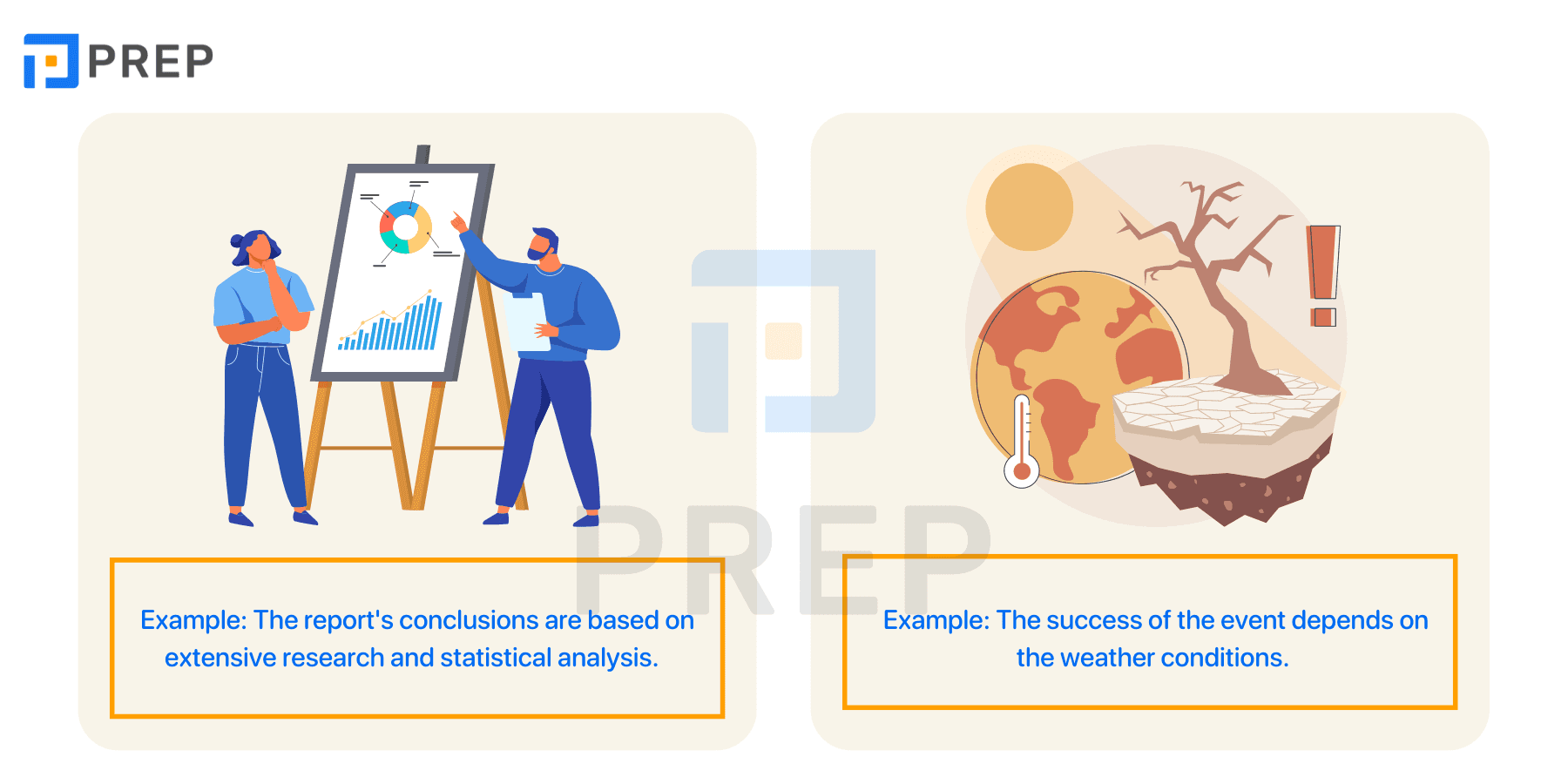
The results are based on data collected over three years.
-
This theory is based on extensive experiments and observations.
-
Band scores in IELTS Writing are based on several assessment criteria.
-
The study is based on interviews with over 1,000 participants.
-
The report’s conclusions are based on strong evidence.
Using “be based on” in these ways shows you can clearly express sources, influences, and reasons in both conversation and formal English.
To improve further, you should improve english vocabulary consistently.
II. Alternative Phrases and Paraphrasing
Using synonyms and paraphrasing not only makes your English more flexible and advanced but also helps you avoid repetition—especially in academic writing and speaking tests like IELTS.
Synonyms and Paraphrase Choices
|
Alternative Phrase |
Example Sentence |
|
according to |
According to recent research, the rate is rising. |
|
depend on |
The result depends on many different factors. |
|
is founded on |
The argument is founded on logic, not emotion. |
|
draw from |
The story draws from real-life experiences. |
|
rely on |
The decision relies on accurate information. |
|
use as a source |
The proposal uses previous studies as a source. |
|
is influenced by |
Their design is influenced by Japanese styles. |
|
is derived from |
The solution is derived from a chemical reaction. |
You can improve this by learning learn synonyms in english.
When and How to Paraphrase “Be Based On”
-
When to Paraphrase: Paraphrase “be based on” when you want to avoid repeating the same phrase, show a wider range of vocabulary, or fit more precisely with the context of your sentence (for example, presenting causes, sources, reasons, or foundations).
-
How to Paraphrase:
-
Choose a suitable synonym: Select a phrase that closely matches the meaning you want (for credibility, “is founded on” is very formal; for a process, “draw from” may fit better).
-
Adjust your sentence structure: Sometimes, paraphrasing requires you to change the grammar slightly.
Original: The recommendation is based on expert opinion.
Paraphrase: The recommendation draws from expert opinion.
Paraphrase: According to expert opinion, the recommendation was made. -
Don’t paraphrase when the original meaning could be lost: In some contexts (especially legal or academic), keeping “be based on” is best for clarity and precision.
-
-
In IELTS Writing/Speaking: Strategic paraphrasing shows lexical resource, but always make sure your alternative fits the grammatical and logical context of your answer.
You can also review usage of in order to vs so as to in english for similar transformations.
III. Practice Exercises with Answers
Apply your knowledge about “be based on” by completing the following exercises.
Exercise 1: Choose the Correct Sentence
For each pair, choose the sentence that uses “be based on” correctly.
-
A. The rule is base on scientific studies.
B. The rule is based on scientific studies. -
A. Our project is base on data from 2020.
B. Our project is based on data from 2020. -
A. The results was based on interviews.
B. The results were based on interviews. -
A. The story was base on real events.
B. The story was based on real events. -
A. His suggestion based on her advice.
B. His suggestion is based on her advice.
Exercise 2: Rewrite with “be based on” or a Suitable Alternative
Rewrite each sentence using “be based on” or an alternative phrase from the paraphrasing section.
-
This decision uses customer feedback as its main source.
-
Their plan relies on current market trends.
-
The program draws from international examples.
-
The price depends on the size of the product.
-
Their answer uses information from the article.
Exercise 3: Correct the Mistake
Each sentence contains an error with “base on” or “be based on.” Correct each one.
-
The label is base on color and weight.
-
This opinion base on experience.
-
The design base on Japanese style.
-
The result was base on two surveys.
-
Our report base on the latest statistics.
Answer Key
[prep_collapse_expand open_text="View more" close_text="Show less"]
|
Exercise 1 |
Exercise 2 |
Exercise 3 |
|
|
|
[/prep_collapse_expand]
IV. Achieve Your Dream IELTS Band Score
PREP hopes that through this article, you have grasped the meaning of Base on in English, its structure, usage, and the differences between Based on and Basing on. If your goal is to achieve a Band 7+ or higher, these IELTS resources are for you :
- IELTS course: Mastering IELTS exam from zero to hero

Hi I'm Chloe, and I am currently serving as an Product Content Administrator at Prep Education. With over five years of experience in independent online IELTS study and exam preparation, I am confident in my ability to support learners in achieving their highest possible scores.
Comment
Premium content
View all



Personalized roadmap


Most read



UEN: 202227322W
Address: 114 LAVENDER STREET, #11-83 CT HUB 2, SINGAPORE (338729)