IELTS Task 2: Young People Changing Jobs
This guide explains how to approach IELTS Writing Task 2 questions about young people regularly changing jobs. You will learn how to structure opinion and discussion essays, analyze career mobility trends, use employment-related vocabulary, and present logical reasoning to achieve a higher band score.
Keynote – Sample Answer Quick Overview
For this essay, explain why job changing among young people is common (career exploration, skill development, changing markets), and then clearly state whether you think the advantages outweigh the disadvantages. Support your position with logical arguments and, if possible, real examples or research.
Key Points to Remember:
-
Address both the reasons for frequent job changes and the pros and cons
-
Organize body paragraphs logically: one for causes, one for analysis (advantages/disadvantages and your opinion)
-
Use precise vocabulary: “job mobility,” “career advancement,” “labor market,” “job security,” “skill acquisition”
-
Avoid overusing “job,” “change,” and “work”—vary your language and use collocations
-
Support your stance with explanation and examples, not just simple statements
-
Maintain a formal, academic tone and clear paragraphing throughout
I. Task 2 Question Overview for "Young People Regularly Change Their Job Over the Years"
The topic “young people regularly change their job over the years” is a popular IELTS Writing Task 2 subject, usually presented as an opinion or discussion essay. It deals with changing patterns in employment among young generations—whether this is positive, negative, or what causes it.
You can explore IELTS writing task 2 discussion essay.
Typical Task 2 Question:
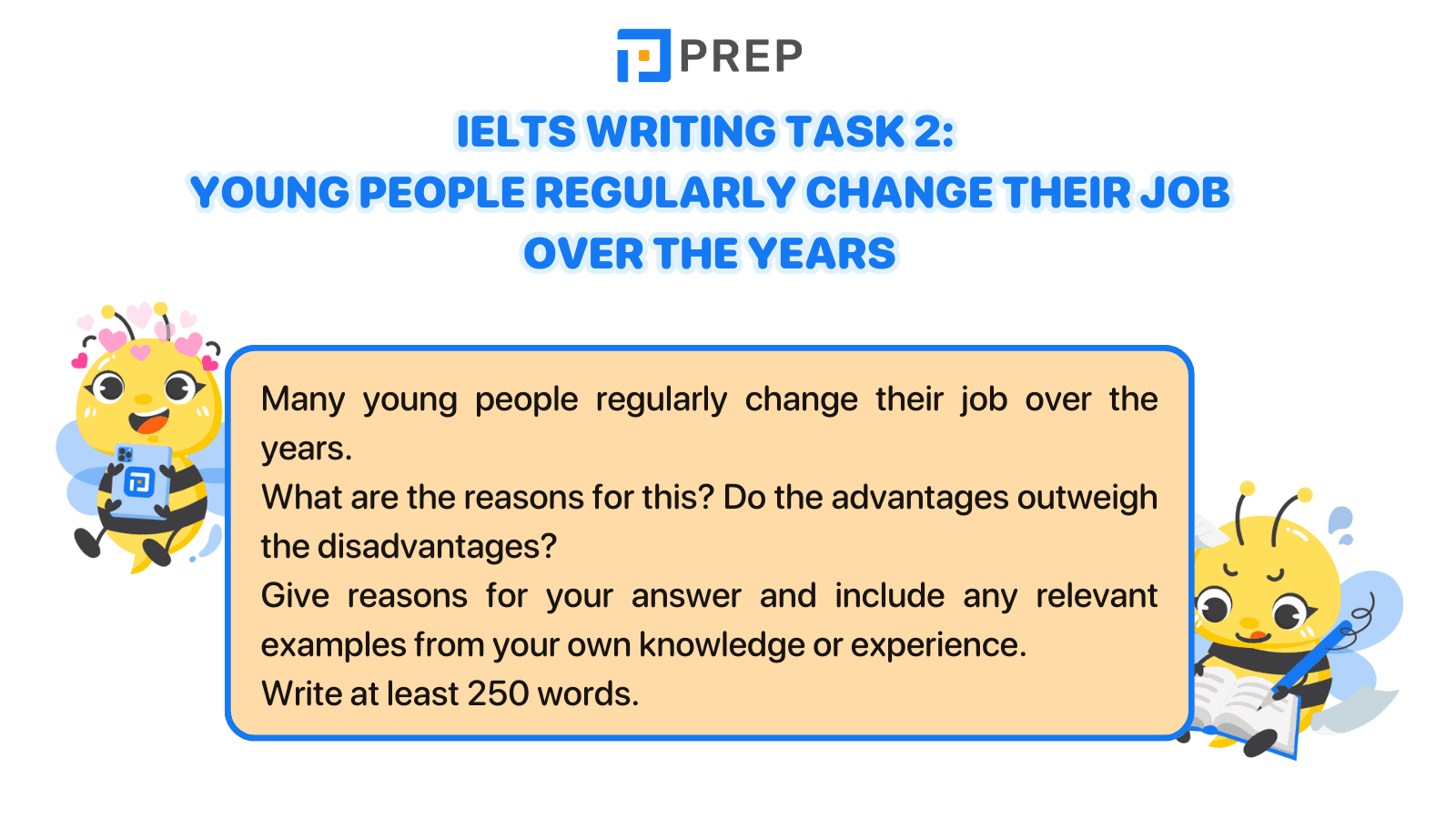
These days, many young people frequently change their jobs rather than working for the same company for many years.
Why is this the case?
Do the advantages of this outweigh the disadvantages?
Essay Type: Two-part question (Reasons & Advantages/Disadvantages)
To understand this format better, review IELTS writing task 2 question types.
Primary Requirements:
-
Explain the reasons why young people change jobs often (e.g., desire for new experiences, better opportunities, dissatisfaction, changing job markets)
-
Present your view on the consequences: are the benefits (skill development, networking, job satisfaction) greater than the drawbacks (lack of stability, weak job security, no long-term prospects)?
-
Support your answer with clear arguments and, where possible, real/explained examples
This is a classic “Reasons and Advantages/Disadvantages” Task 2 essay, requiring well-developed analysis of causes as well as a clearly justified opinion on their impact.
You can explore ideas for IELTS writing.
II. Band 5.5–6.5 Sample for Young People Regularly Changing Jobs
Below is a Band 5.5–6.5 sample essay for the topic “Young people regularly change their job over the years.” This essay answers both the “why” and “advantages/disadvantages” parts, using clear but basic arguments and language.
1. Band 5.5–6.5 Sample Essay with Paragraph Analysis
Sample Essay:
Nowadays, it is common for young people to change their jobs many times instead of working for one company for a long time. There are some reasons for this, and I think the advantages are greater than the disadvantages.
The first reason is that young people want new experiences and do not want to feel bored. They think changing jobs helps them learn new skills and meet new people. Also, sometimes they leave because they want a better salary or a job that suits them more. Today, there are more opportunities, so it is easier to find a different job.
There are some disadvantages. Moving from job to job can make it difficult to have a stable life. People may find it hard to make long-term friends or get promoted. However, I believe the benefits are bigger. By trying different jobs, young people can find work they really like and develop many useful skills. They also become more flexible, which is important in today’s job market.
In conclusion, there are both good and bad sides to changing jobs often, but I think the benefits are more important, especially for young people who want to learn and improve.
Paragraph Analysis:
-
Introduction:
-
Paraphrases task and signals an advantage-outweighs stance; specifies there are reasons for the trend.
-
-
Body Paragraph 1:
-
Explains main reasons: desire for new experiences, better salary, job fit, more opportunities.
-
Ideas are clear but exemplification is lacking.
-
-
Body Paragraph 2:
-
Lists disadvantages (stability, promotions), but explains why benefits (skills, flexibility, finding passion) are greater.
-
Reasoning is straightforward, limited to general statements.
-
-
Conclusion:
-
Summarizes the point of view clearly.
-
2. Common Vocabulary and Expressions (Band 5.5–6.5)
For the topic “young people regularly change their job over the years,” Band 5.5–6.5 essays use practical, straightforward language. While these words are clear, they are often repeated and lack advanced or academic style.
Useful Vocabulary
|
Category |
Examples |
|
Career/Work |
job, work, company, job change, employer, job market, position |
|
Mobility/Reasons |
change jobs, find a new job, want new experience, get better pay, leave work, salary, learn new skills, opportunities, bored, suit / not suit |
|
Stability |
stable, stability, long-term, promotion, stay in one company, life, friends at work |
|
Benefits/Drawbacks |
advantage, disadvantage, benefit, problem, learn, improve, lose, flexible, hard/difficult, easy |
Common Expressions and Phrases
-
“Young people change their jobs often/regularly/many times.”
-
“Find a job that suits them better.”
-
“Want to get more experience or a higher salary.”
-
“It is hard to have a stable life.”
-
“It is easier to find new opportunities these days.”
-
“Moving from job to job can be difficult.”
-
“They learn new skills and become more flexible.”
-
“The benefits of changing jobs are greater than the disadvantages.”
Notes for Band 5.5–6.5:
-
Vocabulary is practical but repetitive (“job,” “change,” “work,” “skills”). Avoid common mistakes in IELTS writing.
-
Expressions are direct but rarely paraphrased or academic.
-
“Advantage,” “disadvantage,” “benefit,” and “problem” are common.
-
Few collocations or synonyms; sentences are often literal and not idiomatic.
3. Grammar & Sentence Structures (Band 5.5–6.5)
At Band 5.5–6.5, essays about young people changing jobs frequently exhibit straightforward grammar. Most sentences are simple or compound, using common linkers such as “and,” “but,” or “because.” Errors in agreement, article use, tense, and run-ons are common—but meaning is generally clear.
Common Sentence Patterns
|
Type |
Examples |
|
Simple sentences |
“Young people change their jobs often.” “They want a better job.” |
|
Compound sentences |
“They learn new skills and meet new people.” |
|
Reason/cause |
“People leave a job because they are not happy.” |
|
Contrast |
“There are some problems, but there are also many benefits.” |
|
Giving opinion |
“I think the advantages are greater.” |
|
Generalization |
“Today, it is easy to find a new opportunity.” |
Frequent Grammar Mistakes
|
Error Type |
Incorrect |
Correct |
|
Subject–verb agreement |
“People wants to improve their life.” |
“People want to improve their life.” |
|
Article/plural errors |
“Find new skills in different job.” |
“Find new skills in different jobs.” |
|
Run-on sentences |
“They change job a lot so they can learn they also feel happy.” |
“They change job a lot so they can learn. They also feel happy.” |
|
Verb tense inconsistency |
“Last year, she change job three times.” |
“Last year, she changed jobs three times.” |
Style and Linking
-
Relies on and/but/because/so for connecting ideas
-
Sentences often start with “People…,” “They…,” “It is…,” “Young people…”
-
Occasionally includes lists (“They want new experience, better pay, or friends.”)
-
Very limited use of clauses or conditionals
III. Band 7.0+ Model for Young People Regularly Changing Jobs
Below is a Band 7.0+ model essay for the topic “Young people regularly change their job over the years” - This sample shows how to integrate advanced argumentation, academic vocabulary, and flexible, accurate grammar for a high IELTS band.
1. Band 7.0+ Model Essay with Paragraph Analysis
Sample Essay:
In recent decades, it has become increasingly common for young people to change jobs several times during their careers, rather than remaining with one company long-term. This trend can be attributed to both personal and economic factors, and although it poses certain challenges, I believe the advantages outweigh the disadvantages.
The first reason for this phenomenon is that today’s job market values adaptability and a broad skillset. Many young professionals seek diverse experiences to remain competitive, gain exposure to different industries, and develop a range of competencies. Furthermore, rapid technological change and the growth of the gig economy encourage frequent job switching, as permanent positions become less common and contract work proliferates. Job dissatisfaction also plays a role, as employees are less willing to tolerate poor management or limited upward mobility.
Admittedly, frequent job changes can create issues such as a lack of career stability, weaker long-term professional relationships, and limited retirement benefits. However, I argue that these drawbacks are outweighed by the opportunities for personal growth and career development. Individuals who move between roles are more likely to discover their true strengths and interests, build extensive professional networks, and stay intellectually engaged. For example, research shows that people who change jobs strategically often experience faster salary progression and greater job satisfaction in the long run.
In conclusion, while there are certain risks associated with regular job changes, the flexibility, skill acquisition, and self-discovery they promote render this trend largely advantageous for young people today.
Paragraph Analysis:
-
Introduction:
-
Paraphrases the task, identifies key causes, and sets out an “advantages outweigh disadvantages” thesis.
-
-
Body Paragraph 1:
-
Explains main reasons—market demands, gig economy, dissatisfaction; uses advanced vocabulary (“adaptability,” “broad skillset,” “upward mobility”).
-
Shows awareness of economic and personal factors.
-
-
Body Paragraph 2:
-
Discusses disadvantages but frames them as less significant; gives concrete benefits and research evidence for advantage.
-
Uses advanced grammar (relative clauses, participles, linkers) and collocations (“build professional networks,” “strategic job changes”).
-
-
Conclusion:
-
Restates main claim, using academic phrasing (“render this trend largely advantageous”).
-
2. Advanced Vocabulary & Collocations for the Topic
For a Band 7.0+ essay on “young people regularly change their job over the years,” use topic-specific, precise, and academic vocabulary. Collocations related to employment, career growth, and the job market will significantly increase your lexical resource score.
Academic Vocabulary & Collocations
|
Theme/Idea |
Expressions / Collocations |
|
Changing jobs |
job mobility, career transition, frequent/regular job changes, switch careers, change employers, move between industries, professional turnover |
|
Reasons/motives |
seek fresh challenges, pursue career advancement, search for job satisfaction, escape poor management, lack of upward mobility |
|
Benefits |
broaden one’s skillset, build professional networks, enhance adaptability, accelerate salary progression, foster personal growth, develop transferable skills |
|
Disadvantages |
lack of job security, forfeit retirement benefits, disrupt professional relationships, unstable employment history, hinder long-term planning |
|
Economic/market |
gig economy, contract work, dynamic labor market, demand for flexibility, adapt to workplace changes |
Useful Expressions & Sentence Starters
-
“The contemporary workforce places a premium on adaptability and lifelong learning.”
-
“Many young professionals prefer to seek fresh challenges rather than settle for routine.”
-
“Rapid changes in technology incentivize employees to acquire new competencies.”
-
“While job hopping may entail certain risks, it can ultimately lead to greater career fulfilment.”
-
“A stable career trajectory is desirable, but it is increasingly difficult to achieve in today’s dynamic labor market.”
Idiomatic and Academic Phrases
-
“climb the career ladder”
-
“expand one’s professional horizons”
-
“become a well-rounded employee”
-
“embrace portfolio careers”
-
“exposure to diverse working environments”
-
“plan for long-term advancement”
3. Grammar & Sentence Structures (Band 7.0+)
A Band 7.0+ essay on “young people regularly change their job over the years” is marked by flexible and accurate grammar, with frequent use of complex and compound sentences, advanced connectors, and natural referencing. Grammar is used to support nuanced argumentation and show logical relationships between points.
Advanced & Complex Sentence Structures
|
Function |
Example Structure |
|
Cause & effect |
“Because the modern job market rewards adaptability and diverse skills, many young people opt for regular job changes.” |
|
Concession/contrast |
“Although frequent career transitions can hinder long-term stability, they often increase personal satisfaction.” |
|
Conditionals |
“If individuals remain open to new opportunities, they are more likely to achieve rapid career advancement.” |
|
Passive structures |
“Unprecedented flexibility is now demanded by employers in many industries.” |
|
Using relative clauses |
“Young professionals who change jobs strategically often enjoy a broader skillset and higher earning potential.” |
|
Present/past perfect |
“Those who have accumulated varied experiences are often more resilient in a changing labor market.” |
|
Nominalization |
“Job mobility is increasingly regarded as a strategic career approach.” |
Advanced Linking & Cohesive Devices
-
Contrasting: “Nevertheless,” “Even so,” “While this is true, …”
-
Explaining results: “As a result,” “Therefore,” “Consequently,” “This allows them to…”
-
Adding points: “Furthermore,” “In addition,” “Moreover,” “Another contributing factor is…”
-
Referencing: “This trend,” “Such changes,” “These skills,” “Those who…”
IV. Examiner’s Comments: Young People Regularly Changing Jobs Essays
When examiners assess essays on “young people regularly change their job over the years,” they consider how well you explain both the reasons for this trend and weigh its benefits and drawbacks.
-
Task Response: Both the causes and the analysis of advantages/disadvantages are developed with depth. Reasons for job changing are explained in context, and the candidate’s view (“advantages outweigh disadvantages” or vice versa) is clearly justified with supporting argument and/or examples.
-
Coherence and Cohesion: Paragraphs are logically sequenced (intro → causes → drawbacks vs. benefits → conclusion), each built around a clear topic sentence. Cohesive devices (“although,” “as a result,” “while,” “such trends”) are used fluently for transitions and referencing.
-
Lexical Resource: Uses a wide range of academic vocabulary and collocations: “job mobility,” “pursue advancement,” “long-term stability,” “professional networks,” “lack of upward mobility.” Paraphrasing is natural; repetition is rare.
-
Grammatical Range & Accuracy: Accurate and flexible use of complex, conditional, and passive structures. Errors are rare, and long sentences do not become confusing.
Suggestions for Band Improvement:
-
Develop both parts: Clearly explain reasons for the trend and weigh both pros and cons with examples.
-
Use advanced language: Apply academic collocations, paraphrase “job change,” “opportunity,” and “skills.”
-
Balance argument: Explain why you think the benefits or drawbacks are greater.
-
Support your stance: Add evidence—statistics, research, or real-life observation.
-
Vary your grammar: Include at least 2–3 complex or conditional sentences in each body paragraph.
A Band 7+ response analyzes causes with depth, explores both sides, supports the preferred view with logical reasoning, and demonstrates control of advanced vocabulary and grammar.
Apply the formula for IELTS writing band 7.
Hopefully, after reading the above, you now know how to develop a detailed outline and write a sample IELTS Writing Task 2 Young people regularly change their job over the years. Regularly visit PREP to update more quality IELTS Writing Task 2 essays!

Hi I'm Chloe, and I am currently serving as an Product Content Administrator at Prep Education. With over five years of experience in independent online IELTS study and exam preparation, I am confident in my ability to support learners in achieving their highest possible scores.
Comment
Premium content
View all




Personalized roadmap


Most read





UEN: 202227322W
Address: 114 LAVENDER STREET, #11-83 CT HUB 2, SINGAPORE (338729)