IELTS Task 2: Forcing Foreign Language Study
This guide explains how to approach IELTS Writing Task 2 questions about whether schools should force students to learn a foreign language. You will learn how to structure opinion and discussion essays, develop balanced arguments, use education-related vocabulary, and present logical reasoning to achieve a higher band score.
Keynote – Sample Answer Quick Overview
When tackling this essay, analyze both arguments: individual freedom and motivation versus the academic and global benefits of compulsory language learning. State your own position early and consistently support it with balanced reasoning and relevant examples.
Key Points to Remember:
-
Present both sides: reasons for making language study optional and for making it compulsory
-
Develop each viewpoint with specific examples or logical explanation
-
Use topic-specific and academic vocabulary for education and language learning
-
Organize body paragraphs logically (e.g., one for each side, one for your own view)
-
Clearly state and justify your opinion throughout the essay
-
Avoid one-sided argument or vague generalizations—depth and development matter
I. Task 2 Question Overview for "Schools should not force students to learn a foreign language"
The topic “schools should not force students to learn a foreign language” is a classic IELTS Writing Task 2 prompt. It is often presented as an “agree/disagree” or a “discuss both views and give your own opinion” question, addressing compulsory foreign language study in schools.
Typical Task 2 Question:
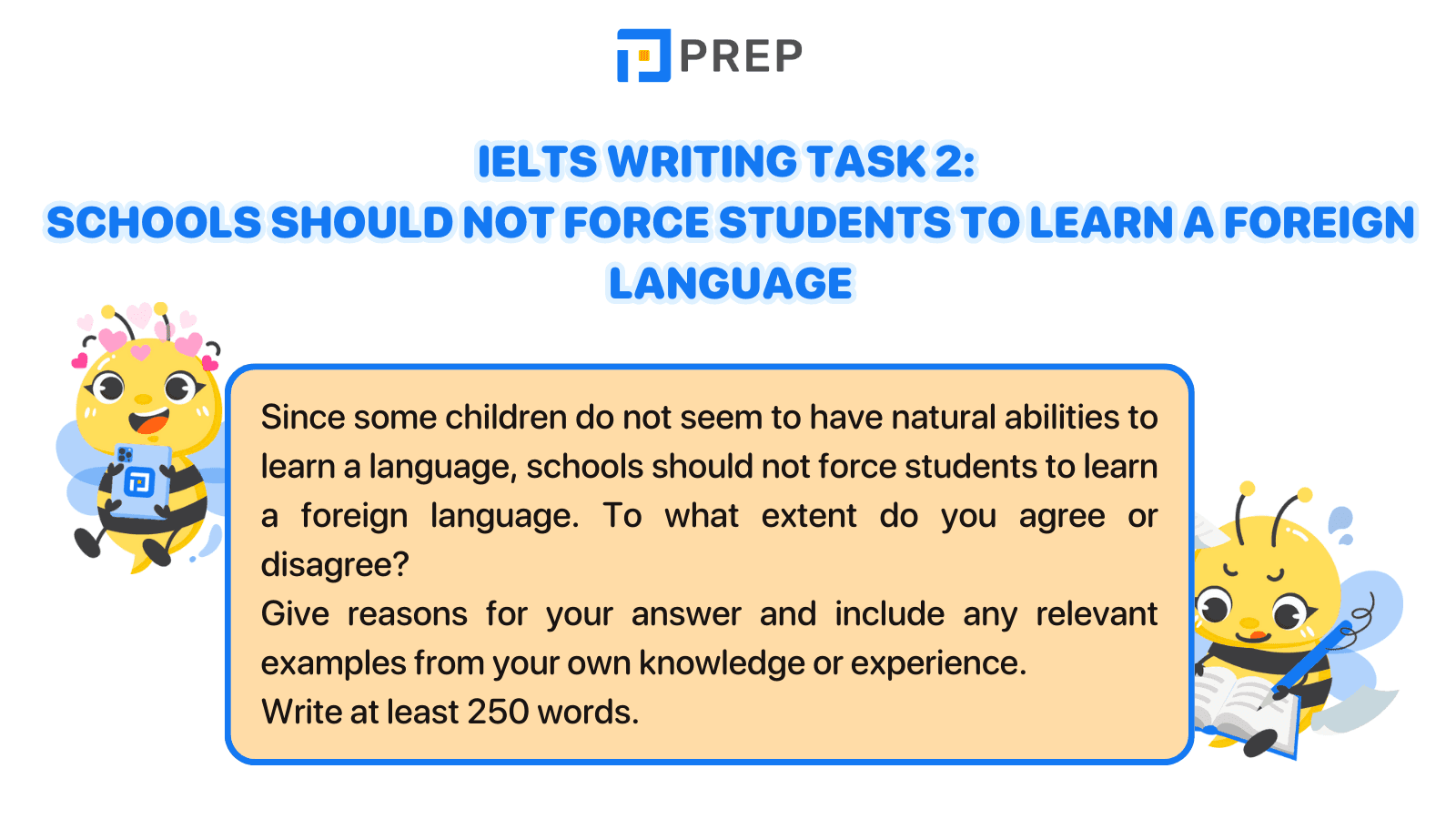
Some people believe that schools should not force students to learn a foreign language if they do not want to.
To what extent do you agree or disagree?
To explore all formats, refer to IELST writing task 2 question types.
Essay Type: Opinion (Agree/Disagree) or Discussion + Opinion.
To understand this format better, review opinion essay IELST writing task 2.
Primary Requirements:
-
Present arguments in support of making foreign language study optional (e.g., individual freedom of choice, diverse talents and interests, risk of demotivation, students may not benefit if uninterested).
-
Present arguments for compulsory foreign language learning, if choosing to discuss both views (e.g., cognitive benefits, global opportunities, essential 21st-century skill, cultural understanding).
-
Clearly express your own opinion and support it with reasons and examples.
This question fits the Opinion or Discussion + Opinion type, requiring a clear stance, development of both arguments (if relevant), and justification throughout the essay.
You can also explore IELTS writing task 2 discussion essay for this structure.
II. Band 5.5–6.5 Sample for Schools and Foreign Languages
Below is a Band 5.5–6.5 sample essay for the topic “Schools should not force students to learn a foreign language.” This example demonstrates a basic organization of ideas, simple language, and a clear opinion—typical features of a mid-band IELTS Writing Task 2 response.
1. Band 5.5–6.5 Sample Essay with Paragraph Analysis
Sample Essay:
Some people think that schools should not make students study a foreign language if they do not want to. I partly agree with this view. In this essay, I will explain both sides and give my opinion.
On the one hand, students have different talents and interests, so not everyone will enjoy or do well with language learning. If students are forced to study a new language, they may feel bored or stressed. For example, some children prefer science or art, but spend many hours on languages they might not use in the future. If schools make language lessons optional, students will have more freedom to choose what is best for them.
On the other hand, learning a foreign language is very useful. It helps students get better jobs when they are older and makes it easier to travel. Also, it can help students understand different cultures and meet people from other countries. For these reasons, many schools believe it should be a required subject.
In my opinion, foreign language lessons should be available to all students, but not compulsory. If students are really interested, they will learn better. Forcing everyone can make some lose interest in school.
Paragraph Analysis:
-
Introduction:
-
Paraphrases task and signals a partial agreement; states intent to explain both views.
-
-
Body Paragraph 1:
-
Argues against compulsory language study (focus on choice, motivation, different skills).
-
Simple points with one developed example.
-
-
Body Paragraph 2:
-
Argues for mandatory language education (global benefits, jobs, culture).
-
Explanation is clear, but arguments stay general.
-
-
Conclusion/Opinion:
-
Opinion is moderately balanced (should not be compulsory, but freely available).
-
Closing sentences are simple and repetitive.
-
Learn how to develop ideas in writing task 2.
2. Common Vocabulary and Expressions (Band 5.5–6.5)
For the topic “schools should not force students to learn a foreign language,” Band 5.5–6.5 essays typically feature simple, repetitive vocabulary and “safe” expressions. While these words communicate the basic ideas, they often lack variety, precision, or an academic tone.
Common issues are explained in mistakes in IELTS writing.
Useful Vocabulary
|
Category |
Examples |
|
Language Learning |
foreign language, study a language, learn English/French, language class, language lesson |
|
School/Subject |
school, subject, compulsory, optional, required, lesson, class, interest, talent |
|
Freedom & Motivation |
want to, do not want to, interested, like/dislike, choose, prefer, boring, difficult, stressed |
|
Benefits |
useful, get a job, travel, understand other people, culture, help in the future |
|
Disadvantages |
waste of time, forced, not good at languages, not interested, lose interest in school |
Common Expressions and Phrases
-
“Schools should not force students to learn a language.”
-
“Some students do not like language classes.”
-
“Making a subject compulsory can be stressful.”
-
“Foreign languages are useful for jobs and travel.”
-
“Students should be free to choose what they want to study.”
-
“It is important for culture and meeting new people.”
-
“Not every student needs another language in the future.”
-
“If they are interested, they will learn better.”
Notes for Band 5.5–6.5:
-
Vocabulary is repeated (“learn,” “language,” “school,” “study,” “useful”).
-
Few collocations or synonyms for “foreign language,” “subject,” or “compulsory.”
-
Complex or academic vocabulary (“linguistic skill,” “curriculum,” “requirement”) is rare.
-
Most expressions are either neutral or informal.
3. Grammar & Sentence Structures (Band 5.5–6.5)
At Band 5.5–6.5, grammar and sentence structures are clear but not varied. Most sentences are short or compound, using basic connectors and rarely attempting more advanced forms. Typical mistakes include errors with agreements, articles, and run-on sentences, though meaning is rarely lost.
Common Sentence Patterns
|
Type |
Examples |
|
Simple sentences |
“Schools should not make languages compulsory.” “Some students do not like languages.” |
|
Compound sentences |
“It is useful for travel, and it can help with jobs.” |
|
Using ‘because/so/but’ |
“Students learn better if they are interested.” “It can be hard because not everyone likes to study them.” |
|
Basic opinions |
“I think students should choose what to study.” |
|
Giving reasons |
“Language is important, so it should be an option for everyone.” |
Frequent Grammar Mistakes
|
Error Type |
Incorrect |
Correct |
|
Subject–verb agreement |
“Everyone have to study English.” |
“Everyone has to study English.” |
|
Plural/article errors |
“He goes to lesson.” |
“He goes to a lesson.” |
|
Run-on sentences |
“Some want to learn some do not it depends.” |
“Some want to learn; some do not. It depends.” |
|
Tense consistency |
“Last year students must learn French.” |
“Last year, students had to learn French.” |
Style and Linking
-
Common use of “and,” “but,” “because,” “so.”
-
Sentences often start with “It is,” “Students,” “Some people,” “Schools.”
-
Rarely uses complex or conditional sentences.
-
Generalizations: “Most students…,” “Languages are…”
III. Band 7.0+ Model for Schools and Foreign Languages
The following section presents a Band 7.0+ sample essay for the topic “Schools should not force students to learn a foreign language,” along with a detailed paragraph analysis. This model shows how to present balanced arguments, use advanced vocabulary, and employ complex grammar to achieve a high score on IELTS Writing Task 2.
1. Band 7.0+ Model Essay with Paragraph Analysis
Sample Essay:
Some argue that making foreign language study compulsory for all students is unnecessary and even counterproductive, while others maintain that it is an essential skill in the modern world. Although I recognize the challenges of mandatory language instruction, I believe that requiring students to learn a foreign language offers significant long-term benefits.
On one hand, opponents of compulsory language lessons point out that students have varying interests and aptitudes. Forcing all pupils to study a foreign language may cause frustration among those who struggle, resulting in disengagement or reduced motivation for school in general. Furthermore, not all students will use a foreign language in their future careers, so time and resources might be better invested in subjects aligned with their aspirations and strengths.
Nevertheless, there are powerful arguments for making language study a universal requirement, particularly in an increasingly globalized world. Learning another language strengthens cognitive skills, enhances cultural awareness, and opens doors to jobs and educational opportunities abroad. It also fosters empathy and adaptability in young people, skills which are valuable no matter what field they pursue. In countries where language instruction is compulsory, such as the Netherlands or Sweden, young people often achieve a high level of linguistic competence that benefits them for a lifetime.
In conclusion, while not everyone may enjoy language study, the broader social and personal advantages mean that schools should expect all students to gain at least basic proficiency in a foreign language. With adequate support and effective teaching methods, most students can succeed and benefit from learning a new language.
Paragraph Analysis:
-
Introduction:
-
Clearly paraphrases the issue, introduces both views, takes a thoughtful stance.
-
-
Body Paragraph 1:
-
Discusses reasons against compulsory study, develops points about individual suitability and relevance.
-
Shows advanced linking (“may cause frustration…resulting in…”), precise vocabulary (“aptitudes,” “disengagement”).
-
-
Body Paragraph 2:
-
Argues for universal requirement, uses academic collocations (“globalized world,” “cognitive skills,” “cultural awareness”).
-
Includes international examples and links advantages to lifelong benefits.
-
-
Conclusion:
-
States and justifies clear opinion: universal proficiency with proper support is ideal.
-
Academic style, summary of both pragmatic and aspirational aims.
-

2. Advanced Vocabulary & Collocations for the Topic
To achieve Band 7.0+ for an essay on whether schools should require foreign language study, you need to use advanced, topic-specific vocabulary and precise collocations related to education, language acquisition, and student development.
Academic Vocabulary & Collocations
|
Theme/Idea |
Expressions / Collocations |
|
Educational Policy |
compulsory curriculum, core subject, universal requirement, mandatory language classes, curriculum design |
|
Language Acquisition |
attain proficiency, linguistic competence, cognitive development, enhance brain plasticity, foster communication skills |
|
Student Diversity |
varied aptitudes, individual strengths, personalized learning, student motivation, differentiated instruction |
|
Career & Globalization |
global workforce, international opportunities, cross-cultural competence, multilingual advantage |
|
Social/Cultural |
promote empathy, cultural awareness, broaden horizons, bridge cultural gaps |
|
Potential Drawbacks |
lack of engagement, academic disengagement, misallocation of resources, counterproductive policies |
Expand your range with learn IELTS writing vocabulary.
Useful Expressions & Sentence Starters
-
“Making language learning compulsory may…”
-
“Attaining basic proficiency in a second language benefits students by…”
-
“A universal language requirement equips young people for the global workforce.”
-
“Language study fosters not only communication skills but also cognitive development.”
-
“Given diverse aptitudes among learners, a one-size-fits-all approach may not be optimal.”
-
“Research indicates that early exposure to foreign languages enhances brain development.”
Idiomatic and Academic Phrases
-
“a gateway to global opportunities”
-
“acquire a marketable skill”
-
“tailor instruction to individual needs”
-
“bridge the language barrier”
-
“the benefits far outweigh the drawbacks”
-
“skills transferable beyond the classroom”
3. Grammar & Sentence Structures (Band 7.0+)
A Band 7.0+ essay on the topic of compulsory foreign language study will exhibit a range of complex sentences, accurate grammar, and advanced linking. Your grammar should enable you to express nuanced arguments and balance both perspectives clearly.
Advanced & Complex Sentence Structures
|
Function |
Example Structure |
|
Balancing views |
“While compulsory language study may not appeal to all students, the advantages generally outweigh the drawbacks.” |
|
Explaining consequences |
“If language learning is made optional, some students might miss out on skills crucial for a global workforce.” |
|
Concession and contrast |
“Although not every student excels at language acquisition, exposure to a new language develops resilience and adaptability.” |
|
Passive/relative clauses |
“The benefits which have been demonstrated in multilingual countries include…” |
|
Cause and effect |
“Because language study enhances cultural awareness, it better prepares students for international experiences.” |
|
Conditionals |
“If instruction is tailored to individual needs, students are more likely to succeed and remain engaged.” |
Linking & Cohesive Devices
-
Contrasting: “Nevertheless,” “However,” “In spite of this,” “On the other hand”
-
Adding emphasis: “Indeed,” “Furthermore,” “What is more,” “Significantly”
-
Providing examples: “For instance,” “A case in point is…,” “This can be seen in…”
-
Summarizing: “Ultimately,” “All things considered,” “In summary,” “For these reasons”
Academic Style and Reference
-
Use academic register: “It is widely recognized that…” / “Policy-makers should consider…”
-
Reference back to points: “Such policies,” “These advantages,” “This approach,” “These students…”
IV. Examiner’s Comments: Schools and Foreign Languages Essays
For the topic “Schools should not force students to learn a foreign language,” IELTS examiners look for a balanced, well-developed argument, clear opinion, and advanced language use.
-
Task Response: Both arguments (for and against compulsory language learning) are fully explored, supported with specific and relevant reasons or examples. The candidate’s opinion is clear and justified, rather than simply stated.
-
Coherence and Cohesion: Ideas are logically sequenced, with clear topic sentences, appropriate paragraphing, and smooth transitions (e.g., “although,” “for instance,” “on the other hand”). Reference words (this, such, these) are used well.
-
Lexical Resource: Wide range of academic and topic-specific words and collocations (e.g., “attain linguistic proficiency,” “differentiated instruction,” “universal curriculum requirement,” “marketable skill”). Paraphrasing is natural and repetition is rare.
-
Grammatical Range & Accuracy: Variety of complex, compound, and conditional sentences; correct use of passive and referential phrases; errors are rare and do not impede clarity.
Suggestions for Band Improvement:
-
Balance both views and focus on cause-effect in each point.
-
Give concrete examples (e.g., reference a country, school, or policy).
-
Develop each argument, rather than listing several reasons with minimal explanation.
-
Use advanced vocabulary and paraphrase the key terms (“compulsory,” “language curriculum,” “sustain motivation,” “personalized approach”).
-
Demonstrate variety in sentence structure and referencing throughout.
A Band 7+ essay on this topic shows mature, well-supported reasoning, advanced language, and a thorough ability to weigh social, educational, and individual priorities—always with a clear, evidence-based opinion.
To reach Band 7+, follow the formula for IELTS writing band 7.
Hopefully, after reading this article, you now have a clear understanding of the specific prompt, a detailed outline, and the best sample IELTS Writing Task 2 Schools should not force students to learn a foreign language. Keep following PREP to regularly update your valuable English knowledge!

Hi I'm Chloe, and I am currently serving as an Product Content Administrator at Prep Education. With over five years of experience in independent online IELTS study and exam preparation, I am confident in my ability to support learners in achieving their highest possible scores.
Comment
Premium content
View all



Personalized roadmap


Most read





UEN: 202227322W
Address: 114 LAVENDER STREET, #11-83 CT HUB 2, SINGAPORE (338729)