IELTS Task 2: Career Path Decision Essay
This guide explains how to approach IELTS Writing Task 2 questions about deciding on a career path early and sticking to it. You will learn how to structure opinion and discussion essays, develop balanced arguments, use career-related vocabulary, and present clear reasoning to achieve a higher band score.

Keynote – Sample Answer Quick Overview
When answering this question, discuss both the arguments for early career specialization (such as gaining deep expertise, achieving stability, and building a strong reputation) and for exploring various jobs (including developing diverse skills, adaptability, and personal fulfillment). State your own opinion clearly and justify it throughout the essay.
Key Points to Remember:
-
Analyze both perspectives with balanced arguments and paragraph structure
-
Support your points with specific reasons or real-life examples
-
Use academic vocabulary for describing career choices and development
-
Avoid simply listing advantages/disadvantages—develop each idea
-
Make your personal stance explicit and consistent from introduction to conclusion
I. Task 2 Question Overview for "Decide on a career path early and keep to it"
The topic “decide on a career path early and keep to it” is a common IELTS Writing Task 2 prompt, usually phrased as a “Discuss both views and give your own opinion” or direct opinion essay. The question asks whether it is better for young people to choose a career path early and stick with it throughout life, or to change jobs and experience different professions.
Typical Task 2 Question:
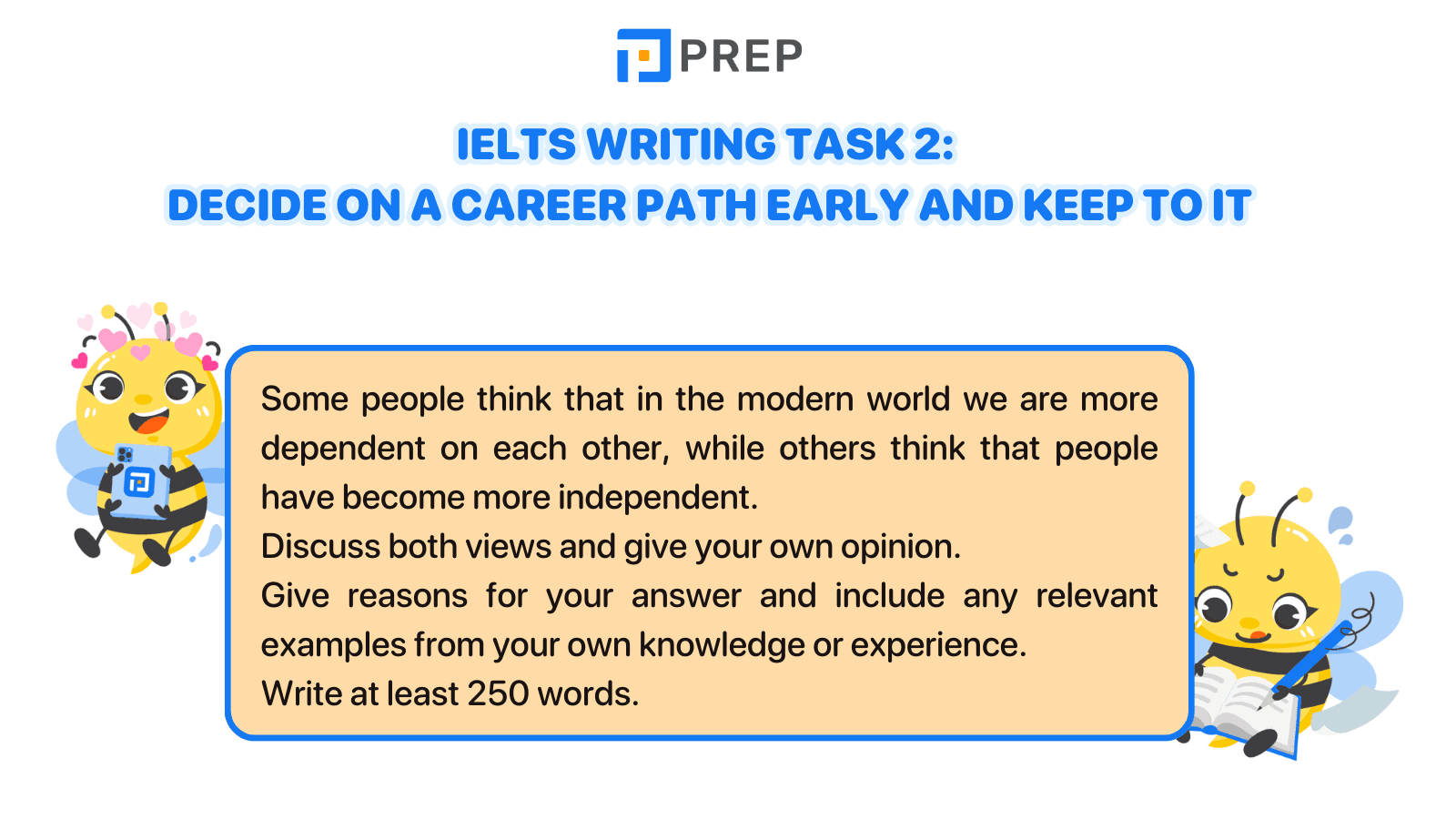
Some people believe it is best for young people to decide on a career early and follow it for life.
Others argue that it is better to try different jobs.
Discuss both these views and give your own opinion.
To explore all formats, refer to IELTS writing task 2 question types.
Essay Type: Discussion + Opinion (Discuss both views and give your opinion)
Primary Requirements:
-
Present arguments for making an early career decision and staying in the same field (e.g., career stability, development of expertise, job security).
-
Present arguments for exploring multiple career options or changing jobs (e.g., adaptability, life experience, finding true passion, avoiding stagnation).
-
Clearly state your own view and justify it with examples or logical reasoning.
This question is a classic example of a “Discuss both views and give your opinion” essay, requiring you to analyze both sides and demonstrate a clear, well-supported personal stance.
To understand this format better, review IELTS writing task 2 discussion essay.
II. Band 5.5–6.5 Sample for Deciding on a Career Path Early
Below you will find a sample essay for the topic “Decide on a career path early and keep to it,” written at a Band 5.5–6.5 level. This example reflects how an average candidate might approach this “Discuss both views and give your opinion” question, using clear but basic language and essay structure.
You can also review opinion essay IELTS writing task 2.
1. Band 5.5–6.5 Sample Essay with Paragraph Analysis
Sample Essay:
Some people think it is better for young people to choose a job early and stay in that career for life. Others believe it is good to change jobs sometimes and try different things. In this essay, I will discuss both views and give my opinion.
On the one hand, picking a career early and following it for many years can make people more experienced. They can learn more and become experts in their job. Also, they may get good promotions and earn higher salaries. It can help them have a stable life, and they do not need to worry about finding a new job all the time.
On the other hand, some people want to try different jobs in their life. This can give them more experience and a chance to find a job they really like. If they do not enjoy their first job, they can change. It also helps them learn new skills and meet many people.
In my opinion, it is better to try new jobs when you are young. People do not always know what is best for them at first, so they should have a chance to change if they are not happy.
Paragraph Analysis:
-
Introduction:
-
Paraphrases the task; states both views and signals a personal opinion.
-
-
Body Paragraph 1:
-
Lists clear reasons for one-job-for-life: experience, promotion, stability.
-
Lacks examples and in-depth development.
-
-
Body Paragraph 2:
-
Lists reasons for changing jobs: more experience, happiness, learning.
-
Ideas are basic and not supported by specific evidence.
-
-
Conclusion/Opinion:
-
Clearly gives a personal stance (prefer changing) but does not elaborate or justify extensively.
-
To write stronger endings, review conclusion in IELTS writing task 2.
2. Common Vocabulary and Expressions (Band 5.5–6.5)
For the topic "decide on a career path early and keep to it," Band 5.5–6.5 candidates typically use clear but basic vocabulary. The words and expressions below are useful for describing jobs, career decisions, stability, and trying different professions.
Useful Vocabulary
|
Category |
Examples |
|
Job/Career |
job, career, work, occupation, position, field, industry |
|
Stability |
stable job, stay in one job, keep a job, secure job, promotion |
|
Change/Experience |
change jobs, try new jobs, different experience, learn new skills |
|
Achievements |
get a promotion, become an expert, earn a higher salary, be successful |
|
Feelings/Attitude |
be happy, like a job, do not enjoy, not satisfied |
|
General reasons |
for a long time, from an early age, many years, most people, young people |
Common Expressions
-
“Choose a job/career early and stay in it for life”
-
“Try many different jobs/fields in your life”
-
“Gain more experience by working in different places”
-
“Become an expert by doing one job for a long time”
-
“Get promoted and earn more money”
-
“Be unhappy in a job and want to change”
-
“Find a job you really like”
-
“Have a stable life”
3. Grammar & Sentence Structures (Band 5.5–6.5)
At the Band 5.5–6.5 level, grammar structures are generally straightforward and mostly accurate. However, there is limited variety. Sentences rely on simple linkers and are prone to repetition. Occasional errors in agreement, tense, or articles may also appear.
Common Sentence Patterns
|
Type |
Examples |
|
Simple sentences |
“Some people choose a job early.” “It is good for the future.” |
|
Compound sentences |
“You can gain experience and get a better job.” |
|
Using ‘because/so/but’ |
“People stay in one job because it is safe.” “They change jobs if they are bored.” |
|
Opinions |
“I think it is better to try different jobs.” “In my opinion, stability is important.” |
|
Generalizations |
“Most young people change jobs many times.” |
Frequent Grammar Mistakes
|
Error Type |
Incorrect |
Correct |
|
Subject–verb agreement |
“People chooses new job.” |
“People choose a new job.” |
|
Tense errors |
“She stay in her job for ten years.” |
“She stayed in her job for ten years.” |
|
Article/plural errors |
“He found an interesting work.” |
“He found interesting work.” |
|
Run-on sentences |
“Some want a better career they change jobs a lot.” |
“Some want a better career, so they change jobs a lot.” |
Style and Linking
-
Frequent use of “and,” “but,” “because,” and “if.”
-
Paragraphs may start with “Some people think…,” “Many people…,” “There are…”
-
Little use of complex or conditional sentences.
III. Band 7.0+ Model for Deciding on a Career Path Early
The following section gives a model Band 7.0+ essay for the topic “Decide on a career path early and keep to it,” along with a paragraph-by-paragraph analysis.
1. Band 7.0+ Model Essay with Paragraph Analysis
Sample Essay:
Some people argue that choosing a career early in life and remaining committed to it is the most effective way to achieve long-term success. Others, however, believe that changing jobs and exploring different career paths leads to greater satisfaction and growth. This essay will discuss both perspectives before outlining my own position.
On the one hand, those who support a single-career approach point out that staying in the same profession enables individuals to develop deep expertise and a robust professional reputation. Such specialization can result in faster promotions, higher income, and a sense of job security. For instance, doctors and engineers who dedicate their entire careers to one field often become highly respected experts, trusted by colleagues and valued by employers. Moreover, staying in one job can help people plan for the future, as they can predict their career trajectory and retirement benefits.
On the other hand, advocates of career flexibility emphasize the advantages of adaptability in today’s fast-changing job market. By switching roles or industries, individuals can acquire diverse skills, discover their passions, and avoid stagnation or burnout. For example, someone who starts in marketing but later moves into tech or entrepreneurship may find a more satisfying fit and broader career prospects. Additionally, changing jobs can help workers respond to economic shifts and technological advances, making them more resilient throughout their working lives.
In my view, while there are clear merits to early specialization, it is ultimately more beneficial for young people to explore a range of opportunities before settling on a career. This approach fosters personal growth and allows individuals to make more informed, fulfilling choices in the long run.
Paragraph Analysis:
-
Introduction:
-
Paraphrases the task, signals both arguments, and presents the writer’s own position (last sentence).
-
-
Body Paragraph 1:
-
Develops the “stay with one career” view, using reasons (expertise, security, promotions) and a concrete professional example (doctors, engineers).
-
Academic vocabulary and collocations included (specialization, robust professional reputation).
-
-
Body Paragraph 2:
-
Explores the “multiple jobs” approach, discussing adaptability, avoiding burnout, skill diversity, and real-world application (changing industries).
-
Links points with advanced & varied linking words, includes practical reasoning (job market, resilience).
-
-
Conclusion/opinion:
-
Restates a personal position, clearly justified and future-oriented.
-
Language is concise, demonstrates argument weighing, and closes decisively.
-
Band 7.0+ Features Highlighted:
-
Developed, extended arguments on both sides with supporting examples
-
Cohesive devices and topic-specific academic vocabulary throughout
-
Accurate, varied complex structures, relative clauses, and conditional sentences
-
Specific rather than general reasoning
-
Clear, well-supported final opinion

2. Advanced Vocabulary & Collocations for the Topic
At Band 7.0+ for the essay “Decide on a career path early and keep to it,” you should use sophisticated, topic-specific language and collocations to express ideas around career stability, flexibility, and personal growth.
Academic Vocabulary & Collocations
|
Concept/Idea |
Collocations / Expressions |
|
Career stability |
pursue a singular career path, build long-term expertise, enjoy job security, plan for retirement, predictable career trajectory |
|
Career flexibility |
embrace career mobility, switch professions, adapt to a dynamic job market, broaden skill sets, transition between industries |
|
Personal development |
foster self-discovery, realize one’s passion, avoid career stagnation, enhance adaptability, develop transferable skills |
|
Workplace success |
climb the career ladder, earn a promotion, establish a professional reputation, secure a lucrative position |
|
Challenges/risks |
face employment uncertainty, risk burnout, struggle with job satisfaction, encounter limited advancement |
|
Benefits (general) |
reap the rewards of specialization, remain resilient to economic shifts, maximize personal fulfillment |
To expand your range, explore learn IELTS writing vocabulary.
Useful Expressions & Sentence Starters
-
“Changing jobs allows individuals to broaden their horizons and acquire new competencies…”
-
“Those who dedicate themselves to a single career path tend to…”
-
“A linear career trajectory may provide a sense of stability and predictability…”
-
“Conversely, career flexibility equips people to navigate an evolving labor market…”
-
“One potential drawback of frequent job changes is…”
Idiomatic and Polished Academic Language
-
“climb the corporate ladder”
-
“become an authority in the field”
-
“future-proof one’s career”
-
“specialize in a niche area”
-
“test the waters in multiple industries”
-
“career path is not set in stone”
-
“adapt to shifting professional landscapes”
-
“strike a balance between stability and exploration”
3. Grammar & Sentence Structures (Band 7.0+)
Band 7.0+ responses for the topic “Decide on a career path early and keep to it” demonstrate variety and control in structure, using complex sentences, accurate referencing, and advanced linking.
Advanced Sentence Structures
|
Function |
Example Structure |
|
Stating general belief |
“It is widely believed that committing to a single profession ensures long-term security.” |
|
Weighing alternatives |
“While early specialization can result in rapid advancement, it may also limit personal growth.” |
|
Using conditionals |
“If young people are encouraged to explore, they may ultimately discover their true passion.” |
|
Cause and effect |
“Because the job market is increasingly dynamic, adaptability has become a crucial skill.” |
|
Conceding a point |
“Although a stable career path is attractive, switching fields frequently can foster adaptability.” |
|
Relative clauses |
“Those who remain in one industry, which is becoming less common, often develop unrivaled expertise.” |
Useful Complex and Compound Linking
-
Contrasting views: “On the other hand,…” “Conversely,…” “Nevertheless,…”
-
Adding ideas: “Furthermore,…” “In addition,…” “What is more,…”
-
Explaining/summarizing: “In summary,…” “Overall,…” “For these reasons,…”
-
Providing examples: “For instance,… ” “A case in point is…”
Formal Style and Pronoun Reference
-
“Such a strategy may benefit those who value stability.”
-
“This approach, however, may not suit everyone.”
-
“Many people now seek careers that are not necessarily linear.”
-
“These choices reflect shifting attitudes in today’s workforce.”
IV. Examiner’s Comments: Career Path Essays
A Band 7.0+ essay on the topic “Decide on a career path early and keep to it” is characterized by balanced argument development, mature reasoning, and flexible language use. Here is how examiners distinguish high-band essays from lower-band responses:
-
Task Response: Both views are examined in depth with relevant, extended examples or analysis. The writer’s personal stance is clear and justified with nuanced reasoning or a real-world example.
-
Coherence and Cohesion: Paragraphs are logically sequenced, each focused on a single, clear idea. Cohesive devices and referencing (“such a strategy,” “this approach,” “on the other hand…”) connect ideas smoothly throughout the essay.
-
Lexical Resource: Wide range of topic-specific and academic vocabulary such as “specialization,” “career mobility,” “professional reputation,” “broaden skill sets.” Collocations and idiomatic phrases are used naturally.
-
Grammatical Range and Accuracy: Flexible use of complex, compound, and conditional structures; errors are rare and do not hinder understanding or naturalness.
To understand scoring, see IELTS writing band scores.
Suggestions to Reach Band 7+:
-
Develop both views with depth: Avoid surface-level pros/cons and give reasons, examples, or consequences for each side.
-
Justify your position: The strongest essays use real examples or thoughtful logic—not just “I think it is better to change jobs.”
-
Paraphrase key terms and vary language: Use topic collocations and avoid repeating “job,” “work,” or “life.”
-
Use advanced structures: Try conditionals, relative clauses, and mixed sentence lengths for cohesion and style.
A Band 7+ response convinces the examiner that you can organize, develop, and articulate nuanced ideas fluently—using both language and logic suited for the IELTS test and for real-world communication.
To improve faster, follow the formula for IELTS writing band 7.
Hopefully, after reading the high-quality sample IELTS Writing Task 2 Decide on a career path early and keep to it (band 7.0+), you have learned how to develop a detailed outline and use vocabulary more appropriately. Keep following PREP for more great IELTS Writing Task 2 prompts and samples!

Hi I'm Chloe, and I am currently serving as an Product Content Administrator at Prep Education. With over five years of experience in independent online IELTS study and exam preparation, I am confident in my ability to support learners in achieving their highest possible scores.
Comment
Premium content
View all




Personalized roadmap


Most read





UEN: 202227322W
Address: 114 LAVENDER STREET, #11-83 CT HUB 2, SINGAPORE (338729)