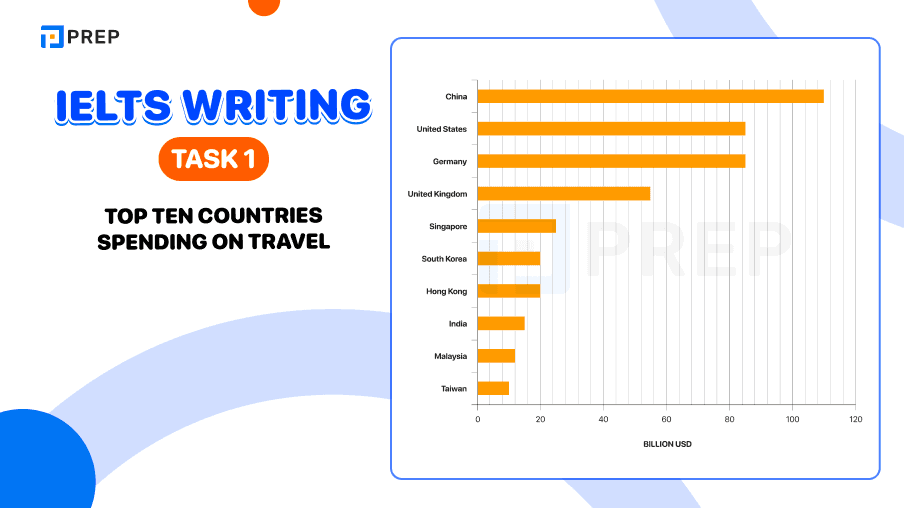
IELTS Writing Task 1 Top ten countries spending on travel
This guide explains how to approach IELTS Writing Task 1 questions about the top ten countries spending on travel. You will learn how to identify key rankings, compare expenditure data logically, write a strong overview, and use precise academic language to improve Task Achievement and Coherence.
Keynote – Task 1 Quick Guide
Direct Answer: For this task, focus on comparing the top spenders, major gaps, and any groupings or clusters among the ten countries—rather than simply listing every number.
Key Points to Remember:
-
Highlight which country spent the most and the least, as well as any countries with similar expenditures
-
Use a four-part structure: Introduction, Overview, Body 1, Body 2
-
Group and compare logically (by rank, region, or spending level), not just from left to right
-
Use precise comparative and superlative vocabulary
-
Avoid unnecessary detail; keep your writing clear, concise, and academic
I. What Is This IELTS Writing Task 1 Question Type?
The question “Top ten countries spending on travel” is a classic IELTS Writing Task 1 comparative bar chart or table task. It typically presents data about the total amount (or percentage) that each of the ten leading countries spent on international travel in a given year. You can compare this with pie chart task 1 to understand different chart formats.
In this task, you are required to:
-
Summarize and compare key data about travel spending among the top ten countries
-
Highlight major differences, similarities, and rankings (such as which country spent the most, which countries were close in amount, and any unexpected positions)
-
Identify and report trends, significant outliers, or groups of countries with similar spending levels. For trend-based questions, explore graphs with a trend.
How this question is different from others:
-
Instead of listing all figures, your answer should focus on overall ranking, dramatic gaps, and any notable groupings or surprises
-
The overview must pick up on who leads, who are in the middle, who lags, and if there are sharp divides or close clusters
Key elements to identify before writing:
-
Countries and their ranking: Who is first, last, middle? Any ties?
-
Units and measure: Dollars, euros, or percentage of global spending?
-
Main trends: Any country spending much more or much less than the rest? Are there regional patterns (e.g., Europe vs. Asia)?
-
Significant differences: Big jumps between positions, or are amounts close together?
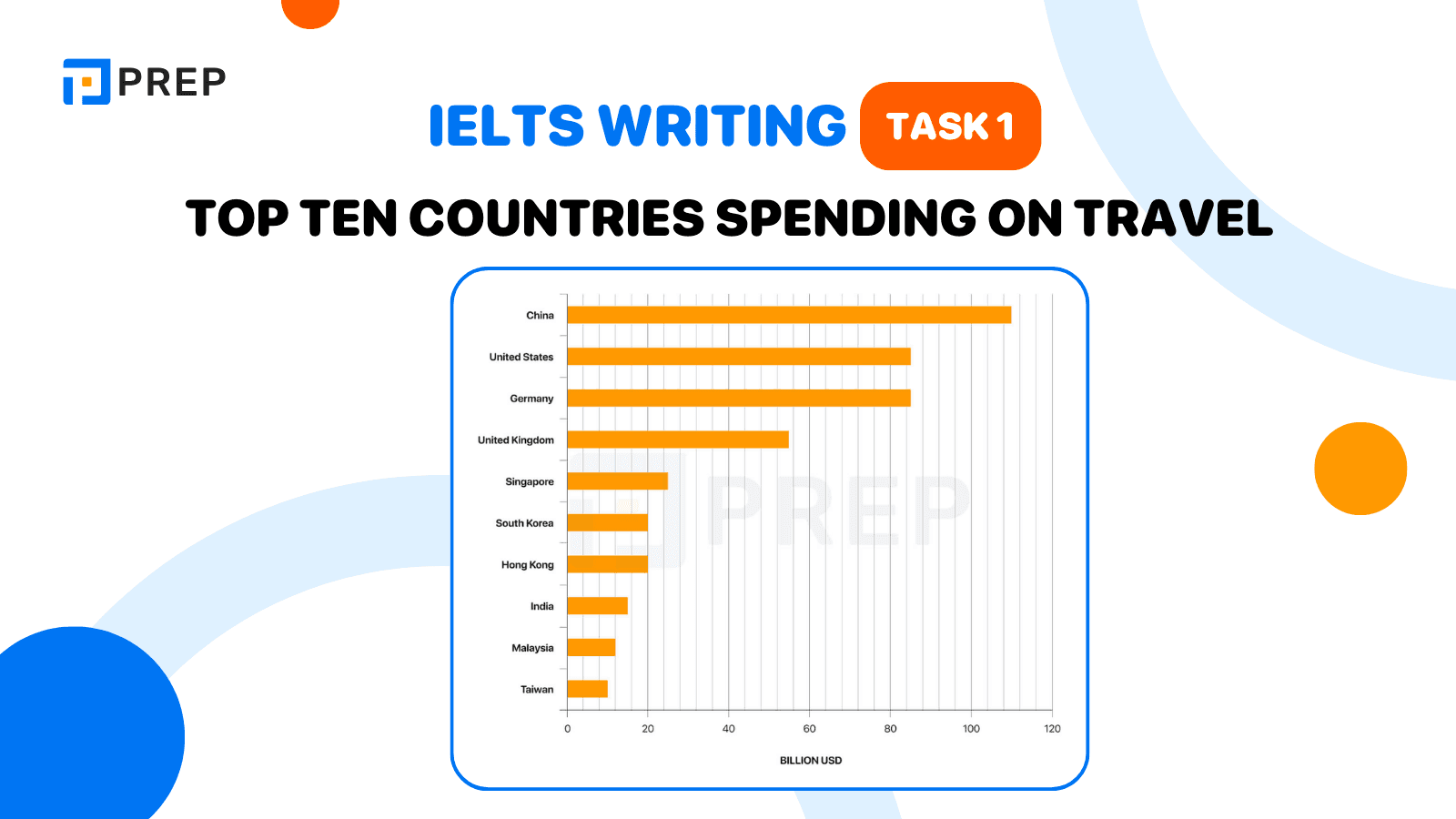
To better understand all formats, review IELTS writing task 1 question types.
II. Recommended Structure for Task 1
To write a high-scoring response for “top ten countries spending on travel,” you should organize your answer into four clear sections. The standard structure includes:
-
Introduction: Paraphrase the task to introduce the chart or table. You can improve this skill with IELTS writing task 1 introduction.
-
Overview: Summarize the main ranking, biggest spenders, clusters, or key patterns (without specific data). To master this section, refer to IELTS writing task 1 overview.
-
Body Paragraph 1: Describe and compare the leading countries and most significant differences. For better organization, review IELTS writing task 1 body paragraph.
-
Body Paragraph 2: Present details about countries in the middle or at the bottom, noting any similarities, exceptions, or additional trends
1. Sample Essay on IELTS Writing Task 1 – Top Ten Countries Spending on Travel
Question:
The bar chart below shows the amount of money spent on international travel by the top ten countries in 2019.
Summarize the information by selecting and reporting the main features, and make comparisons where relevant.
Sample Answer:
The bar chart compares travel spending by the top ten countries in 2019.
Overall, the United States and China spent by far the most on international travel, with a clear gap between them and all other countries. European countries dominated the middle rankings, while countries such as Brazil and Russia were among the lowest spenders in the top ten.
The United States led with approximately $160 billion, nearly double the amount spent by China ($87 billion). Germany and the United Kingdom followed with $83 billion and $72 billion, respectively. Countries like France, Italy, and Spain made up the middle of the ranking, each spending between $40 billion and $55 billion.
At the bottom of the list, Russia and Brazil both spent less than $20 billion, which is a fraction of the total spent by the US and even less compared to other leading countries. There was also a noticeable gap between the top two spenders and the rest, as almost all other countries spent less than $90 billion.
In conclusion, the chart shows a significant disparity among the top ten countries, with the US and China well ahead, several European countries in the middle, and Brazil and Russia with the lowest spending in this group.
Why this essay works well:
-
Introduction paraphrases the task concisely. This relies on strong skills in paraphrasing in IELTS writing.
-
Overview highlights biggest spenders, major gap, and regional pattern
-
Body paragraphs are grouped logically: top leaders, middle, bottom
-
Comparative and superlative language is used throughout
-
The response is clear, focused, and academic

2. Useful Language for This Task Type
When describing the top ten countries spending on travel in IELTS Writing Task 1, it’s important to use precise comparison language, ranking vocabulary, and academic expressions for sums and groups.
Vocabulary for Ranking and Spending
|
Function |
Useful Phrases |
|
Indicating the leader |
“The United States was the leading spender…” “China ranked second in travel expenditure…” |
|
Showing runners-up |
“Germany and the United Kingdom were among the biggest spenders…” |
|
Grouping the middle |
“France, Italy, and Spain made up the middle rankings…” |
|
Identifying the lowest |
“At the bottom of the top ten, Russia and Brazil spent the least…” |
|
Indicating sums |
“with an expenditure of $87 billion” “total spending reached…” |
Vocabulary for Comparison and Gaps
|
Purpose |
Examples |
|
Showing differences |
“nearly double,” “a clear gap,” “significantly ahead of,” “far greater than” |
|
Indicating similar amounts |
“had similar levels of spending,” “amounts were nearly equal” |
|
Highlighting ranges/clusters |
“the vast majority of countries spent under $100 billion” |
|
Expressing disparities |
“There was a substantial disparity between the top two and the rest.” |
Sentence Structures for Academic Tone
|
Purpose |
Examples |
|
Introducing data |
“The bar chart illustrates…” “According to the figures,…” |
|
Making complex comparisons |
“The US spent almost twice as much as China, while the remaining countries lagged far behind.” |
|
Summing up groups |
“Most of the top ten countries were European nations, clustered in the middle of the ranking.” |
Style and Grammar Notes
-
Use formal, academic phrases (“expenditure,” “top-ranked,” “in contrast”)
-
Use comparative/superlative forms: “higher than,” “the highest,” “lowest spenders”
-
Present simple tense for describing current/typical data
-
Group information logically, not just left-to-right on the chart
III. How This Task Type Is Assessed in IELTS Writing
For “top ten countries spending on travel” in IELTS Writing Task 1, your answer is evaluated against the four official band descriptors. To understand scoring, see IELTS writing band scores.
Task Achievement
-
Select and report main features—especially key differences (leaders, laggards), rankings, significant gaps, and notable clusters.
-
Provide a clear overview summarizing major patterns (e.g., “the US and China were far ahead, while most others spent less than $90 billion”).
-
Avoid simply listing all countries and figures in order—instead, group countries logically or by spending levels.
Coherence and Cohesion
-
Organize your essay clearly: Introduction, Overview, Body 1 (leaders), Body 2 (middle/bottom).
-
Group information into logical paragraphs—avoid merging all countries in one paragraph.
-
Use linking and comparative language for clear relationships: “by contrast,” “similarly,” “in comparison,” “while,” “whereas.”
Lexical Resource
-
Use a variety of academic vocabulary for ranking and spending: “lead,” “ranked,” “expenditure,” “lagged behind,” “dominated,” “significant gap,” “cluster.”
-
Employ a range of comparative and superlative structures: “twice as much,” “the most,” “significantly higher/lower.”
-
Avoid repetitive or informal words—paraphrase where possible.
Grammatical Range and Accuracy
-
Use a mix of simple, compound, and complex sentences; include both active and passive forms appropriately.
-
Maintain accurate use of present simple (for recent or typical data).
-
Use comparative/superlative forms and precise quantifiers (“nearly double,” “more than half,” “slightly ahead of”).
-
Ensure accuracy with plurals, articles, and prepositions.
A high-scoring answer for this chart groups countries intelligently, highlights important contrasts, and uses concise academic English with accurate grammar and formal linking expressions.
Hopefully, after reading this article, you now have a good understanding of the task prompt, a detailed outline, and a high-quality sample IELTS Writing Task 1 Top Ten Countries Spending on Travel. Let’s follow PREP regularly for more helpful English learning content!

Hi I'm Chloe, and I am currently serving as an Product Content Administrator at Prep Education. With over five years of experience in independent online IELTS study and exam preparation, I am confident in my ability to support learners in achieving their highest possible scores.
Comment
Premium content
View all


Personalized roadmap


Most read



UEN: 202227322W
Address: 114 LAVENDER STREET, #11-83 CT HUB 2, SINGAPORE (338729)