IELTS Writing Task 1 The cost of water in five cities in Australia
This guide explains how to approach IELTS Writing Task 1 questions about the cost of water in five cities in Australia. You will learn how to identify key differences, compare price data logically, write a strong overview, and use precise academic language to improve Task Achievement and Coherence.

Keynote – Task 1 Quick Guide
Direct Answer: For this task, focus on comparing the main price differences and trends among the five cities—especially for both minimal and higher water usage levels—instead of listing every figure.
Key Points to Remember:
-
Identify which city is the most and least expensive, and any that are similar
-
Use a four-part structure: Introduction, Overview, Body 1, Body 2
-
Group data logically, for example by usage level or by city ranking
-
Use precise comparison language and avoid vague terms
-
Summarize key patterns and skip unnecessary detail—clarity is more important than quantity
I. What Is This IELTS Writing Task 1 Question Type?
The question “The cost of water in five cities in Australia” is a typical IELTS Writing Task 1 comparative chart or table. It presents data about water prices (or household water bills) in five different cities at a specific time or over several years. You can explore comparative graphs IELTS Writing Task 1 to master comparison techniques.
In this task, you are required to:
-
Summarize and compare key data about water costs across the five cities
-
Highlight major contrasts, similarities, and notable trends—for example, which city has the highest or lowest cost, whether any two cities are similar, or if there’s a significant change over time
-
Identify and report biggest price differences, unexpected values, and common patterns
How this question is different from others:
-
Instead of just stating figures, your answer should focus on comparisons, ranking, and logical grouping (e.g., cities with similar prices, significant outliers, or changes)
-
The overview should describe main contrasts (e.g., “City A is consistently most expensive”, “City D and City E have the lowest costs”)
-
Sometimes the data may show prices for different usage levels (low/high consumption), in which case you must compare both scales appropriately
Key elements to identify before writing:
-
Cities and categories: List and group the five cities and any subcategories (e.g., usage levels, years)
-
Units and measure: Cost per kiloliter, annual bill, or another format
-
Main trends: Which city is always most/least expensive? Do any cities have similar costs? Are there big jumps or gradual increases?
-
Any anomalies: Is any city much cheaper or more expensive than expected?
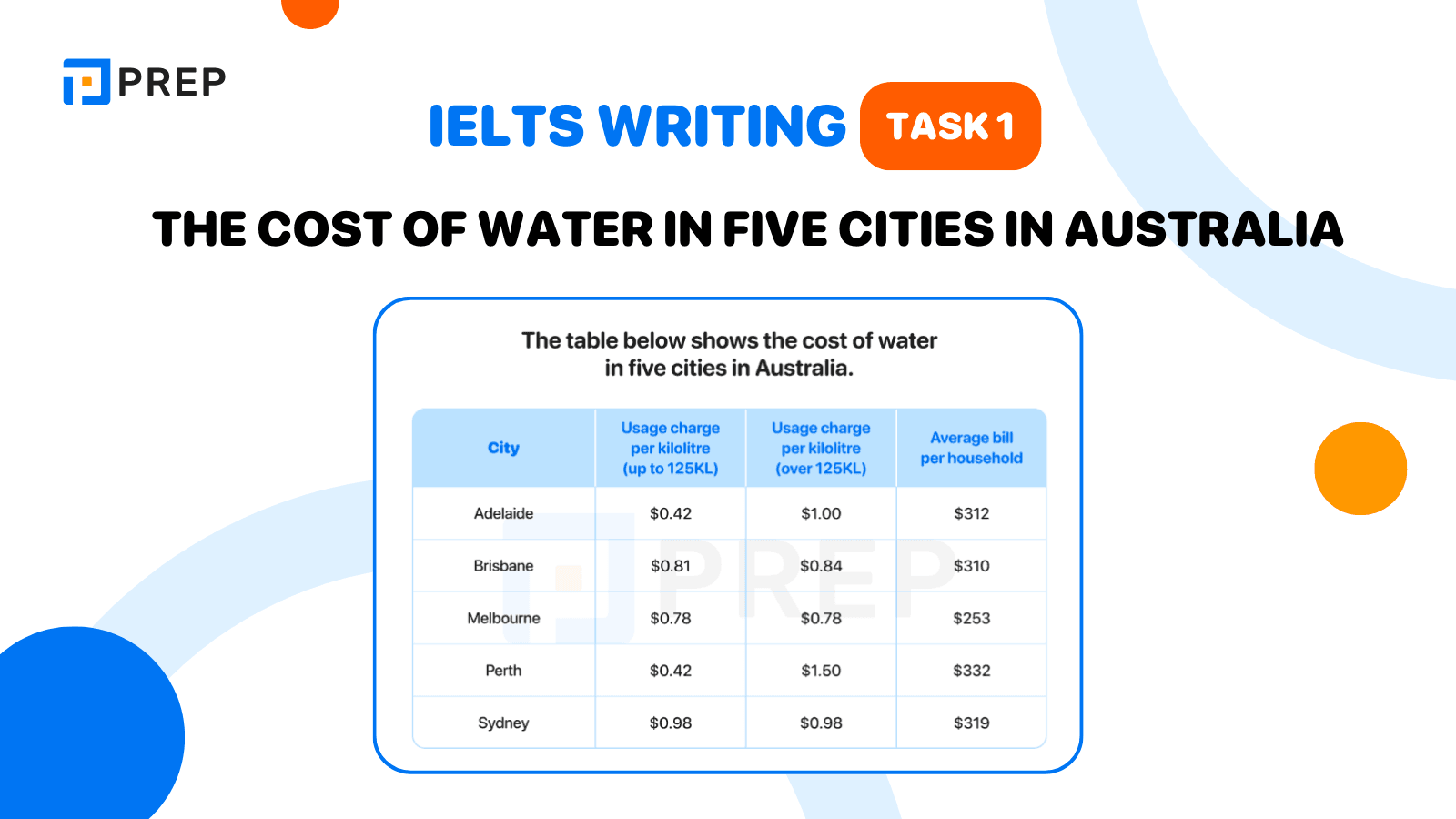
To better understand different formats, refer to IELTS writing task 1 question types.
II. Recommended Structure for Task 1
To achieve a high score on a Task 1 about the cost of water in five cities in Australia, you should organize your response into four clear sections. The standard structure includes:
-
Introduction: Paraphrase the question to introduce what the chart or table displays
-
Overview: Summarize the main trends, contrasts, or patterns (without using specific figures). To improve this skill, review IELTS writing task 1 overview.
-
Body Paragraph 1: Describe and compare the most striking features (e.g., the most/least expensive cities, remarkable differences). You can learn effective techniques in IELTS writing task 1 introduction.
-
Body Paragraph 2: Present additional comparisons, similarities among cities, details for other categories, or elaborate on secondary trends
1. Sample Essay on IELTS Writing Task 1 – The Cost of Water in Five Cities in Australia
Question:
The table below shows the cost of water (in Australian dollars per kiloliter) in five Australian cities.
Summarize the information by selecting and reporting the main features, and make comparisons where relevant.
Sample Answer:
The table presents the cost of water per kiloliter in five Australian cities: Sydney, Melbourne, Brisbane, Adelaide, and Perth.
Overall, there is considerable variation in water prices across the cities, with Perth consistently being the most expensive, while Sydney and Melbourne offer the lowest rates. Most cities have similar charges for lower usage, but prices differ more sharply for higher consumption levels.
At the minimum usage level, all five cities charge between $0.98 and $1.20 per kiloliter, with Sydney and Melbourne at the low end ($0.98) and Perth at the high end ($1.20). However, for households using larger amounts of water, Perth’s rate rises to $2.00 per kiloliter, which is substantially more expensive than the next highest city, Adelaide ($1.50). By contrast, Sydney and Melbourne remain the cheapest even at higher usage, with both charging just $1.00.
In summary, while water costs are generally affordable for low usage in all five cities, households using more water will pay significantly higher prices in Perth and Adelaide compared to Sydney and Melbourne.
Why this essay works well:
-
The introduction paraphrases the prompt concisely. This requires strong skills in paraphrasing in IELTS writing.
-
The overview summarizes main price patterns and contrasts among cities
-
The body paragraphs group data logically (by usage level and by city)
-
Comparative and superlative language is used throughout
-
The writing is clear, precise, and academic
2. Useful Language for This Task Type
When comparing the cost of water in different cities in IELTS Writing Task 1, using precise comparative language and academic vocabulary is essential for clarity and accuracy. To improve lexical range, explore learn IELTS writing vocabulary.
Vocabulary for Comparison and Price
|
Function |
Useful Phrases |
|
Showing highest/lowest |
“Perth had the highest water price…” “Sydney offered the lowest rate…” |
|
Similar costs |
“Water prices in Sydney and Melbourne were almost identical…” |
|
Noting variation |
“There was significant variation among cities…” |
|
Identifying increases |
“The rate increased sharply for high usage in Perth…” |
|
Expressing differences |
“Perth charged nearly twice as much as Sydney for high water consumption.” |
|
Highlighting exceptions |
“Unlike the other cities, Brisbane’s rate remained unchanged for all usage levels.” |
Vocabulary for Describing Data and Change
|
Purpose |
Examples |
|
Grouping by city or usage |
“For minimum usage, all cities charged between…” “At higher consumption levels…” |
|
Reporting figures |
“the cost per kiloliter was $1.20 in Perth” “households paid $0.98 in Sydney” |
|
Change or stability |
“remained the same,” “rose to,” “doubled at,” “showed little variation” |
Useful Sentence Structures
|
Purpose |
Examples |
|
Introducing data |
“The table displays the water cost in five cities…” “According to the chart,…” |
|
Making comparisons |
“Perth was by far the most expensive city, especially at higher usage levels.” |
|
Generalizing |
“In general, prices for higher water usage were more variable than for minimal consumption.” |
|
Noting patterns |
“Both Sydney and Melbourne kept prices low regardless of usage.” |
Grammar and Style Notes
-
Use comparative/superlative forms: “higher than,” “the most expensive,” “the least costly”
-
Use present simple for facts about costs, or past simple if describing historical/older data
-
Favor formal, academic tone: avoid “a lot more,” “cheaper,” “a big difference”—instead use “substantially higher/lower,” “minimal difference”
III. How This Task Type Is Assessed in IELTS Writing
When describing and comparing the cost of water in five cities in Australia, your answer will be assessed across the four official IELTS Writing Task 1 criteria:
Task Achievement
-
Clearly select and report main price contrasts, ranges, and patterns across different cities and for different usage levels.
-
Summarize overall trends and highlight any outliers or similarities between cities.
-
Avoid listing every figure; focus on the most important contrasts and any surprising gaps. Many common issues are explained in mistakes in IELTS writing.
-
Provide a balanced overview that covers both minimal and higher usage, if presented.
Coherence and Cohesion
-
Structure your response in logical paragraphs: Introduction, Overview, Body 1, Body 2.
-
Group your analysis meaningfully: for example, first by usage level, then by city, or vice versa.
-
Use linking words and comparative phrases accurately: “by contrast,” “while,” “however,” “in comparison,” “unlike.”
-
Ensure each main paragraph has a clear focus (e.g., lowest/highest costs, price progression, similarities, anomalies).
Lexical Resource
-
Use a range of formal, academic vocabulary for price, comparison, and change: “rate,” “cost per kiloliter,” “double,” “remain constant,” “showed variation.”
-
Use comparative/superlative structures: “the highest price,” “less expensive than,” “significantly cheaper.”
-
Avoid vagueness (“a lot more,” “very expensive”) in favor of precise, data-driven terms.
-
Paraphrase the question and avoid repeating basic terms.
Grammatical Range and Accuracy
-
Employ a mix of simple and complex sentences, including passive and noun phrases where appropriate.
-
Use correct tenses: present simple for current/typical prices, past simple for historical rates.
-
Use comparison structures fluently: “X charged almost twice as much as Y,” “the only city where the price doubled with usage.”
-
Maintain accuracy with plurals, articles, and subject–verb agreement.
A high-scoring answer groups pricing patterns logically, highlights main contrasts, and avoids unnecessary repetition or detail. Use precise, formal language and clear paragraphing for maximum clarity and coherence. To reach a higher band, follow the formula for IELTS writing band 7.
Hopefully, this article has helped you understand the prompt, detailed outline, and a high-quality sample IELTS Writing Task 1 The cost of water in five cities in Australia at band 7.0+. Keep following PREP to get more useful English knowledge updates!

Hi I'm Chloe, and I am currently serving as an Product Content Administrator at Prep Education. With over five years of experience in independent online IELTS study and exam preparation, I am confident in my ability to support learners in achieving their highest possible scores.
Comment
Premium content
View all




Personalized roadmap


Most read



UEN: 202227322W
Address: 114 LAVENDER STREET, #11-83 CT HUB 2, SINGAPORE (338729)