IELTS Writing Task 1 Population of New Zealand from 2011 to 2012
This guide explains how to approach IELTS Writing Task 1 questions about the population of New Zealand from 2011 to 2012. You will learn how to identify key changes, compare demographic data clearly, write a strong overview, and use precise academic language to improve your band score.
Keynote – Task 1 Quick Guide
Direct Answer: For this task, focus on describing the main changes and comparisons in New Zealand’s population by age group from 2011 to 2012—highlighting increases, decreases, and the most significant trends, not every number.
Key Points to Remember:
-
Identify which groups increased, decreased, or remained stable
-
Use a four-part structure: Introduction, Overview, Body 1, Body 2
-
Group information by age/trend, not only in data order
-
Emphasize the most significant change or standout group
-
Keep your writing precise, formal, and focused on summary and comparison
I. What Is This IELTS Writing Task 1 Question Type?
The question “Population of New Zealand from 2011 to 2012” is a typical IELTS Writing Task 1 trend and comparison chart (often shown as a table or line graph). It gives population data for New Zealand over two consecutive years and may include breakdowns by age group, gender, or region.
In this task, you are required to:
-
Summarize and compare the population numbers/trends across different groups or years. This is similar to how you analyze data in IELTS writing task 1 comparative graphs.
-
Highlight increases, decreases, and stability in total population or in specific groups (e.g., “population rose overall, but declined for the youngest age group”)
-
Identify and report major contrasts, exceptions, or patterns within the data, such as growth in older groups or decline in others
You can review IELTS writing task 1 line graph graph with a trend to better understand this format.
Key elements to identify before writing:
-
Years, categories, or breakdowns: Are you reporting by age, gender, region, or only totals?
-
Direction and magnitude of change: Which groups increased or decreased? By how much?
-
Important contrasts/patterns: Is overall growth small or large? Any age group or category stand out?
-
Any stability: Did some groups remain nearly the same, while others changed dramatically?
To explore more formats, you should check IELTS writing task 1 question types.
II. Recommended Structure for Task 1
For a question like “Population of New Zealand from 2011 to 2012,” a high-scoring answer should follow a clear four-part organization.
-
Introduction: Paraphrase the question and introduce the chart, table, or graph (mentioning years, location, and breakdowns if any). You can improve this skill by practicing paraphrasing in writing IELTS.
-
Overview: Summarize the key trends and major changes or patterns (overall growth/decline, standout increases or decreases, main stability). You can improve this section by learning IELTS writing task 1 overview.
-
Body Paragraph 1: Highlight the most significant or dramatic changes (e.g., largest increases/decreases, groups with clear trends). To structure your ideas better, refer to IELTS writing task 1 body paragraph.
-
Body Paragraph 2: Present additional comparisons, secondary patterns, exceptions, or less extreme changes
1. Sample Essay on IELTS Writing Task 1 – Population of New Zealand from 2011 to 2012
Question:
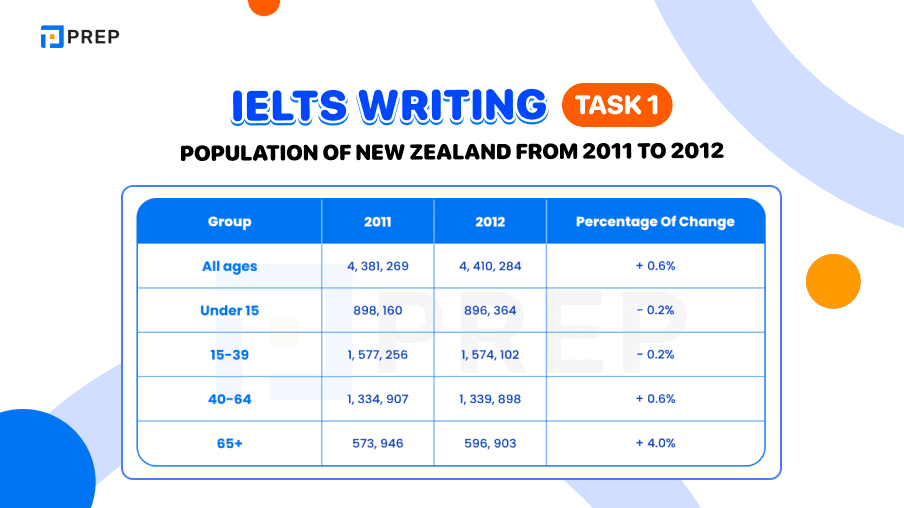
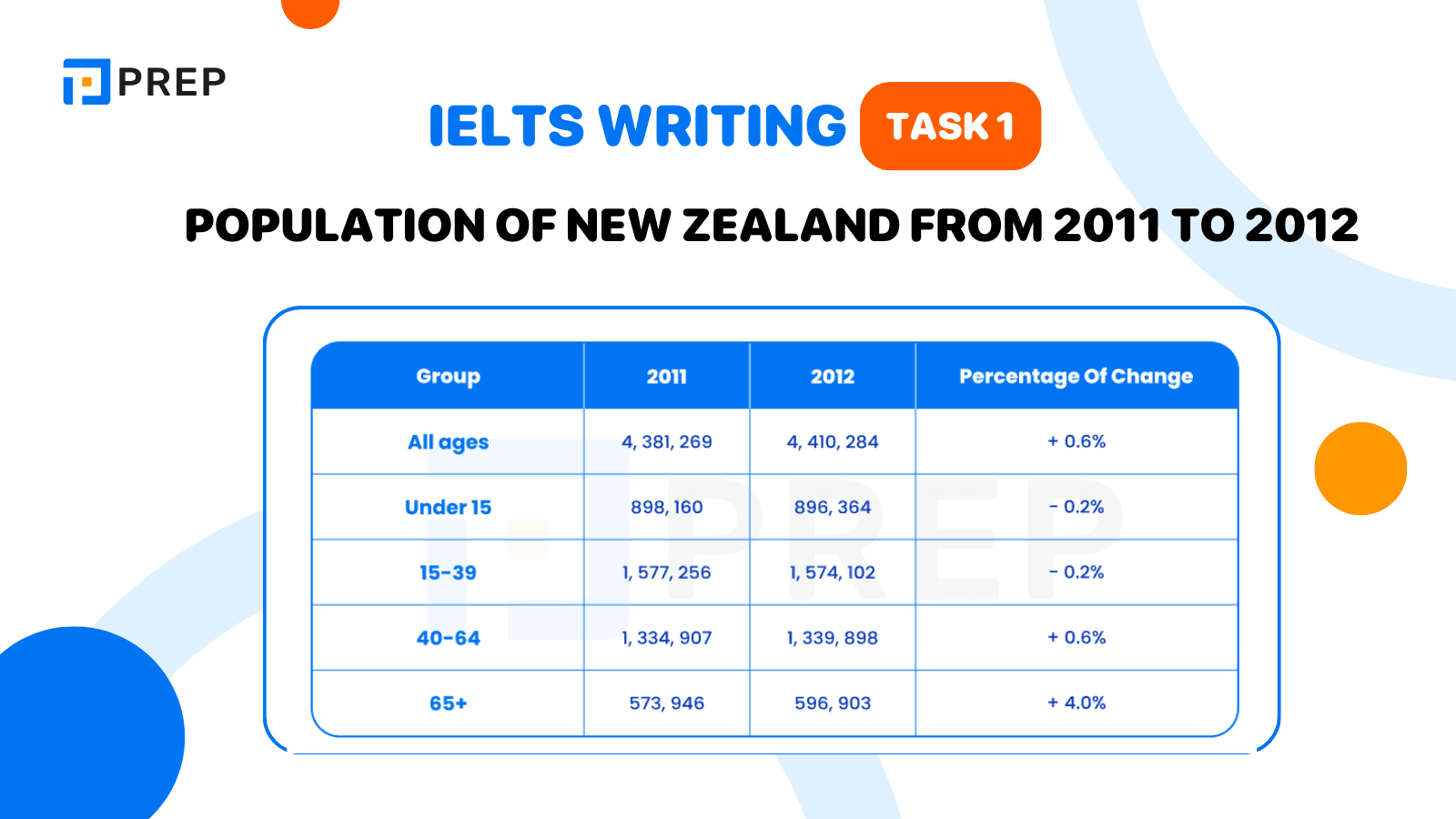
The table below shows New Zealand’s population by age group in 2011 and 2012.
Summarize the information by selecting and reporting the main features, and make comparisons where relevant.
Sample Answer:
The table provides data on the population of New Zealand by age group in 2011 and 2012.
Overall, the country experienced a slight overall growth in total population, with the most significant increase seen in the oldest age group (65+), while the number of children under 15 declined.
The total population rose from 4.381 million in 2011 to 4.410 million in 2012. Most notably, the 65+ age group increased from 573,000 to 601,000 (a rise of nearly 5%), marking the largest proportional growth. The 40–64 age group also saw a small increase. By contrast, the population of those under 15 years fell from 898,000 to 896,000, and the 15–39 age group decreased from 1.658 million to 1.647 million.
In summary, New Zealand’s slight population growth from 2011 to 2012 was mainly due to an increasing number of elderly residents, while the population of younger people declined.
Why this essay works well:
-
Introduction paraphrases the prompt concisely and completely
-
Overview summarizes the main trend (growth, demographic shift toward older population)
-
Body paragraphs are logically grouped: (largest change, minor/negative trends)
-
Key data chosen strategically—focus on percent, relative size, and pattern
-
Academic tone and clear language

2. Useful Language for This Task Type
When describing population trends in New Zealand from 2011 to 2012, it’s important to use clear vocabulary for comparison, growth or decline, and proportions. Here are useful phrases to strengthen your response:
Vocabulary for Describing Change and Trend
|
Function |
Useful Phrases |
|
Expressing increases |
“rose to,” “increased by,” “saw a (slight/significant) increase,” “grew from… to…” |
|
Expressing decreases |
“fell to,” “decreased by,” “declined from… to…,” “dropped slightly/significantly” |
|
Describing stability |
“remained steady,” “stayed nearly the same,” “was almost unchanged” |
|
Highlighting proportion |
“accounted for,” “made up,” “represented” |
Vocabulary for Comparison and Emphasis
|
Purpose |
Examples |
|
Grouping and ranking |
“the largest group was…,” “the highest/lowest population was…” |
|
Highlighting growth or decline |
“the only group to show a significant increase was…,” “the number of children under 15 was the only category to decline” |
|
Noting contrast |
“by contrast,” “while,” “however,” “in comparison,” “unlike the other groups” |
|
Quantifying change |
“an increase of nearly 5%,” “a slight drop of 11,000 people,” “grew by just over 2%” |
Useful Sentence Structures
|
Purpose |
Examples |
|
Introduction/overview |
“The table gives information about…” / “Overall, the population slightly increased, mainly due to growth in the elderly group.” |
|
Specific comparison |
“The 65+ age group grew more rapidly than any other category.” |
|
Summing up minor/negative trend |
“Both the under-15 and 15–39 groups showed a slight decline.” |
Grammar and Style Notes
-
Use past simple (“increased,” “dropped”) for changes between two completed years.
-
Use comparative structures clearly: “greater than,” “the largest increase,” “less than.”
-
Use academic, data-driven language: avoid “a lot,” “pretty big,” use “significant,” “slight,” “marginal.”
-
Be concise—summarize key changes instead of listing every figure.
III. How This Task Type Is Assessed in IELTS Writing
For questions like “Population of New Zealand from 2011 to 2012”, your response is evaluated according to the four official IELTS Writing Task 1 criteria. Here is how each applies to this type of trend and comparison task:
Task Achievement
-
You are expected to:
-
Select and summarize the most relevant changes and differences between years or age groups.
-
Clearly highlight increases, decreases, stability, or major shifts.
-
Provide a clear overview (e.g., “population grew slightly, mainly due to an increase in the oldest group”).
-
-
Do not list all numbers—focus on the main contrasts and overall patterns.
Coherence and Cohesion
-
Organize your answer in four paragraphs (Introduction, Overview, Body 1, Body 2).
-
Group details logically (by age group, direction of change, or trend).
-
Use logical linking and comparison language: “by contrast,” “while,” “however,” “meanwhile,” “whereas.”
-
Avoid jumping back and forth between years or age groups without a logical sequence.
Lexical Resource
-
Use a range of vocabulary for describing population changes: “increase,” “decline,” “remain steady,” “account for,” “category.”
-
Use comparison and quantifying language: “the largest increase,” “a marginal drop,” “fell slightly,” “rose by nearly five percent.”
-
Avoid repetitive or vague words; maintain an academic and objective tone.
Grammatical Range and Accuracy
-
Use both simple and complex sentence structures; compare groups using accurate grammar.
-
Use the past simple for completed years (“rose,” “decreased”).
-
Employ comparatives, superlatives, and range expressions: “the biggest change,” “the only group to increase,” “the sharpest decline.”
-
Maintain accuracy in verb forms, articles, and agreement.
A high-scoring answer groups similar trends, focuses on the main changes, uses precise vocabulary, and organizes points logically with clear language throughout.
To practice more complex data tasks, explore IELTS writing task 1 mixed charts.
This article provides the most detailed sample IELTS Writing Task 1 Population of New Zealand from 2011 to 2012, scored at 7.0+. Practice this prompt immediately with PREP's Virtual Writing Room to quickly improve your own band score! Wishing you all the best!

Hi I'm Chloe, and I am currently serving as an Product Content Administrator at Prep Education. With over five years of experience in independent online IELTS study and exam preparation, I am confident in my ability to support learners in achieving their highest possible scores.
Comment
Premium content
View all



Personalized roadmap


Most read





UEN: 202227322W
Address: 114 LAVENDER STREET, #11-83 CT HUB 2, SINGAPORE (338729)