IELTS Task 1: Population Figures for Four Nations
This guide explains how to approach IELTS Writing Task 1 questions about population figures for four countries. You will learn how to identify key trends, write a clear overview, organize comparisons logically, and use accurate academic language to improve Task Achievement and Coherence.

Keynote – Task 1 Quick Guide
Direct Answer: When describing population figures, your goal is to compare the size, change, and overall trend of populations among countries — not to report every number.
Key Points to Remember:
-
Focus on the big picture: highest and lowest populations, sharp changes, or similar growth
-
Use a 4-part structure: Introduction, Overview, Body 1, Body 2
-
Group countries based on trend or category (e.g., steady growth vs. rapid growth)
-
Only use specific numbers to support comparisons — don’t list all figures
-
Avoid common mistakes: wrong verb tense, poor grouping, or data overload
I. What Is This IELTS Writing Task 1 Question About?
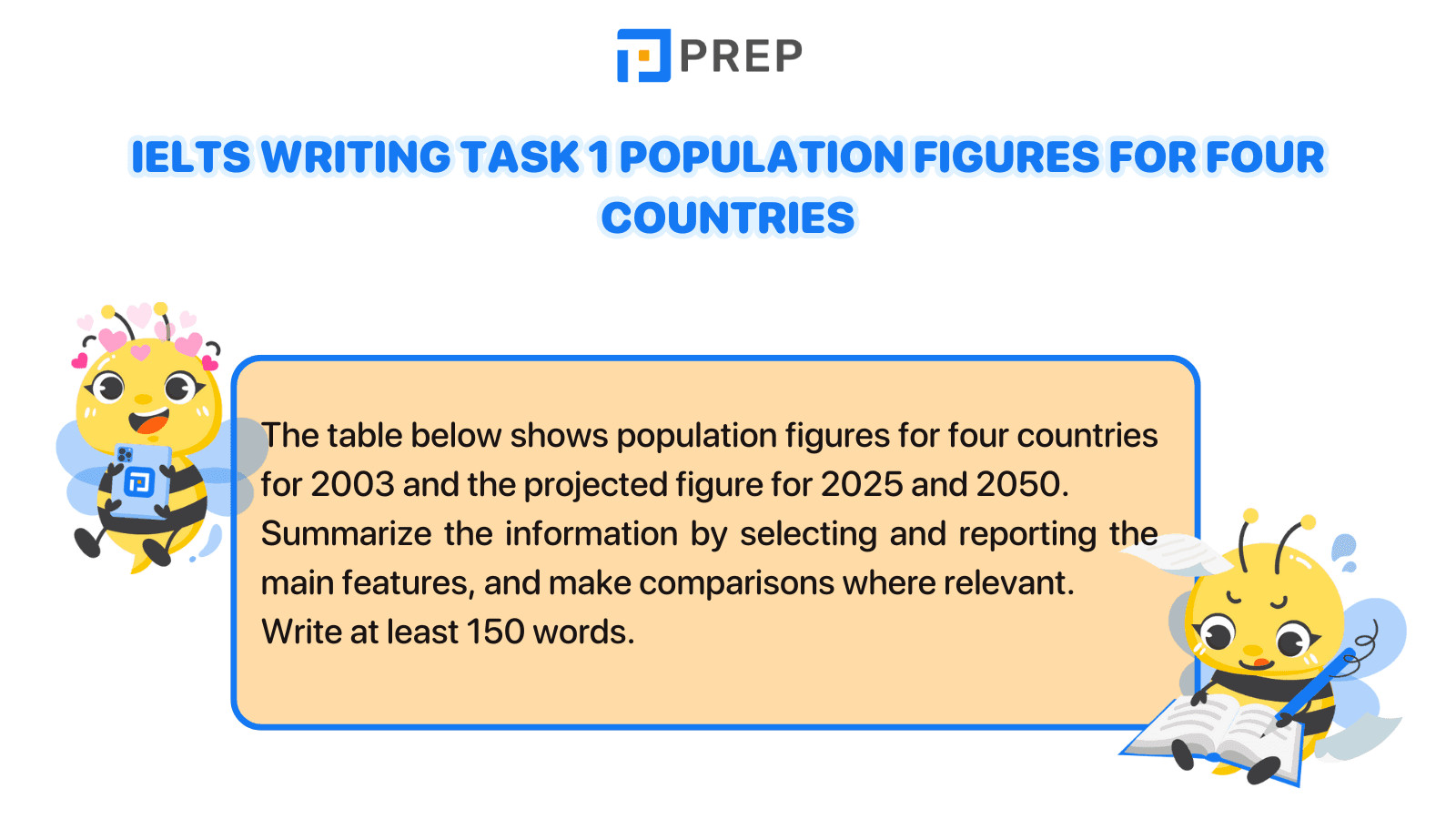
The question “Population figures for four countries” is a classic IELTS Writing Task 1 comparative graph question, often presented as a bar chart, table, or line graph. In this task, your goal is to:
-
Summarize and compare population figures between the countries
-
Identify significant differences, similarities, and changes
-
Highlight notable trends, such as which country had the highest or lowest population, or whether a country's population increased rapidly or remained stable
Unlike maps or process diagrams, this type focuses on quantitative comparison. You must describe how countries differ in population size and how these differences change over time, if a timeline exists.
If the data includes future projections (e.g., population in 2050), you are also expected to show awareness of how to describe estimated or forecasted figures.
To understand this format better, explore IELTS writing task 1 question types.
Key elements to identify before writing:
-
Time frame: Are the population figures from the past, present, or future?
Use past simple, present simple, or future tenses accordingly. -
Units of measurement: Millions? Thousands? Percentages?
This impacts how you phrase your comparisons correctly. -
Number of countries compared: In this case, four — so you need to decide:
-
Whether to group them by size (e.g., countries with the largest/smallest populations)
-
Or by trend (e.g., increasing vs. decreasing)
-
-
Main trends:
-
Is one country growing quickly while others are stable?
-
Is there a sudden shift in ranking between countries?
-
Are all values close together, or is there a wide difference?
-
II. Recommended Structure for Task 1
To achieve a high band score in IELTS Writing Task 1 when describing population figures for multiple countries, you should follow a clear and logical four-part structure. The standard structure includes:
-
Introduction: Paraphrase the task question to introduce the chart or table. You can improve this step with IELTS writing task 1 introduction.
-
Overview: Summarize the most striking differences, trends, or overall comparisons. A detailed guide is available in IELTS writing task 1 overview.
-
Body Paragraph 1: Focus on the most notable figures or countries (e.g., highest and lowest populations). For better organization, see IELTS writing task 1 body paragraph.
-
Body Paragraph 2: Continue with comparisons or describe other countries and less significant details
1. Sample Essay on IELTS Writing Task 1 – Population Figures
Question:
The chart below shows the population (in millions) of four different countries in 1990 and 2015, with a projection for 2040.
Summarise the information by selecting and reporting the main features, and make comparisons where relevant.
Sample Answer:
The bar chart compares the populations of four countries — China, India, the USA, and Japan — in three different years: 1990, 2015, and a projected figure for 2040.
Overall, China and India had the largest populations throughout the period, with noticeable growth in India. In contrast, Japan had the smallest population and is expected to decline further, while the USA shows steady but moderate growth.
In 1990, China had the highest population at around 1.1 billion, followed closely by India at just under 900 million. By 2015, both countries had grown significantly, with India narrowing the gap. The USA’s population rose from approximately 250 million to over 300 million. Japan's population increased slightly in 2015 but is projected to decline sharply by 2040.
Looking forward to 2040, India is expected to overtake China, reaching nearly 1.5 billion people, while China’s population is predicted to stabilize. The USA is projected to experience modest growth, whereas Japan may see a significant drop, falling below its 1990 level.
Why this essay works well:
-
Introduction clearly paraphrases the topic
-
Overview summarizes the key trend (India rising, Japan falling)
-
Body paragraphs are logically split: past vs. future, high vs. low
-
Language is precise, comparative, and trend-driven
-
Verb tenses are varied and accurate (past simple and future forms)
-
Vocabulary includes useful terms like: projected, followed closely, modest growth, decline sharply, stabilize
2. Useful Language for This Task Type
When writing about population figures across multiple countries, you need a strong command of vocabulary that highlights size, growth, decline, and comparison. Accuracy and clarity in word choice will directly affect your score under the Lexical Resource and Grammatical Range criteria.
Vocabulary for Describing Population Size
|
Function |
Useful Phrases |
|
Talking about large numbers |
“X had the largest population, at around…” |
|
Describing mid-range |
“Y’s population stood at approximately…” |
|
Indicating small numbers |
“Z had by far the smallest population, with just over…” |
|
Expressing ranking |
“India ranked second in terms of total population.” |
|
Talking about proportion |
“X accounted for roughly one-third of the total population.” |
Vocabulary for Trends and Projections
|
Trend Type |
Verbs / Phrases |
|
Increase (past/future) |
rose, increased, grew, is expected to rise, is projected to grow |
|
Decrease (past/future) |
fell, decreased, declined, is predicted to fall, will likely decline |
|
Stability or plateau |
remained stable, stayed constant, is expected to level off |
|
Future forecast |
is projected to reach, is forecast to continue growing, will fall to |
Comparative and Superlative Structures
|
Comparison Type |
Examples |
|
General comparison |
“X had a higher population than Y.” / “X’s figure was almost double Y’s.” |
|
Similarity |
“X and Y had nearly equal populations.” |
|
Superlative |
“China had the highest overall population throughout the period.” |
|
Contrast phrases |
“By contrast,” / “In comparison,” / “Unlike X, Y…” |
Sentence Starters for Task 1
-
“According to the chart,…”
-
“In terms of total population,… ”
-
“Between 1990 and 2015,…”
-
“Over the 50-year period shown,…”
-
“Looking ahead to 2040, it is projected that…”
Style Notes
-
Use formal, objective tone: Avoid personal opinions (e.g., “I think”)
-
Don't be vague: Avoid phrases like “a lot of people” or “many” when precise numbers or trends are given
-
Always report comparisons or trends, not isolated facts
-
Use data selectively to support observations — not every number needs to be mentioned
III. How This Task Type Is Assessed in IELTS Writing
To achieve a high band, your report must match the four official IELTS Writing criteria: Task Achievement, Coherence and Cohesion, Lexical Resource, and Grammatical Range and Accuracy.
Task Achievement
-
Address all elements of the task, summarize the key points and main trends, and make valid comparisons between the countries’ population figures.
-
To score well:
-
Include all necessary parts: Introduction, Overview, 2 Body paragraphs
-
Focus on major differences, trends, and extremes, not every number
-
Mention predictions using modal verbs (e.g., will rise, is expected to decline) if the chart includes future data
-
Coherence and Cohesion
-
Your writing must flow smoothly with clear structure and logical information grouping.
-
To score well:
-
Follow a clear 4-part structure: Introduction, Overview, Body 1, Body 2
-
Group countries by trend or scale (e.g., countries that increased the most)
-
Use cohesive devices such as: In contrast, while, whereas, similarly, meanwhile, from 1990 to 2015…
-
Lexical Resource
-
The ability to use accurate and varied words and phrases to describe quantity, trend, and comparison.
-
To score well:
-
Use a range of precise verbs and adjectives (e.g., surged, declined sharply, remained stable)
-
Include comparison vocabulary (e.g., twice as many, slightly more than, similar to…)
-
Avoid overly casual or spoken expressions
-
Grammatical Range and Accuracy
-
Use a mixture of sentence types with mostly correct grammar. Tenses must match the time frame in the chart (past, present, or future).
-
To score well:
-
Use mix of simple, compound, and complex structures
-
Choose tenses carefully:
past simple → for past data,
present simple → for general facts,
future forms (will, be projected to) → for predictions -
Use comparative structures accurately:
X was greater than Y; Z had the highest population.
-
If you're preparing for population comparison graphs, it's helpful to practice with related Task 1 formats that test similar skills: selecting key data, grouping logically, and making comparisons clearly.
-
Line graphs showing population changes across several countries over time
-
Bar charts comparing population figures from multiple countries
-
Tables or combined charts (e.g., population + urbanization rates, past + future projections)
-
Double bar charts showing age or gender distribution in different countries
-
Maps comparing urban or rural population density before and after development
Above is a sample IELTS Writing Task 1 Population figures for four countries compiled by top-notch teachers at PREP. Refer to it to effectively prepare for the exam and confidently conquer a very high band score in the real test!

Hi I'm Chloe, and I am currently serving as an Product Content Administrator at Prep Education. With over five years of experience in independent online IELTS study and exam preparation, I am confident in my ability to support learners in achieving their highest possible scores.
Comment
Premium content
View all




Personalized roadmap


Most read




UEN: 202227322W
Address: 114 LAVENDER STREET, #11-83 CT HUB 2, SINGAPORE (338729)