IELTS Writing Task 1 Percentage of male and female workers in country A and country B
This guide explains how to approach IELTS Writing Task 1 questions about the percentage of male and female workers in two countries. You will learn how to identify key differences, compare gender data logically, write a strong overview, and use precise academic language to improve Task Achievement and Coherence.
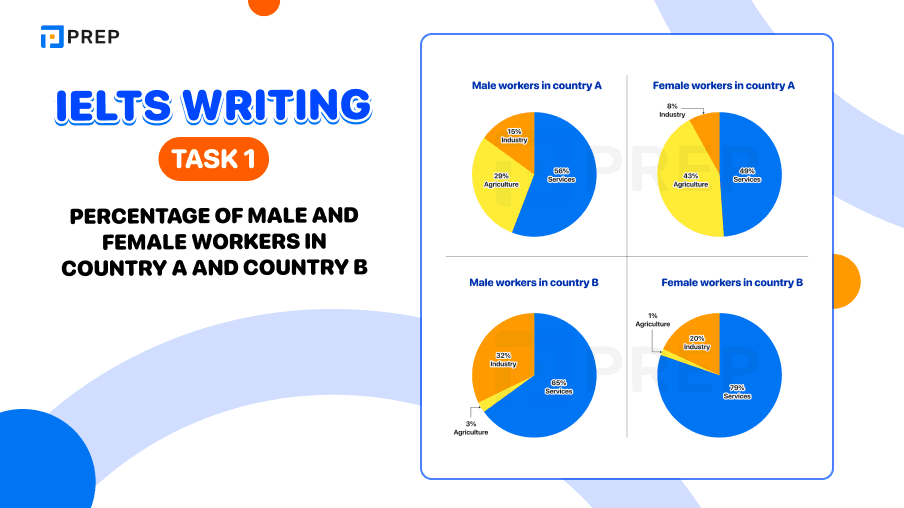
Keynote – Task 1 Quick Guide
Direct Answer: For this task, focus on comparing the main differences and patterns in male and female employment rates between the two countries—rather than listing all individual figures.
Key Points to Remember:
-
Highlight which country and gender have the highest and lowest employment percentages
-
Use a four-part structure: Introduction, Overview, Body 1, Body 2
-
Always group information logically (by country, by gender, or by trend), not just report each category in order
-
Use clear comparative language to show major gaps or similarities
-
Keep your writing concise and academic; avoid unnecessary details or repetition
I. What Is This IELTS Writing Task 1 Question Type?
The question “Percentage of male and female workers in country A and country B” is a classic IELTS Writing Task 1 comparative bar chart or table question. It presents data about the proportion of male and female workers in two different countries, either within specific sectors, overall, or possibly across several years.
In this task, you are required to:
-
Summarize and compare the percentages of men and women in the workforce across countries A and B
-
Highlight major differences, similarities, and trends (e.g., which country has a higher proportion of female workers, where is the gender gap biggest, or in which sectors do men or women dominate). For trend-focused questions, see graphs with a trend.
-
Clearly identify key features such as the group with the highest/lowest percentage, any notable gender reversals, or outliers
How this question is different from others:
-
Your answer must focus on logical comparisons, patterns, and contrasts, not simple data reporting
-
The overview should emphasize main contrasts between countries and gender, as well as any surprising or noteworthy findings
Key elements to identify before writing:
-
Categories: Is the data overall, by industry, or another subgroup?
-
Units and measure: Percentages or raw numbers?
-
Main trends: Is one gender consistently higher? Is there a reversal between countries? Are there any anomalies?
-
Stability or change: Does the chart show one point in time or changes over time?
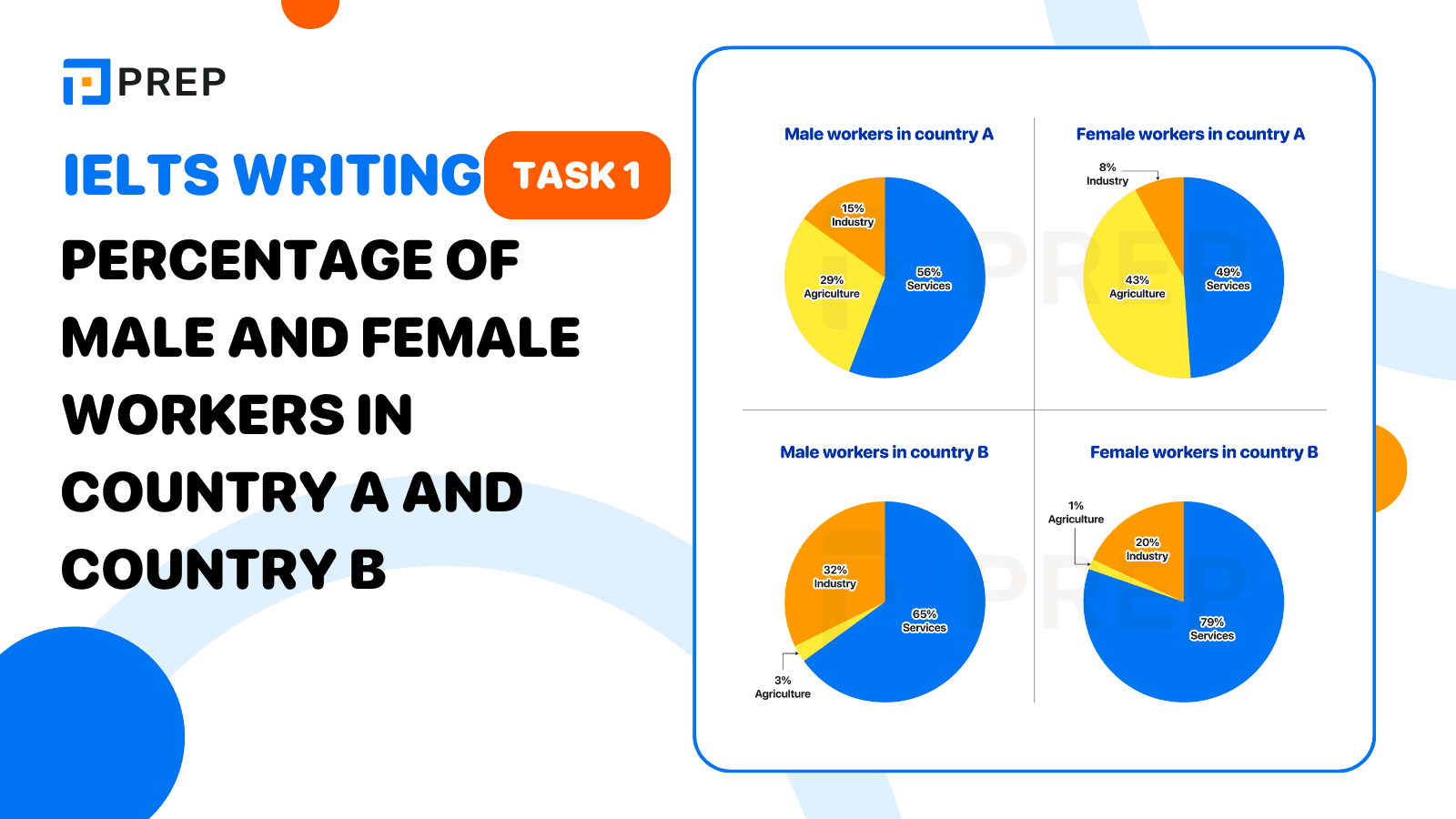
To understand how to analyze this format more effectively, you can explore IELTS writing task 1 question types for a complete overview of all Task 1 formats.
II. Recommended Structure for Task 1
To achieve a high score on a Task 1 about the percentage of male and female workers in country A and country B, your response should follow a four-part structure.
-
Introduction: Paraphrase the question and introduce the chart or table. You can improve this skill with IELTS writing task 1 introduction.
-
Overview: Summarize the main contrasts and key findings, focusing on overall trends, gender differences, or country differences. To master this part, refer to IELTS writing task 1 overview for detailed guidance.
-
Body Paragraph 1: Describe and compare the most significant features (such as the highest and lowest percentages, or striking contrasts between countries and genders). For clearer structure, review IELTS writing task 1 body paragraph.
-
Body Paragraph 2: Present additional comparisons, exceptions, or less prominent details
1. Sample Essay on IELTS Writing Task 1 – Percentage of Male and Female Workers in Country A and Country B
Question:
The bar chart below shows the percentage of male and female workers in Country A and Country B in 2010.
Summarize the information by selecting and reporting the main features, and make comparisons where relevant.
Sample Answer:
The bar chart compares the proportions of male and female employees in Country A and Country B in 2010.
Overall, Country A had a higher percentage of male workers than female workers, while Country B had a more balanced workforce, with female participation nearly equalling or occasionally surpassing male participation.
In Country A, male workers accounted for about 65% of the workforce, compared to only 35% for females. By contrast, Country B’s workforce was almost evenly divided, with male employees representing just over 50% and female employees around 48%. Notably, the gender gap in Country A was significantly larger, whereas in Country B, the difference between genders was minimal.
In summary, Country A’s labor force was dominated by men, but Country B showed a far more equal gender distribution among employees.
Why this essay works well:
-
Introduction restates the question in different words. This relies heavily on paraphrasing in IELTS writing to avoid repetition.
-
Overview highlights the most important contrasts (gender gap, balance)
-
Body paragraphs use specific data and comparison language
-
The grouping of information is logical and easy to follow
-
Language and grammar are clear, academic, and concise
2. Useful Language for This Task Type
When describing and comparing the percentage of male and female workers in two countries, you should use precise comparative language, academic vocabulary for proportions, and flexible grammatical structures. To expand your range, explore learn IELTS writing vocabulary.
Vocabulary for Comparison and Trends
|
Function |
Useful Phrases |
|
Showing higher/lower rates |
“Country A had a higher proportion of male workers…” “Country B’s female workforce narrowly exceeded/matched/reached…” |
|
Describing contrasts |
“By contrast,” “In comparison,” “Unlike Country A, Country B…” |
|
Expressing balance/parity |
“an almost equal distribution,” “female participation nearly matched male participation,” “the gap between genders was minimal” |
|
Highlighting gender gaps |
“The gender gap was more pronounced in Country A…” “Country B displayed far greater gender equality…” |
|
Noting exceptions |
“The only exception was…,” “A notable difference is that…” |
Vocabulary for Describing Data and Proportion
|
Purpose |
Examples |
|
Reporting figures |
“accounted for,” “represented,” “comprised,” “made up” |
|
Comparing percentages |
“more than twice as many men as women were employed in Country A…” |
|
Grouping by country/gender |
“In Country B, both genders had similar participation rates…” |
Common Sentence Structures
|
Purpose |
Examples |
|
Introducing the chart |
“The bar chart illustrates…” / “The table presents data on…” |
|
Making direct comparison |
“The difference in male and female employment was most marked in Country A.” |
|
Generalizing |
“Overall, male employment dominated in Country A, whereas Country B had a balanced workforce.” |
|
Noting a trend or outlier |
“The only significant exception was among…” / “A clear pattern of male dominance was found in…” |
Grammar and Style Notes
-
Use past simple tense for historical data (“accounted for,” “was recorded”)
-
Use comparative and superlative structures: “higher than,” “the largest difference,” “the most balanced distribution”
-
Favor formal language and avoid conversational terms
-
Use grouping and summary phrases to stay concise and academic
III. How This Task Type Is Assessed in IELTS Writing
When describing and comparing the percentage of male and female workers in two countries, your answer is evaluated using the four official band descriptors. To understand scoring in detail, check IELTS writing band scores.
Task Achievement
-
You must clearly select and compare key data points, especially the main similarities and differences between countries and genders.
-
Provide a clear overview summarizing the main pattern (for example, “Country A had a large gender gap, while Country B was almost equal”).
-
Avoid listing or reporting every single figure—focus on major contrasts and the most relevant groups. Common errors are explained in mistakes in IELTS writing.
Coherence and Cohesion
-
Structure your answer in logical paragraphs: Introduction, Overview, Body 1, Body 2.
-
Group information by meaningful categories (gender, country, general patterns).
-
Use linking words and contrast devices (e.g., “by contrast,” “however,” “meanwhile,” “similarly”).
-
Do not jump between countries and genders without a logical order; use appropriate paragraphing.
Lexical Resource
-
Use a varied academic vocabulary for data description (e.g., “proportion,” “rate,” “gap,” “balance,” “dominance,” “represented”).
-
Include a range of comparative language (“higher than,” “more pronounced,” “almost equal,” “twice as many”).
-
Avoid simple repetition of “men” and “women”—try “male workforce,” “female participation,” “gender gap,” or “distribution.”
Grammatical Range and Accuracy
-
Use a mix of simple and complex sentences; control comparative and superlative forms accurately.
-
Tenses: usually past simple for a chart showing data from a particular year.
-
Ensure subject–verb agreement and proper article/plural usage.
-
Employ clear comparison structures, such as:
-
“the highest percentage was observed in…”
-
“there was a much larger gap in Country A than Country B.”
-
A high-scoring answer for this task type is concise, analytical, well-organized, and uses academic language to compare and contrast gender and country data clearly and logically. To reach a higher band, follow the formula for IELTS writing band 7.
Hopefully, the sample for IELTS Writing Task 1 Percentage of male and female workers in Country A and Country B that PREP has shared above has helped you grasp the outline and how to develop a complete IELTS Writing Task 1. Wishing you success!

Hi I'm Chloe, and I am currently serving as an Product Content Administrator at Prep Education. With over five years of experience in independent online IELTS study and exam preparation, I am confident in my ability to support learners in achieving their highest possible scores.
Comment


Premium content
View all




Personalized roadmap


Most read




UEN: 202227322W
Address: 114 LAVENDER STREET, #11-83 CT HUB 2, SINGAPORE (338729)