IELTS Task 1: Local Museum 1957 and 2007
This guide explains how to approach IELTS Writing Task 1 Local Museum in 1957 and 2007. You will learn how to describe layout changes clearly, organize comparisons logically, write an effective overview, and use precise spatial language to improve your band score.
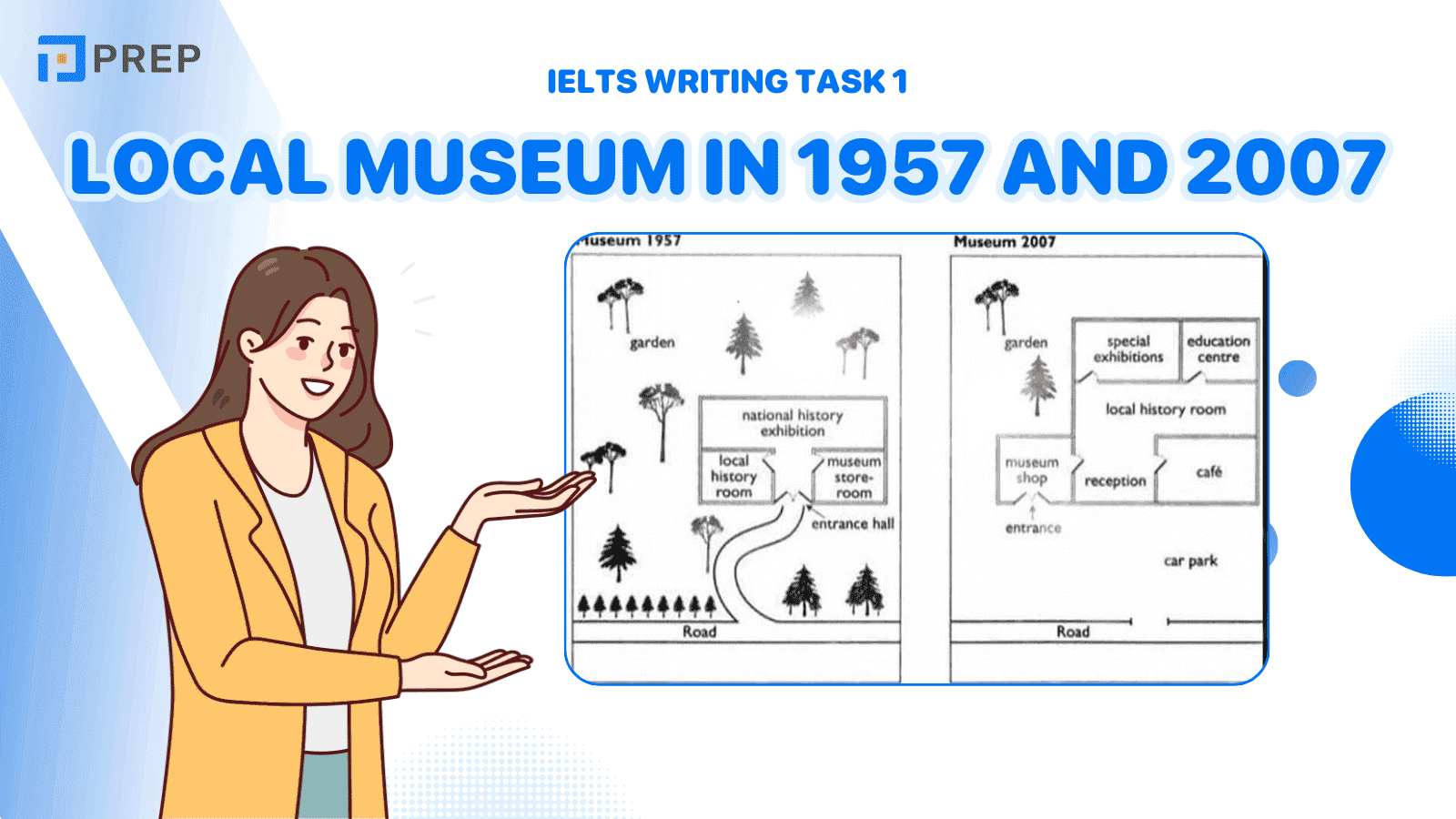
Keynote – Task 1 Quick Guide
Direct Answer - For the Local Museum map comparison, your task is to describe how the layout changed between 1957 and 2007, focusing on major structural developments rather than minor details.
Key Points to Remember
-
Identify:
-
Areas that were added, removed, or relocated
-
Functional changes (e.g., new facilities, expanded spaces)
-
Shifts in purpose (traditional layout → modern facilities)
-
-
Focus on:
-
Overall development trend
-
Significant transformations
-
Clear spatial comparisons
-
-
Use correct tense:
-
Past tense for 1957
-
Past tense for 2007 (since both are historical)
-
-
Organize body paragraphs logically:
-
By area (east/west/central zones)
-
Or by type of change (demolition, expansion, renovation)
-
-
Avoid:
-
Listing every single feature
-
Forgetting the overview paragraph
-
Mixing spatial descriptions without clear structure
-
I. What Is This IELTS Writing Task 1 Question Type?
The question “Local museum in 1957 and 2007” is a classic IELTS Writing Task 1 map comparison, which requires you to describe and compare how a certain place has changed over time. For this topic, you are given two diagrams of a local museum: one from the year 1957 and another from 2007.
In this task, you are required to:
-
Identify and describe major physical and functional changes to the museum and its surrounding area
-
Compare the layout, facilities, and features between 1957 and 2007
-
Notice what was added, removed, expanded, or remained unchanged over the 50-year period
How this question type is different from others:
-
Map/questions focus on changes in space and function, not just numbers or trends
-
You must track the development of the museum as a site: new galleries, rearranged entrances, added facilities, or landscaping. A similar transformation task is IELTS writing task 1 process.
-
Your overview needs to highlight the biggest changes: for instance, increases in size, new exhibition areas, or shifts from basic to modern facilities
Key elements to identify before writing:
-
Time frames: Always distinguish clearly between 1957 and 2007
-
Major changes: Look for expansions, demolitions, repurposing of spaces, and any new buildings or zones on the map
-
Landmarks and features: Galleries, entrances, cafes, shops, car parks, green spaces, walking paths
-
Patterns or themes: Has the museum become larger, more visitor-friendly, or more specialized in its features?
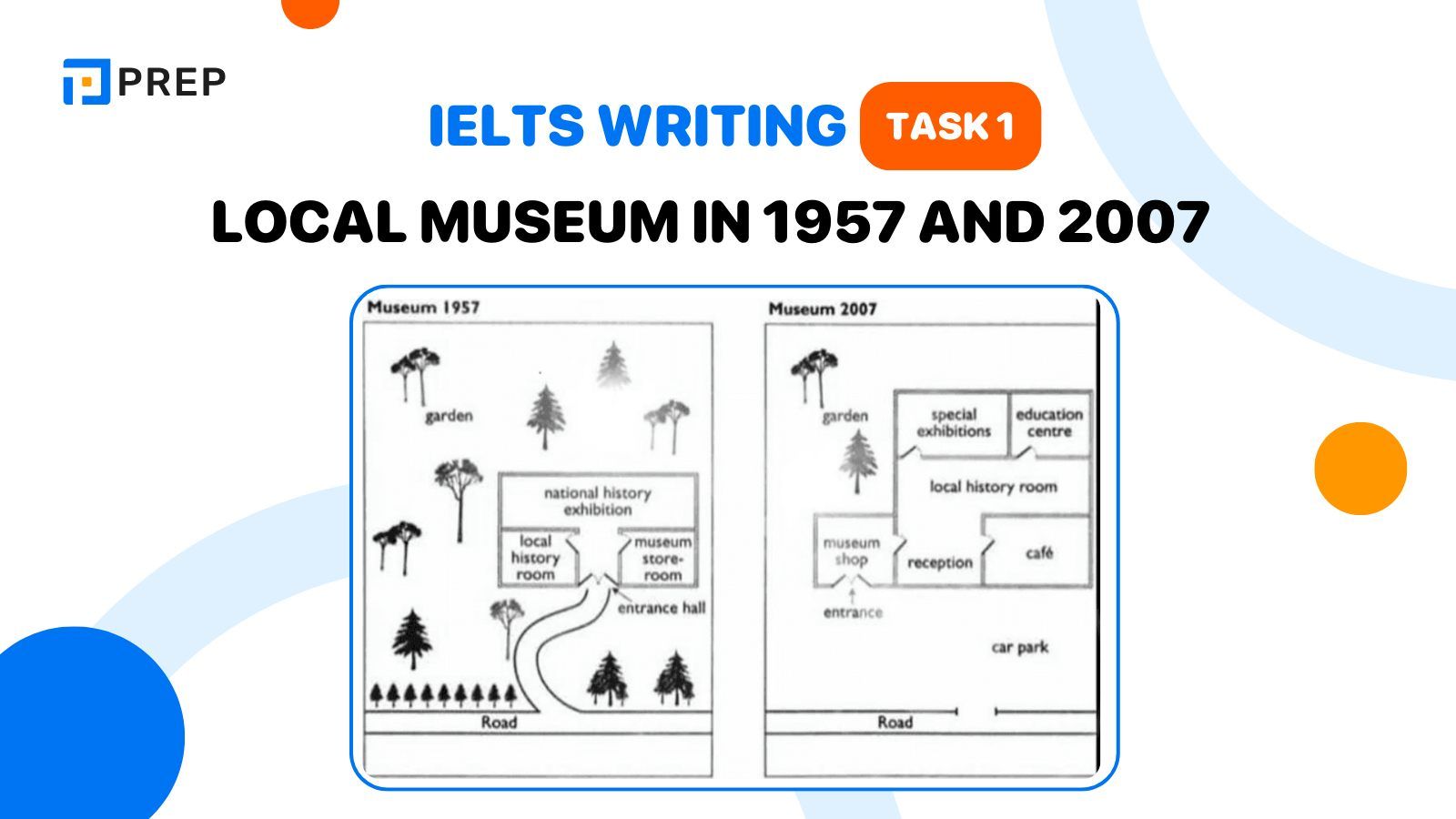
For a full overview, see IELTS writing task 1 map.
II. Recommended Structure for Task 1
To achieve a high band score on a Task 1 map comparison like “Local museum in 1957 and 2007”, you should use a clear, logical four-part structure. The standard structure includes:
-
Introduction: Paraphrase the task, mentioning the museum and the two years shown. You can improve this skill with IELTS writing task 1 introduction.
-
Overview: Summarize the main changes or most noteworthy developments without including detailed features. For better summaries, refer to IELTS writing task 1 overview.
-
Body Paragraph 1: Describe the first set of significant changes (for example, changes to the main building or central areas). For clearer organization, see IELTS writing task 1 body paragraph.
-
Body Paragraph 2: Describe other notable changes (to entrance, gardens, new facilities, surrounding areas) or unchanged features
1. Sample Essay on IELTS Writing Task 1 – Local Museum in 1957 and 2007
Question:
The maps below show a local museum in 1957 and in 2007.
Summarise the information by selecting and reporting the main features, and make comparisons where relevant.
Sample Answer:
The two maps illustrate how the layout and facilities of a local museum changed between 1957 and 2007.
Overall, the museum experienced significant expansion and modernization over the 50-year period. Key developments include the extension of galleries, the addition of new visitor facilities, and the reorganization of outdoor areas.
In 1957, the museum consisted of two small exhibition galleries, a main entrance at the south, a landscaped garden, and car parking to the east. By 2007, both galleries had been enlarged, with a third gallery and a new shop added to the east side. The garden area was reduced to make space for a café and an indoor children’s play zone. The entrance was moved from the south to the east, and the parking area was expanded.
In summary, the local museum not only increased in size but also introduced more amenities and services, making it more accessible and attractive for a wider range of visitors.
Why this essay works well:
-
Introduction paraphrases the topic and time periods clearly.
-
Overview summarizes key trends (expansion, modernization, new facilities)
-
Body paragraphs are grouped logically: interior and main building changes vs. outside/garden/entrance changes
-
Transformation language is clear: “enlarged,” “added,” “expanded,” “reduced,” “moved”
-
Accurate tense use: past simple passive, present perfect, and present simple
-
Objective, formal academic style

2. Useful Language for This Task Type
Using accurate and varied language will help you clearly explain the spatial and functional changes shown in the museum maps for IELTS Writing Task 1.
Vocabulary for Describing Changes
|
Type of Change |
Useful Phrases |
|
Addition |
"A new [gallery/shop/café/play area] was built/added/introduced…" |
|
Expansion |
"The [galleries/parking area] were enlarged/extended…" |
|
Reduction/Removal |
"The [garden] was reduced in size…" "The old shop was removed/disappeared…" |
|
Conversion/Reorganization |
"The garden area was converted into a café…" "The entrance was moved to…" |
|
Unchanged Feature |
"The exhibition halls remained the same…" "No major changes were made to…" |
Vocabulary for Location and Position
|
Function |
Examples |
|
Directions |
"to the east", "on the north side", "in the center of", "at the southern entrance" |
|
Relation |
"next to", "adjacent to", "opposite", "beside", "between" |
|
Layout |
"located at the far end", "towards the main road", "surrounded by…" |
Comparative and Overview Language
-
"In 1957…, by 2007…"
-
"The biggest change was the addition of…"
-
"While the garden area was reduced, new indoor facilities appeared."
-
"Compared to 1957, the museum now offers…"
-
"Some areas, such as the exhibition halls, remained unchanged."
Grammar & Style Notes
-
Use past simple and past perfect passives: "was added", "had been moved", "was reduced"
-
Use clear transition words to show time and change: "formerly," "after redevelopment," "meanwhile"
-
Avoid informal expressions (no "got bigger"; use "was enlarged" instead)
-
Be concise and group related changes for clarity
III. How This Task Type Is Assessed in IELTS Writing
When describing map comparisons such as “Local museum in 1957 and 2007”, your answer is evaluated using the four official IELTS Writing Task 1 criteria. Each has specific relevance for this task type:
Task Achievement
-
You are expected to identify and group the most important physical and functional changes on the maps.
-
A strong overview is essential and should summarize the biggest trends (e.g., expansion, modernization, increased facilities).
-
Avoid listing every feature—focus on changes that most affect the overall layout or visitor experience.
-
Use precise verbs of change and accurate tenses (past simple, passive, where appropriate).
Coherence and Cohesion
-
Structure your answer into Introduction, Overview, Body Paragraph 1, and Body Paragraph 2.
-
Present information in logical groups—such as interior changes versus exterior or facility changes.
-
Use linking devices to signal contrast or time: “while,” “afterwards,” “compared to 1957,” “meanwhile.”
-
Ensure each paragraph develops a single main idea.
Lexical Resource
-
Show a good range of vocabulary for describing change, location, size, and function (e.g., “extended,” “expanded,” “converted into,” “to the west of”).
-
Use accurate, formal language and precise spatial prepositions.
-
Avoid vague words (e.g., “stuff,” “thing”) and repetition of simple terms.
-
Use comparative and superlative phrases to highlight differences where relevant.
Grammatical Range and Accuracy
-
Vary your sentence types: use both simple and complex sentences, as well as passive structures.
-
Tenses must clearly distinguish between past states and present results (e.g., “was added,” “is now used for…”).
-
Make careful use of articles, plurals, and subject–verb agreement.
-
Employ a balance of active and passive forms to keep your writing formal and varied.
You can review them in detail in IELTS writing band scores.
This article provides the sample IELTS Writing Task 1 Local museum in 1957 and 2007 with a band score of 7.0+, composed by the top-tier teachers at PREP. Thoroughly review it to effectively prepare for the exam and achieve your target Speaking band score!

Hi I'm Chloe, and I am currently serving as an Product Content Administrator at Prep Education. With over five years of experience in independent online IELTS study and exam preparation, I am confident in my ability to support learners in achieving their highest possible scores.
Comment
Premium content
View all



Personalized roadmap


Most read





UEN: 202227322W
Address: 114 LAVENDER STREET, #11-83 CT HUB 2, SINGAPORE (338729)