IELTS Writing Task 1 Liverton Docks In 1980 And Now
This guide explains how to approach IELTS Writing Task 1 Liverton Docks in 1980 and now. You will learn how to describe key changes, organize comparisons logically, write a strong overview, and use accurate spatial language to achieve a higher band score.
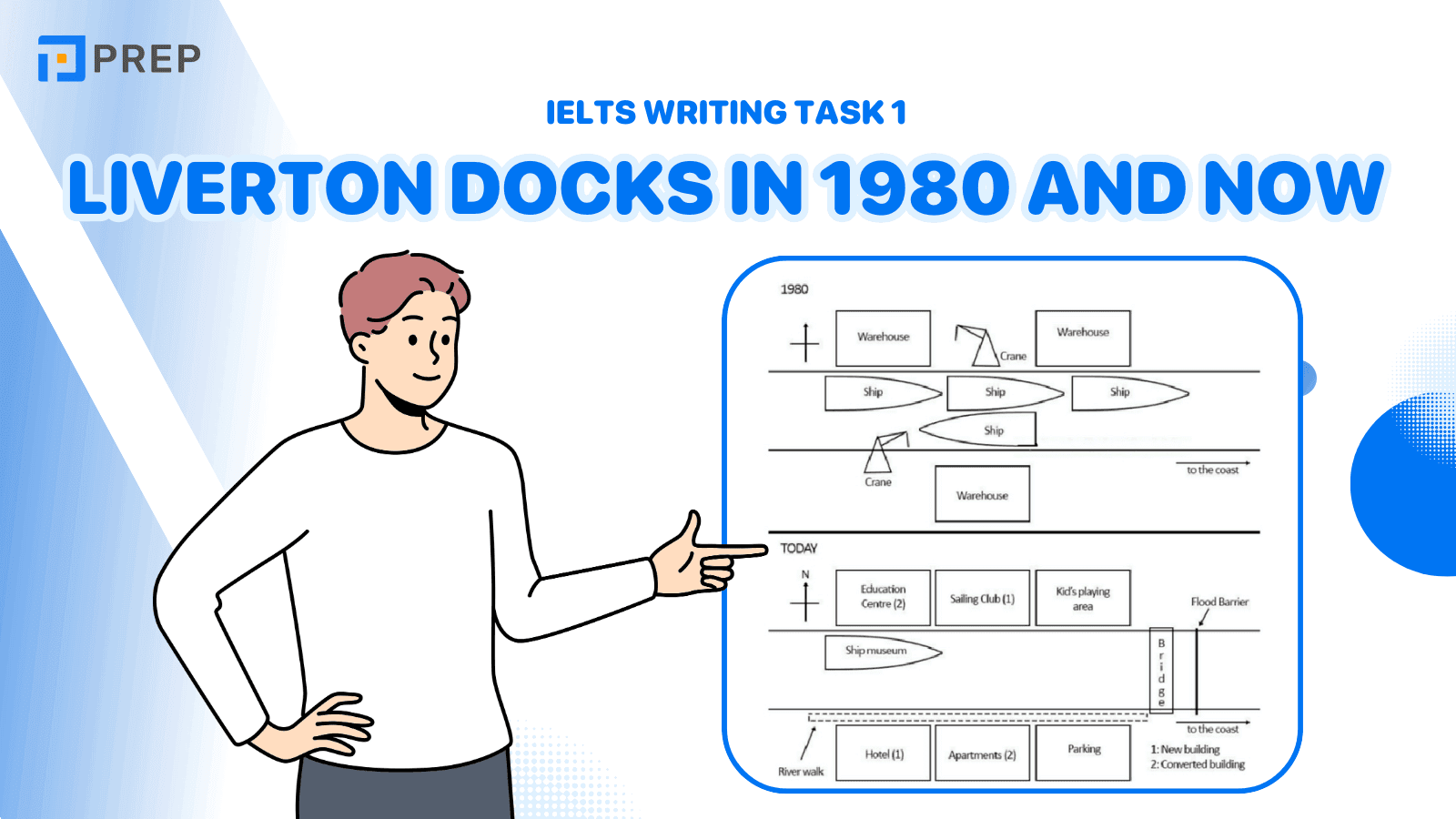
Keynote – Task 1 Quick Guide
For the Liverton Docks map question, your task is to compare the layout in 1980 with the current version, highlighting major structural changes and overall development trends clearly and logically.
Key Points to Remember
-
Identify:
-
What areas were removed
-
What new facilities were added
-
Which structures were relocated or replaced
-
-
Focus on:
-
Major transformations (industrial → residential/commercial shifts)
-
Functional changes in the area
-
Overall development direction
-
-
Use correct tense:
-
Past tense for 1980
-
Present tense for “now”
-
-
Organize body paragraphs:
-
Group changes by area (north/south/center)
-
Or by type of change (demolished, constructed, converted)
-
-
Avoid:
-
Listing every minor detail
-
Forgetting to write a clear overview
-
Mixing past and present tenses incorrectly
-
I. What Is This IELTS Writing Task 1 Question Type?
Map questions like “Liverton Docks in 1980 and now” require you to describe and compare physical and structural changes to a specific location over time. Typically, you’ll see two diagrams: one showing the docks in the past (1980), and one showing the same area as it appears now.
In this task, you are required to:
-
Identify and summarize major changes in Liverton Docks between 1980 and the present
-
Describe additions, removals, conversions, and unchanged features clearly
-
Compare the overall character, function, or layout of the docks before and after redevelopment
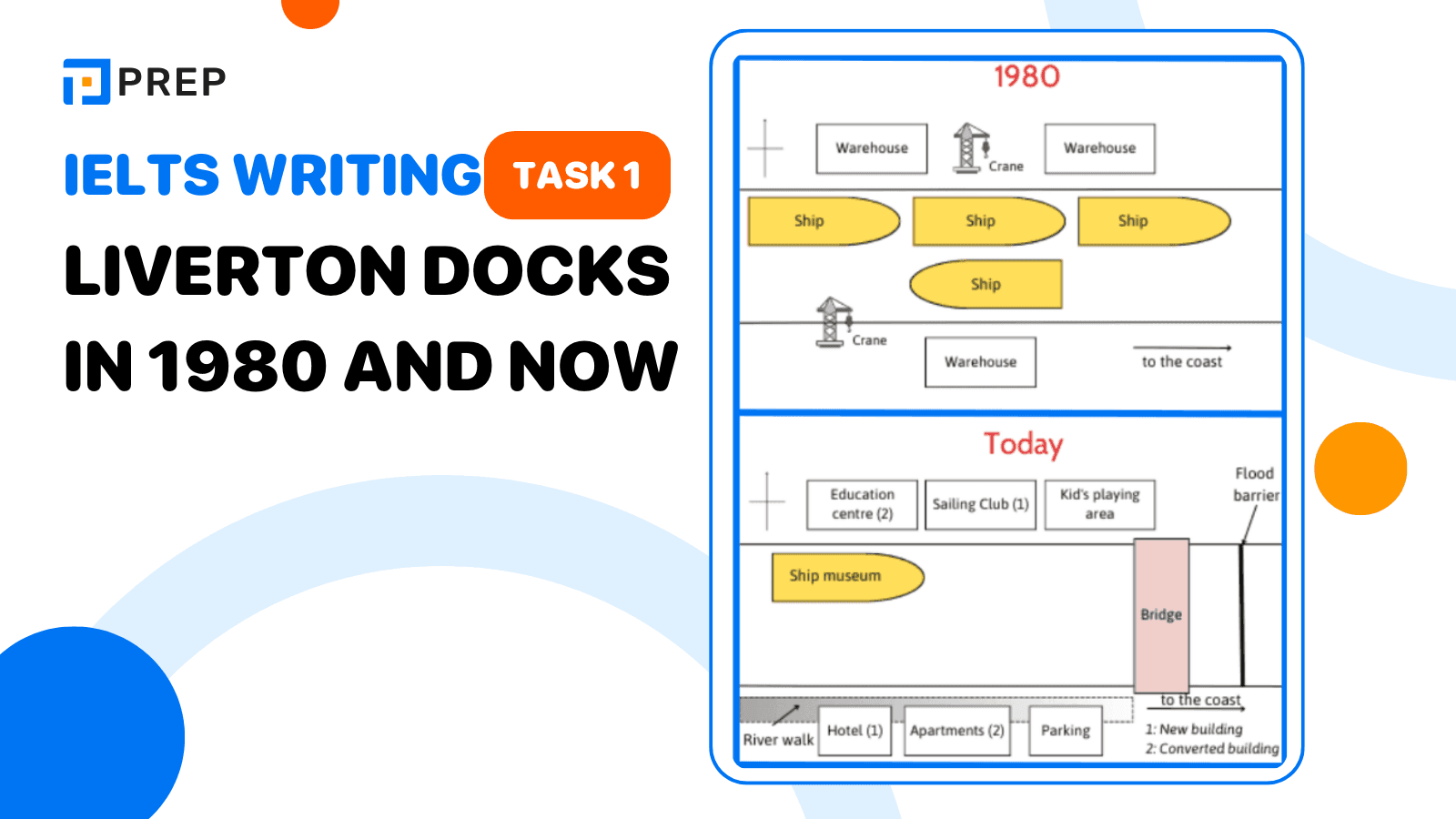
How is this question different from other Task 1 types?
-
Map tasks focus on spatial and infrastructural transformations, not just quantities or trends.
-
Instead of interpreting numbers, you need to track what has been built, removed, converted, or stayed the same over time. A similar transformation-based task is IELTS writing task 1 process.
-
Your overview should highlight the most significant shifts or themes (e.g., “industrial to commercial use,” “transport access improved,” etc.)
You can explore all formats in IELTS writing task 1 question types.
Key elements to identify before you write:
-
Time frames: Clearly distinguish features “in 1980” from “now”
-
Landmarks and layout: Docks, warehouses, docksides, roads, parking, green areas, new facilities
-
Types of change: Construction, demolition, repurposing, addition of tourism/leisure features
-
Main patterns: What was the central change in function or design? What stayed unchanged?
II. Recommended Structure for Task 1
To write a high-scoring answer for a map comparison task like “Liverton Docks in 1980 and now,” you should use a clear four-part structure. This will help you identify and group the major physical and functional changes in a logical way.
The standard structure includes:
-
Introduction: Paraphrase the map question and introduce the two time points. For better paraphrasing, check IELTS writing task 1 introduction.
-
Overview: Summarize the most significant overall changes or trends (without specific detail). You can improve this skill with IELTS writing task 1 overview.
-
Body Paragraph 1: Describe major changes and developments in the first area(s)/features. To organize ideas clearly, see IELTS writing task 1 body paragraph.
-
Body Paragraph 2: Discuss remaining changes or any features that stayed the same

1. Sample Essay on IELTS Writing Task 1 – Liverton Docks in 1980 and Now
Question:
The maps below show Liverton Docks in 1980 and now.
Summarize the information by selecting and reporting the main features, and make comparisons where relevant.
Sample Answer:
The two maps illustrate how Liverton Docks has changed from 1980 to the present day.
Overall, the docks have undergone dramatic redevelopment, shifting from an industrial shipping area to a mixed-use zone with an emphasis on residential and leisure facilities. Many former industrial features, such as warehouses and cranes, were removed to make way for apartments, entertainment, and improved access.
In 1980, Liverton Docks featured rows of warehouses on both sides of the river, several large cranes along the quayside, and a main road leading to a car park and offices. The area was mainly used for commercial storage and transportation.
Now, the warehouses have been replaced by blocks of flats on both sides. The central road has been expanded, and a roundabout has been added, connecting to a new car park and a supermarket. The old office building has become a riverside café, while a children’s play area and a hotel have also been built nearby. All cranes have been removed, and a footbridge for pedestrians now crosses the river, improving access between the two sides.
In summary, Liverton Docks has shifted focus from industry to community living and recreation, creating a more diverse and people-centered area.
Why this essay works well:
-
Introduction paraphrases the map task
-
Overview highlights the main shifts in land use and function
-
Body paragraphs are grouped by type of change (industrial to residential, new facilities, improved transport)
-
Clear location and comparison language: “replaced,” “converted,” “now features,” “expanded,” “demolished,” etc.
-
Tenses and passive forms are varied and used appropriately
2. Useful Language for This Task Type
Using precise and varied language is essential when describing map comparisons in IELTS Writing Task 1. Focus on verbs of change, location expressions, and comparative phrases that help the examiner clearly follow how Liverton Docks has transformed.
Vocabulary for Describing Changes
|
Type of Change |
Useful Phrases |
|
Addition |
"A new [apartment complex/café/hotel] was built/constructed/added..." "There is now..." |
|
Removal |
"The warehouses/cranes were demolished/removed/disappeared..." |
|
Conversion |
"[The old office] was converted into a café." "The park area became a playground." |
|
Expansion |
"The road was expanded/enlarged; a roundabout was introduced..." |
|
Repurposing |
"The dockside became a leisure district." "The former offices have been repurposed as residential flats." |
|
Unchanged |
"The river remained unchanged." "The supermarket is still in the same location." |
Expressions for Location and Position
|
Function |
Examples |
|
Directions |
north/south/east/west of the river, to the left of, adjacent to |
|
Prepositions |
opposite, beside, near, at the end of, along, between |
|
Describing layout |
"Located in the northeast corner...", "running alongside the river..." |
Comparative and Overview Language
-
"Compared to 1980, the area now includes..."
-
"The biggest change was the removal/addition of..."
-
"While the warehouses have disappeared, new housing and leisure facilities have appeared."
-
"The docks have shifted from an industrial focus to a more community-based area."
-
"No significant changes were made to the river itself."
Grammar & Style Notes
-
Use past simple for changes (e.g., "was replaced") and present simple/passive for current features (e.g., "is now occupied by…")
-
Use passive structures to emphasize the transformation: "…has been converted," "…were demolished"
-
Keep descriptions objective and concise. Avoid irrelevant speculation or personal opinions.
III. How This Task Type Is Assessed in IELTS Writing
Writing about map comparisons such as Liverton Docks in 1980 and now is evaluated according to the four official IELTS Writing Task 1 criteria. Each criterion has specific requirements for this type of task:
Task Achievement
-
You are expected to clearly summarize and compare the main physical and functional changes between the two maps.
-
An effective overview must highlight the most significant developments (e.g., shift from industrial to residential use).
-
Focus on major transformations and avoid describing every minor change.
-
Use appropriate verb tenses, especially past simple and present perfect/passive forms.
Coherence and Cohesion
-
Structure your report with four paragraphs: Introduction, Overview, Body 1, Body 2.
-
Group changes logically: by area (north/south), by type (additions vs. removals), or by function (residential, commercial).
-
Use linking words such as “while,” “in contrast,” “after redevelopment,” or “meanwhile” to connect ideas.
-
Each paragraph should develop a single main idea that relates to the overall changes.
Lexical Resource
-
Show a wide range of vocabulary for changes and spatial description: “constructed,” “expanded,” “replaced,” “transformed,” “adjacent,” “located at.”
-
Use accurate prepositions to describe positions and layout.
-
Avoid repetitive words and basic phrases (e.g., don’t repeat “built” or “made”).
-
Style should be formal and objective.
Grammatical Range and Accuracy
-
Use a mix of simple, compound, and complex sentences; demonstrate control of passive forms.
-
Tenses must accurately reflect time frames (e.g., “was replaced,” “is now used for…”).
-
Use comparative and superlative structures as needed: “larger than,” “most significant change.”
-
Watch for errors in articles, plurals, and subject–verb agreement.
A high-scoring Task 1 map answer groups related changes, identifies main developments, and avoids simply listing every detail in isolation. Use clear grouping, comparative language, and precise grammar to impress the examiner with your overview and detailed descriptions.
You can review them in detail in IELTS writing band scores.
This article has provided the most comprehensive sample IELTS Writing Task 1 Liverton Docks In 1980 And Now at band 7.0+. Study it thoroughly if you are in the final stages of preparation for the IELTS exam. And don't forget to spend time each day practicing Writing tasks in PREP's virtual classroom to quickly boost your band score.

Hi I'm Chloe, and I am currently serving as an Product Content Administrator at Prep Education. With over five years of experience in independent online IELTS study and exam preparation, I am confident in my ability to support learners in achieving their highest possible scores.
Comment
Premium content
View all




Personalized roadmap


Most read




UEN: 202227322W
Address: 114 LAVENDER STREET, #11-83 CT HUB 2, SINGAPORE (338729)