IELTS Writing Task 1 High-speed Continuous Internet Connection of Households
This guide explains how to approach IELTS Writing Task 1 questions about high-speed continuous internet connection of households. You will learn how to identify key trends, compare data logically, write a strong overview, and use precise academic language to improve Task Achievement and Coherence.
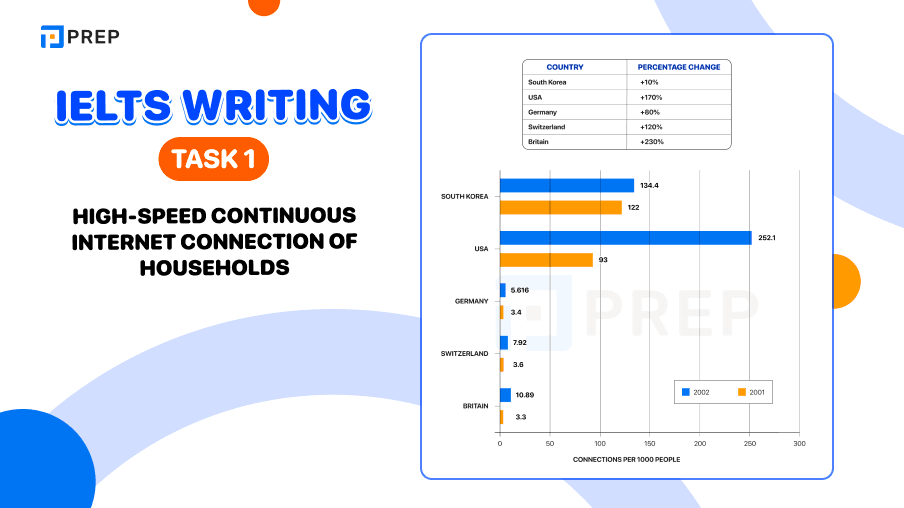
Keynote – Task 1 Quick Guide
Direct Answer: When describing data about high-speed internet access, highlight the most important differences and trends between countries or years, rather than reporting every figure individually.
Key Points to Remember:
-
Focus on overall patterns: who had the highest, lowest, and the biggest changes
-
Use a four-part structure: Introduction, Overview, Body 1, Body 2
-
Group and compare relevant data; do not list each number in sequence
-
Use clear comparison and trend language
-
Avoid unnecessary detail and keep your answer concise and logical
I. What Is This IELTS Writing Task 1 Question Type?
The question “High-speed continuous internet connection of households” is a typical IELTS Writing Task 1 comparative graph question—usually shown as a bar chart, line graph, map, or table. It presents data about the percentage or number of households with high-speed (broadband) internet access in different countries, regions, or over time.
In this task, you are required to:
-
Summarize and compare key features about internet access among households
-
Identify trends, similarities, and differences, such as which country or year had the highest/lowest percentage, or where rapid changes occurred
-
Report major increases, improvements, or disparities (e.g., urban vs. rural, different age groups, multiple countries, or time trends)
How this question type is different from others:
-
Instead of simply reporting totals, you need to focus on comparisons and patterns in how connectivity rates change or differ
-
Data may cover a timeline (years), a geographical comparison (multiple countries), or a demographic breakdown (age, income). This type of data is also common in IELTS writing task 1 mixed charts.
-
Your overview should focus on main trends, rapid growth, leading/lagging countries, or surprising differences
Key elements to identify before writing:
-
Time frame: Are the figures from different years? Are there forecasts for the future?
-
Groups compared: By country, region, household type, or another category
-
Units and scale: Percentages, millions of households, access rates, etc.
-
Major trends: Which group grew fastest? Which group started low but caught up? Any stable/unchanged data?
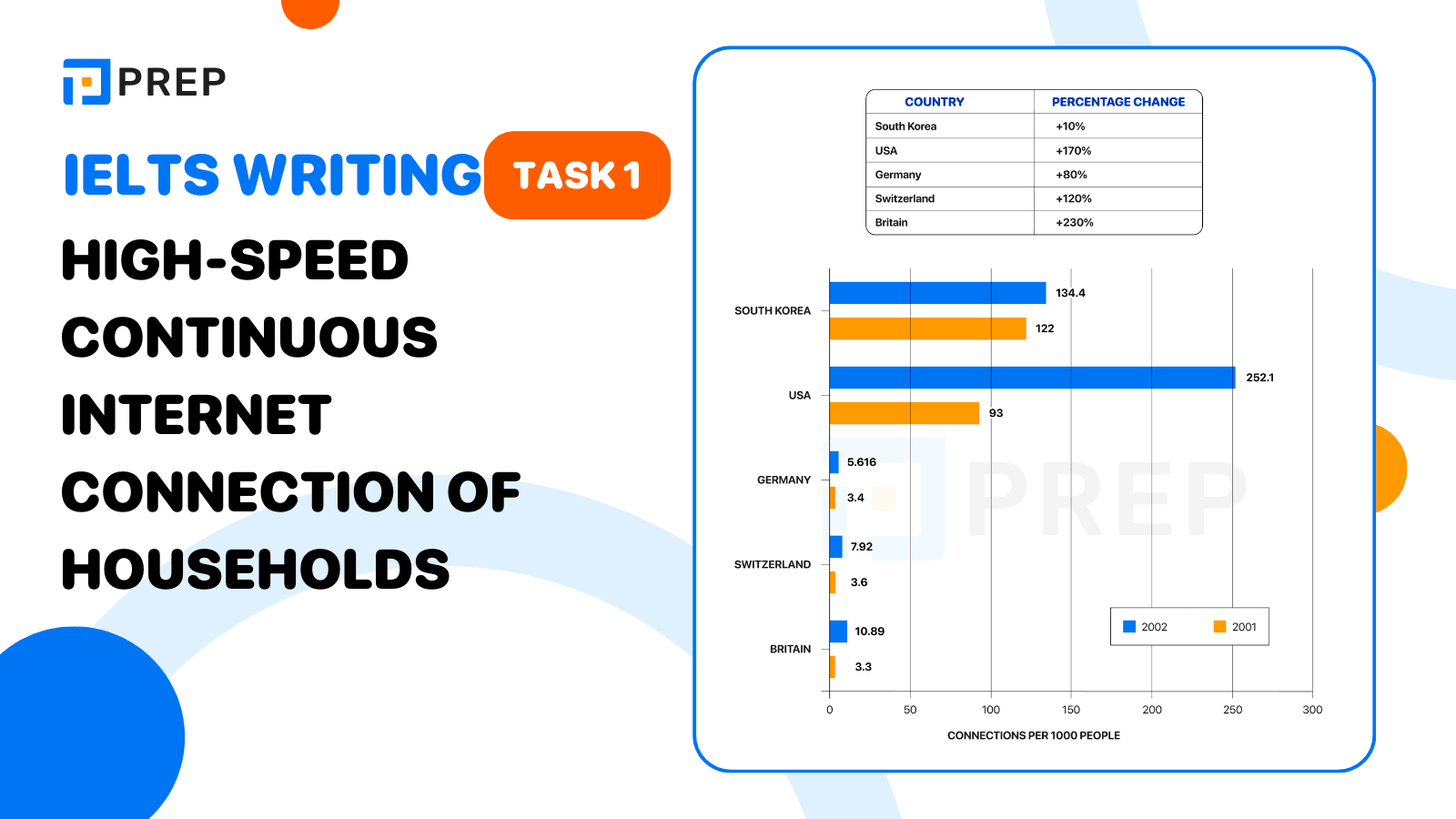
For a full guide, see IELTS writing task 1 comparative graphs.
II. Recommended Structure for Task 1
To score well on a Task 1 about “high-speed continuous internet connection of households,” you should organize your answer into four clear sections.
-
Introduction: Paraphrase the question to introduce what the chart, graph, or table shows. For better paraphrasing, see IELTS writing task 1 introduction.
-
Overview: Summarize the main trends, differences, or most striking features — without providing specific numbers. You can improve this step with IELTS writing task 1 overview.
-
Body Paragraph 1: Describe and compare the most significant trends, leading groups, or major changes. To organize your ideas clearly, refer to IELTS writing task 1 body paragraph.
-
Body Paragraph 2: Present secondary trends, contrasts, exceptions, or less prominent details
1. Sample Essay on IELTS Writing Task 1 – High-speed Continuous Internet Connection of Households
Question:
The chart below shows the percentage of households with high-speed continuous internet access in five different countries from 2000 to 2020.
Summarize the information by selecting and reporting the main features, and make comparisons where relevant.
Sample Answer:
The bar chart illustrates the proportion of households in five countries—France, Germany, the UK, Italy, and Spain—with high-speed continuous internet connections between 2000 and 2020.
Overall, all countries experienced a marked rise in internet connectivity over the two decades, with Germany consistently leading in access rates, while Italy and Spain started from much lower levels but gradually closed the gap.
In 2000, fewer than 20% of households in any country had high-speed internet access; Germany and France were slightly ahead of the others. By 2010, all countries had reached at least 50%, with Germany at 75% and Italy still lagging at 55%. From 2010 to 2020, the UK saw the biggest jump, surpassing both France and Spain to reach nearly 95% in 2020. Italy and Spain also made significant progress, reaching around 85% by 2020, while Germany retained the top position at 98%.
In summary, household internet access increased dramatically in all countries, with Germany and the UK emerging as the most connected by 2020, and the gap between countries narrowing significantly over time.
Why this essay works well:
-
Introduction paraphrases the prompt clearly
-
Overview highlights main trends (general increase, leading countries, convergence)
-
Body paragraphs group details logically by initial leader, major changes, and closing gaps
-
Comparative and superlative structures are used to show ranking and change
-
Accurate reporting of time, passive and active structures, and concise academic style

2. Useful Language for This Task Type
When describing data about household internet access across different countries or years in IELTS Writing Task 1, you should use precise comparative language, academic vocabulary for trends and quantities, and a range of grammatical structures.
Vocabulary for Comparison and Ranking
|
Function |
Useful Phrases |
|
Show differences |
“Germany had a higher percentage than France…” “Italy lagged behind…” |
|
Show similarity |
“France and the UK had similar rates of access…” |
|
Show change over time |
“The gap narrowed significantly over the period…” |
|
Expressing highest/lowest |
“Germany registered the highest proportion in every year…” “Italy had the lowest access rate at the start…” |
|
Introducing contrast |
“In contrast,” “Meanwhile,” “By comparison,” “On the other hand…” |
Vocabulary for Trends
|
Trend Type |
Useful Verbs & Phrases |
|
Upward trend |
rise, increase, grow, climb, surge, shoot up |
|
Sharp rise |
soar, skyrocket, jump sharply |
|
Steady growth |
increase gradually, rise steadily |
|
Downward/stagnant |
remain low, stay unchanged, lag behind, be slow to increase |
|
Describing closing gap |
catch up, close the gap, reach parity, narrow the difference |
Useful Sentence Structures
|
Purpose |
Examples |
|
Introducing data |
“The chart shows…” / “According to the data,…” |
|
Referring to time periods |
“Over the 20-year period…” / “Between 2000 and 2020…” |
|
Describing rankings |
“Germany consistently ranked first in every year shown.” |
|
Making comparisons |
“Italy’s rate was less than half that of Germany in 2000, but by 2020, the difference was minimal.” |
Style and Grammar Notes
-
Use present simple for describing facts (e.g., “shows,” “has,” “is”) and past simple for historical data.
-
Use passive forms when the agent is not important (e.g., “was recorded,” “was reached”).
-
Favor formal phrases like “proportion of households,” “data indicates…,” “over the period.”
You can improve this skill with paraphrasing in IELTS writing.
III. How This Task Type Is Assessed in IELTS Writing
For questions on high-speed continuous internet connection of households, your writing is evaluated using the four official IELTS Writing Task 1 criteria. You can review them in detail in IELTS writing band scores.
Task Achievement
-
You must clearly select, summarize, and compare the main trends, differences, and similarities in household internet access.
-
Include a strong overview that highlights the most significant features: e.g., which country led, which lagged, major rises or changes over the time period.
-
Avoid reporting every single number; instead, group data and focus on the most important contrasts.
-
If the chart includes past and present (or predictions), use appropriate verb tenses to show change.
Coherence and Cohesion
-
Organize your response using a logical four-part structure: Introduction, Overview, Body Paragraph 1, Body Paragraph 2.
-
Present information by category (e.g., leading countries, countries with slow progress, closing gaps).
-
Use linking words and comparative devices such as “while,” “in contrast,” “meanwhile,” “by comparison,” “similarly.”
-
Ensure each body paragraph develops a clear, main idea relevant to the data.
Lexical Resource
-
Demonstrate varied and precise vocabulary for trends (e.g., “rose steadily,” “surged,” “remained stable,” “closed the gap”).
-
Use comparative and superlative forms accurately (“the most rapid growth,” “significantly lower access”).
-
Avoid word repetition. Use alternative verbs and nouns where possible (“proportion,” “rate,” “penetration,” “level of access”).
-
Maintain a formal and academic tone at all times.
Grammatical Range and Accuracy
-
Use a mix of simple and complex sentences, including comparative and contrastive structures.
-
Clearly use tenses appropriate to each time period (past, present, or predictions).
-
Employ passive voice and noun phrases for variety and academic style (“was achieved by,” “rates were recorded for…”).
-
Watch for subject–verb agreement and accurate use of articles and prepositions.
In this article, PREP has shared a high-quality sample for IELTS Writing Task 1 High-speed continuous internet connections in households. Let’s follow PREP for more IELTS Writing Task 1 articles!

Hi I'm Chloe, and I am currently serving as an Product Content Administrator at Prep Education. With over five years of experience in independent online IELTS study and exam preparation, I am confident in my ability to support learners in achieving their highest possible scores.
Comment
Premium content
View all




Personalized roadmap


Most read




UEN: 202227322W
Address: 114 LAVENDER STREET, #11-83 CT HUB 2, SINGAPORE (338729)