IELTS Writing Task 1: Describe a Modern Landfill Diagram
This guide explains how to describe a modern landfill for household waste in IELTS Writing Task 1. You will learn how to interpret the diagram, structure your report, use appropriate grammar and linking phrases, and compare Band 6–8 responses. Practical tips are also included to help you write clearly and efficiently in the exam.

I. Understanding the Modern Landfill Diagram in IELTS Writing Task 1
The "design of a modern landfill for household waste" is a typical process diagram that may appear in IELTS Writing Task 1 – Academic Module. It does not present data or dynamic changes over time, but instead illustrates a physical system or process in a static way. Your job as a candidate is not to explain the science behind the diagram, but to accurately describe what is shown using clear, well-organized language.
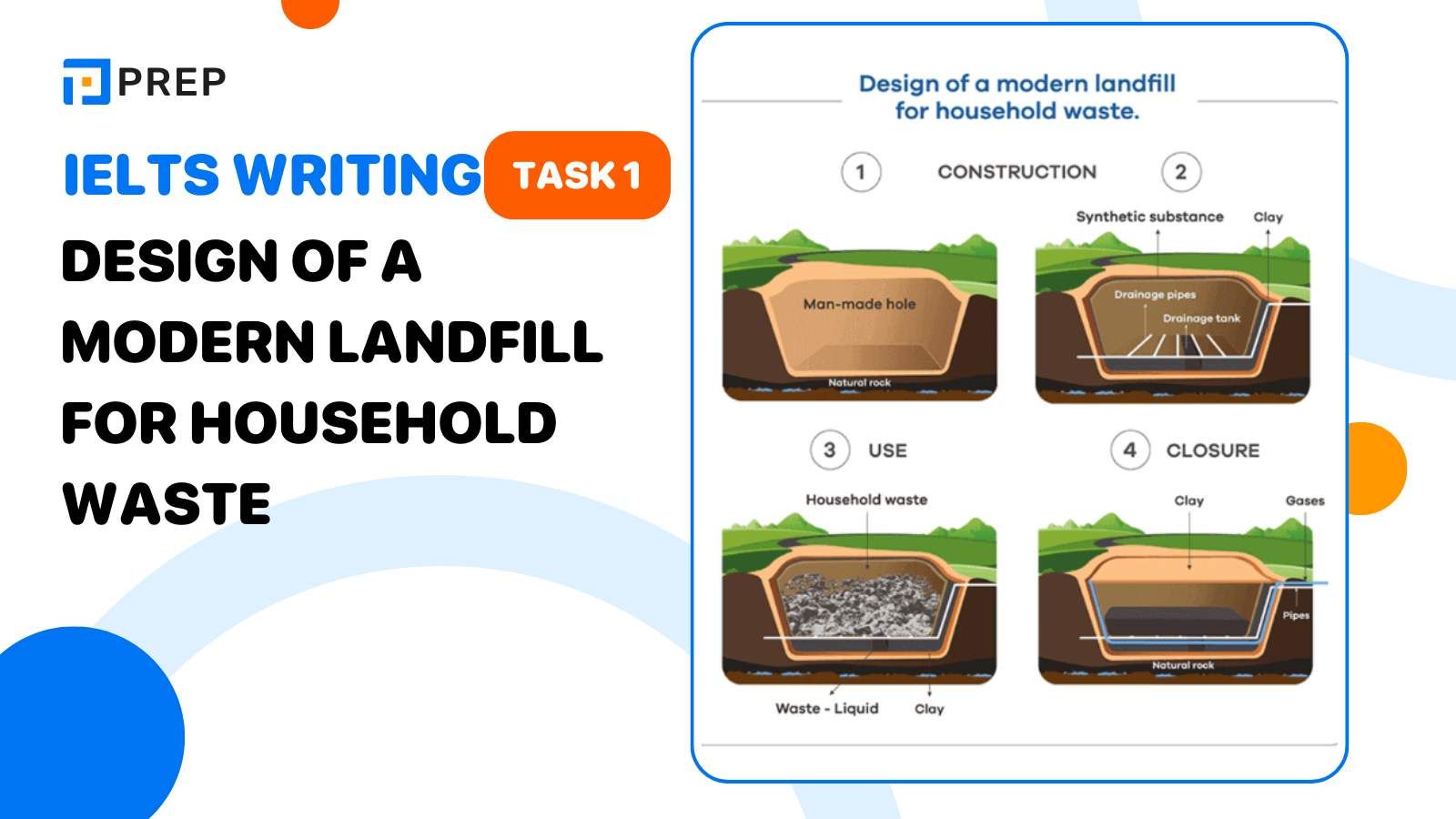
The landfill system illustrated usually includes several components, such as:
-
A man-made hole dug into the ground,
-
Multiple engineered layers (e.g. clay, synthetic liner),
-
Drainage pipes or systems for liquid waste,
-
A final sealing phase after the landfill is full.
This diagram represents a linear process, moving from waste input to eventual closure. It is static, showing stages and structures but not involving repeated recycling or circular movement.
When you approach this kind of task, you should observe and mentally classify the visual elements into logical steps or phases:
-
Initial setup – a hole is dug in natural rock and prepared with protective layers.
-
Active use phase – household waste is added and liquid waste is drained out.
-
Closure phase – landfill is sealed after reaching full capacity; fitted with ventilation pipes.
Additionally, directional arrows are often shown to represent flow (e.g. leachate movement). All of this must be described factually and impersonally, using appropriate process language.
You may also need to describe materials, functions, and the chronological sequence of events — all without inserting opinions or unnecessary technical explanations.
This type of illustration follows the same principles explained in IELTS writing task 1 process, where candidates describe stages in a clear and logical sequence.
Comparing with Other Task 1 Diagram Types
Unlike charts (bar, pie, or line graphs), which focus on numerical data, and maps, which show spatial changes, process diagrams like the landfill design assess your ability to:
-
Describe a system,
-
Present steps in logical order,
-
Use clear and precise language rather than data-driven analysis.
In other words, process diagrams evaluate your general English proficiency in technical explanation more than math or spatial description.
Knowing the type of diagram is essential, as each has unique requirements in tone, structure, and grammar usage.
A broader understanding of IELTS writing task 1 question types helps candidates quickly adjust their structure and language to different visuals.
II. How to Structure Your Task 1 Writing for a Process Diagram
When approaching IELTS Writing Task 1—particularly with a process diagram such as the design of a modern landfill for household waste—your success depends heavily on how well you structure your response. A strong essay in Task 1 requires clarity, logical flow, accurate grammar, and appropriate vocabulary.
Suggested Paragraph Structure for Task 1 (Process Question)
Your response should follow a 4-paragraph format, which works well for most static and dynamic process diagrams:
-
Introduction
-
Paraphrase the task statement using your own words.
-
Avoid copying directly from the question.
-
-
Example:
“The diagram illustrates how a modern landfill site is constructed and used for the disposal of household waste.” -
Overview
-
Summarize the overall process in 1–2 sentences.
-
Mention how many stages there are, what the first and final steps are, and the general purpose of the system.
-
-
Example:
“The process consists of three main stages, beginning with the construction of the landfill site and ending with the sealing of the waste chamber after use.” -
Body Paragraph 1 (Early to Middle Stages)
-
Describe the first half of the process (e.g., site preparation, layering, and waste input).
-
Group related visual details logically and describe them accurately.
-
-
Body Paragraph 2 (Later Stages and Final Outcome)
-
Focus on the remaining steps (e.g., groundwater control, closure stage, gas formation).
-
Maintain chronological and functional sequencing.
-
Each paragraph should link naturally to the next, and transitions between steps must be smooth. Avoid listing steps mechanically—aim for flow and coherence.
Writing an effective summary at this stage follows the same principles outlined in IELTS writing task 1 overview.
Grammar and Tense Rules for Describing Diagrams
The present simple tense is used (even for completed/static systems) because you’re describing how something typically functions. More importantly, the passive voice is widely used in process writing since the agent (e.g., "people", "workers") is usually not mentioned.
Key grammar choices:
-
Present simple passive: “The hole is dug…” / “Waste is deposited…”
-
Use sequencing phrases for clarity: “First”, “Then”, “After that”, “Finally”
-
Avoid personal pronouns and opinions: do not say “I think” or “We can see”
Examples of passive process language:
-
“A drainage system is installed…”
-
“Household waste is deposited into the chamber…”
-
“After the site is full, it is covered with a clay layer…”
Common Linking Phrases for Describing a Process
Using appropriate linking expressions enhances flow and helps the examiner follow the progression of your description.
|
Function |
Examples |
|
To show sequence |
First, Next, Then, Following this, Subsequently |
|
To indicate a stage |
At the beginning, In the final stage, At this point |
|
To describe result |
As a result, This leads to, Consequently |
|
To add detail |
In addition, Moreover, Alongside this |
These transitions not only improve clarity but also show your ability to organize and present ideas—a key part of the Coherence & Cohesion criterion in IELTS scoring.
Mastering these elements has a direct impact on IELTS writing band scores, particularly in Task Achievement and Coherence.
III. Sample Band 6-8 Answer for the Landfill Diagram
One of the most effective ways to improve your writing in IELTS Task 1 is by learning through comparison. By analyzing the differences between a Band 6 and a Band 8 response on the same Task 1 diagram—such as the design of a modern landfill for household waste—you gain a clearer understanding of how to elevate your grammar, vocabulary, organization, and task achievement.

Band 6 Answer: Sample and Analysis
Question Prompt (paraphrased):The diagram shows how a modern landfill for household waste is designed and used.
Band 6 Sample Answer:
The diagram shows how a landfill is used for waste. First, a deep hole is dug in the ground. It also has clay at the bottom and some kind of liner. After that, people put household waste inside. Then a pipe lets liquids out. When it is full, they close it and add pipes for gas. The system is now completed.
Analysis of Band 6 Features:
-
Task Achievement: Partial description; lacks detail about components (e.g. leachate, rock layer, sealing process).
-
Coherence & Cohesion: Sentences are loosely connected and overly simplistic.
-
Lexical Resource: Vocabulary is limited and sometimes vague ("some kind of liner", "they close it").
-
Grammatical Range & Accuracy: Basic structures, mostly active voice, with minimal variety.
Why Band 6?
The response is understandable but lacks the precision and range expected of higher-level writing. The verbs are too general, and the passive voice is not used appropriately. The student describes the steps but misses the technical function of each component.
Band 8 Answer: Sample and Analysis
Band 8 Sample Answer:
The diagram illustrates the structure and operation of a modern landfill site designed for the disposal of household waste.
Overall, the process consists of three main phases: the construction of a landfill cavity, its active use for waste storage, and its closure after being filled. The system includes components for both physical containment and liquid waste management.
Initially, a man-made hole is excavated in a natural rock surface and lined with a thick layer of clay. A synthetic material is then added to reinforce the base, and drainage pipes are installed at the bottom to channel liquid waste. After the foundation is complete, household waste is deposited into the chamber.
Once the landfill reaches capacity, it is sealed with a layer of clay. Ventilation pipes are also added to allow gases produced by the decomposing waste to escape. At this stage, the system is no longer in use but remains intact to manage any residual materials.
Analysis of Band 8 Features:
-
Task Achievement: Fully describes each phase and all key components from the diagram.
-
Coherence & Cohesion: Logical sequencing is maintained using clear transitions (e.g. “Initially,” “Once the landfill reaches capacity…”).
-
Lexical Resource: Strong use of academic and technical vocabulary (e.g. “excavated,” “synthetic material,” “decomposing waste”).
-
Grammatical Range & Accuracy: Wide variety of sentence structures, mostly passive, used with high accuracy.
Why Band 8?
This response identifies and clearly explains each technical element of the diagram. It follows task instructions, uses accurate language, and demonstrates strong control of grammar and cohesion. The overview is clear and addresses the general process.
Takeaways: From Band 6 to Band 8
|
Area |
Band 6 |
Band 8 |
|
Detail and Accuracy |
General description |
Full identification of steps + components |
|
Vocabulary |
Limited, basic |
Varied, technical, and topic-specific |
|
Grammar |
Simple (mostly active voice) |
Complex, mostly passive structures |
|
Structure |
Unstructured, linear |
Clear paragraphing with linkers and logical flow |
|
Overview |
Missing or weak overview |
Strong overview highlighting stages of the system |
By reviewing and comparing these sample responses, IELTS learners can better understand what separates competent writing from advanced writing—and how to push their own work closer to Band 8 performance. Writing practice should always include feedback, structure-conscious drafting, and vocabulary refinement.
IV. Tips and Pitfalls When Writing About Process Diagrams
Describing a process diagram in IELTS Writing Task 1 is often considered more challenging than dealing with charts or tables. It requires not just linguistic accuracy, but also the ability to present technical information clearly and logically. Whether the diagram illustrates a natural cycle, an industrial process, or a design like a modern landfill, candidates must avoid common errors and apply strategic approaches to communicate effectively.
This section outlines the most frequent pitfalls IELTS students encounter with process diagrams, followed by essential tips to help you write with clarity, structure, and precision during the test.
Common Mistakes to Avoid
-
Failing to include an overview
-
Many candidates forget to write a clear summary in the second paragraph.
-
Without an overview, your Task Achievement score will be limited to Band 5 or 6.
-
Tip: Always mention the number of stages and the start-and-end points of the process.
-
-
Listing steps mechanically
-
Repeating “first,” “second,” “then” for every step creates a robotic tone and harms cohesion.
-
Tip: Group stages logically and use a mix of transitional phrases.
-
-
Using the wrong tense or voice
-
Describing a static process in the present simple but forgetting to use the passive voice.
-
Tip: Use present passive consistently—e.g., “a hole is dug,” “pipes are installed.”
-
-
Including personal opinions or explanations
-
Candidates often insert interpretations like “this is important because...” which violates IELTS Writing Task 1 instructions.
-
Tip: Stay factual and objective. Just describe what you see.
-
-
Inaccurate or vague vocabulary
-
Using unclear terms such as “things,” “stuff,” or “some pipes” reduces precision.
-
Tip: Learn and apply topic-specific vocabulary (e.g., leachate, drainage, synthetic liner).
-
-
Missing essential stages
-
Skipping steps or elements shown in the diagram due to lack of planning.
-
Tip: Spend 2 minutes scanning the diagram before writing. Note down every visible stage.
-
Many of these issues are also highlighted in mistakes in IELTS Writing, which explains why candidates often lose marks.
Tips to Make Your Description More Academic and Accurate
-
Paraphrase the title carefully: Use synonyms and restructure the sentence. For example, “The diagram shows...” can be rewritten as “The illustration presents the structure and operation of...”
-
Write an effective overview: Focus on what the entire diagram is about, including its purpose and main phases, without detailing each step.
-
Start each body paragraph clearly: Begin with sequencing devices like “Initially,” “In the next step,” or “Upon completion of the previous phase...” to guide the reader.
-
Use passive constructions wherever possible: Because agents (doers) are usually not specified in process diagrams, the passive voice is more appropriate.
-
Maintain formal tone and neutral language: Avoid contractions, personal pronouns, or emotive words. Use an academic tone throughout.
Time-Saving Tips for Exam Conditions
-
Spend 2-3 minutes analyzing the diagram before writing
-
Identify the number of steps, key technical components, and any direction of flow or sequence.
-
Note leads (arrows), materials, and key terms to avoid missing information.
-
-
Create a micro-outline during planning
-
Jot down bullet points for the introduction, overview, and all main phases.
-
This small step prevents confusion and repetition during your writing process.
-
-
Reserve the last 2 minutes for revision
-
Check for missing steps, grammar errors, and word repetition (especially overused verbs like “put” or “having”).
-
Ensure connectors are used naturally.
-
By avoiding critical mistakes and applying the techniques above, your description of process diagrams—whether it's landfill systems, water cycles, or manufacturing—is far more likely to earn a Band 7 or higher. Focus on clarity, structure, and accurate technical language, and you will significantly raise the quality of your Task 1 writing.
-
Applying these strategies consistently will help learners improve IELTS Writing and Reading skills across multiple task types.
Above is the full article by PREP on how to describe the design of a modern landfill for household waste in IELTS Writing Task 1. We hope this guide helps you understand the diagram clearly, organize your ideas effectively, and write with greater accuracy and confidence during the exam. Keep practicing with PREP to build your writing skills—step by step.

Hi I'm Chloe, and I am currently serving as an Product Content Administrator at Prep Education. With over five years of experience in independent online IELTS study and exam preparation, I am confident in my ability to support learners in achieving their highest possible scores.
Comment
Premium content
View all



Personalized roadmap


Most read




UEN: 202227322W
Address: 114 LAVENDER STREET, #11-83 CT HUB 2, SINGAPORE (338729)