Have Something Done in English: Structure and Use
“Have something done” is a useful English grammar structure used to describe services or events others do for you. In this guide, you’ll learn what it means, how to use it correctly in different tenses, and how it differs from similar forms — with examples and exercises included.
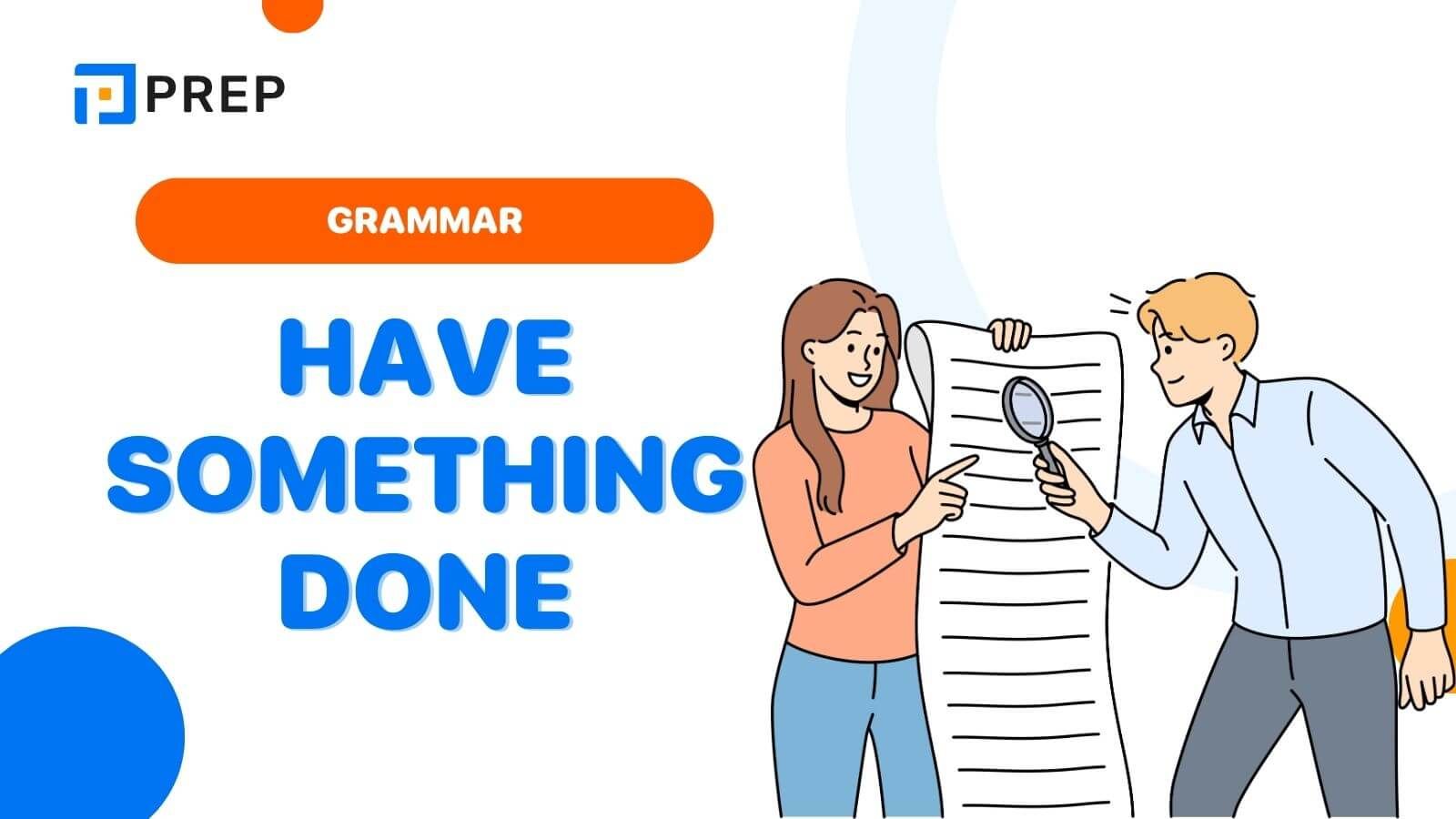
I. What Does “Have Something Done” Mean in English?
The structure “have something done” is a common grammar pattern in English, often called the causative form. It is used when someone arranges for another person to do something for them, or when something happens to them — sometimes unexpectedly.
Although it looks like a passive voice, its use is unique and practical. It's widely seen in daily communication, exams like IELTS, and in business English as well.
To Show That You Pay or Ask Someone to Do Something
This is the most common use of the structure. We use it when we arrange for someone else (usually a professional or service provider) to do something for us.
Examples:
-
I had my hair cut yesterday. (= Someone cut my hair for me.)
-
She’s having her house painted this week.
-
We’ll have the wedding photos taken tomorrow.
You are not doing the action yourself; you are arranging or paying for it to be done.
-
For a focused explanation of similar patterns, see causative verbs.
To Describe an Unpleasant or Unexpected Experience
Sometimes, “have something done” is used in a negative or unintentional context — when something happens to us that we didn’t want or plan.
Examples:
-
He had his car stolen last night. (= Someone stole his car — an unwanted event.)
-
They had their window broken during the storm.
-
I had my bag taken while I wasn’t looking.
In this meaning, it shows that something bad happened to the subject — often unexpectedly or accidentally.
Understanding this grammar helps you sound more natural in spoken and written English — especially when describing services, events, and unexpected experiences. In the next section, you’ll learn how the structure is formed in different tenses.
For a broader grammar review, see learn english grammar.
1. Structure of “Have Something Done” (Causative Form)
The causative structure “have something done” is used to show that someone else does something for the subject. It follows a clear grammatical pattern and can be used in different tenses, in both positive and negative forms, as well as in questions.
Basic Sentence Structure
|
Form |
Structure |
Example |
|
Affirmative |
have/has + object + past participle (V3) |
I have my hair cut every 2 months. |
|
Negative |
do/does/did + not + have + object + V3 |
She did not have her nails painted. |
|
Yes/No Question |
Do/Does/Did + subject + have + object + V3 |
Did you have your car washed? |
|
WH- Question |
WH + do/does/did + subject + have + object + V3 |
Why did he have the report edited? |
Structure Across Common Tenses
|
Tense |
Structure |
Example Sentence |
|
Present Simple |
have/has + object + V3 |
They have their windows cleaned every week. |
|
Past Simple |
had + object + V3 |
I had my car serviced yesterday. |
|
Present Continuous |
am/is/are having + object + V3 |
She is having her living room painted. |
|
Past Continuous |
was/were having + object + V3 |
We were having the roof fixed when it rained. |
|
Present Perfect |
have/has had + object + V3 |
He has had his house decorated recently. |
|
Future (will) |
will have + object + V3 |
I will have the documents signed tomorrow. |
|
Modal verbs |
modal + have + object + V3 |
You should have your brakes checked soon. |
This structure is highly useful when talking about professional services, daily tasks done by others, or even unintended events. In the next section, you’ll learn how to use it correctly in everyday contexts.
-
To describe ongoing arrangements, see present perfect continuous tense.
2. “Have Something Done” vs Similar Structures
There are several grammar structures in English that look or sound similar to “have something done”, but they express different meanings or levels of formality. To use them accurately, it’s important to understand how they compare.
Below are the two most common comparisons:
“Have Something Done” vs “Get Something Done”
Both structures are causative and share the same basic meaning: you arrange for someone else to do something for you. However, “get something done” is slightly more informal and more common in spoken English.
|
Structure |
Meaning |
Tone/Formality |
Example |
|
have something done |
arrange for someone to do a task |
Neutral to formal |
I had my documents translated by a professional. |
|
get something done |
arrange for someone to do a task |
Informal / spoken |
I got my phone fixed yesterday. |
Notes:
-
Both use the past participle (V3) at the end
-
“Have” is more common in writing and formal English
-
“Get” is often used in casual, spoken conversation
If you need a quick review of verb forms and what follows each pattern, read to v and ving.
“Have Someone Do” vs “Make Someone Do”
These structures look similar but convey different types of control:
-
have someone do something = ask/arrange for someone to do something
-
make someone do something = force or strongly cause someone to do something
|
Structure |
Form |
Meaning |
Example |
|
have someone do something |
have + person + base verb |
Arrange or request |
I had the assistant print the files. |
|
make someone do something |
make + person + base verb |
Force, require |
The teacher made us redo the project. |
Notes:
-
The verbs that follow both structures are in the base form (infinitive without “to”)
-
“Have someone do” is more neutral: there's an agreement or instruction
-
“Make someone do” implies pressure, lack of choice, or command
Understanding these differences will help you express cause, responsibility, and tone more precisely in both writing and speaking.
II. Exercises – Practice “Have Something Done”
To fully understand and remember how to use “have something done”, practice is essential. Below are three types of exercises to help you apply the causative structure in different ways. Each exercise includes clear instructions and examples to guide you.
Exercise 1. Fill in the Blanks
Complete the sentences using the correct form of “have + object + past participle.”
Example:
I __________ (have / car / repair) yesterday.
→ I had my car repaired yesterday.
Questions:
-
She __________ (have / nails / paint) at the salon.
-
We __________ (have / house / clean) every weekend.
-
He __________ (have / suit / make) for the wedding.
-
They __________ (have / documents / translate) into English.
-
I __________ (have / watch / fix) tomorrow morning.
Exercise 2. Rewrite the Sentences
Turn the following active or passive sentences into the causative “have something done” form.
Example:
A mechanic fixed my car.
→ I had my car fixed.
Questions:
-
A photographer is taking our wedding photos.
-
The dentist checked her teeth.
-
John will wash the windows.
-
Someone cleaned their apartment yesterday.
-
The IT staff is updating my software right now.
Exercise 3. Multiple Choice Quiz
Choose the correct form to complete each sentence.
-
I need to __________ my phone repaired.
a) get
b) have
c) make -
We __________ the documents signed last week.
a) had
b) have
c) has -
She __________ her hair cut every two months.
a) has
b) is
c) does -
Did you __________ your passport renewed?
a) have
b) had
c) having -
They are __________ their garden redesigned.
a) has
b) having
c) have
Answer Key
[prep_collapse_expand open_text="View more" close_text="Show less"]
|
Exercise 1 |
Exercise 2 |
Exercise 2 |
|
|
|
[/prep_collapse_expand]
This article encompasses all the knowledge on how to use the "have something done" structure that PREP has shared with you. Be mindful to use it correctly in communication and in your English exams!

Hi I'm Chloe, and I am currently serving as an Product Content Administrator at Prep Education. With over five years of experience in independent online IELTS study and exam preparation, I am confident in my ability to support learners in achieving their highest possible scores.
Comment
Premium content
View all



Personalized roadmap


Most read



UEN: 202227322W
Address: 114 LAVENDER STREET, #11-83 CT HUB 2, SINGAPORE (338729)