Describe a Time You Worked in a Team: Part 2 & 3
This guide helps you describe a time when you worked in a team for Speaking Part 2 and Part 3. It includes cue card guidance, band 5.0–6.0 and band 7.0+ sample answers, teamwork-related vocabulary, grammar structures, and examiner comments to improve fluency, coherence, and idea development.

I. Cue Card – Describe a Time When You Worked in a Team
Cue Card – IELTS Speaking Part 2
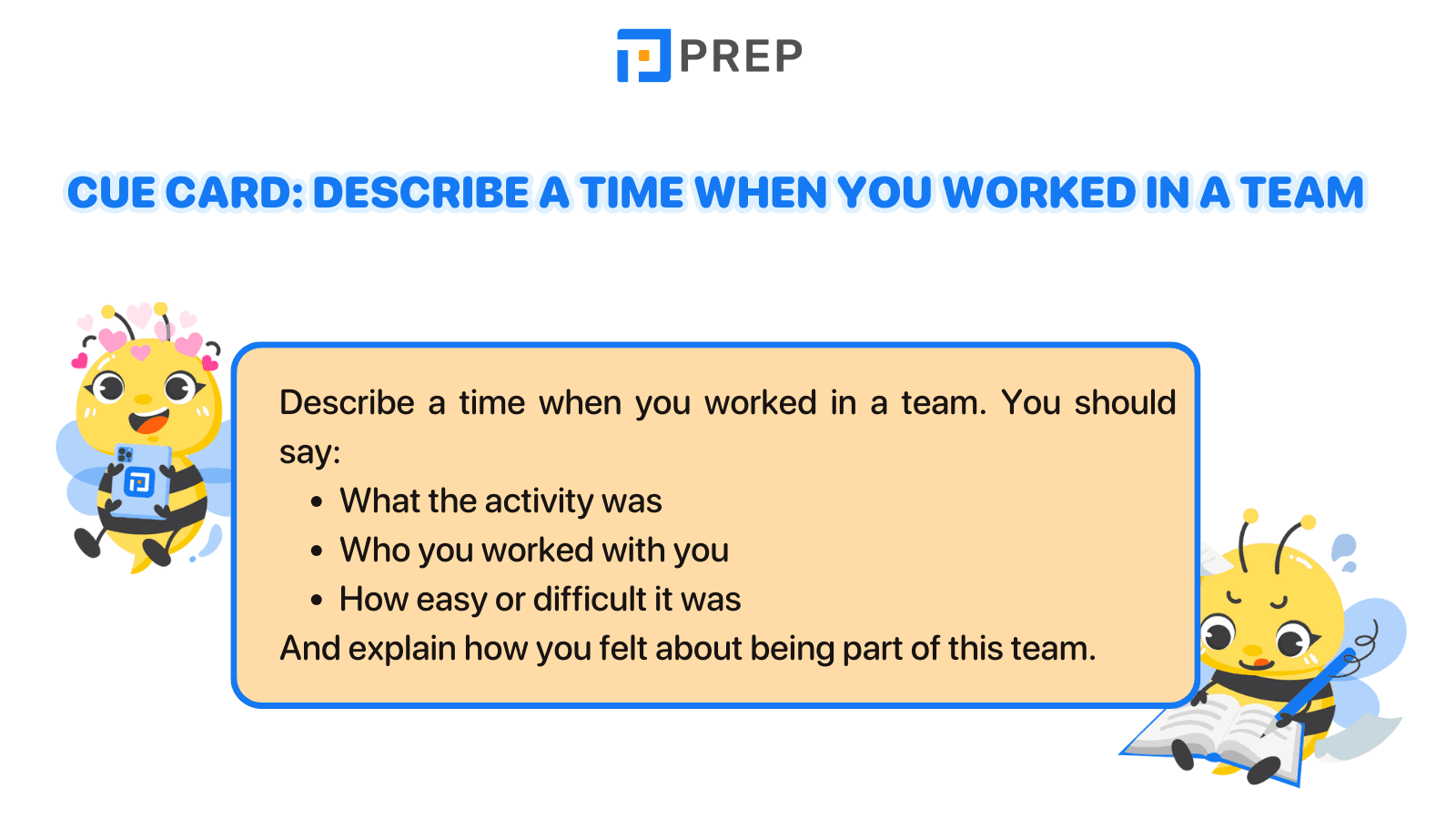
Describe a time when you worked in a team.
You should say:
-
What you did as a team
-
Who was on the team
-
What role you played
-
And explain how you felt about working in a team
To structure your response clearly, refer to answer speaking part 2 in IELTS.
How to Generate Ideas Quickly
-
Task/Project: Was it a school assignment, a work project, a sports competition, organizing an event, or something else? You can also organize your ideas effectively using brainstorming diagrams in IELTS speaking.
-
Team Members: Friends, classmates, colleagues, family members, or mixed group?
-
Your Role: Leader, presenter, designer, organizer, supporter, researcher, etc.
-
Feelings/Outcome: Was teamwork enjoyable, challenging, effective? Did you learn anything about yourself or teamwork? Were you proud/satisfied/frustrated?
Brainstorming Table (Optional)
|
Category |
Ideas (Examples) |
|
Task/Project |
School science project |
|
Team Members |
Four classmates from math class |
|
Role |
Prepared the presentation and slides |
|
Feelings/Result |
Nervous at first, then proud after presenting well |
II. Band 5.0–6.0 Sample – Speaking Part 2 & 3
This section provides a Band 5.0–6.0 sample answer for “Describe a time when you worked in a team.” The answer is clear, simple, and follows the cue card structure.
To improve your performance, learn how to expand answers in IELTS speaking.
1. Speaking Sample Answer – Part 2
Describe a time when you worked in a team.
You should say:
-
What you did as a team
-
Who was on the team
-
What role you played
-
And explain how you felt about working in a team
Sample Answer (Band 5.0–6.0):
Last year, I worked in a team for a group project at my school. We had to make a science presentation about the environment. My team had four people – all were my classmates.
I worked on the presentation slides for the group. Another friend found information, and the others helped with pictures and speaking. We often met after class to prepare.
At first, I was nervous because I had not worked like this before. But later, I felt better because everyone helped each other. On the day of the presentation, we finished the work well and the teacher gave us a good mark. I felt proud of my team and learned that teamwork is very important.

2. Speaking Sample Answer – Part 3
At the Band 5.0–6.0 level, answers should be short, clear, and use basic reasoning or a simple example.
Question 1: Why do people sometimes prefer to work alone rather than in a team?
Some people like to work alone because they can do things their own way. They do not have to wait for others or worry about team problems. It is sometimes faster and less stressful for them.
Question 2: What are the advantages of working in a team?
Working in a team has many benefits. People can share ideas and help each other. If one person has a problem, others can support them. Also, work can be finished faster when everyone works together.
Question 3: Do you think teamwork is important in schools and workplaces?
Yes, I think teamwork is very important in both places. In school, students learn from each other. At work, teamwork helps people do big projects and solve problems that one person cannot do alone.
3. Vocabulary Highlight
At the Band 5.0–6.0 level, clear and topic-related vocabulary is important for describing teamwork. Use simple words to state your role, people involved, actions, and feelings.
Vocabulary by Topic
|
Topic |
Useful Words & Phrases |
Example Sentence |
|
Team & Roles |
team, group, classmates, leader, member, role |
I was a member of the team for the school project. |
|
Actions |
work together, discuss, help, present, share |
We worked together and shared different ideas. |
|
Project/Task |
science project, presentation, homework |
We did a science presentation about the environment. |
|
Feelings |
nervous, proud, happy, excited, stressed |
I felt nervous at first, but proud in the end. |
|
Support |
help each other, solve problems, support |
We helped each other and solved problems as a team. |
Short Phrases
-
“We shared different ideas.”
-
“Everyone worked together.”
-
“I was responsible for making the slides.”
-
“We met after school to prepare.”
-
“I learned teamwork is important.”
4. Grammar and Structures
At Band 5.0–6.0, your answers should use mainly present simple (for habits, general truths) and past simple (for what happened in your story). Most sentences should be simple or compound, linked by “and,” “but,” or “because.” Focus on being clear and correct rather than complex.
Tense Usage
|
Tense / Structure |
Usage |
Example |
|
Present Simple |
To talk about teamwork in general |
Teamwork is important in school and work. |
|
Past Simple |
To tell your specific team experience |
I worked in a team last year. |
|
Compound Sentences |
Add details and reasons with and/but/because |
We met many times because the project was hard. |
Sentence Starters
-
I worked in a team when…
-
My group had…
-
I was responsible for…
-
We helped each other with…
-
In the end, I felt…
Keep your sentences simple, use the right tense, and link your ideas clearly for a strong Band 5.0–6.0 answer.
III. Band 7.0+ Sample – Speaking Part 2 & 3
At Band 7.0+, you should show clear organization, fluent expression by improving your fluency and coherence IELTS speaking.
1. Speaking Sample Answer – Part 2
Describe a time when you worked in a team.
You should say:
-
What you did as a team
-
Who was on the team
-
What role you played
-
And explain how you felt about working in a team
Sample Answer (Band 7.0+):
One memorable experience of teamwork for me was organizing a charity event for my university’s community service club last year. Our team consisted of six members, all with different strengths and backgrounds, which made the group dynamic and creative.
I was in charge of public relations, so I coordinated with sponsors and managed our social media campaign to attract more participants. Meanwhile, others took care of logistics, budgeting, and event setup. We communicated frequently through online meetings and divided tasks based on each person’s skills.
Working in this team was both challenging and rewarding. At times, we faced disagreements about the event plan, but we learned to listen to each other and reach compromises. The event turned out to be a huge success, raising more money than we expected for our chosen cause.
Looking back, I felt genuinely proud, not only of the outcome, but also of how well we collaborated. This experience definitely improved my leadership and communication skills.
For a related topic, you can explore describe a time when you gave advice to others sample.
2. Speaking Sample Answer – Part 3
At Band 7.0+, Part 3 responses should be well-developed, logical, and use a range of vocabulary and grammar to explore ideas in depth.
Question 1: What makes a successful team?
I believe a successful team is built on strong communication, clear goals, and mutual respect. When team members feel comfortable sharing ideas and opinions, they can solve problems more creatively. It’s also crucial that everyone understands their role and trusts each other to complete tasks. In my experience, a diversity of skills and perspectives leads to better solutions and fewer conflicts, which is why well-organized teams usually achieve their objectives more efficiently.
Question 2: Do you think leaders are essential for effective teamwork?
In most cases, yes. While self-managed teams can work in certain situations, a good leader provides direction, motivates members, and helps resolve conflicts. An effective leader listens actively and makes decisions that benefit the whole group rather than just a few individuals. However, I think leadership can be shared too—sometimes, different people take the lead depending on the task at hand, which can inspire more engagement from everyone.
Question 3: How has modern technology changed teamwork?
Technology has revolutionized the way people collaborate. Tools like video conferencing, shared online documents, and instant messaging make it possible for teams to work together, even from different locations or time zones. This increases flexibility and can speed up project work. However, it also means team members must be disciplined and communicate clearly to avoid misunderstandings, since digital communication can sometimes lack the nuance of face-to-face interaction.
For more practice, explore answer speaking part 3 in IELTS.
3. Vocabulary Highlight
At Band 7.0+, use a wide, natural range of topic-related vocabulary and collocations. For teamwork topics, precise wording and idiomatic expressions help you convey complex ideas succinctly and confidently.
Describing Teams & Roles
|
Vocabulary / Phrase |
Usage Example |
|
collaborate / collaborate closely |
We collaborated closely on planning the event. |
|
delegate tasks / responsibilities |
The leader delegated tasks based on our strengths. |
|
play a key role / take initiative |
I played a key role in fundraising and took initiative to recruit volunteers. |
|
group dynamics / team spirit |
Good group dynamics contributed to a positive team spirit. |
|
diverse skillsets / backgrounds |
Our team benefited from our diverse skillsets. |
Actions & Process
|
Vocabulary / Phrase |
Usage Example |
|
coordinate efforts |
We had to coordinate our efforts to meet the deadline. |
|
reach a consensus |
It wasn’t always easy, but we managed to reach a consensus on important decisions. |
|
troubleshoot problems |
When technical issues arose, we worked together to troubleshoot problems. |
|
provide feedback / constructive criticism |
We regularly provided feedback and constructive criticism to improve the work. |
Outcome & Reflection
|
Vocabulary / Phrase |
Usage Example |
|
rewarding / fulfilling experience |
Organizing the event was a truly rewarding experience. |
|
overcome obstacles / challenges |
We overcame many obstacles during the project. |
|
foster mutual respect / trust |
The project helped foster mutual respect among members. |
|
achieve a common goal |
Our shared vision helped us achieve a common goal. |
|
strengthen communication skills |
The teamwork experience strengthened my communication skills. |
Tip: Try to include several collocations naturally in your answers—this boosts your lexical resource and helps your ideas sound more advanced.
4. Grammar and Structures
At Band 7.0+, you should use a range of complex and compound sentence structures naturally, handle mixed tenses accurately, and connect your ideas smoothly with cohesive devices. Flexibility and accuracy are key in fully developed answers about teamwork.
Tense Usage
|
Tense/Structure |
Usage |
Example |
|
Past Simple |
To narrate a specific team experience |
We organized a fundraising event last summer. |
|
Present Simple |
For general opinions or truths |
Good communication is essential for effective teamwork. |
|
Present Perfect |
To show ongoing impact or lessons |
I’ve learned a lot about leadership from working with different teams. |
|
Conditionals & Modals |
For speculation, advice, or expressing possibility |
If each member contributes, the team will be much more successful. |
Complex Structures
|
Structure Type |
Usage / Function |
Example |
|
Relative clauses |
To add detailed description |
The colleague who managed logistics kept everything running smoothly. |
|
Conditionals |
To show consequences or hypothetical situations |
If we hadn’t communicated well, we might not have finished on time. |
|
Contrast/comparison |
To highlight differences, benefits, or drawbacks |
While online teamwork is convenient, it sometimes lacks personal connection. |
|
Cause–effect |
To show reasoning or results |
Because everyone cooperated, we achieved a better result than expected. |
Linking Devices & Style
-
In addition / furthermore / what’s more (adding ideas)
-
As a result / therefore / consequently (showing results)
-
For instance / for example (giving examples)
-
Although / even though / while (contrasting)
-
Personally, I believe… / In my experience… (expressing opinion)
IV. Examiner’s Comments – What a Band 7 Answer Sounds Like
To achieve Band 7.0 or higher when answering “Describe a time when you worked in a team,” candidates need more than a good story. Examiners listen for your ability to organize ideas, reflect, and use language fluently and precisely.
What Examiners Look For
-
Fluency & Coherence: You speak at length, organize your answer logically, and link ideas smoothly.
-
Lexical Resource: You use a wide range of vocabulary, including topic-specific words and collocations about teamwork and group projects.
-
Grammatical Range & Accuracy: You employ complex and compound sentences naturally, with accurate tense control and variety.
-
Pronunciation: You are clear, expressive, and easy to follow—even with some accent.
Features of a Band 7+ Answer
-
Goes beyond description to reflect on team dynamics, personal growth, or group outcomes.
-
Connects ideas: “This experience not only improved my communication skills, but also taught me to value different viewpoints.”
-
Uses precise terms: “project management,” “leadership role,” “mutual respect,” “fulfilling experience,” etc.
-
Demonstrates flexibility: smoothly transitions between story, feelings, and wider opinions on teamwork.
Tips from the Examiner
-
Develop every part of your answer—don’t just say what you did, but explain how it affected you.
-
Support your ideas with specific details or brief examples.
-
Avoid vague language (“it was good”), and aim for reflection and depth.
-
Organize by idea, not just events: challenge, action, result, what you learned.
A Band 7 answer inspires confidence and interest. It demonstrates not just speaking skill but also maturity, self-awareness, and an ability to connect personal experience to broader ideas about cooperation and teamwork.
This article has provided the most complete IELTS Speaking Part 2 sample topic "Describe a time when you worked in a team". Refer to it to effectively practice IELTS at home and achieve a high band score in the actual Speaking test!

Hi I'm Chloe, and I am currently serving as an Product Content Administrator at Prep Education. With over five years of experience in independent online IELTS study and exam preparation, I am confident in my ability to support learners in achieving their highest possible scores.
Comment
Premium content
View all




Personalized roadmap


Most read


UEN: 202227322W
Address: 114 LAVENDER STREET, #11-83 CT HUB 2, SINGAPORE (338729)