Describe a Creative Person: Band 5–7 Guide
This guide explains how to answer the IELTS Speaking Part 2 topic “Describe a creative person.” You will learn how to generate ideas quickly, structure your response clearly, use topic-related vocabulary, and develop natural answers to achieve a higher band score.

I. Cue Card – Describe a Creative Person
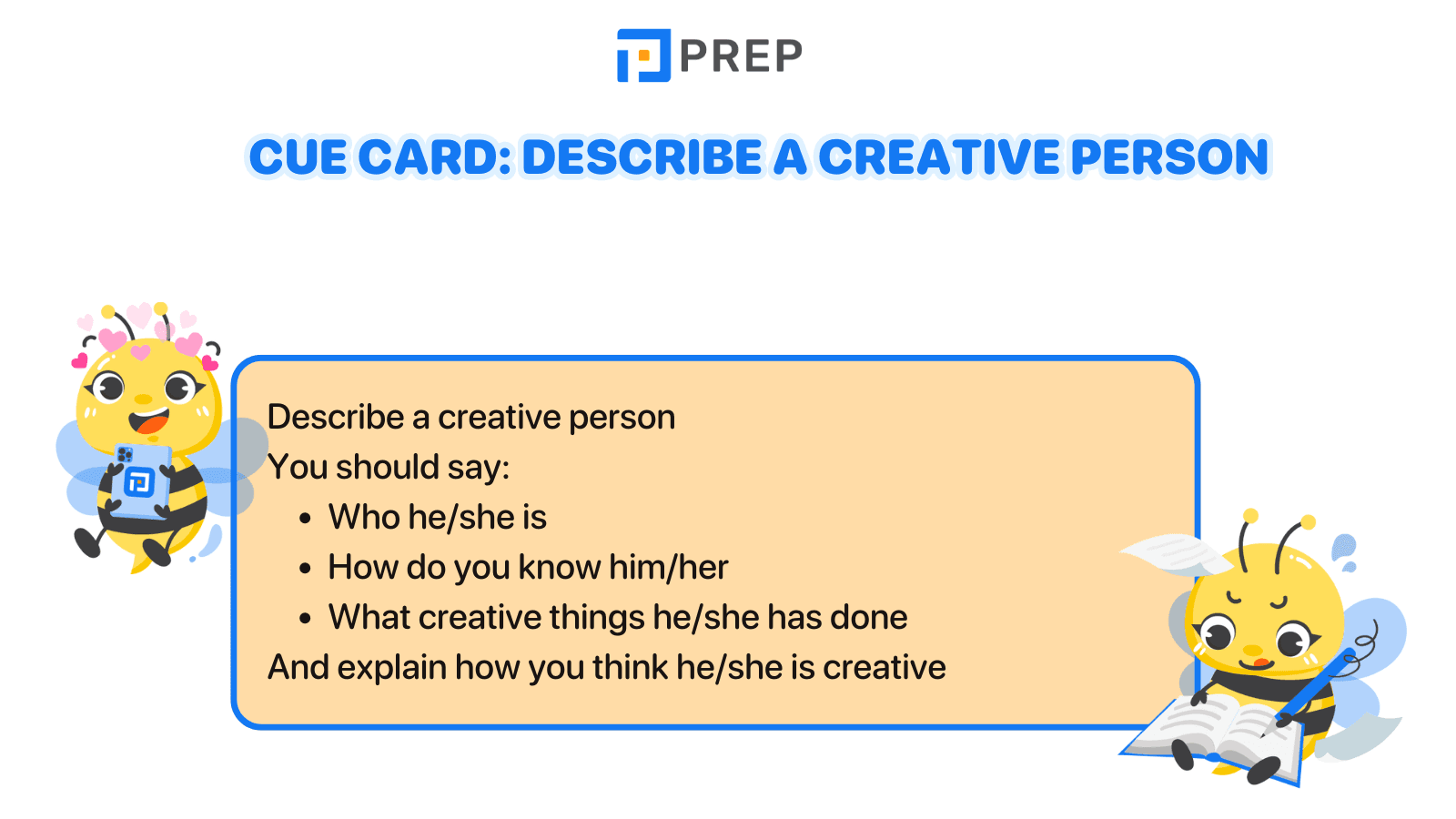
Cue Card – IELTS Speaking Part 2
Describe a creative person you admire.
You should say:
-
Who this person is
-
How you know him or her
-
What creative things he or she has done
-
And explain why you think this person is creative
To structure your ideas better, refer to answer speaking part 2 in IELTS.
How to Generate Ideas Quickly
To prepare a strong, focused answer, you can also use brainstorming diagrams in IELTS speaking to organize ideas quickly.
-
Who: Family member, friend, teacher, famous artist/inventor
-
How you know them: Personal connection, seen on TV, from school, from work
-
Creative acts: Makes art, solves problems, thinks of new ideas, invents something, designs, writes
-
Why creative: Always tries new things, inspires others, can solve problems in unique ways, original thinking
A similar approach can be applied to topics like describe an intelligent person.
Brainstorming Table (Optional)
|
Category |
Example Ideas |
|
Person |
My uncle (writer), my classmate (good at drawing), local chef |
|
How you know |
He is my uncle; we often talk about books; he writes novels |
|
Creative acts |
Published a short story, invents fun games for family gatherings |
|
Why creative |
Always has fresh ideas, encourages others to think differently |
II. Band 5.0–6.0 Sample – Speaking Part 2 & 3
The answers use simple structures to improve your fluency and coherence IELTS speaking.
1. Speaking Sample Answer – Part 2
Describe a creative person you admire.
You should say:
-
Who this person is
-
How you know him or her
-
What creative things he or she has done
-
And explain why you think this person is creative
Sample Answer (Band 5.0–6.0):
A creative person I know is my older brother. He is a university student and lives with my family. I see him every day at home.
He loves making things with his hands. For example, he builds models and sometimes repairs broken machines in our house. He also likes to draw cartoon pictures for my little sister.
I think he is creative because he always thinks of new ideas. When there is a problem, he tries to find a different way to fix it. He makes our life at home more fun and interesting.
Learn more strategies at answer speaking part 3 in IELTS.
2. Speaking Sample Answer – Part 3
At the Band 5.0–6.0 level, Part 3 answers should be short, clear, and use everyday language. Give one or two simple reasons or examples for each question.
Question 1: Do you think creativity is important in daily life?
Yes, I do. Creativity helps people solve problems and find easier ways to do things. It also makes life more interesting.
Question 2: How can children become more creative?
Children can become creative by playing games, drawing, and trying new activities. Schools should let students work on fun projects and use their imagination.
Question 3: Are creative people respected in your country?
Yes, creative people are respected, especially if they make something useful or beautiful. Many people admire artists, inventors, or musicians.
3. Vocabulary Highlight
At the Band 5.0–6.0 level, it is important to use simple and clear words for real-life english conversation.
Vocabulary by Topic
|
Topic |
Useful Words & Phrases |
Example Sentence |
|
People |
creative, imaginative, talented, artistic, smart |
My brother is very creative and talented. |
|
Actions |
make, build, design, draw, invent, fix, solve |
He likes to build models and solve problems. |
|
Describing Ideas |
new ideas, interesting, different, original |
He always thinks of new and original ideas. |
|
Hobbies |
art, music, drawing, writing, making things |
She enjoys art and making things by hand. |
|
Respect/Appreciation |
admire, respect, inspire, special, fun |
I admire people who can inspire others to be creative. |
Common Sentence Starters
-
"He/She is good at..."
-
"He always tries to..."
-
"I think he is creative because..."
-
"She inspires me to..."
-
"He can fix things that are broken."
Tip: Pick phrases that feel comfortable to say and match your real experience or story.
4. Grammar and Structures
At the Band 5.0–6.0 level, you should focus on using basic grammar correctly and making sure your sentences are clear. Most answers are in the present simple or past simple, and ideas are linked using “and,” “but,” or “because.” Small errors are acceptable if your meaning is clear.
Tense Usage – Present Simple & Past Simple
|
Tense |
Usage |
Example |
|
Present Simple |
Describe habits, a person’s character, opinions |
He always helps my sister when she has a problem. |
|
Past Simple |
Tell a story, describe past actions or events |
He fixed my old bike last week. |
Basic Sentence Structures
|
Type |
Structure |
Example |
|
Simple Sentence |
Subject + verb + object |
She draws pictures for her friends. |
|
Compound Sentence |
Use and / but / because |
He likes art and music, but he also plays sports. |
|
“There is/are” |
Talk about ideas or things created |
There are many good ideas in her paintings. |
Common Sentence Starters
|
Expression |
Example |
|
He is/She is... |
He is very creative with his hands. |
|
I think... |
I think she is talented and imaginative. |
|
He likes to... |
He likes to build models from old things. |
|
She can... |
She can solve problems quickly. |
|
It was... |
It was interesting to see what he made. |
Frequent Grammar Mistakes
|
Mistake Type |
Incorrect |
Correct |
|
Missing 3rd person “s” |
She make new things. |
She makes new things. |
|
Verb tense confusion |
He draw a picture yesterday. |
He drew a picture yesterday. |
|
Article errors |
He is artist. |
He is an artist. |
|
Word order mistakes |
Is creative person. |
He is a creative person. |
III. Band 7.0+ Sample – Speaking Part 2 & 3
At Band 7.0+, your answers should:
-
Fully address all cue card points, adding details and personal reflection
-
Use precise, expressive language
-
Demonstrate a good balance of complex and compound sentences
-
Present your story with smooth fluency and confident organization
1. Speaking Sample Answer – Part 2
Describe a creative person you admire.
You should say:
-
Who this person is
-
How you know him or her
-
What creative things he or she has done
-
And explain why you think this person is creative
Sample Answer (Band 7.0+):
One creative person I truly admire is my high school art teacher, Ms. Linh. I had the chance to study with her for three years, and she really changed the way I think about art and creativity.
Ms. Linh is a gifted artist herself—she paints, sculpts, and even designs costumes for local theatre shows. What really impresses me, though, is how she encourages her students to experiment. For example, in class we used recycled materials to make unique sculptures and sometimes even collaborated on large art projects for the community.
I think Ms. Linh is extremely creative because she never sticks to a single technique or idea. She’s always searching for inspiration in daily life, often turning simple objects into something beautiful. Thanks to her, many of us learned to see the world differently and not be afraid of trying new things. Her passion, imagination, and positive energy continue to inspire me now, even after graduation.
2. Speaking Sample Answer – Part 3
At Band 7.0+, Part 3 responses should present well-developed, logical ideas, natural linking phrases, and relevant examples or explanations. Show the ability to reflect on creativity in society, education, and culture.
Question 1: Why is creativity valuable in modern society?
Creativity is essential because it drives innovation and progress. In our rapidly changing world, creative thinking allows people to solve unexpected problems, adapt to new situations, and develop unique products or services. Companies and organizations now recognize that creativity fuels not only the arts, but also science, technology, and everyday life.
Question 2: How can schools encourage creativity among students?
Schools can foster creativity by offering more project-based activities and group work that challenge students to think outside the box. Instead of always focusing on correct answers, teachers should reward original ideas and curiosity. Providing opportunities for students to explore music, art, and creative writing helps develop those skills from an early age.
Question 3: Do you think creativity is something people are born with, or can it be learned?
I believe that while some individuals are naturally more imaginative, everyone can develop creativity through practice and encouragement. Just like any other skill, creativity grows when people are given time, space, and support to experiment or express new ideas. In my view, a mix of natural ability and learning from experience produces the most creative minds.
3. Vocabulary Highlight
At Band 7.0+, your vocabulary should demonstrate range, precision, and flexibility.
Describing Creative People & Abilities
|
Vocabulary / Phrase |
Example Usage |
|
innovative / resourceful |
She is extremely innovative and always finds resourceful solutions. |
|
imaginative / inventive |
His stories are imaginative and inventive. |
|
think outside the box |
Teachers encourage us to think outside the box. |
|
problem-solving skills |
Creative people often have excellent problem-solving skills. |
|
visionary |
He’s a true visionary in the world of technology. |
Talking about Actions & Achievements
|
Vocabulary / Phrase |
Example Usage |
|
experiment with |
She likes to experiment with new colors in her paintings. |
|
push boundaries |
He constantly pushes boundaries in modern design. |
|
artistic expression |
Freedom of artistic expression is highly valued. |
|
groundbreaking |
Their new project was completely groundbreaking. |
|
inspire others |
Her positive outlook inspires others to be creative. |
Reflecting on Creativity in Society
|
Vocabulary / Phrase |
Example Usage |
|
foster creativity |
Schools should do more to foster creativity. |
|
nurture talent |
Good teachers know how to nurture talent in their students. |
|
encourage originality |
We need to encourage originality in every field. |
|
cultural impact |
Her work has had a strong cultural impact locally. |
|
spark new ideas |
Traveling can often spark new ideas and fresh perspectives. |
4. Grammar and Structures
At Band 7.0+, you should demonstrate flexible, accurate, and varied grammar. The aim is to combine complex and compound sentences naturally, using linking phrases, a mix of tenses, and structures that allow you to analyze and reflect as you speak.
Tense Usage – Varied and Purposeful
|
Tense / Structure |
Usage |
Example |
|
Present Simple |
Talk about general facts or a person’s habits |
She always looks for original solutions to everyday problems. |
|
Past Simple |
Describe a story or example from the past |
He invented a new way to recycle plastic last year. |
|
Present Perfect |
Link past actions to the present |
She has inspired many students over the years. |
|
Conditionals |
Give opinions or hypotheticals |
If schools reward creativity, students will be more motivated. |
|
Modals (can, should, might) |
Suggest, recommend, or express ability |
Teachers should encourage students to use their imagination. |
Complex Sentence Structures
|
Structure Type |
Usage / Purpose |
Example |
|
Relative Clauses |
Add detail smoothly |
The artist who lives next door has won several awards. |
|
Cause/Effect & Contrast |
Explain reasons, compare ideas |
Although not everyone is born creative, most can develop it. |
|
Embedded Clauses |
Make explanations and opinions more nuanced |
What fascinates me is how she combines science and art in her work. |
|
Advanced Linking |
Create logical flow and coherence |
In addition, For instance, On the other hand, Personally, I believe |
Advanced Style Tips
-
Move beyond “I think…” and “because” by using phrases like “In my opinion…”, “One reason for this is…”, or “This shows that…”.
-
Vary sentence openings and lengths for natural rhythm.
-
Balance examples, explanations, and reflections:
“While some say creativity is a natural gift, I would argue that it is mostly developed through experience and support.”
IV. Examiner’s Comments – What a Band 7 Answer Sounds Like
To achieve Band 7.0 or higher in IELTS Speaking for the topic “Describe a creative person you admire”, candidates are expected to provide not just basic information, but also depth, detail, and flexibility in both vocabulary and grammar.
What Makes a Real Band 7+ Answer?
-
Goes beyond the cue card to reflect, explain, and connect ideas
-
Shows a passion for the topic through variety of vocabulary and grammar
-
Uses personal examples, comparisons, and thoughtful evaluation
-
Sounds natural and flexible, not memorized
Tips for Achieving Band 7+
-
Expand every point—always ask yourself “why” or “how”
-
Use high-level linking (“On top of that…”, “For this reason…”)
-
Show both factual knowledge and your own perspective
-
Practice speaking about a range of creative fields, not just art (science, business, social work…)
A Band 7+ answer doesn’t just describe a creative person—it explains what makes them special, what we can learn from them, and why creativity really matters in today’s world.
V. Master IELTS Skills for a High Band Score
This article has provided the sample essay for IELTS Speaking Part 2 on the topic "Describe a creative person." If you want continuous support, PREP’s mentorship will guide you from start to finish
-
IELTS preparation full course: Score Big in IELTS With Our Expert Tips!

Hi I'm Chloe, and I am currently serving as an Product Content Administrator at Prep Education. With over five years of experience in independent online IELTS study and exam preparation, I am confident in my ability to support learners in achieving their highest possible scores.
Comment
Premium content
View all
Personalized roadmap


Most read



UEN: 202227322W
Address: 114 LAVENDER STREET, #11-83 CT HUB 2, SINGAPORE (338729)