Experience Collocations: Verb, Adjective, and Nouns
Experience collocations are widely used in IELTS Writing, academic essays, CVs, and professional communication. This guide introduces common verb, adjective, and noun collocations with “experience,” highlights high-value academic expressions, and explains how to use them naturally to improve clarity, accuracy, and lexical range in writing.

I. Common Experience Collocations in English
The word “experience” is one of the most widely used nouns in both spoken and written English. Because of its broad meaning and flexibility, it appears frequently in a wide range of contexts—from IELTS writing and academic essays to résumés, business emails, and everyday conversation.
In English, collocations are natural combinations of words that are often used together by native speakers. Mastering collocations with “experience” helps learners express ideas more fluently, avoid awkward phrasing, and enhance their performance in English proficiency exams.
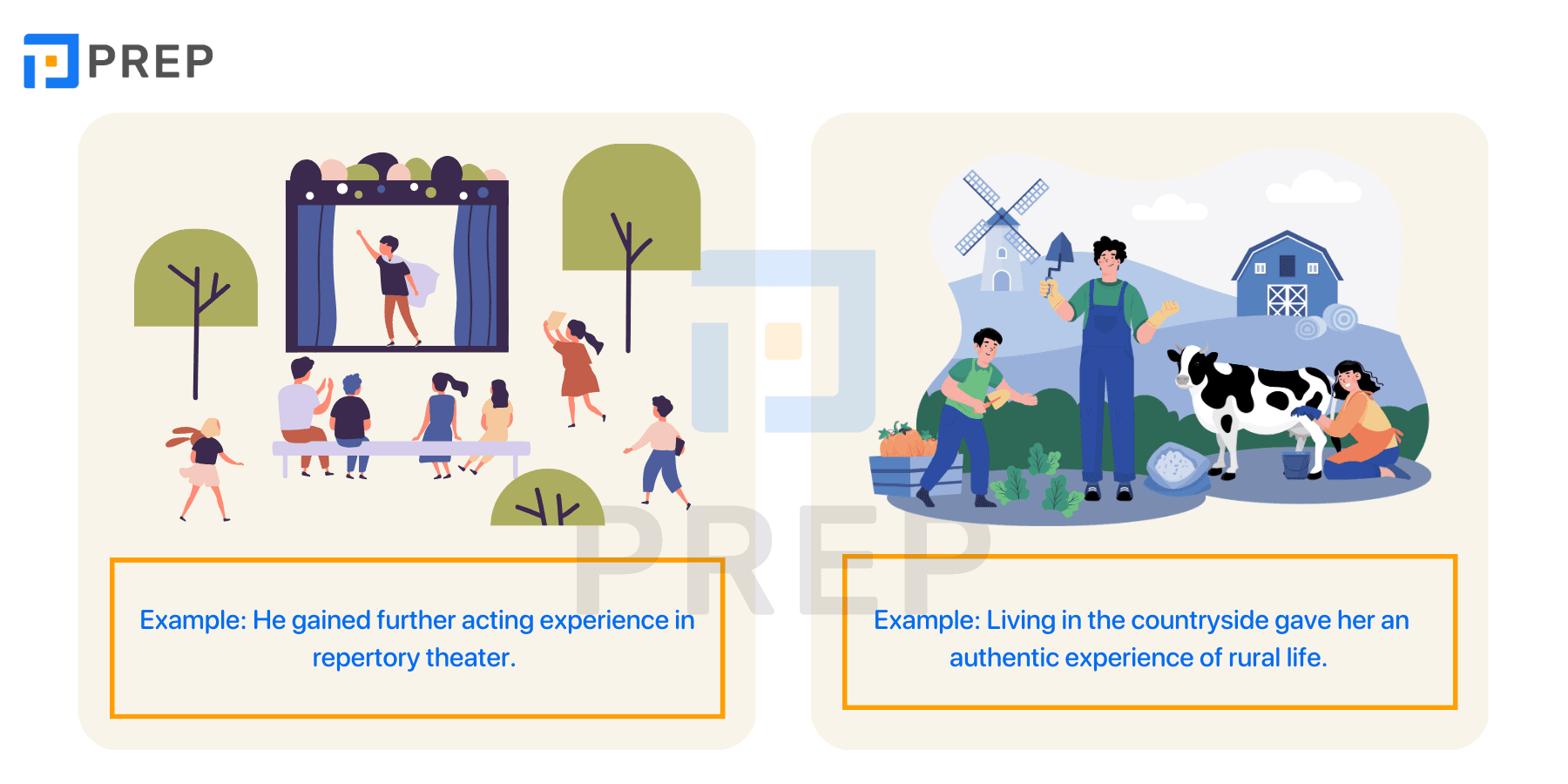
The noun “experience” commonly appears in collocations with verbs, adjectives, and in fixed noun phrases, each of which carries a unique nuance. For example:
-
gain experience (to accumulate knowledge through practice)
-
valuable experience (to describe something meaningful or professionally useful)
-
work experience, hands-on experience (set phrases that describe real-life practical knowledge)
Whether you're writing an IELTS Task 2 essay, describing your background in a job interview, or explaining a personal story, using the correct collocations with “experience” can enhance clarity, sophistication, and naturalness in your English.
In argumentative tasks, pairing these with collocations with opinion helps you express viewpoints more convincingly.
1. Verb + experience collocations
Collocations that pair verbs with the noun “experience” are among the most commonly used and flexible constructions in academic, professional, and test-based English. They allow speakers and writers to describe how someone develops, possesses, applies, or lacks experience in various fields.
|
# |
Collocation |
Meaning |
Example Sentence |
|
1 |
gain experience |
to acquire through effort or exposure |
She gained experience in digital marketing last year. |
|
2 |
have experience |
to possess knowledge, often from the past |
I have experience working with international students. |
|
3 |
get experience |
to begin obtaining or collecting experience |
You should get some experience before applying. |
|
4 |
acquire experience |
to obtain, particularly in formal/academic contexts |
They acquired experience through an internship abroad. |
|
5 |
lack experience |
to not have enough experience |
Many junior staff lack experience in leadership roles. |
|
6 |
build experience |
to gradually accumulate or grow experience |
I’m building experience in research and data analysis. |
|
7 |
develop experience |
to expand or deepen existing experience |
This role helps me develop experience in client relations. |
|
8 |
bring experience |
to contribute previous experience |
He brings international teaching experience to the school. |
|
9 |
offer experience |
to provide a setting where experience is gained |
Volunteering offers experience in event organization. |
|
10 |
share experience |
to talk about one’s experience |
The speaker shared decades of experience with the audience. |
|
11 |
reflect experience |
to demonstrate previous experience in a behavior |
Her leadership reflects years of experience. |
|
12 |
require experience |
to demand experience as a qualification |
This job requires at least two years’ experience. |
|
13 |
apply experience |
to use past experience to do something new |
He applied his teaching experience when designing the course. |
|
14 |
draw on experience |
to rely on experience for decision-making |
I had to draw on my past experience in crisis management. |
|
15 |
relate experience |
to describe or tell others about it |
Can you relate your experience in the tech industry? |
|
16 |
enrich experience |
to make an experience more valuable or meaningful |
Traveling abroad enriched my personal and cultural experience. |
|
17 |
enhance experience |
to improve experience or make it more effective |
Workshops help enhance the student learning experience. |
|
18 |
describe experience |
to explain what you’ve done or felt |
It’s hard to describe the experience in just a few words. |
|
19 |
recall experience |
to remember and talk about past experiences |
She recalled her experience volunteering in Africa. |
|
20 |
define experience |
to explain what something meant to you |
This course defined my experience at university. |
|
21 |
accumulate experience |
to collect over time |
He accumulated years of experience as a financial analyst. |
|
22 |
interpret experience |
to make sense of a situation through prior knowledge |
We interpret new problems through past experience. |
|
23 |
value experience |
to recognize the worth of an experience |
Teachers should value students’ experience beyond the classroom. |
|
24 |
tailor experience |
to shape an experience for a specific purpose |
The training program tailors experience to each learner. |
|
25 |
maximize experience |
to make the most out of experience opportunities |
Internships help students maximize hands-on experience. |
Use in IELTS and Academic Contexts:
-
Instead of saying: “I know how to lead a team”, try:
“I have accumulated valuable leadership experience through managing cross-functional projects.” -
When structuring answers in IELTS Speaking or Task 2, collocations like build experience, apply experience, or require experience help your response sound more advanced and idiomatic.
A structured program like the IELTS Vocabulary Booster helps turn these patterns into active, exam-ready usage
2. Adjective + experience collocations
Adjective + “experience” collocations are used to describe the quality, depth, emotional value, or professional relevance of an experience. These expressions help add nuance and precision to your English, especially in formal, academic, or career-related contexts.
|
# |
Collocation |
Meaning / Context |
Example Sentence |
|
1 |
valuable experience |
useful, helpful for professional/personal growth |
He gained valuable experience during his internship. |
|
2 |
relevant experience |
directly related to the topic or task |
My relevant experience in education was highlighted in the CV. |
|
3 |
hands-on experience |
practical, real-world experience |
The course offers hands-on experience with lab equipment. |
|
4 |
extensive experience |
a wide range or long-term exposure |
She has extensive experience in international project management. |
|
5 |
prior experience |
earlier or previous experience |
Prior experience in customer service is preferred. |
|
6 |
previous experience |
similar to “prior”, already acquired |
His previous experience was in the hospitality industry. |
|
7 |
professional experience |
work-related, career-based experience |
The candidate had five years of professional experience. |
|
8 |
teaching experience |
specific domain: education |
Applicants must show proof of teaching experience. |
|
9 |
learning experience |
experience that led to learning |
Traveling alone was a great learning experience. |
|
10 |
enriching experience |
adds value intellectually or emotionally |
Studying abroad was an enriching experience for her. |
|
11 |
unforgettable experience |
emotionally impactful and memorable |
It was an unforgettable experience to climb Mount Fuji. |
|
12 |
traumatic experience |
emotionally distressing or painful |
Losing a parent at a young age is a traumatic experience. |
|
13 |
positive experience |
satisfying, enjoyable |
It was a very positive experience working with that team. |
|
14 |
negative experience |
disappointing, not favorable |
His first job interview was a negative experience. |
|
15 |
practical experience |
experience that involves doing, not theory |
Employers appreciate candidates with practical experience. |
|
16 |
rewarding experience |
satisfying in outcome |
Volunteering was a highly rewarding experience. |
|
17 |
direct experience |
experience gained through personal involvement |
Children learn best through direct experience. |
|
18 |
limited experience |
not much experience |
He had limited experience but showed strong potential. |
|
19 |
remarkable experience |
notably unusual or impressive |
Speaking at TEDx was a remarkable experience. |
|
20 |
insightful experience |
leads to deeper understanding |
Mentoring others gave me an insightful experience about leadership. |
|
21 |
intense experience |
emotionally or mentally overwhelming |
The training program was an intense experience. |
|
22 |
cultural experience |
exposure to different traditions or contexts |
Living in Japan was a rich cultural experience. |
|
23 |
real-life experience |
not simulated or theoretical |
Case studies bridge theory with real-life experience. |
|
24 |
transformative experience |
fundamentally changes one's view or mindset |
Studying abroad was a transformative experience for him. |
|
25 |
life-changing experience |
significantly alters the course of a person's life |
Surviving the accident was a life-changing experience. |
Usage Notes for IELTS and Formal English:
-
In Writing Task 2 (Education/Work topics):
Use "valuable, relevant, practical" to increase lexical precision:
Internships provide students with valuable, hands-on experience that boosts career readiness. -
In CVs and Statements of Purpose:
Phrases like "extensive professional experience", "relevant teaching experience", or "limited research background" are often expected. -
In Speaking Parts 2 and 3:
Use emotionally loaded collocations such as "unforgettable", "life-changing", "challenging", to sound expressive and fluent.
These collocations form a core part of advanced IELTS writing vocabulary required for higher band scores.
3. Noun phrases with experience
Noun phrases containing experience are frequently used in both academic and professional contexts. They describe different types, sources, or aspects of experience in a way that is concise, natural, and precise. Using these phrases effectively can make your writing more formal and your speaking more sophisticated.
|
# |
Noun Phrase |
Meaning / Usage |
Example Sentence |
|
1 |
work experience |
practical experience in a job |
I gained work experience through a summer internship. |
|
2 |
teaching experience |
professional experience in education |
Applicants must have prior teaching experience. |
|
3 |
field experience |
hands-on experience in a professional field |
Field experience is required for all engineering students. |
|
4 |
job experience |
experience from previous employment |
Her job experience matches the role perfectly. |
|
5 |
life experience |
general experience gained from life events |
Life experience often shapes a person’s perspective. |
|
6 |
real-world experience |
practical, outside-the-classroom experience |
The course includes real-world experience in business. |
|
7 |
hands-on experience |
active, practical engagement |
Hands-on experience is essential in vocational training. |
|
8 |
internship experience |
experience gained during a formal internship |
My internship experience in marketing helped me get hired. |
|
9 |
customer service experience |
specific work history in customer relations |
He has years of customer service experience. |
|
10 |
research experience |
experience participating in academic research |
I developed research experience while writing my thesis. |
|
11 |
practical experience |
experience doing things vs. learning theory |
Employers value practical experience over academic grades. |
|
12 |
volunteer experience |
unpaid work, often in community settings |
Volunteer experience is highly respected by universities. |
|
13 |
clinical experience |
experience working in a medical setting |
Nursing students must complete clinical experience. |
|
14 |
educational experience |
any structured learning experience |
Studying abroad was a defining educational experience. |
|
15 |
previous experience |
experience from the past |
My previous experience is mostly in tech startups. |
|
16 |
international experience |
experience living/studying/working abroad |
International experience improves language and adaptability. |
|
17 |
professional experience |
formal work experience in one’s career field |
She brings 10 years of professional experience to the role. |
|
18 |
management experience |
experience in leading people/projects |
Strong management experience is a key requirement. |
|
19 |
cross-cultural experience |
interaction with other cultures |
Cross-cultural experience is essential in global business. |
|
20 |
user experience |
how users interact with products/processes |
The app provides a seamless user experience. |
|
21 |
cultural experience |
experience of traditions/customs from a culture |
The trip was a rich cultural experience. |
|
22 |
interview experience |
past experience in job interviews |
She shared her interview experience to help others prepare. |
|
23 |
leadership experience |
acting in leadership/management roles |
He highlighted his leadership experience from group projects. |
|
24 |
learning experience |
context where learning occurs |
Failure can be a powerful learning experience. |
|
25 |
client-facing experience |
interacting directly with clients |
The position requires client-facing experience. |
Application Tips:
-
IELTS Writing Task 2 (e.g. Education/Employment):
Practical experience and theoretical knowledge should be equally valued in modern education. -
CV / Resume Example:
Demonstrated strong leadership and cross-cultural experience during international university projects. -
TOEFL Speaking/Statement of Purpose:
My internship experience gave me a deeper understanding of marketing strategy in real-company settings.
II. Experience Collocations for IELTS and Academic Writing
In IELTS Writing Task 2, academic essays, research papers, and formal applications, using natural, topic-specific collocations with the word experience helps improve both accuracy and lexical sophistication. These collocations allow you to express complex ideas clearly, appropriately, and fluently—key requirements for achieving a high score in Lexical Resource (IELTS) or strong writing marks in academic settings.
High-Value Collocations for IELTS Writing Task 2
These collocations often appear in essays discussing education, training, employment preparation, or practical vs theoretical learning.
|
Collocation |
Use Example |
|
gain valuable experience |
Students should gain valuable experience through internships. |
|
lack professional experience |
Many recent graduates lack professional experience when job-hunting. |
|
offer practical experience |
Employers should offer practical experience alongside training programs. |
|
build relevant experience |
Volunteering helps young people build relevant experience. |
|
provide hands-on experience |
Vocational training provides hands-on experience for real workplaces. |
These expressions can enhance clarity, precision, and control of formal tone—all crucial for higher bands in IELTS writing.
Academic and Formal Collocations with "Experience"
These collocations are typically found in formal academic writing or research contexts.
|
Collocation |
Use Example |
|
extensive research experience |
The candidate has extensive research experience in the field of data science. |
|
cross-cultural experience |
Cross-cultural experience enriches students’ global perspective. |
|
prior teaching experience |
Applicants must demonstrate prior teaching experience. |
|
real-world professional experience |
The course bridges theory with real-world professional experience. |
|
practical field experience |
Students must complete 30 hours of practical field experience before graduation. |
Using such phrases helps meet the formal register and academic precision expected in university-level writing and postgraduate applications.
How to Use “Experience” Collocations Naturally in Essays
-
Be topic-appropriate: Use teaching experience, clinical experience, management experience depending on the essay topic (education, health, business).
-
Avoid redundancy or informal phrasing: Instead of saying “I know how to do it”, use
“I have relevant experience in this area, particularly in...” -
Use paraphrasing and variation: Avoid repeating “experience” too often. Switch between structures:
-
He brought experience to the role.
-
She applied her experience during the project.
-
Their experience was reflected in the success of the campaign.
-
-
Combine with accurate grammar: Ensure correct collocation grammar:
-
gain experience (not make experience)
-
experience in doing something (not experience to do)
-
Example Band 8+ Sentence (IELTS Writing Task 2):
Some argue that universities should only focus on academic knowledge, but I believe students also need to gain practical experience to succeed in today’s job market.
By using well-chosen collocations with 'experience', your writing will not only sound more fluent and precise, but also reflect the level of vocabulary proficiency required in academic English and high-stakes English exams like IELTS.
III. Achieve Your Dream IELTS Band Score
Your dream band score is just a course away. Gain the knowledge, skills, and strategies needed to ace the exam with ease.
-
IELTS preparation: Join Now and Make Your Dreams Come True!

Hi I'm Chloe, and I am currently serving as an Product Content Administrator at Prep Education. With over five years of experience in independent online IELTS study and exam preparation, I am confident in my ability to support learners in achieving their highest possible scores.
Comment
Premium content
View all

Personalized roadmap


Most read


UEN: 202227322W
Address: 114 LAVENDER STREET, #11-83 CT HUB 2, SINGAPORE (338729)