Consequence Collocations in English: Meaning and Use
Many English learners struggle to use the word consequence naturally in writing. This guide explains what consequence collocations are, groups common verb and adjective patterns, provides real-life and academic examples, and clarifies how consequence differs from similar words such as result and effect.
I. What Is a Consequence Collocation?
The word “consequence” is commonly used in English to refer to the result or outcome of an action, event, or decision. It often appears in discussions involving cause-and-effect relationships, making it especially valuable in formal writing, such as academic essays, reports, and IELTS Writing Task 2 responses.
You can review how to use as a result in english to express similar ideas clearly.
In most cases, consequence carries a neutral to negative tone. It is rarely used for positive outcomes (which are more often expressed with words like benefit, gain, or achievement).
Common usage contexts include:
-
Cause-and-effect explanations:
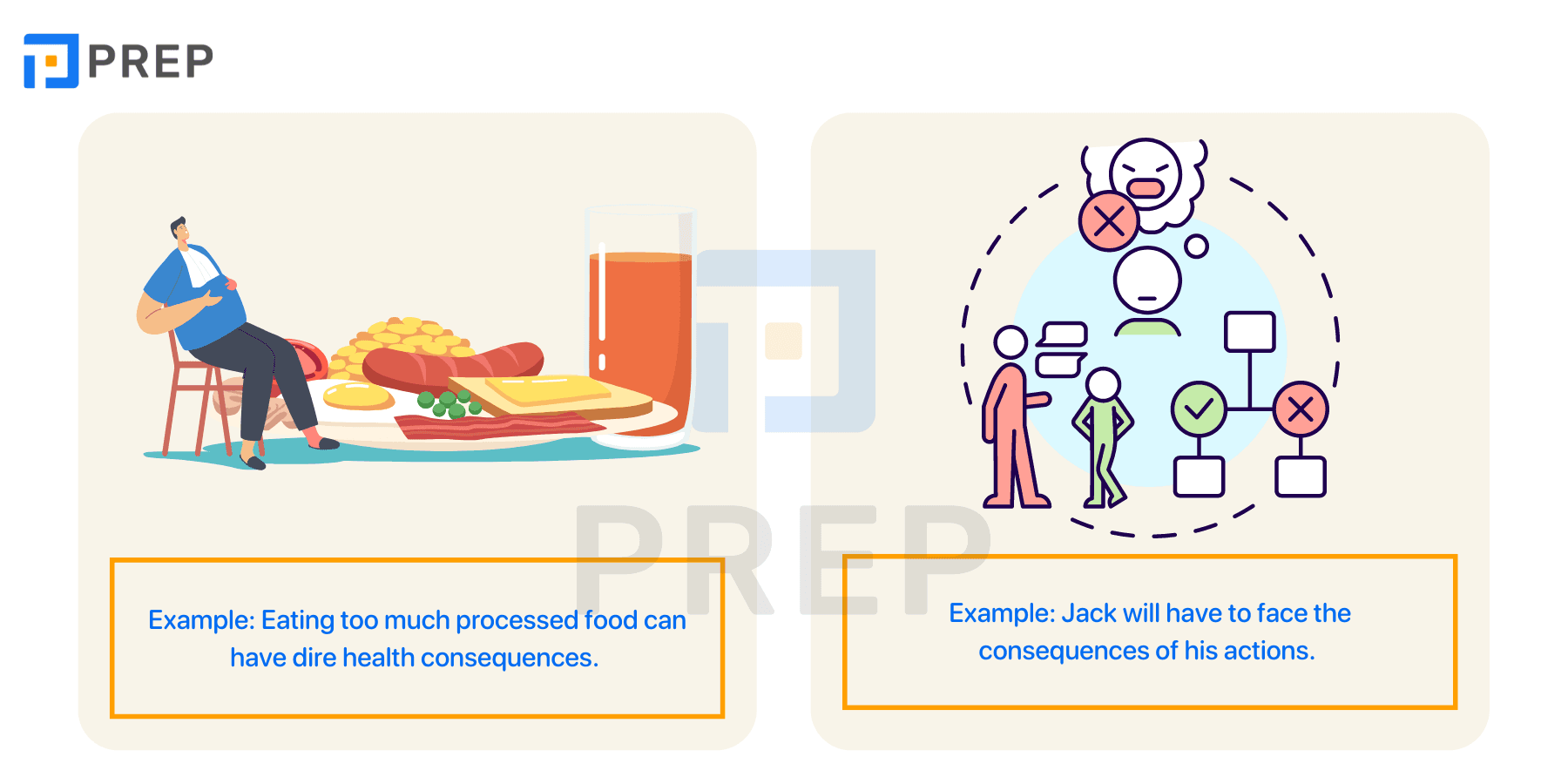
The new policy led to severe consequences for small businesses. -
Warnings or outcomes:
Students who plagiarize may face serious academic consequences. -
Formal writing or legal/policy language:
The consequence of violating the terms is immediate dismissal.
Grammatical Role and Collocational Behavior
“Consequence” is a countable noun, often used in the singular or plural form depending on context:
-
One possible consequence is...
-
The long-term consequences of climate change...
It frequently collocates with:
-
Verbs: face, suffer, consider, bear
-
Adjectives: serious, negative, unintended
-
Prepositions/Phrases: as a consequence of, in consequence, with serious consequences
Learning these collocations not only helps learners use vocabulary accurately, but also upgrade writing fluency and coherence—a crucial requirement in academic settings such as TOEFL, IELTS, or university writing tasks.
Understanding both the tone and context in which consequence appears will help learners make better lexical choices, especially in writing that requires clarity, balance, and formal register.
II. Common Consequence Collocations by Structure
To sound natural and fluent in English—especially in academic or formal writing—it’s essential to use correct and frequent collocations with the noun “consequence.” These are pre-established word combinations that native speakers use instinctively. When used correctly, collocations will improve the clarity, range, and accuracy of your English writing and speaking.
Verb + Consequence Collocations
These verbs are frequently used to describe actions related to consequences, often pointing to causes or responses to those consequences.
|
Verb |
Example Sentence |
|
face |
The organization may face serious legal consequences. |
|
suffer |
Poor planning led them to suffer the consequences. |
|
bear |
The citizens had to bear the consequence of poor leadership. |
|
ignore |
If we ignore the data, we risk significant consequences. |
|
accept |
He accepted the consequences of his decision with maturity. |
|
examine |
Researchers should examine the consequences of the new policy. |
Tip: These verbs often signal responsibility, evaluation, or impact—great for IELTS Task 2 cause-effect topics.
You can also review usage of lead to in english to express cause-effect relationships naturally.
Adjective + Consequence Collocations
These adjectives describe the type or intensity of the consequence. Using the right adjective creates a precise and professional tone.
|
Adjective |
Example Sentence |
|
serious |
The new law could have serious consequences for workers. |
|
negative |
Negative consequences are more likely when rules are not enforced. |
|
long-term |
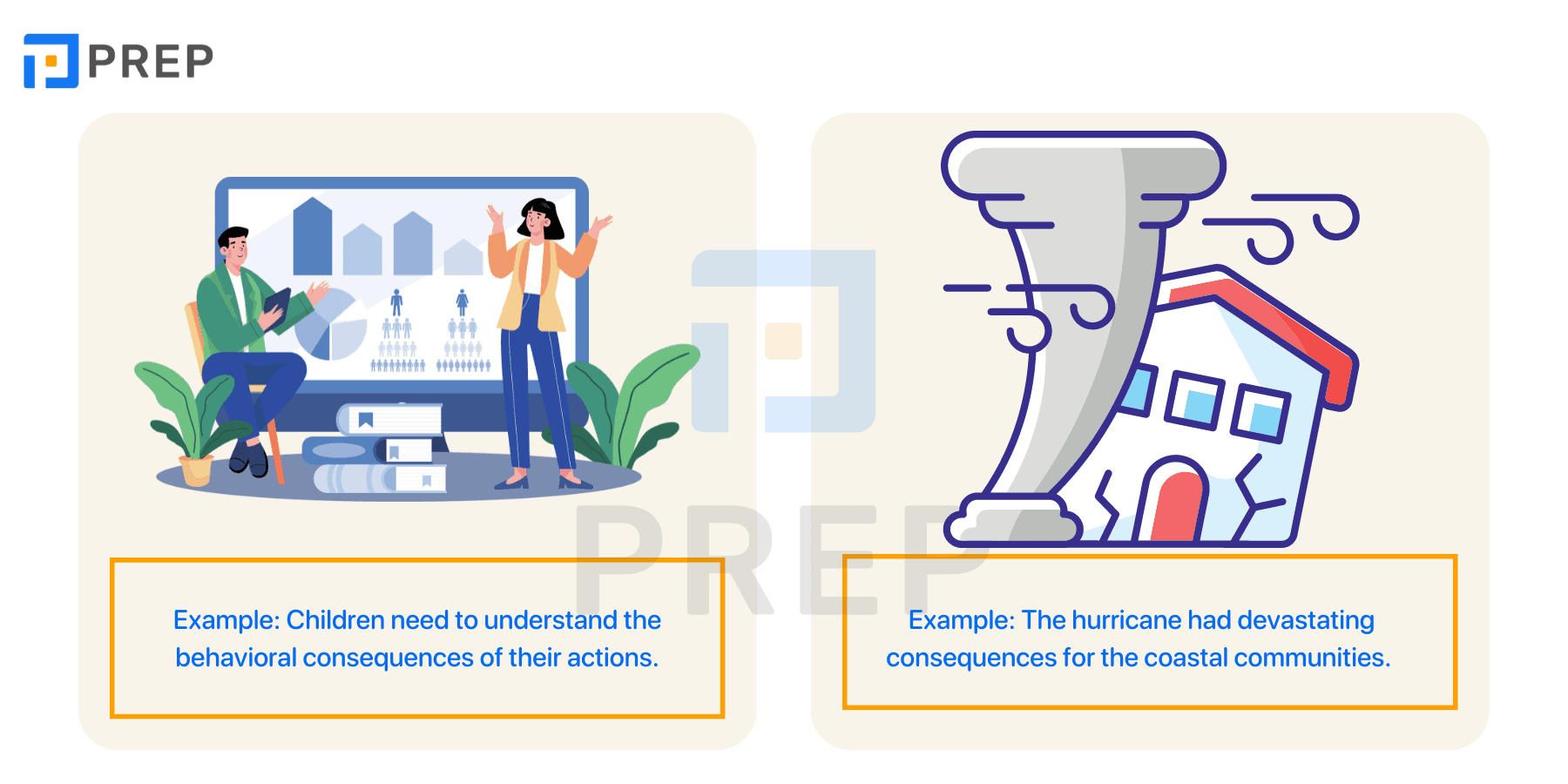
The long-term consequences of climate change cannot be ignored. |
|
unintended |
The reform led to several unintended consequences. |
|
possible |
This decision involves certain possible consequences. |
|
widespread |
Economic collapse may bring widespread consequences. |
Tip: These collocations work well in cause-effect essays, discussions about risk, or analysis writing.
You can strengthen emphasis by learning usage of even in english in sentences.
Academic and Fixed Collocations (Phrases)
These multi-word expressions are often used in formal writing, including academic, technical, legal, and scientific texts.
|
Fixed/Academic Expression |
Example Sentence |
|
as a consequence (of) |
As a consequence of budget cuts, the program was suspended. |
|
in consequence |
The policy was flawed and, in consequence, widely criticized. |
|
lead to serious consequences |
Excessive deforestation can lead to serious consequences. |
|
carry significant consequences |
The company's actions may carry significant financial consequences. |
|
consequence management |
Disaster consequence management is a major part of emergency response. |
Tip: Embedding fixed expressions like these can help raise your lexical resource score in exams.
By mastering these structured collocations with "consequence", learners not only expand their vocabulary but also gain the ability to write with greater precision, formality, and impact—elements that are essential in professional and academic communication.
III. Consequence Collocations in Real Sentences
Learning collocations is not just about memorizing word combinations—it’s about knowing how and when to use them in real contexts. To help you internalize how consequence collocations work in natural English, this section provides practical sentence examples in both everyday English and academic/formal writing.
Everyday English Examples
In conversational or general-purpose English, collocations with “consequence” are often used to express warning, responsibility, or logical outcomes.
|
Collocation |
Example Sentence |
|
face the consequences |
If you break the rules, you have to face the consequences. |
|
suffer the consequences |
She ignored the warning and suffered the consequences. |
|
accept the consequences |
He made a mistake and accepted the consequences with maturity. |
|
bear the consequences |
We had to bear the consequences of our poor decision-making. |
|
live with the consequences |
You made your choice—now live with the consequences. |
These examples are commonly used in speech, storytelling, media, or informal writing.
Academic and Formal Writing Examples
In academic texts, reports, and formal essays, “consequence” collocations are used to describe complex cause-effect relationships or to make arguments sound more objective and analytical.
|
Collocation |
Example Sentence |
|
unintended consequences |
The policy led to several unintended social and economic consequences. |
|
serious consequences |
Deforestation may have serious environmental consequences. |
|
as a consequence (of) |
As a consequence of the inadequate planning, the project failed. |
|
may result in unforeseen consequences |
Ignoring early signs may result in unforeseen medical consequences. |
|
carry legal/financial consequences |
Failure to comply may carry significant legal consequences. |
Notice how these are more formal in tone, feature precise language, and are ideal for written arguments or analysis.
You can expand your range by learning learn synonyms in english.
IV. Consequence vs Similar Words in Collocations
While consequence is a common academic noun used to describe the result of an action or event, it is often mistakenly used interchangeably with other words such as result, outcome, or impact. Though they may appear similar in meaning, these words often form different collocations, carry different levels of formality, and operate in distinct grammatical patterns or registers.
Consequence vs Result
Both words can describe the effect of an action, but “result” tends to be neutral or positive, and is slightly more general-purpose than “consequence,” which often implies something negative or serious.
|
Word |
Typical Collocations |
Example Sentence |
|
consequence |
suffer the consequences serious consequences |
He ignored the warnings and suffered the consequences. |
|
result |
achieve results the end result was... |
The new marketing strategy achieved positive results. |
Use in context:
-
Use result when describing measurable outcomes or neutral developments.
-
Use consequence when implying responsibility, risk, or negative effect.
Consequence vs Outcome
Outcome usually refers to the final state after a process or event, often in clinical, legal, or political contexts. It is less emotionally charged than consequence and often used in research or objective evaluations.
|
Word |
Typical Collocations |
Example Sentence |
|
consequence |
unintended consequence |
The new policy had unintended social consequences. |
|
outcome |
positive outcome outcome of negotiations |
The outcome of the trial was unexpected. |
Use in context:
-
Prefer outcome when discussing results in measured or neutral terms such as studies, evaluations, or procedures.
-
Use consequence when emphasizing cause-effect relationships, especially with potential risk.
Consequence vs Impact
Impact implies a strong influence or effect, often immediate or powerful. While consequence suggests a logical outcome, impact focuses on degree/intensity of change.
|
Word |
Typical Collocations |
Example Sentence |
|
consequence |
bear the consequences |
Citizens had to bear the consequences of the policy failure. |
|
impact |
significant impact negative impact impact on |
The pandemic had a significant impact on global economies. |
Use in context:
-
Use impact when describing influence or force of change.
-
Use consequence when describing a resulting event or condition that follows an action.
Understanding which word—and collocation—to use allows your writing to sound more natural, precise, and aligned with native-like academic norms.
Read more articles:
PREP hopes that through this article, you have gained more useful collocations with Consequence and can use them in your communication. Let’s follow PREP for more English language knowledge updates!

Hi I'm Chloe, and I am currently serving as an Product Content Administrator at Prep Education. With over five years of experience in independent online IELTS study and exam preparation, I am confident in my ability to support learners in achieving their highest possible scores.
Comment
Premium content
View all


Personalized roadmap


Most read




UEN: 202227322W
Address: 114 LAVENDER STREET, #11-83 CT HUB 2, SINGAPORE (338729)