Chinese E Explained: Pronunciation, Meaning, Examples
Many learners search for “chinese e” because they are unsure whether it is a letter, a sound, or a character. This guide explains the E sound in Mandarin pinyin, introduces common characters pronounced with E, and provides simple vocabulary and sentence examples for beginners.
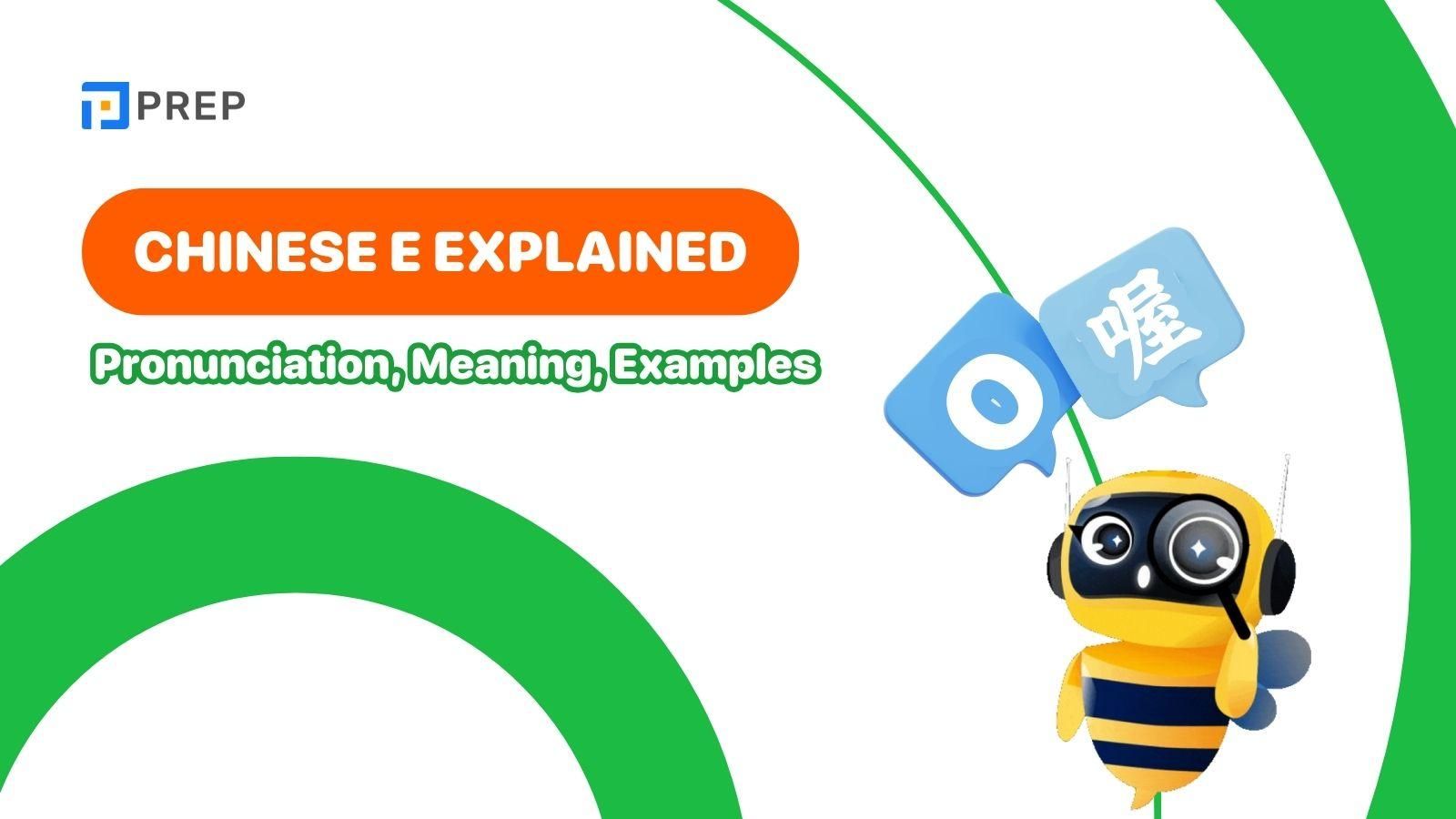
I. Chinese E in Mandarin Pinyin Pronunciation
Many learners who search for “Chinese E” are actually looking for guidance on how the letter “E” is pronounced in Mandarin Chinese pinyin. Unlike in English, where “E” can have multiple vowel sounds, Mandarin assigns distinct sounds based on its phonetic system – Pinyin.
There are several situations where learners encounter the “E” sound and feel uncertain:
-
They see the letter “E” in pinyin syllables like “he,” “de,” “ge,” “me,” and wonder how to pronounce it.
-
They hear native speakers making a sound unfamiliar to English ears and try to look it up using “Chinese E.”
-
They want to understand how pinyin vowels work – especially as “E” behaves differently from Western phonetics.
This part of Chinese phonetics often causes confusion because the pinyin “E” does not sound like the English “ee” (as in “see”) or “eh” (as in “bed”).
The letter “E” in Mandarin pinyin typically represents a mid-central or back vowel sound, often described as:
-
A semi-open, neutral vowel close to the English “uh” (as in “fur” or “learn,” depending on accent), but more relaxed and central.
-
Not nasal unless combined with a nasal final like "-eng".
-
This vowel can also change slightly depending on the consonant before it, especially in compound finals like “ie”, “ue”, or “ei”, where it behaves differently.
Examples of pinyin syllables with the basic “E” vowel include:
-
“de” (的) – grammatical particle, very common
-
“he” (喝) – to drink
-
“ge” (哥) – older brother
-
“me” (么) – particle for questions, e.g., 什么
Each of these syllables features the standalone “E” vowel, pronounced with the mouth slightly open, the tongue slightly retracted, and a relaxed throat sound.
II. Chinese Characters Pronounced with Chinese E
In Mandarin Chinese, a single pinyin syllable such as “e” or any syllable ending with the vowel “e” can correspond to multiple Chinese characters, each with different meanings, tones, and grammatical uses. This can be confusing for beginners, especially when the spoken sound seems identical but the written symbols are completely different.
Common Characters Pronounced as “E” or with “-e” Finals
-
的 (de) – A grammatical particle used to indicate possession or attribution.
-
了 (le) – A particle that indicates a completed action or a change of state.
-
和 (hé) – Means “and” or “with”.
-
喝 (hē) – Means “to drink”.
-
哥 (gē) – Means “older brother”.
-
鹅 (é) – Means “goose”.
-
额 (é) – Means “forehead” or “quota”.
-
恶 (è) – Can mean “evil” or “to hate”, depending on context and tone.
Though many of these characters include the “E” sound in Mandarin, they differ by tone and character structure. Some are neutral in tone, while others use the four Mandarin tones, changing the meaning entirely.
Why One Sound Can Match Many Characters
This variation exists because Mandarin is a tonal language with limited syllables but thousands of meanings. For example:
-
The syllable “e” alone may represent:
-
饿 (è) – hungry
-
恶 (è) – evil
-
鹅 (é) – goose
-
额 (é) – forehead
-
All these share a similar base sound but are distinguished by intonation (tone) and character.
That’s why when learning Chinese pronunciation, especially a vowel like “E”, it’s essential to learn both the tone and the character together, not just how it sounds phonetically.
III. Vocabulary and Sentence Examples with “Chinese E”
To help learners internalize how the “E” sound appears in everyday Mandarin, it’s useful to study a set of common vocabulary items and see them applied in real sentences. This not only improves pronunciation and tone recognition, but also builds contextual understanding of how “E” is used across grammar structures and real-life communication.
Basic Vocabulary with the “E” Sound
Here are some frequently used words that include the “E” vowel sound in their pinyin form, organized by tone:
|
Chinese |
Pinyin |
English Meaning |
Tone |
|
饿 |
è |
hungry |
4th |
|
恶 |
è |
evil/bad/disgusting |
4th |
|
鹅 |
é |
goose |
2nd |
|
额 |
é |
forehead or quota |
2nd |
|
哥 |
gē |
older brother |
1st |
|
喝 |
hē |
to drink |
1st |
|
和 |
hé |
and/with |
2nd |
|
的 |
de |
possessive particle |
neutral |
|
了 |
le |
completed action particle |
neutral |
Example Sentences Using “E” Vocabulary
These short example sentences are designed for beginner learners and use words with the “E” sound in clear, simple contexts:
-
我饿了。
Wǒ è le.
→ I am hungry.
(Uses: 饿 “è” – hungry, 了 – particle indicating change of state) -
他是我哥。
Tā shì wǒ gē.
→ He is my older brother.
(Uses: 哥 “gē” – older brother) -
我和你一起去。
Wǒ hé nǐ yìqǐ qù.
→ I’ll go with you.
(Uses: 和 “hé” – and/with) -
她在喝水。
Tā zài hē shuǐ.
→ She is drinking water.
(Uses: 喝 “hē” – to drink) -
那只鹅很大。
Nà zhī é hěn dà.
→ That goose is big.
(Uses: 鹅 “é” – goose)
Each sentence offers reinforcement of tones and usage in natural structures. Learners should be encouraged to say them aloud, identify the tone color, and write them out to become familiar with the character form.
Above is the full article by PREP on how the “E” sound appears in Mandarin Pinyin, how it's used across different Chinese characters, and how to apply that knowledge through vocabulary and sentence examples. We hope this guide helps you pronounce more confidently, recognize tones more accurately, and feel more prepared when encountering spoken Mandarin in real conversations.

Hi I'm Chloe, and I am currently serving as an Product Content Administrator at Prep Education. With over five years of experience in independent online IELTS study and exam preparation, I am confident in my ability to support learners in achieving their highest possible scores.
Comment
Premium content
View all




Personalized roadmap


Most read


UEN: 202227322W
Address: 114 LAVENDER STREET, #11-83 CT HUB 2, SINGAPORE (338729)