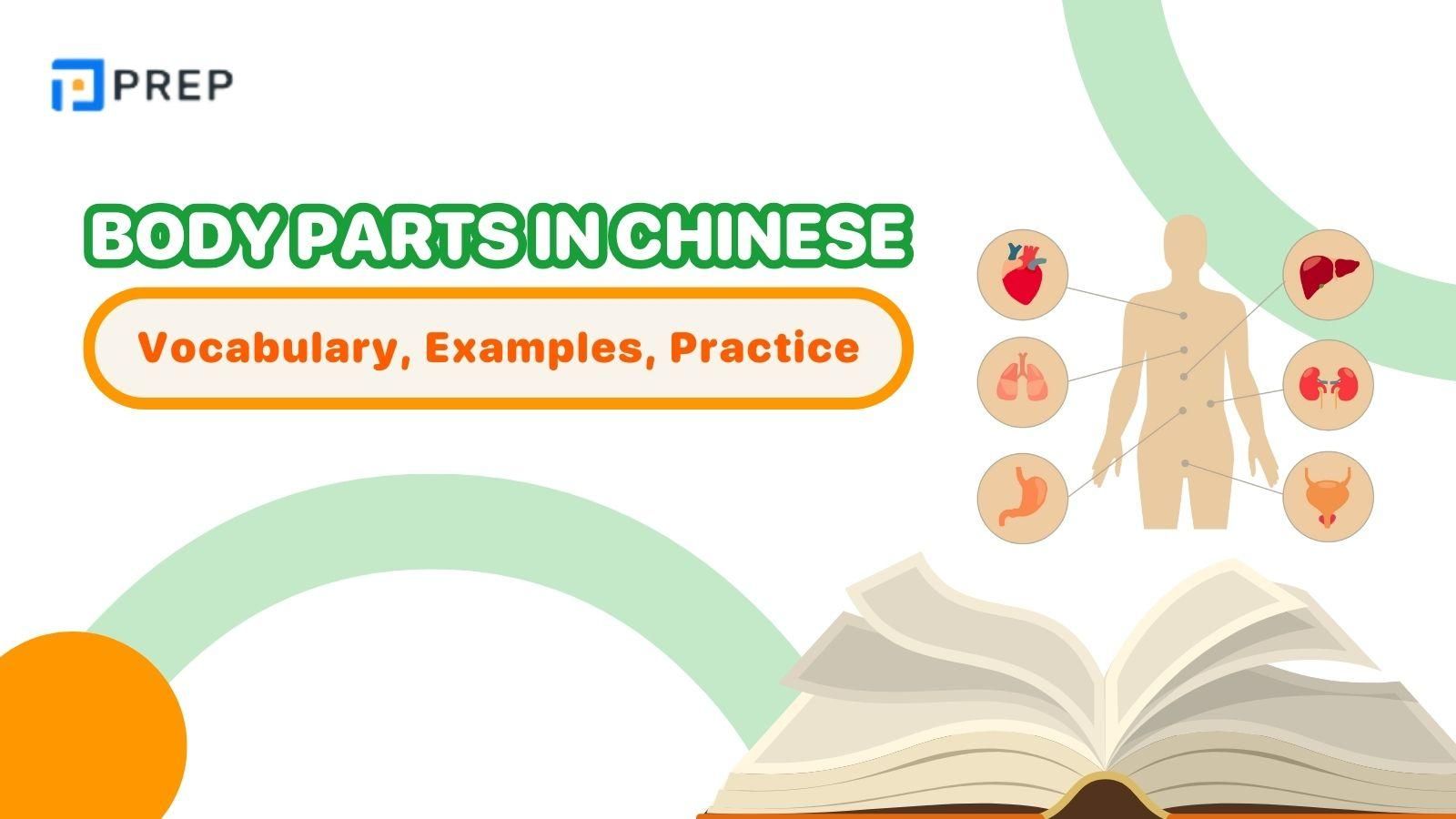
Body Parts in Chinese: Vocabulary, Examples, Practice
This beginner-friendly guide introduces essential body parts in Chinese, organized by head, limbs, and internal parts. You’ll learn characters with pinyin, practice simple daily sentences, and review HSK-relevant vocabulary with effective study tips for beginners.
I. Basic Body Parts in Chinese Vocabulary
Learning how to name body parts in Chinese is an essential step for any Mandarin learner. Whether you’re describing how you feel, pointing to something in conversation, or preparing for the HSK exam, body-related vocabulary shows up more often than you might expect.
Why Learn Body Parts in Chinese?
-
It’s common in everyday conversation. Words like “hand” (手 – shǒu), “head” (头 – tóu), or “eye” (眼睛 – yǎnjing) are frequently used to describe actions, give instructions, or express how you feel.
-
It’s test-relevant. Many of these terms appear directly or indirectly in beginner to intermediate HSK levels.
-
It supports listening and speaking fluency. Understanding body-related words helps learners follow classroom instructions, follow along with children’s songs, or even explain symptoms to a doctor.
-
It helps with visual memory. Because body parts are physical and visible, it’s easier to link words to actions and gestures, which improves retention.
To make learning easier, we’ve broken the vocabulary into three main sections: head and face, upper body and limbs, and lower body including internal parts. Each section includes a clean list of Chinese characters, pinyin, and English meanings to help you build recognition and pronunciation confidence.
1. Head and face (头部 / 脸部)
This section introduces useful vocabulary related to the head and facial features. These words are especially helpful in daily life, language class instructions, and during basic conversations about appearance, health, and identity.
|
Chinese |
Pinyin |
English |
|
头 |
tóu |
head |
|
脸 |
liǎn |
face |
|
头发 |
tóufa |
hair |
|
额头 |
étóu |
forehead |
|
眼睛 |
yǎnjing |
eyes |
|
眉毛 |
méimáo |
eyebrows |
|
睫毛 |
jiémáo |
eyelashes |
|
鼻子 |
bízi |
nose |
|
耳朵 |
ěrduo |
ears |
|
嘴巴 |
zuǐba |
mouth |
|
牙齿 |
yáchǐ |
teeth |
|
舌头 |
shétou |
tongue |
|
下巴 |
xiàba |
chin |
|
面颊 |
miànjiá |
cheek |
|
脸颊 |
liǎnjiá |
cheek (alt.) |
|
脸孔 |
liǎnkǒng |
facial appearance |
|
脸色 |
liǎnsè |
complexion |
Tip for learners: Many of these words function as building blocks. For example, “眼” means “eye,” and adding “镜” (jìng – lens) makes “眼镜” (yǎnjìng – glasses).
Practice saying each of these words aloud, paying close attention to the tones. Listening to pronunciation recordings and mimicking them helps reinforce correct pronunciation and tone memorization.
2. Upper body and limbs (上半身 / 四肢)
These body parts are essential for describing physical actions, giving commands (like "raise your hand"), or even talking about daily routines such as getting dressed or exercising. Many of these words are also useful when learning verbs of movement or giving simple subject-verb-object sentences.
|
Chinese |
Pinyin |
English |
|
手 |
shǒu |
hand |
|
手指 |
shǒuzhǐ |
finger |
|
拇指 |
mǔzhǐ |
thumb |
|
食指 |
shízhǐ |
index finger |
|
手掌 |
shǒuzhǎng |
palm |
|
手腕 |
shǒuwàn |
wrist |
|
胳膊 |
gēbo |
arm (colloquial) |
|
手臂 |
shǒubì |
arm |
|
肘部 |
zhǒubù |
elbow |
|
肩膀 |
jiānbǎng |
shoulder |
|
胸 |
xiōng |
chest (general) |
|
胸部 |
xiōngbù |
chest area |
|
背 |
bèi |
back |
|
脖子 |
bózi |
neck |
|
喉咙 |
hóulóng |
throat |
Many of these terms often appear in compound words or collocations. For example:
-
“手指甲” (shǒu zhǐjia) – fingernail
-
“举手” (jǔ shǒu) – raise one’s hand
Listening to native pronunciation, using physical movement while saying the word, or labeling diagrams can all help speed up the learning process.
3. Lower body and internal parts (下半身 / 内脏)
Knowing how to name the lower body and major internal organs is useful not only in daily communication but also in medical, health-related, or physical activity contexts. These vocabulary items commonly appear in health forms, hospital conversations, sports, or exercise instructions.
|
Chinese |
Pinyin |
English |
|
腿 |
tuǐ |
leg |
|
大腿 |
dàtuǐ |
thigh |
|
小腿 |
xiǎotuǐ |
calf (lower leg) |
|
膝盖 |
xīgài |
knee |
|
脚 |
jiǎo |
foot |
|
脚趾 |
jiǎozhǐ |
toe |
|
脚跟 |
jiǎogēn |
heel |
|
臀部 |
túnbù |
buttocks |
|
屁股 |
pìgu |
butt (colloquial) |
|
腰 |
yāo |
waist/lower back |
|
肚子 |
dùzi |
belly/stomach area |
|
胃 |
wèi |
stomach (organ) |
|
肝 |
gān |
liver |
|
肺 |
fèi |
lungs |
|
心脏 |
xīnzàng |
heart |
|
肾 |
shèn |
kidney |
|
脑 |
nǎo |
brain |
|
膀胱 |
pángguāng |
bladder |
Some of these words are very common in spoken language (like 肚子 – dùzi), while others are more likely to be used in formal or medical contexts (like 心脏 – xīnzàng).
When practicing these words:
-
Pair them with verbs or simple phrases:
“我腿疼。” (My leg hurts.),
“她的心脏不好。” (She has heart issues.) -
Use gestures to associate meaning visually.
-
Practice with expressions involving health or movement.
II. Sentence Examples and Daily Dialogue
Learning body parts in isolation is just the first step. To use them effectively, you need to hear them in action—through simple sentences, classroom instructions, and everyday expressions, especially ones related to physical activity, feelings, or health.
Using Body Parts in Basic Sentences
These short sentence structures help you describe pain, appearance, position, and simple actions using relevant vocabulary.
Examples:
-
我头疼。
Wǒ tóu téng.
→ My head hurts. -
他的眼睛很大。
Tā de yǎnjing hěn dà.
→ His eyes are big. -
她的腿很长。
Tā de tuǐ hěn cháng.
→ Her legs are long. -
请张开嘴。
Qǐng zhāngkāi zuǐ.
→ Please open your mouth. -
手不要动。
Shǒu bú yào dòng.
→ Don’t move your hand.
These structures are useful for daily conversations, doctor visits, and describing how you feel.
Classroom Commands and Prompts
Many Mandarin teachers use total physical response (TPR)—involving instructions paired with movement—to teach parts of the body.
Common classroom commands include:
-
摸头!
Mō tóu! – Touch your head! -
举手!
Jǔ shǒu! – Raise your hand! -
闭上眼睛!
Bì shàng yǎnjing! – Close your eyes! -
指指你的耳朵。
Zhǐ zhǐ nǐ de ěrduo. – Point to your ears. -
跳一跳!
Tiào yí tiào! – Jump a little!
Pairing these phrases with motion makes learning more intuitive and interactive—especially for young learners.
Body Vocabulary in Children’s Songs
One of the best ways to reinforce vocabulary is through music. Many Chinese versions of classic children's songs include body parts and movements to help memorization through rhythm and repetition.
A well-loved Chinese version of “Head, Shoulders, Knees and Toes” is:
头,肩膀,膝盖,脚,膝盖,脚
Tóu, jiānbǎng, xīgài, jiǎo, xīgài, jiǎo
This song is typically performed with matching gestures, which helps learners internalize meaning naturally.
Other body-related children’s songs or rhymes include:
-
我的身体 (My Body)
-
我会动 (I Can Move)
By hearing and using these words rhythmically, learners retain meaning more quickly and comfortably—even without formal study.
III. Body Parts in Chinese for Exams and Learning Practice
Learning body parts is not just about naming features or playing classroom games—it’s also a core part of standardized Chinese exams, especially at beginner and lower intermediate levels such as HSK 1–3. These terms frequently appear in vocabulary lists, reading comprehension, basic dialogues, and listening tasks.
Body Parts Vocabulary Common in HSK
Body part words show up in HSK in many forms—as nouns in simple descriptions, as part of actions (e.g., using hands or feet), or in phrases describing physical condition.
Here are some HSK-relevant body-related words categorized by frequency:
|
Chinese |
Pinyin |
English |
HSK Level |
|
手 |
shǒu |
hand |
1 |
|
眼睛 |
yǎnjing |
eyes |
1 |
|
头发 |
tóufa |
hair |
1–2 |
|
嘴巴 |
zuǐba |
mouth |
2 |
|
腿 |
tuǐ |
leg |
2–3 |
|
胳膊 |
gēbo |
arm |
3 |
|
耳朵 |
ěrduo |
ear |
3 |
|
背 |
bèi |
back |
3 |
|
肚子 |
dùzi |
belly / stomach area |
3 |
These words may appear in sentence completion, picture-labeling questions, or dialogues such as:
-
“他今天不舒服,肚子疼。”
-
“请你闭上眼睛。”
To do well on the HSK, learners should be able to:
-
Recognize the characters and tones
-
Identify the pinyin when listening
-
Use these words contextually in short sentences
How to Practice Body Vocabulary Effectively
Here are proven ways to build and retain body-related vocabulary for exams:
-
Use spaced repetition (SRS) tools: Apps like Anki or Pleco allow you to create flashcards with tone markings, characters, images, and audio.
-
Practice with visual diagrams: Label printable silhouettes of the human body using Chinese terms and test yourself by covering parts and guessing.
-
Write out full phrases instead of single-word drills” Use sample sentences that mirror HSK formats. For example:
“我的____很疼。” (My ____ hurts.)
Choose from a list: 头、脚、手… -
Listen and shadow short dialogues: Many HSK preparation books and audio files include daily conversations involving body terms—like describing pain or visiting a doctor.
-
Pair review with movement: Especially for kinesthetic learners, act out what you say: touch arm while saying 手臂, jump and say 脚, etc.
Practicing in context, not isolation, will better prepare you for both comprehension and usage under test conditions.
Above is the full article by PREP on how to learn, pronounce, and use body parts in Chinese—from mastering basic vocabulary with pinyin to applying it in daily sentences, classroom expressions, and HSK preparation. We hope this guide helps you build practical vocabulary, remember tones with confidence, and use body-related words naturally in real situations.

Hi I'm Chloe, and I am currently serving as an Product Content Administrator at Prep Education. With over five years of experience in independent online IELTS study and exam preparation, I am confident in my ability to support learners in achieving their highest possible scores.
Comment
Premium content
View all


Personalized roadmap


Most read


UEN: 202227322W
Address: 114 LAVENDER STREET, #11-83 CT HUB 2, SINGAPORE (338729)