「你在說什麼」英文怎麼說?11 種說法語氣完整指南
「你在說什麼英文」的 11 種說法語氣差距很大:最中性安全的是 What do you mean?;帶挑戰語氣的是 What are you talking about?;最禮貌正式的是 Excuse me? / Pardon?;表達完全聽不懂的有 I have no idea what you're talking about、I'm not following you 和 You've lost me。
同一個「你在說什麼」的語意,在不同情緒和場合下要用完全不同的英文句子。What are you talking about? 在朋友間可能只是困惑,但對陌生人說出來可能顯得不禮貌;Does that make sense? 是說話者確認聽者是否跟上,語境與「你在說什麼」相反,但在某些中文語境中對應同樣的溝通需求。
本文整理 11 種說法的語氣差異、情緒強度、適合場合,以及「我不知道你在說什麼英文」、「我聽不懂你在說什麼英文」的完整說法,搭配比較表和 3 段真實對話範例,讓你 30 秒看懂該選哪一句。

- I. 「你在說什麼」英文怎麼說?11 種常用表達全整理
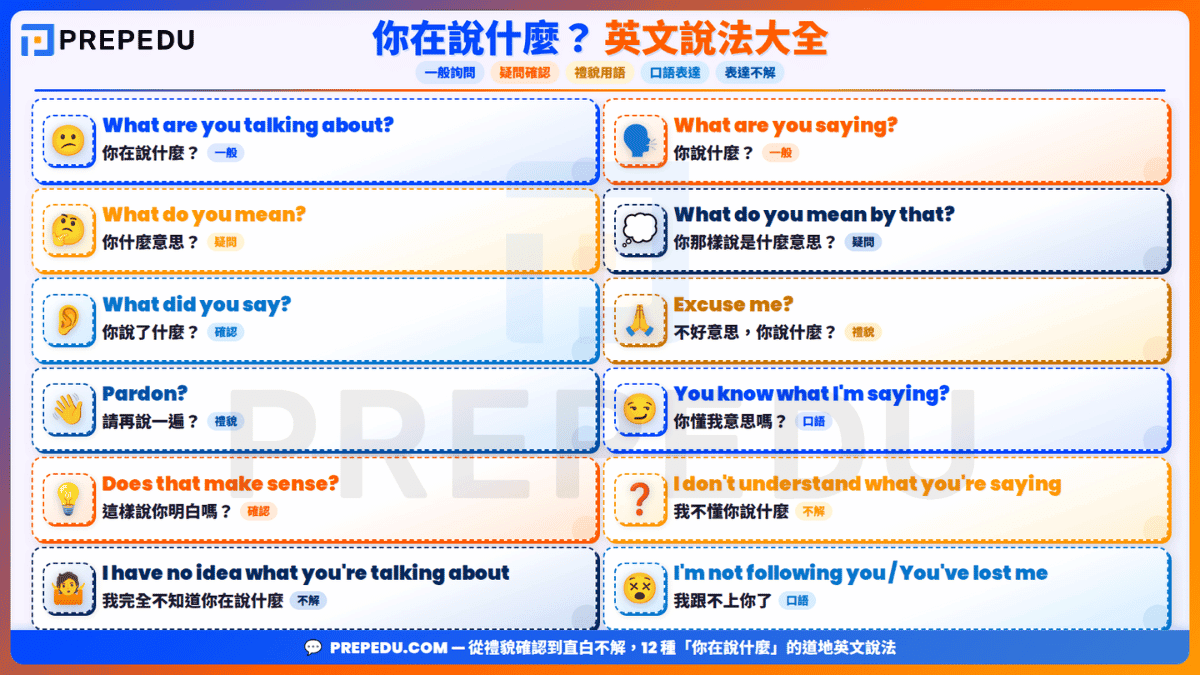
- 1. What are you talking about?
- 2. What are you saying?
- 3. What do you mean?
- 4. What do you mean by that?
- 5. What did you say?
- 6. Excuse me? 和 Pardon?
- 7. You know what I'm saying? 和 You know what I mean?
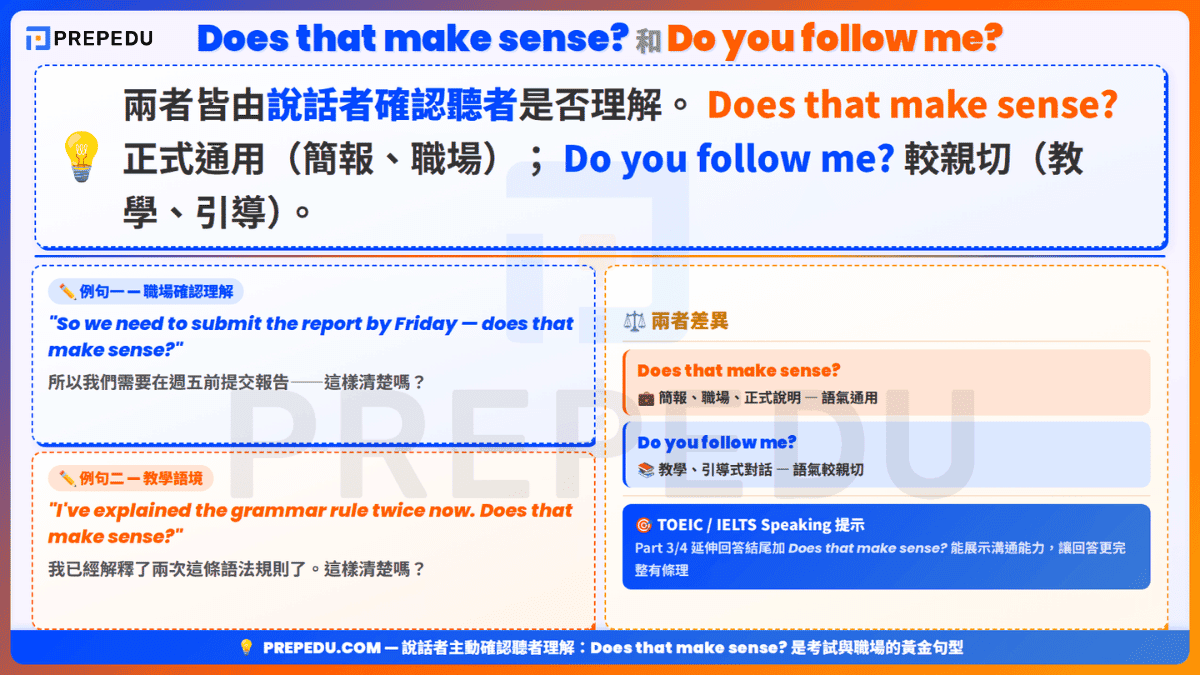
- 8. Does that make sense? 和 Do you follow me?
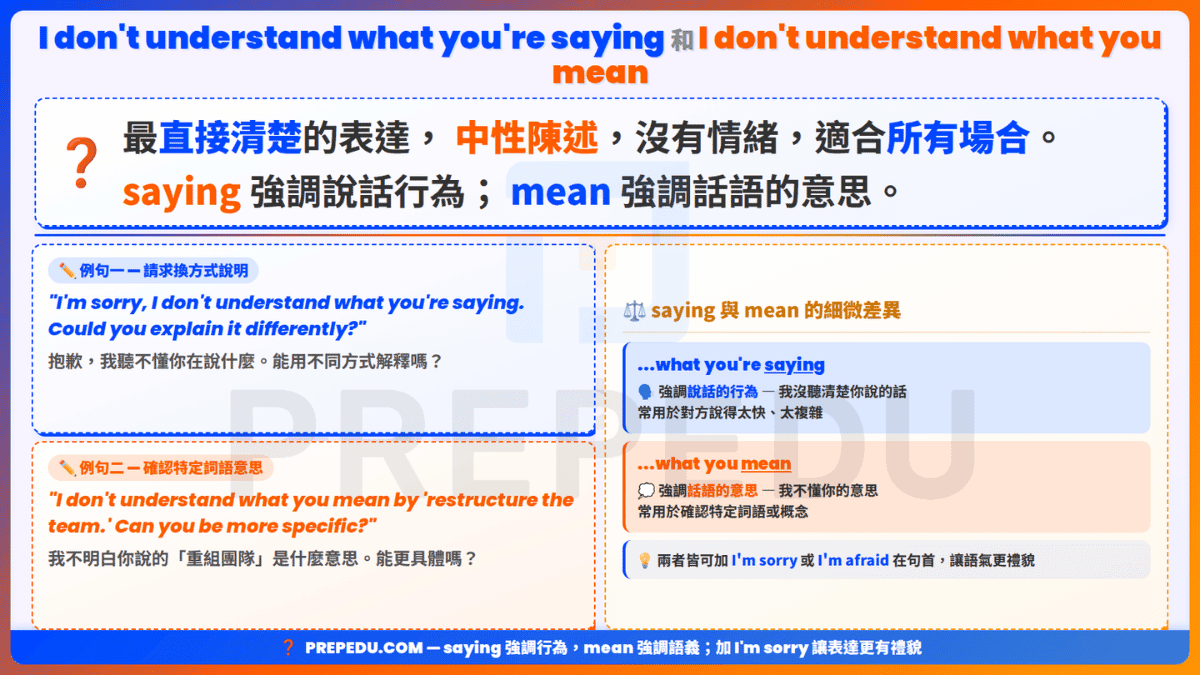
- 9. I don't understand what you're saying 和 I don't understand what you mean
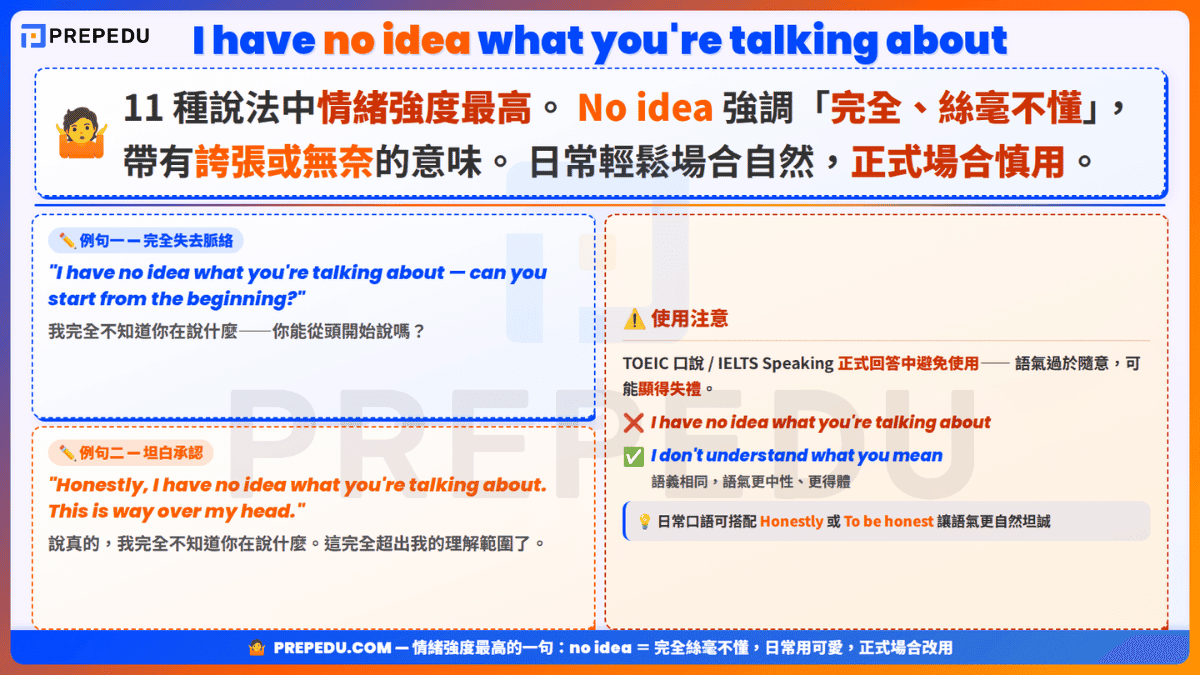
- 10. I have no idea what you're talking about
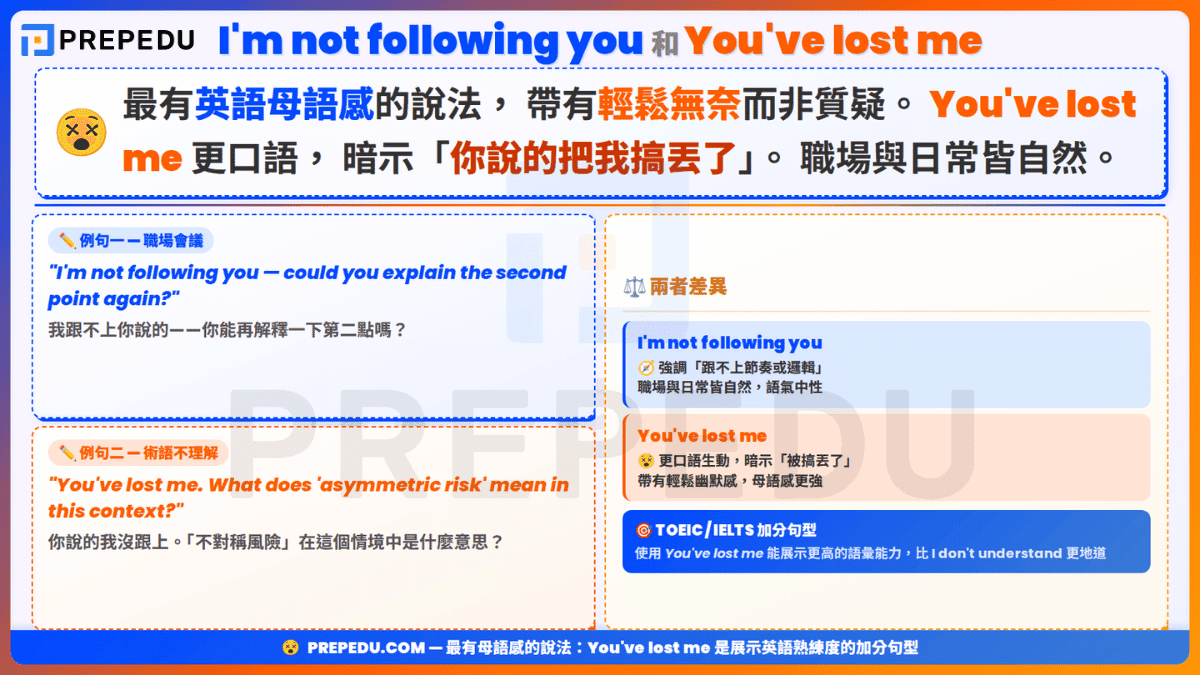
- 11. I'm not following you 和 You've lost me
- II. 「你在說什麼」英文真實對話範例:看看這些句子怎麼用?
- III. 「你在說什麼」英文常見問題 FAQ
- 總結
I. 「你在說什麼」英文怎麼說?11 種常用表達全整理
「你在說什麼」在英文依情緒、方向(是問對方還是表達自己不懂)和正式程度分成三組:問對方的說法(What are you saying?)、確認對方理解的說法(Does that make sense?),以及表達自己不理解的說法(I'm not following you)。先看整體比較表,再逐一掌握每個說法的細節。
比較表:語氣、場合、情緒一次看清楚→ 11 種說法到底差在哪? 這張表把語氣、正式程度、情緒強度、適合場合一次列清楚——掃 30 秒就知道該選哪一句。情緒強度 ★★★ 的說法要特別注意語境,說錯場合容易顯得失禮。
|
你在說什麼英文說法 |
語氣 |
情緒強度 |
正式程度 |
最適合場合 |
|
What are you talking about? |
困惑 / 可帶挑戰 |
★★★ 強 |
★★☆☆ 通用 |
日常;語氣強,慎用 |
|
What are you saying? |
中性困惑 |
★★☆ 中 |
★★☆☆ 通用 |
所有場合 ✅ |
|
What do you mean? |
中性求釐清 |
★☆☆ 低 |
★★☆☆ 通用 |
所有場合 ✅ 最安全 |
|
What do you mean by that? |
略帶質疑 |
★★☆ 中 |
★★☆☆ 通用 |
日常;可顯防衛 |
|
What did you say? |
沒聽清楚 |
★☆☆ 低 |
★★☆☆ 通用 |
聽不清時 |
|
Excuse me?/ Pardon? |
禮貌請重複 |
★☆☆ 低 |
★★★☆ 正式 |
正式場合 ✅ |
|
You know what I'm saying? |
非正式確認 |
★☆☆ 低 |
★☆☆☆ 口語 |
朋友間、非正式 |
|
Does that make sense? |
中性確認理解 |
★☆☆ 低 |
★★★☆ 正式 |
簡報、教學、職場 ✅ |
|
I don't understand what you're saying |
直接表達不懂 |
★★☆ 中 |
★★☆☆ 通用 |
所有場合 ✅ |
|
I have no idea what you're talking about |
完全不懂(強) |
★★★ 強 |
★☆☆☆ 非正式 |
日常;避免正式 |
|
I'm not following you/ You've lost me |
自然跟不上 |
★★☆ 中 |
★★☆☆ 通用 |
日常、會議 ✅ |
1. What are you talking about?
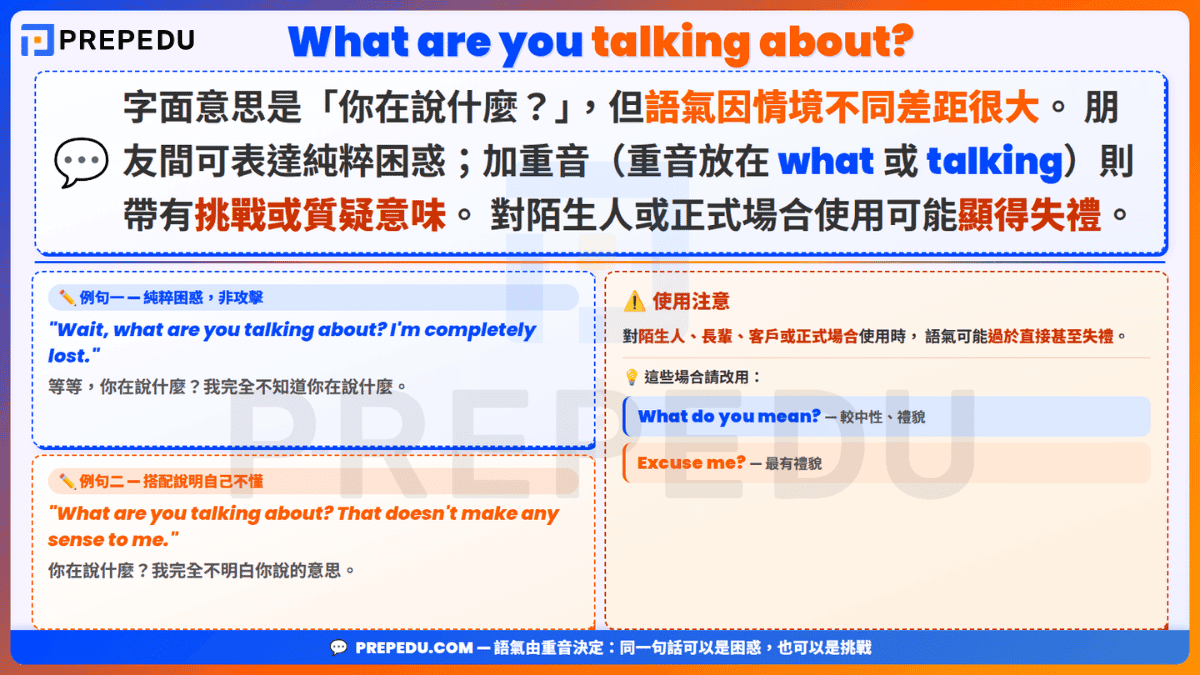
What are you talking about? 字面意思是「你在說什麼?」,但語氣因情境不同而差距很大。在朋友間聊天時,它可以只是表達困惑;但加上強調語氣(重音放在 what 或 talking)時,會帶有明顯的挑戰甚至質疑意味。在正式場合或對陌生人使用,可能顯得不禮貌。例如:
-
What are you talking about? I thought we agreed on a different plan.(你在說什麼?我以為我們說好了另一個方案。) —— 日常職場,語氣有點強
-
What are you talking about? I never said that!(你在說什麼?我從沒說過那種話!) —— 防衛否認,情緒較強
-
Wait, what are you talking about? I'm completely lost.(等等,你在說什麼?我完全不知道你在說什麼。) —— 純粹困惑,非攻擊
-
What are you talking about? That doesn't make any sense to me.(你在說什麼?我完全不明白你說的意思。) —— 搭配說明自己不懂
⚠ 使用注意: What are you talking about? 在對陌生人、長輩、客戶或正式場合使用時,語氣可能過於直接甚至失禮。這些場合請改用 What do you mean? 或 Excuse me? 效果更好。
2. What are you saying?
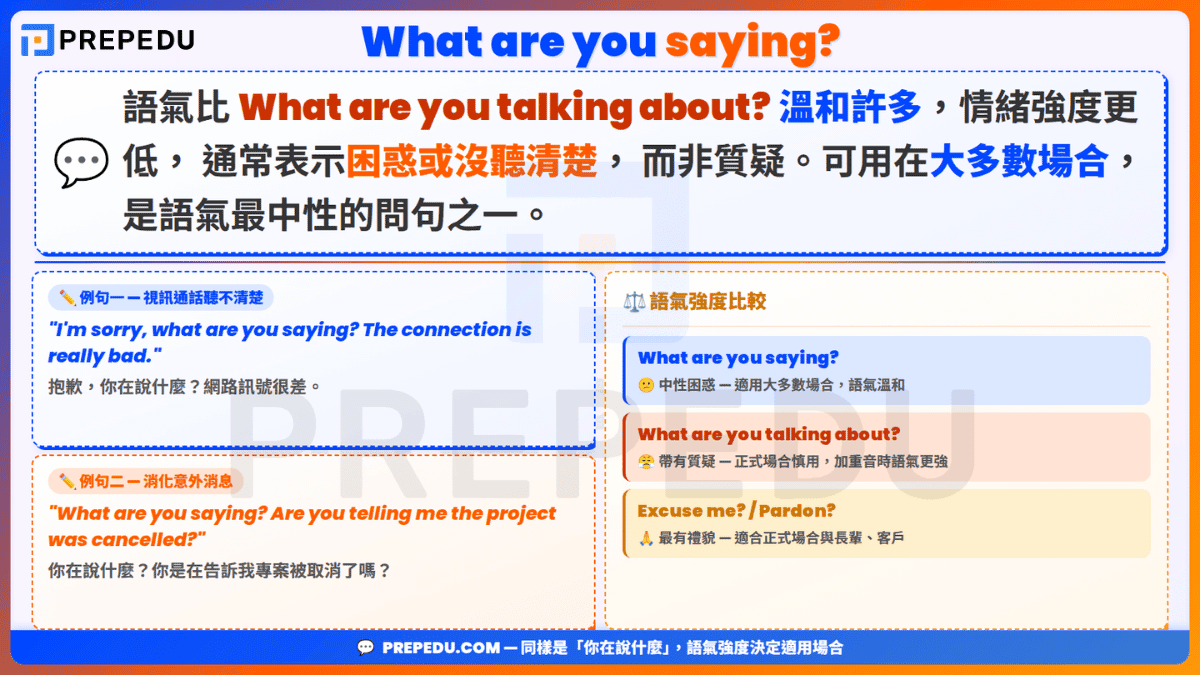
What are you saying? 語氣比 What are you talking about? 溫和許多,情緒強度更低,通常表示困惑或沒聽清楚,而非質疑或挑戰。它可以用在大多數場合,是「你在說什麼英文」中語氣最中性的問句之一。例如:
-
I'm sorry, what are you saying? The connection is really bad.(抱歉,你在說什麼?網路訊號很差。) —— 視訊通話聽不清楚
-
What are you saying? Are you telling me the project was cancelled?(你在說什麼?你是在告訴我專案被取消了嗎?) —— 消化意外消息
-
What are you trying to say? Just tell me directly.(你想說什麼?直接告訴我吧。) —— 想要對方明確說清楚
-
Hold on — what are you saying? I need to hear that again.(等一下——你說什麼?我需要再聽一次。) —— 需要重複確認
3. What do you mean?
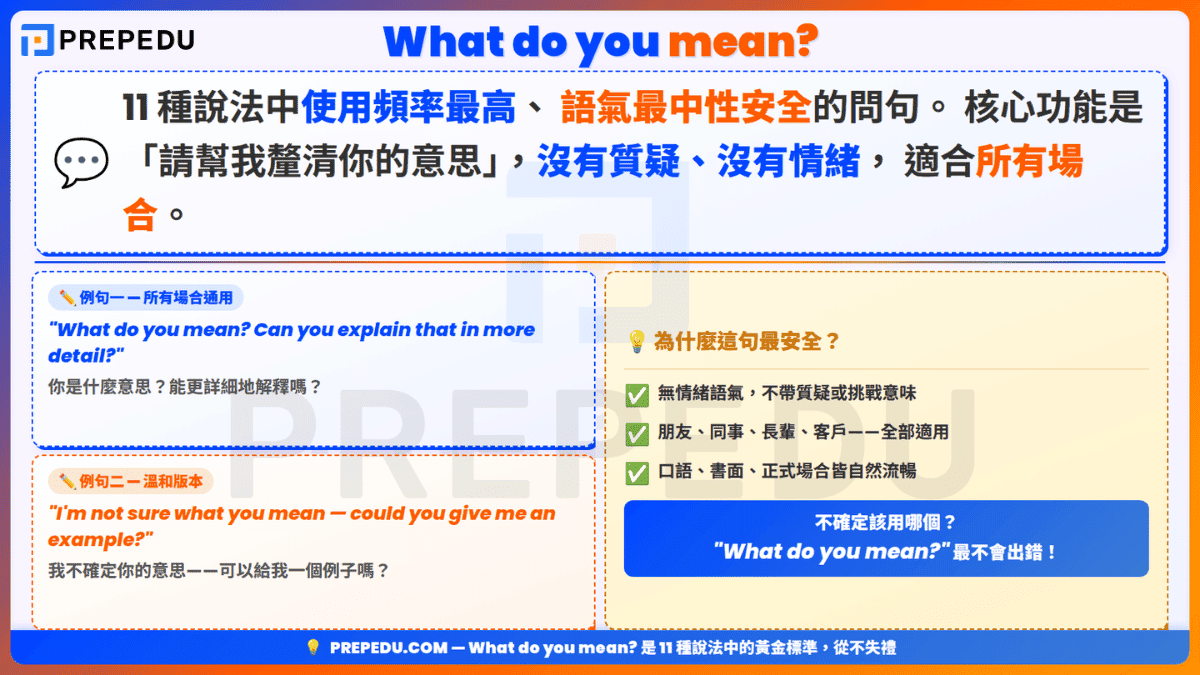
What do you mean? 是「你在說什麼英文」中最常用、語氣最中性安全的問句,也是 11 種說法中使用頻率最高的一個。它的核心功能是「請幫我釐清你的意思」,沒有質疑、沒有情緒,適合所有場合——從朋友聊天到職場正式會議都自然。例如:
-
What do you mean? Can you explain that in more detail?(你是什麼意思?能更詳細地解釋嗎?) —— 所有場合通用
-
What do you mean by 'restructuring'? Are there going to be layoffs?(你說的「重組」是什麼意思?是要裁員嗎?) —— 職場確認細節
-
I'm not sure what you mean — could you give me an example?(我不確定你的意思——可以給我一個例子嗎?) —— 溫和版本
-
What exactly do you mean? I want to make sure I understand correctly.(你到底是什麼意思?我想確保我理解正確。) —— 強調精準理解
💡 What do you mean? 是 11 種「你在說什麼英文」說法中最安全的起點。不確定該用哪個?選這句最不會出錯,所有場合、所有語氣都適用。
4. What do you mean by that?
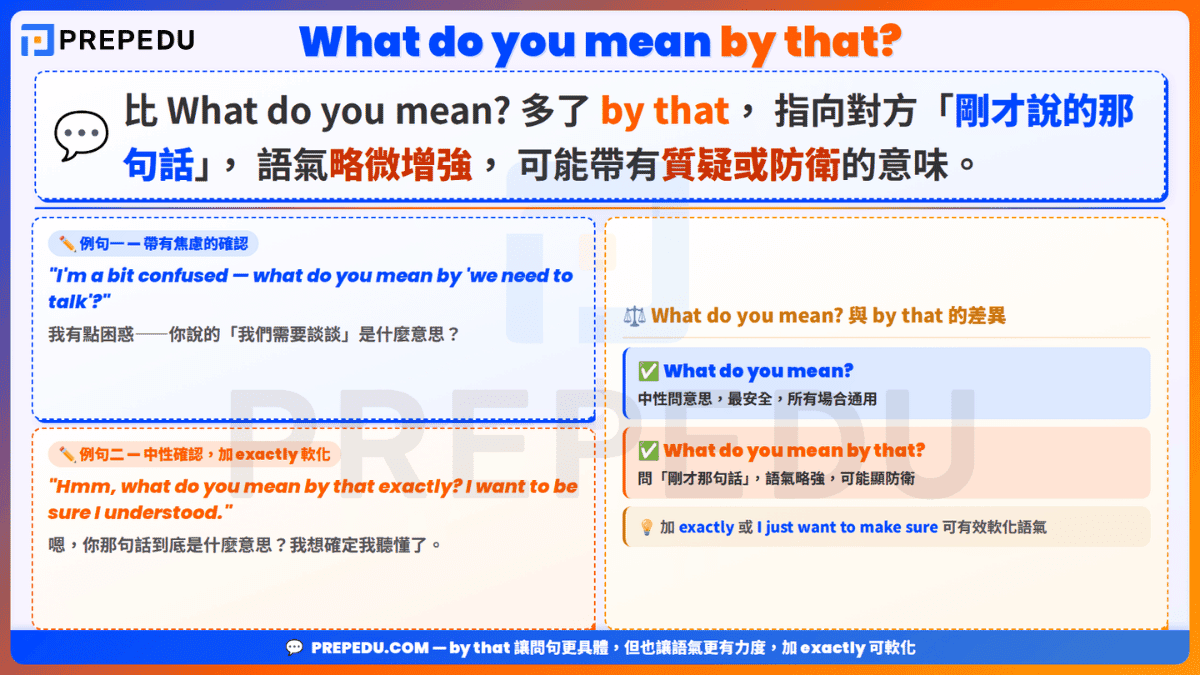
What do you mean by that? 比 What do you mean? 多了 by that,指向對方「剛才說的那句話或那個動作」,語氣略微增強,可能帶有質疑或防衛的意味。它通常用在對方說了某句話或做了某件事之後,你需要確認對方真正的意思,同時可能覺得那句話有點刺耳或不妥。例如:
-
What do you mean by that? Are you saying I didn't do my job properly?(你那句話是什麼意思?你是在說我工作沒做好嗎?) —— 感覺受到批評時
-
I'm a bit confused — what do you mean by 'we need to talk'?(我有點困惑——你說的「我們需要談談」是什麼意思?) —— 帶有焦慮的確認
-
What do you mean by that remark? I think it came across the wrong way.(你那句話是什麼意思?我覺得聽起來不太對。) —— 感覺話語不當
-
Hmm, what do you mean by that exactly? I want to be sure I understood.(嗯,你那句話到底是什麼意思?我想確定我聽懂了。) —— 中性確認,加 exactly 軟化
What do you mean? 與 What do you mean by that?:
-
✅ What do you mean? — 中性,問意思(最安全)
-
✅ What do you mean by that? — 問「剛才那句話」的意思,語氣略強,可能顯防衛
5. What did you say?
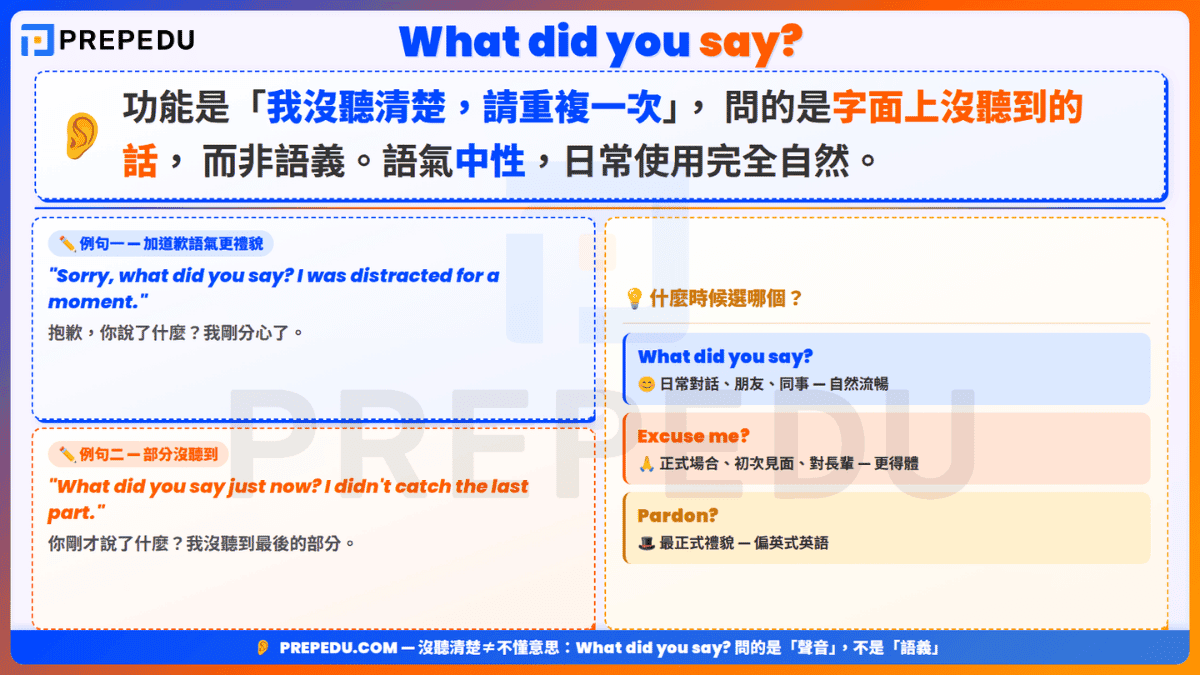
What did you say? 的功能是「我沒聽清楚,請重複一次」,和前幾個問「意思」的說法不同——它問的是字面上沒聽到的話,不是語義。語氣中性,日常使用完全自然。但在很正式的場合,Excuse me? 或 Pardon? 聽起來更禮貌。例如:
-
What did you say? I couldn't hear you over the noise.(你說了什麼?我聽不清楚,周圍太吵了。) —— 環境嘈雜
-
Sorry, what did you say? I was distracted for a moment.(抱歉,你說了什麼?我剛分心了。) —— 加道歉語氣更禮貌
-
What did you say? Did you just say the meeting is cancelled?(你說什麼?你說會議取消了嗎?) —— 確認意外消息
-
What did you say just now? I didn't catch the last part.(你剛才說了什麼?我沒聽到最後的部分。) —— 部分沒聽到
💡 什麼時候用 What did you say? 與 Excuse me?:日常對話選 What did you say?;正式場合、初次見面、對長輩,選 Excuse me? 或 Pardon? 更得體。
6. Excuse me? 和 Pardon?
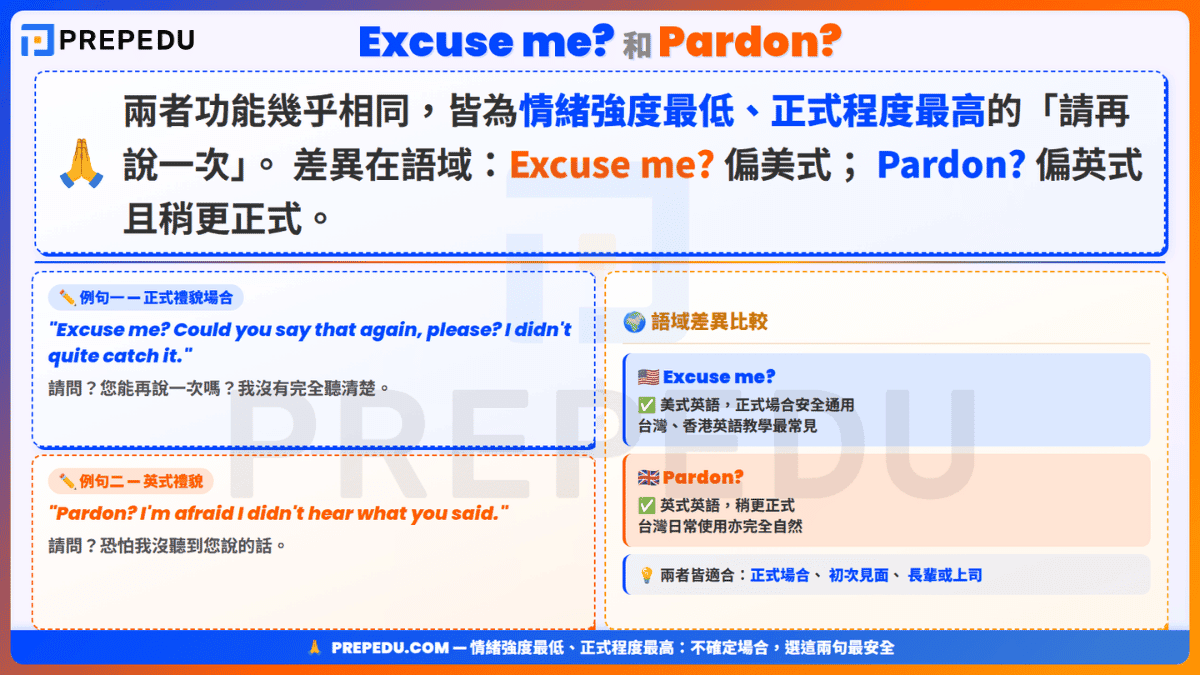
Excuse me? 和 Pardon? 都是「請再說一次」的禮貌問句,情緒強度最低,正式程度最高。兩者在功能上幾乎相同,差異在語域:Excuse me? 在美式英語更常用;Pardon? 在英式英語更常用,也稍微更正式一些。兩者都適合正式場合、初次見面,或對長輩、上司使用。例如:
-
Excuse me? Could you say that again, please? I didn't quite catch it.(請問?您能再說一次嗎?我沒有完全聽清楚。) —— 正式禮貌場合
-
Pardon? I'm afraid I didn't hear what you said.(請問?恐怕我沒聽到您說的話。) —— 英式禮貌
-
Excuse me? I'm not sure I understood — did you say the price is $5,000?(請問?我不確定我有沒有理解——您說價格是 5,000 元嗎?) —— 確認重要資訊
-
I beg your pardon? That was quite unexpected.(請問您說什麼?那出乎我意料。) —— 最正式版本,帶輕微驚訝
Excuse me? 與 Pardon?:
-
✅ Excuse me? — 美式英語,通用,正式場合安全
-
✅ Pardon? — 英式英語,稍更正式,也可在台灣使用
7. You know what I'm saying? 和 You know what I mean?
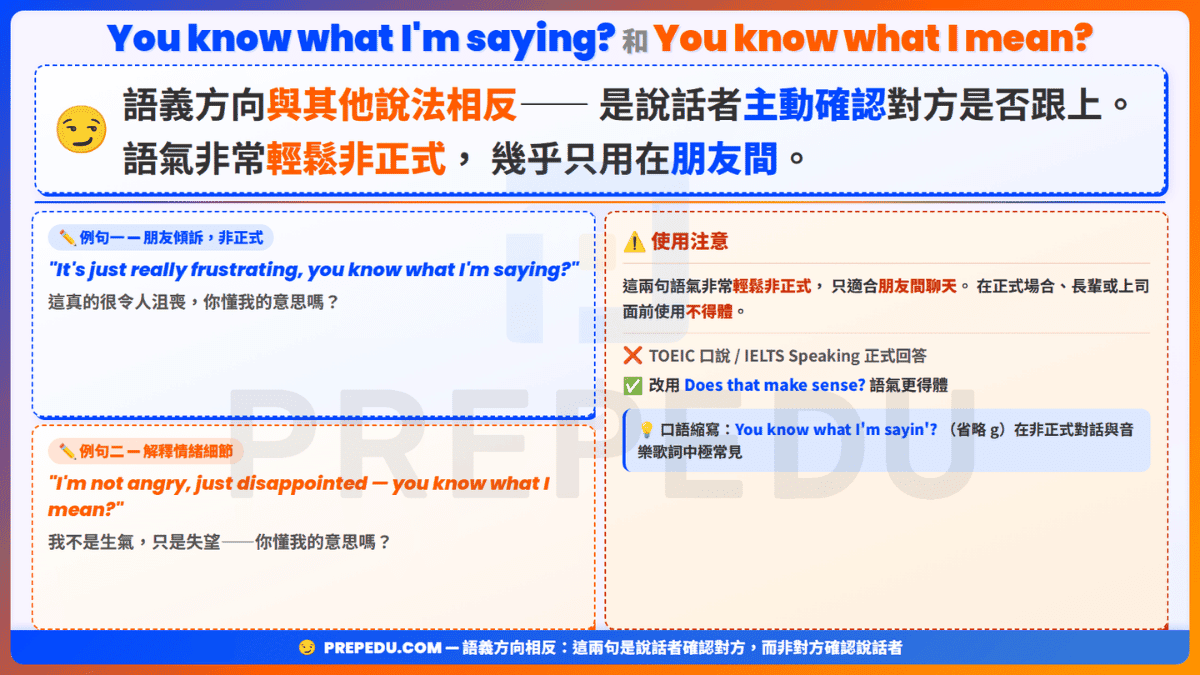
You know what I'm saying?(口語縮寫英文:You know what I'm sayin'?)和 You know what I mean? 是說話者用來確認對方是否跟上、是否理解的非正式說法。這兩個問句是說話者主動確認,語義方向與其他說法相反——是「你知道我在說什麼嗎?」而非「你在說什麼?」。它們語氣非常輕鬆,幾乎只用在非正式對話和朋友間。例如:
-
It's just really frustrating, you know what I'm saying?(這真的很令人沮喪,你懂我的意思嗎?) —— 朋友傾訴,非正式
-
I'm not angry, just disappointed — you know what I mean?(我不是生氣,只是失望——你懂我的意思嗎?) —— 解釋情緒細節
-
I've been working on this for weeks — do you get what I'm saying?(我已經為這件事工作好幾週了——你明白我的意思嗎?) —— 稍正式版本
-
It's complicated, you know? I can't really explain it, you know what I mean?(這很複雜,你懂嗎?我真的說不清楚,你知道我的意思嗎?) —— 說不清楚時的填補語
💡 注意:You know what I'm saying? 在非正式口語中使用頻率很高,但在 TOEIC 口說和 IELTS Speaking 正式回答中不適合使用——改用 Does that make sense? 語氣更得體。
8. Does that make sense? 和 Do you follow me?
Does that make sense? 和 Do you follow me? 都是說話者確認對方是否理解剛才說的內容,語義方向也是從說話者指向聽者。Does that make sense? 最常出現在簡報、教學、職場說明中,語氣正式、通用。Do you follow me? 語氣較親切,常見於教學和引導式對話。例如:
-
So we need to submit the report by Friday — does that make sense?(所以我們需要在週五前提交報告——這樣清楚嗎?) —— 職場確認理解
-
I've explained the grammar rule twice now. Does that make sense?(我已經解釋了兩次這條語法規則了。這樣清楚嗎?) —— 教學語境
-
Let me know if I'm going too fast. Do you follow me so far?(如果我說太快,請告訴我。到目前為止你跟上了嗎?) —— 確認節奏
-
Does that make sense, or would you like me to go over it again?(這樣清楚嗎?還是您希望我再講一遍?) —— 給對方選擇,禮貌
💡 TOEIC 口說和 IELTS Speaking 提示:在 Part 3 或 Part 4 的延伸回答中用 Does that make sense? 作結尾,能展示溝通能力,讓回答聽起來更完整有條理。
9. I don't understand what you're saying 和 I don't understand what you mean
I don't understand what you're saying 和 I don't understand what you mean 是「我聽不懂你在說什麼英文」最直接清楚的表達,中性陳述,沒有情緒強度,完全適合所有場合。兩者語義幾乎相同:saying 強調對方說話的行為;mean 強調對方話語的意思。例如:
-
I'm sorry, I don't understand what you're saying. Could you explain it differently?(抱歉,我聽不懂你在說什麼。能用不同方式解釋嗎?) —— 請求換方式說明
-
I don't understand what you mean by 'restructure the team.' Can you be more specific?(我不明白你說的「重組團隊」是什麼意思。能更具體嗎?) —— 確認特定詞語意思
-
I'm not sure I understand what you mean — could you give me an example?(我不確定我理解你的意思——可以給我一個例子嗎?) —— 溫和請求例子
-
I don't understand what you're saying. Is there a simpler way to put it?(我聽不懂你在說什麼。有更簡單的說法嗎?) —— 請求簡化說明
10. I have no idea what you're talking about
I have no idea what you're talking about 是「我完全不知道你在說什麼英文」的強調說法,情緒強度在 11 種說法中最高。No idea 強調「完全、絲毫不懂」,語氣比 I don't understand 更強烈,帶有一點誇張或無奈的意味。在輕鬆的日常對話中聽起來自然甚至有趣,但在正式場合使用可能顯得太隨意或失禮。例如:
-
I have no idea what you're talking about — can you start from the beginning?(我完全不知道你在說什麼——你能從頭開始說嗎?) —— 完全失去脈絡
-
Honestly, I have no idea what you're talking about. This is way over my head.(說真的,我完全不知道你在說什麼。這完全超出我的理解範圍了。) —— 坦白承認
-
I have no idea what you're talking about — are we even talking about the same thing?(我完全不知道你在說什麼——我們說的是同一件事嗎?) —— 懷疑話題不同
-
Wait — I have absolutely no idea what you're talking about. Can you slow down?(等等——我完全不知道你在說什麼。你能說慢一點嗎?) —— 加 absolutely 強調更強
💡 使用提醒:I have no idea what you're talking about 在 TOEIC 和 IELTS 正式回答中避免使用——改用 I don't understand what you mean 更得體,語義相同但語氣更中性。
11. I'm not following you 和 You've lost me
I'm not following you 和 You've lost me 是「我跟不上你說的」的自然英語說法,情緒上帶有輕鬆的無奈,而非明確的質疑或挑戰。兩者在職場和日常對話中都很自然,是「我聽不懂你在說什麼英文」組中最有英語母語感的說法。You've lost me 語感更口語,暗示「你說的內容把我搞丟了」。例如:
-
I'm not following you — could you explain the second point again?(我跟不上你說的——你能再解釋一下第二點嗎?) —— 職場會議
-
You've lost me. What does 'asymmetric risk' mean in this context?(你說的我沒跟上。「不對稱風險」在這個情境中是什麼意思?) —— 術語不理解
-
I was following you up until the last part — you've lost me there.(我之前都跟上了,但最後那個部分——你把我搞丟了。) —— 指出具體失去的地方
-
Hang on, I'm not following you at all. Can we go back to the beginning?(等等,我完全跟不上你說的了。我們能回到開頭嗎?) —— 完全失去脈絡
💡 You've lost me 是自然地道的說法,母語者在課堂、會議和日常對話中都常用。在 TOEIC 和 IELTS 口說中使用這個說法,能展示更高的語彙能力。
II. 「你在說什麼」英文真實對話範例:看看這些句子怎麼用?
11 種說法的語法規則看懂了,接下來最重要的是看它們如何在真實對話英文中自然搭配使用。以下三段對話分別對應職場會議、電話/視訊通話,以及台灣日常生活場景。
1. 對話一:台北辦公室會議 — 專案說明出現誤解
|
你在說什麼英文對話 |
翻譯 |
|
|
2. 對話二:視訊通話 — 網路不穩定造成溝通困難
|
你在說什麼的英文對話 |
翻譯 |
|
|
3. 對話三:台北街頭 — 朋友間日常閒聊
|
你在說什麼的英文對話 |
翻譯 |
|
|
三段對話共出現了 9 種不同說法的自然搭配。留意在職場會議(對話一)和視訊通話(對話二)中,語氣更中性的說法(I'm not following you、What do you mean?、Does that make sense?)使用頻率更高;在朋友對話(對話三)中,語氣較強的說法(What are you talking about?、I have no idea what you're talking about)更自然。
III. 「你在說什麼」英文常見問題 FAQ
1. What are you talking about? 聽起來很不禮貌嗎?
這取決於語氣而非字詞本身。What are you talking about? 這個句子本身是中性的,但它對語調非常敏感。用平靜、困惑的語氣說出來,只是在表達不理解;用強調重音、語氣上揚說出來(What are you TALKING about?),就會帶有明顯的質疑甚至挑戰意味。在台灣的英語學習環境中,建議學習者:對朋友和熟人,這句話完全可以自然使用;對陌生人、長輩、客戶、上司,或在正式場合,改用 What do you mean? 或 Excuse me? 更安全。
2. Excuse me? 和 Pardon? 有什麼不同?
兩者在功能上幾乎相同,都是「請再說一次」的禮貌問句,差異主要在地區慣用法和正式程度。Excuse me? 在美式英語中最常用,也是台灣學習者最常學到的版本;Pardon? 在英式英語中更普遍,正式程度略高一點,也常見於 IELTS 考試語境。在台灣日常英語和 TOEIC 口說中,Excuse me? 是更通用的選擇;在 IELTS Speaking 的考試環境中,Pardon? 和 Could you repeat that, please? 都很自然。兩者都可以配合完整句子使用(I'm sorry, could you repeat that?),讓禮貌程度更高。
3. 「我聽不懂你在說什麼英文」有哪幾種說法?
「我聽不懂你在說什麼英文」在英文中對應 4 個語氣遞增的說法:
-
I'm not sure what you mean.(我不太確定你的意思。) —— 最溫和,適合所有場合
-
I don't understand what you're saying.(我聽不懂你在說什麼。) —— 中性直接,所有場合 ✅
-
I'm not following you.(我跟不上你說的。) —— 口語自然,日常職場 ✅
-
I have no idea what you're talking about.(我完全不知道你在說什麼。) —— 情緒最強,僅限非正式場合
TOEIC 和 IELTS 口說考試中,I don't understand what you mean 和 I'm not following you 是最安全的選擇,語義清楚、語氣不過激。
4. TOEIC 口說和 IELTS 口說中,哪個說法最安全?
-
TOEIC 口說(TOEIC 口說 Part 3 – TOEIC 口說 Part 4 延伸回答): Does that make sense? 是確認對方理解的首選——它展示說話者有意識地確保溝通成功,是評分者樂見的溝通能力展示。What do you mean? 是請求釐清的最安全說法,語氣中性,不會造成誤解。
-
IELTS 口說(IELTS 口說 Part 3 互動): Excuse me?/ Pardon? 是聽不清楚時的首選——禮貌程度高,符合 IELTS 的正式場合語境。I'm not following you 也是好選擇,能展示自然的英語表達能力。避免使用 What are you talking about? 和 I have no idea what you're talking about,這兩個說法語氣過於非正式或帶情緒,可能影響評分。
總結
「你在說什麼英文」的 11 種說法核心差異在三個維度:情緒強度、方向(問對方還是表達自己不懂)、正式程度。情緒強度最低、最安全的是 What do you mean?(問意思)和 I don't understand what you're saying(表達不懂)——兩者適合所有場合,是台灣學習者的最佳起點。What are you talking about? 和 I have no idea what you're talking about 情緒強度高,僅限朋友間的非正式對話。Excuse me? / Pardon? 在正式場合表現最好,Does that make sense? 是職場和考試中展示溝通能力的利器。
「你知道我在說什麼英文」(You know what I'm saying? / You know what I mean?)和「我聽不懂你在說什麼英文」(I'm not following you / You've lost me)是兩組語感最道地的說法,也是從中級到進階的語感分水嶺。把這兩組說法加入你的日常英語表達,母語者聽到會立刻感到更自然。
今天開始的練習建議: 選出 3 句你最可能在工作或日常生活中用到的說法,每天在腦中造一個場景練習。最推薦的組合是:What do you mean?(最通用)、I'm not following you(最道地)、Does that make sense?(TOEIC / IELTS 最加分)。如果想在 TOEIC 口說和 IELTS Speaking 考試中系統地提升這些表達的語感和準確度,PREPEDU 的 PrepTalk English 課程提供針對台灣學習者設計的情境口語訓練,讓每一句「你在說什麼英文」都說得精準、聽起來道地。

你好!我叫黃秋賢,現在在 prepedu.com 擔任內容企劃。我有超過5年的英語與韓語自學經歷,親身備考 IELTS、TOEIC 與 TOPIK,累積了大量第一手的學習者視角——包括哪些語法規則最讓台灣與香港學習者混淆,以及如何在有限的備考時間內最有效地修正這些錯誤。目前已在 prepedu.com 撰寫超過 1000 篇英語學習文章,內容涵蓋語法、詞彙與考試策略,累積協助數千位學習者解決自學過程中的語法疑問。
評論












統一企業編號:202227322W
地址:114 LAVENDER STREET, #11-83 CT HUB 2, SINGAPORE (338729)