Lei Pronunciation in Chinese: Tones and Examples
Mastering the correct lei pronunciation is essential for Mandarin learners, as the syllable appears in many characters and tones. This guide explains how “lei” is pronounced, how tones change its meaning, how it differs across dialects, and the most common errors learners should avoid when speaking it.
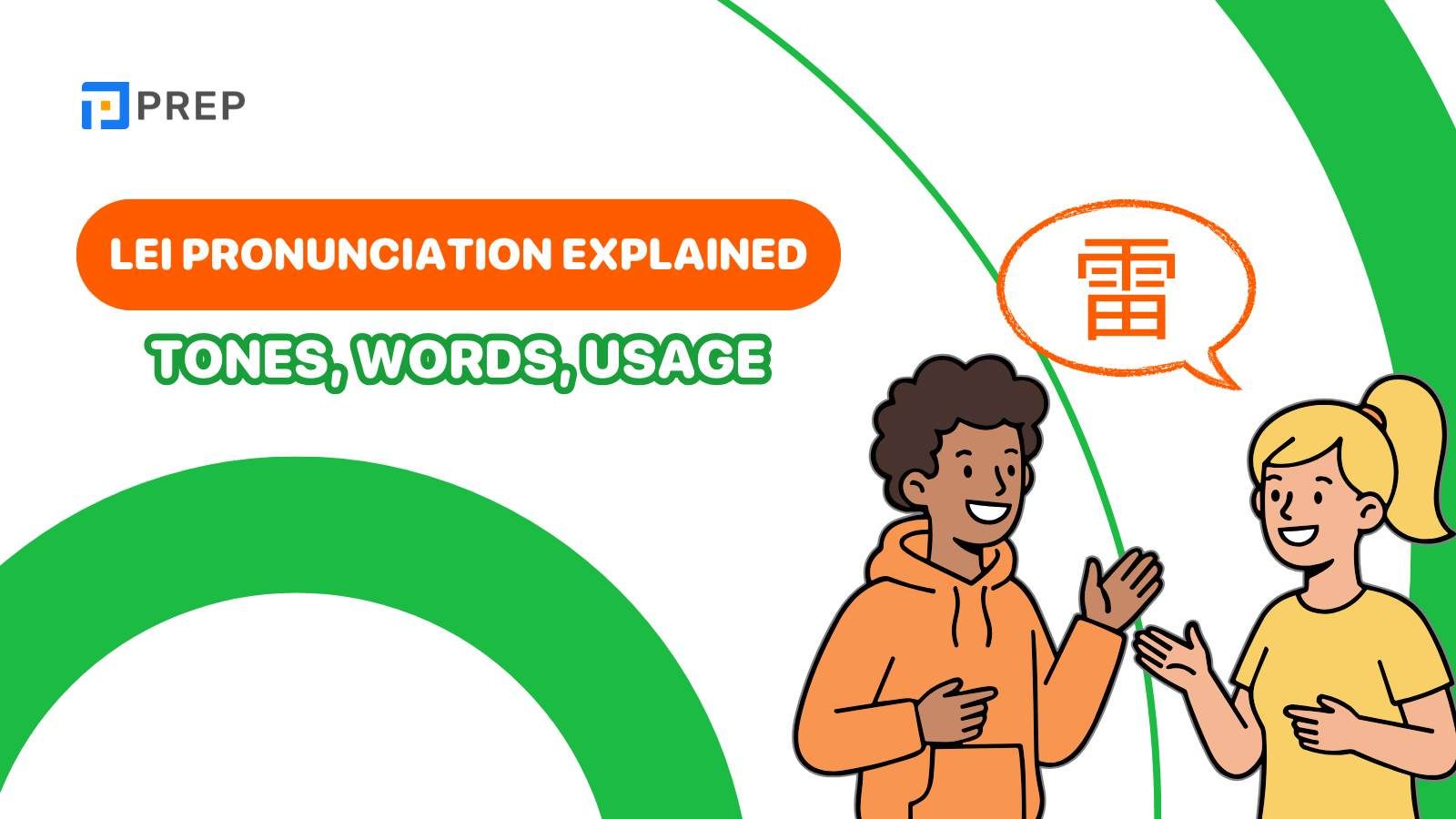
I. What Lei Pronunciation Sounds Like in Mandarin Chinese
The syllable “lei” (lei in pinyin) is commonly encountered in Mandarin Chinese, especially in words like 雷 (léi) meaning “thunder” or as a Chinese surname. But for many learners, the challenge lies not just in reading it, but in pronouncing it with the correct tone and vocal shape. In this section, we’ll explore exactly what “lei” sounds like in Mandarin—and how to say it naturally and accurately.
The pinyin "lei" is made up of:
-
Initial consonant: l, a clear, light “l” sound, like in “love”
-
Final vowel group: ei, which sounds similar to the English “-ay” in “say” or “day”
So phonetically speaking, “lei” is pronounced close to /leɪ/ or “lay” in English—but with a tone added.
Combined, the full sound of "lei" is like saying “lay” in English, but adapting pitch based on the tone in Mandarin.
All Tone Variations of “Lei” in Mandarin
|
Tone |
Pinyin |
Pitch Description |
Approximate English Sound |
Common Character / Meaning |
|
1st tone |
lēi |
high and level |
“l-ayhhh” (steady) |
Rare / Used in dialects |
|
2nd tone |
léi |
rising, like asking a question |
“l-ay?” |
雷 – thunder (commonly used) |
|
3rd tone |
lěi |
dipping (low–rise) |
“l-euh-ee” (low then up) |
累 – tired; 垒 – pile |
|
4th tone |
lèi |
sharp and falling |
“LÉI!” (abrupt drop) |
泪 – tear; 类 – type |
|
Neutral tone |
lei |
light and unstressed |
“lei” (soft and short) |
Rare for this syllable |
Among all five, léi (2nd tone)—as in 雷—is the most frequently used in modern Mandarin.
Minimal Pair Comparisons to Train Your Ear
To pronounce “lei” clearly, it helps to compare it with similar-sounding syllables. Here are some common minimal pairs:
|
Compare With |
Different Sound |
Why It’s Confusing |
|
li (李 / lǐ) |
Final is -i, not -ei |
Learners may mix up because both start with “l” |
|
lai (来 / lái) |
Final is -ai not -ei |
“ai” sounds lower and flatter than “ei” |
|
lei (4th tone) |
Falling instead of rising |
Often mistaken for 2nd tone due to speed/rhythm |
|
léi vs lèi |
2nd vs 4th tone contrast |
Tone confusion alters meaning: 雷 (thunder) vs 泪 (tear) |
Practicing these tone-based comparisons will help fine-tune your pronunciation and boost your listening accuracy when engaging in real-life conversations.
Using the correct tone with “lei” means the difference between “thunder”, “tired”, and “tear”. Mastering it not only improves your clarity but also demonstrates your sensitivity to one of the most essential components of the Mandarin language: tone + syllable unity.
II. Chinese Characters That Use the Lei Pronunciation
The syllable "lei" appears in many commonly used Chinese characters, but the tone of "lei" dramatically changes both meaning and function. For language learners, recognizing which characters carry which tone—and how they differ in meaning—is key to reading accurately and speaking clearly.
Common Chinese Characters Pronounced “Lei”
|
Pinyin |
Character |
Tone |
Meaning |
Example Word |
English Translation |
|
léi |
雷 |
2nd |
thunder |
打雷 (dǎléi) |
to thunder |
|
lěi |
累 |
3rd |
tired |
很累 (hěn lěi) |
very tired |
|
lěi |
垒 |
3rd |
mound / pile |
垒球 (lěiqiú) |
softball |
|
lèi |
泪 |
4th |
tear (from crying) |
流泪 (liúlèi) |
to shed tears |
|
lèi |
类 |
4th |
type / category |
人类 (rénlèi) |
humanity |
|
lèi |
磊 |
4th |
upright / honest |
诚磊 (chénglěi) |
honest and upright (literary) |
This variety shows why just knowing “lei” isn’t enough—you must get the tone right to communicate your meaning clearly.
How Tone Changes the Meaning of “Lei” Pronunciation
In Mandarin, changing the tone of a syllable doesn't just alter the sound—it entirely changes the meaning of the word. Here's how tone variations with "lei" can result in significant shifts in meaning and usage:
-
léi (2nd tone) → 雷 (thunder): used in nature, weather. Loud and rising, just like thunder itself.
-
lěi (3rd tone) → 累 (tired), 垒 (mound): often lower-pitched and used in emotional, physical states.
-
lèi (4th tone) → 泪 (tears), 类 (type): sharp, falling tone often tied to strong emotion or classification.
Accidental tone mistakes can lead to confusion. For example:
-
Saying "我很雷" (wǒ hěn léi) instead of "我很累" (wǒ hěn lěi) doesn't mean "I’m tired”—instead, it might sound like “I’m thunder,” which is grammatically incorrect and confusing in context.
Tips for Learning Lei-Based Characters
-
Associate tone with imagery or emotion. Think of 雷 (thunder) as rising like a rumble—2nd tone rising pitch. Think of 泪 (tears) falling like a drop—4th tone falling pitch.
-
Group characters by tone when studying vocabulary to build awareness through tone clusters.
-
Practice with compound terms, as tones are easier to master within real word or phrase contexts.
Understanding the many characters that use the "lei" pronunciation will not only improve your literacy but also help reinforce proper tone recognition and word choice in natural conversation.
III. How “Lei” Is Pronounced in Other Chinese Dialects
While Mandarin pronunciation of “lei” is typically learned first by language students—for example, 雷 (léi) pronounced with a rising second tone—the reality is that the sound and tone of “lei” can vary significantly across regional Chinese dialects. Understanding these differences is important if you’re exposed to Cantonese, Hokkien, or other non-Mandarin varieties of Chinese.
Cantonese Equivalent of “Lei”
In Cantonese, many Mandarin syllables have different pronunciations both in tone and phonetic structure. The Mandarin 雷 (léi, “thunder”) corresponds to the Cantonese "leui4" (雷).
|
Feature |
Mandarin (标准普通话) |
Cantonese (粤语) |
|
Character |
雷 |
雷 |
|
Pronunciation (Jyutping) |
— |
leui4 |
|
IPA |
/leɪ̯/ |
/lɵy̯/ or /lœy̯/ |
|
Tone |
Tone 2 (rising) |
Tone 4 (low falling) |
Not only does the vowel quality shift (closer to “œ” in Cantonese), but the tone is also flatter, giving it a more neutral or low-falling character. This can cause confusion when switching between Mandarin and Cantonese listening environments.
“Lei” in Other Regional Dialects
In dialects such as Hokkien (Minnan), Wu (e.g., Shanghainese), or Hakka, the character 雷 and its pronunciation may sound quite different—or may not include the syllable "lei" at all, depending on local phonetic rules.
-
In Hokkien (Taiwanese), “雷” is pronounced closer to “luî” (roughly rising tone)
-
In Shanghainese (Wu dialect), the phonemes shift significantly, and it's common for tonal contours to flatten or merge, especially in syllables like “lei”
These differences can cause variation in tone perception and character recognition, especially if you’re watching regional dramas or speaking with older generations in Taiwan, Hong Kong, or southern China.
Understanding dialectal variations of syllables like “lei” benefits learners in several ways:
-
Improved listening comprehension when exposed to regional speakers
-
Contextual awareness when characters are used in local names, songs, or colloquial expressions
-
Helps flag potential pronunciation interference when switching between Mandarin and a native dialect (important for heritage speakers)
Even if your focus is on Standard Mandarin, being aware of these dialectal layers helps you appreciate the flexibility and diversity within the language—and why tones and sounds matter even more across regions.
IV. Common Errors in Lei Pronunciation and Fixes
Although the syllable “lei” (like in 雷 – léi, meaning "thunder") may seem simple at first glance, Mandarin learners often struggle with pronouncing it authentically. Mistakes usually arise from tone inaccuracies, vowel misplacement, or over-articulation. Below is a breakdown of the most common pronunciation issues—and how to fix them.
Key Pronunciation Mistakes and How to Fix Them
|
Mistake |
Fix |
|
Mispronouncing the vowel: Saying "lee" or "lay" with English influence instead of the proper Mandarin "ei" sound. |
Practice the pinyin final “ei” by starting with the English word “say” and shortening the end. Repeat tonal drills like lěi, léi, lèi. |
|
Missing or flattening the tone: Saying “lei” with no tone movement or using a straight, flat pitch. |
Learn the second tone (rising) pitch by mimicking a yes-no question’s intonation in English: "Really?" Practice with similar words like méi (没) and shéi (谁). |
|
Overemphasizing the “l” sound: Pushing the tongue too hard on the initial “l”, making it sound heavy. |
Relax the tongue tip. Mandarin "l" is soft and quick—closer to the "l" in “look” than in “full.” Keep transitions smooth. |
|
Incorrect tone choice: Using lèi (4th tone) instead of léi (2nd tone), which could change the word's meaning. |
Study a tone chart and contrast minimal pairs: léi (thunder) vs lèi (tear). Listen and imitate native examples directly. |
|
Tense facial muscles & poor airflow: Stiff jaw or tight articulation causes unnatural or harsh pronunciation. |
Practice with light mouth positioning and open airflow. Say “lei” naturally in a breathy, steady resolution. Use recordings to self-correct. |
Bonus Tip: Use Audio–Visual Feedback
Pairing native audio input with visual speech awareness is the most effective method to fix habits:
-
Use platforms like Forvo, Google Translate, YouTube, or Chinese pronunciation apps to hear “lei” pronounced by native speakers.
-
Record yourself with tone markings, then compare, adjust, and repeat.
Remember: in tonal languages like Mandarin Chinese, even a small change in pitch or vowel can shift the meaning completely. For example:
-
雷 (léi) → thunder (correct)
-
泪 (lèi) → tear (wrong tone)
-
累 (lěi) → tired (even more confusing!)
By targeting core pronunciation errors with strategic, repetitive practice, you’ll not only improve your clarity when saying “lei,” but also build confidence in your tone mastery overall.
Follow PREP for structure, native sound tools, and confidence-driven practice—so every syllable you say in Mandarin feels more natural, more accurate, and more authentically yours.

Hi I'm Chloe, and I am currently serving as an Product Content Administrator at Prep Education. With over five years of experience in independent online IELTS study and exam preparation, I am confident in my ability to support learners in achieving their highest possible scores.
Comment
Premium content
View all


Personalized roadmap


Most read



UEN: 202227322W
Address: 114 LAVENDER STREET, #11-83 CT HUB 2, SINGAPORE (338729)