IELTS Reading Test Format: A Complete Overview
This guide provides a clear overview of the IELTS Reading test format for both Academic and General Training modules. You will learn how the test is structured, the skills examiners look for, the types of questions you will face, and the strategies needed to approach each section effectively and confidently.
I. Overview of the IELTS Reading Test Format
The IELTS Reading test is one of the four core components of the IELTS exam and is designed to evaluate how well you can read and understand written English under timed conditions. This section remains structurally consistent across both Academic and General Training modules, but the type of content, difficulty level, and text sources vary between the two.
Key Features of the IELTS Reading Test
-
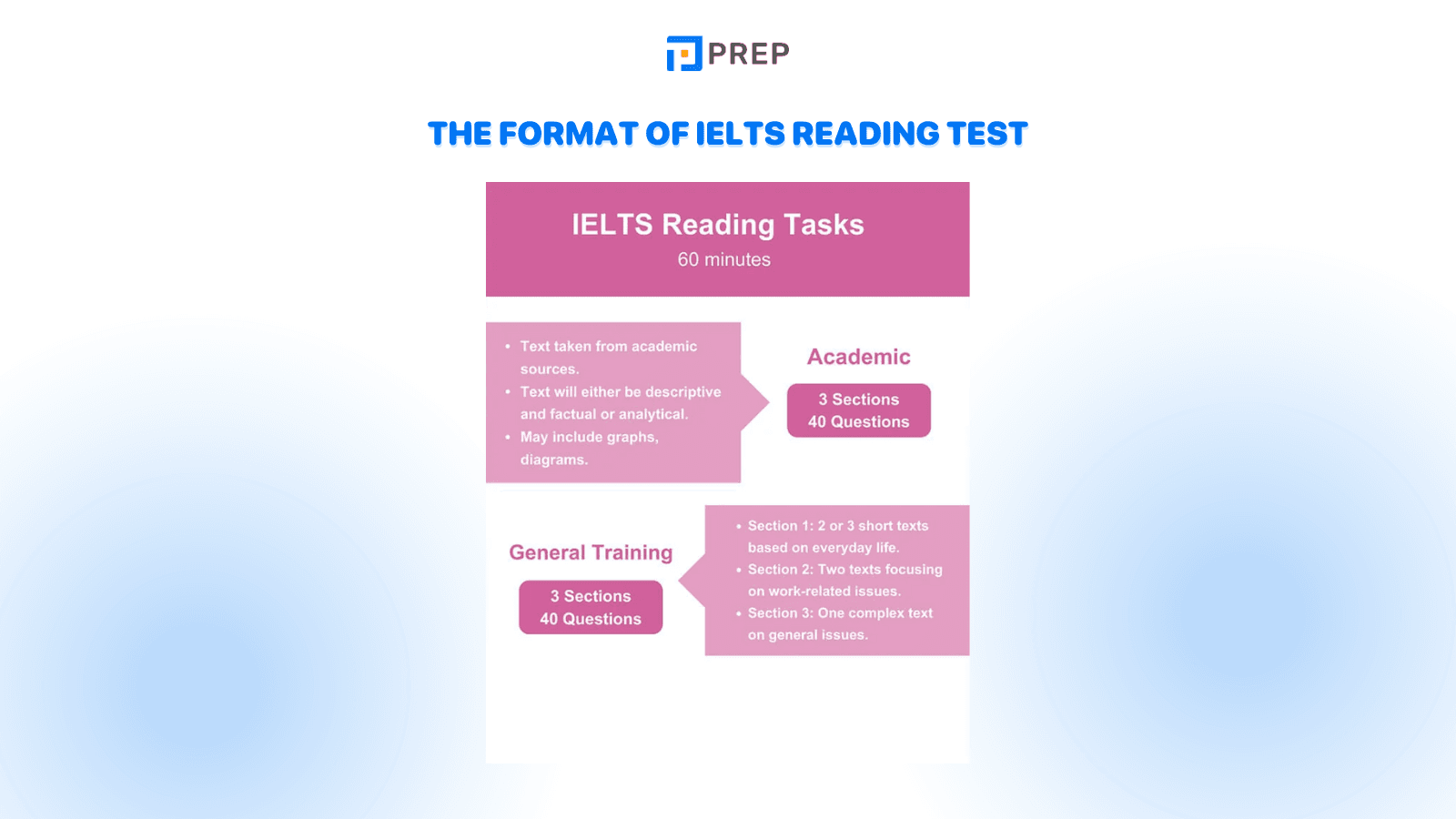
Total Time: The test lasts 60 minutes without any additional time to transfer answers to the answer sheet. Candidates must read, answer, and record their answers within this period.
-
Number of Questions: There are 40 questions in total, distributed evenly across three reading passages.
-
Passage Structure and Difficulty: The test consists of three sections or passages, and they are arranged in increasing order of difficulty. The first passage is generally the easiest, while the third is typically the most complex in terms of vocabulary and logical reasoning.
-
Question Format: All 40 questions are multiple formats — including multiple choice, matching, sentence completion, True/False/Not Given, and others — designed to test a variety of reading skills.
Scoring System
Each correct answer receives 1 raw point. The total number of correct answers (out of 40) is then converted to a band score ranging from 1 to 9 according to the official IELTS band conversion table. There is no negative marking, so candidates are encouraged to answer all questions, even if unsure.
Academic vs General Training: What’s the Difference?
While the structure of the test — timing, question types, and number of questions — remains the same for both modules, there are some key differences in content:
|
Feature |
Academic Module |
General Training Module |
|
Text Source |
Extracts from academic books, journals, or research-based texts |
Texts from advertisements, notices, handbooks, guidebooks |
|
Purpose of Texts |
To test the ability to comprehend complex ideas and academic vocabulary |
To evaluate reading skills in everyday social and work-related contexts |
|
Vocabulary Level |
Formal, subject-specific, more abstract |
Semi-formal, straightforward, workplace-oriented |
Understanding these structural differences is essential for selecting the right version of the test and developing effective preparation strategies.
1. IELTS Academic Reading Test Format
The IELTS Academic Reading test is designed to assess your ability to read and comprehend passages taken from academic sources. It is suitable for those planning to study at university or enter a professional setting where advanced reading skills are required.
Passage Types and Content
-
The test includes three long reading passages, each ranging from 700 to 900 words.
-
Texts are extracted from books, journals, magazines, or newspapers, often dealing with academic, scientific, or analytical topics.
-
They are non-specialist, meaning you do not need subject-specific knowledge to understand them.
-
The passages may include descriptive, analytical, discursive, or argumentative writing, sometimes accompanied by diagrams, graphs, or illustrations.
Types of Questions in the Academic Module
There are 40 questions in total, covering a variety of formats that assess different reading skills:
-
Multiple choice
-
Matching headings
-
True/False/Not Given or Yes/No/Not Given
-
Sentence completion
-
Summary, note, or table completion
-
Matching information or features
-
Diagram label completion
-
Short-answer questions
These question types test your ability to locate information, identify opinions or arguments, match thematic content, and understand the overall structure of the passage.
For a detailed breakdown of how each format works and what skills it targets, you can explore IELTS Reading question types.
Common Challenges for Academic Test Takers
-
Time pressure: You have only 60 minutes to complete all three passages (without breaks), and the difficulty increases with each passage.
-
Complex sentence structure: Texts often include passive voice, nominalization, and academic vocabulary.
-
Similar wording and paraphrasing: Understanding how questions paraphrase ideas from the passage is a key challenge.
-
Distractors in question options: Choosing wrong answers due to minor details that appear “correct” is a frequent issue.
To perform well in the Academic Reading test, it's essential to become familiar with academic text structures and question logic. Regular practice with Cambridge-style reading passages and targeted strategy training will help you manage timing, accuracy, and complexity — all critical to achieving a high band score.
Developing strong paraphrasing skills, such as those explained in paraphrasing in IELTS, can significantly improve your accuracy in Reading tasks.
2. IELTS General Training Reading Format
The IELTS General Training Reading test is designed to evaluate how well candidates can understand written English used in everyday life and workplace contexts. Although the structure (60 minutes, 40 questions) is the same as the Academic version, the content and text types in the General module are simpler and more practical in nature.
Section Structure and Text Sources
The test is divided into three sections, with texts that gradually increase in difficulty:
-
Section 1 includes two or three short factual texts, typically related to daily life (e.g. advertisements, public notices, schedules).
-
Section 2 contains two texts focused on workplace or training-related materials such as company policies, job descriptions, or guidelines.
-
Section 3 is one longer, more complex text, often narrative or argumentative, similar in style to a magazine or newspaper article.
These texts simulate the types of reading materials you would encounter in an English-speaking professional or social environment.
What Skills Are Tested?
The General Training Reading test assesses a wide range of practical reading skills, including:
-
Understanding general meaning and specific detail
-
Identifying key information quickly (scanning techniques)
-
Following the logical flow of information
-
Interpreting tone, purpose, and attitude of the writer
-
Handling textual complexity progressively across sections
While the text content may not be academic, candidates still need to process and analyze large volumes of information effectively under time pressure.
Typical Question Types
As with the Academic module, there are 40 questions in various formats, including:
-
Multiple choice
-
Matching information or headings
-
True/False/Not Given
-
Sentence and summary completion
-
Short-answer questions
The core task remains understanding how specific information is structured or implied within the text and identifying evidence quickly.
Although the General Training module uses more familiar language and everyday topics, the test still requires strong reading techniques and the ability to handle various question types efficiently. Adequate time management and daily practice with workplace and social reading materials can significantly improve your score in this module.
II. How Examiners Assess the IELTS Reading Test
Unlike the Writing and Speaking sections, the IELTS Reading test is not subjectively graded by an examiner. Instead, it is objectively scored based on the number of correct answers out of 40. Each correct answer is worth one raw point, and there is no penalty for incorrect answers, meaning you should always attempt every question.
Scoring System and Band Conversion
Your raw score (number of correct answers) is converted into an IELTS Band Score on a 0–9 scale using official conversion tables. While the test format is identical in structure for both Academic and General Training modules, the band score thresholds differ slightly, with General Training requiring a higher number of correct answers for some band scores.
Here is a sample comparison:
|
Band Score |
Academic (Correct Answers) |
General Training (Correct Answers) |
|
5.5 |
~22–23 |
~26–27 |
|
6.0 |
~23–26 |
~30–31 |
|
7.0 |
~30–32 |
~34–35 |
|
8.0 |
~35–36 |
~37–38 |
Note: The actual conversion may vary slightly between test sessions.
What Skills Are Measured?
The IELTS Reading test assesses a combination of reading comprehension skills, including:
-
Skimming: Reading quickly to understand the main idea of a passage
-
Scanning: Locating specific facts or keywords efficiently
-
Detailed reading: Understanding finer details or subtle distinctions in information
-
Inference: Identifying implied meaning or the writer’s attitude
-
Understanding opinion vs fact: Ability to determine viewpoint-based vs neutral content
Each question type is designed to test one or more of these skills. For example:
-
Matching headings evaluates ability to understand main ideas.
-
True/False/Not Given requires making inferences and locating exact references.
-
Summary completion demands detailed understanding of specific sections.
Importance of Following the Format
Though scoring is objective, formatting errors can still hurt your score. For instance:
-
Writing multiple answers when only one is required
-
Spelling and grammatical mistakes in short-answer questions
-
Incorrect transfer of answers (especially in paper-based tests)
Being familiar with the test format helps you avoid these basic errors and approach each question type with the right strategy.
III. How to Approach the IELTS Reading Test Format Effectively
Understanding the IELTS Reading test format is only the first step — the real challenge lies in knowing how to apply that format strategically under exam pressure. A strong approach balances time management, comprehension skills, and task-specific solutions. Below are three key ways to work with the format effectively on test day.
Identify Question Types Quickly and Accurately
Each passage is followed by one or several question types, and recognizing them immediately helps you know what strategy to apply. Common question types include:
-
Matching headings
-
True/False/Not Given
-
Multiple-choice
-
Sentence/summary completion
-
Matching features/information
Tips:
-
Practice classifying question types before exam day.
-
Read instructions carefully — answering "Yes / No / Not Given" instead of "True / False / Not Given" is a common mistake.
-
Underline keywords in the questions to help scan more effectively.
Among these, matching headings IELTS Reading requires a strong understanding of paragraph purpose rather than keyword matching.
Use Format-Based Reading Strategies
Once you’ve identified the task type, use suitable strategies aligned with the test format:
-
Skim the passage first to get the structure and main ideas. This is crucial for Matching Headings and locating information.
-
Scan for keywords when looking for specific facts or answers in summary completion or short-answer questions.
-
Read intensively only when needed, especially for inference-type tasks like opinion identification or True/False/Not Given.
Time-saving tip: Don't attempt to read every word of all three passages — focus on what’s needed to answer the question type in front of you. Each task requires a targeted reading method.
Avoid Common Format-Related Mistakes
Many test-takers unintentionally lose marks because they misuse the format or ignore clear guidelines. Here are some to watch for:
-
Answering with more words than allowed (e.g., “NO MORE THAN TWO WORDS”)
-
Copying misspelled words from the passage, especially in completion tasks
-
Writing letter options (A, B, C) when you’re meant to write the actual word or phrase
-
Wasting too much time on Passage 1 and having to rush through later sections
Strategy: Set your pace. Aim for 20 minutes per passage, with time built in to check answers. Mark questions you’re unsure about and return to them at the end if time allows.
By tailoring your approach to the test format — identifying question types quickly, applying targeted reading skills, and avoiding common missteps — you can maximize your efficiency and significantly improve your IELTS Reading score. Format familiarity doesn’t just help with understanding the test; it builds the confidence needed to perform under pressure.
To apply these strategies in real exam conditions, regular practice with authentic materials such as IELTS Reading practice tests is highly recommended.
This article has provided a detailed breakdown of the IELTS Reading test format, including the differences between Academic and General Training, how examiners assess your performance, and practical strategies to approach the test effectively. PREP wishes you focused preparation and the confidence to achieve your target band score in the IELTS Reading section!

Hi I'm Chloe, and I am currently serving as an Product Content Administrator at Prep Education. With over five years of experience in independent online IELTS study and exam preparation, I am confident in my ability to support learners in achieving their highest possible scores.
Comment
Premium content
View all
Personalized roadmap


Most read



UEN: 202227322W
Address: 114 LAVENDER STREET, #11-83 CT HUB 2, SINGAPORE (338729)